A little while back I did a review of Easybib as an assignment for one of my courses. It’s a tool we recommend to our students. For a while I was impressed by it’s notetaking tool and I’ve tried using it a few times because it kind of makes intuitive sense. But it just doesn’t work for me. And I’m beginning to realise why…. read more
Category: Learning
Plagiarism – time for a review?
I’ve just been exposed to a few discussions on plagiarism which I share in a post here.
Cockroaches, beetles and ants
Digital reading and studying – teachers are students too…
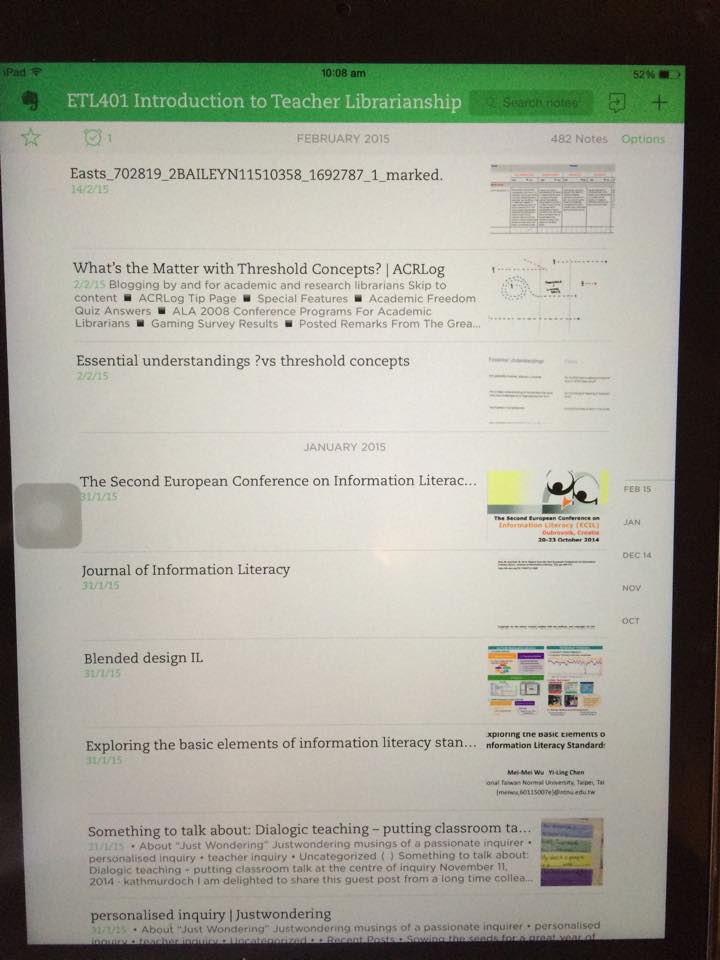
Last night I saw a flurry of posts on one of my Facebook groups – the one with teachers who are students, often back to school after a gap of years or even decades. That was me 30 months ago. Yes I had spent two years studying Chinese at HKU more recently, but that was a more hands / ears / body on task physical exercise than the more recent CSU experience of first doing my MIS and now my M Ed (KNDI). I promised if I had time after my assignment for today, I’d post a little about how I manage using a combination of paper, coloured pens and Evernote to keep on top of my reading and modules. I’ve written briefly about using tools to organise one’s studying, an article in Incite which unfortunately wasted too much space on a picture of me in lieu of what I wanted, which was screen shots of how to do stuff. At some point I’d like to do some screen casting of how this all works in reality, but since I’m moving house next week, I just don’t have the time to edit it down to something quick and slick and presentable!
Here is a step by step account of what I do (CSU resources, plus Evernote Premium (paid) plus Zotero (free) plus Word for Mac 2011 and a desire to print as little as possible):
1. Open a new notebook in Evernote for my new course
As you can see here my whole life is on Evernote – personal, professional and learning, each have their own notebook. You can also group notebooks together (I’ve put all my CSU courses into the CSU group, although I keep my most current course floating as it’s then easier – less clicks) to add to the notebook. Because Evernote is so wonderfully searchable, there is no need to file by module or topic, you can just tag notes if you want, or not.
2. Go into the modules and download the Subject Overview and individual Modules
I then go into Interact (2) and download the subject overview and individual modules and save as PDF files. I also print these, single sided and file them. This is the only printing I do during the course. It was not always so, but I couldn’t stand the waste of paper and needed a more efficient way!

I put all the module pdf’s onto my desktop and then drag them into my Evernote Notebook. I also have the Evernote app on my iPad, and I make sure that at the end of each day I synchronise between my laptop and my iPad so that they’re both current. Because I have Evernote premium I can read all my notes OFFLINE – very important to me, as I don’t have 3/4G on my iPad, only Wifi, and I don’t always have Wifi in the places I’m snatching moments of study!
3. Find the Schedule and put the dates into your physical / virtual calendar with reminders!
4. Start populating Evernote with everything you need to read
I usually take a moment when I’m tired and want to feel productive but I just don’t have the energy to do hard thinking or reading or writing work. I open the modules and start clicking on every link.

Then I do the following:
Journal Articles
Go to Primo, find the article, save / download as a PDF (I just tag it and dump it on my desktop).

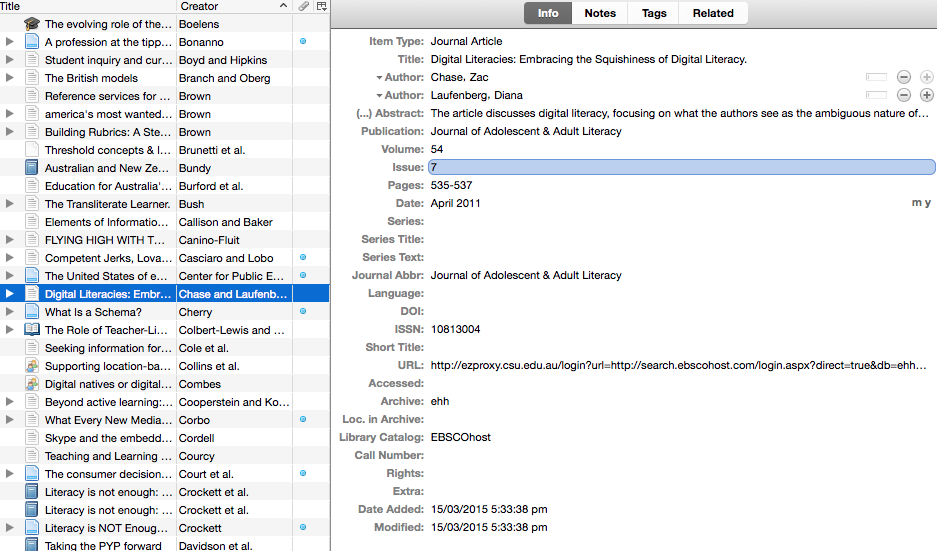
At the same time find the “cite / export citation” button and save the citation in the format you need for your citation tool (I use Zotero, so it is a RIS file.


In Zotero I open a new collection

And then I import the
“RIS” file into Zotero, (just need to click on it, with Zotero open on the correct collection) making sure all the files are completed correctly.

Websites
For websites, I use the Evernote Addon, so I just need to click on it, and I can save the article / site onto Evernote into whatever notebook I choose:

I
In order to save the citation, I right-click in order to activate the Zotero addon, which will save the URL and any correctly coded information (usually this is not much, only URL and title – so you need to manually put in the author, date, website name, etc. to ensure a co rrect citation)
I repeat this process for eBooks (“print” the relevant chapter to PDF, put the ISBN into the Zotero wizard), and other material. You can save the links to YouTube and Vimeo videos, I’ve not bothered to put them in Evernote – I try to watch them on my laptop – if anyone has a good solution for that besides downloading and taking up a lot of memory to watch offline …
I then have a desktop littered with lots and lots of pdf files, and I then just drag and drop the lot into the correct notebook.
5. Sync Evernote on iPad to Laptop
Because I’m working and a mother and taxi-driver, I spend quite a bit of “lost” time waiting for kids at sports or picking them up etc. Often I then don’t have access to wifi. I’ve paid for the premium version of Evernote for this reason. In any event, with or without wifi, my way of studying is then as follows (obviously this is personal).

I will add another few things about Evernote. It is very collaborative. So you can share notebooks with fellow Evernote users. If you get yourselves organised you can share who collates the information for which module and set up a group. Or ask a fellow student who has done the course already … but please consider academic honesty, plagiarism, digital citizenship and all that when you do these things.
6. Start reading and reflecting
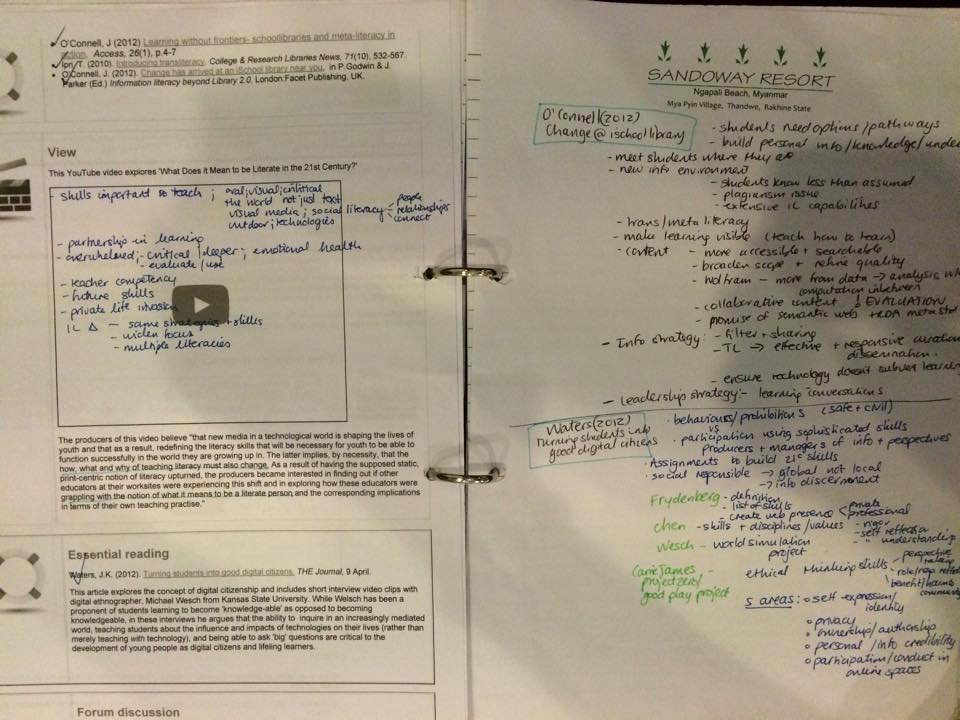
I take the next chunk of work I need to do and put the printed out modules in front of me. As I read the module, I tick the paragraphs. When I get to a reading, I will then open the reading in Evernote ( the search function is amazing) and start reading. As I read, I take notes on the blank left hand side of the module so it is opposite to where it is referred to in the module. I’ve made a personal convention for my note-taking. I do it in blue or black and put references to people and other readings in green and important items that I’ll want to refer to later in my assignments or blog posts or think more about in red. This is what it looks like (If I’ve printed the modules double sided, I put my notes on other paper as close to the module where it is referred to as possible). I don’t skim much to be honest, but some articles / book chapters etc. merit more note taking than others. Some are just a repetition and some are gold mines.
7. Writing an assignment
When it gets to writing an assignment I just glance through my modules and find the relevant sections / key words. I then glance at my notes and focus on the purple / green bits. I look for more articles in Primo by referring to the authors who have written on the subject and are frequently mentioned. I also “file” those articles into Evernote and the citations into Zotero as I collect them.
When I’m writing, I try to plan out what I want to say, and then I will try and find research to back it up. Because Evernote is so searchable, I can search on key phrases or words or combinations of words and get a listing of all the articles they appear in. I can then quickly scan these and see if they are worth citing.
Since Zotero has a word add on, I just have to Click on “insert citation” and it jumps into Zotero

I can then choose the author / article title and decide whether it is a direct quotation (add the page or paragraph number) and how I’m going to cite (author, date); author (date); author …. (date) etc.

When I’m finished I just say “insert bibliography”
and it completes the entire bibliography in APA style, alphabetical order etc.
If I’m editing and I delete a citation / paragraph, I just have to update it, and it’s all correct again.
NOTE:
This is just one way of getting organised. There are many ways and many tools, you need to experiment and find your own way as to what is comfortable for you. For example, one lecturer suggested we just print the first page (with the abstract) of each article and make a summary on that page. If anyone has further tips and tricks, please add comments to this. I’d also like to learn of other ways to make things easier.
A little on language
Anyone who’s known me longer than about 3 seconds will understand that besides knowledge and information the other great love of my life is language, bilingualism, multi-lingualism and all that goes with it. So I write quite a bit on the matter as a learner, as a parent, as a librarian.
Here is the introduction to three lectures I’ve recently attended, with a link to my summaries.
Assessment Item 8: Digital Storytelling Project and Reflection
Part A: Context for Digital Story Telling Project
“Knowledge, then, is experiences and stories, and intelligence is the apt use of experience, and the creation and telling of stories. Memory is memory for stories, and the major processes of memory are the creation, storage, and retrieval of stories.” (Schank & Abelson, 1995, p. 8)
In Asia, particularly Hong Kong, where parenting is a competitive sport, giving your children the opportunity to learn Chinese has become the holy grail of expatriate parenting. Children are enrolled in language programs and immersion schools without much understanding or consideration of the possible consequences. Research is scant, seldom longitudinal and evidence is mainly anecdotal, A focus on positive success stories and oral ability prevails, while a climate of shame and fear prevents openness, analysis and understanding when children do not succeed.
Our family’s story of “chasing the dragon” is one of success, failure and ultimate triumph. Storytelling is a way of making sense of events and experiences and communicating this (Botturi, Bramani, & Corbino, 2012) to others in a similar situation.
The subject area covers language, bilingualism and mother tongue from both a pedagogical and socio-emotional point of view. The purpose is to illuminate the complexities underlying language choices in families in the international school context through storytelling. The intended audience are parents, educators and administrators in International Schools. This story will be basis of a presentation at a conference on language next year. It will be used to add context to academic theory on mother-tongue, language learning and identity so that educators and parents alike not only have an intellectual understanding of the theories but an emotional response through this story to the platitude that “every child is unique”.
Academics and educators may lose sight of the fact that the audience that may best profit from their research and knowledge on bilingualism may only be vaguely aware of the information they need, often filtered through their own or other’s experience (King & Fogle, 2006). The intended audience of this project may have not have the time, inclination or access to scholarship in a form and format that is easily understood and resonates with them. Stories influence “attitudes, fears, hopes, and values” and are more effective at changing belief than persuasive writing as a result of changing how information is processed by the audience (Gottschall, 2012) due to escape into an alternative reality, connection with characters, emotional involvement and self-transformation (Green, Brock, & Kaufman, 2004). The affordances of digital story-telling including audience participation enhance this engagement (Alexander, 2011). Although students are required to have a high level of English proficiency, often parents do not and their learning needs may therefore not be met. The affordance of digital storytelling is to incorporate multi semiotic systems that ‘allow for the linking and integration of cognitive, tacit, affective, cultural, personal, graphic and photographic ways of exploring, articulating, expressing and representing sense-making about learning and identity’ (Williams, 2009, cited in Walker, Jameson, & Ryan, 2010, p. 219).
Within the international school context, language is an area fraught with assumptions, misapprehension and emotion . This interactive digital experience has value for program implementation as it highlights many of the issues surrounding language acquisition and maintenance in an accessible format allowing for both breadth and depth in understanding of the topic. Parents, with the best intentions in the world make pedagogically unsound decisions while educators, often coming from a mono-lingual background, may be unable to assist families in their linguistic paths and school administrators may be hampered to do right by the individual due to the logistical and cost complexity of catering to multiple linguistic backgrounds and nuances.
This project aims to increase awareness in all intended audiences so that choices can be made based on current understanding of best practice, educational and logistical issues and potential hurdles along the way. Perhaps we can let go of the “holy grail” of Chinese at the cost of our mother tongues and embrace, pursue and celebrate our own languages, culture and identity, reassured by what we know about language skill transferability.
Part B: Digital Story Telling Project
URL: chasingthechinesedragon.blogspot.com
Please note:
In the creation of my digital story, I have made extensive use of old video footage and photos of my children and others in a classroom setting. I have received the permission from my children to do so, and they partook in a series of interviews with me. However, in order to preserve their and others privacy and confidentiality I have decided to make the product and the blog in which the content occurs private until they are old enough to give permission that is legally binding. As they are now aged 11 and 12, I do not think their consent is as informed as it should be.
I would therefore request people to email me their email addresses so that I can include them on the list of people with permission to access the blog. I’m sorry for the inconvenience around this.
I have discussed this with a number of educators at our school and they feel this is the best way to proceed.
I will use some of the video clips and research for the presentation at the language conference in May, but that will be a dynamic rather than static presentation which will limit the exposure to a wide audience without the necessary context.
Part C: Critical Reflection
There are a number of dimensions related to working as an educational professional in the increasingly pervasive digital environment. We no longer merely have a duty to teach content and information but need to equip ourselves, and our students with digital literacy and critical evaluative skills to deal with the multi-modal formats encountered in the education journey.
Value of digital story telling
In the “context” section, it was highlighted how effective stories are in changing belief and how information is processed and understood including the emotional engagement and interactive potential of digital media (Bailey, 2014c; Coleborne & Bliss, 2011; Gottschall, 2012; Green et al., 2004; Matthews, 2014). A case can also be made for the role storytelling has in assimilating knowledge and memory (Schank & Abelson, 1995).
Tools and strategies for teaching / learning
In a recent essay, The Economist proposes a hierarchy of knowledge and learning and distinguishes between digital formats that have a function of “presenting people with procedural information they need in order to take on a simple task or fulfil a well-stated goal” versus teaching through “books” that can have its “pedagogy enriched by embedded media and software that adapts them to the user’s pace and needs” (The Economist, 2014, Chapter 5). Certainly the digital realm offers the possibility of engaging learners in a multi-modal environment which is more likely to resonate with their preferred way of receiving information provided the educator has a good understanding of how to select and use the tools (Anstey & Bull, 2012; Bowler, Morris, Cheng, Al-Issa, & Leiberling, 2012; Phillips, 2012; Unsworth, 2008; Walsh, 2010).
As educators our role needs to evolve and combine aspects of discovery, critical evaluation and enabling access to the most appropriate material (Dockter, Haug, & Lewis, 2010; Leacock & Nesbit, 2007; Nokelainen, 2006; Parrott, 2011), while at the same time educating our students to be mindful consumers and producers of content aware of the “weapons” in their and other’s storytelling “arsenal” and how these can be deployed for good and ill (Gottschall, 2012; Walker et al., 2010; Walsh, 2010).
Then there is the psycho/socio-neurological dimension of the impact digital literature has on how our students access, absorb, process and reflect on information and learning (Edwards, 2013; Goodwin, 2013; Jabr, 2013; Margolin, Driscoll, Toland, & Kegler, 2013; Wolf & Stoodley, 2008). Finally, for our students there are questions around the evolution of their skill sets as they move from consumption of digital products to creation, expression, engagement and interactivity (Hall, 2012).
Current and future developments
An exciting function of digital creations is the way materials can meet learning needs of all types of learners (Kingsley, 2007; Rhodes & Milby, 2007). However, one has to wonder about ephemeral nature of material, formats and platforms in the digital environment with the related issues of curation, preservation and archiving. Just as it appears that blogging as a tool for learning and storytelling has had its rise and demise, so too other platforms may not have longevity.
The whole field appears to be in its infancy with emerging and evolving norms, standards and platforms, (Maas, 2010; Valenza, 2014) where one can only wonder who the winners and losers will be.
Factors around design and publication
There are economic issues of efficiency, resource and time wastage as many individual teachers with varying levels of capability; capacity; understanding and access to tools attempt to participate in the creation of materials (Bailey, 2014b). One issue is the absence of a clearing house or “store” such as “Teachers pay Teachers” (Teachers Pay Teachers, 2014) or “Teacher created Resources” (Teacher Created Resources, 2014) so the discovery of relevant material remains serendipitous and local. For example, YouTube abounds with “educational” material, but lacks a rating system appropriate for educational quality control including checking for producer bias.
For digital curriculum based material, critical mass, economies of scale, and the integration of pedagogy, design and technical tools and marketing are needed which puts educational publishers or organisation such as TED Education (Ted-ed, n.d.) rather than individual educators in a strong position to take control of this arena.
Copyright, Digital rights, licensing
There are issues around digital rights, rights management, copyright and the like, both for the creator and the consumer of digital products for the classroom. Cost and ownership is a tricky area as many products are leased rather than purchased, are platform captive and access to full text for students with disabilities may be precluded (Michaud, 2013; O’Brein, Gasser, & Palfrey, 2012; Puckett, 2010).
Conclusion
At the end of following this course, it could be suggested that the course name “Literature in Digital Environments” is a misnomer (Bailey, 2014a), and “Literacy in Digital Environments” could be an alternative title to encompass all the aspects of this rich arena.
References:
Alexander, B. (2011). Storytelling: A tale of two generations (Chapter 1). In The new digital storytelling: creating narratives with new media (pp. 3–15). Santa Barbara, California: Praeger.
Anstey, M., & Bull, G. (2012). Using multimodal factual texts during the inquiry process. PETAA, 184, 1–12. Retrieved from http://chpsliteracy.wikispaces.com/file/view/PETAA+Paper+No.184.pdf
Bailey, N. (2014a, August 20). When is it digital literature? [Web Log post]. Retrieved October 12, 2014, from http://thinkspace.csu.edu.au/informativeflights/2014/08/20/when-is-it-digital-literature/
Bailey, N. (2014b, September 10). Module 4.1: What questions or answers do you have in relation to digital storytelling? [Web log post]. Retrieved October 12, 2014, from http://thinkspace.csu.edu.au/informativeflights/2014/09/10/module-4-1-what-questions-or-answers-do-you-have-in-relation-to-digital-storytelling/
Bailey, N. (2014c, September 30). Assessment item 7: Blog 4 – Electronic media and the nature of the story [Web log post]. Retrieved October 12, 2014, from http://thinkspace.csu.edu.au/informativeflights/2014/09/30/assessment-item-7-blog-4-electronic-media-and-the-nature-of-the-story/
Botturi, L., Bramani, C., & Corbino, S. (2012). Finding Your Voice Through Digital Storytelling. TechTrends, 56(3), 10–11. doi:10.1007/s11528-012-0569-1
Bowler, L., Morris, R., Cheng, I.-L., Al-Issa, R., & Leiberling, L. (2012). Multimodal stories: LIS students explore reading, literacy, and library service through the lens of “The 39 Clues.” Journal of Education for Library and Information Science, 53(1), 32–48.
Coleborne, C., & Bliss, E. (2011). Emotions, Digital Tools and Public Histories: Digital Storytelling using Windows Movie Maker in the History Tertiary Classroom. History Compass, 9(9), 674–685. doi:10.1111/j.1478-0542.2011.00797.x
Dockter, J., Haug, D., & Lewis, C. (2010). Redefining Rigor: Critical Engagement, Digital Media, and the New English/Language Arts. Journal of Adolescent & Adult Literacy, 53(5), 418–420. Retrieved from http://ezproxy.csu.edu.au/login?url=http://search.ebscohost.com/login.aspx?direct=true&db=eric&AN=EJ871723&site=ehost-live
Edwards, J. T. (2013). Reading Beyond the Borders: Observations on Digital eBook Readers and Adolescent Reading Practices. In J. Whittingham, S. Huffman, W. Rickman, & C. Wiedmaier (Eds.), Technological Tools for the Literacy Classroom: (pp. 135–158). IGI Global. Retrieved from http://services.igi-global.com/resolvedoi/resolve.aspx?doi=10.4018/978-1-4666-3974-4
Goodwin, B. (2013). The Reading Skills Digital Brains Need. Educational Leadership, 71(3), 78. Retrieved from http://ezproxy.csu.edu.au/login?url=http://search.ebscohost.com/login.aspx?direct=true&db=f5h&AN=91736083&site=ehost-live
Gottschall, J. (2012, May 2). Why Storytelling Is The Ultimate Weapon. Retrieved September 29, 2014, from http://www.fastcocreate.com/1680581/why-storytelling-is-the-ultimate-weapon
Green, M. C., Brock, T. C., & Kaufman, G. F. (2004). Understanding Media Enjoyment: The Role of Transportation Into Narrative Worlds. Communication Theory, 14(4), 311–327. doi:10.1111/j.1468-2885.2004.tb00317.x
Hall, T. (2012). Digital Renaissance: The Creative Potential of Narrative Technology in Education. Creative Education, 03(01), 96–100. doi:10.4236/ce.2012.31016
Jabr, F. (2013, April 11). The Reading Brain in the Digital Age: The Science of Paper versus Screens [Article]. Retrieved August 31, 2014, from http://www.scientificamerican.com/article/reading-paper-screens/
King, K., & Fogle, L. (2006). Bilingual Parenting as Good Parenting: Parents’ Perspectives on Family Language Policy for Additive Bilingualism. International Journal of Bilingual Education and Bilingualism, 9(6), 695–712. doi:10.2167/beb362.0
Kingsley, K. V. (2007). Empower Diverse Learners With Educational Technology and Digital Media. Intervention in School & Clinic, 43(1), 52–56. Retrieved from http://ezproxy.csu.edu.au/login?url=http://search.ebscohost.com/login.aspx?direct=true&db=ehh&AN=26156207&site=ehost-live
Leacock, T. L., & Nesbit, J. C. (2007). A Framework for Evaluating the Quality of Multimedia Learning Resources. Educational Technology & Society, 10(2), 44–59.
Maas, D. (2010, June). Web-based Digital Storytelling Tools and Online Interactive Resources [Web Log]. Retrieved from http://maasd.edublogs.org/files/2010/06/Web-based-Digital-Storytelling-Tools-Online-Interactives-2gwjici.pdf
Margolin, S. J., Driscoll, C., Toland, M. J., & Kegler, J. L. (2013). E-readers, Computer Screens, or Paper: Does Reading Comprehension Change Across Media Platforms?: E-readers and comprehension. Applied Cognitive Psychology, 27(4), 512–519. doi:10.1002/acp.2930
Matthews, J., RGN BSc PG Dip. (2014). Voices from the heart: the use of digital storytelling in education. Community Practitioner, 87(1), 28–30. Retrieved from http://search.proquest.com/docview/1474889132?accountid=10344
Michaud, D. (2013). Copyright and Digital Rights Management: Dealing with artificial access barriers for students with print disabilities. Feliciter, 59(1), 24–30. Retrieved from http://search.proquest.com.ezproxy.csu.edu.au/docview/1286679756?accountid=10344
Nokelainen, P. (2006). An empirical assessment of pedagogical usability criteria for digital learning material with elementary school students. Journal of Educational Technology & Society, 9(2), 178–197. Retrieved from http://ezproxy.csu.edu.au/login?url=http://search.ebscohost.com/login.aspx?direct=true&db=ehh&AN=85866426&site=ehost-live
O’Brein, D., Gasser, U., & Palfrey, J. G. (2012, July 1). E-Books in Libraries: A Briefing Document Developed in Preparation for a Workshop on E-Lending in Libraries. Berkman Center Research Publication No. 2012-15. Retrieved from http://ssrn.com/abstract=2111396
Parrott, K. (2011, July 18). 5 Questions to Ask When Evaluating Apps and Ebooks [Web log post]. Retrieved August 31, 2014, from http://www.alsc.ala.org/blog/2011/07/5-questions-to-ask-when-evaluating-apps-and-ebooks/
Phillips, A. (2012). A creator’s guide to transmedia storytelling: how to captivate and engage audiences across multiple platforms. New York: McGraw-Hill.
Puckett, J. (2010). Digital Rights Management as Information Access Barrier. Progressive Librarian, Fall-Winter(34/35), 11–24. Retrieved from http://www.progressivelibrariansguild.org/PL_Jnl/pdf/PL34_35_fallwinter2010.pdf
Rhodes, J. A., & Milby, T. M. (2007). Teacher-Created Electronic Books: Integrating Technology to Support Readers With Disabilities. The Reading Teacher, 61(3), 255–259. doi:10.1598/RT.61.3.6
Schank, R. C., & Abelson, R. P. (1995). Knowledge and Memory: The Real Story. In R. S. Wyer (Ed.), Knowledge and Memory: The Real Story (Vol. VIII, pp. 1–85). Hillsdale, NJ: Lawrence Erlbaum Associates. Retrieved from http://cogprints.org/636/1/KnowledgeMemory_SchankAbelson_d.html
Teacher Created Resources. (2014). Teacher Created Resources – Educational Materials and Teacher Supplies. Retrieved October 11, 2014, from http://www.teachercreated.com/
Teachers Pay Teachers. (2014). TeachersPayTeachers.com – An Open Marketplace for Original Lesson Plans and Other Teaching Resources. Retrieved October 11, 2014, from http://www.teacherspayteachers.com/
TED-Ed. (n.d.). Lessons Worth Sharing. Retrieved October 12, 2014, from http://ed.ted.com/
The Economist. (2014, October). The future of the book. Retrieved October 11, 2014, from http://www.economist.com/news/essays/21623373-which-something-old-and-powerful-encountered-vault
Unsworth, L. (2008). Multiliteracies, E-literature and English Teaching. Language and Education, 22(1), 62–75. doi:10.2167/le726.0
Valenza, J. (2014). The Digital Storytelling Tools Collection. Retrieved October 11, 2014, from https://edshelf.com/profile/joycevalenza/digital-storytelling-tools
Walker, S., Jameson, J., & Ryan, M. (2010). Skills and strategies for e-learning in a participatory culture (Ch. 15). In R. Sharpe, H. Beetham, & S. Freitas (Eds.), Rethinking learning for a digital age: How learners are shaping their own experiences (pp. 212–224). New York, NY: Routledge.
Walsh, M. (2010). Multimodal literacy: What does it mean for classroom practice? Australian Journal of Language and Literacy, 33(3), 211–239.
Wolf, M., & Stoodley, C. J. (2008). Proust and the squid: the story and science of the reading brain. New York: Harper Perennial.
Assessment Item 6: Digital Storytelling Topic Proposal
“Knowledge, then, is experiences and stories, and intelligence is the apt use of experience, and the creation and telling of stories. Memory is memory for stories, and the major processes of memory are the creation, storage, and retrieval of stories.”(Schank & Abelson, 1995, p. 8)

Red Dragon Wallpaper Download. (2011)
Proposal Topic:
“追龍 – Chasing the Dragon*
a family’s story of language and identity”
From 2006 to 2011 our family was engaged in learning Chinese in one form or another including language classes, attending a bilingual immersion school and following a university degree – with nearly devastating consequences for one child. This digital story weaves together extracts from blog entries written at the time, digital photos and videos, images of school books and writing and interviews as each child and the family grappled and came to terms with who they were and how language shaped that identity.
Proposed digital tools and/or spaces to be used:
iMovie, Blogger, twitter, facebook, digital photos and videos, memorabilia
Rationale for topic focus
In Asia, particularly Hong Kong, where parenting is a competitive sport, giving your children the opportunity to learn Chinese has become the holy grail of expatriate parenting. Children are enrolled in language programs and immersion schools without much understanding or consideration of the possible consequences.
Research is scant and evidence, mainly anecdotal, focuses on the positive success stories. A climate of shame, and fear of it reflecting badly on the parent, prevents openness when children do not succeed.
Our family’s story of “chasing the dragon” is one of success, failure and ultimate triumph. In this project, I hope to use storytelling as a way of making sense of events and experiences and communicating this (Botturi, Bramani, & Corbino, 2012) to others in a similar situation.
The affordance of digital storytelling is to incorporate multi semiotic systems that ‘allow for the linking and integration of cognitive, tacit, affective, cultural, personal, graphic and photographic ways of exploring, articulating, expressing and representing sense-making about learning and identity’ (Williams, 2009, cited in Walker, Jameson, & Ryan, 2010, p. 219). It is a warning story and also a story of hope.
Finally, I am considering putting in a proposal to present at a conference on language next year. I would like to use this story as the basis of adding context to academic theory on mother-tongue, language learning and identity so that educators and parents alike not only have an intellectual understanding of the theories but an emotional response through this story to the platitude that “every child is unique”.
====================================================
* “chasing the dragon” is a Hong Kong slang term referring to inhaling opium vapour – the metaphorical meaning includes the elusive pursuit of an ultimate high. For the purposes of this story it’s the elusive pursuit of mastering the Chinese language.
====================================================
References:
Botturi, L., Bramani, C., & Corbino, S. (2012). Finding Your Voice Through Digital Storytelling. TechTrends, 56(3), 10–11. doi:10.1007/s11528-012-0569-1
Red Dragon Wallpaper Download. (2011). Retrieved September 14, 2014, from http://www.wallpaperhere.com/Red_Dragon_81049/download_1920x1440
Schank, R. C., & Abelson, R. P. (1995). Knowledge and Memory: The Real Story. In R. S. Wyer (Ed.), Knowledge and Memory: The Real Story (Vol. VIII, pp. 1–85). Hillsdale, NJ: Lawrence Erlbaum Associates. Retrieved from http://cogprints.org/636/1/KnowledgeMemory_SchankAbelson_d.html
Walker, S., Jameson, J., & Ryan, M. (2010). Skills and strategies for e-learning in a participatory culture (Ch. 15). In R. Sharpe, H. Beetham, & S. Freitas (Eds.), Rethinking learning for a digital age: How learners are shaping their own experiences (pp. 212–224). New York, NY: Routledge.
Blog post 3: Write a book review – Diversity
1. A detailed description of the activity undertaken
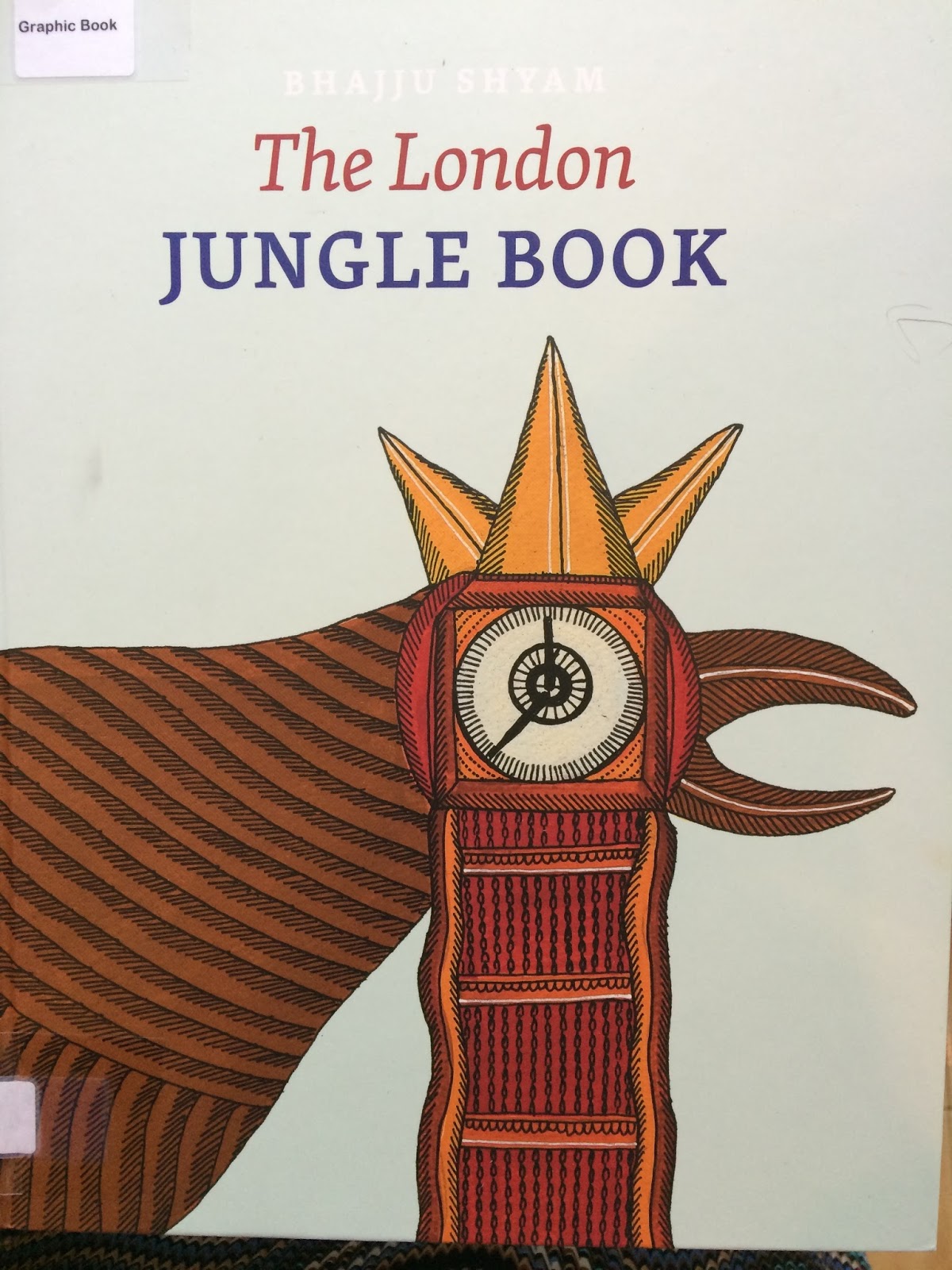
The visually stunning book: The London Jungle Book by Bhajju Shyam (Shyam, Rao, & Wolf, 2014) was reviewed. In this recently republished book, an Indian artist from the Gond tribe creates a visual travelogue of his experiences in London where he lives for two months to paint murals in an Indian restaurant. The title refers back to Rudyard Kipling’s Jungle book – a juxtaposition where an Englishman travelled to the jungle area where Shyam lives and wrote of his experiences there.
  |
|
| The visual story and text / Explanation of drawings | |
Besides the wonderful illustrations and the poignant but perceptive comments on London and its people, I particularly liked the fact that the book could be read on multi-levels and is therefore suitable for readers of all ages. There is a visual story accompanied by text in translation from his oral storytelling that will appeal as he simply recounts experiences and observations of a foreign land. Then the artist explains his choices of drawing as he breaks with traditional communal symbols and traditions in order to tell a unique and personal story. An additional level is added by the reader, who while reading this will no doubt reflect on his or her own travel experience or knowledge and feelings about London.
Extension activities for students could include investigating and comparing Kipling’s book with this as well as the works of the anthropologist Verrier Elwin who lived with the Gond tribe.
2. Answers to the following questions:
What did you learn?
In the first place I realized that although I’ve been reviewing books informally (in my Goodreads profile, or on my blog) for a while, I didn’t actually know what the principles of a good review were, so I had to first do some research on that. I found three good reputable resources, Owl Purdue writing lab (Brizee, 2012); BookTrust (Playa, 2014) and Scholastic (Philbrick, 2014) and compared the elements.
How was the activity relevant to your professional practice?
As a librarian I am often asked my opinion on books or need to write brief reviews. I had not approached this in a structural way before, so it is good to have a review “template” in mind when talking about a book. I can encourage students to write reviews on the books they have read, and give them tips on how to do so.
Were any gaps in your knowledge revealed? How might you fill those gaps?
At first the illustrations struck me as being reminiscent of Australian Aboriginal art, so I did some more research on the Gond Tribe and ethnic minorities in India. About 30% of our students are Indian, and I recognised that I know very little about India and its vast diversity in language, culture, art and literary traditions. I can fill the gaps in my knowledge both by reading up about the country and its people and by having conversations with students and their parents to better understand the nation.
3. References:
Brizee, A. (2012, September 19). Purdue OWL: Book Review. Retrieved September 7, 2014, from https://owl.english.purdue.edu/owl/resource/704/01/
Philbrick, R. (2014). Writing with Writers: Writing a Book Review. Retrieved September 7, 2014, from http://teacher.scholastic.com/writewit/bookrev/
Playa, L. (2014). Tips for writing book reviews [Article]. Retrieved September 7, 2014, from http://www.booktrust.org.uk/books/teenagers/writing-tips/tips-for-writing-book-reviews/
Shyam, B., Rao, S., & Wolf, G. (2014). The London jungle book. India: Tara Books.
Assessment Item 4: Critical Reflection of Digital Literature Experiences
What makes a good digital text
Despite Goodreads’ narrow interpretation of a book as being something with an ISBN number, “the book as a physical object with paper pages is now only one version of what a book might be” (Hancox, 2013, para. 7). As many have discussed before, a digital text can take many formats and permutations (James & de Kock, 2013; Parker, 2013; Sadokierski, 2013b; Walsh, 2013).
Various criteria exist as to what constitutes a good digital text. Its ability to engage, enhance, experience, elucidate, explain and entertain (James & de Kock, 2013; Miller, 2011); the use of multiple media and a single unified story without redundancy between media (Phillips, 2012; Walker et al., 2010); a linear yet enhanced reading experience, engaging multiple literacy and learning styles with intelligent, flexible and intuitive design with longevity (Parrott, 2011). To this can be added the potential to cater for different ability and facility with language and technology and preferred multi-sensory behaviour while bridging participatory skills and social needs with academic skills (Anstey & Bull, 2012; Roskos, Burstein, Shang, & Gray, 2014; Walker et al., 2010). Finally a good text, digital or otherwise will immerse and absorb the reader while allowing them to interact with the world and others, or an alternate reality, vicariously and integrate new knowledge and understanding into their existing schema or worldview (Fuhler, 2010; Ryan & Ryan, n.d.).
Compare experience digital versus print
In any comparison of the print / digital experience it should be emphasized that neither has moral nor educational superiority, but rather fulfil different functions and meet different literary, literacy and learning needs.
The most obvious difference is the format, though the non-linear nature of digital media is often commented on with its potential to disrupt the reading process and the need to have a strategy to stay on track and the necessity of learning and incorporating new conventions and practices in experiencing digital literature (Anstey & Bull, 2012; Chuk, Hoetzlein, Kim, & Panko, 2012; Francus, 2013; James & de Kock, 2013; Roskos et al., 2014; Skains, 2010). Digital features can create an enticement to buy, assist with the appreciation of literature, facilitate interpretation and understanding or motivate adjunct composition (Unsworth, 2006).
Experimentation with digital literature will, after a while, create a sense of discomfort in a self-aware educator as it becomes obvious that “their” pedagogical functions of elucidation and enhancing understanding of literature are usurped by the medium which can offer these benefits in a manner that fits with a learners’ preferred learning style and mode at a personalized pace. However, one’s role as a curator, guide and co-collaborator in all literary and literacy aspects of learning is enhanced (Lamb, 2011; Leu et al., 2011; Mills & Levido, 2011). Finally, the teacher can use the digital affordances to enhance student’s 21st century literacy skills as they come to grips with understanding the codes and conventions, functions and aspects of all semiotic systems (Anstey & Bull, 2012; Bowler, Morris, Cheng, Al-Issa, & Leiberling, 2012; Malita & Martin, 2010; Walker et al., 2010).
Incorporation of a text into a learning program
One of the digital texts I most enjoyed was ‘First World War: the story of a global conflict‘ (Panetta, 2014a).

The scope of this interactive documentary is such that it could be used in a variety of classroom settings, however the one I would choose would be the unit on “Memoir writing” in the Grade 7 English Unit where students are encouraged to explore a variety of compelling narratives and to create their own story (UWCSEA-East Campus, 2013). The students are from many different countries and cultures, including around one third from India, and the documentary, in particular the “Empire” chapter could form the basis for curating works of literature, poetry, music and art created in times of conflict and war. Students could bring examples of narratives and art forms from their own cultures that either relates to World War 1 or other conflicts to supplement material introduced by the teacher such as examples from the “The Disasters of War, 1800-2014,” show (Rubin, 2014). This would align with the concept of the teacher being a facilitator and curator who shares and highlights aspects of the curriculum in a multi-modal and social context allowing students to extrapolate to their own learning and literacy (Fuhler, 2010; Mitra, 2013; Serafini & Youngs, 2013) and ties in with the concepts of design thinking in education where “The focus is on processes – producing, assessing, developing, creating, revisiting, revising. Learning content becomes secondary to developing the how-to skills for how to be a learner in the 21st century” (Gerstein, 2014).
https://embed-ssl.ted.com/talks/sugata_mitra_build_a_school_in_the_cloud.html
References:
Anstey, M., & Bull, G. (2012). Using multimodal factual texts during the inquiry process. PETAA, 184, 1–12. Retrieved from http://chpsliteracy.wikispaces.com/file/view/PETAA+Paper+No.184.pdf
Bowler, L., Morris, R., Cheng, I.-L., Al-Issa, R., & Leiberling, L. (2012). Multimodal stories: LIS students explore reading, literacy, and library service through the lens of “The 39 Clues.” Journal of Education for Library and Information Science, 53(1), 32–48.
Chuk, E., Hoetzlein, R., Kim, D., & Panko, J. (2012). Creating socially networked knowledge through interdisciplinary collaboration. Arts and Humanities in Higher Education, 11(1-2), 93–108. doi:10.1177/1474022211426906
Francus, M. (2013, October 22). Pride and Prejudice Goes Interactive: “The Lizzie Bennet Diaries.” Video presented at the Pride and Prejudice: The Bicentennial, Paper 5. Retrieved from http://corescholar.libraries.wright.edu/celia_pride/conference/october11/5
Fuhler, C. J. (2010). Using primary-source documents and digital storytelling as a catalyst for writing historical fiction in the fourth grade. In B. Moss & D. Lapp (Eds.), Teaching new literacies in grades 4-6: Resources for 21st-century classrooms (pp. 136–150). New York, NY: Guilford Press.
Gerstein, J. (2014, August 27). The Educator as a Design Thinker [Web log post]. Retrieved August 30, 2014, from http://usergeneratededucation.wordpress.com/2014/08/27/the-educator-as-a-design-thinker/
Hancox, D. (2013, December 13). When books go digital: The Kills and the future of the novel. Retrieved August 29, 2014, from http://theconversation.com/when-books-go-digital-the-kills-and-the-future-of-the-novel-20098
James, R., & de Kock, L. (2013). The Digital David and the Gutenberg Goliath: The Rise of the “Enhanced” e-book. English Academy Review, 30(1), 107–123. doi:10.1080/10131752.2013.783394
Lamb, A. (2011). Reading redefined for a transmedia universe. Learning and Leading with Technology, 39(3), 12–17. Retrieved from http://ezproxy.csu.edu.au/login?url=http://search.ebscohost.com/ login.aspx?direct=true&db=ehh&AN=67371172&site=ehost-live
Leu, D. J., McVerry, J. G., O’Byrne, W. I., Kiili, C., Zawilinski, L., Everett-Cacopardo, H., … Forzani, E. (2011). The new literacies of online reading comprehension: Expanding the literacy and learning curriculum. Journal of Adolescent & Adult Literacy, 55(1), 5–14. doi:10.1598/JAAL.55.1.1
Malita, L., & Martin, C. (2010). Digital Storytelling as web passport to success in the 21st Century. Procedia – Social and Behavioral Sciences, 2(2), 3060–3064. doi:10.1016/j.sbspro.2010.03.465
Miller, L. (2011, June 15). “The Waste Land”: T.S. Eliot takes the app store [Review]. Retrieved August 27, 2014, from http://www.salon.com/2011/06/15/the_waste_land/
Mills, K. A., & Levido, A. (2011). iPed: pedagogy for digital text production. The Reading Teacher, 65(1), 80–91. doi:10.1598/RT.65.1.11
Mitra, S. (2013, February). Sugata Mitra: Build a School in the Cloud [Talk Video]. Retrieved August 29, 2014, from http://www.ted.com/talks/sugata_mitra_build_a_school_in_the_cloud
Panetta, F. (2014). A global guide to the First World War [Interactive documentary]. Retrieved from http://www.theguardian.com/world/ng-interactive/2014/jul/23/a-global-guide-to-the-first-world-war-interactive-documentary
Parker, J. (2013, December 18). When stories are more than paper: Transmedia trends in Young Adult Literature. Presentation presented at the YALSA 2012 YA Literature Symposium, St. Louis, MO. Retrieved from http://prezi.com/l0j03_mb1dma/when-stories-are-more-than-paper-transmedia-trends-in-young-adult- literature/
Parrott, K. (2011, July 18). 5 Questions to Ask When Evaluating Apps and Ebooks [Web log post]. Retrieved August 31, 2014, from http://www.alsc.ala.org/blog/2011/07/5-questions-to-ask-when-evaluating-apps-and-ebooks/
Phillips, A. (2012). A creator’s guide to transmedia storytelling: how to captivate and engage audiences across multiple platforms. New York: McGraw-Hill.
Roskos, K., Burstein, K., Shang, Y., & Gray, E. (2014). Young Children’s Engagement With E-Books at School: Does Device Matter? SAGE Open, 4(1). doi:10.1177/2158244013517244
Rubin, A. (2014, August 28). Horror Is a Constant, as Artists Depict War [Review]. Retrieved August 31, 2014, from http://www.nytimes.com/2014/08/31/arts/design/horror-is-a-constant-as-artists-depict-war.html?emc=edit_th_20140831&nl=todaysheadlines&nlid=69344483
Ryan, S., & Ryan, D. (n.d.). What is literature? Retrieved August 31, 2014, from http://dlibrary.acu.edu.au/staffhome/siryan/academy/foundation/what_is_literature.htm
Sadokierski, Z. (2013, November 12). What is a book in the digital age? [Web log post]. Retrieved August 29, 2014, from http://theconversation.com/what-is-a-book-in-the-digital-age-19071
Serafini, F., & Youngs, S. (2013). Reading Workshop 2.0. Reading Teacher, 66(5), 401–404. Retrieved from http://ezproxy.csu.edu.au/login?url=http://search.ebscohost.com/login.aspx?direct=true&db=pbh&AN=92711892&site=ehost-live
Skains, R. L. (2010). The Shifting Author–Reader Dynamic: Online Novel Communities as a Bridge from Print to Digital Literature. Convergence: The International Journal of Research into New Media Technologies, 16(1), 95–111. doi:10.1177/1354856509347713
Unsworth, L. (2006). Learning through web contexts of book-based literary narratives. In E-literature for children enhancing digital literacy learning (pp. 29–43). London; New York: Routledge. Retrieved from http://public.eblib.com/choice/publicfullrecord.aspx?p=198496
UWCSEA-East Campus. (2013, August). Program Outline – Middle School English – Grade 7. Retrieved August 29, 2014, from https://sites.google.com/a/gapps.uwcsea.edu.sg/east-ms-english/header-3/unit-planners
Walker, S., Jameson, J., & Ryan, M. (2010). Skills and strategies for e-learning in a participatory culture (Ch. 15). In R. Sharpe, H. Beetham, & S. Freitas (Eds.), Rethinking learning for a digital age: How learners are shaping their own experiences (pp. 212–224). New York, NY: Routledge.
Walsh, M. (2013). Literature in a digital environment. In L. McDonald (Ed.), A literature companion for teachers (pp. 181–194). Marrickville, NSW: Primary English Teaching Association Australia (PETAA).
What I love about 21st century learning
This is one of those somewhat arbitrary posts, tangentially related to the topic.
One of the things that excites me about learning now, versus when I was at school or my parents were at school is just how accessible everything and everyone is. One just has to be slightly motivated to want to know something, have access to high speed internet and the world is literally your oyster.
I have a brother with ADHD and I have a son with ADHD. Their learning worlds could not be more different. If my son struggles with a textbook or a mathematically concept or wants to learn something but the books available are too hard for him, he has so many other options. He can go onto Kahn Academy. He can search for youtube tutorials, he can Skype and chat to a friend or relative. And of course, if your attempts at getting information are so richly rewarded, you are much more motivated as a learner to keep learning.
And now my experience. When writing my last blog post I was interested in Dr. Francus’ talk, and dug out her contact details and asked her for a transcript. Unlike my son, I prefer reading text to watching a video. She replied right back to me, and then even went to the trouble of reading my blog post and writing a very thoughtful reply to me, confirming my suspicion that the best part of interactive media is to be interactive while it unfolds rather than in retrospect.
When I was growing up in South Africa, which then felt like the back of the beyond and may as well have been another planet, not just another country due to its self-imposed and sanction imposed isolation, I could never envisage a reality where an author or person of note would enter a dialogue with a learner. That is today’s wonderful reality, there for the taking. And digital literature is just a small part of it all!
 Informative Flights - Musings of a Teacher Librarian