Buying the future of research …

There’s been quite a to-do on librarian sites recently about the acquisition of RefMe, an academic citation tool by Chegg, a purveyor of online textbooks and tutors (and more). Before you click past this, let’s have a little look and think about this business model…

The citation engine issue

In the opinion of my peers – CiteThisForMe is an inferior product to its precursor RefMe. To be technical about this –
  • it doesn’t allow for importing .ris files from databases (a common standard)
  • you can’t create folders for citations
  • user interface is poor
  • numerous popup boxes for editing
  • no google SSO
  • no easy import function from existing products
  • it’s not terribly good or accurate
  • etc.

So far it seems one librarian wrote about the take-over with foreboding  but again, more from a technical point of view. It’s just not a very good product. As he pointed out – none of the “quick and dirty” products are very good. For non pure-academic sites (i.e. paid databases) It boils down to whether some back-end programmer has bothered to capture much (if any) meta-data on author, date, title etc. And I’m afraid to say that’s exactly the type of site most of our students cut their researching teeth on. Think of it as the crack-cocaine of citation. You add a chrome extension, you go to a website / youtube video / online newspaper and click the extension and like magic your citation is generated. But not quite. At worst it’ll just pick up the URL, at best perhaps a title and author. And I’m afraid to say most teachers grading “research” are long happy that even that’s been included in a bibliography or works cited or reference list.

From boring citation to sexy ‘critical moments’

But actually none of that really matters. Well it does, sort of, eventually to the people who matter who care. What is somewhat more concerning is this.
The first time RefMe came into the (financial) news in a serious way was in 2015 when GEMs Education threw some money at it. Educational companies don’t throw money at citation tools unless there’s something in it for them:

But it isn’t just students who are showing an interest in the platform, RefME has received £2.7 million backing from GEMs Education, the largest private education company in the world. They want to encourage more schoolchildren to use the app, as pupils are now increasingly having to reference too.

‘We’ve identified 150-200 million kids around the world who cite,’ said Hatton.
The platform also does more than create references – RefME collects information about what people cite, making a map of the data. This means it can give you recommendations based on what other people who used that same citation went on to find, something Hatton calls ‘removing the search from research’.

Then the Chegg acquisition 2 years later, and one of the first things you see when you open their site is side by side in the news is the financial results and the tie in between this “academic” provider and a “global media agency”
Screen Shot 2017-03-16 at 8.15.43 PM
Screen Shot 2017-03-16 at 8.11.25 PM
Bait and switch tactics …
and when you read the terms and conditions you find out:
The Services may collect “Personal Information” (which is information that can be used to identify or contact a specific individual, such as your name and email address), account information (such as a password or other information that helps us confirm that it is you accessing your account) and demographic or other information (such as your school, gender, age or birthdate and zip code and information about your interests and preferences).

And you thought FaceBook was bad …


“When you submit, post, upload, embed, display, communicate, link to, email or otherwise distribute or publish any review, problem, suggestion, idea, solution, question, answer, class notes, course outline bibliographic and citation information comment, testimonial, feedback, message, image, video, text, profile data or other material (“User Content”) to Chegg, any Chegg employee or contractor, or a Chegg Website, you grant Chegg and our affiliates, licensees, distributors, agents, representatives and other entities or individuals authorized by Chegg, a non-exclusive, worldwide, perpetual, unlimited, irrevocable, royalty-free, fully sublicensable (through multiple tiers) and fully transferable right to exercise any and all copyright, trademark, publicity, and database rights you have in the content, in any media known now or in the future, and to make, use, reproduce, copy, display, publish, exhibit, distribute, modify, sell, offer for sale, create derivative works based upon and otherwise use the User Content.
Note that we may create, facilitate or display social advertisements, whereby your name, profile and photo may be used to advertise products and services to your network based on your use of the Services and your interactions with Chegg. You agree that Chegg may use your name and profile picture in connection with social ads to advertise products and services to your network based on your use of the Services and your interactions with Chegg and third parties through the Services.
You further agree that Chegg is free to use any ideas or concepts contained in any User Content for any purposes whatsoever, including, without limitation, developing, manufacturing and marketing products and services; and creating informational articles, without any payment of any kind to you. You authorize Chegg to publish your User Content in a searchable format that may be accessed by users of the Services and the Internet. To the fullest extent permitted by law, you waive any moral rights you may have in any User Content you submit, even if such User Content is altered or changed in a manner not agreeable to you.” (Privacy Policy)
Well actually FaceBook is bad – the worst possible place to put all that information exchange and community knowledge and knowhow, (I’m looking at you my lovely library networks on Facebook), but we kind of know it’s bad and we live with it for all kinds of reasons, and most of us (I hope) extract the useful stuff and put it elsewhere like Evernote or GoogleDrive or … (oops who owns it then!?).
When Chegg bought Easybib, this is what the press release had to say:
“In the last 12 months, Imagine Easy’s bibliography and research tools powered about 240 million sessions and EasyBib alone saw more than 7 million unique users in March 2016, Chegg tells me. In total, all of these services together have helped students from mangling more than 1.4 billion bibliography entries.”
Bear in mind, nothing you do in their services is actually yours, not even the services you may have paid for:
Service Modifications
Chegg reserves the right, in our sole discretion, to make changes to or discontinue any of the Services at any time. Any description of the Services provided by Chegg is not a representation that the Services are working or will always work in that manner, as Chegg is continuously updating the Services, and these updates may not always be reflected in the Terms of Use.
Now this is one thing if you’re a Grade 5 student and with much blood sweat, tears and encouragement from your teachers, librarian and parents you’ve managed to come up with a bibliography of 3-5 items that say more that “wikipedia” or youtube.com. It’s quite another if you’re a serious researcher at say doctorate or post-doctorate level and have a few thousand articles referenced, with abstracts and perhaps attached documents or pdfs. Or if your 4,000 word extended essay is due in a few weeks time to finish off your IB, and the RefMe plug is pulled with practically no sensible communication from the company from the announcement at the end of January to about a week before the pulling of the plug on the 28th February (the Facebook trail of increasing panic and despair is awful – and that was just the librarians) – twitter showed some upset students but not as many as one would expect – perhaps the RefMe user base wasn’t that big or serious about social media – or they were too busy scrambling to migrate their data to an alternative platform.
So what is Chegg buying (by the way, the numbers are still relatively small potatoes in investment speak, but they’ve got ambition!)
If you have a look at last year’s financial report, this bit, where they refer to the acquisition of EasyBib is relevant:
With education representing a trillion-dollar opportunity in the U.S. alone, we believe that the number of students who will leverage online tools, use the services we have, and then benefit from new services that we plan to offer will increase dramatically over the next decade. That is why we continue to make strategic investments to take advantage of this growing opportunity. At the core of our success is reaching more students than anyone else, knowing more about them than anyone else, and leveraging that data to improve our products and services, acquire customers for less, and increase their customer satisfaction. That is the essence of what the Student Graph does, and we have been consistent in our product and business development strategies by investing in services that can both leverage and contribute to the Student Graph which accelerates our growth. That was the driving force behind our acquisition of Imagine Easy which has been one of the quickest and most successful integrations into the company. With 30 million annual unique visitors according to comScore, we continue to be confident that this acquisition is an enormous opportunity for students, for Chegg, and for our shareholders. There have been over 1.5 billion citations created to date with more than 400 million new ones added in 2016 alone. Already we are exceeding the expectations we have for the business and it is quickly becoming a core part of the Chegg Services platform.
The financial results are quite phenomenal actually – they’re making money, real money off a digital platform. They’ve got current students by the short and curlies and a pipeline of 200 million school kids to add to their existing user-base in the coming years. Lure them in with solving the citation hassle and then move them up the feeding chain to online textbook hire and tutors and test prep. As a former finance person I must say this is smart. I’m also wondering how much of their revenue is from selling their customer data on to media companies and all the social media / off-line entertainment type tie-ins?
So, that’s that for what’s going on in the otherwise boring old citation world… and now the next thing – online paraphrasing anyone?  Soon all you’ll have to do is get into a university (another service offered by Chegg) and the just physically sit out (or party through) your 3 or 4 years while the digital tools take care of all the messy bits of assignments and hand ins.
(ps. if you want to know what I recommend for what it’s worth? NoodleTools for K-12 students, and Zotero thereafter. And no, I don’t get a commission from either of them, and yes I pay for both for the premium service).

A tale of two systems

I’ve just spent the last 4 days at the #LKSW2017 where 80 librarians around the SE Asian region got together to learn and share (mainly teacher) librarian practise. I also hosted a Chinese lady from a school in China and gave a daily ride to another Canadian librarian working at a school in China. We had some great conversations.

The first workshop I attended was led by Brad Tyrell. He of the magnificent Libguides at Scotch College that induce envy in every other libguide – even if you know that there is a slew of very techie people behind the gloss. During the workshop he kept emphasizing that everything that they’ve done is on a creative commons basis, and in fact shared all the documentation and templates used to make the guides.  He also explained that their staff’s job descriptions include an imperative to share what they’ve done – so everytime they’ve created a new library guide, they not only share it with staff and students internally, but they also have to post it on the listserv / social media of their local library association.

This is something I’m very comfortable with, and in fact have had many discussions with my lecturers at CSU about plagiarism and the sharing of academic output amongst students, where my (slightly controversial) view was that every academic assignment I’ve made is, and should be public, and that if students abuse it, or lecturers can’t be bothered to change the assignment, the system should take care of it… discussions documented here.  My libguides are also open, and I encourage people to take what they need from them and to adapt them to their own situation – and in turn, I get inspiration and links and resources from the other community guides. What do we all want? A little acknowledgement and for it to be on a “I share so you don’t just take, but also share”.

Then there is the in-between state, I’d call it the TpT state (teachers pay teachers), where you’ve made something that’s taken so much work, it’s done in your spare time and has cost you time and effort and is of a quality that you feel you can sell it. Personally I don’t do this, I’m more on the open source side of things, but I have bought items from other teachers where I like what they’ve done and don’t think I could do a better job.  For a rationale for this model, please read this.

And then the opposite extreme.  Chatting to my two compatriots working in China, I was surprised to hear that neither their catalogues, nor their library guides were open.  I was asking about sourcing Chinese books for our program in particular, and specifically nonfiction books for our UOIs. While they were helpful, and the actual answer is due to the predominance of text-books their is a less developed nonfiction publishing market at the primary level, none of their catalogs or resource lists were open. So unlike many other schools where I could take a look into their lists to find some good resources, this wouldn’t be possible. They explained that the Chinese private school market is very very competitive and this is all considered to be proprietary and competitive information.

Which of course leads to the question – are you being stupid or reducing your own competitiveness by sharing?  I’d like to think not and that everyone is better off as a result of this and opening things up allows them to be improved upon. Provided of course that the person doing the adaptation and improving is similarly civic minded and pays the sharing forward – which isn’t always the case.

Literacy is not enough: Why we need to teach information literacy

Some weeks are just like hitting the jackpot in terms of the news and media world shouting out “yes, this is necessary” – although of course they don’t phrase it that way, and they certainly wouldn’t invoke libraries, librarians and information literacy in their communal hand wringing. But they should.

The first was the retraction of an article in Science. (Retraction watch – who knew that it even existed? And now I know it’s going to be on my reading list from time to time! They’re on twitter @RetractionWatch so that makes it easier – makes me think of “This idea must die” which is also on my reading list after hearing this talk).

Jesse Singal has written an excellent article – “The Case of the Amazing Gay-Marriage Data” – it really is worth reading the whole thing because it covers so many aspects of the world of academic publishing, how it can go badly wrong, and just how unlikely it is that it is found out and even if it’s found out, how hard it is to be a whistleblower.

The second, was about chocolate, and how unfortunately it doesn’t help in weight loss and in fact we’d all just been had as it was a bunch of science writers playing with journalists and our gullibility and lack of information literacy.  Here is John Bohannon, the culprit (?) ‘fessing up: “I Fooled Millions Into Thinking Chocolate Helps Weight Loss. Here’s How” and Rachel Ehrenberg’s indignant retort on behalf of journalists “Attempt to shame journalists with chocolate study is shameful
Obviously (one hopes) this is going to have repercussions in tertiary education and in journalism. But what can we learn from it in the K-12 environment?
Well a good place to start would probably be to introduce students to the concept of cognitive bias (and to do it WAY before they’re doing TOK at IB level).  Here is a great little article by George Dvorsky on the twelve most common cognitive biases. Let’s get everyone thinking – a little assignment for my readers – post in the comments what cognitive biases were present in each case! Just as we teach our G4’s about marketing tricks of the trade, I’m sure this can be presented in a way that is accessible and easy to understand and relate to their own lives. 
I’m also thinking about how we could expand the math curriculum to replace a fear of numbers and statistics with a healthy dose of scepticism and what questions to ask and how to dig behind the “headline” numbers. I sometimes wonder why it is that we don’t challenge our students more about their own data.  Thinking back to the exhibition presentations of our Grade 5’s – yes they did a great job, and it was amazing what they pulled together and the confidence with which they could present. But who was looking at the data? Each group had a mentor, who could (should?) challenge when things don’t add up, when what they’re saying and what they can back it up with doesn’t match. When things just don’t make common logical sense.   Now this is a tricky thing. A very tricky thing. We don’t like confrontation, and we’re not really good at it either.  Now look back at the first article.  If the co-author had applied a little common sense and said “hey, if you’ve sampled 100,000 people, how did you get the $1m budget? (simple multiplication / extrapolation)” 
… how about Brookman? Things don’t make sense to him, and what’s everyone saying? “don’t rock the boat”  And our students. Yes we want to created a safe learning environment where mistakes can be made.  BUT and this is a big BUT, we also want to be able to call them on their mistakes, give them a chance to correct them and build the resilience of being able to cope appropriately with (constructive) criticism AND the idea that this research thing is serious, and can and will be up to challenge, AND make them think more critically about how they interpret and use other’s research.  I was not a part of the whole process and I know our digital literacy coaches and librarian were involved, I’m wondering if the math coach was also involved or not?  And in a school without a math coach – who would be doing this?  How many teachers at any level feel comfortable and confident enough around numbers and the “math” side of research to assume this role?  I’d argue all should be, and if not that’s some PD that needs to be done as a priority. Because in the future and in the now, numbers are being used all around us, and the big big thing is “big data” and if we don’t know how to look at numbers and to ask the right kinds of questions we are going to be manipulated into making the wrong assumptions, making the wrong choices. This stuff is important. (See my favourite math blogger Mathbabe on this).
All of us are literate in the sense of reading and writing. And some of us are critical readers of literature, we can analyse and comment and dissect. And then we get into the realm of being information literate, on the basic level, the whole model thing of finding a question, finding information, interpreting and using it, reflecting etc.  And then only can we get to the point of understanding who is writing something and why and then really understanding the socio-cultural / political and meta-cognitive things that are going on behind information. And if we don’t start with the basics and make sure it’s embedded in everything we do, how will we ever get there?

Academic honesty should never be ambiguous

Ok, I know I have a somewhat ambivalent stance on what constitutes plagiarism and the value of collaborative and cooperative learning but one thing I’m clear on is academic honesty.  If you used something that someone else made just say that you did that. And depending on your age and level a simple copy and paste of the link is sufficient.I recently went around our G5’s exhibition project and was thoroughly impressed at their work. I did sneakily ask a few for their sources and most could point to at least a page of attribution as to where they’d got their numbers and facts.  Well done (here is a great video of it by the way).


G5 Exhibition Video 2015 from UWC South East Asia on Vimeo.

Fast forward to early this morning. I’m putting the washing in the machine and the kids are getting ready for school and finally my daughter lets me see the video she’s been working on for the last 4 days – one holidays and festivals in the middle ages. It’s a great video with her narrating the festivals of the year with lovely pictures and music from the middle ages in the background.  And then at the end “Thank you for watching” and black screen.

I told her I thought it was great, but that she didn’t have to thank anyone at the end, and instead a list of attribution for the images and music would be good. “Our teacher said we didn’t have to do it” was her reply. I told her that she knew that I expected it of her, and she then showed me that she had in fact made a list of the URLs but hadn’t put it into EasyBib to get into MLA format. I asked why not, and she came with some story about how citations / attribution hadn’t been in the original assignment nor in the rubric and the teacher didn’t want to add it on afterwards. I was a little annoyed at this. I said she could at least put it at the end of her video, but she didn’t think that would be “fair” on the others who didn’t. Fair? How about the fairness of the people to whom the images belonged? OK they’re all long dead now, and perhaps most of the images are in common domain, but still, it’s the principal.

I was annoyed at myself being annoyed at her, when actually I should be annoyed at the school. How can they go from being citation semi-stars in primary school to not having it expected at middle school. This is not the first instance, it is one of many, many, many in both my children’s grades across all subjects – academic honesty really does need to be institutionalised and inside every single assignment across the board! I’m at least glad my ranting has had an effect on my kids and they’re at now keeping lists to show me – but if it’s only for me for how long will my influence last?

Third time requires a post – plagiarism

This morning plagiarism crossed my screen for the third time in a week, which means the topic is demanding to be written about!

The first time was during an academic discussion last week. A group of us were being asked our opinion about the proliferation of study groups on FaceBook and other social media platforms and their role not only in mutual support during study, but the potential for plagiarism and other forms of academic dishonesty.

I have a somewhat contrarian view on the thin lines between collaboration and theft.  Perhaps I am naive, perhaps I’ve not felt the very real repercussions of having had my work plagiarised.  Perhaps I’m reading too much utopian digital future type articles and books.

Through my blog I share a lot of what I’m thinking and doing and researching. I also have posted most of my academic submissions of the last 2 years online where they can be freely read. Of course much of what I’m writing about are things I’m particularly interested and passionate about, and I’ve abridged or edited things so as not to post too many details of my school or colleagues that would not be relevant or appropriate for public consumption.  To me, the most useful parts of anyone else’s academic submission would be the layout / structure of the essay / paper / report and the bibliography.  I’ll happily share my bibliography with anyone and everyone.

And now it starts to get tricky.  On the one hand, the whole point of academic publishing and journal articles is to make your work publicly (albeit behind a paywall) available and for your work to be part of an ongoing quest to knowledge or the resolution of societal or scientific problems. On the other hand, in the grey area of being on the path to accreditation and while doing so jumping through academic hoops while writing essays and papers and having them marked and moderated by the system, you’re supposed to keep all that knowledge and learning private or secret, just between yourself and your lecturer?  Can you see the problem? The double standard? The irony?  So part of my argument, is that if a lecturer can’t be bothered to sufficiently change the topic of the assessments and the way in which the course is evaluated, then if another student were to use the work of a former student the lecturer is kind of to blame.  Although I would hope that the student would at least credit the work of the first student. Which because the whole system is rotten they are obviously incapable of doing, because then the whole thing becomes uncomfortably transparent. Ditto the lecturers who are obtuse or unhelpful.

The second time was this article in the Telegraph which appeared 2 days ago. A couple of interesting points are highlighted (I must say, #1700 for a dissertation is very cheap – if I think what each of my courses cost individually, that wouldn’t even pay for one course / semester, so whoever is writing that stuff is either undervaluing themselves, or the whole academic thing is such a farce as to be worthless).  I think the topic is a whole lot bigger than many (particularly academics) think. It is not as simple as “plagiarism is an act of fraud. It involves both stealing someone else’s work and lying about it afterward” (plagiarism.org). As the article points out – plagiarism happens more often in mass courses where there is little contact between the tutor and the student. It also happens when there are language difficulties experienced by students and the stakes are high.  And, we are obviously (sic) trying to root out “copying and collusion” – at least while our youth is studying. Once they get into the world of work it’s called collaboration and teamwork. I’m wondering about this Prof. Braisby who is so keen to educate his students on the evils of plagiarism.  Is any time being spent in dialogue between the students, tutors, professors, administrators and powers that be in institutions to look more closely at the subject. Or are we all very quick to make the subject black and white?

Finally this morning, LibraryGrits, weighed in on the topic with a very nice little graphic which was the most nuanced look at the subject – the symptoms of plagiarism.

Although, I’d be pedantic and say that plagiarism was symptomatic of the other causes which she named as symptoms.
Having a closer look at her list, I would say that different items need to be addressed in different ways. I’m wondering if newer versions could reflect this by the grouping / colouring?
In my personal value system “don’t care about ethics” would be a serious problem.
Anything to do with the policing and lack of consequences is an institutional / teacher problem.
The rest, including laziness (please read “the myth of laziness” before jumping to laziness conclusions) need to systematically be addressed and scaffolded and worked on in combination with the teacher, school and probably parents. And here is where my tendency to put my work out there in the open comes into play – by putting examples out, we address the issues of “ignorance of formatting / protocols” and “exposure to modelling of best practise”.
Issues of language barriers, search and retrieval skills, organisation and time management skills need to sorted out while the student is at school, isn’t that part of creating “life long learners” as opposed to “life long plagiarisers, thieves and frauds”?  I think the pressure to achieve high grades absolutely cannot be divorced from this whole discussion.  Anyone else been following the Palo Alto suicides and all the press around it?
We are living in very interesting times in terms of knowledge dissemination, acquisition and creation and the formal institutions of school, university and college are struggling to keep up as bastions of certification, accreditation and credibility. The dear Professor in the Telegraph article alluded to this, but I don’t think he really “got it”.
And language. Yes language. So many of our students at every level are studying in a language that is not their own. Their tongues and their minds are slashed and offered to the gods of English and sacrificed to the hopes of a better life in that illusionary magical tongue.  I can only imagine based on what I know from living in tongues other than English in various times of my life how much is lost and distorted in translation.

References:

Gurney-Read, J. (2015, April 13). £1,700 for a dissertation, but what’s the real cost of plagiarism? Retrieved April 15, 2015, from http://www.telegraph.co.uk/education/educationnews/11532848/1700-for-a-dissertation-but-whats-the-real-cost-of-plagiarism.html
McKenzie, D. (2015, April 14). Symptoms of Plagiarism [Web Log]. Retrieved April 15, 2015, from http://librarygrits.blogspot.sg/2015/04/symptoms-of-plagiarism.html
What is Plagiarism? (n.d.). Retrieved April 15, 2015, from http://www.plagiarism.org/plagiarism-101/what-is-plagiarism/


Referencing

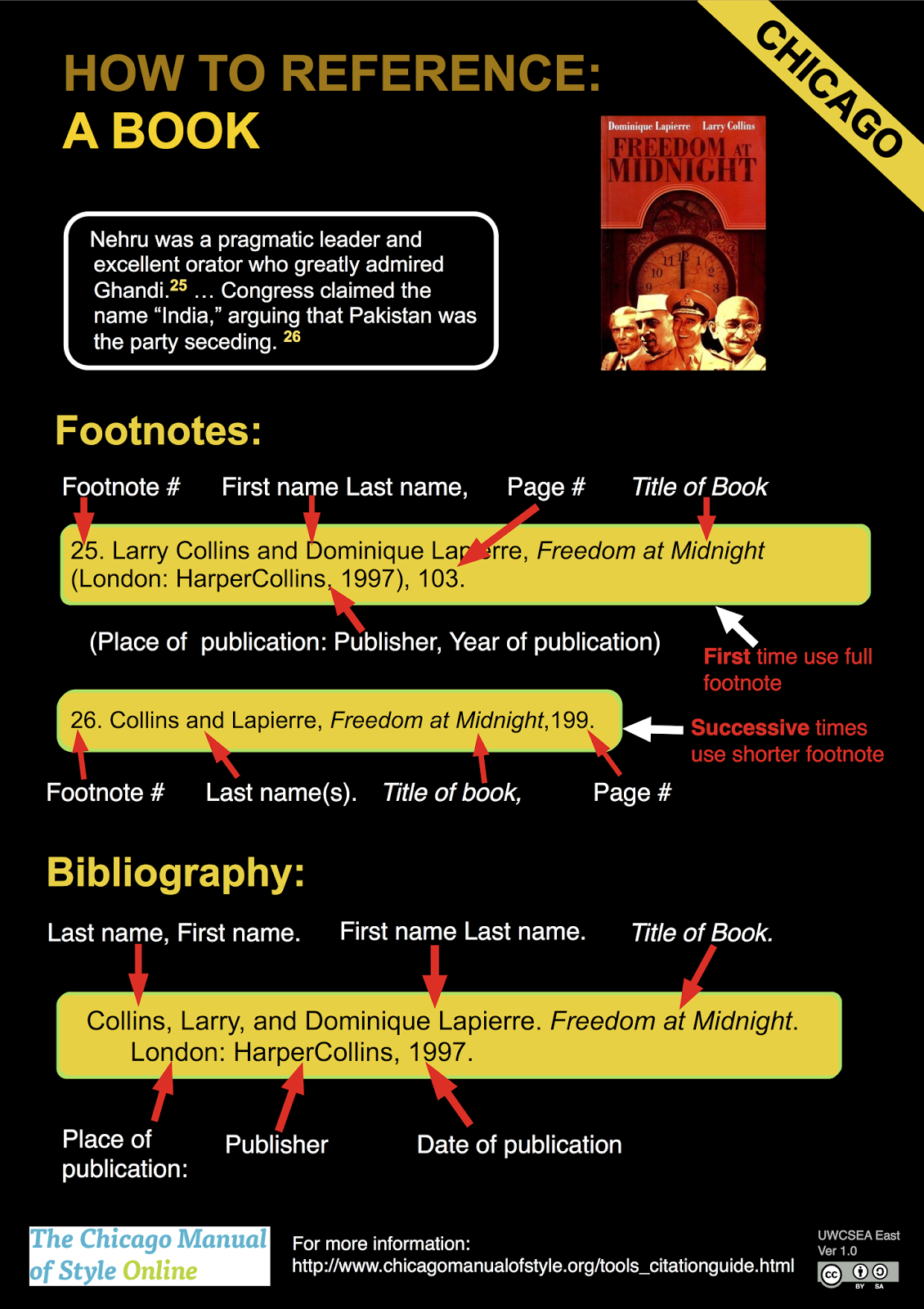
At times one has to get right back to basics and the last few weeks I’ve been huddled over my computer becoming more familiar with “Pages” than any non-design person would ever want to become.  All for the sake of trying to make simple basic posters outlining the most common example of the referencing styles we employ here at school.

We use MLA up to IB level, and then subject heads can decide what citation style is most appropriate for their discipline, choosing between MLA, APA and Chicago.   We decided to use the most commonly cited resources of our students, Journal Article, Website, Book, Video, Image and Newspaper Article.

The 80:20 rule definitely came into play here.  After I thought I was 80%+ finished, Katie started looking through it and then spent further hours and hours refining things. We asked for opinions and checking and refined things further.  Of course by simplifying one leaves out all the infinite varieties and complexities, but we also home that it illustrates the basic principles and we can then help out with the refinements as required.

Here is a link to the Google+ sites where they’ve been posted for:

APA
MLA
Chicago

All the posters are available under a CC license and we welcome comments and improvements.


Information literacy – Beyond Search and Cite

Here is the presentation I gave at the Bangkok Librarian workshare last weekend.  Basically my argument is we shouldn’t start our conversations on information literacy with the choice of which model we’ll employ, but should take a step back to what our philosophy of learning is, and choose an IL philosophy accordingly.  This would then inform our standards and benchmarks (S&B) which need to take cognisance of the latest thought in the Threshold Concepts as they relate to IL so that we can incorporate these in our S&B and then, we can think about models and delivery.  Otherwise we get stuck with students who can go through the motions but will not be able to transfer concepts and practises between disciplines and from the school to the home / work / life setting.

Appreciate comments.

most exciting thing since sliced bread …

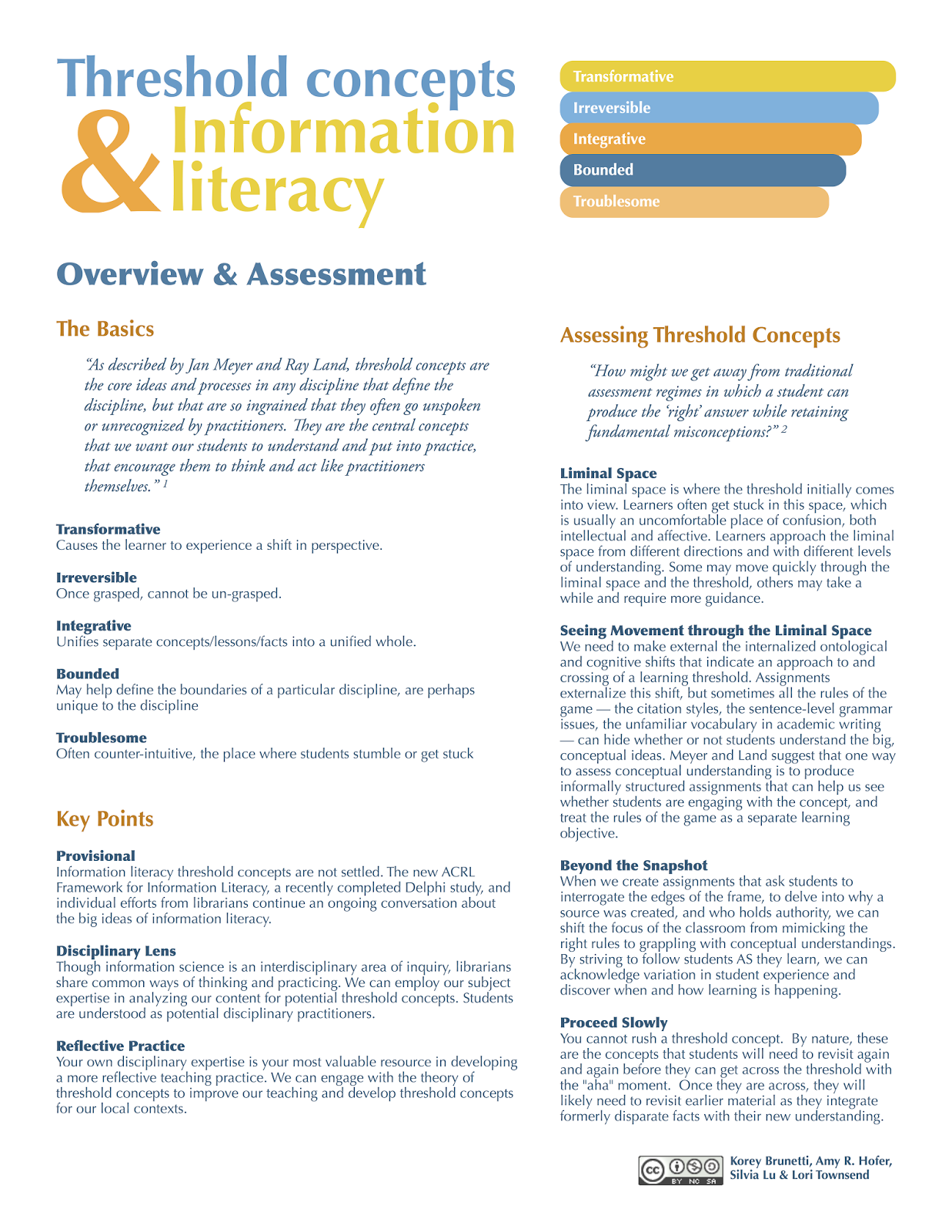
My discussions with Katie Day always lead to interesting stuff.  One such moment was reference to “threshold concepts” which she discovered during last year’s ALA conference.  It was buried in her long post about the whole conference, and I’d like to dig it up and put it in the spot-lights it deserves here.  I think this is going to be “the” topic of the coming age.

Because I’m still delaying and procrastinating on my assignment on IL, I’m going to refer you to the excellent handout of Brunetti, Hofer, Lu & Townsend  which summarises it all beautifully.  I’d also encourage you to read the more extended article if you have a chance:

Hofer, A. R., Townsend, L., & Brunetti, K. (2012). Troublesome Concepts and Information Literacy: Investigating Threshold Concepts for IL Instruction. Portal: Libraries and the Academy, 12(4), 387–405. doi:10.1353/pla.2012.0039

Would love comments and ideas and musings about how and where and if this would be relevant at school level.

Brunetti, K., Hofer, A. R., Lu, S., & Townsend, L. (n.d.). Threshold concepts & Information literacy – Overview & Assessment. Retrieved from http://www.ilthresholdconcepts.com/uploads/3/0/9/7/30975467/cuny_handout.pdf
It was also a “hot topic” in the 2014 European Conference on  Information Literacy in Dubrovnik, Croatia.  Next thing on my list is to go through the conference proceedings.

Information Literacy is more than a set of skills

The question of whether information literacy (IL) is more than a set of skills is an important one, as it sets the philosophical basis that informs the approach that an institution and its administrators, teachers and teacher librarians (TL) take in the design and implementation of a program.  Read more …

Activity 1: Review an electronic resource for children or young adults or about delivering services to children or young adults

A detailed description of the activity undertaken

The bibliographic tool: EasyBib was reviewed.  This tool is used at UWCSEA-East for secondary students for citation, note taking, research paper organisation, the creation of annotated bibliographies and to teach academic honesty.  The topic of

* Digital materials/resources and emerging technologies

is covered in this post.

Firstly the ease of set up was evaluated followed by the creation of citations in EasyBib.

Ease of Setup:

In order to set up EasyBib, the school’s library guide was followed.  Following the slide show step by step, the set up was fairly easy.  It took about 30 minutes, including looking for passwords and access codes.  For a student reasonably familiar with add-ons and chrome (which most of our students should be) this part should not be a problem.


Creation of Citations:

In order to review the citation tool, a few of the most common primary resources used by our students was tested using EasyBib.  For each resource, output was created in the 2 most common citation methods used by the school, namely MLA and APA.  The output was then compared to the citation using Zotero (which I am most familiar with and which was previously used by the school as a citation tool) and both were checked to the MLA and APA guidelines.  The other factor that was looked at included how much additional manual input was required and how “intuitive” manual completion was.


Print book –

I only needed to input the ISBN and the tool did the rest automatically.

MLA Result EasyBib:
Lipson, Charles. Cite Right: A Quick Guide to Citation Styles–MLA, APA, Chicago, the Sciences, Professions, and More. Chicago: U of Chicago, 2011. Print.

MLA Result Zotero:
Lipson, Charles. Cite Right: A Quick Guide to Citation Styles–MLA, APA, Chicago, the Sciences, Professions, and More. 2nd ed. Chicago?; London: University of Chicago Press, 2011. Print. Chicago Guides to Writing, Editing, and Publishing.

APA Result EasyBib:
Lipson, C. (2011). Cite right: A quick guide to citation styles–MLA, APA, Chicago, the sciences, professions, and more. Chicago: University of Chicago Press.

APA Result Zotero:
Lipson, C. (2011). Cite right: a quick guide to citation styles–MLA, APA, Chicago, the sciences, professions, and more (2nd ed.). Chicago?; London: University of Chicago Press.

All results were comparable, except EasyBib abbreviated University to “U” (which is acceptable) and added “Print” as the format which is correct, further, EasyBib did not state the edition, whereas Zotero did.

Journal Article –

Two different articles were selected and the DOI was input. EasyBib could find neither of the citations (Zotero could find the citation using the DOI only).  Trying “autocite” using the name of the journal also didn’t work, so manual input was required. Unlike Zotero, you cannot chose between author full name and separating between Name, Initial and Surname, so copying and pasting the information requires 3 or 4 steps instead of one.

MLA Result EasyBib:
Croll, Theodore P., DDS, and Kevin J. Donly, DDS. “Tooth Bleaching in Children and Teens.” Journal of Esthetic and Restorative Dentistry 26.3 (2014): 147-50. Web.

MLA Result Zotero: 
Croll, Theodore P., and Kevin J. Donly. “Tooth Bleaching in Children and Teens: Perspectives.” Journal of Esthetic and Restorative Dentistry 26.3 (2014): 147–150. CrossRef. Web. 6 Aug. 2014.

APA Result EasyBib:
Croll, T. P., DDS, & Donly, K. J., DDS. (2014). Tooth Bleaching in Children and Teens. Journal of Esthetic and Restorative Dentistry, 26(3), 147-150.

APA Result Zotero:
Croll, T. P., & Donly, K. J. (2014). Tooth Bleaching in Children and Teens: Perspectives. Journal of Esthetic and Restorative Dentistry, 26(3), 147–150. doi:10.1111/jerd.12108

Since EasyBib has a space for a suffix, and the journal article stated the authors were both DDS, this suffix was included, but this does not appear to be necessary. For MLA, once again, EasyBib correctly includes the format (Web) which Zotero doesn’t.

Of the APA results, only the Zotero result is in fact correct and up to date with the latest APA guidelines as it includes the DOI. The lack of EasyBib’s ability to extract data from the DOI can be seen as a drawback particularly for older students who use journal articles more frequently.  This may be a result of the fact that EasyBib is only linked with JStor and Proquest.  In order to test this hypothesis, another DOI was tested (from a Proquest related journal), and this resulted in a correct link – and correct citation in both MLA and APA.

APA result EasyBib:
Rey, P. J. (2012). Alienation, Exploitation, and Social Media. American Behavioral Scientist, 56(4), 399-420. doi: 10.1177/0002764211429367

APA result Zotero:
Rey, P. J. (2012). Alienation, Exploitation, and Social Media. American Behavioral Scientist, 56(4), 399–420. doi:10.1177/0002764211429367

MLA result EasyBib:
Rey, P. J. “Alienation, Exploitation, and Social Media.” American Behavioral Scientist 56.4 (2012): 399-420. Web. 6 Aug. 2014.

MLA result Zotero
Rey, P. J. “Alienation, Exploitation, and Social Media.” American Behavioral Scientist 56.4 (2012): 399–420. CrossRef. Web. 6 Aug. 2014.

The “CrossRef” item in the Zotero MLA result is not correct, it should state “Web”.

Internet resource –

A considerable amount of information was missing.  In fact the only item that was correct was the URL, and every other piece needed to be found. However, every step of the way EasyBib gave helpful hints as to what information was needed and where the information could be found. A particularly useful feature was the way that the “finished” citation evolved alongside the fill in boxes – the “LearnCite” feature.

MLA Result EasyBib:
Hume-Pratuch, Jeff. “How to Use the New DOI Format in APA Style.” APA Style Blog. American Psychological Association, 25 July 2014. Web. 06 Aug. 2014.

MLA Result Zotero:
Hume-Pratuch, Jeff. “APA Style Blog: How to Use the New DOI Format in APA Style.” APA Style Blog. Blog. N.p., 25 July 2014. Web. 6 Aug. 2014.

In this instance, the EasyBib citation is the correct one, mainly as a result of the fact that Zotero doesn’t have an entry space for the publisher / owner of the website.

APA Result EasyBib:
Hume-Pratuch, J. (2014, July 25). APA Style Blog: How to Use the New DOI Format in APA Style. Retrieved August 6, 2014, from http://blog.apastyle.org/apastyle/2014/07/how-to-use-the-new-doi-format-in-apa-style.html

APA Result Zotero:
Hume-Pratuch, J. (2014, July 25). How to Use the New DOI Format in APA Style. APA Style Blog. Blog. Retrieved August 6, 2014, from http://blog.apastyle.org/apastyle/2014/07/how-to-use-the-new-doi-format-in-apa-style.html

In this instance neither EasyBib nor Zotero are correct.  According to the APA the correct citation would be:

Hume-Pratuch, J. (2014, July 25). How to Use the New DOI Format in APA Style [Blog post]. Retrieved August 6, 2014, from http://blog.apastyle.org/apastyle/2014/07/how-to-use-the-new-doi-format-in-apa-style.html

2. Answers to the following questions:


What did you learn?

I learnt that despite the appearance of ease and automatic generation, one needs to have a healthy dose of scepticism and the willingness to be familiar with the citation rules and to check results or input against these rules. I also became better informed about DOIs and the limitations of two commonly used citation generators. I also contacted the APA to confirm my understanding of the requirements for citation of websites and Zotero about the apparent failure to comply with either MLA or APA for website referencing. To my surprise both organisations got back to me within a few hours, the APA to confirm and Zotero to say that the error would be fixed and they subsequently sent me the system update request to prove it was being dealt with!  This has also taught me that as a consumer I can approach service organisations and make reasonable requests for change.

How was the activity relevant to your professional practice as a librarian for children or young adults?

In my academic life I use Zotero, so I was not fully comfortable with using EasyBib and not fully aware of its capabilities and limitations. This activity has given me the opportunity to explore these. I can now better serve my student clients and find the information needed for them to manage the citation and referencing needed for their research.

Were any gaps in your knowledge revealed? How might you fill those gaps?

Personally I am very familiar with APA, while most of the school uses MLA, with the exception of IB (International Baccalaureate) students in certain subjects.  This has enabled me to become more familiar with the requirements of MLA and to notice the differences in requirements between the two. I have also found some good resources on both APA and MLA that I can consult when in doubt as to the correct citation form. Creating this blog post, with its complications of formatting has also revealed a huge gap in my ability to create a blog with as good a “look and feel” as I can create in a word document.  Understanding HTML may be my next PD learning experience.

Websites consulted and references: