How to WINN in the new school year

Part of my vacation time is usually spent doing personal learning and preparing for the new year for both my students and for how I can impact teaching and learning for teachers. Last year was my first in a new environment – both in terms of level (middle school rather than primary) and country/school (Beijing, China). This year I’m preparing with somewhat more hindsight and the fact that we have 12 new teachers starting. This post I’m going to focus more on how I hope to support teachers.

Last year, my predecessor very kindly typed up a long list of answers to my 100s of questions to help guide me in the new position. It’s something I refer to from time to time even further into the year. This year I compiled a “newbies” guide with the help and input of all my fellow (last year) new teachers, and the rest of the staff on the nitty-gritty things that we wish we’d known before starting. We sent it out into the world and based on the feedback added additional information. It seems to have had some success with 1,282 views since it was created in May. But it’s a lot of information to digest.

Today I stumbled on the videos (and book) of Nick Shackleton Jones via a tweet on a blogpost of his (yes, rabbit hole – but this time a good one). This has definitely changed my whole view on how to approach supporting teachers, and perhaps even how to work with students.

A brief summary of the takeaways of the videos

Part 1 – distinguish between content dumping (my newbie Libguide – and other Libguides) and performance support. In order to give performance support you need to understand / analyse what people are trying to do and provide resources that have DESIGN & UTILITY.

Find out from your audience WHAT I NEED NOW (WINN).

Part 2 – this session is particularly interesting for on-boarding and knowledge sharing. The basic elements are things that people need immediately (how to use the computer); advice from peers, understanding how things connect together; factsheets; one page guides; checklists.

Part 3 – discusses the affective (emotional) context of learning and how to alternate between providing resources (when the audience has a strong emotional response to the information) and experiences (when the emotional response / interest is lower). The 5Di design process is introduced (define, discover, design, develop, deploy & iterate). Of particular use in my context was the CONCERN-TASK-RESOURCES model. I think that is a great way of deciding what resources to focus on by working out the concerns of the audience, relating them to tasks and then providing the resources that can help with the tasks.

I can see this working really well for designing learning experiences for our Day 9s to ensure that they are student need rather than teacher driven.

So, what I thought I’ll do is during the newbie week and first week of teachers back have daily debrief sessions on a pop-in or digital basis called WINN where teachers can quickly and briefly address what their concerns or tasks are that they need immediate help with and to build up the resources they need. Pop in is easy enough, for the digital I’m thinking of using our “ask” function of Libguides that I just started populating at the end of last year, so that the questions can accumulate into a knowledge database.

========================

Here is a longer video on “how people learn” worth the 29 minute investment – and a link to the book “How People Learn : Designing Education and Training that Works to Improve Employee Performance” I have a small gripe on the “employee performance” part of the subtitle – as I think it’s pretty universally applicable – but I guess that’s his background.

Header Photo by Felix Staffler from Pexels

Trust me I’m a …

I’ve had this vague feeling ever since I started in the middle school that I’m just not serving my population well on the research side of things. I’ve tried putting my finger on it in the past but the unease has been growing. It started with being dissatisfied with nonfiction and that we’re not doing enough to uncover what research really looks like. I’ve not blogged much this year – partly due to having a lot on my plate with moving schools and school section, but also by choice since there’s just been so much to process and I’m not sure if writing it would be the best option.

It’s now near the end of May and my unease has not abated. A few things are going much better – I’m slowing getting some more collaboration going between the library and the various subjects. Which in some ways leads to more soul searching on how to best serve our students. I think I’m beginning to better understand the problem, not that I’m any closer to a solution. danah boyd gave yet another amazing talk recently and here is the transcript: “Agnotology and Epistemological Fragmentation” – bigger words than I’m accustomed to blogging on, but please indulge me and read the link, as it’s a good, albeit scary read. In particular what struck me was her discussion of the “data void” because that is exactly the description for what I’m experiencing as a middle school librarian.

In primary life was relatively easy – students had their passions – dinosaurs and trucks and kittens and ocean life and their inquiries, the rainforest, energy, etc. and I had a plethora of resources, mainly print books that could explain things in a simple yet clear and age appropriate way.

My latest existential crisis is the result of a rather good collaboration with G8 Biology, where we’re trying to take some biological understanding of cells and make it relevant to your average 13/14 year old in the throes of puberty where everything is more interesting than cellular details. So the idea was to try and help them examine what’s going on at a cellular basis when they indulge in typical teen behaviour – eating, drinking, going to the spa, putting on sunscreen, using makeup, experimenting with alcohol or smoking/vaping, dyeing their hair etc. I’m gathering some basic background information in a Libguide so that they don’t get bogged down in a google blackhole.

But that pulls me into the rabbit hole instead as I try to find scientific information. With the teachers we’d already decided that any books we had were largely irrelevant content detailed and superceded by better online models and information. But what we needed now was good information tailored to the unit.

I started with what I thought would be something relatively simple – deodorants – nothing could be further from the truth. On the one hand you have Dr. Mercola, and his ilk, countless hysterical “health” bloggers; Huffington post and on the other, the 200 page report on the matter from the EU scientific commission. Then there was the Doctor in the Harvard review (via Credo) answering questions posed by her daughter and her daughter’s friends and her mother and neighbour. With some pretty definitive answers, but not a citation or reference to back up her views. I don’t think so. So I had to eliminate that as a potential source – Harvard or not, Doctor or not.

As boyd so perfectly puts it “One of the best ways to seed agnotology is to make sure that doubtful and conspiratorial content is easier to reach than scientific material. YouTube is the primary search engine for people under 25. It’s where high school and college students go to do research. Digital Public Library of America works with many phenomenal partners who are all working to curate and make available their archives. Yet, how much of that work is available on YouTube?

I had a similar problem when I was trying to find some nonfiction books on vaping and e-cigarettes – the books were merely adequate. In particular I was interested in at least one chapter, or even a page that dealt with the science of nicotine / of what’s going on in the lungs, the science. A few good images that didn’t just include pictures of the hardware of vaping! But there isn’t anything.

Where does that leave us as teachers and teacher librarians? Caulfield, who I highly respect for his work on information literacy, has come up with an alternative to CRAAP – SIFT

  • (S)TOP
  • (I)nvestigate the Source
  • (F)ind better coverage
  • (T)race claims, quotes, and media back to the original context

It makes sense, I liked it, but it sat a little uneasily with me, and after reading boyd, I understand why. What happens when you’re going through SIFT and you get to the F and find that there is no better coverage? This can be due to a number of reasons –

  • The gap between what is accessible at your level of understanding / education / language /
  • the preferred mode of access gap (see the comment on YouTube earlier)
  • the void between what I would call the “Goop press” (see this, and this) and science journals.
  • The chasm between what student friendly sources publish and what students are actually researching – anyone find anything really good on micro-plastics recently? – Not in any of the databases my school subscribes to…
  • The fact that even the most intelligent and well meaning teacher in my environment is loath to consider allowing students to use wikipedia (that will be a whole blog post on its own)

You will not achieve an informed public simply by making sure that high quality content is publicly available and presuming that credibility is enough while you wait for people to come find it. You have to understand the networked nature of the information war we’re in, actively be there when people are looking, and blanket the information ecosystem with the information people need to make informed decisions (boyd).

In the mean time, I’m encouraging my teachers and students to use Beers & Probst’s Notice and Note for Nonfiction. At the very least I’m hoping that using it will give them a sense of unease. Of uncertainty, of wondering if what they are reading can be believed, and if not that if not now, at some point they’ll continue to mull over the topic and eventually be able to research it further, and if necessary change their minds or opinions on what they learnt back when they were in G8.

Beyond beyond search and cite

A long while ago (3 years) I wrote a post about the fact that we needed to look beyond “search and cite” in teaching information literacy and look at the threshold concepts of research, and a presentation I’d given on the theme. I remember at the time seeing half the audience (of librarians) eyes glazing over and thinking, “oh no, this isn’t going to work if it’s not something librarians get and relate to – and how on earth would students buy in?” I still believe that understanding threshold concepts in any discipline and for us librarians in research / information literacy is crucial in diagnosing misunderstandings and structuring our teaching. But then yesterday I had another insight on how this could be approached in a far better way.

studentIn my current position I’m considered to be part of the school wide coaching team, and as a group it was suggested we read “Student-Centered Coaching” by Diane Sweeney. I’ve been enjoying the fact that it’s a pretty practical book and one where you start to think that by taking the focus off the coach or even the teacher, you can actually take a lot of the emotion out of the coaching / teaching equation.

The book emphasises the use of data, but not necessarily the data provided by testing, but rather from the usual formative and summative assessment that is going on anyway.  One example used DRA testing – the equivalent of which occurs all over regularly anyway, and another a rubric from a writing program using a writing prompt. The idea is to select pieces of writing and score them on writing conventions and then group students into bands of “exceeding, experienced, competent, developing, emerging or below emerging” conventions. One then tries to move those groups / cluster using differentiated instruction up the scale.

I immediately thought of a lost opportunity last term, I’d had to teach citation to groups of students prior to their final assessment of a unit. It had been hectic both on my side and the teacher / classes and I’d been beating myself up a bit about it. Then my son (a different grade) came home and showed me an I&S assessment task (ungraded) he’d done and asked me what I thought of it. That’s a tough call. Because,  there was a lot going on there and not all of it was pretty.

And then I realised it was the perfect way to do a “backwards by design” session on searching and citing.

What if the “works cited list” and in-text citations of an assessment task of a whole class or grade were to be critically looked at?  It is a few lines that reveal so much of what’s going on in research. And then based on that one could group students according to where they were and what needed to be worked on and then individualise that part of the rubric in order to see if there was progress in understanding (and if they were approaching the thresholds!).

A quick reminder of the IL threshold concepts – research is/has:

  • Authority – Is constructed and contextual
  • Format – the creation, production and dissemination of research is not equivalent to its delivery or how it is experienced
  • Information goods – research has a cost and a value
  • Information structure (searching as strategic exploration) – an ability to look “under the hood” of databases and search engines (including more and more as we use things like Google scholar – the algorithms that spit out the results)
  • Research process – as iterative, difficult and building on the those who came before
  • Scholarly discourse – citation is a point of access into this discourse
  • (Research as inquiry – ongoing nature of research this is used by some but not all researchers)

Some of the things I noticed when looking at my son’s paper were –

Evidence (just two examples as an example): Not understanding that “Et al.” means “and others” – encountered in the in-text citation and works cited. The in-text citation followed the format (author, date) while the works cited was MLA8. Kind of.

Indication of not understanding:  

  • authorship = authority. But behind that was an understanding of the research process that included groups of people working on a topic
  • Format – since he’d used google scholar as a delivery point for the search. And from there had got to the database article without realising that it was an article in a database.  And didn’t understand the format or
    Screen Shot 2018-10-14 at 19.21.28information structure.
    This is something, if MLA8 is correctly taught and deployed, including its emphasis of a Russian Doll like structure of containers, should become obvious.  There is another – more simple aspect of formatthat of the format of citing and where that can be found. I showed him the  ”  marks in google scholar and how that led to the citation that could be copied into NoodleTools as is… a revelation
    for him. I also showed him in the original journal article of two other sources how he could find the citations and just copy and paste them – let’s consider small steps here!

Indication of understanding:

  • Scholarly discourse – here is where my own prejudice to APA versus MLA8 for the humanities come in – the date is probably a better indication of the point of scholarly discourse and understanding that something more recent would encompass prior research

The Scott (2017) article listed below is a particularly good one – because it asks students to rank their understanding of the concepts and to explain them. And this is where you can see the metacognitive value of “knowing what you don’t know” (please read Errol Morris’  series of articles on the anosognosics dilemma – the best ever on this, if you haven’t already) comes into play

“One mentioned domain knowledge as a barrier: “You have to have some type of familiarity with the topic to ‘enter the conversation.’” (Scott, 2017, p. 295)

To reign this back, we’re talking about middle and high school. So wading straight into threshold concepts may be going in too deep for the average student. But it may be a useful diagnostic tool.

Getting back to the coaching bit – doing an autopsy on in-text citations and the works cited list would reveal where the gaps and issues both in searching and citing were. The humanities teacher is probably looking at the assessment using a different lens – that of understanding and using the information and the ability to write it up in an academically acceptable manner using some kind of scaffolding (e.g. point, evidence). And at the end of the assessment, once a grade has been given and the focus has moved onto the next unit / assessment, the gaps in the ATL “research” may not have been identified, recognised, nor addressed in the teaching or assessment rubric for the next unit.

I believe in rubrics as a way of shaping teaching and focusing attention in student effort. If in a year, the teacher in conjunction with the librarian, moves through perhaps four iterative cycles of research, I’m sure we’d see real progress in both the practical ability and metacognition of students as they approach research and the threshold concepts.

=================

Here are some articles that explore further information literacy as a threshold concept in an interesting way:

Further reading:

Corrall, S. (2017). Crossing the threshold: reflective practice in information literacy development. Journal of Information Literacy, 11(1), 23. https://doi.org/10.11645/11.1.2241
Hofer, A. R., Townsend, L., & Brunetti, K. (2012). Troublesome concepts and information literacy: Investigating threshold concepts for IL instruction. Portal: Libraries & The Academy, 12(4), 387-405.
Hofer, A., Brunetti, K., Townsend, L., & Portland State University. (2013). A threshold concepts approach to the standards revision. Comminfolit, 7(2), 108. https://doi.org/10.15760/comminfolit.2013.7.2.141
Morris, E. (2010, June 20). The anosognosic’s dilemma: Something’s wrong but you’ll never know what it is (Part 1). Retrieved 4 February 2014, from http://opinionator.blogs.nytimes.com/2010/06/20/the-anosognosics-dilemma-1/?_php=true&_type=blogs&_php=true&_type=blogs&_r=1
Scott, R. (2017). Transformative? Integrative? Troublesome? Undergraduate student reflections on information literacy threshold concepts. Communications in Information Literacy, 11(2), 283–301. https://doi.org/10.15760/comminfolit.2017.11.2.3
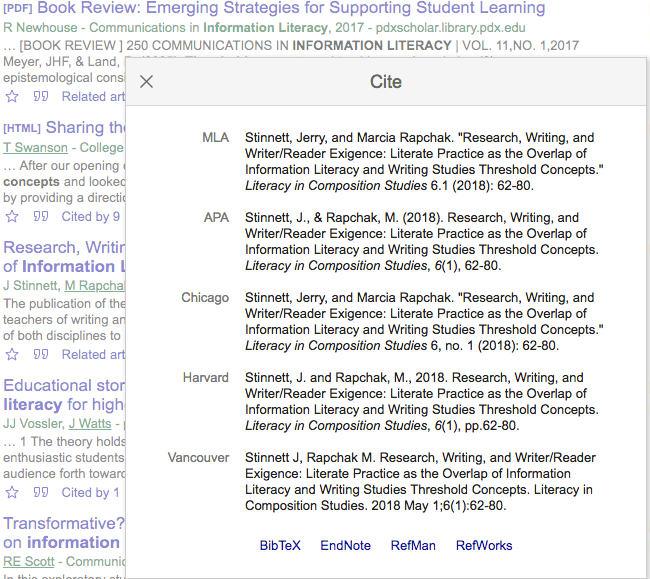
Stinnett, J., & Rapchak, M. (2018). Research, writing, and writer/reader exigence: Literate practice as the overlap of information literacy and writing studies threshold concepts. Literacy in Composition Studies, 6(1), 62–80. Retrieved from http://licsjournal.org/OJS/index.php/LiCS/article/viewFile/180/239
Townsend, L., Hofer, A. R., Lin Hanick, S., & Brunetti, K. (2016). Identifying threshold concepts for information literacy: A Delphi Study. Communications in Information Literacy, 10 (1), 23-49. https://doi.org/10.15760/comminfolit.2016.10.1.13

The Imitation Game

Recently I’ve been given to much pause of thought about learning and education, not the least following watching the movie “The imitation game” about Alan Turing’s code breaking during WW2 on the plane, followed by three days of intensive attending of presentations at 21CLHK.   It’s taken a while to try and crystallise my thoughts, and they’re probably still not as coherent as they should be, but these are my main takeaways.

While Turing is attempting to build a machine that will, in the long term, take over the work of cracking this (and other) codes, everyone around him is desperately engaged in a race against the clock. And at midnight each day the clock is reset, all work they did that day is useless and they start again from nothing the next day.  While I know that education is not exactly like that, I sometimes feel that a school year is like that Bletchley park day with a teacher racing against the daily clock, against the time-tabled period which they’re allotted to do one thing or another and then the bell goes or the summer holiday starts and we’re back at square one, but the child is handed over to the next person.  I’ve said before this is fine for the “middle”. It’s the children at the extremes where this handing over is most acutely observed, either in a positive or negative sense as they lurch through the process of learning and hopefully becoming educated beings.

Far worse is not only is Turing not supported, but the mediocre middle are out to destroy not only his machine, but him as well.

Ironically it is always easier, and more appreciated,  to work extremely hard at a huge volume of output,  than to openly take a step back and reconsider the foundation upon which practices and assumptions lie.

I’ve often decried the lack of longitudinal research in education. Our current high schoolers, what do they “look” like now (from a literacy standpoint which is my optical focus) and what did they look like when they were in G4 (my area of concern for my BWB club). And my G4’s where did they come from? How soon did their literacy attempts start to diverge from the middle? How about the ELL students? We know that the process of learning a language to CALP (cognitive academic language proficiency) level is a 5-7 year process. So when they exit an ELL programme after 2-3 years we haven’t even scratched the surface.

I attended quite a few sessions / presentations at 21CLHK that were symptomatic and typical of this “information” age. A deluge of ideas and devices and applications, delivered at a rate exceeding the absorption of most of the (highly intelligent) brains present.  I fear we employ the same methodology with our students. I know that I do. I get 40 minutes a week with my G5&6s and 20 minutes a week with the rest. Lessons and wisdom (in as much as I can claim to have any) needs to be imparted within a fraction of that to allow time for browsing of books. Teach the teacher they admonish. The teacher who has no time, as they race through a curriculum, that while enquiry based, demands 6 inquiries in 8 months. And where none of the units in G1 look at cars and planes or dinosaurs or dogs and cats or insects or space or the other obsessions a 6 year old has.

book-of-mistakes.jpg

I can read stories. Stories that I hope will cut through the clutter and touch their hearts. And I can but try to shove the right books in the right hands before the next group of wonderful eager expectant hugging children walk in. I sometimes say to my more illustrious and famous ex-MBA friends that I’m paid in hugs rather than dollars, and its true. I can try to show, not tell, them that mistakes aren’t important, it’s what you do with them that matters.

And then the Social-emotional (SE) dimension. Back to Turing. By the movie depiction he was socially inept, cared more for his work and ideas and machine than for the people around him. The movie at least gave a nice nod to the ideas of development of relationships and collaboration and the notion that a good team needs more than just raw intelligence. I do badger on a bit on SE Learning and the need for books and picture books to aid discussions and self-exploration / understanding.  I am confronted daily with students who struggle in this area, many of whom don’t have the “brilliant mind” that people like Turing had to perhaps compensate. The children who return a book and say – “it was an important book, because you know I’m also being bullied” and I look at them and I can see why their cohort would target them and how hard it is to protect them and turn the tide of otherwise nice kids performing macro and micro aggressions on children who are just slightly off kilter enough to merit the worst kind of attention.

And then you see an article like this one, announcing an OECD Pisa-like test for Social-Emotional skills. Please take the time to read and absorb the article and its implications. There is part of me that says perhaps the children who so desperately need interventions will get them. There is another (larger) part of me that knows that we do all sorts of other math and literacy testing that doesn’t lead to additional help so how on earth would we find the people, the expertise, the money, the time to devote to this area? And once it’s tested, and the tests are far reaching – even into the untouchable of untouchables in education – student’s homes, what will happen to the results? I’ve seen students desperately in need of having reading disability testing where parents have refused as they’re terrified of the stigma of a label even as innocuous as dyslexia as the child goes through school.

So I wonder, what can and should our responses be? Can we, should we, slow things down? Try to look at school as the whole process and learning as life-long – as we so often purport to do or hear the meaninglessly bandied phrase “life long learning” when all we actually do in schools is cut short every attempt a child makes at extending learning?

Chris Crutcher (author of Whale talk amongst other books) posted this on his Facebook in December (it takes a while to find amongst all his US-politics angst, so I will repost it here). I’ll leave you to think about it.

Almost everyone I know who dismisses the teaching profession wouldn’t last a day with this cool little dude (age 6!) – in a classroom where a whole bunch of kids see the world 180 degrees from him – before making him think he’s awful. This is the gamut range in EVERY classroom, k-16 and beyond. His teachers KNOW there isn’t an easy answer, but they come back and come back and come back, looking for what works; in an American educational environment crafted largely by non educators who would rather score high on mind-numbing tests of memory, than celebrate – and PAY for – creativity and expression and wildly different learning styles.

SO…this is for anyone who ever tells you teachers take that job so they can have three months off, or that “Those who can, do; those who can’t, teach,” and for anyone who needs a great example of why it isn’t:

WORD FOR WORD

12-4-17

N. School is hard.

?

N. I want them to leave me alone.

?

N. Grown ups. They want me to do work, but I am too tired. Then they keep bothering me with words. I just want to stay one hour cause school bothers me. I hate school.

?

N. Boring. It’s so boring. I don’t want to go to school.

?

N. I want to stay home and have fun. I can teach myself. I like to use my brain and think and learn without being in a big building. They don’t help us learn, they just suspend us. I already know what they say. I’m just bored. Games help me learn. Building things help me learn. I study things and learn and not in a big building. Computers help me learn. They tell me stuff I don’t know. They don’t let me learn there at school. I have to sit there and listen. I want to learn non-fiction because I’m a scientist. They are wasting my time.

?

I could be learning. I want non-fiction so I can study. They read fiction stories but I like non-fiction books and computers. They’re making me dumb cause they don’t tell me non-fiction. They want me to be normal, but I want to be a robot maker. They try to make me normal but I don’t want to.

? Normal?

N. Sit there and listen which I don’t want to. That is so dumb. I want to do stuff so I can learn.

? If you were the teacher?

N. I would have kids do cool stuff like learn how to build cool bridges. I never got to go to the computer lab. They make me do dumb papers but I want to use the computer, cause computers know cool stuff. I want to learn everything, but school is holding me back.

?

It takes me away from studying and learning. (Chris Crutcher, Facebook, 11 December 2017)


Scheduling – priorities and dissonance

New year, new chances, old problems. The perennial one of scheduling library time. I kind of started commenting on people’s posts and questions on FaceBook and then decided it merited a blog post on its own. There is also a whole discussion on libraries and librarians going at the IBO level where priorities, recognition, roles, responsibilities etc. are also being hashed out. But coming from a corporate background and not an educational one, I sometimes can’t help seeing things a bit differently.

One of the most useful courses I followed during my librarian studies was “Designing spaces for learning”. And spaces weren’t just physical spaces, or even physical and online spaces, it includes temporal space – as I wrote about here  and design thinking. The thing is that time is the great leveller. We all have 24 hours of it a day, but what we choose to do with it is telling, because it will determine who we are as librarians and display our priorities more strongly than just about anything else we do.  I could even put money on the fact that if you walked into a school where there was a troubling relationship between the librarian and staff / admin and you asked to see the library timetable it could be used as both a diagnostic tool and a cure.

So I’ll begin this post by giving a shout-out to my principal who gives me the autonomy necessary to both think all this out and then to discuss it with her and implement it. She also gives me the support I need when things are not working optimally, if I’m reasonable in my requests and it supports student learning.  My PYP coordinators who are allowing me to be their educational partners also makes things a lot easier. And the school I’m at that generously allows for 3 support staff members in the library in their HR budget to open up time for me to be doing higher order teacher-librarian things rather than processing and circulating books. Now apologies for a barrage of management-type speak and jargon, please bear with me.

In library scheduling there are two main schools of thought, primarily defined as fixed scheduling (you set up a schedule each year / term, and every class gets their time to go to the library at that designated time) and flexible scheduling (the librarian’s time is bookable, on demand). Each have their benefits and drawbacks – with fixed you get to see everyone regularly, but in a large school you have no time left, or go on a two / three week schedule. With flexible you run the risk of never ever seeing some kids depending on the teacher’s ideas of the library, priorities etc. Most larger schools where the ratio of librarian to students is low (e.g. 1 librarian to 1500 students) opt for a flexible schedule. Our ratio is 1:630 with 34 classes so theoretically a fixed schedule can work, and I’ve tried to build some flex into it otherwise I’d never do the things that differentiate me from what a teacher or library assistant can do.

Priorities

The first part of the process is to decide what your priorities are. Now in education this is way harder than in corporate life, since often many of your priorities are set for you. It also took me a little while to get the experience and confidence to actually realise what my priorities should be and to advocate for them.  And also to decide what my priorities shouldn’t be and to draw a line in the sand.  Part of your priorities are governed by your school’s mission and value statement. Part is about your integrity to yourself as a professional (teacher) librarian and part is about the resources physical and financial your school has.

My personal priority statement is “I am about literacy“. So everything that has to do with any of the literacies (alphabetic, informational, numerical, multi-lingual and to a certain extent digital) I will prioritise.  I steer clear of discussions on makerspaces for that reason, partly because we have a dedicated STEAM department, and partly because if it has nothing to do with creating some form of reading, writing or research I consider it outside of my ambit. OK, shoot me, but you have to draw the line somewhere or you’ll have to compromise on something else, or just never stop working 24 hours a day.

The next thing is to think about how you are going to integrate yourself into teaching and learning in a collaborative way. There are two frequent laments heard in this regard “I don’t have time for meetings” and “I don’t get invited to meetings” – and here is where a supportive principal comes in. The very first thing that went into my timetable this year were the days and times for co-planning for each grade. It’s taken 2 years to get to this point and I only need / want to go to the meetings once a unit – usually a week or so before the unit starts so I’m involved in hearing where the team wants to go with the unit, what digital and physical resources they need and how I can meaningfully integrate information literacy or other ATL skills into the unit. I also only need to be there for about 10-20 minutes depending on whether it’s an old or new unit. So what about the other 4/5 weeks? Well I’m using the time to DO what the team needs. And if I’m teaching in that time, I can’t be doing. Doing includes making library guides (that’s how I have time for them), curating resources, ordering new resources, weeding old resources. Although I am not considered a HOD, my principal also kindly invites me to the weekly lead meetings so I know what is going on and coming up, and can involve the library in any way that is meaningful.

Then comes the fixed part, which fulfils my literacy priority. Since I do have a manageable ratio / number of students / classes, I have a fixed part of my schedule whereby each student gets to come to the library once a week. How has this been engineered? By chunking time and students. 40 lesson periods and 34 classes would mean no time for co-planning, co-teaching, own planning let alone the library facility management stuff. So, based on the advice of my predecessor and in the face of intense resistance from teachers, the timetable was split into 20 minute library times from G4 and under and kept at 40 minute sessions for G5 & 6. The compromise for lower level teachers is they can pair up with another teacher in the same grade had have 40 minutes with 2 classes. It’s not my preference, but they may choose this.  I do this because I want to see every single child every single week and make sure that I am helping them with free voluntary reading.  In Krashen’s (2004) words ” evidence from several areas continues to show that those who do more recreational reading show better development in reading, writing, grammar and vocabulary, These results hold for first and second language acquisition, and for children and adults. ”  I am an unabashed book pusher. I do everything I can to put books in the hands of children that they want to read. And to do that I need to see them and I need to know them. Especially the ones that will only come to the library that once a week.

Yes you can do a library lesson in 20 minutes, if you have staff who can do the check-in / check-out and shelving while you’re doing the reading, the mini-lesson and the reader-advisory, and if your teachers are in the library helping. Yes I do get that much support from my school and I’m very grateful for it.

Another small note on this section – switching costs nearly killed me in my first year. I was doing a G1 class then a G6 class then a G3 class then Kindergarten jumping around day in and day out. So I asked teachers to try and schedule in the library so that all the classes in a grade (or 2 grades, depending on number of classes) were on the same day. It worked last year and we kept it up this year – it was actually easier timetabling that way – constraints work. There were only 2 exceptions where the larger school timetable and teacher preps meant that I’m taking a class to help them out on a day different to the rest of the grade. That’s not bad going.

My next priority is multi-lingual literacy. Actually part of it comes in the fixed part. We are a bilingual English/Chinese school. I am the parent of two bilingual children. A child is NOT bilingual unless they are bi-literate. I will not compromise on that. I faced fierce opposition from parents complaining via teachers when I insisted that every child in the bilingual program had to take home a book in each of the languages irrespective of their ability to read in that language at that point*. I am very uncompromising on some things and this is one of them. At home, I have two bilingual teenagers, one in Chinese, one in Dutch who are still doing their languages as a first language only because I am uncompromising on the fact bilingual has to be bi-literate otherwise you are fooling yourself. And bi-literate means reading and writing. The classes that have “first dibs” on the library timetable are the bilingual teachers. One of my library assistants has to be fluent in Chinese and able to read aloud to my students and help me curate chinese resources.

So those are the bilingual classes. We also have ELL (English Language Learners) and students doing French as a second language. Their teachers also have (and take) the opportunity to bring their students into the library (or the library classroom where my world language resides) with their students every week. Language can just not be taught in isolation from books and reading.

The learning eco-system priority. Teaching and learning does not occur in a vacuum. Children are part of a family, a linguistic community, a social community, a cultural community. At the primary level, besides teachers,  parents are my best allies in my literacy goals for my students. So they get two periods once a week for library information sessions, for time to drop in for some reader advisory, for meetings the school needs to hold in my space for them.  I am a neutral zone. I am there to help them realise their goals for their family.

Then there is my co-teaching / information literacy teaching priority. I’m listing this last just because it’s last in the process, not because it’s last in priority. Doing all the above, specifically the 20 minute slots with the younger kids gives me 8 x 40 minute periods where I can make myself available for whatever lessons my teachers would like me to teach in the library or in the classroom. These are not used every week, but now that we’re integrated the research ATL into units they will be used far more.

My library facility priority, means I’ve blocked off 2 periods for inter-campus meetings, either by google-hangout or face2face with my fellow librarians and with my own staff.

These are my priorities and how I’ve structured my temporal space to accommodate them (see below). I’m in primary school – people in MS or HS may have other priorities and concerns. People in larger or smaller schools will have other issues. But the bottom line is your priorities need to be worked out (it’s taken me 2 years to get here and to articulate them), and reflected in your timetable. And you need to articulate them well so that if necessary you can argue your case with whoever is getting in the way of allowing you to reflect them in your timetable.  Things may and probably will change, but that’s it for now.
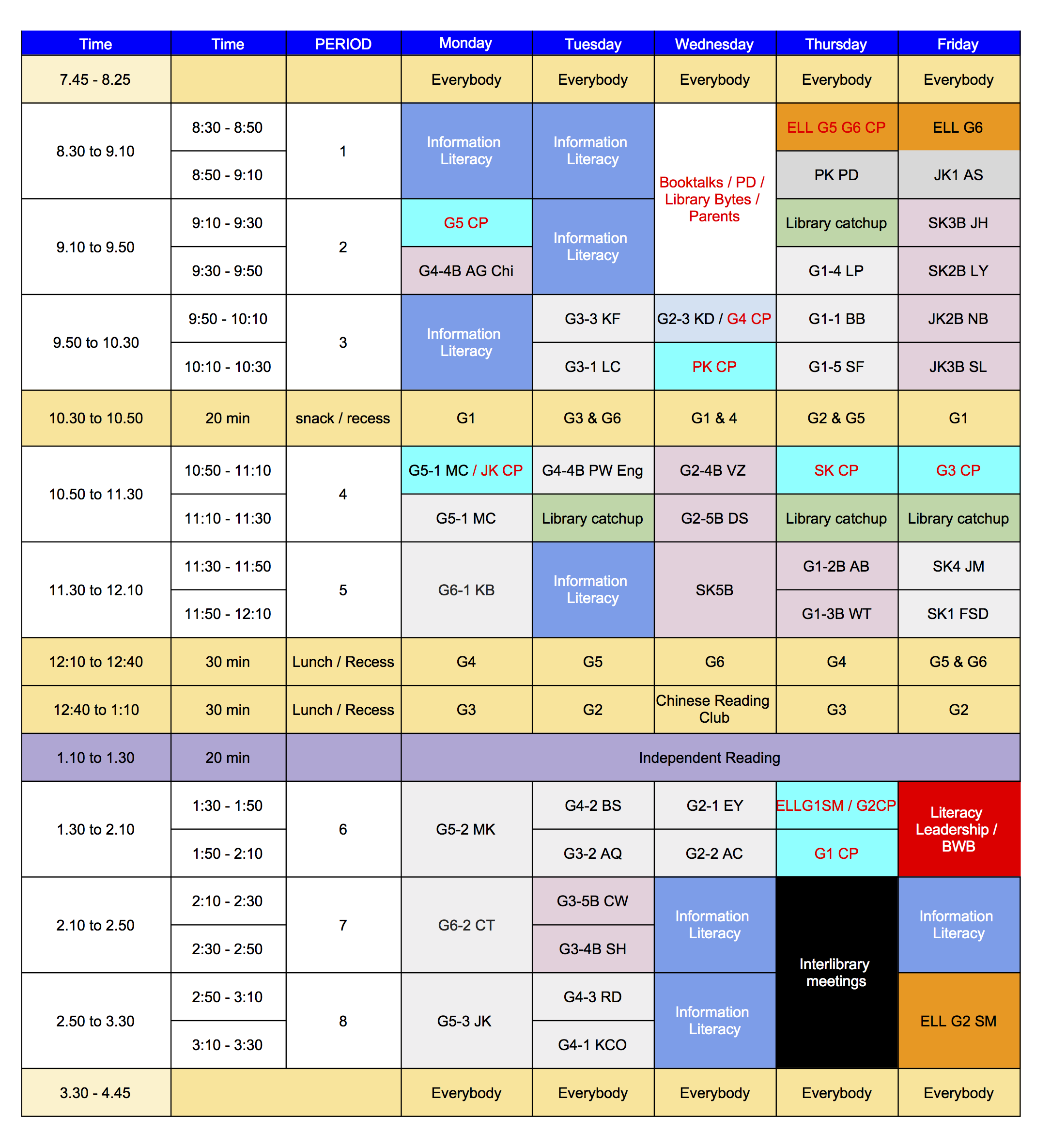
library timetable 2017:8

As a closing note – another part of the IBO library/librarian discussion was about the “super-librarian” archetype. I don’t want to be a super librarian. I want to be a great librarian. When Clark Kent is busy being superman, he neglects being Clark Kent. We cannot afford to be super-librarians because super librarians can and do burn out. And while everyone around this type of librarian says how super-librarianish they are, I don’t think they get the recognition they really deserve as librarians. And their successors have big shoes to fill, but not necessarily the right shoes to fill.


* Why do I insist on this? Often they can’t read the book, sometimes/ often their parents can’t read the book. Because they can’t read the book YET. Just like my kindergarten and pre-kindergarten children take home books they can’t read, so too my English / French / Dutch speaking kids take home Chinese books because the assumption has to be that they WILL be able to read those books. Otherwise get out of the bilingual program. Seriously. What do we do with mono-lingual kids who can’t read? We read to them. What if we can’t read? We sit and page through the books with them and we ask them to explain the pictures to us.  We ask them to point out the words they do recognise. We ask them to point out the letters they recognise.




But I was born here!

One of my favourite UOI (Units of inquiry) has started for my G3 students – in our library lesson last week I introduced the theme through reference to (a somewhat dated, but still very clear) video

Now one thing you can be certain about with students is that their responses will not be predictable. So too this time – what happened? They were cheering every-time their own flag appeared – irrespective whether it was to say that their nation was in the “top” for migration to or from – the subtlety of the relative positions totally escaped them.

At the point of the video where there is talk about how visa systems let people in or exclude them, I paused the video and mentioned the fact that actually all of them sitting there were migrants. Shocked silence for a few seconds followed by indignant cries of “but I’ve lived here all my life” or “but I was born here” or “my parents have lived here for 12 years”. I then asked how many of them were Singapore passport holders. In the 4 classes I had that afternoon, none. Yet they were all insistent on their rights not to be called migrants. I suspect they think of migrants as migrant workers in the sense of their helpers or construction workers.  When we got to the “push” and “pull” factors I said perhaps they should go home and ask their parents what were the push and pull reasons for being in Singapore.

How protected a life our students lead. A large number of leaving parents have come to me at the end of last year to have their library records cleared and signed off and told tales of the employment pass holder being made redundant and a home leave Christmas holiday being turned into a “packing up in a hurry and going home to an uncertain future” holiday. Those children leave and the ones left behind have no idea of the realities, are shielded from the realities.  I remember how few children could relate to Eve Buntings “Yard Sale” during the Global Read Aloud last year. They could only tell tales of moving to ever larger houses and getting more possessions rather than scaling down. The offspring of the 1%.

How much should our children know? How much should these sad, difficult and terrible things be made real and relevant to them instead of being images on screen or stories in books?  And if we make it more real, do we build empathy or fear?  I remember my daughter having weeks of nightmares after first learning about 9/11, combined with a trip to the coastal defense museum in HK and jets flying at the level of our apartment in HK. 5 year olds are not good with historical time perspective. Perhaps 8 year olds are not good with financial and living condition perspectives. Tough questions. Is this the right unit for Grade 3s?

You can find my research guide for the unit here, but I’d like to highlight some resources I find particular effective include:

Virtual reality

Clouds over Sidra

//player.with.in/embed/index.html?id=21

Interactive documentary

Refugee republic

Dynamic flow map

Also only until 2010, but a brilliant piece of interactive mapping of migrant flows too and from countries.

As educators we are expected to present information in a neutral fashion. I can only hope that some of our students are able to take what we present and link the past to the present and the future given the current changes in global politics – particularly with relation to human migration.