Category: CSU
INF530: Blog post 2: Digital Information Ecology
In information ecology, an information system is compared to a natural organism or ecological system whereby internal and external knowledge is integrated in a balanced manner, and information objects, services and products are managed using organisational and digital tools, and sense making “cleaning filters” which adapt and change in response to changes in the environment or the constituents (Candela et al., 2007; Steinerová, 2011; Wang, Guo, Yang, Chen, & Zhang, 2015).
Information ecology is a multi-disciplinary emerging field that covers digital libraries, information ecosystems, e-commerce, networked environments and the issues around rapidly developing new technologies. It offers a framework within which to analyse the relationships between organisations, information technology and information objects in a context whereby the human, information technology and social information environment is in harmony (Candela et al., 2007; Wang et al., 2015). It provides an alternative point of view to the traditional systems design and engineering perspective of information flow, and answers the central question of how to apply knowledge into a dynamic complex organisation.
Nardi and O’Day (1999) explain the interrelationship between people, tools, and practises (cited in Perrault, 2007; Wang et al., 2015) within the context of a shared environment (eco-system) with a cognitive, language, social and value system. The inter-relationship or dependency between the constituents means that changes impact the whole system. Steinerová (2011) and (Candela et al., 2007) looked at the elements of digital libraries and suggested that librarians examine where value integration can take place between the library service, technology, scholarship and culture adding value through new services or contributions to learning, user experience, research productivity, teaching or presenting and preserving cultural heritage.
Applying these ideas to the school environment, constituents of the eco-system include teachers, teacher librarians, students administration, parents and custodial staff (Perrault, 2007). Elements of the system will co-exist but also compete and share, converge and diverge in a dynamic interactive, complex environment (García‐Marco, 2011). The role of the library is such that the information ecology needs to be understood in order to support information seeking behaviour and thereby discover the zones of intervention and areas to leverage to optimise advance information seeking, usage, creation and dissemination within that eco-system and beyond. In response curriculum, content and subject delivery that can be reshaped and constructed dynamically and in a collaborative way according to changes in the environment or needs of students (O’Connell, 2014).
Relating this to my current work, I found the work of Perrault relevant in looking at how multimodal resources and adaptive technologies can best serve students with special educational needs (Perrault, 2010, 2011; Perrault & Levesque, 2012). This type of thinking can be adapted to considering the needs of bi- and multi-lingual students who are part of the school’s information ecology, but have a linguistic and cultural learning and informational need which can be seen as a potential zone of intervention for collaboration between the teacher, teacher librarian, family and community. Provided of course that within the international school group dynamic and context it is understood what is specific to particular linguistic and cultural groups and what is generalizable (Vasiliou, Ioannou, & Zaphiris, 2014) and how best to integrate systematic change and innovation, cognizant of the consequences that may be direct, indirect, desirable and undesirable, and often unanticipated despite our best efforts (Perrault, 2007).
References:
Candela, L., Castelli, D., Pagano, P., Thanos, C., Ioannidis, Y., Koutrika, G., … Schuldt, H. (2007). Setting the Foundations of Digital Libraries – The DELOS Manifesto. D-Lib Magazine, 13(3/4).
García‐Marco, F. (2011). Libraries in the digital ecology: reflections and trends. The Electronic Library, 29(1), 105–120. http://doi.org/10.1108/02640471111111460
O’Connell, J. (2014, July 19). Information ecology at the heart of knowledge [Web Log]. Retrieved March 28, 2015, from http://judyoconnell.com/2014/07/19/information-ecology-at-the-heart-of-knowledge/
Perrault, A. M. (2007). The School as an Information Ecology: A Framework for Studying Changes in Information Use. School Libraries Worldwide, 13(2), 49–62. Retrieved from http://ezproxy.csu.edu.au/login?url=http://search.ebscohost.com/login.aspx?direct=true&db=ehh&AN=28746579&site=ehost-live
Perrault, A. M. (2010). Reaching All Learners: Understanding and Leveraging Points of Intersection for School Librarians and Special Education Teachers. School Library Media Research, 13, 1–10. Retrieved from http://ezproxy.csu.edu.au/login?url=http://search.ebscohost.com/login.aspx?direct=true&db=ehh&AN=67740987&site=ehost-live
Perrault, A. M. (2011). Rethinking School Libraries: Beyond Access to Empowerment. Knowledge Quest, 39(3), 6–7. Retrieved from http://ezproxy.csu.edu.au/login?url=http://search.ebscohost.com/login.aspx?direct=true&db=ehh&AN=58621336&site=ehost-live
Perrault, A. M., & Levesque, A. M. (2012). Caring for all students. Knowledge Quest, 40(5), 16–17. Retrieved from http://ezproxy.csu.edu.au/login?url=http://search.ebscohost.com/login.aspx?direct=true&db=ehh&AN=82564002&site=ehost-live
Steinerová, J. (2011). Slovak Republic: Information Ecology of Digital Libraries. Uncommon Culture, 2(1), 150–157. Retrieved from http://pear.accc.uic.edu/ojs/index.php/UC/article/view/4081
Vasiliou, C., Ioannou, A., & Zaphiris, P. (2014). Understanding collaborative learning activities in an information ecology: A distributed cognition account. Computers in Human Behavior, 41(0), 544–553. http://doi.org/10.1016/j.chb.2014.09.057
Wang, X., Guo, Y., Yang, M., Chen, Y., & Zhang, W. (2015). Information ecology research: past, present, and future. Information Technology and Management, 1–13. http://doi.org/10.1007/s10799-015-0219-3
Blog Task 1: INF530
At the risk of being facetious I’d like to compare my current state of knowledge to the old jaw about being “as old as your tongue and a little older than your teeth”. It is so hard to define where one is in terms of knowledge and understanding in just about any field, particularly this one. Throughout my journey in the MIS (Master of Information Studies) I’ve attempted to grasp at every opportunity to not only be exposed to the digital concepts and practices of information studies and education, but also to integrate them into my own professional, educational and private life. Yet I don’t know what I don’t know. I’ve written before about the anosognosic’s dilemma, and each course refer back to the excellent article by Morris (2010).
The context of my learning professionally is working part-time as an “apprentice” in the secondary library of a K-12 international school in Singapore while I complete my Masters in Education. My “master” is well entrenched in the digital world and steps bravely where many shy away. We spoke recently about the teachers who employ the old tactics of the formerly illiterate, the phrases “I’ve forgotten my glasses, / it’s too dark / too small can you just read that for me?” have been replaced by “I don’t have time / you’re so much quicker at doing that / do you mind quickly finding …” or more defensive negations of the entire digital realm.
A school has a number of constituencies; one that I like to try and focus time and energy on as a librarian are the parents. I’ve also spent quite a few years discovering where the intersection of my interests, passions and profession lies. As a person who grew up bilingual and has spent the last 23 years living in different places around the world, each time learning new languages, the idea of language, mother tongue maintenance and sustainability preoccupies me. I also believe it is an area where we (as teacher librarians) can make a significant difference by leveraging our knowledge of personal learning networks / environments and communities of practice even if we are not bi or multi-lingual ourselves. I recently held a parents’ forum at school with our self-taught language coordinator that was very well received. I have fallen into this area by dint of interest and co-incidence, however with the benefit of hindsight I make some guesses at why this would be a good area to commence evangelizing about the benefits of digital learning. There is a need / deficit in the current models, specialization is globally dispersed, and the current practices and lack of emphasis make it a low stakes area for experimentation. Given global mobility through choice or circumstance it is also an area that will need considerable attention in the future.
In my opinion the central theme in all these discussions is that of ownership and control. And the battling for or relinquishing of control and ownership over learning is at the heart of conflicts over curriculum, teaching and learning philosophy – how threatening guided inquiry, collaboration and formative assessment can be! Following through on the concepts, practice and promise of what we are learning may prove to be very unsettling for the status quo and vested interests. Which side are we on personally in our own learning and professionally as gatekeepers or conduits of the learning of others?
Morris, E. (2010, June 20). The Anosognosic’s Dilemma: Something’s Wrong but You’ll Never Know What It Is (Part 1). Retrieved February 4, 2014, from http://opinionator.blogs.nytimes.com/2010/06/20/the-anosognosics-dilemma-1/?_php=true&_type=blogs&_php=true&_type=blogs&_r=1
New Course
Well another two weeks and I embark on my next course towards my M. Ed (Knowledge Networks and Digital Innovation). It looks like it’s going to be quite a ride! This week we have a holiday for Chinese New Year, so I’ve been “printing” out my modules and saving them to Evernote and hopefully I’ll have the energy and inclination to get all my readings downloaded and stored as well in anticipation of March.
This time it is INF530 – Concepts and Practices for a Digital Age.
Even my blog(s) header(s) have been updated with a pretty picture I took in Myanmar.
Yup, we’re moving house AGAIN. I’ve stopped even counting local moves and just count the trans-continental ones these days. It was the usual landlord games of wanting to hike up the rent in a falling market – between the landlord trying to increase the rent (no go, I just found a place at the same price – which was 30% cheaper than the advertised price), the school increasing school fees, and CSU increasing the university fees (46% from my MIS if you please …) without any salary increase and bonus freezes, it’s going to be a tight year. But that leaves me with having to pack up, sort out and declutter before mid March – oh, and did I mention my inlaws arrive just after the move? Luckily my MIL is an ace at helping me get sorted.
But decluttering is good. And necessary. And even after 2 years we’ve accumulated stuff that can go. So that’s what I’ll be doing in between getting my study life sorted.
Digital Storytelling tools worth looking at (1)
There is a plethora of tools in the virgin outback of digital storytelling. This does not make one’s life any easier, plus there is the chorus of cellos in the background warning you that most of these tools that you invest time and effort into learning and using may not be around forever, or even for very long. So what’s one to do? Certainly it shouldn’t stop one from playing around and experimenting – particularly with the more common tools that are handy to know anyway (think iMovie / window’s movie maker etc.) I’d love to hear comments of what you’ve used and what has worked for you or your students
Here are a few of the tools I’ve experimented with personally, or have seen well used during my INF533 Literature in Digital Environments course at CSU (if you’re looking for a great course to upskill yourself, I can thoroughly recommend it – you can take it as a single course “just for fun” and it is fun).
Creativist is an example of “scrollitelling”. It’s a really low-barrier tool where you can combine pictures and video with a story. The free version limits the size of your files (150 MB). DW Academie gives a rather nice guide here which is worth reading through before you try.
 |
| https://www.creatavist.com/featured |
Inklewriter by Inklestudios is a platform for interactive choice based stories. It is really easy to get started on and in its simplest version one can just add text. Photos can be added relatively easily but there is no video option, which is a pity. I can see great possibilities for use with students who are exploring options for example of subject choice or university or study choices – they could explore options and alternatives in a “safe” and personal environment imagining “what if…”
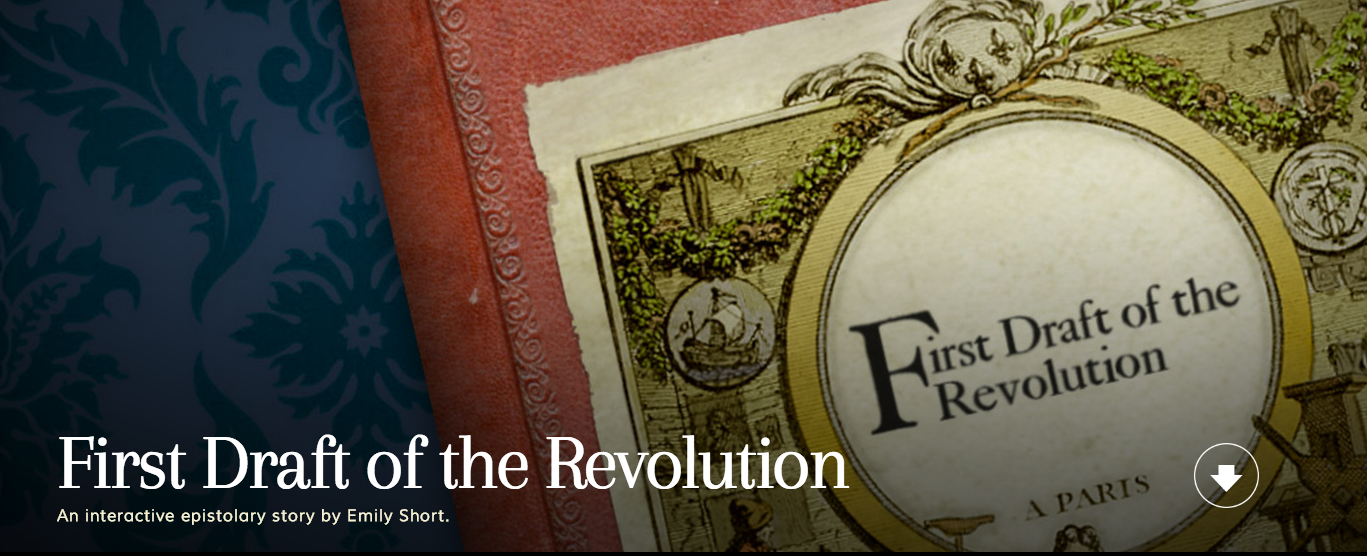 |
| http://www.inklestudios.com/firstdraft/ |
Popcorn Webmaker by Mozilla is another easy “plug and play” tool. It uses some of the basic conventions of video editing with various layers (sound, video, picture) and allows one to embed elements in a story. One of the interesting variations on this is that the interactive element allows the audience to remix the original and make their own stories.
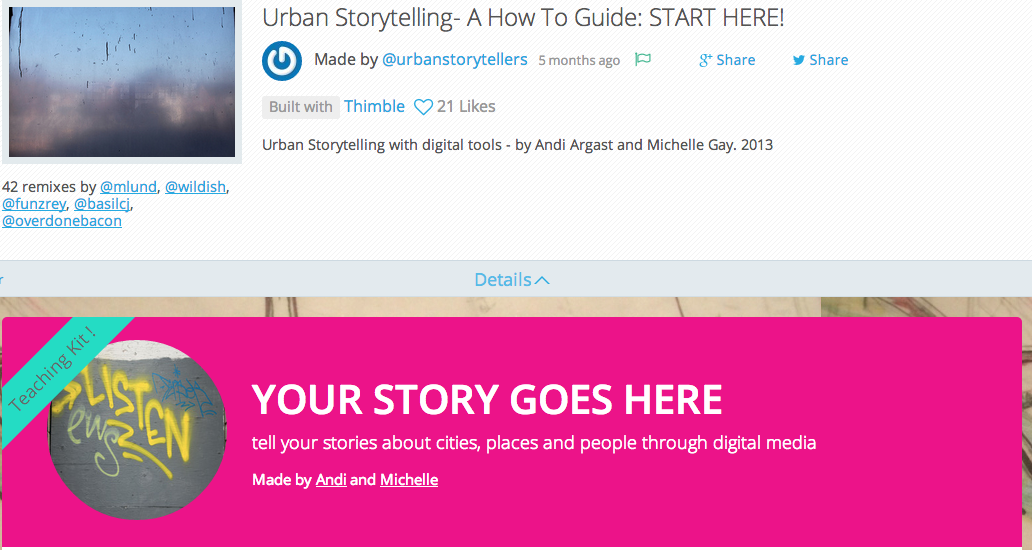 |
| https://urbanstorytellers.makes.org/thimble/MzY3OTE5MTA0/urban-storytelling-a-how-to-guide-start-here |
More ideas and lists:
- Kathy Shrok
- Joyce Valenza
- Submarine Channel
- Mindshift
- 50 ways
- 9 Tools for Journalists (some very good tools)
Finally Storygami – something that is unfortunately still in Beta and where one can hire the team to realise your storytelling dreams, but where I see great potential for use in educational settings.
Digital Storytelling – an 8-week interactive program for Middle School students
Note: This is the example of the type of program that could be held for this age group – it is an academic submission and as such has not been tested in reality.
____________________________________________________________________
Assessment Item 1: Report and program for specified age group
INF 505 – Library Services for Children and Youth
____________________________________________________________________
Assessment Item 1: Report and program for specified age group
INF 505 – Library Services for Children and Youth
Digital Storytelling – an 8-week interactive program for Middle School students at UWCSEA-East
Report prepared for the Librarian of UWCSEA-East by Nadine Bailey, September 2014
___________________________________________________________________
“For those associations and borrowed emotions, coming as they do from outside, carry young people over the dangerously spongy spiritual ground of the years during which one must signify something to oneself, while one is still too incomplete really to signify anything at all” (Musil, 2001, p. 10 writing on the value of literature for adolescents)
Part 1: Background and context
United World College of South East Asia East (UWCSEA-East) is an International School located in Singapore. It has a student population of 2,240 who come from 68 different countries and speak 50 different languages (UWCSEA, n.d.). Around 40% of the students are bilingual and 12% speak more than two languages. As an international school drawing on an expatriate population, it has a high student turnover and the community can largely be described as cosmopolitan elite. The campus has two libraries, one for the Kindergarten and Primary students, and the other for Secondary students.
|
Section
|
Number
|
|
Kindergarten
|
353
|
|
Primary School
|
654
|
|
Middle School
|
587
|
|
High School
|
324
|
|
IB
|
321
|
|
Total
|
2,239
|
Figure 1: Student breakdown by section
The school recently won the “21st Century school of the year award” (21stCL, 2013) and has a one-laptop-per-child program from Grade 6. Secondary school parents are ambivalent about the prevalence of computers in their children’s lives and often complain that their teenagers spend too much “non-productive” time on social media and online-game playing.
While the school offers a wide range of activities to the students, including outdoor adventure, sports, drama, music and socially driven clubs, there are no activities catering for creative writing or story-telling. There is a “techspert” club which deals with the technical rather than the creative aspects of technology and at present, besides the parents’ book club, the library does not run any programs outside of curriculum teaching, readers’ advisory, and reference or research assistance. Some teachers, learning support staff and librarians feel there is a need for a creative writing activity outside of the classroom to cater for younger adolescents who are introvert or struggle to express themselves due to shyness, learning differences or developing English skills and who would otherwise get “lost” in such a large, noisy, busy and extroverted campus.
The affordances of Web 2.0, social media and digital technology may have pedagogical and social benefits to secondary students, particularly those who are shy or socially awkward, and act as a bridge to physical relationships and interactions (Gorrindo, Fishel, & Beresin, 2012; Greenhow, Robelia, & Hughes, 2009). Educational research has indicated that exposure to technological tools in the creation of digital stories and book talks benefit students through increased motivation, engagement, ownership, control, confidence and deeper understanding. In turn, both the reading and writing aspects of textual literacy are improved (Barnard, 2011; Beach, 2012; Gunter & Kenny, 2008, 2012; Kenny & Gunter, 2004; Kenny, 2011; Ragen, 2012; Yoon, 2013). It was therefore decided to combine the creative writing and technology aspects in a “Digital Storytelling” eight-week interactive program.
This program will be targeted to Middle School students, (grades 6 to 8) for a number of reasons. Firstly, as students move into Middle School (around age 12), they loose the structure and security of one class teacher and a fixed group of classmates while at the same time academic demands become higher. In addition, besides losing part of their peer group from the previous year due to international relocations, the school adds extra classes and pupils, resulting in about a third of the cohort being new to both Singapore and the school. This is the age group where, in Eriksonian terms, students are struggling with the commencement of puberty, and the related psychological stresses of developing and discovering an identity, negotiating social interaction and affiliating with friends, causes and ideals (Greenhow et al., 2009). Finally, this development takes place within a digital and online context which may be overwhelming to young teens as they explore the boundaries of online social behaviour and interaction (Gorrindo et al., 2012) and may not have positive role models in their home or peer environments.
“One reason that an afterschool program can have such a large impact relates back to the developmental needs of teenagers” (Jones & Waddle, 2002, p. 43). These needs can be summarised as:
· Positive social interaction with adults and peers
· Structure and clear limits
· Physical activity
· Creative expression
· Competence and achievement
· Meaningful participation
· Opportunities for self-definition (Jones & Waddle, 2002 cited in Meyers, Fisher, & Marcoux, 2007)
The secondary library that will host this program is a two-level open-plan space with moveable bookshelves. Teenage students are comfortable in the welcoming library space which incorporates design thinking in creating zones for comfort, relaxation, reading and social interaction. The ground floor is mainly open plan with two study rooms with carousels and one large classroom (the Think Tank), while most of the collection is located on the first floor that additionally has two study rooms set up for audio-visual work.
Part 2: Design and develop a program
In this section, the following elements of program design will be covered: goals and objectives; cost and logistical considerations; marketing and promotion; and program delivery. Evaluation will be covered in the next section.
Goals and objectives
The primary goal is to design a program in which students can use technology in a positive and creative way to express themselves through storytelling in a safe environment that meets their developmental needs.
The program objectives, their relevance and how they will meet these needs are summarized below:
|
Objective
|
Relevance
|
Related Developmental need
|
|
1. Introduce students to concepts, examples and tools of digital storytelling
|
Students are familiar with literature and with digital tools, however not with digital storytelling. This will broaden their competencies while scaffolding on what they already know.
|
Competence and achievement
Structure and clear limits |
|
2. Support students in the creation of their own narratives using the tools of digital storytelling
|
For successful creative output, students will need technical, literacy and social support in an encouraging non-judgmental environment
|
Creative expression
Positive social interaction with Adults and Peers Competence and Achievement Opportunities for Self-definition |
|
3. Provide a forum for sharing, promotion, collaboration and interaction
|
Student’s digital storytelling outputs receive validation through providing an appreciative audience while allowing them to contribute the same to their fellow participants.
|
Positive social interaction with Adults and peers
Meaningful participation |
Figure 2: Objectives, relevance and developmental needs
Cost, staffing and other logistical considerations
Since the program will be run from the school library using school equipment, premises and staff, there are no associated program costs. Instruction time given to the program will count towards staff’s “educator activity contribution requirement”. Students will use their own laptops, pre-loaded with all the necessary software and digital tools for which the school has an education license.
· Image – iPhoto and Photoshop
· Moving image – iMovie
· Text – Google documents or Pages
· Music / sound / voice over – iTunes / Garage band / Voicethread
Thirteen Nikon D7000 cameras with tripods are available for loan during school hours to students and teachers. Besides the “Think Tank” meeting room where most of the sessions will be held, the library has two audio-visual rooms equipped with a television, projector and green or blue screen which will be reserved for program students during weeks 5 and 6, during the program time at lunch time. The program will run as an official school activity for eight weeks on a Monday afternoon from 15h15 to 17h00 so as not to clash with the sports and other activity programs. Sign up will be through the school activity sign up program. The activity is free and limited to 12 students selected from a pool of applicants in consultation with tutor mentors, learning support staff and the school counsellor.
Program delivery
Writing is a complex highly abstract process involving productive rather than receptive skills. These include cognitive, psychological and semiotic expertise within the social, cultural and historical context of the writer. Students often have an imbalance between their spoken and written abilities and get bored by the recursive steps of planning, prewriting, drafting, revising and editing (Thompson, 2012). Ways to encourage reluctant writers include ensuring that the topic is: relevant; of interest; taught naturally; understandable; engages emotions; expresses an inner world and is delivered in a playful manner (Vygotsky, 1978, cited in Nilsson, 2010). Fortunately, digital and technological tools have been shown to create new motivation and purpose in reluctant writers (Beach, 2012; Burke & Kafai, 2012; Dreon, Kerper, & Landis, 2011; Green, 2011; Hall, Hall, Hodgson, Hume, & Humphries, 2012; Morgan, 2014).
In the creation of this program, the above factors were considered, while the weekly structure follows the four P’s of digital storytelling (Knight, 2012):
· Plan (Objective 1 – concept and tool introduction) – weeks 1-3,
· Produce (Objective 2 – support students in their creation) – weeks 4-6,
· Publish and Promote (Objective 3 – provide a forum for sharing) – week 7
Instructors were carefully selected to ensure they had a good rapport with this age group, but were not involved with them as classroom teachers, so did not have any pre-conceptions about their writing, technological or creative skills.
An overview of the activities is given in Appendix 1.
Week 1: Experience it!
During the first session, a variety of digital literature will be made available to the group. An example of each type will be briefly introduced and then students will be free to chose and borrow the example that most appealed to them, or to find other examples in that genre.
Week 2: Telling Tales
This week the elements of storytelling will be introduced. Using the conceptual framework of Branigan (1992, cited in Kenny, 2011), story telling as a universal construct includes the interaction between a teller and the audience with the elements of time and place (background), cause (conflict or challenge) and effect (fight or flight) which result in a transformation as the story is resolved.
The acronym “I AM TOP CAMP” is a useful way to remember the principles of digital story telling, i.e. Interactive; Authentic; Meaningful; Technological; Organized; Productive; Collaborative; Appealing; Motivating; and Personalized (Yoon, 2013).
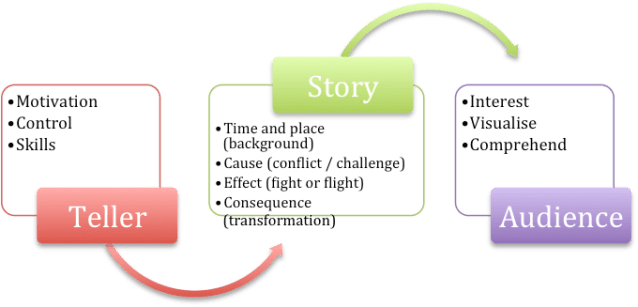

Figure 3: Storytelling process
Week 3: Storyboard
Building on the experiences of week one and learning of week two, students will be encouraged to start thinking about creating a storyboard for their own story. Comics and graphic books will be used to scaffold this activity (Hall et al., 2012). The elements of good design will be introduced, namely Contrast, Alignment, Repetition, Proximity otherwise known as CARP (Reynolds, 2008).
Week 4: Digital tool box
Each of the modal choices in digital storytelling (still and moving image, text, voiceover, music and sound (Buchholz, 2014)) requires the use of different technological tools, which can either be used separately, or in combination with each other.
Weeks 5 & 6: Production
Students are given the opportunity to create their own story. They have complete control over the type of story, tools to use and whether to work in a group or pairs or individually. Additional staff members will be available on a roving basis to trouble-shoot and assist students with any technical or story-telling difficulties they encounter. Audio-visual rooms and digital cameras will also be available during lunchtimes should students wish to work on their story outside of the activity time.
Week 7: Performance
One of the problems with creative writing is the perceived lack of an audience (Thompson, 2012). Although collaboration, interaction and sharing has been a part of all the activities up to now, this week the activity makes the audience explicit. The group’s productions will be shown at a special screening in the small black box theatre. Students can invite friends, parents and teachers.
Week 8: Reflection and celebration
In the final week, students will be able to reflect on their experiences during the last 7 weeks and provide feedback to the group (Survey – Appendix 4). This will be part of the evaluation discussed in the next section. Students will be allowed to bring along a snack for a celebratory party and will be invited to help as student volunteers in the Production stage of the next program.
Detailed activity plan – Week 1
Materials required
Laptop (MacBook) and iPads with preloaded eBook apps, screen, projector, apple TV for screening. The following digital literature should be preloaded onto iPads, available online or available for borrowing from the library catalog:
|
Type
|
Name
|
Link
|
|
Interactive Documentary
|
A global guide to the first world war (Panetta, 2014)
|
|
|
Twitterature
|
100 Greek Myths retold in 100 tweets (Crown Publishing, 2012)
|
|
|
Digital Novel
|
Inanimate Alice (DreamingMethods, 2012)
|
|
|
Vlog
|
Lizzie Bennet Diaries (Su, Noble, Rorick, & Austen, 2014)
|
|
|
Animated dreamtime stories
|
Dust Echoes (ABC, 2007)
|
|
|
iPad app and eBook
|
Shakespeare in Bits – Romeo and Juliette (Mindconnex Learning Ltd, 2012)
|
Figure 4: Digital Literature examples for screening
Step by step procedures of what is to be done
|
Item
|
Equipment / Material
|
Timing
|
|
Greet students and ask for a brief introduction with name, class, where they are from and any experience or expectations they have from the program.
|
Stickers for students to write the names on
|
10 minutes
|
|
Perform a short icebreaker such as “two truths and one lie” with students in pairs.
|
n/a
|
10 minutes
|
|
Ask students to do initial survey using google forms.
|
Survey (Appendix 3)
|
5 minutes
|
|
Show snippets of the first three examples of digital story telling – A Global guide to the first world war, 100 Greek Myths and Inanimate Alice.
|
Laptop, projector and screen. Ensure various resources are open to minimise turnover time
|
3 resources, 5 minutes each = 15 minutes
|
|
Open discussion on what appeals to the students
|
Use the elements of successful digital story telling i.e. Interactive; Authentic; Meaningful; Technological; Organized; Productive; Collaborative; Appealing; Motivating; and Personalized (Yoon, 2013) to scaffold activity
|
20 minutes
|
|
Give students a break to have a snack, use the washroom, etc.
|
10 minutes
|
|
|
Show snippets of the next three examples of digital story telling – Lizzie Bennet Diaries, Dust Echoes and Shakespeare in Bits – Romeo and Juliette.
|
Laptop, projector and screen. Ensure various resources are open to minimise turnover time.
|
3 resources, 5 minutes each = 15 minutes
|
|
Ask students to choose the type of digital storytelling that most appeals to them; they can explore the resource in the remaining class time and borrow the resource to explore further at home.
|
Assist with loan and downloading of materials or searching of similar materials.
|
20 minutes
|
|
Finish in time for buses / pickup
|
Total 1 hour 45 minutes
|
Figure 5: Step by Step Procedure for week 1
Audience, staffing and other considerations
As discussed in Part 1, there will be 12 middle school students aged 12 – 15 years. All students should have a laptop and access to the library catalog and the Internet. The secondary school librarian will demonstrate the material and show where similar material can be found in the catalog. An assistant librarian should be on hand to troubleshoot if students have problems loading the apps or eBooks, signing in or any other technical difficulties. Ensure room shades are all working so the room can be darkened sufficiently.
Marketing and promotion
The school markets all activities through the website and has a centralized signup program, however, as this is a new activity, additional promotion will be needed. A promotional calendar has been created including a short synopsis of each activity and its relevance (see Figure 2 below, and Appendix 1 for the promotional calendar).
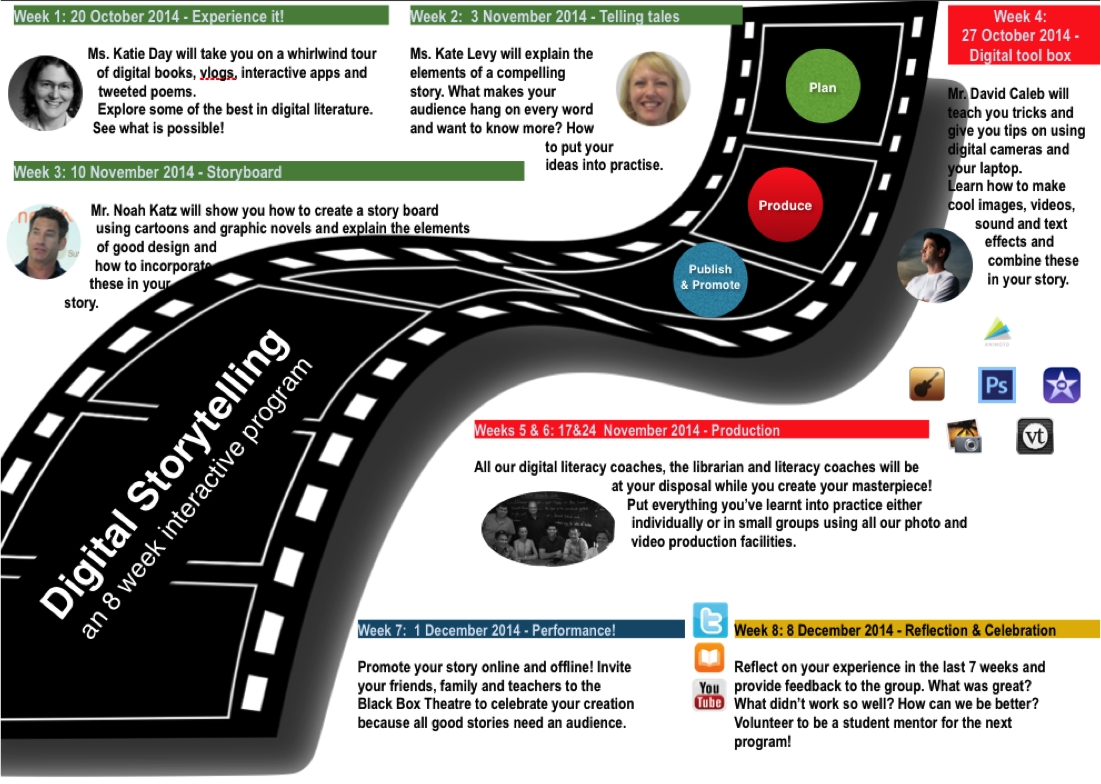
Figure 6: Promotional Calendar
Printed posters will be put in the library, hallways, and elevator notice boards. In order to attract those students who would most benefit from the program a combination of “pull” and “push” promotion will be needed, so flyers will be given to Middle School language teachers, digital literacy coaches, learning support teachers and school counsellors who will be encouraged to discuss participation with students who may benefit from the program. A link to the calendar will also be placed on the library portal and in the school newsletter, the eBrief.
Part 3: Evaluation and reflection
How to evaluate the program
There are two main ways in which participants will evaluate the program. In the first place a questionnaire will be completed (see Appendix 4). Secondly students will reflect on their own work and give feedback to other participants as part of the reflection in Week Eight. Students are used to the PNI method of reflecting on the Positives, Negatives and possible Improvements. The most relevant evaluation however will be whether the activity is seen as interesting in subsequent semesters with demand and over-subscription from students during the Season 2 signup period. Although the student as “client” will be the main evaluator of the program, the teachers and digital, visual and text literacy coaches will also be asked to give feedback on the content, logistics and perceived usefulness of the program.
Some digital storytelling programs have administered pre- and post- program literacy tests to students to evaluate the efficacy of the program (Barnard, 2011; Beach, 2012; Gunter & Kenny, 2008; Ragen, 2012; Yoon, 2013). But, since the primary goal of the program is to provide a social and creative outlet for students using digital tools, this will not be undertaken formally. However, the tutor mentors of the students participating in the program will be asked if they feel the program had any impact on the students socially or academically.
Reflection
One of the issues to be considered in this program will be the possible duality in the audience it attracts. On the one hand it may appeal to students with a passion for reading and writing, who already have a high level of sophistication and affiliation for writing. On the other, it may appeal to students who have difficulties in expressing themselves due to learning or language difficulties. They may be attracted by the expressive affordances of digital literature, the lure of technology or they may be encouraged to join in by their English teacher, learning or language support teacher or school counsellor. An important consideration would be how to cater to both these groups allowing each to build on their strengths without compromising the needs of either. A further concern is that students will put a disproportionate amount of time into struggling with flashy technology and this will compromise the story-telling process. For this reason, digital tools are only introduced in the fourth week, after storytelling and the storyboard has been completed. During the mentoring, digital literacy coaches should remind students of academic honesty, consideration of DRM (digital rights management) and the correct accreditation or attribution of images and other material.
In setting up this program, older students were not considered, since once they move into High School and the International Baccalaureate program; study and exam pressures result in limited time for participation in activities. In the primary school, extensive writing workshops are already in place, led by the literacy coach. At a later stage, if the program is successful it could be expanded to include other groups of students.
Finally, it is important to reflect on the developmental needs of teenagers in the light of the objectives and characteristics of the program.
|
Objective
|
|
1. Introduce students to concepts, examples and tools of digital storytelling
|
|
2. Support students in the creation of their own narratives using the tools of digital storytelling
|
|
3. Provide a forum for sharing, promotion, collaboration and interaction
|
Figure 7: Objectives revisited
|
Developmental Need
|
Expression
|
Program Objectives
|
Program characteristics
|
|
Positive Social Interaction with Adults & Peers
|
Seek attention, socialization
|
2, 3
|
Small group of students with specialist teachers with a variety of skills and personalities
|
|
Structure & Clear Limits
|
Push boundaries, challenge authority
|
1, 2, 3
|
Program is limited to 8 sessions with a clear structure within which choice and autonomy is possible
|
|
Physical Activity
|
Running, jostling, roaming
|
n/a
|
Not applicable
|
|
Creative Expression
|
Vandalism, Vine, Instagram, Snapchat
|
2
|
Creative storytelling is the main thrust of the program
|
|
Competence & Achievement
|
Competitive behaviour, Minecraft, number of followers on social media
|
1,2,3
|
The program allows for mastery of technological and storytelling skills within a new format, end result is performed and published
|
|
Meaningful Participation
|
Opinionated, socialization, clique club or team membership
|
2, 3
|
Activities allow for interaction in the physical and virtual space
|
|
Opportunities for Self-Definition
|
Status symbols, dress and hair,
|
2
|
Students are encouraged to consider their culture, linguistic and social identities in producing their story
|
Figure 8: Summary of developmental needs, expression, program objectives and characteristics
(Adapted from: National Middle School Association (1996). Research Summary: Young Adolescent’s Developmental Needs, 2006, cited in Gallaway, 2008).
References
21stCL. (2013). School of The Year – 21st Century Learning International. Retrieved May 15, 2014, from http://21c-learning.com/awards/school-of-the-year/
ABC. (2007). Dust Echoes. Retrieved August 20, 2014, from http://www.abc.net.au/dustechoes/dustEchoesFlash.htm
Barnard, C., A. (2011). How Can Teachers Implement Multiple Modalities into the Classroom to Assist Struggling Male Readers? (Education Masters Paper 26). St. John Fisher College, Rochester, NY.
Beach, R. (2012). Uses of Digital Tools and Literacies in the English Language Arts Classroom. Research in the Schools, 19(1), 45–59.
Buchholz, B. (2014). “Actually, that’s not really how I imagined it”: Children’s divergent dispositions, identities, and practices in digital production. In Working Papers in Literacy, Culture, and Language Education (Vol. 3, pp. 25–53). Bloomington, IN: School of Education, Indiana University. Retrieved from http://education.indiana.edu/graduate/programs/literacy-culture-language/specialty/wplcle/index.html
Burke, Q., & Kafai, Y. B. (2012). The writers’ workshop for youth programmers: digital storytelling with scratch in middle school classrooms (pp. 433–438). Presented at the Proceedings of the 43rd ACM technical symposium on Computer Science Education, ACM.
Crown Publishing. (2012, November). @LucyCoats: 100 Greek Myths Retold in 100 Tweets (with tweets). Retrieved September 4, 2014, from https://storify.com/CrownPublishing/100-greek-myths-retold-in-100-tweets
DreamingMethods. (2012). Inanimate Alice – About the Project [Digital Novel]. Retrieved September 4, 2014, from http://www.inanimatealice.com/about.html
Dreon, O., Kerper, R. M., & Landis, J. (2011). Digital Storytelling: A Tool for Teaching and Learning in the YouTube Generation. Middle School Journal, 42(5), 4–9.
Gallaway, B. (2008). Pain in the Brain: Teen Library (mis)Behavior. Retrieved September 4, 2014, from http://www.slideshare.net/informationgoddess29/pain-in-the-brain-teen-library-misbehavior-presentation
Gorrindo, T., Fishel, A., & Beresin, E. (2012). Understanding Technology Use Throughout Development: What Erik Erikson Would Say About Toddler Tweets and Facebook Friends. Focus, X(3), 282–292. Retrieved from http://focus.psychiatryonline.org/data/Journals/FOCUS/24947/282.pdf
Green, M. R. (2011). Writing in the Digital Environment: Pre-service Teachers’ Perceptions of the Value of Digital Storytelling. In American Educational Research Association (pp. 8–12). Retrieved from http://worldroom.tamu.edu/Workshops/Storytelling13/Articles/Green.pdf
Greenhow, C., Robelia, B., & Hughes, J. E. (2009). Learning, Teaching, and Scholarship in a Digital Age: Web 2.0 and Classroom Research: What Path Should We Take Now? Educational Researcher, 38(4), 246–259. doi:10.3102/0013189X09336671
Gunter, G. A., & Kenny, R. F. (2008). Digital booktalk: Digital media for reluctant readers. Contemporary Issues in Technology and Teacher Education, 8(1), 84–99.
Gunter, G. A., & Kenny, R. F. (2012). UB the director: Utilizing digital book trailers to engage gifted and twice-exceptional students in reading. Gifted Education International, 28(2), 146–160. doi:10.1177/0261429412440378
Hall, M., Hall, L., Hodgson, J., Hume, C., & Humphries, L. (2012). Scaffolding the Story Creation Process. In 4th International Conference on Computer Supported Education. Porto, Portugal. Retrieved from http://www.lynnehall.co.uk/pubs/ScaffoldingTheStoryCreationProcess.pdf
Jones, P., & Waddle, L. L. (2002). New directions for library service to young adults. Chicago: American Library Association.
Kenny, R. F. (2011). Beyond the Gutenberg Parenthesis: Exploring New Paradigms in Media and Learning. Journal of Media Literacy Education, 3(1), 32–46. Retrieved from http://www.jmle.org
Kenny, R. F., & Gunter, G. A. (2004). Digital booktalk: Pairing books with potential readers. Association for Educational Communications and Technology, 27, 330–338.
Knight, S. (2012, June 20). Introduction to Digital Storytelling. Retrieved September 6, 2014, from http://www.slideshare.net/sknight/digital-storytelling-ed554?related=1
Meyers, E. M., Fisher, K. E., & Marcoux, E. (2007). Studying the everyday information behavior of tweens: Notes from the field. Library & Information Science Research, 29(3), 310–331. doi:10.1016/j.lisr.2007.04.011
Mindconnex Learning Ltd. (2012, January 25). Shakespeare In Bits: Romeo & Juliet iPad Edition on the App Store [iTunes]. Retrieved September 6, 2014, from https://itunes.apple.com/us/app/shakespeare-in-bits-romeo/id370803660?mt=8
Morgan, H. (2014). Using digital story projects to help students improve in reading and writing. Reading Improvement, 51(1), 20–26. Retrieved from http://search.proquest.com/docview/1540737338?accountid=10344
Musil, R. (2001). The confusions of young Törless. (S. Whiteside, Trans.). New York, N.Y.: Penguin Books.
Nilsson, M. (2010). Developing Voice in Digital Storytelling Through Creativity, Narrative and Multimodality. International Journal of Media, Technology and Lifelong Learning, 6(2), 148–160. Retrieved from http://seminar.net/index.php/volume-6-issue-2-2010/154-developing-voice-in-digital-storytelling-through-creativity-narrative-and-multimodality
Panetta, F. (2014). A global guide to the First World War [Interactive documentary]. Retrieved from http://www.theguardian.com/world/ng-interactive/2014/jul/23/a-global-guide-to-the-first-world-war-interactive-documentary
Ragen, M. (2012). Inspired technology, inspired readers: How book trailers foster a passion for reading. Access, 26(1), 8–13. Retrieved from http://search.proquest.com/docview/934354989?accountid=10344
Reynolds, G. (2008). Chapter 6 Presentation Design: Principles and Techniques. In Presentation Zen: Simple Ideas on Presentation Design and Delivery (pp. 152–163). New Riders. Retrieved from http://www.presentationzen.com/chapter6_spread.pdf
Su, B., Noble, K., Rorick, K., & Austen, J. (2014). The secret diary of Lizzie Bennet. London ; Sydney: Simon & Schuster.
Thompson, I. (2012). Stimulating reluctant writers: a Vygotskian approach to teaching writing in secondary schools: Stimulating reluctant writers. English in Education, 46(1), 85–100. doi:10.1111/j.1754-8845.2011.01117.x
UWCSEA. (n.d.). Languages at UWCSEA. Retrieved from http://issuu.com/uwcsea/docs/uwcsea_languages
Yoon, T. (2013). Are you digitized? Ways to provide motivation for ELLs using digital storytelling. International Journal of Research Studies in Educational Technology, 2(1). doi:10.5861/ijrset.2012.204
Appendix 1: Program Overview
|
Element
|
Synopsis
|
Relevance
|
Instructor
|
Location
|
|
|
Week 1:
20 October 2014
|
Experience it!
|
A whirlwind tour of digital books, vlogs, interactive apps and tweeted poems.
|
Provide background to program and give understanding of what is possible.
|
Ms. Katie Day – secondary school librarian – expert in YA literature
|
Library Think Tank
|
|
Week 2:
27 October 2014
|
Telling tales
|
Elements of storytelling explained with particular reference to digital storytelling.
|
Storytelling, no matter what the medium is the basis of this program.
|
Ms. Kate Levy – high school English teacher
|
Library Think Tank
|
|
Week 3:
3 November 2014
|
Storyboard
|
Students shown how to create a storyboard using the example of cartoons and graphic novels and elements of good design are introduced.
|
Learn the elements of good design and how to incorporate these in your story.
|
Mr. Noah Katz – visual literacy coach
|
Library Think Tank
|
|
Week 4:
10 November 2014
|
Digital tool box
|
Digital tools for capturing and combining different modal choices (image, sound, text) are explained. Best practise is highlighted.
|
Bring students digital skills to a comparative level of mastery and show how to incorporate into their storytelling.
|
Mr. David Caleb – digital literacy coach, photographer and author of “The Photographer’s Toolkit”
|
Library Think Tank
|
|
Week 5:
17 November 2014
|
Production
|
Students will be given the time and resources to put their ideas and skills into practise. They can choose between individual, paired or group production.
|
Students will be aided in their creation of digital stories by competent experts they can achieve their creative goals within a clear structure.
|
All 7 school digital literacy coaches, librarian and Ms. Levy
|
Library – Emily Dickinson, Pablo Neruda rooms & Think Tank – green, blue or white screens available
|
|
Week 6:
24 November 2014
|
Production
|
||||
|
Week 7:
1 December 2014
|
Performance!
|
Output is produced and promoted. Friends, family and teachers are invited to the Black Box Theatre watch the digital storytelling productions.
|
An explicit audience is an important aspect of storytelling. Students will have a sense of competency and achievement.
|
Ms. Katie Day, participants, digital literacy coaches
|
Black Box Theatre
|
|
Week 8:
8 December 2014
|
Reflection
|
Time is given for reflection and feedback of the last 7 weeks. The end results are celebrated and promoted further.
|
The end of the program is indicated by this activity both setting a limit to the formal program and allowing reflection and also validating participants by requesting their evaluation and suggestions for improvement.
|
All instructors
|
Library Think Tank
|
Appendix 2: Promotional Calendar

Appendix 3: Pre-program Survey

To give us an idea of your current understanding, preferences and skills please complete this survey. Thank you!
|
Definitely
|
Usually
|
Some-what
|
Not really
|
Not at all
|
|
|
I enjoy reading or watching
|
|||||
|
Fiction, stories, memoirs
|
|||||
|
Non-fiction or documentaries
|
|||||
|
Poetry
|
|||||
|
I can use the following technology
|
|||||
|
Digital Camera
|
|||||
|
Digital Video Camera
|
|||||
|
iPhoto
|
|||||
|
Photoshop
|
|||||
|
iTunes
|
|||||
|
Garage Band
|
|||||
|
iMovie
|
|||||
|
I use the following social media
|
|||||
|
Facebook
|
|||||
|
Instagram
|
|||||
|
Twitter
|
|||||
|
YouTube
|
|||||
|
Other – please state which ……
|
|||||
|
I express my creativity through
|
|||||
|
Writing
|
|||||
|
Art or photography
|
|||||
|
Music or dance
|
|||||
|
Drama and acting
|
|||||
|
Video or film
|
|||||
|
I am not creative
|
|||||
|
What do you expect from this program?
|
|||||
Appendix 4: Post Program Survey

Now you have finished the program please reflect on your experiences and learning.
|
Definitely
|
Usually
|
Some-what
|
Not really
|
Not at all
|
|
|
I understand the concepts and tools of Digital Storytelling
|
|||||
|
Different types of digital stories
|
|||||
|
What is important in storytelling
|
|||||
|
How to create a storyboard
|
|||||
|
I can produce my own digital story
|
|||||
|
I can use the following technology
|
|||||
|
Digital Camera
|
|||||
|
Digital Video Camera
|
|||||
|
iPhoto
|
|||||
|
Photoshop
|
|||||
|
iTunes
|
|||||
|
Garage Band
|
|||||
|
iMovie
|
|||||
|
I would recommend this program
|
|||||
|
To friends / classmates
|
|||||
|
To teachers
|
|||||
|
What was the best / most positive part of this program?
|
|||||
|
What didn’t you enjoy about this program?
|
|||||
|
What improvements would you suggest?
|
|||||

This work by Nadine Bailey is licensed under a Creative Commons Attribution-NonCommercial-ShareAlike 4.0 International License.
Research summary on Language
The post below is based on the background research I did for INF538 Value Added-information Services in June 2014. Please cite me as the author should you wish to quote / use any of this.
This study has presented the typical knowledge management dilemma – there is a considerable amount of information and research, both academic and practical but it is widely dispersed and personal experience is often not documented.
Most research into BML (bi- and multi-lingualism) concerns itself with assimilation of immigrants (Fillmore, 2000; Slavin, Madden, Calderon, Chamberlain, & Hennessy, 2011; Slavin et al., 2011; Winter, 1999); maintaining minority (or majority) languages in a dominant language environment (Ball, 2011; Dixon, Zhao, Quiroz, & Shin, 2012) or language immersion or bilingual programmes; (Caldas & Caron-Caldas, 2002; Carder, 2008; Cummins, 1998; Genesee, 2014; Hadi-Tabassum, 2004; Soderman, 2010) aspects of which may or may not be relevant to this study or its population.

Researchers agree on a number of factors which impact on the successful acquisition and retention of a second or subsequent language in the BML population. These relate to the student, family, school and the community or society.
A large vocabulary in any language contributes to overall “oral proficiency, word reading ability, reading comprehension, and school achievement”(Dixon, Zhao, Quiroz, et al., 2012, p. 542). Vocabulary is influenced by the parent’s level of education, access to and availability of resources, and the quality and quantity of parent-child interactions, including shared reading, frequency of story telling and conversations.
The International school context results in a number of issues that complicate MT provision, including the multicultural and multilingual nature of the student population, resulting in ‘fictive monolingualism’ and the transience of both the student and teacher population, with the resultant socio-psychological implications on learning (Caldas & Caron-Caldas, 2002; Hacohen, 2012; Hornberger, 2003). However, where the “cultural capital” of the school included valuing language diversity in its environment and teaching practise, students had an increased sense of belonging, higher levels of reading literacy and they scored significantly higher academically. Continued development of ability in two or more languages on a daily basis resulted in a deeper understanding of language across contexts. Best practice includes a well structured MT program with at least some inclusion in the school timetable and fee structure, inclusion of other subject matter in MT lessons, support for English acquisition through a daily ESL/EAL program, a socio-culturally supportive environment, better awareness and training for subject teachers, affirmation of students’ identity as bi- or multi-lingual and collaboration with parents, while block scheduling was not optimal for language learning (Carder, 2014; IBO, 2011; Tramonte & Willms, 2010; Vienna International School, 2006; Wallinger, 2000). Research in heritage language (HL) teaching and learning indicates that macro-approaches and other specific strategies that build on learners’ existing language skills could be leveraged to improve reading and writing abilities, increase motivation and participation and validate students’ identity although specific teacher training for HL is recommended (Lee-Smith, 2011; Wu & Chang, 2010).

The support of a locally based language community, including faith and cultural communities had a positive impact which could mitigate socio-economic status (SES) factors and enhance learning through beliefs and practises, classes and cultural and religious activities (Dixon, Zhao, Quiroz, et al., 2012). Finally the availability of and access to learning resources, complementary schooling, books and other materials impacted on acquiring and maintaining language(Scheele, Leseman, & Mayo, 2010)
Although the value of BML has become more widely accepted and most parents and educators appreciate and encourage the process, a number of concerns have rightly been voiced on the process and efficacy of reaching the goal of a BML child. In the first instance, the quality of the productive language – oral and or written skills – of one or all of the child’s languages may not develop to a sufficiently high level for academic or employment purposes (Cummins, 1998).

This work by Nadine Bailey is licensed under a Creative Commons Attribution-NonCommercial-ShareAlike 4.0 International License.
Bailey, N. (2014, November 12). Research summary on Language. Retrieved November 23, 2013, from http://informativeflights.blogspot.sg/2014/11/research-summary-on-language.html
_________________________________________________________________________________
Background Research
This study has presented the typical knowledge management dilemma – there is a considerable amount of information and research, both academic and practical but it is widely dispersed and personal experience is often not documented.
History
Most research into BML (bi- and multi-lingualism) concerns itself with assimilation of immigrants (Fillmore, 2000; Slavin, Madden, Calderon, Chamberlain, & Hennessy, 2011; Slavin et al., 2011; Winter, 1999); maintaining minority (or majority) languages in a dominant language environment (Ball, 2011; Dixon, Zhao, Quiroz, & Shin, 2012) or language immersion or bilingual programmes; (Caldas & Caron-Caldas, 2002; Carder, 2008; Cummins, 1998; Genesee, 2014; Hadi-Tabassum, 2004; Soderman, 2010) aspects of which may or may not be relevant to this study or its population.
Until fairly recently the situation of high socio-economic status (SES) students in international schools is given at best a glancing mention and appears to have been a marginal area amongst researchers, as they are considered to be a privileged elite with more options and choices and greater economic means than immigrant or minority students (Ball, 2011; Carder, 2006; de Mejía, 2002). There are calls for “celebrating diversity” in the classroom, (Stauft, 2011) mentions of international food fairs, the involvement of the Parents’ Association and ensuring that the school conveys the message to parents on the importance of maintaining MT (Hayim-Bambe, 2011), while most research looks into integration and scaffolding to English.
Bilingualism
Researchers distinguish between three types of bilingualism. Simultaneous bilingualism – exposure to two languages from birth; early successive bilingualism – first exposure aged 1 – 3 years; and second language bilingualism – first exposure aged 4 – 10 years. There is considerable debate as to what exactly the “critical” ages are for successful language learning. As Kirsten Winter pointed out “Language learning is a continuum and bilingualism is not a perfect status to be achieved.” (Winter, 1999, p. 88). Typical language learners cycle through alternating stages of passive (receptive) and productive (expressive) skills, usually in the order of listening, speaking, reading and then writing.
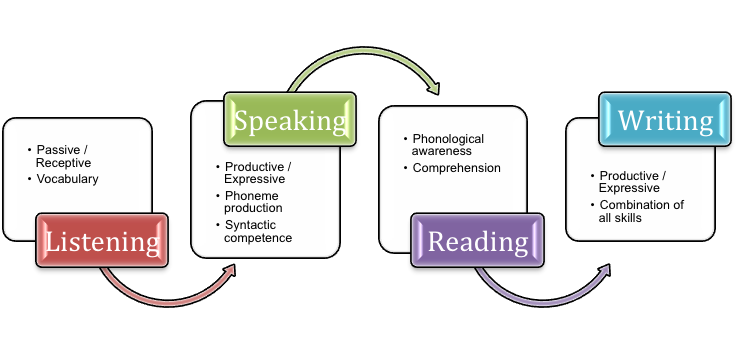
Figure 1: Continuum of language learning
Initially children learn phoneme production, syntactic competence and build vocabulary while phonological awareness then helps to develop literacy skills. The ability to understand both the ‘microstructure’ of sentences and a ‘macrostructure’ of the relationship between ideas results in language comprehension (Beech, 1994).
An important distinction is made between the surface skill of listening and speaking, which is usually acquired within two years (BICS – Basic Interpersonal Communication Skills), and the literacy skills of reading and writing at an abstract academic level (CALP – Cognitive Academic Language Proficiency), a targeted five to seven year process – as will be discussed later under “concerns” (Cummins, 1998). Due to transferability, concepts learnt and established in one language are more easily learnt in another language but only if a child has achieved CALP (Cummins, 1998; Dixon, Zhao, Shin, et al., 2012; Shoebottom, n.d.).
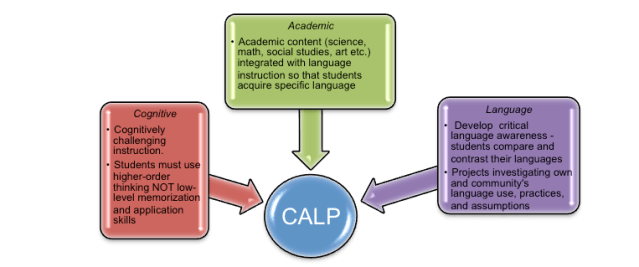
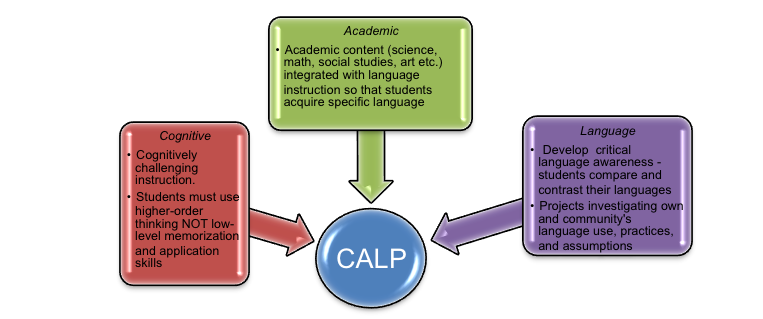
Figure 2: Elements of CALP
Factors Impacting Acquisition
Researchers agree on a number of factors which impact on the successful acquisition and retention of a second or subsequent language in the BML population. These relate to the student, family, school and the community or society.
Student
A child’s language learning aptitude is a mixture of cognitive and personality factors (Ehrman & Leaver, 2003; Stauft, 2011). Cognitive factors include learning style and strategy while personality factors include “motivation, self-efficacy and affective self-management” (Hayim-Bambe, 2011, p. 59). Low motivation, low self-esteem, and high anxiety result in a ‘mental block’ and impede language acquisition (Krashen, 1982). Extroverts tend to monitor their language use less than introverts, perfectionists and children who lack self-confidence. Moving beyond individual differences, considerable research has been done on the strategies that so-called “Good Language Learners” (GLL) employ, particularly in the field of second-language acquisition (Abhakorn, 2008; Griffiths, 2008; E. Le Pichon, de Swart, Vorstman, & van den Bergh, 2010; Emmanuelle Le Pichon, De Swart, Vorstman, & Van Den Bergh, 2013; Wang, 2013). These competencies, which improve with age, include directed attention, control of emotions, anticipation, mime, cooperation, imitation, clarification and asking for assistance, can arguably be taught or encouraged in a learning environment by teachers or parents.
Research often attempts to identify critical periods or ages of language acquisition, with inconclusive results, as motivation and meta-cognitive skills can be confounding variables since older students have better developed meta-cognitive skills (Barac & Bialystok, 2011; Beech, 1994; Bowden, Steinhauer, Sanz, & Ullman, 2013; Cummins, 1998, 2003; Genesee, 2014; Granena & Long, 2013; Emmanuelle Le Pichon et al., 2013; MacSwan & Pray, 2005; Saito, 2013). Less has been written about the socio-psychological aspects, including the impact of the teenage years where adolescents disengage from the family and identify with their peer group in an attempt to construct an identity outside of the family, which may or may not include their cultural/linguistic identity as a bilingual. Ensuring ample venue or context based immersion in the MT with access to meaningful peer relationships (particularly during vacation time) can help with the maintenance of the MT in this period (Caldas & Caron-Caldas, 2002).
Family
A large vocabulary in any language contributes to overall “oral proficiency, word reading ability, reading comprehension, and school achievement”(Dixon, Zhao, Quiroz, et al., 2012, p. 542). Vocabulary is influenced by the parent’s level of education, access to and availability of resources, and the quality and quantity of parent-child interactions, including shared reading, frequency of story telling and conversations.
Parent’s level of education influences language aspirations and is often correlated with a positive view of bilingualism, ensuring the quantity and quality of resources and amount of support provided to children (Lopez, 2005, cited in Dixon et al., 2012). Whether the child was born in the home country, and the length of time they lived there, impacts on the level of language maintenance. Many children in the international school environment were born in a third country (neither the home nor resident country).
In looking at the role of parental involvement it is important to acknowledge and cater for the diversity of families within an International school (Sears, 2011). Table 1 below is based on Sears’ analysis of the types of families, their views on the role of English versus MT and what types of maintenance effort can be expected, with advice to the school. Caution should be exercised in interpreting these generalisations, since within a family siblings may be different depending on their linguistic and birth country history, and the existence of a strong national curriculum may influence choices.
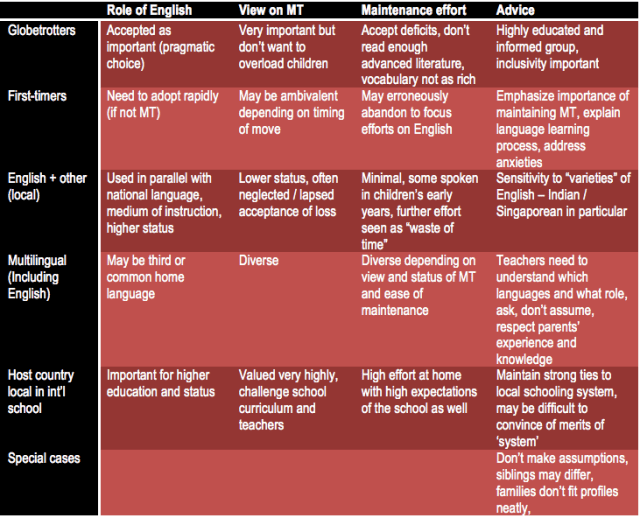
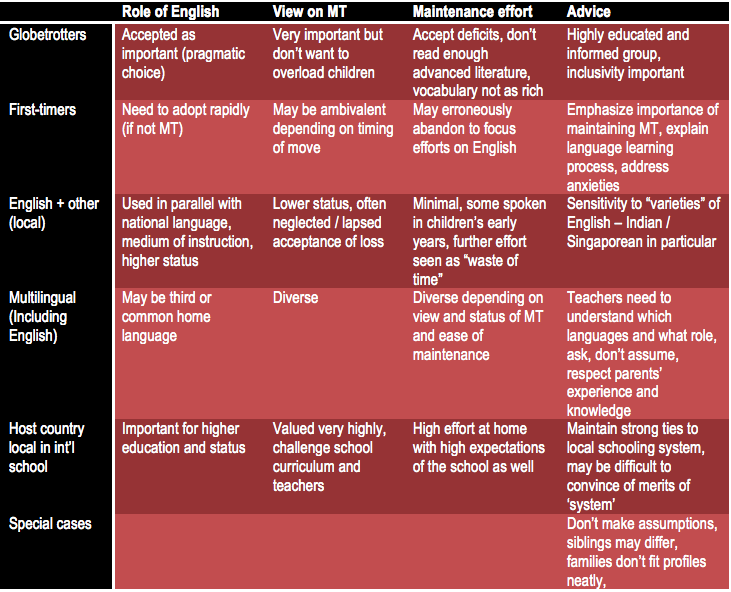
Table 1: Families and Languages
School
The International school context results in a number of issues that complicate MT provision, including the multicultural and multilingual nature of the student population, resulting in ‘fictive monolingualism’ and the transience of both the student and teacher population, with the resultant socio-psychological implications on learning (Caldas & Caron-Caldas, 2002; Hacohen, 2012; Hornberger, 2003). However, where the “cultural capital” of the school included valuing language diversity in its environment and teaching practise, students had an increased sense of belonging, higher levels of reading literacy and they scored significantly higher academically. Continued development of ability in two or more languages on a daily basis resulted in a deeper understanding of language across contexts. Best practice includes a well structured MT program with at least some inclusion in the school timetable and fee structure, inclusion of other subject matter in MT lessons, support for English acquisition through a daily ESL/EAL program, a socio-culturally supportive environment, better awareness and training for subject teachers, affirmation of students’ identity as bi- or multi-lingual and collaboration with parents, while block scheduling was not optimal for language learning (Carder, 2014; IBO, 2011; Tramonte & Willms, 2010; Vienna International School, 2006; Wallinger, 2000). Research in heritage language (HL) teaching and learning indicates that macro-approaches and other specific strategies that build on learners’ existing language skills could be leveraged to improve reading and writing abilities, increase motivation and participation and validate students’ identity although specific teacher training for HL is recommended (Lee-Smith, 2011; Wu & Chang, 2010).
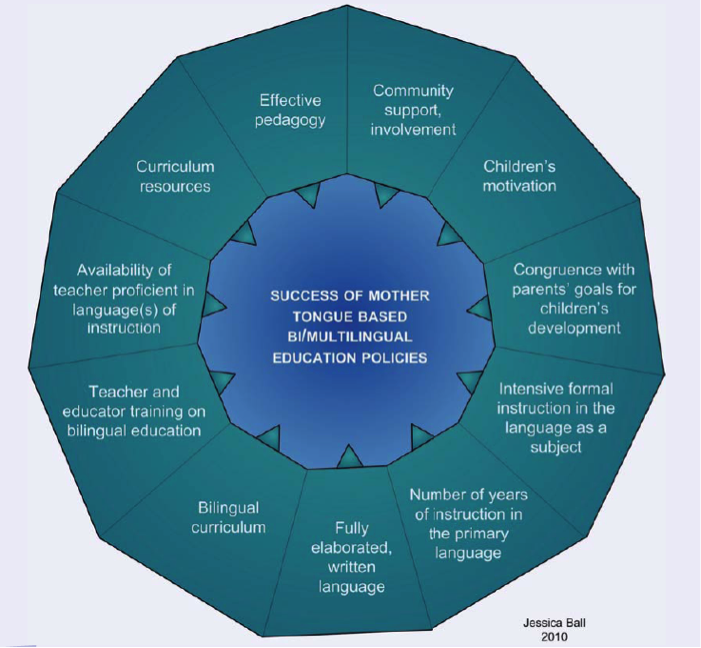
Source: (Ball, 2011, p. 46)
In her work for UNESCO, Ball suggested a number of policy dimensions that enhance the success of an educational policy. These are depicted in Figure 3above.
Literacy is seen as crucial for development of CALP. External and internal factors affect literacy motivation in language learning. Factors in schools include classroom environment, appropriate text availability and teachers. Collaboration among teachers and in the school-home nexus can enhance the perception of reading and writing as a pleasurable activity outside of the learning context. Although research generally favours intrinsic motivation, in the case of language learners, extrinsic motivation including recognition, grades, social acceptance, competition, rewards related to reading and compliance can play a role in creating a positive association with and nurturing literacy while not negatively impacting on intrinsic motivation (Fong, 2007). A well equipped library, organisation of international book fairs, other tongue events, culture clubs, reading hours with older to younger / parents to students a language buddy system and national days at school are other ways literacy can be focused on (Brewster, 2011; Krashen, 2004).
Community and Society
The support of a locally based language community, including faith and cultural communities had a positive impact which could mitigate socio-economic status (SES) factors and enhance learning through beliefs and practises, classes and cultural and religious activities (Dixon, Zhao, Quiroz, et al., 2012). Finally the availability of and access to learning resources, complementary schooling, books and other materials impacted on acquiring and maintaining language(Scheele, Leseman, & Mayo, 2010)
While languages associated with upward mobility and high SES thrive, languages considered to have a lower SES risk being neglected or suppressed by dominant or higher SES language (Gulf News, 2013; Srivastava, 2012). The profile of parents’ language use at home as well as peer pressure in the adolescent years impacts on children’s language use, in this context parents may speak just the MT, the MT plus English, just English or a third “common” language – irrespective of what their MT may be or a combination of these depending on the context, while at school, English dominates (Caldas, 2006; Dixon, Zhao, Quiroz, et al., 2012; Scheele et al., 2010). In this respect, the languages Hindi and Mandarin form a special case. They are considered to be higher status languages than other Chinese “dialects” and Indian languages, and also serve as a “common” language in those populations. If parents are not proficient in these languages, or have a lower vocabulary, they are less likely to use them at home, which in turn impacts on the child’s language proficiency (Dixon, Zhao, Quiroz, et al., 2012; Saravanan, 2001; Srivastava, 2012; Wei & Hua, 2010). Amongst Chinese diaspora the dominant view was “to qualify as Chinese, one must know the language, and to know the language means to be able to read and write the written characters” (Wei & Hua, 2010, p. 159). While: “Young Indians with high SES and high educational achievement generally changed their primary language to English” (Saravanan, 2007 cited in Dixon et al., 2012, p. 558).
The final factor is the function attributed to that language by society. In Singapore, the government “has assigned different functions to English and the ethnic languages. While ethnic languages constitute cultural identity, intra-ethnic communication, and ethnic solidarity, English is promoted for interethnic communication, national unity, and to facilitate science learning, higher education, and economic advancement” (Bokhorst-Heng, 1999, cited in Dixon et al., 2012, p. 547). The question is whether international schools similarly assign these functions to language.
Concerns
Although the value of BML has become more widely accepted and most parents and educators appreciate and encourage the process, a number of concerns have rightly been voiced on the process and efficacy of reaching the goal of a BML child. In the first instance, the quality of the productive language – oral and or written skills – of one or all of the child’s languages may not develop to a sufficiently high level for academic or employment purposes (Cummins, 1998).
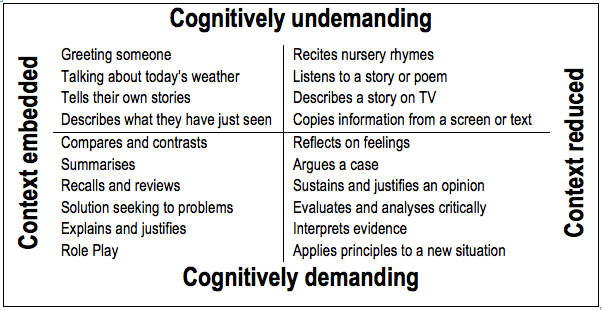
Figure 4: Context / cognition matrix
Source: (Carder, 2014, p. 72)
As Figure 4 shows, there is a significant difference between cognitively demanding and undemanding tasks, and the ability to use language in a context reduced environment (Carder, 2014). Secondly, studies have shown that speech and language problems that underlie both or all languages may be misinterpreted as natural delays in learning English and children from a BML background compared to monolingual children with the same problem, are often referred much later, or not at all, for help (Winter, 1999). Related to this, other research has found that behavioural or emotional problems may result from language problems including speech disorder, isolated expressive disorder, mixed receptive-expressive high level language disorder, specific language impairment and other language disorders and delays. They emphasize the importance of fully assessing language skills in these BML populations (Grizzle & Simms, 2009; Toppelberg, Medrano, Morgens, & Nieto-Castañon, 2002).

Figure 5: The “thin ice” of BICS vs. dual-iceberg of CALP
Source: (Carder, 2014 p.72)
Then there is the “drop-out” risk. Literature distinguishes between early-exit bilingual education which is seen as “subtractive” and late exit or “additive” bilingual education (Ball, 2011; Cummins, 1998). Subtractive bilingualism is where children do not develop language beyond the BICS stage due to suppression by the dominant school or societal language and their MT cannot be used to leverage learning in the school or societal language. These children run the risk of not having high, abstract and academic level in any language which impacts negatively on their academic proficiency.
Another problem can be misguided parental interference and effort. Research has found that parents mainly rely on their own experiences in language learning in making choices for their children, referring to a combination of popular literature and expert advice to justify these decisions. BML families tend to form “family language policies” on home communication. Parents’ efforts could be better supported, their uncertainties addressed and misconceptions clarified as few parents were properly aware of the challenges, issues, consistency and effort of raising BML children, nor of the fact that children raised in bilingual homes often become active users of only one language depending on the context (Caldas & Caron-Caldas, 2002; King & Fogle, 2006).
References:
Abhakorn, J. (2008). The Implications of Learner Strategies for Second or Foreign Language Teaching. ARECLS, 5, 186–204.
Ball, J. (2011). Enhancing learning of children from diverse language backgrounds: mother tongue-based bilingual or multilingual education in the early years. UNESCO Education Sector.
Barac, R., & Bialystok, E. (2011). Cognitive development of bilingual children. Language Teaching, 44(01), 36–54. doi:10.1017/S0261444810000339
Beech, J. R. (1994, May). The Language Continuum: From Infancy to Literacy. British Journal of Psychology, 85(2), 303+. Retrieved from http://go.galegroup.com.ezproxy.csu.edu.au/ps/i.do?id=GALE%7CA16108054&v=2.1&u=csu_au&it=r&p=EAIM&sw=w&asid=51afee8e669e5df051f4e2bc9c7c54d6
Bowden, H. W., Steinhauer, K., Sanz, C., & Ullman, M. T. (2013). Native-like brain processing of syntax can be attained by university foreign language learners.Neuropsychologia, 51(13), 2492–2511. doi:10.1016/j.neuropsychologia.2013.09.004
Brewster, J. (2011). The Role of the Library in Supporting Young Language Learners and their Families. In E. Murphy (Ed.), Welcoming linguistic diversity in early childhood classrooms: learning from international schools (pp. 157–167). New York: Multilingual Matters.
Caldas, S. J. (2006). Raising bilingual-biliterate children in monolingual cultures. Clevedon ; Buffalo: Multilingual Matters.
Caldas, S. J., & Caron-Caldas, S. (2002). A Sociolinguistic Analysis of the Language Preferences of Adolescent Bilinguals: Shifting Allegiances and Developing Identities. Applied Linguistics, 23(4), 490–514. Retrieved from http://ezproxy.csu.edu.au/login?url=http://search.ebscohost.com/login.aspx?direct=true&db=ehh&AN=44400977&site=ehost-live
Carder, M. (2006). Bilingualism in International Baccalaureate programmes, with particular reference to international schools. Journal of Research in International Education, 5(1), 105–122. doi:10.1177/1475240906061867
Carder, M. (2008). The development of ESL provision in Australia, Canada, the USA and England, with conclusions for second language models in international schools. Journal of Research in International Education, 7(2), 205–231. doi:10.1177/1475240908091305
Carder, M. (2014). The language repertoires of five IB Diploma students in an international school. Retrieved from http://mclanguage.tripod.com/webonmediacontents/55a%20The%20language%20repertoires%20of%20five.pdf
Cummins, J. (1998). Immersion education for the millennium: What have we learned from 30 years of research on second language immersion? In M. R. Childs & R. M. Bostwick (Eds.), Learning through two languages: Research and practice (pp. 34–47). Katoh Gakuen, Japan.
Cummins, J. (2003). Putting Language Proficiency in Its Place: Responding to Critiques of the Conversational – Academic Language Distinction. Retrieved May 27, 2014, from http://iteachilearn.org/cummins/converacademlangdisti.html
De Mejía, A.-M. (2002). Power, prestige, and bilingualism international perspectives on elite bilingual education. Buffalo, N.Y.: Multilingual Matters. Retrieved from http://search.ebscohost.com/login.aspx?direct=true&scope=site&db=nlebk&db=nlabk&AN=79495
Dixon, L. Q., Zhao, J., Quiroz, B. G., & Shin, J.-Y. (2012). Home and community factors influencing bilingual children’s ethnic language vocabulary development. International Journal of Bilingualism, 16(4), 541–565. doi:10.1177/1367006911429527
Dixon, L. Q., Zhao, J., Shin, J.-Y., Wu, S., Su, J.-H., Burgess-Brigham, R., … Snow, C. (2012). What We Know About Second Language Acquisition: A Synthesis From Four Perspectives. Review of Educational Research, 82(1), 5–60. doi:10.3102/0034654311433587
Ehrman, M., & Leaver, B. L. (2003). Cognitive styles in the service of language learning. System, 31(3), 393–415. doi:10.1016/S0346-251X(03)00050-2
Fillmore, L. W. (2000). Loss of Family Languages: Should Educators Be Concerned? Theory Into Practice, 39(4), 203–210. doi:10.1207/s15430421tip3904_3
Fong, E. (2007). The L2 Reading Motivation of EAL Students: Experiences in an International School in Singapore (Master Dissertation). The University of Sheffield, Sheffield, UK.
Genesee, F. (2014). Myths and misunderstandings about dual language acquisition in young learners. Presented at the ECIS-ESLMT, Amsterdam, Netherlands.
Granena, G., & Long, M. H. (2013). Age of onset, length of residence, language aptitude, and ultimate L2 attainment in three linguistic domains. Second Language Research, 29(3), 311–343. doi:10.1177/0267658312461497
Griffiths, C. (Ed.). (2008). Lessons from good language learners. Cambridge ; New York: Cambridge University Press.
Grizzle, K. L., & Simms, M. D. (2009). Language and Learning: A Discussion of Typical and Disordered Development. Current Problems in Pediatric and Adolescent Health Care, 39(7), 168–189. doi:10.1016/j.cppeds.2009.04.002
Gulf News. (2013, May 9). Use of Arabic language needs conscious nurturing. Retrieved April 6, 2014, from http://gulfnews.com/opinions/editorials/use-of-arabic-language-needs-conscious-nurturing-1.1181394
Hacohen, C. (2012). “The norm is a flux of change”: teachers’ experiences in international schools. Educational Psychology in Practice, 28(2), 113–126. doi:10.1080/02667363.2011.646092
Hadi-Tabassum, S. (2004). The Balancing Act of Bilingual Immersion. Educational Leadership, 62(4), 50. Retrieved from http://ezproxy.csu.edu.au/login?url=http://search.ebscohost.com/login.aspx?direct=true&db=f5h&AN=15274676&site=ehost-live
Hayim-Bambe, A. (2011). The Importance of Maintaining Mother Tongue and Culture in the Classroom. In E. Murphy (Ed.), Welcoming linguistic diversity in early childhood classrooms: learning from international schools (pp. 72–79). New York: Multilingual Matters.
Hornberger, N. H. (2003). Continua of biliteracy an ecological framework for educational policy, research, and practice in multilingual settings. Clevedon, UK; Buffalo: Multilingual Matters. Retrieved from http://public.eblib.com/EBLPublic/PublicView.do?ptiID=204118
IBO. (2011). Language and learning in IB programmes. International Baccalaureate Organization.
King, K., & Fogle, L. (2006). Bilingual Parenting as Good Parenting: Parents’ Perspectives on Family Language Policy for Additive Bilingualism. International Journal of Bilingual Education and Bilingualism, 9(6), 695–712. doi:10.2167/beb362.0
Krashen, S. D. (1982). Principles and practice in second language acquisition (1st ed.). Oxford ; New York: Pergamon.
Krashen, S. D. (2004). The power of reading: insights from the research. Westport, Conn.; Portsmouth, N.H.: Libraries Unlimited ; Heinemann.
Lee-Smith, A. (2011). Issues in Teacher Training for Korean Heritage Learners. Retrieved May 31, 2014, from http://archive.cls.yale.edu/info/?p=789
Le Pichon, E., De Swart, H., Vorstman, J. A. S., & Van Den Bergh, H. (2013). Emergence of patterns of strategic competence in young plurilingual children involved in French international schools. International Journal of Bilingual Education and Bilingualism, 16(1), 42–63. doi:10.1080/13670050.2012.679251
Le Pichon, E., de Swart, H., Vorstman, J., & van den Bergh, H. (2010). Influence of the context of learning a language on the strategic competence of children.International Journal of Bilingualism, 14(4), 447–465. doi:10.1177/1367006910370921
MacSwan, J., & Pray, L. (2005). Learning English Bilingually: Age of Onset of Exposure and Rate of Acquisition Among English Language Learners in a Bilingual Education Program. Bilingual Research Journal, 29(3), 653–678. doi:10.1080/15235882.2005.10162857
Saito, K. (2013). Age effects on late bilingualism: The production development of /ɹ/ by high-proficiency Japanese learners of English. Journal of Memory and Language, 69(4), 546–562. doi:10.1016/j.jml.2013.07.003
Saravanan, V. (2001). The Significance of Bilingual Chinese, Malay and Tamil Children’s English Network Patterns on Community Language Use Patterns.Early Child Development and Care, 166(1), 81–91. doi:10.1080/0300443011660107
Scheele, A. F., Leseman, P. P. M., & Mayo, A. Y. (2010). The home language environment of monolingual and bilingual children and their language proficiency.Applied Psycholinguistics, 31(01), 117. doi:10.1017/S0142716409990191
Sears, C. (2011). Listening to Parents: Acknowledging the Range of Linguistic and Cultural Experiences in an Early Childhood Classroom. In E. Murphy (Ed.),Welcoming linguistic diversity in early childhood classrooms: learning from international schools (pp. 185–195). New York: Multilingual Matters.
Shoebottom, P. (n.d.). The language learning theories of Professor J. Cummins. Retrieved April 6, 2014, from http://esl.fis.edu/teachers/support/cummin.htm
Slavin, R. E., Madden, N., Calderon, M., Chamberlain, A., & Hennessy, M. (2011). Reading and Language Outcomes of a Multiyear Randomized Evaluation of Transitional Bilingual Education. Educational Evaluation and Policy Analysis, 33(1), 47–58. doi:10.3102/0162373711398127
Soderman, A. K. (2010). Language Immersion Programs for Young Children? Yes…But Proceed with Caution. Phi Delta Kappan, 91(8), 54–61. Retrieved from http://ezproxy.csu.edu.au/login?url=http://search.ebscohost.com/login.aspx?direct=true&db=ehh&AN=50262555&site=ehost-live
Srivastava, K. (2012, September 19). Hindi a hit among Marathi students. Retrieved April 6, 2014, from http://www.dnaindia.com/mumbai/report-hindi-a-hit-among-marathi-students-1742590
Stauft, N. (2011). An International School Celebrates its Diversity. In E. Murphy (Ed.), Welcoming linguistic diversity in early childhood classrooms: learning from international schools (pp. 53–61). New York: Multilingual Matters.
Toppelberg, C. O., Medrano, L., Morgens, L. P., & Nieto-Castañon, A. (2002). Bilingual Children Referred for Psychiatric Services: Associations of Language Disorders, Language Skills, and Psychopathology. Journal of the American Academy of Child & Adolescent Psychiatry, 41(6), 712–722. doi:10.1097/00004583-200206000-00011
Tramonte, L., & Willms, J. D. (2010). Cultural capital and its effects on education outcomes. Economics of Education Review, 29(2), 200–213. doi:10.1016/j.econedurev.2009.06.003
Vienna International School. (2006). VIS ESL & MT Department: mission statement. Retrieved May 30, 2014, from http://school.vis.ac.at/esl/main.html
Wallinger, L. M. (2000). The Effect of Block Scheduling on Foreign Language Learning. Foreign Language Annals, 33(1), 36–50. doi:10.1111/j.1944-9720.2000.tb00888.x
Wang, B. (2013). Using GRA and GSM Methods to Identify the Learning Strategies of Good Language Learners. International Journal of E-Education, E-Business, E-Management and E-Learning. doi:10.7763/IJEEEE.2013.V3.266
Wei, L., & Hua, Z. (2010). Voices from the diaspora: changing hierarchies and dynamics of Chinese multilingualism. International Journal of the Sociology of Language, 2010(205). doi:10.1515/ijsl.2010.043
Winter, K. (1999). Speech and language therapy provision for bilingual children: aspects of the current service. International Journal of Language & Communication Disorders, 34(1), 85–98. doi:10.1080/136828299247658
Wu, M.-H., & Chang, T.-M. (2010). Heritage Language Teaching and Learning through a Macro-Approach. Working Papers in Educational Linguistics, 25(2), 23–33.
This work by Nadine Bailey is licensed under a Creative Commons Attribution-NonCommercial-ShareAlike 4.0 International License.
Assessment Item 8: Digital Storytelling Project and Reflection
Part A: Context for Digital Story Telling Project
“Knowledge, then, is experiences and stories, and intelligence is the apt use of experience, and the creation and telling of stories. Memory is memory for stories, and the major processes of memory are the creation, storage, and retrieval of stories.” (Schank & Abelson, 1995, p. 8)
In Asia, particularly Hong Kong, where parenting is a competitive sport, giving your children the opportunity to learn Chinese has become the holy grail of expatriate parenting. Children are enrolled in language programs and immersion schools without much understanding or consideration of the possible consequences. Research is scant, seldom longitudinal and evidence is mainly anecdotal, A focus on positive success stories and oral ability prevails, while a climate of shame and fear prevents openness, analysis and understanding when children do not succeed.
Our family’s story of “chasing the dragon” is one of success, failure and ultimate triumph. Storytelling is a way of making sense of events and experiences and communicating this (Botturi, Bramani, & Corbino, 2012) to others in a similar situation.
The subject area covers language, bilingualism and mother tongue from both a pedagogical and socio-emotional point of view. The purpose is to illuminate the complexities underlying language choices in families in the international school context through storytelling. The intended audience are parents, educators and administrators in International Schools. This story will be basis of a presentation at a conference on language next year. It will be used to add context to academic theory on mother-tongue, language learning and identity so that educators and parents alike not only have an intellectual understanding of the theories but an emotional response through this story to the platitude that “every child is unique”.
Academics and educators may lose sight of the fact that the audience that may best profit from their research and knowledge on bilingualism may only be vaguely aware of the information they need, often filtered through their own or other’s experience (King & Fogle, 2006). The intended audience of this project may have not have the time, inclination or access to scholarship in a form and format that is easily understood and resonates with them. Stories influence “attitudes, fears, hopes, and values” and are more effective at changing belief than persuasive writing as a result of changing how information is processed by the audience (Gottschall, 2012) due to escape into an alternative reality, connection with characters, emotional involvement and self-transformation (Green, Brock, & Kaufman, 2004). The affordances of digital story-telling including audience participation enhance this engagement (Alexander, 2011). Although students are required to have a high level of English proficiency, often parents do not and their learning needs may therefore not be met. The affordance of digital storytelling is to incorporate multi semiotic systems that ‘allow for the linking and integration of cognitive, tacit, affective, cultural, personal, graphic and photographic ways of exploring, articulating, expressing and representing sense-making about learning and identity’ (Williams, 2009, cited in Walker, Jameson, & Ryan, 2010, p. 219).
Within the international school context, language is an area fraught with assumptions, misapprehension and emotion . This interactive digital experience has value for program implementation as it highlights many of the issues surrounding language acquisition and maintenance in an accessible format allowing for both breadth and depth in understanding of the topic. Parents, with the best intentions in the world make pedagogically unsound decisions while educators, often coming from a mono-lingual background, may be unable to assist families in their linguistic paths and school administrators may be hampered to do right by the individual due to the logistical and cost complexity of catering to multiple linguistic backgrounds and nuances.
This project aims to increase awareness in all intended audiences so that choices can be made based on current understanding of best practice, educational and logistical issues and potential hurdles along the way. Perhaps we can let go of the “holy grail” of Chinese at the cost of our mother tongues and embrace, pursue and celebrate our own languages, culture and identity, reassured by what we know about language skill transferability.
Part B: Digital Story Telling Project
URL: chasingthechinesedragon.blogspot.com
Please note:
In the creation of my digital story, I have made extensive use of old video footage and photos of my children and others in a classroom setting. I have received the permission from my children to do so, and they partook in a series of interviews with me. However, in order to preserve their and others privacy and confidentiality I have decided to make the product and the blog in which the content occurs private until they are old enough to give permission that is legally binding. As they are now aged 11 and 12, I do not think their consent is as informed as it should be.
I would therefore request people to email me their email addresses so that I can include them on the list of people with permission to access the blog. I’m sorry for the inconvenience around this.
I have discussed this with a number of educators at our school and they feel this is the best way to proceed.
I will use some of the video clips and research for the presentation at the language conference in May, but that will be a dynamic rather than static presentation which will limit the exposure to a wide audience without the necessary context.
Part C: Critical Reflection
There are a number of dimensions related to working as an educational professional in the increasingly pervasive digital environment. We no longer merely have a duty to teach content and information but need to equip ourselves, and our students with digital literacy and critical evaluative skills to deal with the multi-modal formats encountered in the education journey.
Value of digital story telling
In the “context” section, it was highlighted how effective stories are in changing belief and how information is processed and understood including the emotional engagement and interactive potential of digital media (Bailey, 2014c; Coleborne & Bliss, 2011; Gottschall, 2012; Green et al., 2004; Matthews, 2014). A case can also be made for the role storytelling has in assimilating knowledge and memory (Schank & Abelson, 1995).
Tools and strategies for teaching / learning
In a recent essay, The Economist proposes a hierarchy of knowledge and learning and distinguishes between digital formats that have a function of “presenting people with procedural information they need in order to take on a simple task or fulfil a well-stated goal” versus teaching through “books” that can have its “pedagogy enriched by embedded media and software that adapts them to the user’s pace and needs” (The Economist, 2014, Chapter 5). Certainly the digital realm offers the possibility of engaging learners in a multi-modal environment which is more likely to resonate with their preferred way of receiving information provided the educator has a good understanding of how to select and use the tools (Anstey & Bull, 2012; Bowler, Morris, Cheng, Al-Issa, & Leiberling, 2012; Phillips, 2012; Unsworth, 2008; Walsh, 2010).
As educators our role needs to evolve and combine aspects of discovery, critical evaluation and enabling access to the most appropriate material (Dockter, Haug, & Lewis, 2010; Leacock & Nesbit, 2007; Nokelainen, 2006; Parrott, 2011), while at the same time educating our students to be mindful consumers and producers of content aware of the “weapons” in their and other’s storytelling “arsenal” and how these can be deployed for good and ill (Gottschall, 2012; Walker et al., 2010; Walsh, 2010).
Then there is the psycho/socio-neurological dimension of the impact digital literature has on how our students access, absorb, process and reflect on information and learning (Edwards, 2013; Goodwin, 2013; Jabr, 2013; Margolin, Driscoll, Toland, & Kegler, 2013; Wolf & Stoodley, 2008). Finally, for our students there are questions around the evolution of their skill sets as they move from consumption of digital products to creation, expression, engagement and interactivity (Hall, 2012).
Current and future developments
An exciting function of digital creations is the way materials can meet learning needs of all types of learners (Kingsley, 2007; Rhodes & Milby, 2007). However, one has to wonder about ephemeral nature of material, formats and platforms in the digital environment with the related issues of curation, preservation and archiving. Just as it appears that blogging as a tool for learning and storytelling has had its rise and demise, so too other platforms may not have longevity.
The whole field appears to be in its infancy with emerging and evolving norms, standards and platforms, (Maas, 2010; Valenza, 2014) where one can only wonder who the winners and losers will be.
Factors around design and publication
There are economic issues of efficiency, resource and time wastage as many individual teachers with varying levels of capability; capacity; understanding and access to tools attempt to participate in the creation of materials (Bailey, 2014b). One issue is the absence of a clearing house or “store” such as “Teachers pay Teachers” (Teachers Pay Teachers, 2014) or “Teacher created Resources” (Teacher Created Resources, 2014) so the discovery of relevant material remains serendipitous and local. For example, YouTube abounds with “educational” material, but lacks a rating system appropriate for educational quality control including checking for producer bias.
For digital curriculum based material, critical mass, economies of scale, and the integration of pedagogy, design and technical tools and marketing are needed which puts educational publishers or organisation such as TED Education (Ted-ed, n.d.) rather than individual educators in a strong position to take control of this arena.
Copyright, Digital rights, licensing
There are issues around digital rights, rights management, copyright and the like, both for the creator and the consumer of digital products for the classroom. Cost and ownership is a tricky area as many products are leased rather than purchased, are platform captive and access to full text for students with disabilities may be precluded (Michaud, 2013; O’Brein, Gasser, & Palfrey, 2012; Puckett, 2010).
Conclusion
At the end of following this course, it could be suggested that the course name “Literature in Digital Environments” is a misnomer (Bailey, 2014a), and “Literacy in Digital Environments” could be an alternative title to encompass all the aspects of this rich arena.
References:
Alexander, B. (2011). Storytelling: A tale of two generations (Chapter 1). In The new digital storytelling: creating narratives with new media (pp. 3–15). Santa Barbara, California: Praeger.
Anstey, M., & Bull, G. (2012). Using multimodal factual texts during the inquiry process. PETAA, 184, 1–12. Retrieved from http://chpsliteracy.wikispaces.com/file/view/PETAA+Paper+No.184.pdf
Bailey, N. (2014a, August 20). When is it digital literature? [Web Log post]. Retrieved October 12, 2014, from http://thinkspace.csu.edu.au/informativeflights/2014/08/20/when-is-it-digital-literature/
Bailey, N. (2014b, September 10). Module 4.1: What questions or answers do you have in relation to digital storytelling? [Web log post]. Retrieved October 12, 2014, from http://thinkspace.csu.edu.au/informativeflights/2014/09/10/module-4-1-what-questions-or-answers-do-you-have-in-relation-to-digital-storytelling/
Bailey, N. (2014c, September 30). Assessment item 7: Blog 4 – Electronic media and the nature of the story [Web log post]. Retrieved October 12, 2014, from http://thinkspace.csu.edu.au/informativeflights/2014/09/30/assessment-item-7-blog-4-electronic-media-and-the-nature-of-the-story/
Botturi, L., Bramani, C., & Corbino, S. (2012). Finding Your Voice Through Digital Storytelling. TechTrends, 56(3), 10–11. doi:10.1007/s11528-012-0569-1
Bowler, L., Morris, R., Cheng, I.-L., Al-Issa, R., & Leiberling, L. (2012). Multimodal stories: LIS students explore reading, literacy, and library service through the lens of “The 39 Clues.” Journal of Education for Library and Information Science, 53(1), 32–48.
Coleborne, C., & Bliss, E. (2011). Emotions, Digital Tools and Public Histories: Digital Storytelling using Windows Movie Maker in the History Tertiary Classroom. History Compass, 9(9), 674–685. doi:10.1111/j.1478-0542.2011.00797.x
Dockter, J., Haug, D., & Lewis, C. (2010). Redefining Rigor: Critical Engagement, Digital Media, and the New English/Language Arts. Journal of Adolescent & Adult Literacy, 53(5), 418–420. Retrieved from http://ezproxy.csu.edu.au/login?url=http://search.ebscohost.com/login.aspx?direct=true&db=eric&AN=EJ871723&site=ehost-live
Edwards, J. T. (2013). Reading Beyond the Borders: Observations on Digital eBook Readers and Adolescent Reading Practices. In J. Whittingham, S. Huffman, W. Rickman, & C. Wiedmaier (Eds.), Technological Tools for the Literacy Classroom: (pp. 135–158). IGI Global. Retrieved from http://services.igi-global.com/resolvedoi/resolve.aspx?doi=10.4018/978-1-4666-3974-4
Goodwin, B. (2013). The Reading Skills Digital Brains Need. Educational Leadership, 71(3), 78. Retrieved from http://ezproxy.csu.edu.au/login?url=http://search.ebscohost.com/login.aspx?direct=true&db=f5h&AN=91736083&site=ehost-live
Gottschall, J. (2012, May 2). Why Storytelling Is The Ultimate Weapon. Retrieved September 29, 2014, from http://www.fastcocreate.com/1680581/why-storytelling-is-the-ultimate-weapon
Green, M. C., Brock, T. C., & Kaufman, G. F. (2004). Understanding Media Enjoyment: The Role of Transportation Into Narrative Worlds. Communication Theory, 14(4), 311–327. doi:10.1111/j.1468-2885.2004.tb00317.x
Hall, T. (2012). Digital Renaissance: The Creative Potential of Narrative Technology in Education. Creative Education, 03(01), 96–100. doi:10.4236/ce.2012.31016
Jabr, F. (2013, April 11). The Reading Brain in the Digital Age: The Science of Paper versus Screens [Article]. Retrieved August 31, 2014, from http://www.scientificamerican.com/article/reading-paper-screens/
King, K., & Fogle, L. (2006). Bilingual Parenting as Good Parenting: Parents’ Perspectives on Family Language Policy for Additive Bilingualism. International Journal of Bilingual Education and Bilingualism, 9(6), 695–712. doi:10.2167/beb362.0
Kingsley, K. V. (2007). Empower Diverse Learners With Educational Technology and Digital Media. Intervention in School & Clinic, 43(1), 52–56. Retrieved from http://ezproxy.csu.edu.au/login?url=http://search.ebscohost.com/login.aspx?direct=true&db=ehh&AN=26156207&site=ehost-live
Leacock, T. L., & Nesbit, J. C. (2007). A Framework for Evaluating the Quality of Multimedia Learning Resources. Educational Technology & Society, 10(2), 44–59.
Maas, D. (2010, June). Web-based Digital Storytelling Tools and Online Interactive Resources [Web Log]. Retrieved from http://maasd.edublogs.org/files/2010/06/Web-based-Digital-Storytelling-Tools-Online-Interactives-2gwjici.pdf
Margolin, S. J., Driscoll, C., Toland, M. J., & Kegler, J. L. (2013). E-readers, Computer Screens, or Paper: Does Reading Comprehension Change Across Media Platforms?: E-readers and comprehension. Applied Cognitive Psychology, 27(4), 512–519. doi:10.1002/acp.2930
Matthews, J., RGN BSc PG Dip. (2014). Voices from the heart: the use of digital storytelling in education. Community Practitioner, 87(1), 28–30. Retrieved from http://search.proquest.com/docview/1474889132?accountid=10344
Michaud, D. (2013). Copyright and Digital Rights Management: Dealing with artificial access barriers for students with print disabilities. Feliciter, 59(1), 24–30. Retrieved from http://search.proquest.com.ezproxy.csu.edu.au/docview/1286679756?accountid=10344
Nokelainen, P. (2006). An empirical assessment of pedagogical usability criteria for digital learning material with elementary school students. Journal of Educational Technology & Society, 9(2), 178–197. Retrieved from http://ezproxy.csu.edu.au/login?url=http://search.ebscohost.com/login.aspx?direct=true&db=ehh&AN=85866426&site=ehost-live
O’Brein, D., Gasser, U., & Palfrey, J. G. (2012, July 1). E-Books in Libraries: A Briefing Document Developed in Preparation for a Workshop on E-Lending in Libraries. Berkman Center Research Publication No. 2012-15. Retrieved from http://ssrn.com/abstract=2111396
Parrott, K. (2011, July 18). 5 Questions to Ask When Evaluating Apps and Ebooks [Web log post]. Retrieved August 31, 2014, from http://www.alsc.ala.org/blog/2011/07/5-questions-to-ask-when-evaluating-apps-and-ebooks/
Phillips, A. (2012). A creator’s guide to transmedia storytelling: how to captivate and engage audiences across multiple platforms. New York: McGraw-Hill.
Puckett, J. (2010). Digital Rights Management as Information Access Barrier. Progressive Librarian, Fall-Winter(34/35), 11–24. Retrieved from http://www.progressivelibrariansguild.org/PL_Jnl/pdf/PL34_35_fallwinter2010.pdf
Rhodes, J. A., & Milby, T. M. (2007). Teacher-Created Electronic Books: Integrating Technology to Support Readers With Disabilities. The Reading Teacher, 61(3), 255–259. doi:10.1598/RT.61.3.6
Schank, R. C., & Abelson, R. P. (1995). Knowledge and Memory: The Real Story. In R. S. Wyer (Ed.), Knowledge and Memory: The Real Story (Vol. VIII, pp. 1–85). Hillsdale, NJ: Lawrence Erlbaum Associates. Retrieved from http://cogprints.org/636/1/KnowledgeMemory_SchankAbelson_d.html
Teacher Created Resources. (2014). Teacher Created Resources – Educational Materials and Teacher Supplies. Retrieved October 11, 2014, from http://www.teachercreated.com/
Teachers Pay Teachers. (2014). TeachersPayTeachers.com – An Open Marketplace for Original Lesson Plans and Other Teaching Resources. Retrieved October 11, 2014, from http://www.teacherspayteachers.com/
TED-Ed. (n.d.). Lessons Worth Sharing. Retrieved October 12, 2014, from http://ed.ted.com/
The Economist. (2014, October). The future of the book. Retrieved October 11, 2014, from http://www.economist.com/news/essays/21623373-which-something-old-and-powerful-encountered-vault
Unsworth, L. (2008). Multiliteracies, E-literature and English Teaching. Language and Education, 22(1), 62–75. doi:10.2167/le726.0
Valenza, J. (2014). The Digital Storytelling Tools Collection. Retrieved October 11, 2014, from https://edshelf.com/profile/joycevalenza/digital-storytelling-tools
Walker, S., Jameson, J., & Ryan, M. (2010). Skills and strategies for e-learning in a participatory culture (Ch. 15). In R. Sharpe, H. Beetham, & S. Freitas (Eds.), Rethinking learning for a digital age: How learners are shaping their own experiences (pp. 212–224). New York, NY: Routledge.
Walsh, M. (2010). Multimodal literacy: What does it mean for classroom practice? Australian Journal of Language and Literacy, 33(3), 211–239.
Wolf, M., & Stoodley, C. J. (2008). Proust and the squid: the story and science of the reading brain. New York: Harper Perennial.
The point of literature
I absolutely couldn’t have said it better, so I’d like to share this movie by Marcus Armitage.
What is Literature for? from Marcus Armitage on Vimeo, animated by Marcus Armitage and Ignatz Johnson Higham.
Voice over Alain de Botton.
Assessment item 7: Blog 4 – Electronic media and the nature of the story
Electronic media are not simply changing the way we tell stories: they’re changing the very nature of story, or what we understand (or do not understand) to be narratives. To what extent is this true?
From: https://www.youtube.com/watch?v=p6E8jpFasR0
Many authors have argued that storytelling is intrinsic to humanity (Schank & Abelson, 1995) and part of memory and learning. And yet for some reason it appears to me that storytelling had something of a hiatus in the last century, perhaps as a side effect of the post war modern corporate life, the emphasis on the scientific method and the space race. However the proliferation of research, writings and talks on the power of storytelling in all aspects of life from the scientific (Bailey, 2013) to the corporate (Gottschall, 2012) to education (Matthews, 2014) and everything in-between hints that storytelling is once again coming into its own (Pettitt, Donaldson, & Paradis, 2010; Sauerberg, 2009). Whether electronic media is a cause or an effect of this or whether it is just part of the zeitgeist is something we will only know in hindsight.
What we traditionally understand to be narrative consists of a storyteller, an audience and the narrative elements of a hero, a problem, an antagonist, tasks, a turning point and an outcome (Alexander, 2011). How electronic media is changing the nature of this is by broadening the concept of who is the storyteller. Once a digital narrative moves beyond being a story delivered electronically as in an eBook, or as a movie, but streamed or available digitally and goes to being an interactive “event” in which the distinction between the storyteller and the audience blurs and is interchangeable, one can talk about the nature of the narrative being changed by the media and its affordances. The creator becomes an initiator and the audience becomes collaborators and co-creators. The question then is whether one can still find the narrative elements back in this new hybrid creation? Does the participation of many voices enhance or hamper the profundity, meaning and emotion at the root of the narrative? Does engagement and involvement and participation equate to the “wisdom of crowds” or does it result in a “lowest common denominator” product? Are we moving from a period of finite works of infinite genius to infinite works of dubious merit (Pickett, 1986) – albeit a series of very clever and networked and buzzed works.
Another matter in all of this that is somewhat bothering me is the way in which the “science” of storytelling and its capacity to capture attention and emotion in its audience is being (ab)used for commercial purposes or to manipulate audiences to create changes in political (Simsek, 2012), social (Burgess & Vivienne, 2013; LaRiviere, Snider, Stromberg, & O’Meara, 2012) or public sphere (Poletti, 2011). Proponents would of course argue that the ends justify the means – but of course both sides of the debate have the same weapons in their arsenals (see the whole climate change narrative as an example of this), and as educators this makes our task of aiding the new generation of learners to be knowledgeable, discernable, informed and aware that much more important.
References:
Alexander, B. (2011). Storytelling: A tale of two generations (Chapter 1). In The new digital storytelling: creating narratives with new media (pp. 3–15). Santa Barbara, Calif: Praeger.
Bailey, P. (2013, March 27). Science Writing: You need to know how to tell a good story [Web log]. Retrieved September 29, 2014, from http://www.theguardian.com/science/2013/mar/27/penny-bailey-science-writing-wellcome
Burgess, J. E., & Vivienne, S. (2013). The remediation of the personal photograph and the politics of self-representation in digital story- telling. Journal of Material Culture, 18(3), 279–298. Retrieved from http://eprints.qut.edu.au/62708/
Gottschall, J. (2012, May 2). Why Storytelling Is The Ultimate Weapon. Retrieved September 29, 2014, from http://www.fastcocreate.com/1680581/why-storytelling-is-the-ultimate-weapon
LaRiviere, K., Snider, J., Stromberg, A., & O’Meara, K. (2012). Protest: Critical lessons of using digital media for social change. About Campus, 17(3), 10–17. doi:10.1002/abc.21081
Matthews, J., RGN BSc PG Dip. (2014). Voices from the heart: the use of digital storytelling in education. Community Practitioner, 87(1), 28–30. Retrieved from http://search.proquest.com/docview/1474889132?accountid=10344
Pettitt, T., Donaldson, P., & Paradis, J. (2010, April 1). The Gutenberg Parenthesis: oral tradition and digital technologies. Retrieved August 29, 2014, from http://web.mit.edu/comm-forum/forums/gutenberg_parenthesis.html
Pickett, D. (1986). What is literature – established canon or popular taste? English Today, 2(01), 37. doi:10.1017/S0266078400001735
Poletti, A. (2011). Coaxing an intimate public: Life narrative in digital storytelling. Continuum, 25(1), 73–83. doi:10.1080/10304312.2010.506672
Sauerberg, L. O. (2009). The Encyclopedia and the Gutenberg Parenthesis. In Media in Transition 6: stone and papyrus, storage and transmission (pp. 1–13). Cambridge, MA, USA.: Massachusetts Institute of Technology.
Schank, R. C., & Abelson, R. P. (1995). Knowledge and Memory: The Real Story. In R. S. Wyer (Ed.), Knowledge and Memory: The Real Story (Vol. VIII, pp. 1–85). Hillsdale, NJ: Lawrence Erlbaum Associates. Retrieved from http://cogprints.org/636/1/KnowledgeMemory_SchankAbelson_d.html
Simsek, B. (2012). Using Digital Storytelling as a change agent for women’s participation in the Turkish Public Sphere (Doctor of Philosophy). Queensland University of Technology, Queensland, Australia. Retrieved from http://eprints.qut.edu.au/50894/1/Burcu_Simsek_Thesis.pdf
 Informative Flights - Musings of a Teacher Librarian