Given the dire state of the nation on reading overall for middle school with each grade reading less than in previous years, this is one small light at the end of the tunnel for me – showing that perhaps we need to narrow rather than continue to broaden our collection and focus on many copies of the most popular books?
Another amazing side effect has been the number of our faculty who are now fans of middle school / young adult literature and who have kept on coming back to finish series (I think it’s really important to have book 1 of as many enticing series as possible in the list). It really matters when not only the ELA teacher but also the PHE/Sports coaches and Drama and Science teachers are reading and recommending books.
Another interesting aspect has been that it seems we’ve arrived at a sort of tipping point of students accessing eBooks and AudioBooks in greater numbers than I’ve previously seen. Since we tend to only buy 3 or 4 of each of the core books (plus whatever ELA has a budget for to put in their class libraries) the most popular books tend to be out all the time, resulting in students then using the digital equivalent. I like AudioBooks as it means I can listen (often at 1.5-2x speed) and do my knitting, and I often have to persuade students that listening to audiobooks is also reading. In a culture where very few students are read to, I think it’s also important for them to hear stories – not the least to avoid embarrassing incidents with the pronunciation of words and names!
Of course I know that borrowing doesn’t always translate to reading (see the amazing way the great Nathan Pyle illustrates this below), but on the other hand I’m also comforted by the fact that our ELA classroom libraries have also stocked up on many of the core books and their circulations are not counted in my stats.
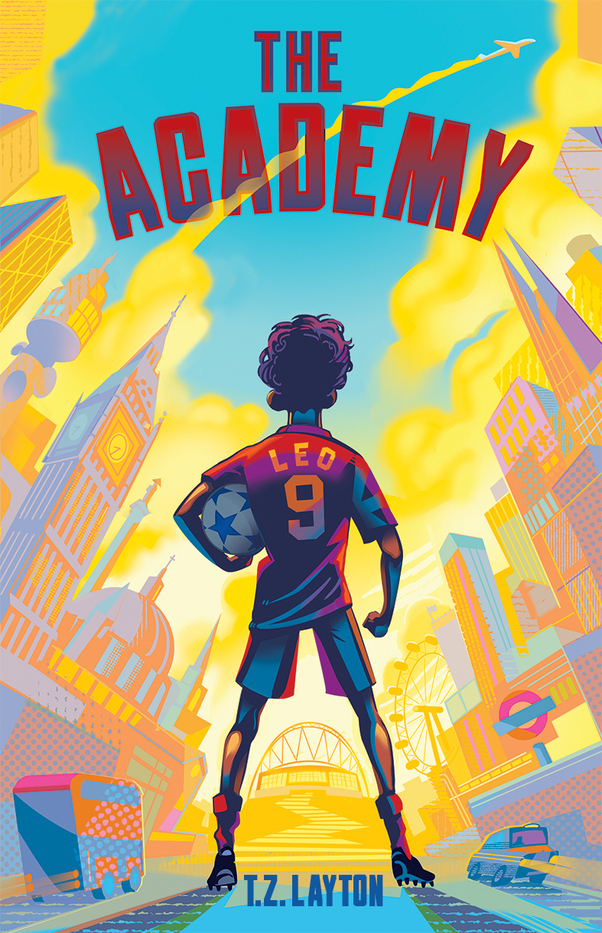
One of the runaway success books I’d like to highlight is “The Academy” by TZ Layton. In common I think with most 10-14 year olds, most of the young soccer players at our school are convinced it’s only a matter of time before they’re scouted into one of the youth leagues and this series feeds their dreams.
Actions & Activities
The actions and activities around the core books this year include:
Culling of the least popular (and some of the most popular*) books from the previous year
Book overviews on the middle school TV displays
Core list on Advisory Slides
“Core Wall” in library
ELA & MS teacher promotion
House points for book reviews
On libguide / recommended to parents during parent conferences
Weekly Kahoot quiz January – May (inter-house competition)
Battle of the Core live quiz assembly – 8 May (moved from January to increase exposure)
* while some of the books were taken out because they just didn’t fly for one reason or another (usually because I’d been misled by a good review without having been able to read the book first, or I misjudged the audience), some have been given wings and are flying on their own without the need to be on a list, or have been adopted by the ELA department as one of their book club books. Of course there is always great irony in choices. After not being able to successfully sell “The thing about jellyfish” by Ali Benjamin all year long, I took it off the list for next year and of COURSE then some young booktokker started recommending it and now everyone wants to read it!
Another side effect has been more faculty coming to me for recommendations for their own reading of for books for their younger kids or nieces / nephews – there is nothing more flattering, no greater gift you can give a librarian than ask for recommendations!
there is nothing more flattering, no greater gift you can give a librarian than ask for recommendations!
In conclusion I’d say if you’re in any doubt about the value of having a core collection, go ahead and try it out. It doesn’t have to be 25 books but it does help to have at least one representative of each genre. Including the first book in a series is always a good idea and I also try to have books that are fairly recent, include books from visiting authors if we have any and to try and tap into the zeitgeist.
We’ve been on summer break for just over a week now and I’m feeling sufficiently rested to sit down and write again.
Book returns
The end of the school year is always a busy time for librarians with the dual task of getting overdue books back and making sure that students have enough of the right books in their hands to entice them to do some reading over the summer. It really is a dichotomy – the students who most need to read more are the ones who have the hardest time keeping track of books – probably because they just borrow because they’re being told to do so and then promptly put the books somewhere never to be found again. And then of course when they become overdue it’s a fuss and bother and they are even less inclined to borrow.
Inventory
The big tasks include doing inventory – something we’ve turned more into a continual process so by the end of the year it’s more just following up on missing items – often they return – from students (or more often returned by nannies or parents) who consider going past the circulation desk as being optional. Unfortunately being in the middle east certain types of books also just disappear depending on the heat of current rhetoric – or in the case of this year actual bombing going on.
Core Collection
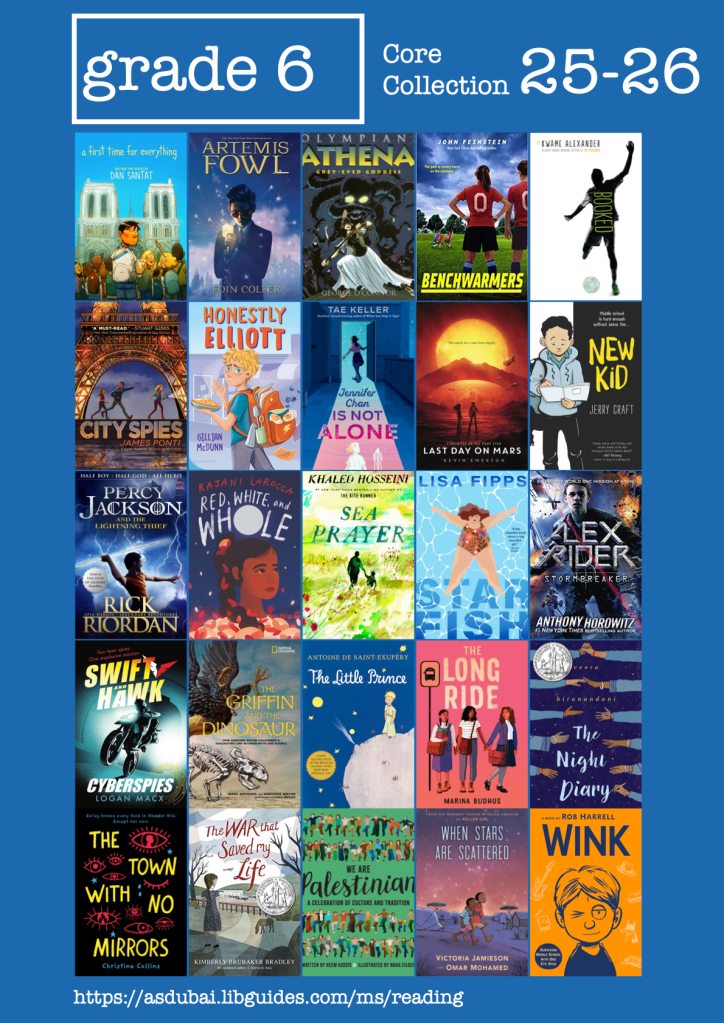
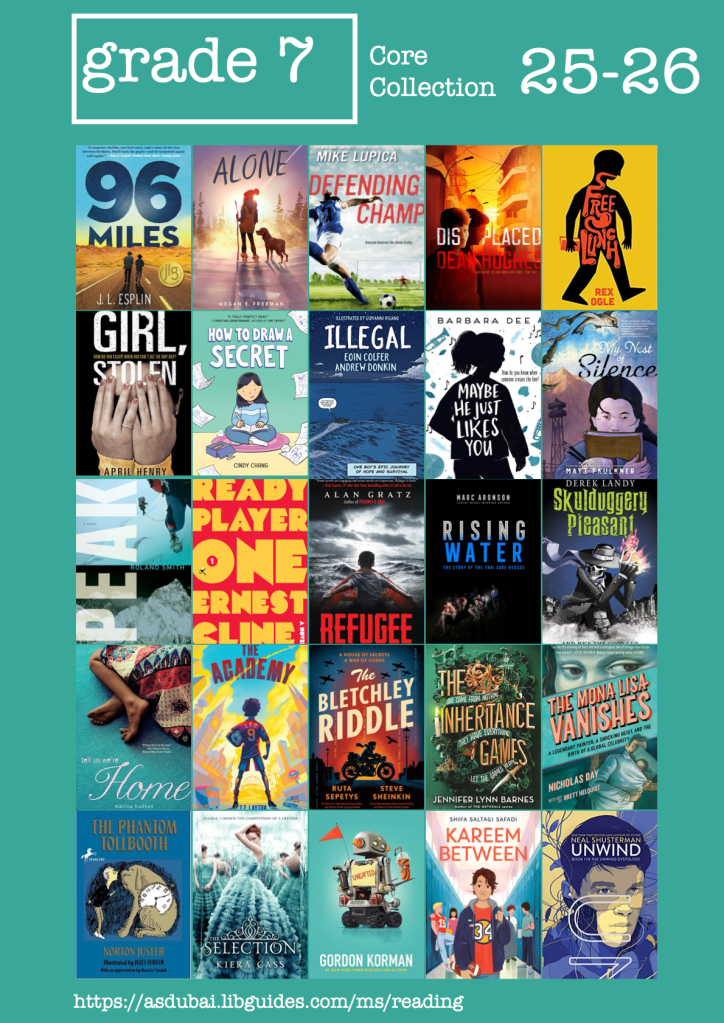
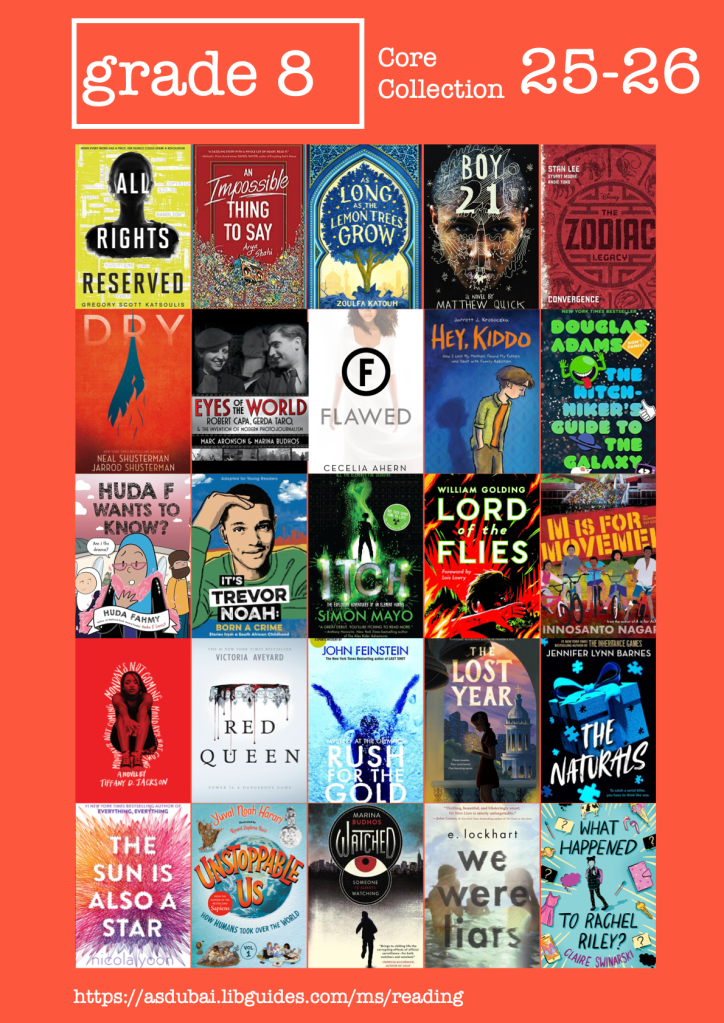
With our ELA (English Language Arts) department I’ve been very busy creating our new “Core Library Books” for the coming year (Grade 6; Grade 7; Grade 8)
And, continuing the tradition started last year, promoting them first with our middle school faculty. I’ll do a separate blog on the result of the core collection this year.
Summer reading
This also feeds into our Summer Reading Libguide which we try to promote as much as possible with students and parents. A few of the ELA classes had their students explore the guide and the various reading lists in detail and then make their own reading goals based on the lists and then email their parents with their reading plans and either borrow the books or request parents purchased them for the summer. I was also on hand with Sora Marketplace open to purchase the eBook or Audiobook for the students who wanted a digital copy. Our summer reading borrowing guideline is “as many books as you need and know you can take care of and return after the break“
Annual Report
The most arduous task at the end of the year, and one which it seems many international school librarians have more or less given up on, is creating the annual report. I can see why people stop doing this. With declining borrowing / reading it can be quite a depressing exercise. It’s also remarkably difficult to get good data our of our systems. Follett Destiny is a dreadful platform to get good data from – in contrast with other systems. I was reading Rutger Bregman’s “Moral Ambition” (see video below) around the same time, and came across the concept of vanity metrics – basically just putting together data that makes you look good. With that at the back of my mind, putting the report together (Annual Report 2024-25) became this exercise in trying to show both that the situation with reading is not great while trying to show that as librarians and teachers we’re doing our darnest to turn the tide and hopefully all is not lost. And even when we lose in reading perhaps we’re making inroads in research. Much as I hated studying business / accounting and was glad to escape being financial person it did put me in good stead for being able to work with data.
I’m planning on doing a bit more blogging this break, so keep coming back! Comment on any topics you’d like to see covered.
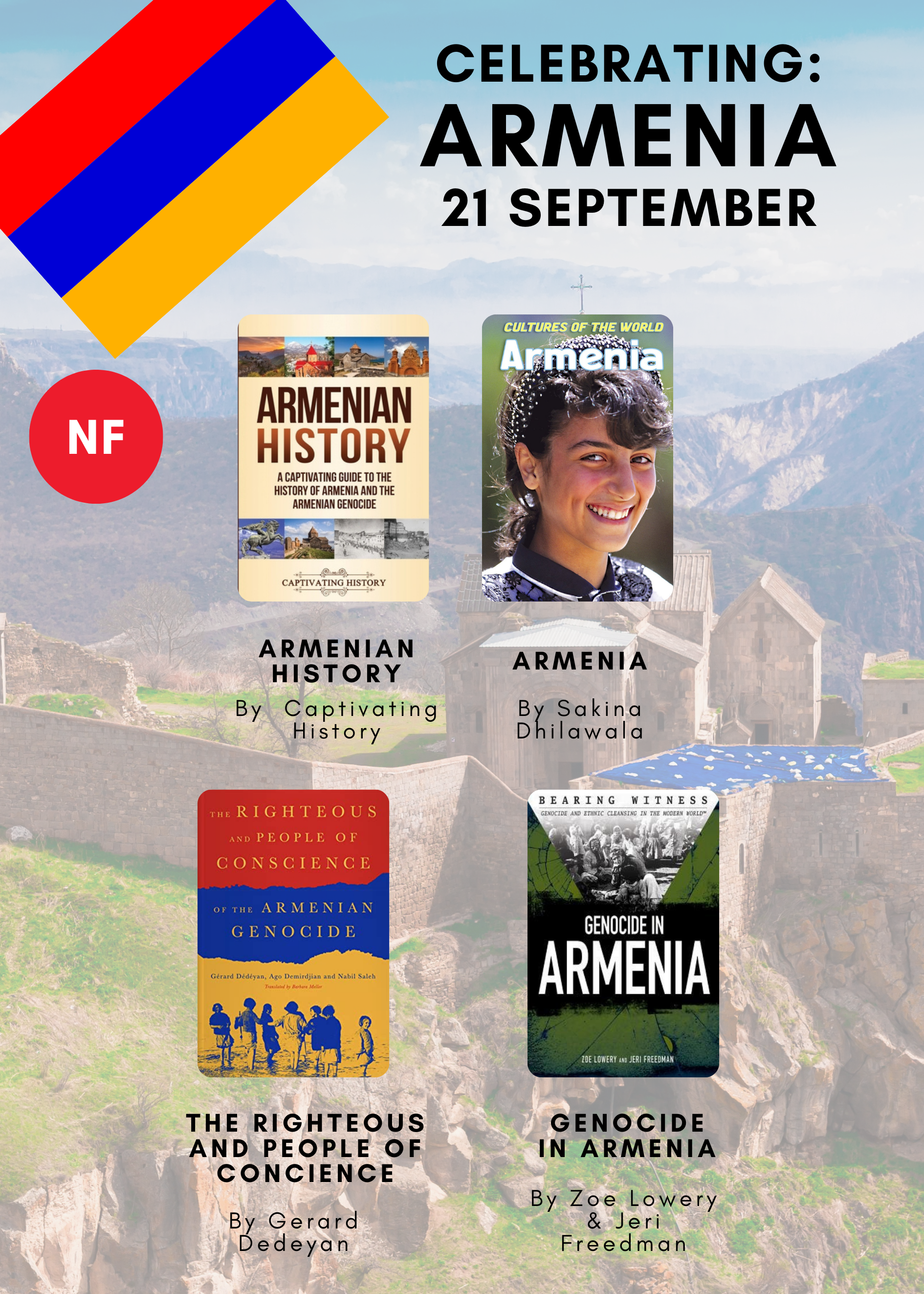
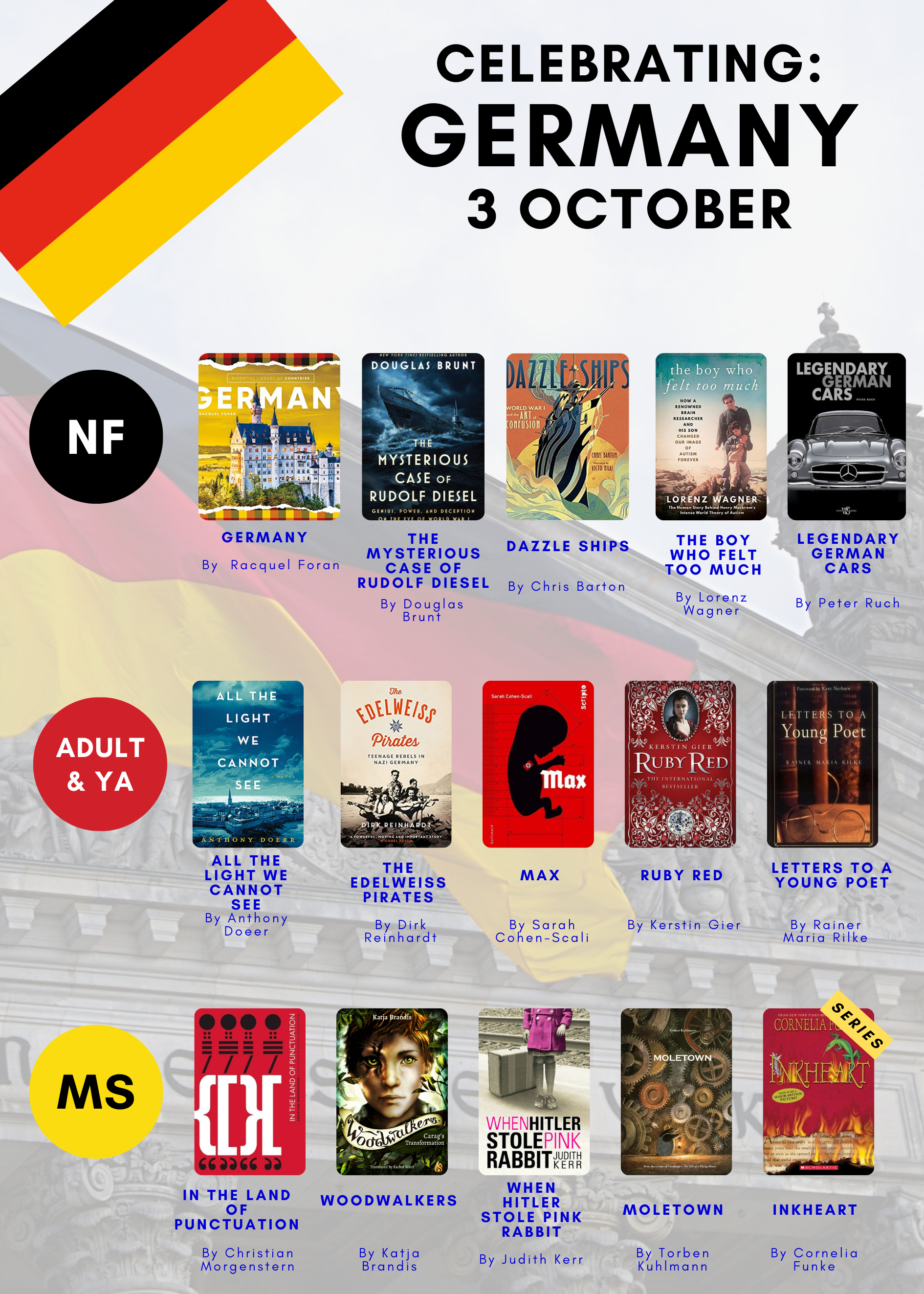
For a while now I’ve been wanting to highlight the curation of books related to the countries and cultures of our students, and finally this year I got around to creating posters “Celebrating xxx” which I post to our school bulletins for students and adults respectively. It’s been a bit of a chicken and egg project – knowing how many students we have from each country / culture – which in itself is truly not as simple a task as it may appear. We use the proxy of first, second and third passports, but as anyone who lives internationally knows, life is a tangle of multiple strands with immigration, migration, expatriation, languages, refugees, fleeing and arriving, births and marriages and transferences and identities. So in the last two years, using this list I’ve been scouring book lists, book catalogues, recommendations, book prizes to where we finally have, for most of the countries with more than 2 students, at least a couple of books besides a travel guide.
A couple of books. How easy that rolls of the tongue. But anyone with a conscience and an iota of empathy will know that that is another potential landmine. I have carried shame for my country of birth, South Africa, for decades, and still often have trouble admitting to its citizenship since I still feel the personal burden of all the wrongs committed by people of my race. It is right that a representative sampling of literature of my country includes reference, analysis and depictions of the pain and despair that apartheid has wrought. But that is not all we are as a nation and people.
I have not yet made the list for South Africa. But that was the dilemma I faced when curating the poster for Germany. A country with a 1000 years of literature beginning with the Nibelungenlied. Whose literature I studied in translation at UCT while ignoring my true passions suppressed doing a commerce degree. Yet looking at the books we have in the library, it appears that the war years, in particular the second world war, and specifically the war atrocities, is the primary lens through which our students form their Germanic world view. Again, it is right and proper that authors, beginning with people like Günter Grass, who, in his time was vilified for daring to address the near past, should shine a light on a terrible past. But that is not all by which they should be known. And more than anything students need to become aware of nuance. By the realisation that it is possible to hold two opposing views in one’s mind simultaneously. And if not through literature, how will they learn that? How sad is it too, that all the books we have about Armenia are about the genocide?
So far I have received nothing but gratitude from our community for both curating / purchasing these books and highlighting them as their national days come by. It is I who is filled with doubt and desire to be able to offer more. And despair that in many cases there isn’t more as countries are ravaged by war and poverty – at times literally with bombs and other times with the devastation of censorship, cultural and monetary poverty and lack of access to publishing and translation of the words that need to be heard by their people, its diaspora and the rest of the worlds children and young adults / adults. We deserve more than the “lonely planet” and “countries of the world” as nice as it is to at least have that.
My good intentions to blog more have come to naught, but here’s some of the stuff I’ve been busy thinking about / learning / pondering / contemplating.
Read Around:
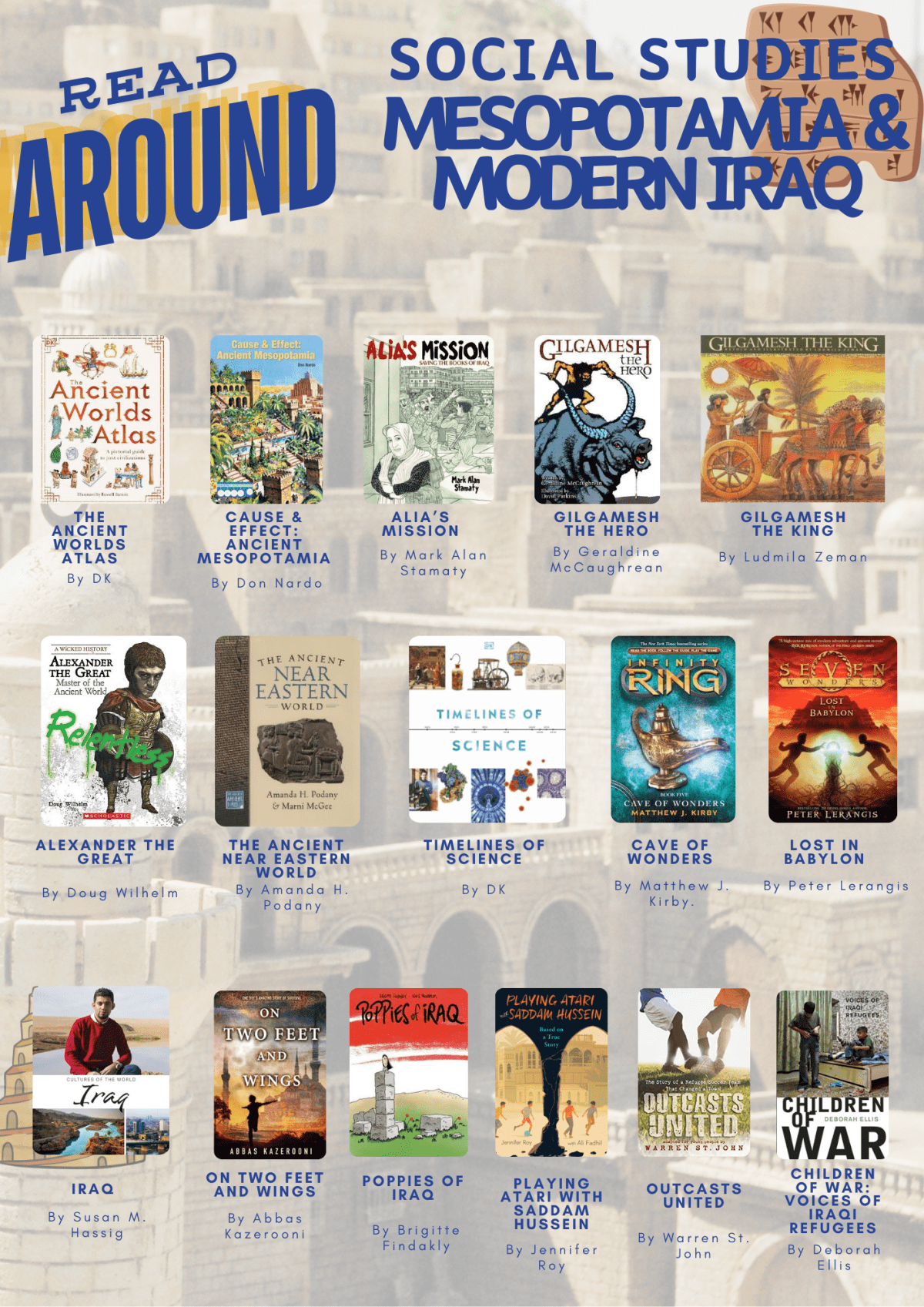
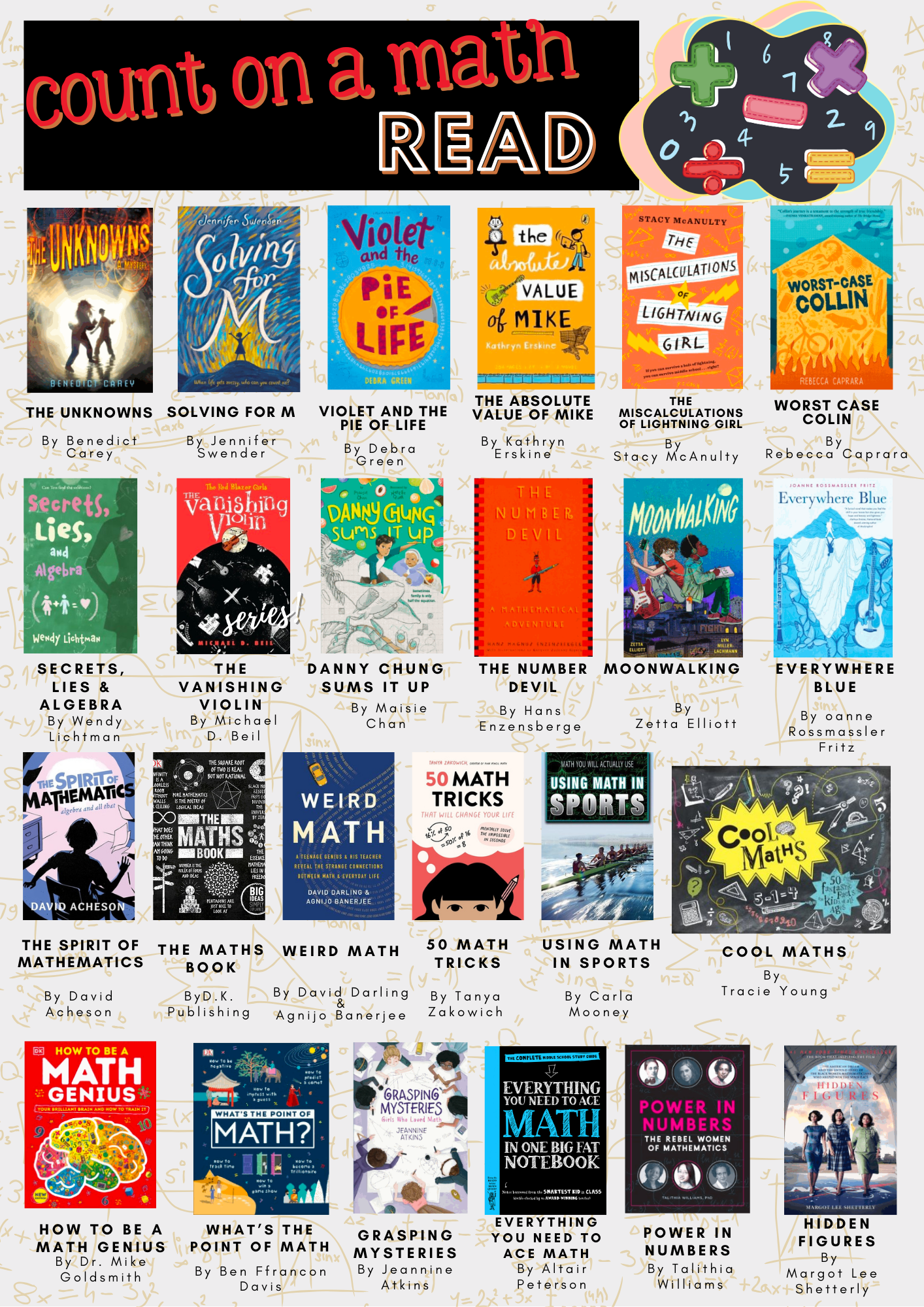
One of the things I’ve noticed moving from PYP / elementary librarian to Middle School is the apparent lack of curiosity in the students coming into the library. I’m sure there are many developmental and sociological reasons for this – not the least the necessity to belong and be cool. This combined with my drive to help “sense-making” in the library for our students – where a plethora of books is wonderful from a curation point of view but hopeless from a choice POV (POV is a very important thing in middle school parlance at the moment) means I’m spending a lot of my spare time (haha, not much of that unfortunately) making “read around” posters that go into look books that are a non-digital physical way of signposting books and hopefully stimulating curiosity and interest beyond what’s going on in the curriculum.
It’s still in a pretty messy form, so I’m not quite yet ready to share my Canva templates, but here are a few examples.
Kind of related to that Katie Day and I are busy creating the “Essential Middle School Nonfiction book list” – a “best of” in our opinion of the books now available for Middle School Students – and tagging the books along a bunch of dimensions of format, topic, geo-location etc. That should be ready soonish.
Learning and AI
Again, with my partner-in-learning, Katie, we’re preparing a talk for educators and parents for the Neev Literature Festival (if you’re anywhere near Bangalore India, that’s the place to be next week – an amazing line up of authors and speakers).
I became somewhat interested in AI, Blockchain and learning and matters related in the summer of 2018 thanks mainly to an article by Jeremy Howard on learning Chinese since at that point I was still in China and actively learning Chinese and I’m always fascinated and very fond (in an intellectual sense) of people who were climbing that mountain with me – this is a more recent podcast featuring him on the subject. I’ve since moved on to learning French and German using Duolingo – which I’m still somewhat deeply sceptical about, but more or less sucked into a learning streak which I suspect is more algorithmically behaviourally induced than true learning. I remember moments learning chinese when I literally was feeling my brain creaking – something Duolingo hasn’t managed to re-create.
Where am I now? Well, AI has progressed a lot faster than my interest in it, if I am completely honest. I’m not sure if it’s a result of a fundamental distrust of whatever the “latest thing” is, or I’m joining Socrates and Plato on a distrust of a new technology – their view being “writing is a fundamentally representational activity. The act of writing only records ideas; it cannot generate them” and I’m with the AI camp saying “AI is a fundamentally regenerational activity; it can only regenerate ideas; it cannot generate them”. Actually I must say I disagree that writing only records ideas – through the process of writing and researching in order to write I do think I generate ideas … maybe not world-changing ones, but ideas nonetheless.
A few things I’ve been watching / reading that I think are of use have been:
Rory Sutherland’s “Are we too impatient to be intelligent” two quotes I particularly liked were “…a problem, I think, which bedevils many technologies and many behaviours. It starts as an option, then it becomes an obligation. We welcome the technology at first because it presents us with a choice. But then everybody else has to adopt the technology, and we suddenly realize we’re worse off than we were when we started.” and “there are things in life where the value is precisely in the inefficiency, in the time spent, in the pain endured, in the effort you have to invest.” – thinking about what he is saying resulted in the title of this blog.
Jay Caspian Kang’s “Does A.I. Really Encourage Cheating in Schools?” with this message “school isn’t about creating new scholarship or answering questions correctly—it’s about teaching proper work habits. A young person who takes the time to go into a library is more likely to develop the types of work habits that will allow him to find accompanying bits of information that might be useful in creating a novel, an algorithm, or a convincing argument. Setting aside the obvious offense of dishonesty, the problem with cheating isn’t so much that the student skips over the process of explaining what they learned—it’s that they deprive themselves of the time-consuming labor of actually having read the book, type out the sentences, and think through the prompt.”
Joshua Rothman’s “What Does It Really Mean to Learn?” – I really loved this article about Leslie Valiant’s book “The Importance of Being Educable” – our ability to learn over the long term. I started reading the book but think the article actually covers the most important points very well.
I’ve also been reading around various academic papers in search of some kind of a framework within which to think about how to teach critical information literacy towards AI. There are a lot of very interesting “click-bait” titles, but so far not very much in the way of substance – so watch this space.
I’m wondering if it’s time for a renaissance. At least in the conversations I’m having with some educators we’re moving back to using nonfiction books for research, printing out articles from databases, using fewer resources more intensively and other such retro ideas. Faced with 22 students aged 10-12 learning about inventions in Mesopotamia I am resisting using the phrase “skim and scan” before they can actually read a paragraph, a page, a chapter and be able to tell what the main idea is and how that relates to what they already know and what they think they still need to find out.
It’s been a little while – but I’m going to direct you all to what I consider to be one of the best series of articles the NY Times has brought out – Errol Morris’ “The Anosognosic’s Dilemma: Something’s Wrong but You’ll Never Know What It Is” about the Dunning-Kruger effect “When people are incompetent in the strategies they adopt to achieve success and satisfaction, they suffer a dual burden: Not only do they reach erroneous conclusions and make unfortunate choices, but their incompetence robs them of the ability to realize it.” besides American (and other) politics, there are few places where this is more rampant than in middle school. It’s not our role as educators to point this out to our students, but rather to bring them to the point where we create the environment where they are nudged into making the right choices – at the very least around learning and to commence that journey of being able to glimpse the horizons of knowing what they don’t know.
Yet again an article despairing how kids are not reading “For Too Many Kids, Books Are Uncool and Unread” with all sorts of “reasons” and little in the way of solutions. So here are a few people / places / organisations who are trying to do something and a little on the work I was doing recently.
Engage everyone
While language arts / language and literature teachers and particularly librarians are often called upon or take it upon themselves to play a role in turning out literate students who hopefully also enjoy reading – it is a mistake to pigeonhole the efforts onto a few people. Just like I spend quite a few hours of my week engaged in coaching students in sport I like to think that my colleagues in other subject areas – including Physical Education etc. could spend a bit of time encouraging students to read. Particularly PHE teachers – since as my now young adult son (previously reluctant reader middle school son) told me “give up mom, middle schoolers don’t listen to anyone except maybe their PHE teachers and sports coaches”.
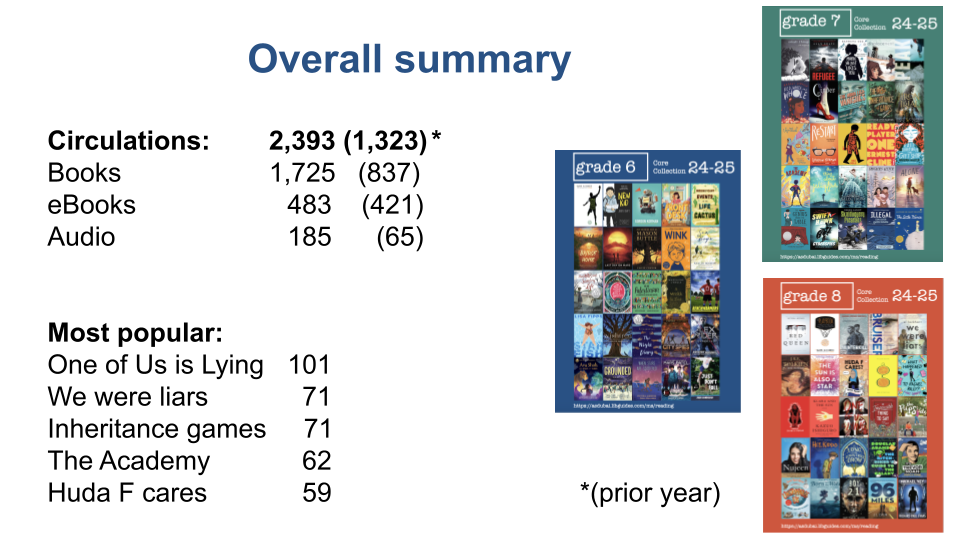
Last year I started having a core collection (an idea initially started in the UK by CLPE, and carried on internationally by Katie Day) of 25 books per grade for our middle school. We invested in at least 3 copies of most of the books and the books were promoted in the ELA (English Language Arts) classes and the library. Having a narrower selection of books to focus on meant that as a group we could try and read as many of these as possible and “sell” them to students. The news crew of our “Falcon Flyer” also helped with promotion by featuring the books, and they were also displayed on our internal TV screens in the library and MS corridor. A weekly quiz via google forms and the “Battle of Core” assembly were less successful than I’d have liked – but let’s say it was something to build on. However when I analysed the circulations from these 75 books I was positively surprised and just how many had circulated. As can be seen – kids still prefer print, and audio is their least preferred medium.
In my discussion with the ELA department about declining reading there was a strong feeling that promoting the books shouldn’t just be on them – and I took that thought to heart and just before the summer in our last staff meeting with the support of our admin launched the “staff summer reading challenge”
This involved quite a bit of preparation work, starting about 6 weeks before the end of term, including updating the lists for the new year, taking out books that weren’t popular or didn’t resonate with students, getting suggestions from our most avid readers (and asking them to pre-read where I wasn’t sure which book would be better) and making sure we had coverage of genres, levels of difficulty and format (verse novel, graphic novel, nonfiction, memoir, fiction) and our books were reflective of our community – each grade having at least one book with a muslim perspective as we’re in the UAE. Our new list can be found on our reading libguide. Next up was making sure all the books were ordered so that they were available before the meeting and then making new posters, shelf-signs with a summary, badges and a “mini-book”.
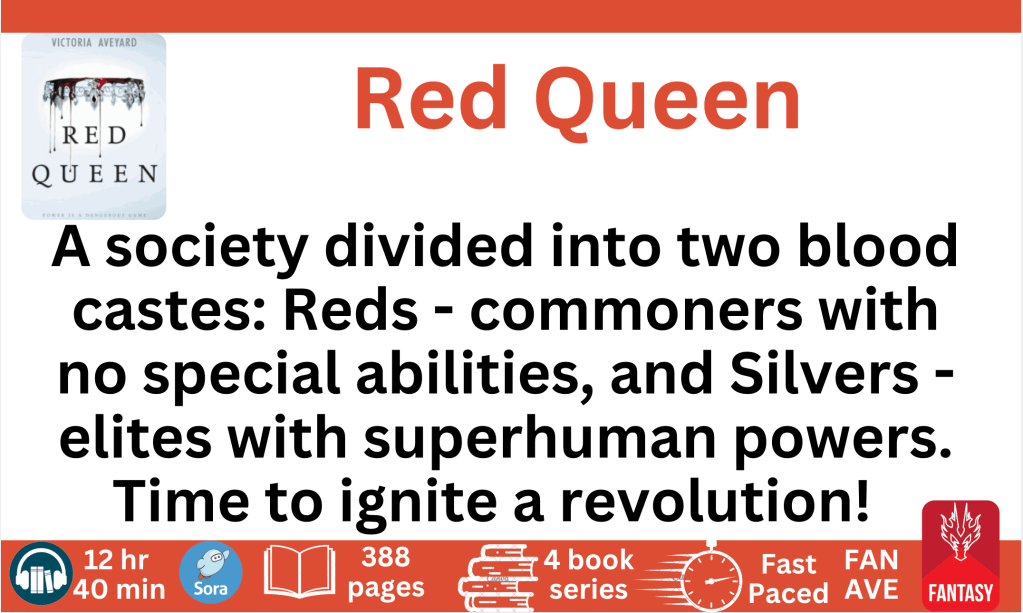
The shelf talker signs were based on inspiration from Kelsey Bogan but I wanted them to convey a little more information that I thought would be relevant in the “selling” process – first to our staff and then to our students, so I amended them a bit – the colouring corresponds to the grade, I added the book image and the genre image. Kept the blurb to 20-25 words (combination of publisher blurbs, Magic School AI summary powers and my knowledge of the book – AI can really get things badly wrong with what trigger words would encourage readers and be very repetitive with some phrasing!); I also added whether we had the eBook or Audiobook and the duration of the audio; pages of the book; whether it was part of a series, and the pacing.
Here are the canva files for our Grade 6; Grade 7 and Grade 8 lists – feel free to use or adjust as necessary.
The badges were made thanks to the loan of a badge maker by our design department and the “mini books” are images of the books on a piece of foam that the teachers can stick on their classroom door.
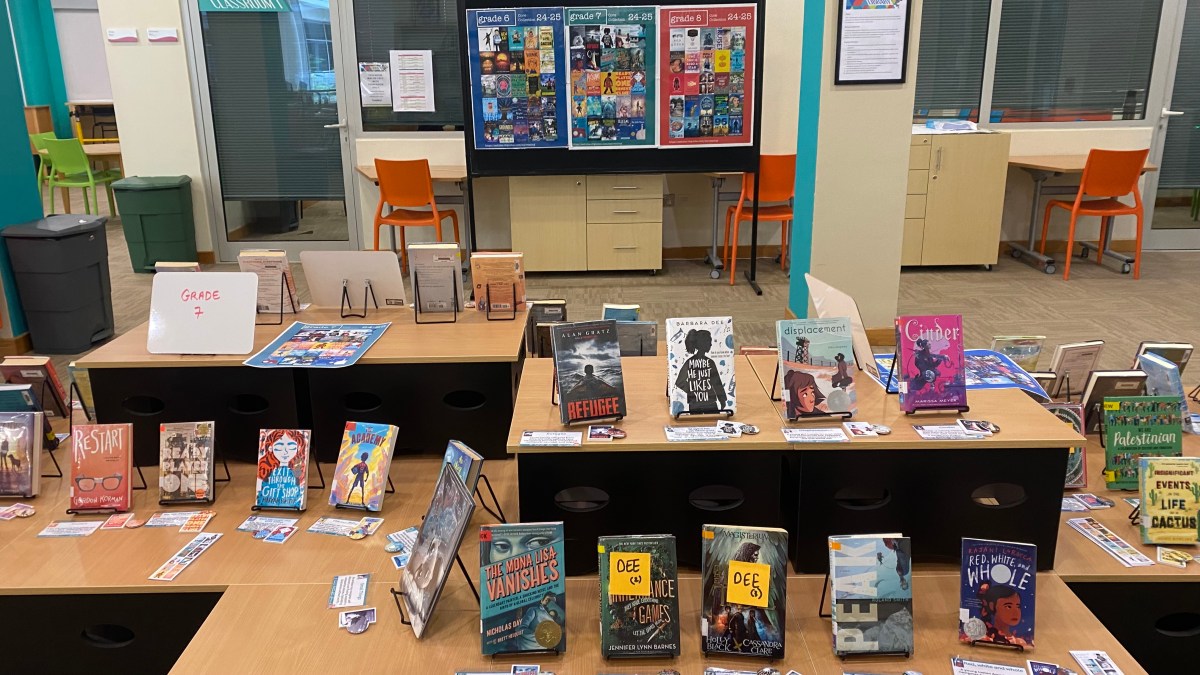
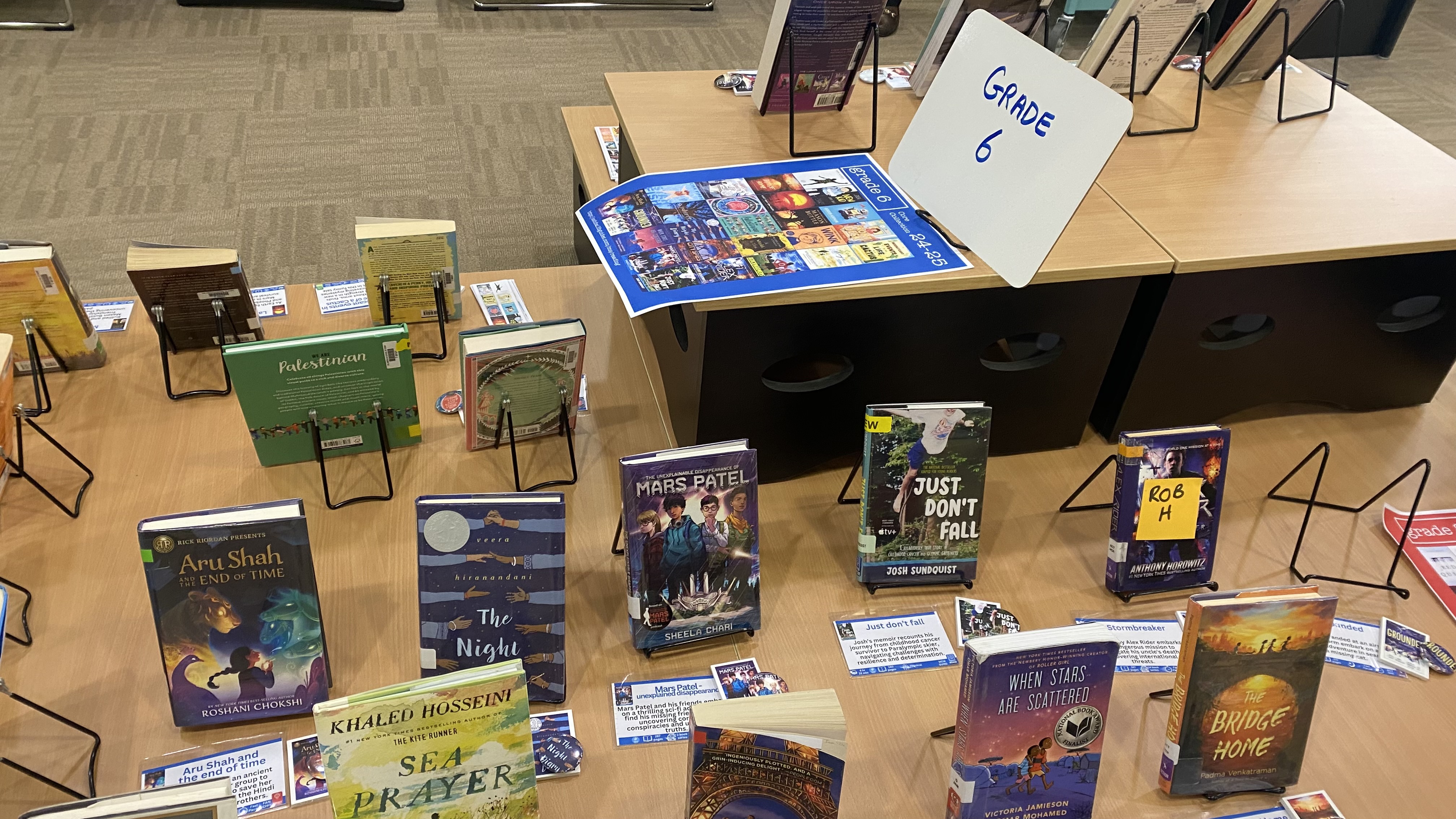
For the meeting, I put all the books on display with their paraphernalia, and the teachers were invited to select a book to borrow for the summer, commit to reading it and to help be the books “key account manager” for the coming year and promote it to students in the coming year. Our communications department helped by taking pictures of teachers with their chosen books (hiding the face) so we can use that for a little promotion guessing game in the new year); teachers borrowed the book and could put the badge on their lanyards. They “claimed” the book by putting a sticky note with their name on the poster. In the end, only 6 out of 52 staff members declined. Several teachers selected more than one book and our drama teacher selected 5 (and sent me a very enthusiastic voice mail last week to say she’d read them all and enjoyed them so much she’d also read all of the rest of the books in the various series, coming to a total of 17 books!).
So, watch this space and we’ll see if this has more of an impact in the coming year.
Other people / organisations making a big difference
Although not always realistic, I am a secret admirer of the “go big or go bust” approach to things. I suspect some times we are actually underestimating the abilities of our students by setting very low goals for them. There is a balance however between something being too daunting versus to infantile. Generally I suggest students should try and read a book a week – something quite manageable if one is truly spending 20-30 minutes a day in focused reading, perhaps combined with audiobooks and some manga / graphic novels. Also, our top readers (ironically – or not – none of whom have mobile phones) manage 2-3x that.
The Neev Reading challenge 2024 of 30 books over 3 months for grades 4-6 combined with author interactions, and a live quiz during the literature festival is a great example of setting a stretch goal, having competitive and noncompetitive tracks and a great starting point to select books. I just love how ideas grow and evolve. When I moved to Beijing in 2018, I was part of the 50 books Reader’s Challenge which I think the librarians at ISB started. In my role of juror for the Neev Children’s Book award, I was chatting to Neev about the challenge, and what worked and didn’t work quite as well – and they grabbed the ball, ran with it and now it’s this amazing thing!
I’ve blogged about the Global ReadAloud before, and still think this is a phenomenal way to involve students and teachers with books and connections with other readers and most importantly the “smelling salts” of reading aloud to them. Here are the selections for 2024. I particularly love “As long as the lemon trees grow” a book that’s on our core list and a fantastic read for older students.
At the end of the school year we have 6 library sessions involving our “upcoming” grade 5 into 6 students to introduce them to the Secondary School library. This year as an exit ticket I asked them to write down their favourite book / author / series. As I roamed around talking to them while they were doing this, I’d say that at least 75% of the books they said they loved the most were books that had been read to them by a teacher, parent, grandparent etc. Reading aloud matter.
Besides her work on the GRA – Pernille Ripp also has some great posters (and books) on encouraging a reading culture, such as the one on “Helping Home adults support adolescent readers”
That’s all I have time for today – if you’d like to have your initiative featured, please let me know!
I need to write an interpretive discussion paper. I’m trying to organise my thoughts. My first and foremost thought is that writing this paper is in direct contravention to the topic of the paper, which is “Digital scholarship in education, in the context of interdisciplinary knowledge and research” – because my digital scholarship is leading me down all sorts of other avenues and thoughts which definitely do NOT fit into the marking rubric. I’m also immensely frustrated at being a distance learner and not knowing who in the zoo to discuss these thoughts with. I’m tired of rehashing the articles that all say the same thing about the evolution from web 1.0 to 2.0 to 3.0 and the fact that we all can be producers and not just consumers, open access (OA), MOOCs, twitter, blogs blah blah.
Transformative?
What are my thoughts right now – on the exact topic? In the first place that digital has not been transformative enough to scholarship. Yes in theory, no in fact. The digital spaces I see in education have been highjacked not by scholars but by self-promoting practitioners of the twitterati. There is a lot of anecdotal rather than research based evidence. And they’re echo-chambers of white middle-class educators, often male. I need to expand my networks, and I’ve been making a concerted effort to follow people who are publishing real peer-reviewed research – some of which are on social media and some of which aren’t. Some who tweet about their research, most who don’t. Or just refer to conferences they’re talking at or have talked at, or their followers enticingly frustratingly refer to such presentations. The thing is that for all this to be transformative it also needs to be heretical. And heretics are not welcome in institutions. Because they threaten the control and status quo of institutions, and by definition are persona-non-grata and there are pathways of recognition (leading to tenure at which point hopefully you’d be entrenched enough to say what the damn you please but by then you’d probably be entrenched enough to buy into the status quo and have a stake in maintaining it). Yes they are clever. Who runs the MOOCs? Who feeds them, who controls them, finances them and their content? – the institutions. And the money. Yes, always follow the money. All those wonderful digital tools. Those databases, those journals, encyclopedias. My gold standard for testing anything a salesman throws at me as a school librarian is looking up “socialism” and “communism” in their search engines. Try it. Just try it.
What is education for? I’ll buy the ‘transformative’ bit on the micro individual well-heeled personal level, – but take it local or regional or national and you have the ‘productive literate citizen’ emerging. What do we want from the 21st Century learner? Link looks great doesn’t it. Global citizens and all those skills (not content or facts), and then you click on “pricing” and you can clone plans. I repeat. You can pay to clone plans. You can pay someone else to do your thinking and planning for you can you can teach to that plan and create clones of every other global child whose school or teacher can afford this. It’s so slick it’s so nicely designed, it’s so intuitive and easy.
Confrontational and Challenging
Easy. Am I a puritan that I think things have to be a struggle and difficult? Not really, I like Vygotsky and the ideal of proximal development. I don’t like when kids are proximally developed to be led by the nose or to follow the breadcrumbs to the cottage in the woods made of candy only to find out that they’ll be trapped by the witch of educational debt in a cage that is not of their making. No, I think that education does not really have so much to be difficult as in inaccessible and alienating, but I think it needs to be difficult in that it should be confrontational and challenging. And education dominated by packaging – of textbooks, of websites, of learning platforms, of learning plans – created by big corporations and big non-profits cannot be confrontational. It can only be nationalistic or capitalistic or serve the needs of the society in which it finds itself. Or the version of what that society thinks its needs are. Good productive (national) citizens. Because often being a global citizen is at odds with being a national citizen. Because then you might just want to open the borders and let the refugees in. You may not vote for the hawks. You’d want to leak confidential documents, hack into university databases, give maternity & paternity leave, free education, a minimum wage, universal health coverage AND WHO WOULD PAY FOR ALL THAT? Huh?
Tower of Babel
So the digital. The open borders, the open access. The flat earth. Where a researcher / research at the other end of the world is at the touch of a button or a click of a mouse. As long as you both have the internet. And speak each other’s language (or preferably that current god of all language, English), as long as that research is in a bundle paid for by your institution. As long as you’re part of an institution, because paying $39.95 per article for research that may or may not be relevant, may or may not be any good is no joke for the casual dilettante. And when you leave formal education, when you graduate and lose access to all that body of formal knowledge, lose your writing on fora and institutional blogs, when the gates to the ivory towers slam shut? Are you no longer a scholar? Are you an ex-scholar? A practitioner? I think about this a lot as I reach the end of this degree.
Language and culture
Coming back to the whole language thing. According to Ren and Montgomery (2015) from 1996 to 2012 – 2,680,395 scholarly articles were published internationally by Chinese authors, 35% of which have never been cited, and the average citation per publication is 6.17 versus 20.45 for an American author. 95% of its most important research “are now published by foreign commercial publisher and locked behind pay-walls” (p. 397). Most scholars do not have the English proficiency, there are not enough translators and therefore the research remains trapped in Chinese repository systems. The article is a fascinating glimpse into the profundity of linguistic barriers, cultural and ideological differences in writing, research and performance metrics that are seldom if ever mentioned in the jubilant digital scholarship literature.
Interdisciplinary
As a fairly recent migrant from the world of commerce and industry to the world of education, one of the other articles I read was cause for inner ironical chuckling. Interdisciplinary. What does that mean? That you stay in your academic ivory tower but build bridges to other towers in the same academic village, or even across the pond to another tower where there are English speakers? And you interact only with the grubby world of business when they sell you OLP (online learning platforms) and data analytic systems and student interfaces and lesson plans and databases. But do you consider that you may be able to learn from that world? Even within business schools, the frenetic search for pertinent case studies is to inform and guide practise by current or potential business people. And so I turn to Siemens and Burr (2013) – who I must say I have a huge amount for respect for, because they are talking, reading about and DOING research in international research teams. They are grappling with linguistic and cultural barriers. And I read their article and the whole time I’m thinking – you’ve got to be kidding me. Yes, you’re probably breaking new ground in your context, but global companies have been doing this for decades. For eons. Your average wet-nosed graduate in a developing country working for a multi-national could have told you of all these challenges AND how they’re resolved in commerce and industry. I have to wonder, when a paper cites Hofstede – 1980 * if they’ve read and understood it’s context (Shell oil company), why they don’t think – heck – those multinational companies must know a thing or two about this – let’s go and ask them how to resolve this rather than us having to reinvent the wheel. Just pop over to your local business school or track down a travelling salesman with a passport to find out more.
I realise I’ve nearly written 1,500 words right now, and I don’t even begin to cover all the ground that I’d want to cover but can’t. I’ll just end by referring back to Gee and Hayes (2011). The first six chapters are a great read to understand the context of current education, language and literacy as part of a continuum of education across the ages – and they can express this background so much better than my amateur fumblings. And after giving a context what is the future? It would have to be in machine translation. In non-affiliation to a single academic organisation or nation. The return of the professional amateur, of “royal societies” that are not royal or national. Different pathways of legitimisation and accreditation. More cooperation and collaboration but also more confrontation. Assignments that are conceptually bound but content liberated. Radically open access to both published and rejected research, with commentary as to the rejection – a bit of meta-cognition anyone? Access to assignments with grading. Plagiarism is only an option in a closed rigid system with unimaginative content related assignments. And those do nothing to further scholarship, digital or otherwise.
(And apologies to all those authors and researchers who are not cited but who are informing my thinking, but were not read in the last few days).
References:
Gee, J. P., & Hayes, E. (2011). Language and learning in the digital age (1st ed). New York, NY: Routledge.
Ren, X., & Montgomery, L. (2015). Open access and soft power: Chinese voices in international scholarship. Media, Culture & Society, 37(3), 394–408. http://doi.org/10.1177/0163443714567019
Siemens, L., & Burr, E. (2013). A trip around the world: Accommodating geographical, linguistic and cultural diversity in academic research teams. Literary and Linguistic Computing, 28(2), 331–343. http://doi.org/10.1093/llc/fqs018
————————
(* As a side note, Hofstede was taught to me as an expat 101 in the early 1990’s before my husband and I left on our first international assignment in Brazil. There is an updated version of his book – co-written by his son and Michael Minkov. Should be read by every ‘global’ educator and student interested in global collaboration and cooperation :
Hofstede, G. H., Hofstede, G. J., & Minkov, M. (2010). Cultures and organizations: software of the mind: intercultural cooperation and its importance for survival (3rd ed). New York: McGraw-Hill.)
My husband and I attended a “school board of governors meets the parents” evening on Thursday night and one of the attendees asked what the school was doing to encourage more girls to go into STEM careers. There was also some discussion about the fact that even in this liberal high achieving school certain stereotypes of “boys being good at math” and “girls being good at the humanities” was panning out (if the ISA scores were an indication at least).
I am glad that type of question was asked, but I think we need to examine the whole gender thing far more deeply. It’s not just about STEM. After the public forum, I confronted the head about the fact that except for this meeting and one other on “teens and technology”, every other public forum of the school had been held during working hours. Including the coming “meet the teacher” event. Which meant that either working parents couldn’t attend, or one or the other or both had to take leave. What kind of message are we sending our students – male and female – at this most formative time in their lives about who we allow and expect to be engaged in a child’s education?
If these meetings are not important – why hold them? If they are important, why are you excluding the economically active role models of your community and only including those who either have enough leisure, have the financial means to be free during working hours, or have chosen for one reason or another (including the reason that if they didn’t stay at home they couldn’t be a participant in their school community life) not to work full-time.
In the years that I chose not to work full-time, one of the over-riding factors in my choice was exactly that I wanted to be a part of my children’s school community and to contribute to their educational lives in this way. Then I was thrust into full-time work out of economic necessity and no longer had the luxury of factoring this into my choice. And now I am one of the excluded.
Now as an excluded I wonder if I am the only one protesting, or if there are more like me, but we are just not aware of each other, since through our exclusion we are isolated voices that can be ignored. I wonder how many tried, failed and gave up. Because the school’s standard answer is that evening events / meetings are not well attended so they are not worth their while. Is it the chicken or the egg. And more than anything else, what does that say to our daughters and sons about expectations of motherhood, careers, educators, participation in a community?
In this week’s module we were posed the following questions:
How would curriculum change if our priority approach was on critical, creative, and collaborative thinking?
What does the reality of the modern age of information– this age of Google –suggest that we “teach”?
Can we simply “update” things as we go, or is it time for rethinking of our collective practice?
I was forwarded this very provocative article from the Atlantic by my boss this week = “The deconstruction of the K-12 teacher” It ties in quite nicely with the theme of this module, but it also turns the questions on their heads.
how would the curriculum change if they were in the hands of learners and not educators?
What does the reality of the modern age of information suggest as to who should be teaching?
Will “updating things as we go” enhance or delay the obsolescence of the current collective practice?
Or at least these could be the questions IF and only IF all the glory day assumptions on technology and education were true. As so many of my cohort have pointed out, the reality on the ground is very different from the theory and assumptions made up in ivory or silicon towers. There are brilliant teachers who don’t touch technology and will never need to and their students are not any the poorer for it. There are physical tools that are just as effective or more so than technological tools (see this great blog by Buffy Hamilton on writeable tables). There are pathetic teachers who wow and woo with their technical powess, and there are self-absorbed #SoMe educators who p*** the hell out of their colleagues and students. There are teachers who are genuinely passionate and engaged with their students AND technology and how the combination can optimise learning and reach students in ways that traditional teaching may not be able to. There are those who have experimented and been rewarded and feel empowered to continue and those who have tried and failed or tried had had their fingers smacked by threatened superiors or administrators or frightened parents.
There are children who are naturally curious and respond to any and every stimulus be it text or video, paper or screen and dive right into everything and those who hang back, those who are scared of failing. Those who’ve seen it all, can do it all and more and those that need a lot of help. A LOT OF HELP. Will technology be the panacea?
I’m not sure that education has ever moved forward by revolution (and it is usually at the behest of entrenched power structures that it does so). Rather it seems to have fits and starts and intermittant warfare (remember the reading/phonics wars?)
The question I think is really, in whose interest is it that education changes, and do they have the power and control to institute those changes? And this is where it gets interesting. Coming back to the Atlantic article – it would appear to make economic sense to only have “super teachers” and to gain economies of scale, so that would benefit local / state governments wanting to save money. It may even be attractive to those wanting to pay less tax. It’s certainly interesting for commercial educational interests (Pearson etal. the most hated kid on the block it seems) to support this.
Who is driving this bus? I get the feeling that many educators are feeling like passengers, some willingly paid for the ride, some were forced to embark, some think they’re the conductor or the ticket collector, But who has set the itinerary, and is there a driver or is it a unmanned ground or cloud vehicle?
I see the changes benefiting students as they can delve deeper and go further than the curriculum would allow. Go beyond the geographical and age limitations set by traditional classrooms. I also see some of them them drowning in content without being able to absorb, internalise or think about it before moving on. I see them learning to use fabulous tools and I see them being sucked into a time-blackhole where the tool and the look of the product becomes more important than the content, the analysis, the thinking or the learning.
I don’t have answers, I just have observations and thoughts and questions right now.
In this week’s module we were posed the following questions:
How would curriculum change if our priority approach was on critical, creative, and collaborative thinking?
What does the reality of the modern age of information– this age of Google –suggest that we “teach”?
Can we simply “update” things as we go, or is it time for rethinking of our collective practice?
I was forwarded this very provocative article from the Atlantic by my boss this week = “The deconstruction of the K-12 teacher” It ties in quite nicely with the theme of this module, but it also turns the questions on their heads…
Who is driving this bus? I get the feeling that many educators are feeling like passengers, some willingly paid for the ride, some were forced to embark, some think they’re the conductor or the ticket collector, But who has set the itinerary, and is there a driver or is it a unmanned ground or cloud vehicle?














 Informative Flights - Musings of a Teacher Librarian