Stilling and stimulating the mind …

I’m busy writing my report for the final assessment – on Information Literacy (IL). Talk about how to eat an elephant.  Or rather I feel like when my kids were overdue for birth – you knew it had to come but they were taking their own sweet time.  Same with the ideas about IL.  It’s a huge topic, confounded by so many variables. I had to grapple with how I felt and thought about it before I could put anything coherent on paper. I just about reached that stage yesterday.  I’ll blog about it some time once this assignment is in.

In the mean time, to cool and still my mind, or keep it otherwise occupied while in the background the IL thoughts are humming I’ve been reading and listening to some great podcasts – this one was by Salman Akhtar on the “Trauma of geographical dislocation” it’s from a psychoanalytic point of view, so you need to get over the first few minutes and may want to skip the last few if Freud isn’t your thing – but the bits inbetween are pure poetry.

On my bedside table at the moment is “Surely you’re joking Mr. Feynman” – I’m just loving the old fashioned writing and casual way he speaks about learning and education – so much is about curiosity and forging one’s own path.  I wonder in the hyper-competitive environment of now if it would even be possible for students to meander so much in their learning and thought, taking out time to dabble in other subjects while pursuing their main degree?  In fact I’m really thinking a lot about why we have degrees and subjects and curriculums.  I know when I was studying business and accounting in the misapprehension that I wished to become an accountant (how can one become? surely you “are” something and then you just need to develop further?), I pursued a parallel existence studying languages and psychology on the side. Then in an alignment of thought, BBC world had a fascinating interview with Dr. Margaret Boden world specialist in artificial intelligence – why? Because she combined philosophy, psychology, neuroscience and a curiosity and passion for learning.  Serious dabblers shall inherit the earth in my world view.

If ever asked what I’d like my children to be (like) when they grow up or even now, I’d say just roll those polyglots together and I’d be happy.

Critical Reflection ETL401

In this course, what I have learnt in the library and information sphere is now placed in the context of the school library, which is where I hope to further my career. In doing so it has clarified and added detail to concepts such as the role of the teacher librarian (TL) and information literacy (IL), while making me aware of what I don’t know much about – particularly in the area of curriculum and learning theories. As such, I am in a slightly stronger position meta-cognitively in ‘knowing what I don’t know’ (Morris, 2010). The comments of my fellow students and the course co-ordinator in the online fora, who come from a teaching background have been invaluable in this respect.


The role of the teacher librarian is complex, multi-faceted and dependent on the school context – which I explored in my first blog post (Bailey, 2014). As I work in a large K-12 international school means that some of the roles are assumed by or shared with the literacy and digital literacy coaches, leading to the need for constant collaboration and partnership not only with classroom teachers, school leadership and administrators but also these coaches.


Evidence and accountability in our role is something I would like to explore further in my work, particularly as we start up new initiatives such as classroom libraries and continue existing work in creating library pathfinders and co-teaching in some humanities models. In this way we can ensure that we are strategic in our time and resource planning to optimise our efficacy.


One of the main themes of this course has been information literacy, where we were introduced to the main thought leaders in this area, including Kuhlthau (2010; 2012a, 2012b, 2012c), Herring (2011; Herring, Tarter, & Naylor, 2002), and Eisenberg (2008; Wolf, Brush, & Saye, 2003). While many of the models of information literacy focus on the scaffolding of skills, information literacy can be seen as having four dimensions: cognitive (skill based); meta-cognitive (reflective); affective (positive and negative emotions); and the socio-cultural, including digital citizenship and ethical use of information (Kong & Li, 2009; Kuhlthau, 2013; Waters, 2012). This, and the question of transferability is something I explored in my blog discussing why information literacy is more than a set of skills (Bailey, 2015b). Literacy convergence and the 21st Century learner are valid realities that rethink the ambit of literacy in an information society that doesn’t only rely on text, and has expectations for learners that go beyond the personal consumption of information to contributing to using knowledge for personal or social transformation (Bailey, 2015a). However they can also be used as buzz words that can obfuscate the essence of information literacy irrespective of the medium used for access and dissemination of information (Crockett, 2013).


Learning naturally goes on outside the (virtual) classroom, and I have learnt a considerable amount through attending TL conferences, work shares, knowledge exchange workshops and conversations with my peers and more experienced TLs. One such conversation led to me investigating the fascinating concept of Threshold Concepts, particularly as it relates to information literacy (Hofer, Townsend, & Brunetti, 2012; Tucker, Weedman, Bruce, & Edwards, 2014). Although most research is currently in tertiary education (Flanagan,2015) I would like to explore which concepts would be relevant for our students and at what level we could introduce them and the most effective activities to do so. I’d also like to investigate assessment tools to aid us in pinpointing the problematic concepts in new students who have not come through the Guided Inquiry process of the school.


Our collaboration is not just with students, teachers and administrators but also parents who are often the ones picking up the slack and tasked with helping frustrated children with assignments or homework (Hoover‐Dempsey et al., 2005; Kong & Li, 2009). I have started doing some outreach to parents through co-ordinating our parent volunteer program, and marketing our online resources but realise I can do far more in educating parents in IL concepts and how best to continue scaffolding these concepts at home and making them aware of how our resources can aid them in this process.


One of the most valuable parts of this course was gaining an understanding of my own learning including cognitive and affective processes in the past two years and reflecting on my attempts to go through this process effectively unscaffolded, relying on instinct and common sense! Perhaps my learning would have been more efficient and effective if I’d known this all at the start, but certainly now I will be better at passing on the knowledge and experience to my students and children.


References:

Bailey, N. (2014, December 7). ETL401 Blog Task 1: The role of the TL in schools [Web Log]. Retrieved January 24, 2015, from http://thinkspace.csu.edu.au/informativeflights/2014/12/07/etl401-blog-task-1-the-role-of-the-tl-in-schools/

Bailey, N. (2015a, January 4). The role of the TL in practise with regard to the convergence of literacies in the 21st Century [Web Log]. Retrieved January 24, 2015, from http://thinkspace.csu.edu.au/informativeflights/2015/01/04/the-role-of-the-tl-in-practise-with-regard-to-the-convergence-of-literacies-in-the-21st-century/

Bailey, N. (2015b, January 18). Blog task 3: Information Literacy is more than a set of skills [Web Log]. Retrieved January 24, 2015, from http://thinkspace.csu.edu.au/informativeflights/2015/01/18/blog-task-3-information-literacy-is-more-than-a-set-of-skills/

Crockett, L. (2013, February 28). Literacy is NOT Enough: 21st Century Fluencies for the Digital Age [Streaming Video]. Retrieved January 4, 2015, from https://www.youtube.com/watch?v=N8DEeR1sraA

Eisenberg, M. B. (2008). Information Literacy: Essential Skills for the Information Age. DESIDOC Journal of Library & Information Technology, 28(2), 39–47.

Flanagan, M. (2015, January 21). Threshold Concepts: Undergraduate Teaching, Postgraduate Training and Professional Development. A short introduction and bibliography [Website]. Retrieved January 25, 2015, from http://www.ee.ucl.ac.uk/~mflanaga/thresholds.html

Herring, J. E. (2011). Assumptions, Information Literacy and Transfer in High Schools. Teacher Librarian, 38(3), 32–36.

Herring, J. E., Tarter, A.-M., & Naylor, S. (2002). An evaluation of the use of the PLUS model to develop pupils’ information skills in a secondary school. School Libraries Worldwide, 8(1), 1.

Hofer, A. R., Townsend, L., & Brunetti, K. (2012). Troublesome Concepts and Information Literacy: Investigating Threshold Concepts for IL Instruction. Portal: Libraries and the Academy, 12(4), 387–405. doi:10.1353/pla.2012.0039

Hoover‐Dempsey, K. V., Walker, J. M. T., Sandler, H. M., Whetsel, D., Green, C. L., Wilkins, A. S., & Closson, K. (2005). Why Do Parents Become Involved? Research Findings and Implications. The Elementary School Journal, 106(2), 105–130. doi:10.1086/499194

Kong, S. C., & Li, K. M. (2009). Collaboration between school and parents to foster information literacy: Learning in the information society. Computers & Education, 52(2), 275–282. doi:10.1016/j.compedu.2008.08.004

Kuhlthau, C. C. (2013, October). Information Search Process [Website]. Retrieved from http://comminfo.rutgers.edu/~kuhlthau/information_search_process.htm

Kuhlthau, C. C., & Maniotes, L. K. (2010). Building Guided Inquiry Teams for 21st-Century Learners. School Library Monthly, 26(5), 18.

Kuhlthau, C. C., Maniotes, L. K., & Caspari, A. K. (2012a). Assessment in guided inquiry. In Guided inquiry design: a framework for inquiry in your school (pp. 111–131). Santa Barbara, California: Libraries Unlimited.

Kuhlthau, C. C., Maniotes, L. K., & Caspari, A. K. (2012b). Guided inquiry design: a framework for inquiry in your school. Santa Barbara, California: Libraries Unlimited.

Kuhlthau, C. C., Maniotes, L. K., & Caspari, A. K. (2012c). The research behind the design. In Guided inquiry design: a framework for inquiry in your school (pp. 17–36). Santa Barbara, California: Libraries Unlimited.

Morris, E. (2010, June 20). The Anosognosic’s Dilemma: Something’s Wrong but You’ll Never Know What It Is (Part 1). Retrieved February 4, 2014, from http://opinionator.blogs.nytimes.com/2010/06/20/the-anosognosics-dilemma-1/?_php=true&_type=blogs&_php=true&_type=blogs&_r=1

Tucker, V. M., Weedman, J., Bruce, C. S., & Edwards, S. L. (2014). Learning Portals: Analyzing Threshold Concept Theory for LIS Education. Journal of Education for Library and Information Science, 55(2), 150–165.

Waters, J. K. (2012, September 4). Turning Students into Good Digital Citizens. Retrieved January 2, 2015, from http://thejournal.com/Articles/2012/04/09/Rethinking-digital-citizenship.aspx

Wolf, S., Brush, T., & Saye, J. (2003). The Big Six Information Skills As a Metacognitive Scaffold: A Case Study. School Library Media Research, 6, 1–24. Retrieved from http://www.ala.org/aasl/sites/ala.org.aasl/files/content/aaslpubsandjournals/slr/vol6/SLMR_BigSixInfoSkills_V6.pdf
 

The Teacher Librarian and multi-lingual environments – an opportunity

 One trend in education that has received limited attention in teacher librarian (TL) literature is the demographic shift in schools to more students with cultural and linguistic diversity. Statistics from the USA, Canada and Australia indicate around one in five students do not speak English – the language of school instruction at home (Australian Bureau of Statistics, 2013; “Canadian Demographics at a Glance: Some facts about the demographic and ethnocultural composition of the population,” n.d.; Center for Public Education, 2012). Data from Sydney University indicates that a national average of 21% disguises local figures at some (particularly state) schools with a range of 50-90% (Ho, 2011). International schools catering to an expatriate population are particularly diverse environments.

Practitioner literature generally concerns itself with cultural diversity in materials and the building of a world literature collection in response to student diversity or as part of a language / humanities curriculum (Garrison, Forest, & Kimmel, 2014). Some international or bilingual schools, build a “Languages other than English” (LOTE) collection.  Schools may try to recruit bilingual or minority TLs, or provide training in competencies in multicultural education (Colbert-Lewis & Colbert-Lewis, 2013; Everhart, Mardis, & Johnston, 2010; Mestre, 2009).

Within a school, the main educational and social issues are to ensure students acquire the language of instruction (English) as quickly as possible and adapt to the new learning environment without loss of educational momentum, while maintaining and developing their mother tongue (Kim & Mizuishi, 2014). Even though there is evidence that support and maintenance of mother tongue is the most effective way of scaffolding such students, schools place most of their effort and resources on English acquisition (Carder, 2007; Cummins, 2001, 2003).

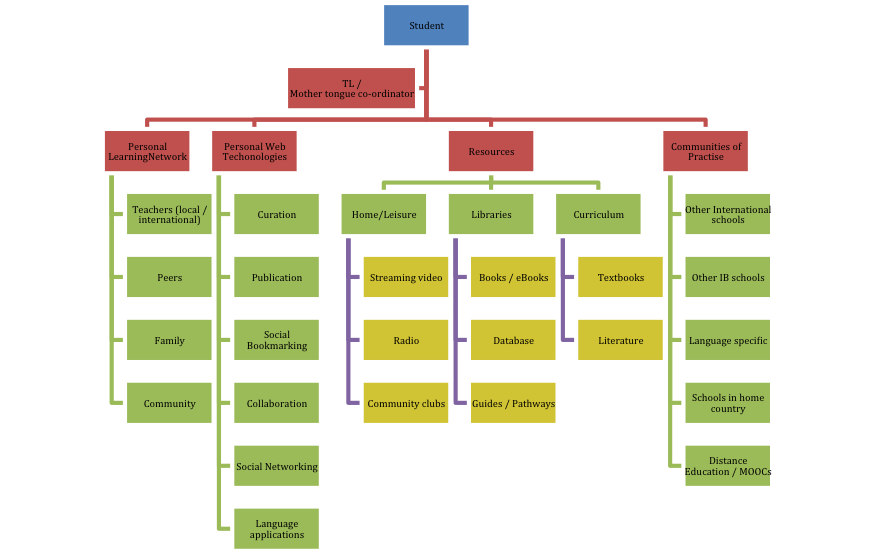
TLs in their own professional development are familiar with the use of geographically dispersed personal learning networks (PLNs) in order to create a personal learning environment (PLE) using a variety technological tools (McElvaney & Berge, 2009; O’Connell, 2014). They also have extensive networks both locally and internationally that can be tapped into. This provides TLs with an ideal opportunity of working with a group of students and teachers in creating their own PLE with a variety of resources, networks and personal web technologies (PWT) both in their mother tongue and the language of instruction.

Figure 1: PLE of an IB self-taught language student

The International Baccalaureate (IB) program allows mother tongue students the option of guided self-study if the school doesn’t offer the language.  Tapping into the experiences and communities of practise (COP) of distance education, massive open online courses (MOOCs), PLNs and PLEs could ameliorate the logistical, resourcing, teaching and learning difficulties of this option unbound by time and geography. A successful pilot scheme with one language group could be rolled out to other groups. Not only will this enhance the reputation of the TL in the school but will also contribute to the schools goals of equity in teaching and resources and ensure support and involvement by the whole school community.

References:

Australian Bureau of Statistics. (2013). Australian Social Trends, April 2013. Retrieved December
14, 2014, from http://www.abs.gov.au/AUSSTATS/abs@.nsf/Lookup/4102.0Main+Features
30April+2013

Canadian Demographics at a Glance: Some facts about the demographic and ethnocultural
composition of the population. (n.d.). Retrieved December 14, 2014, from
http://www.statcan.gc.ca/pub/91-003-x/2007001/4129904-eng.htm

Carder, M. (2007). Bilingualism in international schools: a model for enriching language education.
Clevedon; Buffalo: Multilingual Matters.

Center for Public Education. (2012, May). The United States of education: The changing
demographics of the United States and their schools. Retrieved December 14, 2014, from
http://www.centerforpubliceducation.org/You-May-Also-Be-Interested-In-landing-page-
level/Organizing-a-School-YMABI/The-United-States-of-education-The-changing-
demographics-of-the-United-States-and-their-schools.html

Colbert-Lewis, D., & Colbert-Lewis, S. (2013). The Role of Teacher-Librarians in Encouraging
Library Use by Multicultural Patrons. In C. Smallwood & K. Becnel (Eds.), Library services for
multicultural patrons: strategies to encourage library use
(pp. 73–81). Lanham: The Scarecrow
Press, Inc.

Cummins, J. (2001). Bilingual Children’s Mother Tongue: Why Is It Important for Education?
Retrieved May 27, 2014, from http://iteachilearn.org/cummins/mother.htm

Cummins, J. (2003). Putting Language Proficiency in Its Place: Responding to Critiques of the
Conversational – Academic Language Distinction. Retrieved May 27, 2014, from
http://iteachilearn.org/cummins/converacademlangdisti.html

Everhart, N., Mardis, M. A., & Johnston, M. P. (2010). Diversity Challenge Resilience: School
Libraries in Action. In Proceedings of the 12th Biennial School Library Association of
Queensland
. Brisbane, Australia: IASL.

Garrison, K. L., Forest, D. E., & Kimmel, S. C. (2014). Curation in Translation: Promoting Global
Citizenship through Literature. School Libraries Worldwide, 20(1), 70–96.

Ho, C. (2011). “My School” and others: Segregation and white flight. Australian Review of Public
Affairs
, 10(1). Retrieved from http://www.australianreview.net/digest/2011/05/ho.html

Kim, M., & Mizuishi, K. (2014, December 10). Language and Cultural Differences and Barriers in
an International School Setting – Personal Experiences and Reflections
[Presentation].
UWCSEA-East.

McElvaney, J., & Berge, Z. (2009). Weaving a Personal Web: Using online technologies to create
customized, connected, and dynamic learning environments. Canadian Journal of Learning and
Technology
, 35(2). Retrieved from http://www.cjlt.ca/index.php/cjlt/article/viewArticle/524/257

Mestre, L. (2009). Culturally responsive instruction for teacher-librarians. Teacher Librarian, 36(3),
8–12.

O’Connell, J. (2014). Researcher’s Perspective: Is Teacher Librarianship in Crisis in Digital
Environments? An Australian Perspective. School Libraries Worldwide, 20(1), 1–19.

Thought experiments and information literacy

A little while back KDA (Librarian Edge), enthusiastically placed a book on my desk and said I had to read it and I had to create a library guide based on it (I did, see this, and it was very enthusiastically received by Mr. Fleischman).  She was completely right.  What a wonderful resource has been placed into the hands of librarians and teachers everywhere.  Read more ….

Information Literacy is more than a set of skills

The question of whether information literacy (IL) is more than a set of skills is an important one, as it sets the philosophical basis that informs the approach that an institution and its administrators, teachers and teacher librarians (TL) take in the design and implementation of a program.  Read more …

Blog task 3: Information Literacy is more than a set of skills

The question of whether information literacy (IL) is more than a set of skills is an important one, as it sets the philosophical basis that informs the approach that an institution and its administrators, teachers and teacher librarians (TL) take in the design and implementation of a program.

IL can probably thought as occurring along a continuum of proficiency, dependent on a number of factors including but not limited to:

  • Age / developmental stage of the student (Brown, 2004; Miller, 2011)
  • Psychological, attitudinal and motivational factors including resilience, persistence, ability to deal with ambiguity, complexity and emotion (American Association for School Librarians, 2007; Kuhlthau & Maniotes, 2010)
  • Aptitudes such as prior knowledge, comprehension, interpretation and connection seeking (Herring & Bush, 2011)
  • Social, linguistic and cultural context (Dorner & Gorman, 2012)

Drawing on my interest in language acquisition and particularly the field of bilingualism, I think an argument can be made for comparing IL and bilingualism. Cummins (1998, 2001, 2003) distinguishes between Basic Interpersonal Communication Skills (BICS) and Cognitive Academic Language Proficiency (CALP). Students who have BICS appear to be fluent in the language, however, although they have developed the surface skills of speaking and listening, they lack the ability to succeed in cognitively demanding context-reduced academic tasks. Research indicated that BICS could be acquired in a couple of years, while CALP took five to seven years. Similarly it could be argued that the superficial skills of IL could be acquired reasonably rapidly within context embedded, concrete tasks that are sufficiently scaffolded by the teacher or TL. However, researchers have observed the sometimes elusive ability of students to internalise information literacy instruction, and employ or transfer it across different learning contexts, depending on assumptions made by the learning community (Herring, 2011) even if IL instruction occurs embedded in Guided Inquiry (GI) (Thomas, Crow, & Franklin, 2011). In any event, it would appear that this internalization and transfer of skills did not occur until the high school years – indicating that it is a process that occurs over time and as a result of repeated exposure to and use of IL skills in increasingly complex and abstract learning tasks.

It can be posited that one could look at the students coming out of an institution and employ a retroactive deduction on whether their institution considers IL to merely be a set of skills rather than considering its aspects of transformational process (Abilock, 2004), a learning practice (Lloyd, 2007, 2010 cited in Herring, 2011) or a construct that goes beyond personal learning of content or concept but also encompasses aspects of digital citizenship (Waters, 2012) and the participatory culture of knowledge (O’Connell, 2012).

To conclude, I still have many questions in the context of school based instruction and acquisition of IL. Does it become self-limiting by the assumptions and process by which it is taught? How far does the school system allow students to progress? If one treats IL as a skill – what would motivate a student to go beyond superficial skill acquisition and apparent information fluency and by going through the motions of pre-determined scaffolds and questions to the point of internalization and deeper learning?

References

Abilock, D. (2004). Information literacy: An overview of design, process and outcomes. Retrieved from http://www.noodletools.com/debbie/literacies/information/1over/infolit1.html

American Association for School Librarians. (2007). Standards for the 21st-Century Learner. AASL. Retrieved from http://www.ala.org/aasl/standards-guidelines/learning-standards

Brown, A. (2004). Reference services for children: information needs and wants in the public library. The Australian Library Journal, 53(3), 261–274.

Cummins, J. (1998). Immersion education for the millennium: What have we learned from 30 years of research on second language immersion? In M. R. Childs & R. M. Bostwick (Eds.), Learning through two languages: Research and practice (pp. 34–47). Katoh Gakuen, Japan.

Cummins, J. (2001). Bilingual Children’s Mother Tongue: Why Is It Important for Education? Retrieved May 27, 2014, from http://iteachilearn.org/cummins/mother.htm

Cummins, J. (2003). Putting Language Proficiency in Its Place: Responding to Critiques of the Conversational – Academic Language Distinction. Retrieved May 27, 2014, from http://iteachilearn.org/cummins/converacademlangdisti.html

Dorner, D. G., & Gorman, G. E. (2012). Developing Contextual Perceptions of Information Literacy and Information Literacy Education in the Asian Region. In A. Spink & D. Singh (Eds.), Library and information science trends and research Asia-Oceania (pp. 151–172). Bingley, U.K.: Emerald. Retrieved from http://public.eblib.com/choice/publicfullrecord.aspx?p=862261

Herring, J. E. (2011). Assumptions, Information Literacy and Transfer in High Schools. Teacher Librarian, 38(3), 32–36.

Herring, J. E., & Bush, S. J. (2011). Information literacy and transfer in schools: implications for teacher librarians. Australian Library Journal, 60(2), 123–132.

Kuhlthau, C. C., & Maniotes, L. K. (2010). Building Guided Inquiry Teams for 21st-Century Learners. School Library Monthly, 26(5), 18.

Miller, P., H. (2011). Piaget’s Theory Past, Present, and Future. In U. C. Goswami (Ed.), The Wiley-Blackwell handbook of childhood cognitive development (pp. 649–672). Chichester; Malden, MA: Wiley-Blackwell.

O’Connell, J. (2012). Change has arrived at an iSchool library near you. In Information literacy beyond library 2.0 (pp. 215–228). London: Facet.

Thomas, N. P., Crow, S. R., & Franklin, L. L. (2011). The Information Search Process – Kuhlthau’s Legacy. In Information literacy and information skills instruction: applying research to practice in the 21st century school library (3rd ed., pp. 33–58). Santa Barbara, Calif: Libraries Unlimited.

Waters, J. K. (2012, September 4). Turning Students into Good Digital Citizens. Retrieved January 2, 2015, from http://thejournal.com/Articles/2012/04/09/Rethinking-digital-citizenship.aspx


Getting into and through Algebra

Whoever decided that learning should be “fun” ought to be hung.  Ok, I don’t really mean that. Except when I do.  There are two occasions when I do mean that. One is around math and one is around spelling.

Let’s slay spelling first – who the heck decided that the best way for a kid to learn how to spell was to make them write the words out using different colours and different twirly writing and writing it diagonally and vertically and do all sorts of silly games and things to fill in?  All the way through primary my son had to endure this.  He never minded writing a word 10 or 20 or 100 times. He did mind taking out the coloured pencils and f***ing around doing silly stuff.  And is there any evidence that it works at all?  I sincerely doubt it, and I’d be darned if there is any credible research behind this.  I’m with Sugata Mitra on this. Yes I do think it is preferable to spell correctly and I do despair of one of my children’s inability to spell, but in the scheme of things I just don’t think it’s a deal breaker.  Especially not if it involves hours of meaningless crappy worksheets at the cost of other learning.  And anyway, everytime he spells something incorrectly in his Instagram it’s an opportunity for the smart kids to engage with him and tell him he’s done it wrong and correct it!

On to Algebra.  Now my views there are different. I do think algebra is important.  I just had a tough act selling it to a child who came home on Monday practically in tears because he didn’t have a clue what had been going on in class that day and the minute I started talking “X” and “Y” had a minor fit. So, when in doubt, google it.  There is a lot of rubbish out there on math and algebra.  But I did find a rather nice YouTube video which explained very nicely why algebra was important, and it aligned exactly with my views (which I didn’t know I had – i.e. I knew it was important but was incapable of expressing why properly and in the language that would relate to him).

So it’s now Thursday, and I’m happy to report that with the help of the nice big white board, tons of patiences and forbearance on my part and a burning desire to succeed on his, we have progressed remarkably far.  He gets why and he gets that it’s just a language and that it’s particularly good for lazy people who don’t want to write everything out as it makes things as simple as possible with as few letters as possible.  We’ve done lots of examples of pattern recognition, and converting the expression of simple patterns into equations.  We’ve also managed to get to the understanding that it’s a useful way of generalising an expression so that we can then work anything in a sequence out by applying that expression.  That’s a lot of progress in 4 days.  (Just an aside – the optimal moment for working on this is after he’s spent an hour running or doing Crossfit!  Yay for exercise).
So today we get the first formal bit of school homework.  OMG the English Teachers have been

talking to the Math teachers!  Don’t do it!  It’s two worksheets with a bunch of equations embedded in a picture and you solve the equations and then colour the shapes in to see the picture. Now I can tell you right off the bat that he is not going to do that homework. Not because he doesn’t want to, but because he HATES this type of homework.  So I make a deal with him.  I’ll write out all the equations, he works them out and I’ll do the colouring in (yes sweet saints, what the hell am I doing?). We do the first one, he finishes in a flash, and whereas he’d begun by saying he’d do the second one over the weekend, asks me to do the same for the 2nd and tackles it with gusto.  While he does it we have a little discussion over the fact that c+c = 2c = c(squared).   I the sucker, spend a little longer on the colouring but it gets done.

I mean what’s the alternative. Being “that” mum and writing to the teacher asking to refrain from this insanity? I’m “that mum” enough I think.   The teacher probably thinks it’s “fun” – for the girls maybe.  I just don’t get the point.  More meaningful would be a page of equations and them picking out the ones that are equivalent expressions. Or just pages of equations. Or anything.

thoughts on vacation

Inle Lake Myanmar

One of the great things about a family holiday is the opportunity for conversations about everything as you’re spending a fair amount of time together and not rushing off somewhere.  One of the discussions we had was about travelling and tourism and holidays itself.

Since we had kids we’ve changed our travelling quite a bit, in quantity, quality, location, duration, well everything.  We no longer add a few days holiday to a business trip, fly off somewhere for a long weekend.  We’ve made rules for ourselves, like we’re not both out of the country at the same time. We don’t take them out of school for holidays. We stay at hotels with a decent chance at hygiene and sanitation and no risky behaviour.  But we still like to see the world.  So in Myanmar, fabulous vacation by any standards. Interesting, relaxing, lovely people, beautiful scenery, learning so much.  And the conversation we have is that they’d rather be in the Netherlands hanging out with family or in Switzerland in our place there that is “ours” doing absolutely nothing and particularly “not being a tourist” than any of the experiences they had during the vacation.

Inle Lake Myanmar

So we start discussing the summer. Which is split usually between Holland and  Switzerland.  8 weeks is a long time, wouldn’t they like to explore some other part of Europe, is there nothing else of interest to them?  Nope. No.  Not really.  “Except perhaps Jane Austen’s England, and to see what the picturesque scenery of Gilpin is about” says daughter who was wading through Sense & Sensibility in her current obsession of 18th century literature.  “Absolutely not, the weather in the UK!…” says my husband.  “What about Spain? At least it will be sunny, and we did live there for 3 years after all” – nope, not so interesting, except perhaps if we were to go to Madrid for the Real Madrid open day – football mad son adds.   I remind the table that I had once been promised a trip to Moscow and St. Petersburg that hasn’t materialised.  And what about my daughter’s childhood friend in Sweden who keeps inviting her?  No.  It is home and hearth and identity they are after. Not exotic climes and foreign cultures and history. It is roots and familiarity.

Bagan, Myanmar

Time to read is another wonderful thing of vacations. And between the kindle and iPad and the great books the NLB has on Overdrive, we were adequately supplied.  Plus the appallingly slow internet guaranteed reading time instead of internet surfing.  Even my son got through 6 books (which is probably more than he read the whole of last year).  My daughter insisted that I start reading Ray Bradbury’s short stories.  Then I remembered I’d had 451 Fahrenheit and Martian Chronicles on my “to read” list for just about forever, so I took the easy way out and downloaded the audible versions to accompany on a long train ride and my walks on the beach.

451 Fahrenheit is the most appropriate book I can think of to describe aspects of Singapore.  I just loved some of the passages.  Here are some quotes:

If you don’t want a man unhappy politically, don’t give him two sides to a question to worry him; give him one. Better yet, give him none. Let him forget there is such a thing as war. If the government is inefficient, top-heavy, and tax-mad, better it be all those than that people worry over it. Peace, Montag. Give the people contests they win by remembering the words to more popular songs or the names of state capitals or how much corn Iowa grew last year. Cram them full of noncombustible data, chock them so damned full of ‘facts’ they feel stuffed, but absolutely ‘brilliant’ with information. Then they’ll feel they’re thinking, they’ll get a sense of motion without moving. And they’ll be happy, because facts of that sort don’t change.” 
― Ray BradburyFahrenheit 451

Ngapali Beach, Myanmar
“Why aren’t you in school? I see you every day wandering around.”
“Oh, they don’t miss me,” she said. “I’m antisocial, they say. I don’t mix. It’s so strange. I’m very social indeed. It all depends on what you mean by social, doesn’t it? Social to me means talking to you about things like this.” She rattled some chestnuts that had fallen off the tree in the front yard. “Or talking about how strange the world is. Being with people is nice. But I don’t think it’s social to get a bunch of people together and then not let them talk, do you? An hour of TV class, an hour of basketball or baseball or running, another hour of transcription history or painting pictures, and more sports, but do you know, we never ask questions, or at least most don’t; they just run the answers at you, bing, bing, bing, and us sitting there for four more hours of film-teacher. That’s not social to me at all. It’s a lot of funnels and lot of water poured down the spout and out the bottom, and them telling us it’s wine when it’s not. They run us so ragged by the end of the day we can’t do anything but go to bed or head for a Fun Park to bully people around, break windowpanes in the Window Smasher place or wreck cars in the Car Wrecker place with the big steel ball. Or go out in the cars and race on the streets, trying to see how close you can get to lampposts, playing ‘chicken’ and ‘knock hubcaps.’ I guess I’m everything they say I am, all right. I haven’t any friends. That’s supposed to prove I’m abnormal. But everyone I know is either shouting or dancing around like wild or beating up one another. Do you notice how people hurt each other nowadays?” 

― Ray BradburyFahrenheit 451
I think my kids are fortunate to be in a system that is not just about facts and summative assessment. That it is about enquiry and learning and passion.  But I also wonder about many of the conversations I hear about if that is enough, whether they know enough “facts” have enough background. Certainly the parallel local system here is more factual and exam based.  Is that a tool for mind-control or is it merely a hangover from the British System that’s become entrenched? Is it entrenched because it was useful or because no-one has brain space and time left over to ponder it all?
But what I do worry about is the running ragged of students.  There isn’t much time for social and for quiet contemplation and conversations. It is a very demanding system.  It is a machine and it keeps on running with little pause except for the summers and vacations. But then everyone disappears into their individual little vacuums somewhere across the oceans and the conversations are held elsewhere in other contexts and don’t feed back into the system.  And if your children should stop and stare and not run themselves ragged, they would only be able to continue to talk to you and themselves, since everyone else is rushing by.  It’s been a topic on social media recently amongst some mums here. How their kids are friends with everyone and no-one. How the friendships stop at the school gate. How they don’t come home because the schedules never meet. How they don’t just hang out and there is the nostalgia of when we grew up and our best friends and how much time we just spent with each over.  Not that we had any particularly profound conversations that I can remember. But we were present (no internet, no mobile phones) and together.   
Outside the transit sheds, Yangon
Perhaps that is what my kids are hankering for in their vacation? An idealised view of our childhoods?
The Martian Chronicles was the most apt and amazing book to be listening to for the Myanmar experience.  It was like living in a parallel universe where the ideas of “virgin” territory and neo-colonialism except not exactly, but the rushing in and taking what one could and putting in your own values and demands and ideas into a society that had been relatively isolated was definitely there.  The chapter on the priests was almost unbearable to hear, a constant inner cringing, particularly since I was reading Anne Carter’s “Bewitched by Burma ” (about her father / family, the missionary and bible translation attempts in the early 20th Century) at the same time.
“They began by controlling books of cartoons and then detective books and, of course, films, one way or another, one group or another, political bias, religious prejudice, union pressure; there was always a minority afraid of something, and a great majority afraid of the dark, afraid of the future, afraid of the past, afraid of the present, afraid of themselves and shadows of themselves.” 
― Ray BradburyThe Martian Chronicles

The role of the TL in practise with regard to the convergence of literacies in the 21st Century

In what authors are referring to as the post Gutenberg parenthesis society, (Kenny, 2011; Pettitt, Donaldson, & Paradis, 2010), an emphasis on textual literacy is no longer sufficient. Shifts in technology, particularly with the advent of Web 2.0 and its social media affordances mean that literacy has become a dynamic and multifaceted concept that goes beyond information literacy but incorporates digital, visual, media and a multitude of other literacies under the umbrella term multi-literacy (Mackey & Jacobson, 2011). Trans-literacy as a concept, attempts to map meaning and interaction across these literacies and different media, including social media (Ipri, 2010).


gutenberg parenthesis


O’Connell (2012) suggests the teacher librarian (TL) respond along three strategic dimensions. Firstly through an involvement strategy whereby the TL “meets students where they are”, secondly with a responsive information strategy that filters, curates, and shares content and finally through a leadership strategy by taking leadership in curriculum, broaching the digital divide, championing digital citizenship and global sharing. While she encourages TL’s to create a personal learning environment (PLE), utilize their personal learning network (PLN) and personal web tools (PWT), it can be posited that the TL has to go beyond creating and using these tools personally, but to ensure educators and students in the community can also tap into their power.

Information literacy concerns itself with the selection, evaluation and use of information to solve a problem or research question, however, trans-literacy goes beyond this paradigm to the creation and sharing of ideas and the importance of social connections. Besides constructivism, the TL should incorporate principles of connectivism in their teaching approach, emphasizing the connections between the individual, data and others in the current networked culture (McBride, 2011). This principle is wonderfully illustrated by Joyce Valenza in her video “See Sally Research” (Valenza, 2011), which also highlights the importance of TLs creating an environment in which students go beyond using information for personal research but as a means of expressing themselves as digital citizens. Waters (2012) expounds on the theme of digital citizenship and rightly points out that this should go beyond behaviours and prohibitions creating a safe and civil digital environment but that TLs should encourage their students to participate as producers and managers of information and perspectives in a globally socially responsible manner.


In their book “Literacy is not enough”, Crockett, Jukes and Church (2011) create a conceptual model incorporating information, solution, creativity, collaboration and media fluency and provide the educator or TL with suggested processes and scaffolds for teaching each (reviewed by Loertscher & Marcoux, 2013). In his talk, Lee Crockett emphasizes that these fluencies are important to the 21st-Century learner independent of the amount of digital technology employed, something that is often neglected when technology dominates the conversations (Crockett, 2013).

As TLs we need to be aware of all these discussions around the various iterations of literacies as well as taking leadership in our learning environments and ensuring our teaching and assessments follow the latest standards where these are available.

References:

Crockett, L. (2013, February 28). Literacy is NOT Enough: 21st Century Fluencies for the Digital Age [Streaming Video]. Retrieved January 4, 2015, from https://www.youtube.com/watch?v=N8DEeR1sraA

Crockett, L., Jukes, I., & Churches, A. (2011). Literacy is not enough: 21st-century fluencies for the digital age. Kelowna, B.C. : Thousand Oaks, Calif.: 21st Century Fluency Project ; Corwin.

Ipri, T. (2010). Introducing transliteracy: What does it mean to academic libraries? College & Research Libraries News, 71(10), 532–567. Retrieved from http://crln.acrl.org/content/71/10/532.short

Kenny, R. F. (2011). Beyond the Gutenberg Parenthesis: Exploring New Paradigms in Media and Learning. Journal of Media Literacy Education, 3(1), 32–46. Retrieved from http://www.jmle.org

Loertscher, D. V., & Marcoux, E. (2013). Literacy is not enough: 21st-century fluencies for the digital age. Teacher Librarian, 40(3), 42–42,71.

Mackey, T. P., & Jacobson, T. E. (2011). Reframing Information Literacy as a Metaliteracy. College & Research Libraries, 72(1), 62–78. doi:10.5860/crl-76r1

McBride, M. F. (2011). Reconsidering Information Literacy in the 21st Century: The Redesign of an Information Literacy Class. Journal of Educational Technology Systems, 40(3), 287–300.

O’Connell, J. (2012). Change has arrived at an iSchool library near you. In Information literacy beyond library 2.0 (pp. 215–228). London: Facet.

Pettitt, T., Donaldson, P., & Paradis, J. (2010, April 1). The Gutenberg Parenthesis: oral tradition and digital technologies. Retrieved August 29, 2014, from http://web.mit.edu/comm-forum/forums/gutenberg_parenthesis.html

Valenza, J. (2011). See Sally Research @TEDxPhillyED [Streaming Video]. Retrieved May 22, 2014, from http://blogs.slj.com/neverendingsearch/2011/09/05/see-sally-research-tedxphillyed/

Waters, J. K. (2012, September 4). Turning Students into Good Digital Citizens. Retrieved January 2, 2015, from http://thejournal.com/Articles/2012/04/09/Rethinking-digital-citizenship.aspx


Myanmar – a few library visits

I’ve just been on a trip around Myanmar and got to visit 3 libraries while I was there.  Back home (with more reliable wifi and time) I was able to answer some of my questions while visiting them and learn a little more about the background of books and literature in Myanmar.

The first was absolute luxury.  The hotel we stayed in at Ngapali beach had dedicated a whole building next to the swimming pool to being a library. A bar downstairs with comfortable chairs and peace and quiet (and wifi) and study tables. And shelves upstairs with books, probably left behind by guests, but sorted by language, with the European languages rather than English dominating. It was a great pleasure to sit there in the mornings and work on my next study module – Information Literacy.

The next was in the Thone Htat Monastic Education School.  Here is a little background on monastic education from the Myanmar Times.

We got in contact with the MEDG through UWCSEA-Dover when they came to give a talk at the school. Since my husband was going to Yangon shortly after that with my son, they took a few boxes of books donated by the UWCSEA community to the school.  This trip, we contacted them to ask what they needed so that we could be a bit more specific in our donations on a needs base, and they were particularly interested in Science and Maths books for upper primary / lower secondary.

Now that was actually a pretty difficult request to fulfil.  Because they were asking for books that would help with exploration and experimentation and visiting the local Singapore bookstore, it was crammed with books with practise tests and drills.  I couldn’t find any of the books I’d used with my kids like the Usborne Science experiments, or any of the great books now written for kids on math that makes it a fun and interesting thing. (Here are some lists from Homeschoolmath, Fiction with math in it, the Math Forum, Goodreads and Math Babe).  The kids in Singapore may score in the top of the PISA tables for math and science, but one has to wonder about the mind-numbingly boring process to get there!

The MEDG focuses its attention and resources on “educating the educator” which seems like a very sound approach, and the library was geared mainly to resources for teachers, although there were a number of donated books for the students as well.  Naturally this suffers from the same problem as just about every library I’ve seen in this type of situation – the books are English language cast-offs and totally inappropriate for either learning English or for fostering reading in Mother Tongue for the local population (I’ve written more about this here).

 I do think that the best efforts one can make as a donor is in donating resources for the teachers, or in supporting the local publishing industry (see this article on Myanmar) to stimulate the creation and publishing of culturally and linguistically appropriate literature and other resources. (Bring me a Book, Hong Kong with their Feng ZiKai prize and their community outreach to teach parents to read to their children is an excellent example of this).

UWCSEA is actively involved in helping train the teachers and the teacher trainers and mentoring, and one can see that by the philosophy and approach of the leaders, who are embracing inquiry based learning and trying to get away from the rote and memorisation basis.

The hall that is used for eating, sleeping and schoolwork

 Intrigued by a sign saying “Sarpay Beikman children’s library” I walked into this space near the famous Strand Hotel in Yangon.  There was a friendly librarian, children sitting studying and some posters on the wall, and some books in boxes on shelves, but most of the books were behind glassed doors in the bookshelves.  I was running late and a little lost, so didn’t have much time to ask any questions as to the where and why and how of it, so I’ve had to do that in retrospect.  Seems like Sarpay Beikman is one of the publishing houses and was formerly a translation society. The library seems to be something they’ve set up with their products.  They also run a literary award including a children’s category.

Just for the fun of it – here is a report of UNESCO from 1968 on the state of libraries in Myanmar! Amazing what the internet will throw up at you.