Educational advice – from Facebook?

I subscribe to way too many Facebook groups. I need to stop it actually, they’ve become like women’s magazines. But worse. You keep seeing the same things come up over and over again, but instead of ignoring them you can actually have a say, which is giving yourself the delusion of helpfulness, but actually the smartest person in the room of Facebook groups is not the room itself, to misquote David Weinberger.

Some of the smartest people I know don’t do Facebook and when they do, they’re lurkers not participators. So I guess that’s making me stupid. I just can’t help myself because the fact that someone may actually genuinely want an accurate answer AND follow up is illusionary enough to put up with the ignorance of echo-chambers and the chance that you may learn something.

No where is worse than education groups, and within those groups nothing is worse than questions and answers about bilingualism and language. Except perhaps dinner parties between parents of children of roughly the same age that are excruciating examples of passive aggressive one-upmanship.  Right now the sum of my parenting advice can be summed up as:

  • It’s hard to kill a baby (i.e. CTFD)
  • Regularity, sleep and reading (and don’t be too poor)
  • Avoid dinner parties with other parents unless their children are at least 10 years older than yours
  • Pick two languages and give them all you’ve got

It’s the last point I’d like to write about today. On one of the groups the following was posted:

2yr old (born NOV 2015) who is trilingual (if you can even say this about a 2yr old). German mum, French dad, English spoken with nanny and language between parents. I’m looking for kindergarten options from around next summer … have no idea where to start.
No preference towards public/private or towards any language even though I’m wondering if adding mandarin might be a bit confusing given that there are already the other 3. What do you think? Focus is more on play/social activities rather than academics

This is a pretty typical question and the answers were also pretty typical – a combination of shouting out school names that have either French or German, alternating with saying that children can easily learn any amount of languages (the number 12 was even suggested), compared with humblebrags about how “fluent” their 5 year old was in any number of languages.

I must admit to entering the fray and suggesting that they chose the language of the school based on their future plans if known – i.e. go back to a French / German speaking environment or continue in the international sphere, and based on who would be at home to support the homework and reading. And to choose 2 languages and do them properly.  There are language experts who can help people on this. There are books and research papers written on this.  And don’t ask parents of young children – they know not what they say. Don’t even talk to educators in primary schools.  speak to parents with teenagers, preferably at the point where they have to choose their IB language. Talk to teenagers, and talk to teachers of IB languages.

Being bilingual is NOT just speaking a language. It is reading and writing. Being literate. And that takes formal lesson time, time spent reading and writing AT grade level. There are so many barriers to that. I’m now talking general international schools, of course there are exceptions / bilingual schools. If you’re lucky you’ll get 40 minutes a day in the language at school.  Probably in that language as a SECOND language, i.e. language learning may just be a combination of groundhog day (learning the same things year after year) and/or teaching to the lowest common denominator.  So you’re going to have to supplement at home. Either by classes in the afternoon / weekends, online or with a tutor. Besides having to read to and with your child in that language. And dedicate at least part of your holidays to immersion in that language environment.  As one expert who recently visited our school said “language is not buy one, get one free”. My personal statement is always “you don’t learn a language by breathing the same air as others who speak it”. Bottom line is it takes planning, time and money.

As I write (Saturday afternoon) my husband is in my son’s room reading in Dutch with him. He’s 14. He has in-school after hours Dutch classes for 3 hours a week plus out-of-school additional tutoring for about 2 hours a week / fortnight depending on his needs. According to his Dutch teacher there are many students who cannot enter the program as the level of their “literate” Dutch is too low.  And many of the students in the program are doing Dutch at a much lower level than their chronological age.  We took action when he was 9 and started intensive work on his Dutch after he was failing at Chinese. It’s been expensive and time-consuming but he’s on track for a bilingual diploma plus he can communicate with his Dutch family and if necessary could student there in Dutch at university level.

My daughter thrived in the bilingual English-Chinese environment in Hong Kong, hated the only alternative of Chinese second language at her primary school, Had me nagging her to continue reading and writing chinese in her spare time with a tutor until middle school, got into the native stream for middle school / iGCSE where she’s the only caucasian / non-Chinese-heritage child left in a class of about 8 students only.  This is only because she’s an exceptionally diligent child and kept up her reading and writing. She bemoans the low expectations and standards at school. Most of the students in her class are only doing Chinese on the insistence of their parents. She may do first language IB and has been recommended for it, but has lost motivation.

All of my French friends who have had children come up the system internationally have, to their regret, children doing French second language.

If you’re interested in reading more on this topic, I’ve read, thought and written reams about it. 


L1 and the role of the school

I received an email last night from someone who had read my blog on Building a LOTE collection in an international school and she quite rightly pointed out that it’s a relatively easy thing for a librarian thing to do.  Here is her question:

I am a school librarian in an IB candidate school. We are trying to find strategies to promote mother tongues within the school. As far as the library is concerned, I can develop LOTE collections as you call them, but I was wondering would you know of strategies that would help teachers develop their foreign students’ mother tongues.
Thank you very much for your help.

Now fortunately for me (since I’m chest deep in pre-library renovation stuff I’d just run a PYP connect workshop on the very matter 2 weeks ago, and that question prompted me to put this out! So I’m going to embed the presentation here for everyone to see my (sometimes controversial) views.  And I’ll explain my philosophy and “ingredients” a little.

Ingredients for a successful L1 program in any school

  1. A champion. A committed champion
  2. A supportive and imaginative leadership
  3. Knowledge and information & the dissemination thereof
  4. A committed language group

1. Committed champion

I think the cartoon below will explain this. Although the metaphor I always use is that one cannot be a little bit pregnant. Asking a mono-lingual to be your language champion is probably not the way to go.

agile-safari-pig-and-chicken-part1

The champion does not have to be a teacher or in admin – at my last school I did it as a passionate parent working part time in the library. I’d like to think that, in conjunction with our mother-tongue coordinator we made a huge difference. But I ruffled a lot of (mono-lingual leadership) feathers and perhaps I could only do what I did do, because my job was not at stake. But that’s another story.   This point sounds very easy but it’s not easy being a language champion, even in an international school. I’d even dare to say especially in an international school. Because unfortunately most of them are run by an ‘elite’ corps of white anglo-saxon middle aged monolingual men who are exceptional in paying lip service to language and particularly bad in putting their money (or even support) where their mouths are. There are exceptions. But usually the person is not mono-lingual. The champion needs to be exceptionally knowledgeable, very thick-skinned, very imaginative, networked, and not willing to see problems but only possibilities.

2. A supportive and imaginative leadership

As said before, leadership is the elephant in the room of L1 support. Scratch the surface of almost any international school’s language policy (outside of non-British Europe, since they “get” language) and you will find immense resistance to the language factor unless it serves marketing and certification requirements. Similarly you will see that very seldom do former language teachers rise to power, and existing language teachers are often not power-mongers (research bears this out, but don’t have time to find the citation).

I keep telling leadership at my schools that the lack of a L1* program is a failure of imagination rather than a lack of resources.  I think every 50-something year old knows people who learnt English through bootlegged Beatles cassettes or French learners through chansons. I find it incredible that we think it is so hard now when it’s never been easier to access resources and people at our fingertips.

3. Knowledge and information and the dissemination thereof

We need to make sure our language champion is “powered up” with what works, and what doesn’t and what the potential issues and pitfalls are. We similarly need to educate our educators, from the top down and our parents. Way too little time is spent on this. Instead we send our leadership to leadership PD, our math teachers to math PD, our teachers to “making the PYP happen” countless times in 100s of variations and our language teachers to language PD.  And we never talk to our parents about language except when they’re struggling as ELL (English Language learner) students. As Virginia Rojas always says “Every teacher is a language teacher”.  I have railed countless times against our echo-chambers in education!

In my experience over the last 5 years, if you just bother telling and explaining the whole language thing to parents on time – i.e. when the students are still in primary you get a moment when suddenly you see the cogs in the minds of your audience ticking in over-drive. They totally get it. And the most important messages you need to give them are things that are glaringly obvious to any high-school language teacher but NOT on the radar of a parent concerned about bed-wetting or why Johnny didn’t get invited to Sven’s birthday party:

  • You need 2 languages for IB (I cannot tell you how many early primary or even late primary parents don’t know this.  Yup, it sounds ridiculous, but it’s true)
  • One of those languages COULD be your L1, either school-or self-taught
  • BUT Language takes time – 5-7 years for CALP (i.e the level you need for IB) and YOU (not the school) needs to make sure your child is functionally literate, by the end of primary (i.e. reading and writing at or near native level) because
  • THERE IS LITTLE OR NO TIME even with the best will in the world by the time they get to middle school to catch up. Plus, your influence over them and how they spend their time will diminish rapidly the older they get so you must make sure they have the necessary autonomy and mastery by then.

4.  A Committed language group

Ok, so after your meeting or session with parents it will quickly become apparent who cares. In my experience over the last few years, I can make a guess at who will generally step forward. Usually it’s the French, Japanese, Koreans and Chinese. Sometimes the Dutch and Scandinavians (depending how long they’ve been abroad). And we do a huge disservice to these communities by not making it easier for them to get to full native literacy by the end of primary.

We force them into one of the school languages, (in my children’s personal instance it was Spanish, Chinese or French). Then we teach it as a “fun” and “cultural” experience – something that frustrates both the teachers and the committed students. We teach it as an initio course nearly year after year – ground hog day. So we don’t get the mastery, our students don’t see any purpose. And worst of all, we don’t cater for the ‘natives’ in that language so they either give up and learn a 3rd or 4th language rather than endure the frustration and boredom of their L1.

But there are possibilities. There are schools with “one room school-houses” with different students learning different languages at the same time in small groups.

It can be expensive – personally our family has paid the equivalent of an extra term’s school fees in private tuition for one-on-one Dutch classes to get my son up to speed on his Dutch. It takes time, time that kids would otherwise be playing around, doing sport, watching TV, hanging out.  Commitment is hard. But it pays off. Speak to any IB student doing self-taught L1 and you will see their pride and accomplishment.

How to create commitment – I have just one question that usually decides that matter

What about your grandchildren?

When I ask that suddenly parents decide which side of the fence they’re on. Because that really is the bottom line. Kill your language with neglect and the chances are your grandchildren will have neither your language nor your identity. Some people are totally fine with that. They’re not committed and probably never will be. Don’t waste your time with them. Some care very very deeply and they will be the sparks that will ignite your L1 program. Use them, work with them, allow them to help you talk about and frame your L1 program.

Amazing things can happen from small beginnings.

* I prefer L1 to mother-tongue as my household speaks the father-tongue as well as the mother-tongue


Picking the locks one-by-one

A few months ago a tradesman came to the door to fix something. Here in Singapore such people are often Muslim and therefore petrified of dogs. So my helper put the dog in a separate part of the house and closed the door, not knowing that it was one of those doors that lock themselves if the button is pressed in, which it was for some inexplicable reason. And although that part of the house has two doors leading to outside which are usually open all day every day, they’d been closed and locked due to a late afternoon rainstorm accompanied by a lot of wind.  Before calling the landlord’s agent for a spare key, I did what every other independent woman would do, I googled “how to pick a lock”. The instructions, video and otherwise all boiled down to the same simple steps.

Since I could access the garage and all the tools and assorted things like paperclips and hairclips (grateful for once for stuff lying around the house instead of being tidied up) – I set to work. In the process I discovered that the lock was “the wrong way round” to my sensibilities – do you notice that – doors and locks having to be turned “the other way” to what you’re used to in your home country?
Needless to say, there is a good reason why I’m not a burglar, nor a locksmith and the spare key had to be called into action. If you want to find out more about locks and security – here’s a great episode of 99% invisible.
After that huge digression to come to my point. As I wrote earlier, I have a large population of ELL students who come through the library and I’m always trying to find “that” book that will unlock their desire to read in English (actually I’m trying that for everyone, just this population seems to have the highest and most immediate needs.
Sometimes things happen quite by accident.
My G4 classes have been doing a unit on poetry as part of “how we express ourselves” and besides some great activities with spine poetry (much to the horror of my library assistants who are not used to such free-wheeling attitudes to taking books off the shelf) one day I decided to promote verse novels.
I’ll be the first to admit that I’m no expert on any aspect of children’s literature, but I’m a keen learner, so I looked for some lists of verse novels for elementary students and then tried to see how many I had on hand. I’d read “inside out and back again” which is a fabulous book, so I felt it may work.
For each of my next G4 classes I had a pile of verse novels and I picked out one page to read from each.  Since my darling dog had just been put down the previous night, it was with a chocked voice I read from “Love that Dog” and luckily I had a whole pile of those to dish out since one of my predecessors had the foresight to order them in duplicate.
After the lesson a few of the books were borrowed and I didn’t think that much of it. Then a week later one of my Chinese students sidled up to me during lunch time and asked me for a book “like that dog” book, and I gave him “Hate that cat”, and yesterday he came to me and said he’d finished it and wanted more books like that.  I said “more about animals, or more like poetry” and he affirmed more like poetry, and I passed on “Inside out and back again” and told him it was one of my personal favourite – he quickly scanned inside the book and happily said “yes”.
And yes of course it would work.  I’ve not studied this stuff and I’m feeling my way along, but sometimes our students just help us to discover what it is they want and need.  Coming back to it rationally – verse is short and beautiful and evocative and free. And now it’s just one more tool in my arsenal of lock-picking equipment.
Here are some resources:


Taking ownership and control over language learning

I’m always somewhat surprised at how many parents assume that the school will take care of all aspects of their children’s education. Perhaps I’ve been around the block (or world) too long to take anything for granted, or maybe I care too much or have made too many mistakes along the way.  Or it could be that I’m at the point where a “little knowledge is a dangerous thing” (Alexander Pope, 1709).

Anyway, here are a couple of images from the parent’s forum I put together with our self-taught language coordinator (the whole presentation can be found here).   The main points I’d like to make are

  • Language pathways need to be planned consciously and not left to chance
  • you only have control over what and how much language your child is exposed to for a brief period of time – what then?
  • your language community is no longer bounded geographically
  • you have many community allies where you can exchange best practise irrespective of the language
  • Digital tools are not the enemy – you can use them to create a language immersion environment

 Avoid type 1 at all costs by investing in your mother tongue and working towards abstract language in both languages. Types 2 & 3 are OK, and result if you have up to 20% input in mother tongue. If you want types 4-6, ensure at least 30% input in the language that is not taught  / dominant at school. Work with the teachers on this. Can your child read 1:3 books in their mother tongue (MT)? Are their pieces of work they can research in their MT? Work with the system and enhance it.  There is no “better” type of bilingualism after 4, it’s semantics and circumstance.

 Think about what type of family you are and what roles you assign to your language and to English.

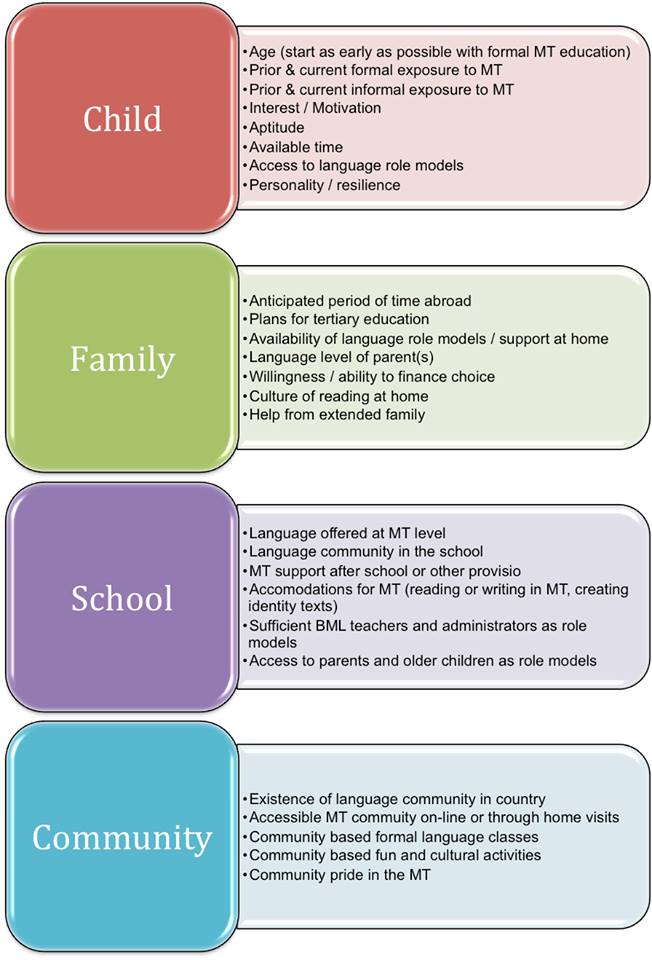
Do a language audit for your family so you have a realistic idea of what you can do to ensure success. Look at all aspects that contribute to success including the child, family, school and community. Make some strategic choices and frame your goals and priorities as a result of this.  You can see my audit here.

Getting back to the question of control and ownership: 

Personal Learning Environment (PLE)

Use some digital tools to create your personal learning environment. You can ensure input and output for listening, speaking reading and writing. Do you know what the current best books are for your child right now? Does your language have literary prizes for picture books and young adult books? Are your children reading them? Are they keeping up to date with radio programs, TV shows? Movies?  

Personal Learning Network (PLN)

Which people and organisations are in your network? Both physical and virtual proximity can be created. Your students can find people to add to their community, from their family, peers, older or younger students in the same country or other countries. In their school and in other schools. 

Community of Practise (COP)

This is where you find out what is best practise and what other people are doing. The “experts” or people who may have experience in one or more aspects of learning. They may be people with children learning the same language, or other parents struggling with the same socio-emotional issues with priority setting and time and logistical constraints. 

There are a number of language communities online – you just need to find their champions and tap into their resources. And then it’s a question of sharing and community building.
On twitter try: #langchat (WL teachers) #frimm (French teachers)#ClavEd #WLteach #flteach

The two sites below have some great resources:
http://catherine-ousselin.org/technology.html 
http://www.cybraryman.com/foreignlanguagelinks.html

Digital Tools

Just because a tool was created in English doesn’t mean it’s exclusively for English use. The whole point of Web 2.0 is you can create and curate to suit your need in ANY language.   Don’t complain about a lack of (age appropriate) resources – create your own. Borrow and extrapolate from material in other languages. Share and share and share. This is not an exhaustive list, just a sampling.

Flipboard can be used to curate any digital material on any topic in any language. This one is specifically on bilingualism, mother tongue and language, however there is no limit! Football in Dutch, Fashion in French Philosophy in German, rock music in Swedish. Start a flipboard with your language community or have your kids start one with theirs.

 Subscription based apps like PressReader can provide families access to their local newspapers and magazines in their home language. It is also a useful tool in the language classroom.

A linguistic trio – Part 1 – Rojas

Virginia Rojas

Before I embark on my summary, here are a couple of links written by other people quoting her, from Patana, the Telegraph,  and some very useful myth busting on language (worth a read).

Rojas commenced her talk by going through the common myths on children and language (see myth busting above). She then explained the 5 types of bilinguals (for more you can read this summary)

  • Compound bilingual / Dominant Bilingual (A person being more proficient in one of the two languages).
  • Co-ordinate bilingual (person develops two parallel linguistic systems, usually when the two parents have different mother tongues and each parent speaks only his or her own mother tongue to the child. In response, the person constructs two separate linguistic systems and can handle each of them easily.)
  • Balanced bilingual (people who are more or less equally proficient in both languages, but will not necessarily pass for a native speaker in both languages).
  • Ambi-bilingual / Equilingual (person who passes in any situation in both languages for a native speaker, i.e. he or she is indistinguishable from a native speaker). 
  • Passive Bilingual (A person who is a native speaker in one and is capable of understanding but not speaking another language.)
  • Semi-bilingual (not strong in either language)
and explained that with the exception of semi-bilingual (not desirable at all), each the type of bilingualism your children ended up with was a matter of choice and planning for the families and children concerned depending on circumstances and goals.

At school

She went on to explain that every teacher is a language teacher – not just language teachers as language comes with content, and pointed to research done at Stanford University on language and literacy learning in the content areas.  A positive learning environment for bilinguals is one where the home language and culture is regarded as an asset, instruction is adapted to meet different needs, children are “immersed but not submersed”, progression is seen from speaking to reading and writing and the child is monitored to ensure growth and progress.  In a later session for teachers she went into detail about “being nice with high expectations” for students who were learning English, and distinguished between the three kinds of vocabulary: basic (T1); high frequency, multiple meaning, cross disciplinary (T2) and low frequency discipline specific (T3).  The most important were the T2 words, which were necessary for bilingualism and achievement and were transferable and allowed for connections (e.g. describe, observe, explain, illustrate, on the other hand, contrast, compare, similar, like, prove etc.). Strategies should include distinguishing between shades of meaning among verbs differing in manner and adjectives differing in intensity. T1 words were the domain of language teachers and T3 of subject specific teachers.

At home

Parents should work on maintaining and improving the home language and not leave this to the school (even if the school provides the language).  Children should be given a “wait-time” of 5-7 years for language to develop, allowing each child it’s own time and way of achieving bilingualism. Parents need to be informed and act accordingly, and to plan their childrens’ bilingualism. In her opinion at least 3 hours a week had to be spend on formal lessons in the home language including reading and writing with additional time during the summer vacation.  Texts and materials should be provided in the home language at home.

In the library

I asked her separately about the library and what role it could play. She reiterated the need for books in other languages to be visible, to have text books in mother tongue available, and to integrate (non-fiction) books into the collection.

Practically for us it wouldn’t make sense to integrate the non-fiction books as we’ve concentrated on fiction except for the odd donated book. It would probably be a good idea to try and get a used text-book donation drive to add to our collection.

A linguistic Trio – part 2 Crisfield

Crisfield (Blog)

Like Rojas, Crisfield began by dispelling some of the common “mummy myths” around language, particularly that it was easier to learn for children – she said something that every parent with older children will have personal experience of – “no it’s still hard, but they’re just too small to complain”. Although they are more phonetically sensitive and therefore more likely to speak other languages without an accent. She emphasized that the role of parents was to ensure that we make our children’s language journeys as easy as possible, and to do this we have 6 tasks:

1. Learn the theory
2. Set Goals
3. Plan to achieve the goals
4. Communicate with our children
5. Communicate with others
6. Know when to get help.

Learn the theory

We commenced with a little bit of jargon, what is mother tongue, L1, home language etc. (see my glossary here for a complete vocabulary).

One of the most important things she touched on is how we need to take care of the messages (verbal, non-verbal and behavioural) we give our children about the relative importance of our mother tongue and our attitudes towards it, particularly in the case of languages with a lower status.

Set Goals

This was a discussion on what level of mastery of language (communicative and literary) was aimed for and why.  It was important to think the whole language journey through (or at least while they were students). While it was possible to impose our language expectations on our children while they were younger, we would need to be able to communicate a valid good reason for continuing the regime as they matured and formed their own opinions. In the case of multiple languages we needed to order our priorities and give reasons for them.

In setting goals, we should ensure we have the necessary knowledge and support network to support those goals and that the goals are realistic (I’ve written more on this here in theory, and as it relates to my family situation).

Plan to achieve the goals

Here the concept of a COP (community of practise) was introduced – i.e. is there a linguistic community around you that you can get help from.  The smaller the COP, the more planning and logistics were required.

The most fundamental issue was planning for enough language input.  According to Crisfield, research showed that for bi/tri-lingualism children needed around 30-35% of their linguistic input to be in the target language. (You will note I’ve said bi/tri-lingualism rather than multi-lingualism, which is what I used to say … I’d not heard the 30-35% statistic before and need to follow up on this). She stated that if language input was only say 20%, the child would understand the language but would most likely become a passive bilingual.  The 30-35% targeted input suggests that three languages are the most realistic option initially – with the caveat that this could change as the child got older.

In the case of language, it appeared that “less is more” should be our motto to ensure our time and effort is focused and is not spread too thinly.

It was also paramount to plan for multiple literacy, so that the language would not be lost over time and children could continue to resource their language maintenance on their own through reading and writing.  Once again, the reminder that BICS (conversational) language takes 1-2 years while CALP was a 3-9 year process (I’ve heard 5-7 years more commonly used).  She also cautioned that problems in other subjects may be masking a problem in language or a learning difficulty.

And in our globally mobile environment – we needed to think about a future in different countries or environments and how this would impact our plan and resourcing.  Language acquisition and sustainability was a long term process that couldn’t rely on one school or community if this was not likely to be permanent.

Communicate with our children

As mentioned earlier, at a certain point we will need to justify our choices to our children and to ensure that they are part of the discussion / conversation around language, and who speaks what and why in the family.  Choices are valid, but they should be properly communicated.

Communicate with others

One should communicate language goals, expectations and intentions with people around you. Like grandparents and other family, babysitters and others in the community to ensure their actions and language they speak are aligned. School teachers and administrators need to be kept in the loop about what is happening linguistically at home.

Know when to get help

If children are exhibiting delays in speech and language, or learning issues it’s important to look at all languages globally and not just at the dominant language. Any therapist, professional or doctor needs to understand the developmental and educational issues around bilingualism so that a proper assessment can be made. It is not good practise for a professional to suggest that one language should be stopped (e.g. to stop the home language to encourage the school language).

5 further issues were also discussed, literacy, content, cognitive development, confidence and social development.

Literacy

Children were learning to read and write in two or more languages.  In doing so, they could use translanguaging, which is where one language is used to help or scaffold the other, languages are used together and used strategically. This did not imply mixing languages or inserting words or sentences of one language into conversations randomly, but rather a strategic use in order to bridge gaps.

In order to become literate, children needed to go beyond merely being able to read in both languages to comprehending and understanding the content. Parents needed to check for understanding after reading to children or when children read to them.  This may require the reading of a story in both languages to ensure that meaning is conveyed, or reading the story more than once.  Reading to children in all languages was fundamental.  And, ironically children could often write before they could read, if they know letter formation and are left to creative phonetic spelling without correction.  Experience rather than accuracy should be emphasized.

Literacy in both languages could be simultaneous (at the same time) or sequential (where reading and writing of one language is started with and then the next added). In the case of a third language it is usually advisable to give children a mental break before adding the literacy of a third language.

Talk about the second language in the MT, compare and contrast and mediate in order to clarify similarities and differences.

Content

If the school language is different to the home language, one should support content at home using the home language with the help of websites or textbooks (in the home language). Conversations at home should include what is being learnt at school so that children gain vocabulary in the home language and make links between the school language and home language. This will enhance the quality of conversation in the home language as well.

Cognitive Development

Research has show that achievement in the school language is dependant on keeping up literacy in the mother tongue, and that if children are incapable of doing things in the mother tongue, they may struggle to do it in any language. It is the mother tongue that pulls all other languages up and if MT is not maintained there will be gaps in cognitive development and difficulties in conceptual thought and conversation.

Confidence

The use of MT encourages confidence in self and in one’s cultural identity.  It encourages cognitive growth and learning and allows children to experience competence at home and at school.  Children are not as resilient as we’d like to think they are, and we need to help them in their language journeys so it is not a case of sink or swim.

Social development

Encourage using the MT socially, during holidays and with family.
In conclusion this was a talk with a lot of very practical advice and tips for families around bringing up children in a bilingual environment, whether the result of two parents speaking different languages, or a child going to school with a non-home language, or even where three languages (mother, father and school) were involved.

The myth of "reluctance"?

I went to a professional development session the other day on motivating secondary students to read. It was a pretty good session with lots of interaction and ideas.  But it did give me pause for thought. About the premise. Yes I agree that reading is important – fundamental in fact to any kind of academic life at any level above primary school. I love an applaud meditations such as those of Alain de Botton on what literature is for (see below).  I think it interesting and noteworthy that numeric goals are being given to just how many books a student should read (20-25) in order to benefit from all these wonderful things.  And yet …

All through the discussions I kept hearing the term “reluctant readers” – they were to be shaken up and motivated and enticed and if we just found the right “entry drug” book, the right set of incentives, the right way to monitor it all, if we showed them how important it was, how much we valued it, then hey presto! They’d go from reading 2 books to 20 books and voila!
The first thing that got me thinking was a name.  Not an idea.  The name “Lars” – a success story in this battle against reluctance.  I have a nephew called Lars.  He’s Dutch. I know a couple of people called Lars who are Danish and Swedish.  And then I wondered.  Could it be that Lars was not reading 25 books in English in his English class because he was perhaps reading them in his mother tongue?  Had anyone asked him about his reading in other languages?  Did anyone care?  Because caring is important.  I know, I have two children reading in their chosen tongues, Dutch and Chinese respectively.  And it’s a balancing act.  One in which you’re teetering on a beam of approval – that of your English teacher on the one hand and your family and / or language tutor/teacher on the other.  And that language teacher / tutor may not even be part of your school community, so if you’re too shy or to nervous or just plain don’t understand that reading is reading and that all reading counts in whatever language you’re reading in – well you’re not going to get credit for that reading.  NOT ONCE in the entire PD session did anyone at any point mention mother tongue reading (except me to my learning partner – but she knows me, and she’s one of us bilingual and multicultural types).  I looked around the room at the pretty homogenous bunch of language teachers around me and it wasn’t surprising. I wonder how many of them were bilingual? Of course that is not what they’d be selected on, but, their class demographic is built up of at least 50% bi- or multi-lingual students. Why are we not talking about this? I suspect because we are not even thinking about this.
Research shows, if you’re interested in it and if you want to acknowledge it, that languages at a CALP (Cognitive academic language proficiency level) scaffold and complement each other.  And if we’ve been doing our job correctly as parents and educators, by the time kids are in secondary school they should have a CALP level in at least one of their languages so it shouldn’t matter too much which language is being read most.   But are we even thinking about this? Is it even on our teaching horizon?  
But then again, how many of our students are not at a CALP level when they enter secondary school? Even if they’re mono-lingual.  With the best intentions and the best resources and all the rest, some students just don’t get there. And no amount of monitoring or encouragement will get them there. It requires more.  Kids don’t wake up one morning and along with acne and hormones decide to be reluctant readers. It’s something that probably creeps up on them.  Mel Levine in his book “The Myth of Laziness” attempts to look behind why students do not succeed in an academic environment.  He finds labels of learning problems and then he tries to look behind those labels and to break down very specific issues that then can be worked on.  So too I think when we are confronted with a reluctant reader we need to look underneath that big label and work out where the reluctance stems from.  Is there an underling difficulty with reading? It is said that if a child is not a competent reader by Grade 3, s/he will struggle for the rest of school.  So what about our children in the expatriate environment who are snatched from their native language environment with the assumption that “they’re young, they’ll pick up xxx language easily” and who don’t establish the competencies early on, and then may or may not get help, or may get language help when the problem is learning or learning help when the problem is language.  Who are more or less forced to drop and ignore their mother tongue at great cost in order to fit into a new environment.
Students don’t just lose a language. They may shed bits of their identity along the way.  One student I spoke to was a success story by all accounts.  Rapidly rising from an EAL (English Additional language) to the mainstream English class in a year.  The picture of diligence.  But who felt in the process she’d lost her self and her voice.  And that wasn’t the worst of it, the worst is that no one around her would acknowledge that her success had come at a cost and that the cost disturbed her.  As an educator one may rather be concerned when a student does not notice or express this frustration and anxiety at the apparent ease of substitution of self.
Back to reading.  I’ve become somewhat enamoured of late of the potential of digital storytelling as a way to allow students to reclaim their identities and voices.   How about we take the immensely successful Lizzie Bennett diaries? Celebrated as having taken the themes of Jane Austen’s Pride and Prejudice and translated them to modern time North America.  Why should we not in our schools have those themes expressed from a Korean, Japanese, Chinese, Indian, African view point? And why just vlogging? It can be vlogging, or twitterature, or multi-media film and text and picture.   We like our “World Literature” we do.  But too often our world literature is a voice that suits a western audience.  We like our stories of China to involve the cultural revolution, of Vietnam the escape to the non-communist west, of Afghanistan something to do with boats and difficulties at the Australian border.  But what about the stories of our students who are a little like us, part of that global cosmopolitan elite, but then not quite. Where the mirror by which they reflect themselves distorts ever so slightly that it is not always perceptible. That is what we should want to hear and what as educators we have a role in eliciting.  And perhaps when that takes place our literature and our world views will be enriched.
I recently suffered through “To rise again at a decent hour” – the self-absorbed rantings of a middle aged white baseball loving north american male tinged with crazed religious passages was more than I could bear. And yet supposedly it was literature having been on the man booker long list. And had I been a student, I would be first in the “reluctant reader” line.  So a lack of identification and interest may foster reluctance.
How about time?  As an idealistic mother I so totally bought into that half hour of reading in bed before lights out.  Easy when you’re doing the reading and setting the bedtime and there is no homework or after school activities that eat into the late afternoon and then munch past dinner time and gulp up the hours past the absolute latest time that you know a child should be asleep. There are always deliverables. 
There are some good things going on.   I’m really gratified to see that some teachers are setting time aside in class for reading. I hope that’s working.  I hope students can read on demand.  I really like the concept of class libraries, the easy availability of books at the point of demand. I also hope we have dedicated enough budget to have that in all our language classrooms as well and to think about how we are meeting the needs of our multi-linguals.  For now just even thinking about them. Just mentioning them in a seminar or workshop would be a huge step forward.

Mother Tongue – How to assess your likelihood of success

One of the things I did as part of my research was to summarise the factors that contributed to a family being able to teach and maintain their mother tongue in their children while living / being educated in an English dominant environment.

First I present the table of factors, and then I present myself filling in this table as an exercise in my own home.

Analysis: The theories of MT acquisition and maintenance versus the reality of our situation

Theory
Reality – Chinese
Reality – Dutch
Child
Age (start as early as possible with formal MT education)
Both started Chinese immersion in Grade 1 (age 6)
Son started formal Dutch in Grade 5 (age 10)
Prior & current formal exposure to MT
1 hour per day class in International School
None
Prior & current informal exposure to MT
Not much – Hong Kong is Cantonese not Mandarin speaking. Daughter did learn characters through observation on the street.
Dutch spoken at home, exposure through paternal grandparents, aunts, uncles and cousins.
Interest / Motivation
Daughter – High;
Son – Low
Daughter not particularly interested, speaks on holiday and to family
Son – High
Aptitude
Daughter – excellent memory which is necessary for amount of memorization necessary
Son – difficulties with working memory due to ADHD doesn’t rely on memory for learning
Son – very good ear and pronunciation, has taken well to spelling and grammar as it’s taught in a formal structured way (unlike English)
Available time
In HK had ample time (27/28 hours a week in class plus a lot of homework)
Daughter: in SG 5x 40 minutes a week class time, 90 minutes a week tutoring, 100 minutes a week required homework plus whatever time she has for self-motivated study and reading
5 x 40 minutes a week class time (1x of which is self-study)
1 x 120 minutes after school tutoring.
Homework around 60 minutes
Daily reading expected 15-20 minutes (doesn’t always happen)
Access to language role models
Limited to school and tutor and one family friend who we see irregularly
Parents speak Dutch at home to each other, Father speaks Dutch to him, Mother speaks English unless in Dutch context
Personality / resilience
Very determined, sees events as challenges rather than setbacks, competitive, responds well to reward systems, perfectionist, introverted and shy
Very sociable, extroverted, not scared of making mistakes. Quite emotional, inclined to give up when things get difficult, or need help to keep going
Family
Anticipated period of time abroad
Indefinite
Indefinite
Plans for tertiary education
Undecided, probably English medium
Considering studying film or photography in Netherlands (early thoughts)
Availability of language role models / support at home
Mother studied Chinese but level is not sufficient to support high level language and literacy needs practically, only in abstract
Both Mother and father speak Dutch in the home
Language level of parent(s)
Mother – Low level
Father – none
Mother – Fluent speaking reading, listening, written poor
Father – Fluent speaking, reading, listening, writing
Willingness / ability to finance choice
Yes
Yes
Culture of reading at home
Yes – but needs prompting and encouragement as slow difficult process and access to the right leveled material is difficult.
Yes – when father is home do co-reading as well
Help from extended family
None, only moral support
Yes – regular phone calls / FaceTime, visits during vacation and go to school with cousins for a few days
School
Language offered at MT level
Yes in theory.  However in practice the amount of time and level is not adequate, plus not enough leveled reading resources and mentoring
None in curriculum until G9. In G7 & G8 offered after school.  His Dutch classes are an exception and privately arranged and funded
Language community in the school
Yes, however she is not particularly a part of it.
Yes
MT support after school or other proviso
Yes, 90 minutes private tutoring after school, school provides walk in clinics 2x a week
Only from G7, however he’s not at the level required yet
Accommodations for MT (reading or writing in MT, creating identity texts)
Yes, in school (since middle school only) and tutor supplements
Yes, but still limited due to level
Sufficient BML teachers and administrators as role models
Administration & non-language teachers traditionally English / mono-lingual with some exceptions. This is changing a bit.
Access to parents and older children as role models
In principal – but need to tap into this more. No formal structures.
Yes, cultural events organized by Dutch Teacher.
Community
Existence of language community in country
Yes, large Chinese speaking population, however local families are not part of school
Yes, Dutch club and fair sized community with events
Accessible MT community on-line or through home visits
Possibly – not investigated yet
Yes
Community based formal language classes
Many tutoring schools that cater to the Chinese curriculum of local schools
Yes
Community based fun and cultural activities
Not as many as in Hong Kong
Yes through Dutch club and school
Community pride in the MT
Many classmates in MT group are not very motivated to learn Chinese, within SG community Mandarin is the formal standard Chinese while most families speak a dialect at home
Generally yes, however many Dutch people speak English well and will switch in mixed groups


Research summary on Language

The post below is based on the background research I did for INF538 Value Added-information Services in June 2014.  Please cite me as the author should you wish to quote / use any of this.

Bailey, N. (2014, November 12). Research summary on Language. Retrieved November 23, 2013, from http://informativeflights.blogspot.sg/2014/11/research-summary-on-language.html

_________________________________________________________________________________

Background Research


This study has presented the typical knowledge management dilemma – there is a considerable amount of information and research, both academic and practical but it is widely dispersed and personal experience is often not documented.


History


Most research into BML (bi- and multi-lingualism) concerns itself with assimilation of immigrants (Fillmore, 2000; Slavin, Madden, Calderon, Chamberlain, & Hennessy, 2011; Slavin et al., 2011; Winter, 1999); maintaining minority (or majority) languages in a dominant language environment (Ball, 2011; Dixon, Zhao, Quiroz, & Shin, 2012) or language immersion or bilingual programmes; (Caldas & Caron-Caldas, 2002; Carder, 2008; Cummins, 1998; Genesee, 2014; Hadi-Tabassum, 2004; Soderman, 2010) aspects of which may or may not be relevant to this study or its population.
Until fairly recently the situation of high socio-economic status (SES) students in international schools is given at best a glancing mention and appears to have been a marginal area amongst researchers, as they are considered to be a privileged elite with more options and choices and greater economic means than immigrant or minority students (Ball, 2011; Carder, 2006; de Mejía, 2002). There are calls for “celebrating diversity” in the classroom, (Stauft, 2011) mentions of international food fairs, the involvement of the Parents’ Association and ensuring that the school conveys the message to parents on the importance of maintaining MT  (Hayim-Bambe, 2011), while most research looks into integration and scaffolding to English.  


Bilingualism


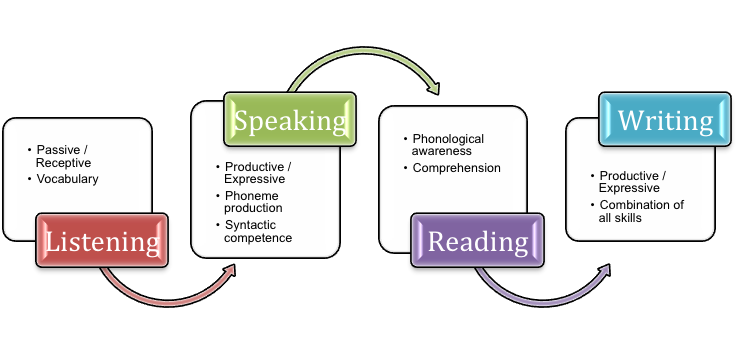
Researchers distinguish between three types of bilingualism. Simultaneous bilingualism – exposure to two languages from birth; early successive bilingualism – first exposure aged 1 – 3 years; and second language bilingualism – first exposure aged  4 – 10 years. There is considerable debate as to what exactly the “critical” ages are for successful language learning. As Kirsten Winter pointed out “Language learning is a continuum and bilingualism is not a perfect status to be achieved.” (Winter, 1999, p. 88).  Typical language learners cycle through alternating stages of passive (receptive) and productive (expressive) skills, usually in the order of listening, speaking, reading and then writing.


Figure 1: Continuum of language learning

Initially children learn phoneme production, syntactic competence and build vocabulary while phonological awareness then helps to develop literacy skills. The ability to understand both the ‘microstructure’ of sentences and a ‘macrostructure’ of the relationship between ideas results in language comprehension (Beech, 1994).

An important distinction is made between the surface skill of listening and speaking, which is usually acquired within two years (BICS – Basic Interpersonal Communication Skills), and the literacy skills of reading and writing at an abstract academic level (CALP – Cognitive Academic Language Proficiency), a targeted five to seven year process – as will be discussed later under “concerns” (Cummins, 1998). Due to transferability, concepts learnt and established in one language are more easily learnt in another language but only if a child has achieved CALP (Cummins, 1998; Dixon, Zhao, Shin, et al., 2012; Shoebottom, n.d.).


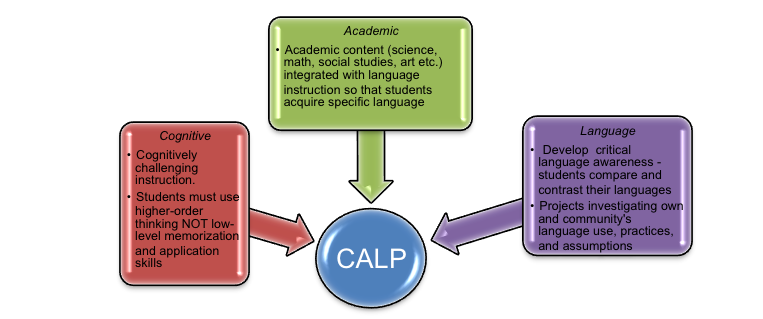
Figure 2: Elements of CALP


Factors Impacting Acquisition


Researchers agree on a number of factors which impact on the successful acquisition and retention of a second or subsequent language in the BML population. These relate to the student, family, school and the community or society.


Student


A child’s language learning aptitude is a mixture of cognitive and personality factors (Ehrman & Leaver, 2003; Stauft, 2011).  Cognitive factors include learning style and strategy while personality factors include “motivation, self-efficacy and affective self-management” (Hayim-Bambe, 2011, p. 59)Low motivation, low self-esteem, and high anxiety result in a ‘mental block’ and impede language acquisition (Krashen, 1982). Extroverts tend to monitor their language use less than introverts, perfectionists and children who lack self-confidence.  Moving beyond individual differences, considerable research has been done on the strategies that so-called “Good Language Learners” (GLL) employ, particularly in the field of second-language acquisition (Abhakorn, 2008; Griffiths, 2008; E. Le Pichon, de Swart, Vorstman, & van den Bergh, 2010; Emmanuelle Le Pichon, De Swart, Vorstman, & Van Den Bergh, 2013; Wang, 2013).  These competencies, which improve with age, include directed attention, control of emotions, anticipation, mime, cooperation, imitation, clarification and asking for assistance, can arguably be taught or encouraged in a learning environment by teachers or parents.
Research often attempts to identify critical periods or ages of language acquisition, with inconclusive results, as motivation and meta-cognitive skills can be confounding variables since older students have better developed meta-cognitive skills (Barac & Bialystok, 2011; Beech, 1994; Bowden, Steinhauer, Sanz, & Ullman, 2013; Cummins, 1998, 2003; Genesee, 2014; Granena & Long, 2013; Emmanuelle Le Pichon et al., 2013; MacSwan & Pray, 2005; Saito, 2013).  Less has been written about the socio-psychological aspects, including the impact of the teenage years where adolescents disengage from the family and identify with their peer group in an attempt to construct an identity outside of the family, which may or may not include their cultural/linguistic identity as a bilingual. Ensuring ample venue or context based immersion in the MT with access to meaningful peer relationships (particularly during vacation time) can help with the maintenance of the MT in this period (Caldas & Caron-Caldas, 2002).


Family


A large vocabulary in any language contributes to overall “oral proficiency, word reading ability, reading comprehension, and school achievement”(Dixon, Zhao, Quiroz, et al., 2012, p. 542). Vocabulary is influenced by the parent’s level of education, access to and availability of resources, and the quality and quantity of parent-child interactions, including shared reading, frequency of story telling and conversations.
Parent’s level of education influences language aspirations and is often correlated with a positive view of bilingualism, ensuring the quantity and quality of resources and amount of support provided to children (Lopez, 2005, cited in Dixon et al., 2012). Whether the child was born in the home country, and the length of time they lived there, impacts on the level of language maintenance.  Many children in the international school environment were born in a third country (neither the home nor resident country).
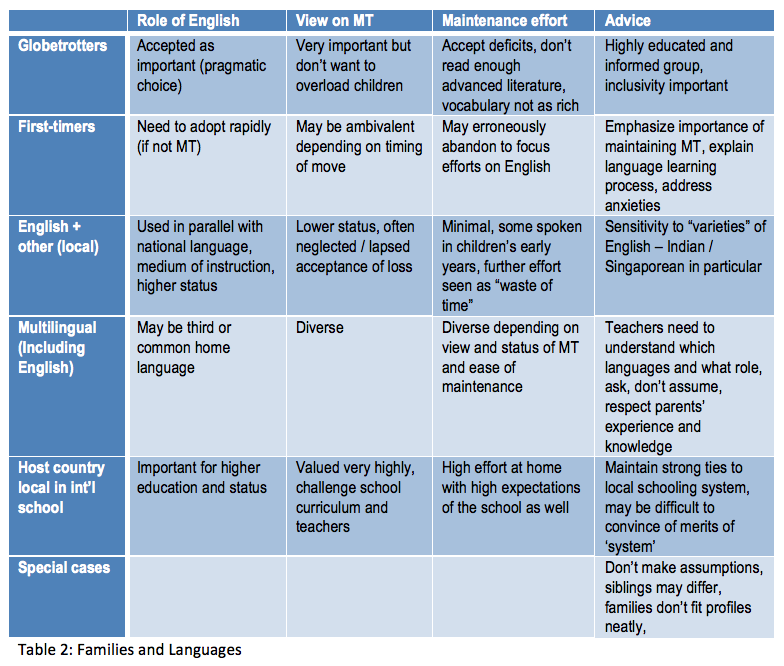
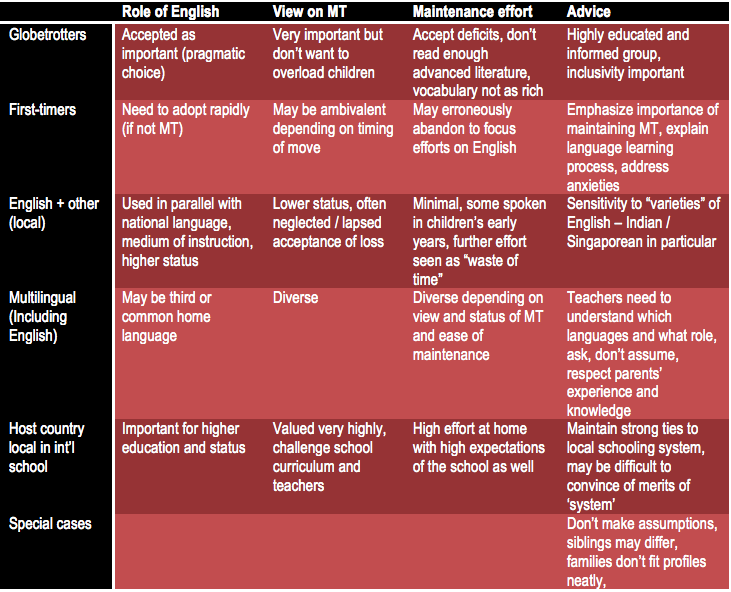
In looking at the role of parental involvement it is important to acknowledge and cater for the diversity of families within an International school (Sears, 2011)Table 1 below is based on Sears’ analysis of the types of families, their views on the role of English versus MT and what types of maintenance effort can be expected, with advice to the school.  Caution should be exercised in interpreting these generalisations, since within a family siblings may be different depending on their linguistic and birth country history, and the existence of a strong national curriculum may influence choices.


Table 1: Families and Languages


School


The International school context results in a number of issues that complicate MT provision, including the multicultural and multilingual nature of the student population, resulting in ‘fictive monolingualism’ and the transience of both the student and teacher population, with the resultant socio-psychological implications on learning (Caldas & Caron-Caldas, 2002; Hacohen, 2012; Hornberger, 2003). However, where the “cultural capital” of the school included valuing language diversity in its environment and teaching practise, students had an increased sense of belonging, higher levels of reading literacy and they scored significantly higher academically. Continued development of ability in two or more languages on a daily basis resulted in a deeper understanding of language across contexts. Best practice includes a well structured MT program with at least some inclusion in the school timetable and fee structure, inclusion of other subject matter in MT lessons, support for English acquisition through a daily ESL/EAL program, a socio-culturally supportive environment, better awareness and training for subject teachers, affirmation of students’ identity as bi- or multi-lingual and collaboration with parents, while block scheduling was not optimal for language learning (Carder, 2014; IBO, 2011; Tramonte & Willms, 2010; Vienna International School, 2006; Wallinger, 2000).  Research in heritage language (HL) teaching and learning indicates that macro-approaches and other specific strategies that build on learners’ existing language skills could be leveraged to improve reading and writing abilities, increase motivation and participation and validate students’ identity although specific teacher training for HL is recommended (Lee-Smith, 2011; Wu & Chang, 2010).

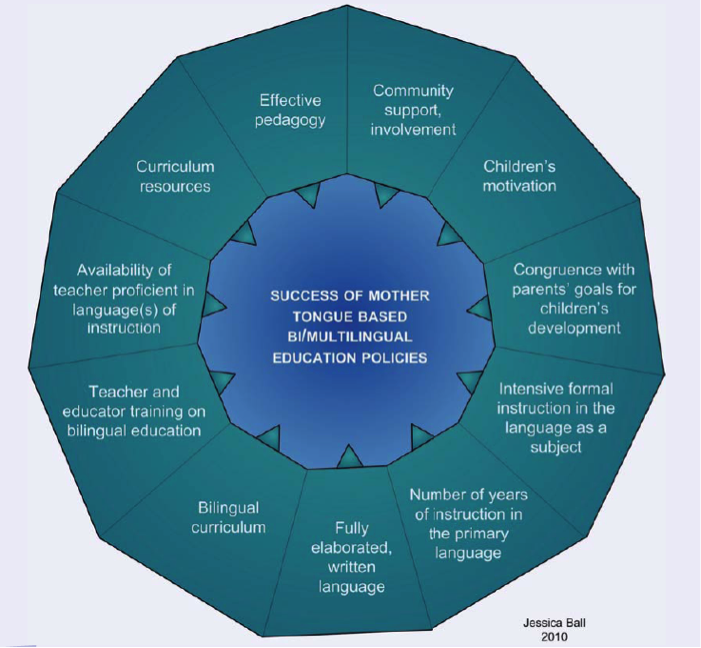
Figure 3: Success of MT based education policies
Source: (Ball, 2011, p. 46)

In her work for UNESCO, Ball suggested a number of policy dimensions that enhance the success of an educational policy. These are depicted in Figure 3above. 
Literacy is seen as crucial for development of CALP. External and internal factors affect literacy motivation in language learning.  Factors in schools include classroom environment, appropriate text availability and teachers. Collaboration among teachers and in the school-home nexus can enhance the perception of reading and writing as a pleasurable activity outside of the learning context. Although research generally favours intrinsic motivation, in the case of language learners, extrinsic motivation including recognition, grades, social acceptance, competition, rewards related to reading and compliance can play a role in creating a positive association with and nurturing literacy while not negatively impacting on intrinsic motivation (Fong, 2007). A well equipped library, organisation of international book fairs, other tongue events, culture clubs, reading hours with older to younger / parents to students a language buddy system and national days at school are other ways literacy can be focused on (Brewster, 2011; Krashen, 2004).


Community and Society


The support of a locally based language community, including faith and cultural communities had a positive impact which could mitigate socio-economic status (SES) factors and enhance learning through beliefs and practises, classes and cultural and religious activities (Dixon, Zhao, Quiroz, et al., 2012). Finally the availability of and access to learning resources, complementary schooling, books and other materials impacted on acquiring and maintaining language(Scheele, Leseman, & Mayo, 2010)
While languages associated with upward mobility and high SES thrive, languages considered to have a lower SES risk being neglected or suppressed by dominant or higher SES language (Gulf News, 2013; Srivastava, 2012). The profile of parents’ language use at home as well as peer pressure in the adolescent years impacts on children’s language use, in this context parents may speak just the MT, the MT plus English, just English or a third “common” language – irrespective of what their MT may be or a combination of these depending on the context, while at school, English dominates (Caldas, 2006; Dixon, Zhao, Quiroz, et al., 2012; Scheele et al., 2010). In this respect, the languages Hindi and Mandarin form a special case.  They are considered to be higher status languages than other Chinese “dialects” and Indian languages, and also serve as a “common” language in those populations. If parents are not proficient in these languages, or have a lower vocabulary, they are less likely to use them at home, which in turn impacts on the child’s language proficiency (Dixon, Zhao, Quiroz, et al., 2012; Saravanan, 2001; Srivastava, 2012; Wei & Hua, 2010). Amongst Chinese diaspora the dominant view was “to qualify as Chinese, one must know the language, and to know the language means to be able to read and write the written characters” (Wei & Hua, 2010, p. 159). While: “Young Indians with high SES and high educational achievement generally changed their primary language to English” (Saravanan, 2007 cited in Dixon et al., 2012, p. 558).
The final factor is the function attributed to that language by society.  In Singapore, the government “has assigned different functions to English and the ethnic languages. While ethnic languages constitute cultural identity, intra-ethnic communication, and ethnic solidarity, English is promoted for interethnic communication, national unity, and to facilitate science learning, higher education, and economic advancement” (Bokhorst-Heng, 1999, cited in Dixon et al., 2012, p. 547).  The question is whether international schools similarly assign these functions to language.


Concerns


Although the value of BML has become more widely accepted and most parents and educators appreciate and encourage the process, a number of concerns have rightly been voiced on the process and efficacy of reaching the goal of a BML child. In the first instance, the quality of the productive language – oral and or written skills – of one or all of the child’s languages may not develop to a sufficiently high level for academic or employment purposes  (Cummins, 1998)


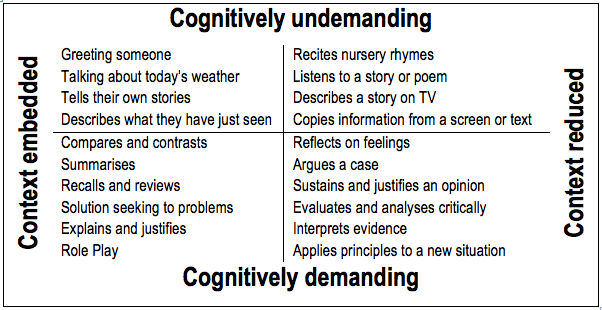
Figure 4: Context / cognition matrix
Source: (Carder, 2014, p. 72)


As Figure 4 shows, there is a significant difference between cognitively demanding and undemanding tasks, and the ability to use language in a context reduced environment (Carder, 2014). Secondly, studies have shown that speech and language problems that underlie both or all languages may be misinterpreted as natural delays in learning English and children from a BML background compared to monolingual children with the same problem, are often referred much later, or not at all, for help (Winter, 1999). Related to this, other research has found that behavioural or emotional problems may result from language problems including speech disorder, isolated expressive disorder, mixed receptive-expressive high level language disorder, specific language impairment and other language disorders and delays. They emphasize the importance of fully assessing language skills in these BML populations (Grizzle & Simms, 2009; Toppelberg, Medrano, Morgens, & Nieto-Castañon, 2002).
Figure 5: The “thin ice” of BICS vs. dual-iceberg of CALP
Source: (Carder, 2014 p.72)


Then there is the “drop-out” risk.  Literature distinguishes between early-exit bilingual education which is seen as “subtractive” and late exit or “additive” bilingual education (Ball, 2011; Cummins, 1998).  Subtractive bilingualism is where children do not develop language beyond the BICS stage due to suppression by the dominant school or societal language and their MT cannot be used to leverage learning in the school or societal language.  These children run the risk of not having high, abstract and academic level in any language which impacts negatively on their academic proficiency.


Another problem can be misguided parental interference and effort. Research has found that parents mainly rely on their own experiences in language learning in making choices for their children, referring to a combination of popular literature and expert advice to justify these decisions. BML families tend to form “family language policies” on home communication.  Parents’ efforts could be better supported, their uncertainties addressed and misconceptions clarified as few parents were properly aware of the challenges, issues, consistency and effort of raising BML children, nor of the fact that children raised in bilingual homes often become active users of only one language depending on the context (Caldas & Caron-Caldas, 2002; King & Fogle, 2006).


References:


Abhakorn, J. (2008). The Implications of Learner Strategies for Second or Foreign Language Teaching. ARECLS, 5, 186–204.

Ball, J. (2011). Enhancing learning of children from diverse language backgrounds: mother tongue-based bilingual or multilingual education in the early years. UNESCO Education Sector.

Barac, R., & Bialystok, E. (2011). Cognitive development of bilingual children. Language Teaching, 44(01), 36–54. doi:10.1017/S0261444810000339

Beech, J. R. (1994, May). The Language Continuum: From Infancy to Literacy. British Journal of Psychology, 85(2), 303+. Retrieved from http://go.galegroup.com.ezproxy.csu.edu.au/ps/i.do?id=GALE%7CA16108054&v=2.1&u=csu_au&it=r&p=EAIM&sw=w&asid=51afee8e669e5df051f4e2bc9c7c54d6

Bowden, H. W., Steinhauer, K., Sanz, C., & Ullman, M. T. (2013). Native-like brain processing of syntax can be attained by university foreign language learners.Neuropsychologia, 51(13), 2492–2511. doi:10.1016/j.neuropsychologia.2013.09.004

Brewster, J. (2011). The Role of the Library in Supporting Young Language Learners and their Families. In E. Murphy (Ed.), Welcoming linguistic diversity in early childhood classrooms: learning from international schools (pp. 157–167). New York: Multilingual Matters.

Caldas, S. J. (2006). Raising bilingual-biliterate children in monolingual cultures. Clevedon ; Buffalo: Multilingual Matters.

Caldas, S. J., & Caron-Caldas, S. (2002). A Sociolinguistic Analysis of the Language Preferences of Adolescent Bilinguals: Shifting Allegiances and Developing Identities. Applied Linguistics, 23(4), 490–514. Retrieved from http://ezproxy.csu.edu.au/login?url=http://search.ebscohost.com/login.aspx?direct=true&db=ehh&AN=44400977&site=ehost-live

Carder, M. (2006). Bilingualism in International Baccalaureate programmes, with particular reference to international schools. Journal of Research in International Education, 5(1), 105–122. doi:10.1177/1475240906061867

Carder, M. (2008). The development of ESL provision in Australia, Canada, the USA and England, with conclusions for second language models in international schools. Journal of Research in International Education, 7(2), 205–231. doi:10.1177/1475240908091305

Carder, M. (2014). The language repertoires of five IB Diploma students in an international school. Retrieved from http://mclanguage.tripod.com/webonmediacontents/55a%20The%20language%20repertoires%20of%20five.pdf

Cummins, J. (1998). Immersion education for the millennium: What have we learned from 30 years of research on second language immersion? In M. R. Childs & R. M. Bostwick (Eds.), Learning through two languages: Research and practice (pp. 34–47). Katoh Gakuen, Japan.

Cummins, J. (2003). Putting Language Proficiency in Its Place: Responding to Critiques of the Conversational – Academic Language Distinction. Retrieved May 27, 2014, from http://iteachilearn.org/cummins/converacademlangdisti.html

De Mejía, A.-M. (2002). Power, prestige, and bilingualism international perspectives on elite bilingual education. Buffalo, N.Y.: Multilingual Matters. Retrieved from http://search.ebscohost.com/login.aspx?direct=true&scope=site&db=nlebk&db=nlabk&AN=79495
Dixon, L. Q., Zhao, J., Quiroz, B. G., & Shin, J.-Y. (2012). Home and community factors influencing bilingual children’s ethnic language vocabulary development. International Journal of Bilingualism, 16(4), 541–565. doi:10.1177/1367006911429527

Dixon, L. Q., Zhao, J., Shin, J.-Y., Wu, S., Su, J.-H., Burgess-Brigham, R., … Snow, C. (2012). What We Know About Second Language Acquisition: A Synthesis From Four Perspectives. Review of Educational Research, 82(1), 5–60. doi:10.3102/0034654311433587

Ehrman, M., & Leaver, B. L. (2003). Cognitive styles in the service of language learning. System, 31(3), 393–415. doi:10.1016/S0346-251X(03)00050-2

Fillmore, L. W. (2000). Loss of Family Languages: Should Educators Be Concerned? Theory Into Practice, 39(4), 203–210. doi:10.1207/s15430421tip3904_3

Fong, E. (2007). The L2 Reading Motivation of EAL Students: Experiences in an International School in Singapore (Master Dissertation). The University of Sheffield, Sheffield, UK.

Genesee, F. (2014). Myths and misunderstandings about dual language acquisition in young learners. Presented at the ECIS-ESLMT, Amsterdam, Netherlands.

Granena, G., & Long, M. H. (2013). Age of onset, length of residence, language aptitude, and ultimate L2 attainment in three linguistic domains. Second Language Research, 29(3), 311–343. doi:10.1177/0267658312461497

Griffiths, C. (Ed.). (2008). Lessons from good language learners. Cambridge ; New York: Cambridge University Press.

Grizzle, K. L., & Simms, M. D. (2009). Language and Learning: A Discussion of Typical and Disordered Development. Current Problems in Pediatric and Adolescent Health Care, 39(7), 168–189. doi:10.1016/j.cppeds.2009.04.002

Gulf News. (2013, May 9). Use of Arabic language needs conscious nurturing. Retrieved April 6, 2014, from http://gulfnews.com/opinions/editorials/use-of-arabic-language-needs-conscious-nurturing-1.1181394

Hacohen, C. (2012). “The norm is a flux of change”: teachers’ experiences in international schools. Educational Psychology in Practice, 28(2), 113–126. doi:10.1080/02667363.2011.646092

Hadi-Tabassum, S. (2004). The Balancing Act of Bilingual Immersion. Educational Leadership, 62(4), 50. Retrieved from http://ezproxy.csu.edu.au/login?url=http://search.ebscohost.com/login.aspx?direct=true&db=f5h&AN=15274676&site=ehost-live

Hayim-Bambe, A. (2011). The Importance of Maintaining Mother Tongue and Culture in the Classroom. In E. Murphy (Ed.), Welcoming linguistic diversity in early childhood classrooms: learning from international schools (pp. 72–79). New York: Multilingual Matters.

Hornberger, N. H. (2003). Continua of biliteracy an ecological framework for educational policy, research, and practice in multilingual settings. Clevedon, UK; Buffalo: Multilingual Matters. Retrieved from http://public.eblib.com/EBLPublic/PublicView.do?ptiID=204118
IBO. (2011). Language and learning in IB programmes. International Baccalaureate Organization.

King, K., & Fogle, L. (2006). Bilingual Parenting as Good Parenting: Parents’ Perspectives on Family Language Policy for Additive Bilingualism. International Journal of Bilingual Education and Bilingualism, 9(6), 695–712. doi:10.2167/beb362.0

Krashen, S. D. (1982). Principles and practice in second language acquisition (1st ed.). Oxford ; New York: Pergamon.

Krashen, S. D. (2004). The power of reading: insights from the research. Westport, Conn.; Portsmouth, N.H.: Libraries Unlimited ; Heinemann.

Lee-Smith, A. (2011). Issues in Teacher Training for Korean Heritage Learners. Retrieved May 31, 2014, from http://archive.cls.yale.edu/info/?p=789

Le Pichon, E., De Swart, H., Vorstman, J. A. S., & Van Den Bergh, H. (2013). Emergence of patterns of strategic competence in young plurilingual children involved in French international schools. International Journal of Bilingual Education and Bilingualism, 16(1), 42–63. doi:10.1080/13670050.2012.679251

Le Pichon, E., de Swart, H., Vorstman, J., & van den Bergh, H. (2010). Influence of the context of learning a language on the strategic competence of children.International Journal of Bilingualism, 14(4), 447–465. doi:10.1177/1367006910370921

MacSwan, J., & Pray, L. (2005). Learning English Bilingually: Age of Onset of Exposure and Rate of Acquisition Among English Language Learners in a Bilingual Education Program. Bilingual Research Journal, 29(3), 653–678. doi:10.1080/15235882.2005.10162857

Saito, K. (2013). Age effects on late bilingualism: The production development of /ɹ/ by high-proficiency Japanese learners of English. Journal of Memory and Language, 69(4), 546–562. doi:10.1016/j.jml.2013.07.003

Saravanan, V. (2001). The Significance of Bilingual Chinese, Malay and Tamil Children’s English Network Patterns on Community Language Use Patterns.Early Child Development and Care, 166(1), 81–91. doi:10.1080/0300443011660107

Scheele, A. F., Leseman, P. P. M., & Mayo, A. Y. (2010). The home language environment of monolingual and bilingual children and their language proficiency.Applied Psycholinguistics, 31(01), 117. doi:10.1017/S0142716409990191

Sears, C. (2011). Listening to Parents: Acknowledging the Range of Linguistic and Cultural Experiences in an Early Childhood Classroom. In E. Murphy (Ed.),Welcoming linguistic diversity in early childhood classrooms: learning from international schools (pp. 185–195). New York: Multilingual Matters.

Shoebottom, P. (n.d.). The language learning theories of Professor J. Cummins. Retrieved April 6, 2014, from http://esl.fis.edu/teachers/support/cummin.htm

Slavin, R. E., Madden, N., Calderon, M., Chamberlain, A., & Hennessy, M. (2011). Reading and Language Outcomes of a Multiyear Randomized Evaluation of Transitional Bilingual Education. Educational Evaluation and Policy Analysis, 33(1), 47–58. doi:10.3102/0162373711398127

Soderman, A. K. (2010). Language Immersion Programs for Young Children? Yes…But Proceed with Caution. Phi Delta Kappan, 91(8), 54–61. Retrieved from http://ezproxy.csu.edu.au/login?url=http://search.ebscohost.com/login.aspx?direct=true&db=ehh&AN=50262555&site=ehost-live

Srivastava, K. (2012, September 19). Hindi a hit among Marathi students. Retrieved April 6, 2014, from http://www.dnaindia.com/mumbai/report-hindi-a-hit-among-marathi-students-1742590

Stauft, N. (2011). An International School Celebrates its Diversity. In E. Murphy (Ed.), Welcoming linguistic diversity in early childhood classrooms: learning from international schools (pp. 53–61). New York: Multilingual Matters.

Toppelberg, C. O., Medrano, L., Morgens, L. P., & Nieto-Castañon, A. (2002). Bilingual Children Referred for Psychiatric Services: Associations of Language Disorders, Language Skills, and Psychopathology. Journal of the American Academy of Child & Adolescent Psychiatry, 41(6), 712–722. doi:10.1097/00004583-200206000-00011

Tramonte, L., & Willms, J. D. (2010). Cultural capital and its effects on education outcomes. Economics of Education Review, 29(2), 200–213. doi:10.1016/j.econedurev.2009.06.003
Vienna International School. (2006). VIS ESL & MT Department: mission statement. Retrieved May 30, 2014, from http://school.vis.ac.at/esl/main.html

Wallinger, L. M. (2000). The Effect of Block Scheduling on Foreign Language Learning. Foreign Language Annals, 33(1), 36–50. doi:10.1111/j.1944-9720.2000.tb00888.x

Wang, B. (2013). Using GRA and GSM Methods to Identify the Learning Strategies of Good Language Learners. International Journal of E-Education, E-Business, E-Management and E-Learning. doi:10.7763/IJEEEE.2013.V3.266

Wei, L., & Hua, Z. (2010). Voices from the diaspora: changing hierarchies and dynamics of Chinese multilingualism. International Journal of the Sociology of Language, 2010(205). doi:10.1515/ijsl.2010.043

Winter, K. (1999). Speech and language therapy provision for bilingual children: aspects of the current service. International Journal of Language & Communication Disorders, 34(1), 85–98. doi:10.1080/136828299247658

Wu, M.-H., & Chang, T.-M. (2010). Heritage Language Teaching and Learning through a Macro-Approach. Working Papers in Educational Linguistics, 25(2), 23–33.


Events & Initiatives

As the parent of children who are growing up in a bilingual household I am passionate about languages, bilingualism and supporting mother tongue.

In February 2013, international Mother Tongue Day I organised a forum for parents to share ideas on mother tongue promotion and maintenance.  The following link will take you to a summary of the presentations, suggested readings etc.