Digital Storytelling tools worth looking at (1)

There is a plethora of tools in the virgin outback of digital storytelling.  This does not make one’s life any easier, plus there is the chorus of cellos in the background warning you that most of these tools that you invest time and effort into learning and using may not be around forever, or even for very long.  So what’s one to do?  Certainly it shouldn’t stop one from playing around and experimenting – particularly with the more common tools that are handy to know anyway (think iMovie / window’s movie maker etc.) I’d love to hear comments of what you’ve used and what has worked for you or your students

Here are a few of the tools I’ve experimented with personally, or have seen well used during my INF533 Literature in Digital Environments course at CSU (if you’re looking for a great course to upskill yourself, I can thoroughly recommend it – you can take it as a single course “just for fun” and it is fun).

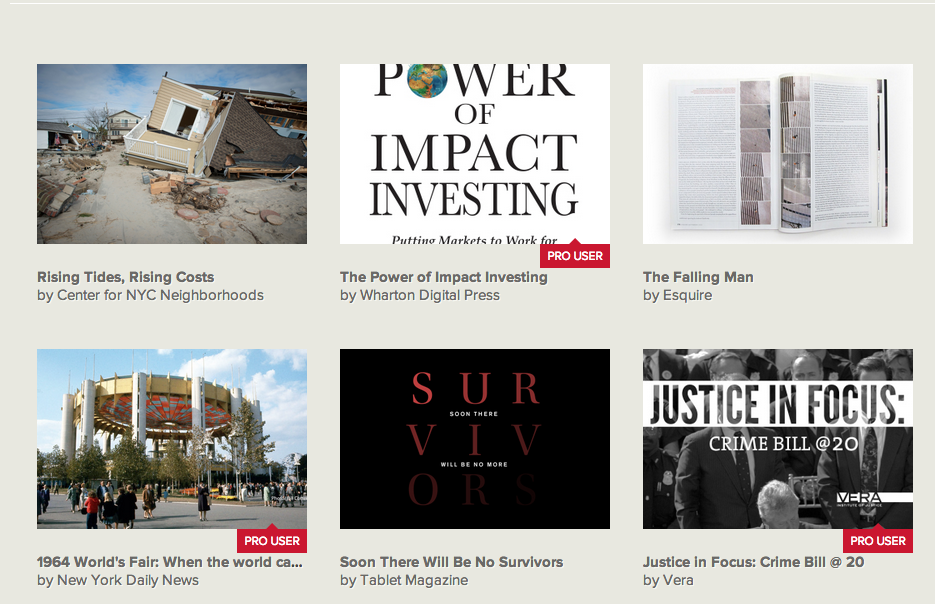
Creativist is an example of “scrollitelling”.  It’s a really low-barrier tool where you can combine pictures and video with a story.  The free version limits the size of your files (150 MB).  DW Academie gives a rather nice guide here which is worth reading through before you try.

https://www.creatavist.com/featured

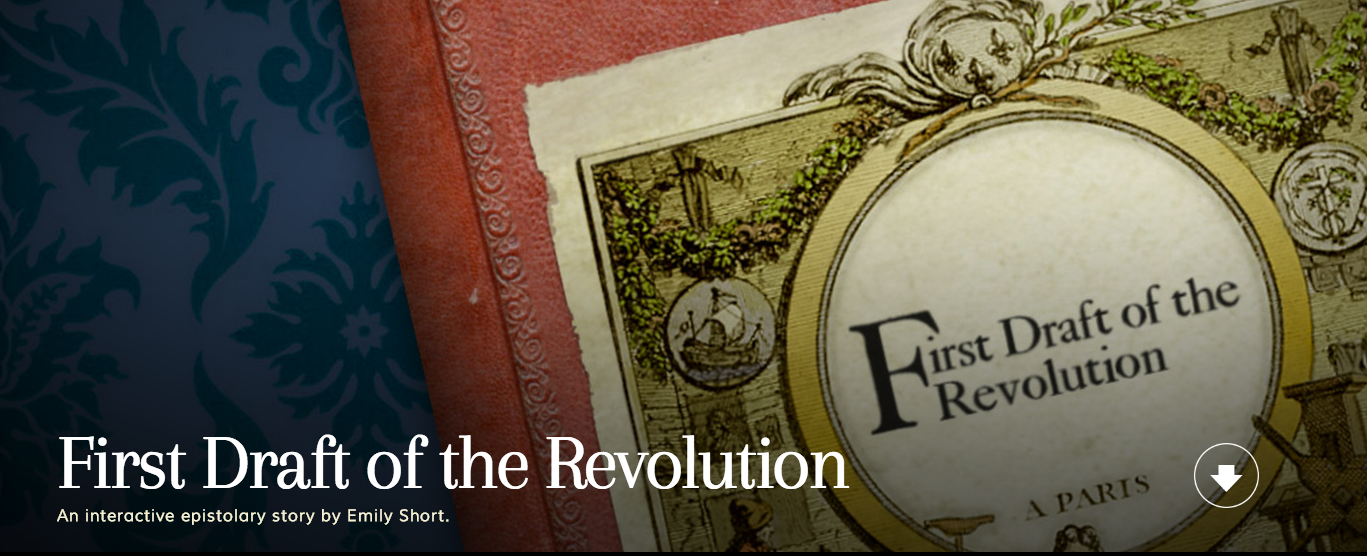
Inklewriter by Inklestudios is a platform for interactive choice based stories.  It is really easy to get started on and in its simplest version one can just add text.  Photos can be added relatively easily but there is no video option, which is a pity.  I can see great possibilities for use with students who are exploring options for example of subject choice or university or study choices – they could explore options and alternatives in a “safe” and personal environment imagining “what if…”

http://www.inklestudios.com/firstdraft/

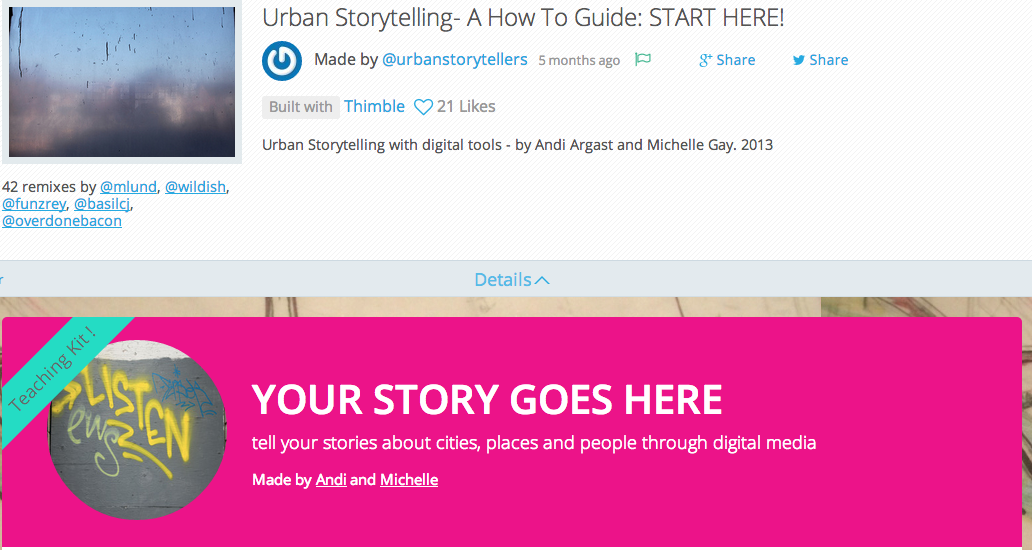
Popcorn Webmaker by Mozilla is another easy “plug and play” tool. It uses some of the basic conventions of video editing with various layers (sound, video, picture) and allows one to embed elements in a story.  One of the interesting variations on this is that the interactive element allows the audience to remix the original and make their own stories.

https://urbanstorytellers.makes.org/thimble/MzY3OTE5MTA0/urban-storytelling-a-how-to-guide-start-here

More ideas and lists:
Finally Storygami – something that is unfortunately still in Beta and where one can hire the team to realise your storytelling dreams, but where I see great potential for use in educational settings.

Assessment Item 8: Digital Storytelling Project and Reflection

Part A: Context for Digital Story Telling Project 

 “Knowledge, then, is experiences and stories, and intelligence is the apt use of experience, and the creation and telling of stories. Memory is memory for stories, and the major processes of memory are the creation, storage, and retrieval of stories.” (Schank & Abelson, 1995, p. 8)

In Asia, particularly Hong Kong, where parenting is a competitive sport, giving your children the opportunity to learn Chinese has become the holy grail of expatriate parenting.  Children are enrolled in language programs and immersion schools without much understanding or consideration of the possible consequences. Research is scant, seldom longitudinal and evidence is mainly anecdotal, A focus on positive success stories and oral ability prevails, while a climate of shame and fear prevents openness, analysis and understanding when children do not succeed.

Our family’s story of “chasing the dragon” is one of success, failure and ultimate triumph. Storytelling is a way of making sense of events and experiences and communicating this (Botturi, Bramani, & Corbino, 2012) to others in a similar situation.

The subject area covers language, bilingualism and mother tongue from both a pedagogical and socio-emotional point of view. The purpose is to illuminate the complexities underlying language choices in families in the international school context through storytelling.  The intended audience are parents, educators  and administrators in International Schools. This story will be basis of a presentation at a conference on language next year.  It will be used to add context to academic theory on mother-tongue, language learning and identity so that educators and parents alike not only have an intellectual understanding of the theories but an emotional response through this story to the platitude that “every child is unique”.

Academics and educators may lose sight of the fact that the audience that may best profit from their research and knowledge on bilingualism may only be vaguely aware of the information they need, often filtered through their own or other’s experience (King & Fogle, 2006). The intended audience of this project may have not have the time, inclination or access to scholarship in a form and format that is easily understood and resonates with them. Stories influence “attitudes, fears, hopes, and values” and are more effective at changing belief than persuasive writing as a result of changing how information is processed by the audience (Gottschall, 2012) due to escape into an alternative reality, connection with characters, emotional involvement and self-transformation (Green, Brock, & Kaufman, 2004).  The affordances of digital story-telling including audience participation enhance this engagement (Alexander, 2011). Although students are required to have a high level of English proficiency, often parents do not and their learning needs may therefore not be met. The affordance of digital storytelling is to incorporate multi semiotic systems that ‘allow for the linking and integration of cognitive, tacit, affective, cultural, personal, graphic and photographic ways of exploring, articulating, expressing and representing sense-making about learning and identity’ (Williams, 2009, cited in Walker, Jameson, & Ryan, 2010, p. 219).

Within the international school context, language is an area fraught with assumptions, misapprehension and emotion . This interactive digital experience has value for program implementation as it highlights many of the issues surrounding language acquisition and maintenance in an accessible format allowing for both breadth and depth in understanding of the topic.  Parents, with the best intentions in the world make pedagogically unsound decisions while educators, often coming from a mono-lingual background, may be unable to assist families in their linguistic paths and school administrators may be hampered to do right by the individual due to the logistical and cost complexity of catering to multiple linguistic backgrounds and nuances.

This project aims to increase awareness in all intended audiences so that choices can be made based on current understanding of best practice, educational and logistical issues and potential hurdles along the way. Perhaps we can let go of the “holy grail” of Chinese at the cost of our mother tongues and embrace, pursue and celebrate our own languages, culture and identity, reassured by what we know about language skill transferability.

Part B: Digital Story Telling Project

URL: chasingthechinesedragon.blogspot.com

Please note:

In the creation of my digital story, I have made extensive use of old video footage and photos of my children and others in a classroom setting. I have received the permission from my children to do so, and they partook in a series of interviews with me. However, in order to preserve their and others privacy and confidentiality I have decided to make the product and the blog in which the content occurs private until they are old enough to give permission that is legally binding. As they are now aged 11 and 12, I do not think their consent is as informed as it should be.

I would therefore request people to email me their email addresses so that I can include them on the list of people with permission to access the blog. I’m sorry for the inconvenience around this.

I have discussed this with a number of educators at our school and they feel this is the best way to proceed.

I will use some of the video clips and research for the presentation at the language conference in May, but that will be a dynamic rather than static presentation which will limit the exposure to a wide audience without the necessary context.

Part C: Critical Reflection

There are a number of dimensions related to working as an educational professional in the increasingly pervasive digital environment.  We no longer merely have a duty to teach content and information but need to equip ourselves, and our students with digital literacy and critical evaluative skills to deal with the multi-modal formats encountered in the education journey.

Value of digital story telling

In the “context” section, it was highlighted how effective stories are in changing belief and how information is processed and understood including the emotional engagement and interactive potential of digital media (Bailey, 2014c; Coleborne & Bliss, 2011; Gottschall, 2012; Green et al., 2004; Matthews, 2014).  A case can also be made for the role storytelling has in assimilating knowledge and memory (Schank & Abelson, 1995).

Tools and strategies for teaching / learning

In a recent essay, The Economist proposes a hierarchy of knowledge and learning and distinguishes between digital formats that have a function of “presenting people with procedural information they need in order to take on a simple task or fulfil a well-stated goal” versus teaching through “books” that can have its “pedagogy enriched by embedded media and software that adapts them to the user’s pace and needs” (The Economist, 2014, Chapter 5). Certainly the digital realm offers the possibility of engaging learners in a multi-modal environment which is more likely to resonate with their preferred way of receiving information provided the educator has a good understanding of how to select and use the tools (Anstey & Bull, 2012; Bowler, Morris, Cheng, Al-Issa, & Leiberling, 2012; Phillips, 2012; Unsworth, 2008; Walsh, 2010).

As educators our role needs to evolve and combine aspects of discovery, critical evaluation and enabling access to the most appropriate material (Dockter, Haug, & Lewis, 2010; Leacock & Nesbit, 2007; Nokelainen, 2006; Parrott, 2011), while at the same time educating our students to be mindful consumers and producers of content aware of the “weapons” in their and other’s storytelling “arsenal” and how these can be deployed for good and ill (Gottschall, 2012; Walker et al., 2010; Walsh, 2010).

Then there is the psycho/socio-neurological dimension of the impact digital literature has on how our students access, absorb, process and reflect on information and learning (Edwards, 2013; Goodwin, 2013; Jabr, 2013; Margolin, Driscoll, Toland, & Kegler, 2013; Wolf & Stoodley, 2008). Finally, for our students there are questions around the evolution of their skill sets as they move from consumption of digital products to creation, expression, engagement and interactivity (Hall, 2012).

Current and future developments

An exciting function of digital creations is the way materials can meet learning needs of all types of learners (Kingsley, 2007; Rhodes & Milby, 2007). However, one has to wonder about ephemeral nature of material, formats and platforms in the digital environment with the related issues of curation, preservation and archiving. Just as it appears that blogging as a tool for learning and storytelling has had its rise and demise, so too other platforms may not have longevity.

The whole field appears to be in its infancy with emerging and evolving norms, standards and platforms, (Maas, 2010; Valenza, 2014) where one can only wonder who the winners and losers will be.

Factors around design and publication

There are economic issues of efficiency, resource and time wastage as many individual teachers with varying levels of capability; capacity; understanding and access to tools attempt to participate in the creation of materials (Bailey, 2014b). One issue is the absence of a clearing house or “store” such as “Teachers pay Teachers” (Teachers Pay Teachers, 2014) or “Teacher created Resources” (Teacher Created Resources, 2014) so the discovery of relevant material remains serendipitous and local.  For example, YouTube abounds with “educational” material, but lacks a rating system appropriate for educational quality control including checking for producer bias.

For digital curriculum based material, critical mass, economies of scale, and the integration of pedagogy, design and technical tools and marketing are needed which puts educational publishers or organisation such as TED Education (Ted-ed, n.d.) rather than individual educators in a strong position to take control of this arena.

Copyright, Digital rights, licensing

There are issues around digital rights, rights management, copyright and the like, both for the creator and the consumer of digital products for the classroom. Cost and ownership is a tricky area as many products are leased rather than purchased, are platform captive and access to full text for students with disabilities may be precluded (Michaud, 2013; O’Brein, Gasser, & Palfrey, 2012; Puckett, 2010).

Conclusion

At the end of following this course, it could be suggested that the course name “Literature in Digital Environments” is a misnomer (Bailey, 2014a), and “Literacy in Digital Environments” could be an alternative title to encompass all the aspects of this rich arena.

References:


Alexander, B. (2011). Storytelling: A tale of two generations (Chapter 1). In The new digital storytelling: creating narratives with new media (pp. 3–15). Santa Barbara, California: Praeger.

Anstey, M., & Bull, G. (2012). Using multimodal factual texts during the inquiry process. PETAA, 184, 1–12. Retrieved from http://chpsliteracy.wikispaces.com/file/view/PETAA+Paper+No.184.pdf

Bailey, N. (2014a, August 20). When is it digital literature? [Web Log post]. Retrieved October 12, 2014, from http://thinkspace.csu.edu.au/informativeflights/2014/08/20/when-is-it-digital-literature/

Bailey, N. (2014b, September 10). Module 4.1: What questions or answers do you have in relation to digital storytelling? [Web log post]. Retrieved October 12, 2014, from http://thinkspace.csu.edu.au/informativeflights/2014/09/10/module-4-1-what-questions-or-answers-do-you-have-in-relation-to-digital-storytelling/

Bailey, N. (2014c, September 30). Assessment item 7: Blog 4 – Electronic media and the nature of the story [Web log post]. Retrieved October 12, 2014, from http://thinkspace.csu.edu.au/informativeflights/2014/09/30/assessment-item-7-blog-4-electronic-media-and-the-nature-of-the-story/

Botturi, L., Bramani, C., & Corbino, S. (2012). Finding Your Voice Through Digital Storytelling. TechTrends, 56(3), 10–11. doi:10.1007/s11528-012-0569-1

Bowler, L., Morris, R., Cheng, I.-L., Al-Issa, R., & Leiberling, L. (2012). Multimodal stories: LIS students explore reading, literacy, and library service through the lens of “The 39 Clues.” Journal of Education for Library and Information Science, 53(1), 32–48.

Coleborne, C., & Bliss, E. (2011). Emotions, Digital Tools and Public Histories: Digital Storytelling using Windows Movie Maker in the History Tertiary Classroom. History Compass, 9(9), 674–685. doi:10.1111/j.1478-0542.2011.00797.x

Dockter, J., Haug, D., & Lewis, C. (2010). Redefining Rigor: Critical Engagement, Digital Media, and the New English/Language Arts. Journal of Adolescent & Adult Literacy, 53(5), 418–420. Retrieved from http://ezproxy.csu.edu.au/login?url=http://search.ebscohost.com/login.aspx?direct=true&db=eric&AN=EJ871723&site=ehost-live

Edwards, J. T. (2013). Reading Beyond the Borders: Observations on Digital eBook Readers and Adolescent Reading Practices. In J. Whittingham, S. Huffman, W. Rickman, & C. Wiedmaier (Eds.), Technological Tools for the Literacy Classroom: (pp. 135–158). IGI Global. Retrieved from http://services.igi-global.com/resolvedoi/resolve.aspx?doi=10.4018/978-1-4666-3974-4

Goodwin, B. (2013). The Reading Skills Digital Brains Need. Educational Leadership, 71(3), 78. Retrieved from http://ezproxy.csu.edu.au/login?url=http://search.ebscohost.com/login.aspx?direct=true&db=f5h&AN=91736083&site=ehost-live

Gottschall, J. (2012, May 2). Why Storytelling Is The Ultimate Weapon. Retrieved September 29, 2014, from http://www.fastcocreate.com/1680581/why-storytelling-is-the-ultimate-weapon

Green, M. C., Brock, T. C., & Kaufman, G. F. (2004). Understanding Media Enjoyment: The Role of Transportation Into Narrative Worlds. Communication Theory, 14(4), 311–327. doi:10.1111/j.1468-2885.2004.tb00317.x

Hall, T. (2012). Digital Renaissance: The Creative Potential of Narrative Technology in Education. Creative Education, 03(01), 96–100. doi:10.4236/ce.2012.31016

Jabr, F. (2013, April 11). The Reading Brain in the Digital Age: The Science of Paper versus Screens [Article]. Retrieved August 31, 2014, from http://www.scientificamerican.com/article/reading-paper-screens/

King, K., & Fogle, L. (2006). Bilingual Parenting as Good Parenting: Parents’ Perspectives on Family Language Policy for Additive Bilingualism. International Journal of Bilingual Education and Bilingualism, 9(6), 695–712. doi:10.2167/beb362.0

Kingsley, K. V. (2007). Empower Diverse Learners With Educational Technology and Digital Media. Intervention in School & Clinic, 43(1), 52–56. Retrieved from http://ezproxy.csu.edu.au/login?url=http://search.ebscohost.com/login.aspx?direct=true&db=ehh&AN=26156207&site=ehost-live

Leacock, T. L., & Nesbit, J. C. (2007). A Framework for Evaluating the Quality of Multimedia Learning Resources. Educational Technology & Society, 10(2), 44–59.

Maas, D. (2010, June). Web-based Digital Storytelling Tools and  Online Interactive Resources [Web Log]. Retrieved from http://maasd.edublogs.org/files/2010/06/Web-based-Digital-Storytelling-Tools-Online-Interactives-2gwjici.pdf

Margolin, S. J., Driscoll, C., Toland, M. J., & Kegler, J. L. (2013). E-readers, Computer Screens, or Paper: Does Reading Comprehension Change Across Media Platforms?: E-readers and comprehension. Applied Cognitive Psychology, 27(4), 512–519. doi:10.1002/acp.2930

Matthews, J., RGN BSc PG Dip. (2014). Voices from the heart: the use of digital storytelling in education. Community Practitioner, 87(1), 28–30. Retrieved from http://search.proquest.com/docview/1474889132?accountid=10344

Michaud, D. (2013). Copyright and Digital Rights Management: Dealing with artificial access barriers for students with print disabilities. Feliciter, 59(1), 24–30. Retrieved from http://search.proquest.com.ezproxy.csu.edu.au/docview/1286679756?accountid=10344

Nokelainen, P. (2006). An empirical assessment of pedagogical usability criteria for digital learning material with elementary school students. Journal of Educational Technology & Society, 9(2), 178–197. Retrieved from http://ezproxy.csu.edu.au/login?url=http://search.ebscohost.com/login.aspx?direct=true&db=ehh&AN=85866426&site=ehost-live

O’Brein, D., Gasser, U., & Palfrey, J. G. (2012, July 1). E-Books in Libraries: A Briefing Document Developed in Preparation for a Workshop on E-Lending in Libraries. Berkman Center Research Publication No. 2012-15. Retrieved from http://ssrn.com/abstract=2111396

Parrott, K. (2011, July 18). 5 Questions to Ask When Evaluating Apps and Ebooks [Web log post]. Retrieved August 31, 2014, from http://www.alsc.ala.org/blog/2011/07/5-questions-to-ask-when-evaluating-apps-and-ebooks/

Phillips, A. (2012). A creator’s guide to transmedia storytelling: how to captivate and engage audiences across multiple platforms. New York: McGraw-Hill.

Puckett, J. (2010). Digital Rights Management as Information Access Barrier. Progressive Librarian, Fall-Winter(34/35), 11–24. Retrieved from http://www.progressivelibrariansguild.org/PL_Jnl/pdf/PL34_35_fallwinter2010.pdf

Rhodes, J. A., & Milby, T. M. (2007). Teacher-Created Electronic Books: Integrating Technology to Support Readers With Disabilities. The Reading Teacher, 61(3), 255–259. doi:10.1598/RT.61.3.6

Schank, R. C., & Abelson, R. P. (1995). Knowledge and Memory:  The Real Story. In R. S. Wyer (Ed.), Knowledge and Memory: The Real Story (Vol. VIII, pp. 1–85). Hillsdale, NJ: Lawrence Erlbaum Associates. Retrieved from http://cogprints.org/636/1/KnowledgeMemory_SchankAbelson_d.html

Teacher Created Resources. (2014). Teacher Created Resources – Educational Materials and Teacher Supplies. Retrieved October 11, 2014, from http://www.teachercreated.com/

Teachers Pay Teachers. (2014). TeachersPayTeachers.com – An Open Marketplace for Original Lesson Plans and Other Teaching Resources. Retrieved October 11, 2014, from http://www.teacherspayteachers.com/

TED-Ed. (n.d.). Lessons Worth Sharing. Retrieved October 12, 2014, from http://ed.ted.com/

The Economist. (2014, October). The future of the book. Retrieved October 11, 2014, from http://www.economist.com/news/essays/21623373-which-something-old-and-powerful-encountered-vault

Unsworth, L. (2008). Multiliteracies, E-literature and English Teaching. Language and Education, 22(1), 62–75. doi:10.2167/le726.0

Valenza, J. (2014). The Digital Storytelling Tools Collection. Retrieved October 11, 2014, from https://edshelf.com/profile/joycevalenza/digital-storytelling-tools

Walker, S., Jameson, J., & Ryan, M. (2010). Skills and strategies for e-learning in a participatory culture (Ch. 15). In R. Sharpe, H. Beetham, & S. Freitas (Eds.), Rethinking learning for a digital age: How learners are shaping their own experiences (pp. 212–224). New York, NY: Routledge.

Walsh, M. (2010). Multimodal literacy: What does it mean for classroom practice? Australian Journal of Language and Literacy, 33(3), 211–239.

Wolf, M., & Stoodley, C. J. (2008). Proust and the squid: the story and science of the reading brain. New York: Harper Perennial.
The point of literature

I absolutely couldn’t have said it better, so I’d like to share this movie by Marcus Armitage.

What is Literature for? from Marcus Armitage on Vimeo, animated by Marcus Armitage and Ignatz Johnson Higham.
Voice over Alain de Botton.

Assessment item 7: Blog 4 – Electronic media and the nature of the story

Electronic media are not simply changing the way we tell stories: they’re changing the very nature of story, or what we understand (or do not understand) to be narratives. To what extent is this true?

From: https://www.youtube.com/watch?v=p6E8jpFasR0

Many authors have argued that storytelling is intrinsic to humanity (Schank & Abelson, 1995) and part of memory and learning. And yet for some reason it appears to me that storytelling had something of a hiatus in the last century, perhaps as a side effect of the post war modern corporate life, the emphasis on the scientific method and the space race. However the proliferation of research, writings and talks on the power of storytelling in all aspects of life from the scientific (Bailey, 2013) to the corporate (Gottschall, 2012) to education (Matthews, 2014)  and everything in-between hints that storytelling is once again coming into its own (Pettitt, Donaldson, & Paradis, 2010; Sauerberg, 2009).  Whether electronic media is a cause or an effect of this or whether it is just part of the zeitgeist is something we will only know in hindsight.

What we traditionally understand to be narrative consists of a storyteller, an audience and the narrative elements of a hero, a problem, an antagonist, tasks, a turning point and an outcome (Alexander, 2011).   How electronic media is changing the nature of this is by broadening the concept of who is the storyteller. Once a digital narrative moves beyond being a story delivered electronically as in an eBook, or as a movie, but streamed or available digitally and goes to being an interactive “event” in which the distinction between the storyteller and the audience blurs and is interchangeable, one can talk about the nature of the narrative being changed by the media and its affordances. The creator becomes an initiator and the audience becomes collaborators and co-creators.  The question then is whether one can still find the narrative elements back in this new hybrid creation? Does the participation of many voices enhance or hamper the profundity, meaning and emotion at the root of the narrative?  Does engagement and involvement and participation equate to the “wisdom of crowds” or does it result in a “lowest common denominator” product?  Are we moving from a period of finite works of infinite genius to infinite works of dubious merit (Pickett, 1986) –  albeit a series of very clever and networked and buzzed works.

Another matter in all of this that is somewhat bothering me is the way in which the “science” of storytelling and its capacity to capture attention and emotion in its audience is being (ab)used for commercial purposes or to manipulate audiences to create changes in political (Simsek, 2012), social (Burgess & Vivienne, 2013; LaRiviere, Snider, Stromberg, & O’Meara, 2012) or public sphere (Poletti, 2011).  Proponents would of course argue that the ends justify the means – but of course both sides of the debate have the same weapons in their arsenals (see the whole climate change narrative as an example of this), and as educators this makes our task of aiding the new generation of learners to be knowledgeable, discernable, informed and aware that much more important.

References:

Alexander, B. (2011). Storytelling: A tale of two generations (Chapter 1). In The new digital storytelling: creating narratives with new media (pp. 3–15). Santa Barbara, Calif: Praeger.

Bailey, P. (2013, March 27). Science Writing: You need to know how to tell a good story [Web log]. Retrieved September 29, 2014, from http://www.theguardian.com/science/2013/mar/27/penny-bailey-science-writing-wellcome

Burgess, J. E., & Vivienne, S. (2013). The remediation of the personal photograph and the politics of self-representation in digital story- telling. Journal of Material Culture, 18(3), 279–298. Retrieved from http://eprints.qut.edu.au/62708/

Gottschall, J. (2012, May 2). Why Storytelling Is The Ultimate Weapon. Retrieved September 29, 2014, from http://www.fastcocreate.com/1680581/why-storytelling-is-the-ultimate-weapon

LaRiviere, K., Snider, J., Stromberg, A., & O’Meara, K. (2012). Protest: Critical lessons of using digital media for social change. About Campus, 17(3), 10–17. doi:10.1002/abc.21081

Matthews, J., RGN BSc PG Dip. (2014). Voices from the heart: the use of digital storytelling in education. Community Practitioner, 87(1), 28–30. Retrieved from http://search.proquest.com/docview/1474889132?accountid=10344

Pettitt, T., Donaldson, P., & Paradis, J. (2010, April 1). The Gutenberg Parenthesis: oral tradition and digital technologies. Retrieved August 29, 2014, from http://web.mit.edu/comm-forum/forums/gutenberg_parenthesis.html

Pickett, D. (1986). What is literature – established canon or popular taste? English Today, 2(01), 37. doi:10.1017/S0266078400001735

Poletti, A. (2011). Coaxing an intimate public: Life narrative in digital storytelling. Continuum, 25(1), 73–83. doi:10.1080/10304312.2010.506672

Sauerberg, L. O. (2009). The Encyclopedia and the Gutenberg Parenthesis. In Media in Transition 6: stone and papyrus, storage and transmission (pp. 1–13). Cambridge, MA, USA.: Massachusetts Institute of Technology.

Schank, R. C., & Abelson, R. P. (1995). Knowledge and Memory:  The Real Story. In R. S. Wyer (Ed.), Knowledge and Memory: The Real Story (Vol. VIII, pp. 1–85). Hillsdale, NJ: Lawrence Erlbaum Associates. Retrieved from http://cogprints.org/636/1/KnowledgeMemory_SchankAbelson_d.html

Simsek, B. (2012). Using Digital Storytelling as a change agent for women’s participation in the Turkish Public Sphere (Doctor of Philosophy). Queensland University of Technology, Queensland, Australia. Retrieved from http://eprints.qut.edu.au/50894/1/Burcu_Simsek_Thesis.pdf

Assessment item 7: Blog 4 – Electronic media and the nature of the story

Electronic media are not simply changing the way we tell stories: they’re changing the very nature of story, or what we understand (or do not understand) to be narratives. To what extent is this true?
Many authors have argued that storytelling is intrinsic to humanity (Schank & Abelson, 1995) and part of memory and learning. And yet for some reason it appears to me that storytelling had something of a hiatus in the last century, perhaps as a side effect of the post war modern corporate life, the emphasis on the scientific method and the space race. However the proliferation of research, writings and talks on the power of storytelling in all aspects of life from the scientific (Bailey, 2013) to the corporate (Gottschall, 2012) to education (Matthews, 2014)  and everything in-between hints that storytelling is once again coming into its own (Pettitt, Donaldson, & Paradis, 2010; Sauerberg, 2009).  Whether electronic media is a cause or an effect of this or whether it is just part of the zeitgeist is something we will only know in hindsight.
What we traditionally understand to be narrative consists of a storyteller, an audience and the narrative elements of a hero, a problem, an antagonist, tasks, a turning point and an outcome (Alexander, 2011).   How electronic media is changing the nature of this is by broadening the concept of who is the storyteller. Once a digital narrative moves beyond being a story delivered electronically as in an eBook, or as a movie, but streamed or available digitally and goes to being an interactive “event” in which the distinction between the storyteller and the audience blurs and is interchangeable, one can talk about the nature of the narrative being changed by the media and its affordances. The creator becomes an initiator and the audience becomes collaborators and co-creators.  The question then is whether one can still find the narrative elements back in this new hybrid creation? Does the participation of many voices enhance or hamper the profundity, meaning and emotion at the root of the narrative?  Does engagement and involvement and participation equate to the “wisdom of crowds” or does it result in a “lowest common denominator” product?  Are we moving from a period of finite works of infinite genius to infinite works of dubious merit (Pickett, 1986) –  albeit a series of very clever and networked and buzzed works.
Another matter in all of this that is somewhat bothering me is the way in which the “science” of storytelling and its capacity to capture attention and emotion in its audience is being (ab)used for commercial purposes or to manipulate audiences to create changes in political (Simsek, 2012), social (Burgess & Vivienne, 2013; LaRiviere, Snider, Stromberg, & O’Meara, 2012) or public sphere (Poletti, 2011).  Proponents would of course argue that the ends justify the means – but of course both sides of the debate have the same weapons in their arsenals (see the whole climate change narrative as an example of this), and as educators this makes our task of aiding the new generation of learners to be knowledgeable, discernable, informed and aware that much more important.
References:
Alexander, B. (2011). Storytelling: A tale of two generations (Chapter 1). In The new digital storytelling: creating narratives with new media (pp. 3–15). Santa Barbara, Calif: Praeger.
Bailey, P. (2013, March 27). Science Writing: You need to know how to tell a good story [Web log]. Retrieved September 29, 2014, from http://www.theguardian.com/science/2013/mar/27/penny-bailey-science-writing-wellcome
Burgess, J. E., & Vivienne, S. (2013). The remediation of the personal photograph and the politics of self-representation in digital story- telling. Journal of Material Culture18(3), 279–298. Retrieved from http://eprints.qut.edu.au/62708/
Gottschall, J. (2012, May 2). Why Storytelling Is The Ultimate Weapon. Retrieved September 29, 2014, from http://www.fastcocreate.com/1680581/why-storytelling-is-the-ultimate-weapon
LaRiviere, K., Snider, J., Stromberg, A., & O’Meara, K. (2012). Protest: Critical lessons of using digital media for social change. About Campus17(3), 10–17. doi:10.1002/abc.21081
Matthews, J., RGN BSc PG Dip. (2014). Voices from the heart: the use of digital storytelling in education. Community Practitioner87(1), 28–30. Retrieved from http://search.proquest.com/docview/1474889132?accountid=10344
Pettitt, T., Donaldson, P., & Paradis, J. (2010, April 1). The Gutenberg Parenthesis: oral tradition and digital technologies. Retrieved August 29, 2014, from http://web.mit.edu/comm-forum/forums/gutenberg_parenthesis.html
Pickett, D. (1986). What is literature – established canon or popular taste? English Today2(01), 37. doi:10.1017/S0266078400001735
Poletti, A. (2011). Coaxing an intimate public: Life narrative in digital storytelling. Continuum25(1), 73–83. doi:10.1080/10304312.2010.506672
Sauerberg, L. O. (2009). The Encyclopedia and the Gutenberg Parenthesis. In Media in Transition 6: stone and papyrus, storage and transmission (pp. 1–13). Cambridge, MA, USA.: Massachusetts Institute of Technology.
Schank, R. C., & Abelson, R. P. (1995). Knowledge and Memory:  The Real Story. In R. S. Wyer (Ed.), Knowledge and Memory: The Real Story (Vol. VIII, pp. 1–85). Hillsdale, NJ: Lawrence Erlbaum Associates. Retrieved from http://cogprints.org/636/1/KnowledgeMemory_SchankAbelson_d.html
Simsek, B. (2012). Using Digital Storytelling as a change agent for women’s participation in the Turkish Public Sphere (Doctor of Philosophy). Queensland University of Technology, Queensland, Australia. Retrieved from http://eprints.qut.edu.au/50894/1/Burcu_Simsek_Thesis.pdf

Fair use? Transformative?

Question:

What exactly is Fair Use? (keep in mind that Australia has Fair Dealing, which is not quite the same). Why did the Judge consider Googles Book search project to be transformative? What are the possible benefits and possible issues with such a project?

____________________________________

According to Stim (2014) “a fair use is any copying of copyrighted material done for a limited and “transformative” purpose, such as to comment upon, criticize, or parody a copyrighted work. Such uses can be done without permission from the copyright owner” (para 1).

In contrast fair dealing in the Australian context is : “There is no general exception for using copyright material simply because you think it is fair or because you are not making a profit. The Copyright Act allows you to use copyright material without permission if your use is a “fair dealing” for one of the following purposes:
• research or study;
• criticism or review;
• parody or satire;
• reporting news; or
• professional advice by a lawyer, patent attorney or trade marks attorney.” (Australian Copyright Council, 2012)

There is no mention here of being “transformative”.

The transformative nature of the Google Book Search project was that it allowed books that had been digitised to be searched, including books that were out of copyright or the existence thereof would not otherwise be known. This was beneficial to the public, including those searching for educational purposes. The search allowed limited access and thereby respected copyright while indicating where the book could be borrowed or purchased.

__________________________________
References:

Australian Copyright Council. (2012, February). Fair Dealing. Retrieved fromhttp://www.copyright.org.au/admin/cms-acc1/_images/169501865452392488546d3.pdf

Stim, R. (2014). What Is Fair Use? Copyright Overview [Overview]. Retrieved September 26, 2014, from http://fairuse.stanford.edu/overview/fair-use/what-is-fair-use/

_______________________

And now for something practical … I’m in charge of setting up and running our school library volunteer program – so I’ve been parodying some vintage posters calling for volunteers, which has had some mixed comments from the community (mainly positive).

It started with this one  about forgetting the cooking – one feminist in the community objected, Volunteer 1


so we followed it with the “man overboard”

Library volunteer male 1


Needless to say we weren’t swamped by men signing up to volunteer!

Then for the training I made a mash-up with the Mad Men poster – it was irresistible – “where the truth lies?”  … wow,

I thought I’d get pushback on the fact that I’d not alpha’ed the cigarette out, but, the communications department was worried we’d fall foul of copyright.  I don’t think so?  What do you think?

volunteer training


Assessment Item 6: Digital Storytelling Topic Proposal

“Knowledge, then, is experiences and stories, and intelligence is the apt use of experience, and the creation and telling of stories. Memory is memory for stories, and the major processes of memory are the creation, storage, and retrieval of stories.”(Schank & Abelson, 1995, p. 8)

red dragon

Red Dragon Wallpaper Download. (2011)

Proposal Topic:

“追龍 – Chasing the Dragon*
a family’s story of language and identity”

From 2006 to 2011 our family was engaged in learning Chinese in one form or another including language classes, attending a bilingual immersion school and following a university degree – with nearly devastating consequences for one child. This digital story weaves together extracts from blog entries written at the time, digital photos and videos, images of school books and writing and interviews as each child and the family grappled and came to terms with who they were and how language shaped that identity.

Proposed digital tools and/or spaces to be used:

iMovie, Blogger, twitter, facebook, digital photos and videos, memorabilia

Rationale for topic focus

In Asia, particularly Hong Kong, where parenting is a competitive sport, giving your children the opportunity to learn Chinese has become the holy grail of expatriate parenting. Children are enrolled in language programs and immersion schools without much understanding or consideration of the possible consequences.

Research is scant and evidence, mainly anecdotal, focuses on the positive success stories.  A climate of shame, and fear of it reflecting badly on the parent, prevents openness when children do not succeed.

Our family’s story of “chasing the dragon” is one of success, failure and ultimate triumph. In this project, I hope to use storytelling as a way of making sense of events and experiences and communicating this (Botturi, Bramani, & Corbino, 2012) to others in a similar situation.

The affordance of digital storytelling is to incorporate multi semiotic systems that ‘allow for the linking and integration of cognitive, tacit, affective, cultural, personal, graphic and photographic ways of exploring, articulating, expressing and representing sense-making about learning and identity’ (Williams, 2009, cited in Walker, Jameson, & Ryan, 2010, p. 219). It is a warning story and also a story of hope.

Finally, I am considering putting in a proposal to present at a conference on language next year. I would like to use this story as the basis of adding context to academic theory on mother-tongue, language learning and identity so that educators and parents alike not only have an intellectual understanding of the theories but an emotional response through this story to the platitude that “every child is unique”.


====================================================

* “chasing the dragon” is a Hong Kong slang term referring to inhaling opium vapour – the metaphorical meaning includes the elusive pursuit of an ultimate high.  For the purposes of this story it’s the elusive pursuit of mastering the Chinese language.

====================================================

References:

Botturi, L., Bramani, C., & Corbino, S. (2012). Finding Your Voice Through Digital Storytelling. TechTrends, 56(3), 10–11. doi:10.1007/s11528-012-0569-1

Red Dragon Wallpaper Download. (2011). Retrieved September 14, 2014, from http://www.wallpaperhere.com/Red_Dragon_81049/download_1920x1440

Schank, R. C., & Abelson, R. P. (1995). Knowledge and Memory:  The Real Story. In R. S. Wyer (Ed.), Knowledge and Memory: The Real Story (Vol. VIII, pp. 1–85). Hillsdale, NJ: Lawrence Erlbaum Associates. Retrieved from http://cogprints.org/636/1/KnowledgeMemory_SchankAbelson_d.html

Walker, S., Jameson, J., & Ryan, M. (2010). Skills and strategies for e-learning in a participatory culture (Ch. 15). In R. Sharpe, H. Beetham, & S. Freitas (Eds.), Rethinking learning for a digital age: How learners are shaping their own experiences (pp. 212–224). New York, NY: Routledge.


Module 4.1: What questions or answers do you have in relation to digital storytelling?

What questions (or answers) have formed in your mind in relation to digital storytelling? How does social media fit into the mix for you? What are the most important connections to learning overall?

=================================

I guess my prime question after watching these extracts of digital storytelling is: “how the heck do they do it?”

In some cases, like the twitterature it is obvious, But when I was watching “<a href=”http://pinepoint.nfb.ca/#/pinepoint&#8221; target=”_blank”>Welcome to PinePoint”</a> (Shoebottom and Simons, 2011) I really wanted them to tell me how to put something like that together, because it’s exactly the type of thing I’d like to do.

So I guess it’s that feeling of seeing something within grasp and realising its potential but not being able to catch hold of it and do something meaningful with it!

For me social media would be what I’d use to strew my “digital crumbs” and to leave me digital clues, as well as to provide a way for the audience to interact with the story, I particularly liked the summary of Locke & Ettinghausen on the 6 points of how we tell new stories;
1. Hide stories in unexpected places
2. Give yourself ridiculous constraints
3. Experiment outside your comfort zones
4. Invent a character without a storyline
5. Give fans stuff to play with
6. Create stories that people can binge on whenever they want” (Fora.TV, 2009)

References:

Fora.TV. (2009, September 23). Once Upon These Times: New Stories for New Audiences [Video file]. Retrieved from http://fora.tv/2009/09/23/Once_Upon_These_Times_New_Stories_for_New_Audiences
Shoebridge, P., & Simons, M. (2011). Welcome to PinePoint [Digital Novel]. Retrieved September 10, 2014, from http://pinepoint.nfb.ca/#/pinepoint

Assessment item 5: Blog task 3

Response comment to: Bec Spink – Reflecting on Digital Literature

I was most interested in your observations on incorporating digital literature in the classroom.  And yet, as I attempt to respond to your posting, after a few minutes of futile scrolling up and down as I tried to reply and refer back to what you have written, in an attempt to resist printing out your post in order to do this successfully (how did everyone else do this?) dual screen compromiseI have taken an interlude to email myself with my fellow student’s blog post addresses and to open the posts on my iPad and with twisted neck and dual screens perched in discomfort I continue*.  And there lies the rub, that so many have hiccupped against – that lack of linearity, the unfamiliarity, the medium (Cull, 2011; Liu, Liao, & Guo, 2009; Nilsson, 2010; Skains, 2010; Walker, Jameson, & Ryan, 2010; Walsh, 2013).  That need to jump around, and while jumping find the train of thought has escaped, perhaps to be regained perhaps not.

I digress. I cannot avoid, you are right. But should I have tweeted my response? I just did. Because I could

“@MissB6_2 I have read and appreciate your “Reflecting on Digital Literature” we are getting there, but the journey is arduous. #INF533″

tweet to Bec
tweet to Bec

I see teachers all around me tweeting. But not to / with their students. I ask them about digital literature, and they look horrified. Too new, too experimental. It’s hard enough getting parents to appreciate YA ala John Green or Sherman Alexie (what is it with all that swearing? What about the classics? Why can’t they do Jane Austen?) – #Beow100 (Madrigal, 2014; Treharne, 2014) or The Lizzie Bennet diary (Francus, 2013; Pemberley Digital, 2013; Su, Noble, Rorick, & Austen, 2014) won’t cut it. And the students, they’re blogging! But they can’t write a letter or an essay. And the spelling is appalling. In my day…


And yet it is wonderful. But. I think educators are afraid.  And perhaps justifiably so. Sure, there are some for whom this is so distant that it may not exist. There are some with an inkling, some exposure and the tingling of excitement. They can incorporate what someone else has done into their lessons. The librarians can put bits of multi-media and multi-modality into their libguides (I know I do).  But in attempting to create full blown authentic edutainment, the type that needs a cast of thousands and not “Captain my captain” standing on a table we are powerless.  We do not lack in imagination, nor dreaming or envisioning the possibilities. We lack in the skills, the time, the patience to fiddle around and budgets to bring them to fruition.  So we languish with other’s interpretations and like a person in a dark corridor with one faint glimmer of light, knock our heads and stub our toes, bumping alternately between our students who demand and need more and different and administrators and parents who hanker after a more certain and fixed past.

Cull, B. . (2011). Reading revolutions: Online digital text and implications for reading in academe | Cull | First Monday. First Monday, 16(6). Retrieved from http://firstmonday.org/ojs/index.php/fm/article/view/3340/2985

Francus, M. (2013, October 22). Pride and Prejudice Goes Interactive: “The Lizzie Bennet Diaries.” Video presented at the Pride and Prejudice: The Bicentennial, Paper 5. Retrieved from http://corescholar.libraries.wright.edu/celia_pride/conference/october11/5

Liu, S., Liao, S., & Guo, J. (2009). Surviving in the digital age by utilizing libraries’ distinctive advantages. The Electronic Library, 27(2), 298–307. doi:10.1108/02640470910947647

Madrigal, A. (2014, January 10). The Elegance of Beowulf in 100 Tweets – The Atlantic. Retrieved August 19, 2014, from http://www.theatlantic.com/technology/archive/2014/01/the-elegance-of-beowulf-in-100-tweets/282989/

Nilsson, M. (2010). Developing Voice in Digital Storytelling Through Creativity, Narrative and Multimodality. International Journal of Media, Technology and Lifelong Learning, 6(2), 148–160. Retrieved from http://seminar.net/index.php/volume-6-issue-2-2010/154-developing-voice-in-digital-storytelling-through-creativity-narrative-and-multimodality

Pemberley Digital. (2013, August 22). Emmy Award Winning, Interactive Web Series “The Lizzie Bennet Diaries” Immerses Fans into Jane Austen’s Timeless Classic [Press Release]. Retrieved August 20, 2014, from http://www.lizziebennet.com/press-release/

Skains, R. L. (2010). The Shifting Author–Reader Dynamic: Online Novel Communities as a Bridge from Print to Digital Literature. Convergence: The International Journal of Research into New Media Technologies, 16(1), 95–111. doi:10.1177/1354856509347713

Su, B., Noble, K., Rorick, K., & Austen, J. (2014). The secret diary of Lizzie Bennet. London ; Sydney: Simon & Schuster.

Treharne, E. (2014, January 9). Beowulf in a Hundred Tweets : #Beow100 [[Web log post]]. Retrieved August 20, 2014, from http://historyoftexttechnologies.blogspot.sg/2014/01/beowulf-in-hundred-tweets-beow100.html

Walker, S., Jameson, J., & Ryan, M. (2010). Skills and strategies for e-learning in a participatory culture (Ch. 15). In R. Sharpe, H. Beetham, & S. Freitas (Eds.), Rethinking learning for a digital age: How learners are shaping their own experiences (pp. 212–224). New York, NY: Routledge.

Walsh, M. (2013). Literature in a digital environment. In L. McDonald (Ed.), A literature companion for teachers (pp. 181–194). Marrickville, NSW: Primary English Teaching Association Australia (PETAA).


* I cannot even workout why my image isn’t upright and how to fix it quickly. What hope is there for me to create a singing and dancing multi-modal digital story?

Assessment Item 4: Critical Reflection of Digital Literature Experiences

What makes a good digital text

Despite Goodreads’ narrow interpretation of a book as being something with an ISBN number, “the book as a physical object with paper pages is now only one version of what a book might be” (Hancox, 2013, para. 7). As many have discussed before, a digital text can take many formats and permutations (James & de Kock, 2013; Parker, 2013; Sadokierski, 2013b; Walsh, 2013).

Various criteria exist as to what constitutes a good digital text.  Its ability to engage, enhance, experience, elucidate, explain and entertain (James & de Kock, 2013; Miller, 2011); the use of multiple media and a single unified story without redundancy between media (Phillips, 2012; Walker et al., 2010); a linear yet enhanced reading experience, engaging multiple literacy and learning styles with intelligent, flexible and intuitive design with longevity (Parrott, 2011). To this can be added the potential to cater for different ability and facility with language and technology and preferred multi-sensory behaviour while bridging participatory skills and social needs with academic skills (Anstey & Bull, 2012; Roskos, Burstein, Shang, & Gray, 2014; Walker et al., 2010). Finally a good text, digital or otherwise will immerse and absorb the reader while allowing them to interact with the world and others, or an alternate reality, vicariously and integrate new knowledge and understanding into their existing schema or worldview (Fuhler, 2010; Ryan & Ryan, n.d.).

Compare experience digital versus print

In any comparison of the print / digital experience it should be emphasized that neither has moral nor educational superiority, but rather fulfil different functions and meet different literary, literacy and learning needs.

The most obvious difference is the format, though the non-linear nature of digital media is often commented on with its potential to disrupt the reading process and the need to have a strategy to stay on track and the necessity of learning and incorporating new conventions and practices in experiencing digital literature (Anstey & Bull, 2012; Chuk, Hoetzlein, Kim, & Panko, 2012; Francus, 2013; James & de Kock, 2013; Roskos et al., 2014; Skains, 2010). Digital features can create an enticement to buy, assist with the appreciation of literature, facilitate interpretation and understanding or motivate adjunct composition (Unsworth, 2006).

Experimentation with digital literature will, after a while, create a sense of discomfort in a self-aware educator as it becomes obvious that “their” pedagogical functions of elucidation and enhancing understanding of literature are usurped by the medium which can offer these benefits in a manner that fits with a learners’ preferred learning style and mode at a personalized pace. However, one’s role as a curator, guide and co-collaborator in all literary and literacy aspects of learning is enhanced (Lamb, 2011; Leu et al., 2011; Mills & Levido, 2011). Finally, the teacher can use the digital affordances to enhance student’s 21st century literacy skills as they come to grips with understanding the codes and conventions, functions and aspects of all semiotic systems (Anstey & Bull, 2012; Bowler, Morris, Cheng, Al-Issa, & Leiberling, 2012; Malita & Martin, 2010; Walker et al., 2010).

Incorporation of a text into a learning program

One of the digital texts I most enjoyed was First World War: the story of a global conflict‘ (Panetta, 2014a).

Screen Shot 2014-08-28 at 1.16.57 pm

The scope of this interactive documentary is such that it could be used in a variety of classroom settings, however the one I would choose would be the unit on “Memoir writing” in the Grade 7 English Unit where students are encouraged to explore a variety of compelling narratives and to create their own story (UWCSEA-East Campus, 2013). The students are from many different countries and cultures, including around one third from India, and the documentary, in particular the “Empire” chapter could form the basis for curating works of literature, poetry, music and art created in times of conflict and war. Students could bring examples of narratives and art forms from their own cultures that either relates to World War 1 or other conflicts to supplement material introduced by the teacher such as examples from the “The Disasters of War, 1800-2014,” show (Rubin, 2014). This would align with the concept of the teacher being a facilitator and curator who shares and highlights aspects of the curriculum in a multi-modal and social context allowing students to extrapolate to their own learning and literacy (Fuhler, 2010; Mitra, 2013; Serafini & Youngs, 2013) and ties in with the concepts of design thinking in education where “The focus is on processes – producing, assessing, developing, creating, revisiting,  revising. Learning content becomes secondary to developing the how-to skills for how to be a learner in the 21st century” (Gerstein, 2014).

https://embed-ssl.ted.com/talks/sugata_mitra_build_a_school_in_the_cloud.html

References:

Anstey, M., & Bull, G. (2012). Using multimodal factual texts during the inquiry process. PETAA, 184, 1–12. Retrieved from http://chpsliteracy.wikispaces.com/file/view/PETAA+Paper+No.184.pdf

Bowler, L., Morris, R., Cheng, I.-L., Al-Issa, R., & Leiberling, L. (2012). Multimodal stories: LIS students explore reading, literacy, and library service through the lens of “The 39 Clues.” Journal of Education for Library and Information Science, 53(1), 32–48.

Chuk, E., Hoetzlein, R., Kim, D., & Panko, J. (2012). Creating socially networked knowledge through interdisciplinary collaboration. Arts and Humanities in Higher Education, 11(1-2), 93–108. doi:10.1177/1474022211426906

Francus, M. (2013, October 22). Pride and Prejudice Goes Interactive: “The Lizzie Bennet Diaries.” Video presented at the Pride and Prejudice: The Bicentennial, Paper 5. Retrieved from http://corescholar.libraries.wright.edu/celia_pride/conference/october11/5

Fuhler, C. J. (2010). Using primary-source documents and digital storytelling as a catalyst for writing historical fiction in the fourth grade. In B. Moss & D. Lapp (Eds.), Teaching new literacies in grades 4-6: Resources for 21st-century classrooms (pp. 136–150). New York, NY: Guilford Press.

Gerstein, J. (2014, August 27). The Educator as a Design Thinker [Web log post]. Retrieved August 30, 2014, from http://usergeneratededucation.wordpress.com/2014/08/27/the-educator-as-a-design-thinker/

Hancox, D. (2013, December 13). When books go digital: The Kills and the future of the novel. Retrieved August 29, 2014, from http://theconversation.com/when-books-go-digital-the-kills-and-the-future-of-the-novel-20098

James, R., & de Kock, L. (2013). The Digital David and the Gutenberg Goliath: The Rise of the “Enhanced” e-book. English Academy Review, 30(1), 107–123. doi:10.1080/10131752.2013.783394

Lamb, A. (2011). Reading redefined for a transmedia universe. Learning and Leading with Technology, 39(3), 12–17. Retrieved from http://ezproxy.csu.edu.au/login?url=http://search.ebscohost.com/ login.aspx?direct=true&db=ehh&AN=67371172&site=ehost-live

Leu, D. J., McVerry, J. G., O’Byrne, W. I., Kiili, C., Zawilinski, L., Everett-Cacopardo, H., … Forzani, E. (2011). The new literacies of online reading comprehension: Expanding the literacy and learning curriculum. Journal of Adolescent & Adult Literacy, 55(1), 5–14. doi:10.1598/JAAL.55.1.1

Malita, L., & Martin, C. (2010). Digital Storytelling as web passport to success in the 21st Century. Procedia – Social and Behavioral Sciences, 2(2), 3060–3064. doi:10.1016/j.sbspro.2010.03.465

Miller, L. (2011, June 15). “The Waste Land”: T.S. Eliot takes the app store [Review]. Retrieved August 27, 2014, from http://www.salon.com/2011/06/15/the_waste_land/

Mills, K. A., & Levido, A. (2011). iPed: pedagogy for digital text production. The Reading Teacher, 65(1), 80–91. doi:10.1598/RT.65.1.11

Mitra, S. (2013, February). Sugata Mitra: Build a School in the Cloud [Talk Video]. Retrieved August 29, 2014, from http://www.ted.com/talks/sugata_mitra_build_a_school_in_the_cloud

Panetta, F. (2014). A global guide to the First World War [Interactive documentary]. Retrieved from http://www.theguardian.com/world/ng-interactive/2014/jul/23/a-global-guide-to-the-first-world-war-interactive-documentary

Parker, J. (2013, December 18). When stories are more than paper: Transmedia trends in Young Adult Literature. Presentation presented at the YALSA 2012 YA Literature Symposium, St. Louis, MO. Retrieved from http://prezi.com/l0j03_mb1dma/when-stories-are-more-than-paper-transmedia-trends-in-young-adult- literature/

Parrott, K. (2011, July 18). 5 Questions to Ask When Evaluating Apps and Ebooks [Web log post]. Retrieved August 31, 2014, from http://www.alsc.ala.org/blog/2011/07/5-questions-to-ask-when-evaluating-apps-and-ebooks/

Phillips, A. (2012). A creator’s guide to transmedia storytelling: how to captivate and engage audiences across multiple platforms. New York: McGraw-Hill.

Roskos, K., Burstein, K., Shang, Y., & Gray, E. (2014). Young Children’s Engagement With E-Books at School: Does Device Matter? SAGE Open, 4(1). doi:10.1177/2158244013517244

Rubin, A. (2014, August 28). Horror Is a Constant, as Artists Depict War [Review]. Retrieved August 31, 2014, from http://www.nytimes.com/2014/08/31/arts/design/horror-is-a-constant-as-artists-depict-war.html?emc=edit_th_20140831&nl=todaysheadlines&nlid=69344483

Ryan, S., & Ryan, D. (n.d.). What is literature? Retrieved August 31, 2014, from http://dlibrary.acu.edu.au/staffhome/siryan/academy/foundation/what_is_literature.htm

Sadokierski, Z. (2013, November 12). What is a book in the digital age? [Web log post]. Retrieved August 29, 2014, from http://theconversation.com/what-is-a-book-in-the-digital-age-19071

Serafini, F., & Youngs, S. (2013). Reading Workshop 2.0. Reading Teacher, 66(5), 401–404. Retrieved from http://ezproxy.csu.edu.au/login?url=http://search.ebscohost.com/login.aspx?direct=true&db=pbh&AN=92711892&site=ehost-live

Skains, R. L. (2010). The Shifting Author–Reader Dynamic: Online Novel Communities as a Bridge from Print to Digital Literature. Convergence: The International Journal of Research into New Media Technologies, 16(1), 95–111. doi:10.1177/1354856509347713

Unsworth, L. (2006). Learning through web contexts of book-based literary narratives. In E-literature for children enhancing digital literacy learning (pp. 29–43). London; New York: Routledge. Retrieved from http://public.eblib.com/choice/publicfullrecord.aspx?p=198496

UWCSEA-East Campus. (2013, August). Program Outline – Middle School English – Grade 7. Retrieved August 29, 2014, from https://sites.google.com/a/gapps.uwcsea.edu.sg/east-ms-english/header-3/unit-planners

Walker, S., Jameson, J., & Ryan, M. (2010). Skills and strategies for e-learning in a participatory culture (Ch. 15). In R. Sharpe, H. Beetham, & S. Freitas (Eds.), Rethinking learning for a digital age: How learners are shaping their own experiences (pp. 212–224). New York, NY: Routledge.

Walsh, M. (2013). Literature in a digital environment. In L. McDonald (Ed.), A literature companion for teachers (pp. 181–194). Marrickville, NSW: Primary English Teaching Association Australia (PETAA).