But I was born here!

One of my favourite UOI (Units of inquiry) has started for my G3 students – in our library lesson last week I introduced the theme through reference to (a somewhat dated, but still very clear) video

Now one thing you can be certain about with students is that their responses will not be predictable. So too this time – what happened? They were cheering every-time their own flag appeared – irrespective whether it was to say that their nation was in the “top” for migration to or from – the subtlety of the relative positions totally escaped them.

At the point of the video where there is talk about how visa systems let people in or exclude them, I paused the video and mentioned the fact that actually all of them sitting there were migrants. Shocked silence for a few seconds followed by indignant cries of “but I’ve lived here all my life” or “but I was born here” or “my parents have lived here for 12 years”. I then asked how many of them were Singapore passport holders. In the 4 classes I had that afternoon, none. Yet they were all insistent on their rights not to be called migrants. I suspect they think of migrants as migrant workers in the sense of their helpers or construction workers.  When we got to the “push” and “pull” factors I said perhaps they should go home and ask their parents what were the push and pull reasons for being in Singapore.

How protected a life our students lead. A large number of leaving parents have come to me at the end of last year to have their library records cleared and signed off and told tales of the employment pass holder being made redundant and a home leave Christmas holiday being turned into a “packing up in a hurry and going home to an uncertain future” holiday. Those children leave and the ones left behind have no idea of the realities, are shielded from the realities.  I remember how few children could relate to Eve Buntings “Yard Sale” during the Global Read Aloud last year. They could only tell tales of moving to ever larger houses and getting more possessions rather than scaling down. The offspring of the 1%.

How much should our children know? How much should these sad, difficult and terrible things be made real and relevant to them instead of being images on screen or stories in books?  And if we make it more real, do we build empathy or fear?  I remember my daughter having weeks of nightmares after first learning about 9/11, combined with a trip to the coastal defense museum in HK and jets flying at the level of our apartment in HK. 5 year olds are not good with historical time perspective. Perhaps 8 year olds are not good with financial and living condition perspectives. Tough questions. Is this the right unit for Grade 3s?

You can find my research guide for the unit here, but I’d like to highlight some resources I find particular effective include:

Virtual reality

Clouds over Sidra

//player.with.in/embed/index.html?id=21

Interactive documentary

Refugee republic

Dynamic flow map

Also only until 2010, but a brilliant piece of interactive mapping of migrant flows too and from countries.

As educators we are expected to present information in a neutral fashion. I can only hope that some of our students are able to take what we present and link the past to the present and the future given the current changes in global politics – particularly with relation to human migration.
BWB where are we at?

After a flurry of research and completing my final paper for my M. Ed, one may think that it’s all over with the inquiry into reluctant readers, boys reading etc. etc.  But it’s not. Far from it in fact. I’ve been a little distracted with the library renovation, a series of unfortunate events with library assistants having close encounters with pregnancy and injuries leading to somewhat more of a day to day burden on my shoulders etc. etc (it’s called “life” I keep reminding myself). But anyway, we carry on unabated with our BWB club (Blokes with Books) and you can come and hear me at the AFCC if you’d like to find out more!

Tim, the teacher leading the club and I had some conversations at the end of last year about how we needed to take things up a notch and really go deeper into the whole reading thing. The question of course is how do you make sure it’s still fun, that they still are committed, while deepening and expanding what they’re reading? We’re talking about 11/12 year old boys after all, and while my dry academic papers sound all unemotional and cool the truth is far from it.  We have spats and have to have firm words about “it’s just a game” and “if you don’t quit fighting about the chairs / beanbags / who got the book first, you will have to stop coming for a while” etc. etc.

But something special has been happening in the two weeks since we’ve been back. Sometimes you just get so caught unawares that you’re not recording or documenting and now I feel I need to document it. Last week our counsellor (who’s joined our team) was sharing how he’d seen an interview with Jamie Oliver about the fact that he’d read his first book at age 38. The boys were actually incredulous. And then a couple started spontaneously sharing how before BWB club they’d never finished a book either, or if they did it was just a quick and easy book and how much more they’re reading now and how it takes practice and perseverance. Note – it also takes courage for a boy this age to come out and say these things to his peers.

This week we reflected on Obama’s reading list and how he’d said it helped calm and focus him in times of stress. And again, a couple of boys put their hands up and said how reading helped them calm down, when they were angry or upset.

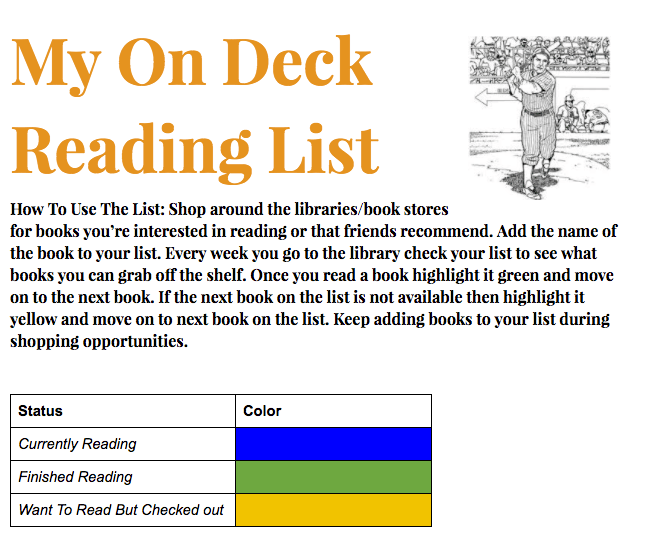
So, whscreen-shot-2017-01-21-at-1-47-36-pmat’s new.  Right now I’m trying to drill into every student at school the necessity of having a “what’s next” list – either a mental list or a  physical list or a pile of books that are the “books in waiting”.  And the great thing about a club like this is that we can try things out on them and see how effective they are.

This week we used Leigh Collazo’s Genre Personality test which you can purchase from TPT (a $5 well spent). My assistants and I spend quite a bit of time this week updating the bookmarks in order to make the book suggestions specific to our library.  The boys did the quiz during the BWB session on Friday and they really enjoyed doing it. It was fun and light-hearted and we kept emphasizing that there was no right or wrong answer and it wasn’t scientific. After they’d tallied up I made a spreadsheet of the topscreen-shot-2017-01-21-at-1-48-01-pm 3 categories of each boy, and as we read out the descriptions there were cries of “yes, that’s exactly how I am” and “I agree” and “yes!”  With their permission we then displayed the results. Most were evenly spread between A, (questioner); B (Escapist) and C (Innovator) with surprisingly few G’s (class clown) which is what I would have expected. Since that took up most of the hour we have with them – we didn’t get around to sharing the bookmarks, and
only introduced the “on deck” spreadsheet to help them keep track of their “what’s next” list – that’s next week’s work.


Reduce, reuse, recycle and repurpose

One of the advantages of being on a tight budget with constraints, as I’ve written about before, is that it forces one into being thrifty and eco-conscious.  I just wanted to say a few words here about ways in which we managed to employ the 4R’s in our library renovation.

Library shelving is very very expensive. And there is a reason for this – it has to withstand a lot of wear and tear, be constantly shifted around and then

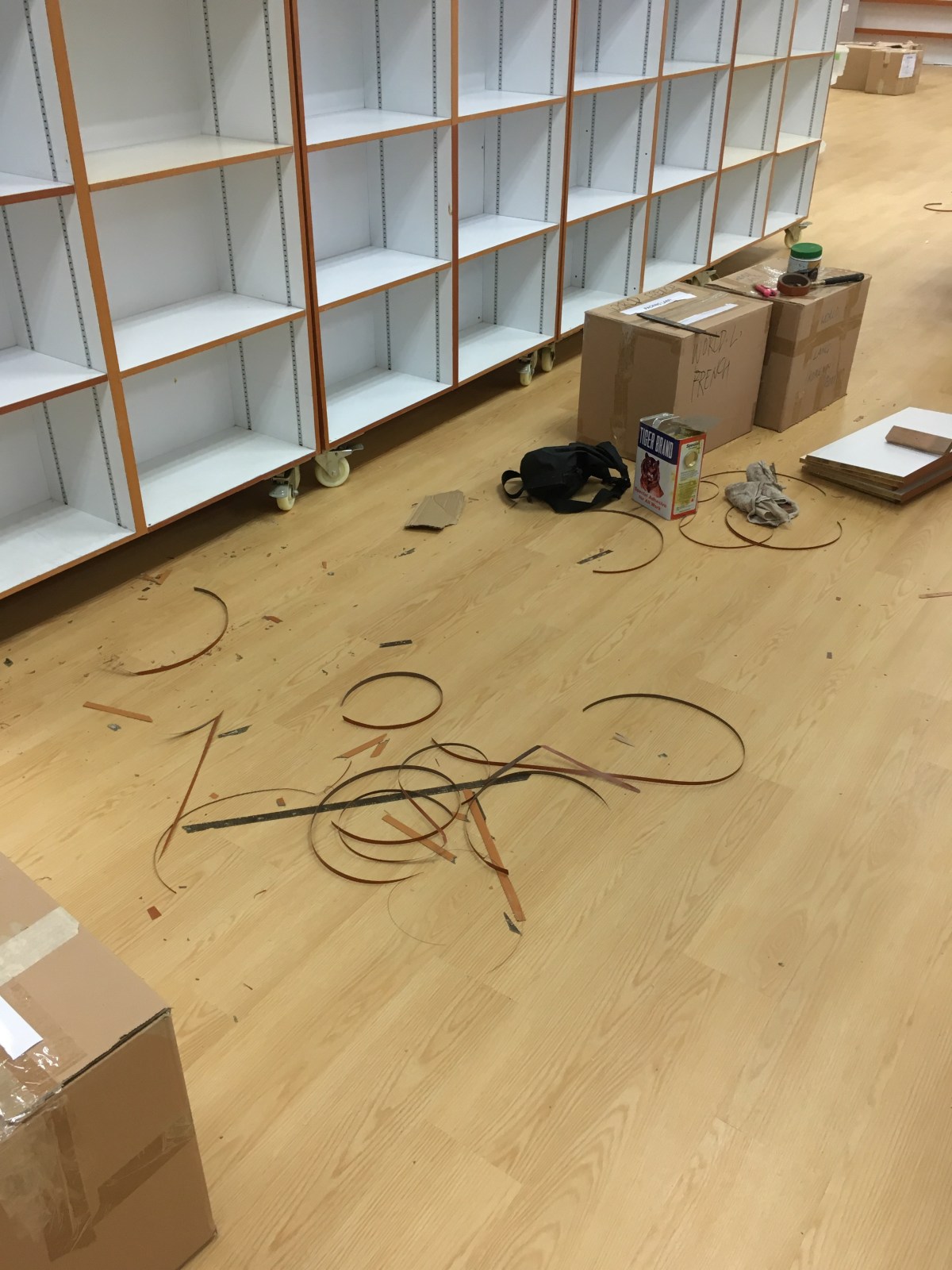
there is the question of load bearing (something our designers didn’t always take into account). Bottom line, we basically had to make do with most of the shelving we already had, and reuse it.  Not all of it was in great condition. So as part of the design brief we asked the contractor to refurbish the broken bits by re-lamination. Unfortunately this is not a very ‘sexy’ part of a renovation project, and we’re still chasing up on bits and pieces that need to be done! Most of it is looking pretty good though.

The green chairs were donated to us from our other campus, and the black shelving, and some other shelving that didn’t fit into the new design were donated by us to other classrooms and campus areas that needed it.

Other little things – our “fiction” etc. signs had a green border that looked out of place with the rebranding, so we just got some black electrical tape and taped over the green, so it looks black now. The non-glass doors got a new layer of paint, and larger glass pane windows.

The shelving above that used to hold picture books now is part of the junior section (I wanted more front facing space for our early chapter books to make them more enticing) so we inserted an extra shelf to each row to accommodate smaller books and the boxes in series.  One of our trolleys got donated to the IT department and the oldest saddest one got a new lick of paint in the same grey colour of our doors (part of the new branding) and looks just great now! The red plastic baskets found a new home in a classroom and was replaced by a wicker basket while we wait for the drop box to be completed. All our weeded books went to the PTA for their second-hand sale. And our old VCR boxes are still in use as alphabet markers in smaller collections – like Chinese fiction.

At the end of the day, besides the old tile carpeting in fact, very little ended up in the scrap heap. In fact many people when they come in have to ask what is actually new, because while everything looks new and different and lighter, they still recognise bits and pieces from the past.  I don’t think that’s a bad thing.


90% there …

Well we’re getting close to completion (all the yellow stickers are things the contractor needs to work on and the pink ones, things we need to do!) on our library project  (more links to the history here, here and here) and I’m feeling a little more relaxed. And even in the mood to discuss what has gone well (and what didn’t go so well / what I would have done differently will be the next post).

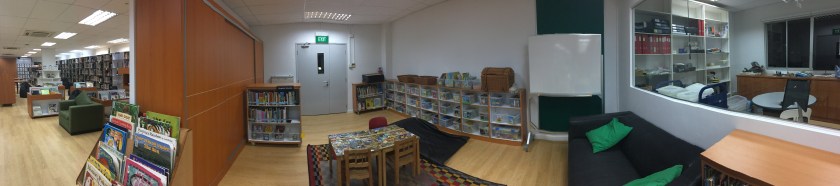
I’ve added 3 pano photos, from the front and back of the library and from our new “classroom” space.

img_4508
View from front
img_4509
View from back
img_4513
New Classroom

Let me start and devote this blog post with what I’m happy with – a comment from one of my Facebook groups prompted me to start with this, because I’m beginning to realise I’m way too much of a glass 1/2 empty kind of person, and if I have anything in the way of resolutions this year it is to be more positive! I’ll put some before / during and after shots in so you can see the difference!

I’m loving:

That I was fully part of the design process – in fact I was the designer and I only have myself (or maybe budget constraints or misinterpretations) to blame for what didn’t work out.  Plus my principal was immensely supportive all along the way, pretty much gave me free reign and was there when I needed her as a sounding board or to confirm a decision.

The wooden floors  

Oh I hated our old carpeting. Despite the fact that it was only about 2 years old it was pretty dirty and yucky – we get a lot of kids through the library each week and kids ain’t (and shouldn’t be) clean beasts. And because they were floor tiles, they could replace them, which meant colour differences, and that picky kid fingers could lift them up so they had to be re-glued regularly.

The extra display space

We librarians love to display and show case our collections. Whether it’s for a special event or to highlight new books, kindness week, a particular theme, whatever. I had no display space except for that which I’d artificially created by leaving shelves empty, and removing a computer from the dreaded pillar!  In the new configuration I’ve been able to convert the pillar to a wonderful wrap around display space.  I’ve also copied an idea from UWCSEA-East primary and added book ledges at the front door (they’re not perfect yet – too big and heavy on themselves but that’s another story).


Teaching spaces

I don’t have great pictures of before, or actually of after, so I’ll have to add these later. Basically my teaching space was a couch and a pulldown screen and a heavy very low flipboard I could drag out of my office when I needed to write anything, but couldn’t leave anywhere because there was no space for it!  Now there is not just one, but two teaching spaces as we knocked down the wall between the library and the staff room and the staff room was divided into a classroom and workroom.  Each has a projector with apple TV and each has a whiteboard space – the classroom a portable whiteboard and the main library will have two writeable glass sliding doors on either side of the projector screen on which to write. As a bonus, they’ve put blinds in front of all the windows that we can pull down so that the audience can also see what’s on the screen after 2pm!

Front Desk

I have very conscientious and neat staff, but open cupboards and a lack of space and no book drop meant that the front desk always looked messy even if it was actually pretty organised.  We went for a curved desk, for the show. I wasn’t 100% happy with that but it looks pretty good. I really like the design and the work surface (the top drawers are actually pull out work spaces) extra cupboard space and the fact that the cupboards have doors. I’ve very worried that the seating space is going to be very tight for three staff members, even if they’re all very petite. The compromise was I wanted the desk to be open on both sides because when (not if) there’s a “situation” on the library floor staff needs to be able to get to it very quickly.

White walls

Did I ever mention how much I hated the babypoop and maroon colour combination? Initially all I really really wanted was a paint-job and different seating furniture – but I got spoilt and got a whole new library!  Having white walls and light floor makes the whole space so much lighter – even though we’ve blocked off the windows on one side.

Collection flow

As the school has grown, so too had the collection. And choices I made last year on where to put what helped some parts of the collection (Fiction and Junior fiction) at a cost to others – nonfiction – where I split 000-399 and 400-999.  Now each part of my collection has it’s own section and I have an entire wall of nonfiction 000-999. It’s impressive even if I say so myself. And it’s “overzichtelijk” a wonderful word for which the English translation is apparently “clear” but what it really means is that you can take everything in in one glance.

There is also enough space on each shelf that books are not crammed together and we can put out front facing book(s) at the end.

I also ordered signage from Merchandising Libraries, both for A-Z for each fiction collection and with words and pictures for the nonfiction section and “shelf talkers” for various sections.

Another good thing is behind the teaching space / projector sliding doors we can now put in all the “kit” boxes – the multiple copies for literature circles and communal reading. Our school is in an old building so we don’t have grade pods or communal areas so all these books are stored in the library, and were stored in my office. I didn’t like this because it meant they were out of sight and mind of teachers and students and the door was a bit of a barrier (especially in the beginning when they didn’t know me) for them to come and browse the books. Now the office space can be used for sorting UOI books (so they won’t be on the floor in front of the main desk anymore), and the books will be easily accessed by everyone.

Teachers’ resources are also all together at adult height!

That’s all I have time for today. I’ll talk furniture and what could have gone better in the next post.