The 10% problem

It’s a funny time of year in education, November and December. I never knew this before. It’s the time when educators need to decide if they’re staying or going in their current school or position, and if not, what the next move will be. I’m new to this game, and as I librarian I get to see all classes, all teachers and many parents. Observation and conversations are things that happen a lot.

The 10% use of the brain myth has been debunked I know, but I think it is still a useful meme to use in education. Because one of the things that keep coming up in the conversations I’m having with people who are leaving of their own volition (some are due to partner careers, or family issues) is the frustration that for one reason or another, all they have, know and are capable of is not being used or recognised. I know, because as an older educator coming late to the game with a longer “past” I feel this very acutely.

A little while back a group of us had an interesting lunch conversation along the lines of our former pre-teaching lives, or what we’d taught before we were teaching what we were teaching. There is so much unlocked knowledge, skill and potential in education. And I’ve just mentioned the teachers. Before I was a TL I was a sort-of SAHM (stay at home mum). Sort of, because I kept studying and doing stuff. Stuff that would keep me sane and my brain occupied while my body was present for young children and a partner who travelled anything from 70-90% of the time, and then we’d move country to spice things up a little more. And I kept bumping into women (mainly) with amazing brains. Women with fantastic pasts whose only outlet was pouring themselves into organising PTA/O fundraising and events and being class-mothers. Not that it’s unimportant, but really? Think of the energy equation – it’s like starting up a blast-furnace every-time you need enough fuel to drive around the block.

While the unlocked potential in teachers is particularly acute in primary, where teachers are often limited to their own classrooms, teaching a breadth of skills and subject areas they may or may not be optimally suited for, I heard the same while working in secondary. One person in particular sticks out. He was very bright, very capable in his own field, constantly seeking out new knowledge. He was also not from the dominant mono-lingual white male BANA pack, and such was an outsider. He left in frustration saying that while he’d been hired for all the bits and pieces he had, he was only being used for a small portion of them and wasn’t even consulted when his PhD specialisation was being looked at in the community (I won’t mention what this was as it would be a give away). I’ve spoken to language teachers a lot, who say they sit mute and unsolicited in meetings while mono-linguals decide language strategy and curricula. Parents who come from a huge diversity of educational and learning backgrounds who are literally NEVER consulted because they are “just” parents. And if they ever dare mention that things could be, and are different elsewhere, at least in some areas, they’re quickly shut down with “well, this is the way we do it here” while the dominant culture and pedagogy continues hurtling down the track.

school is easy

I use hurtling consciously. Because the sad thing in education is the pace. There is just so much busyness. It is no wonder that the 10% usage exists – there is just not enough time for anything else. And all the time there is that anxiety. Parents are skittish that their child is in the “right” school. Ready to run and change at the drop of a hat. Students mete out their time for subject by subject homework. Teachers are stretched thin juggling reporting, marking, teaching, preparation, running excursions and events. And somehow, most times, in the midst of this all, miraculously, learning takes place.

Another sadder thing I’m noticing at the moment is that there is a widespread occurrence of “losing weight after the divorce” to use another bad analogy. And that is, suddenly there is a bunch of people getting all sorts of qualifications (albeit sometimes the maligned-by-me google-educator badges), suddenly getting out there at teacher events and PD as they polish themselves up for the market. That’s more than just a little bit sad. And a lot of a bit of waste on both sides of the equation.

 

Activity 2: Interview – running a successful parent volunteer program in a school library

Libraries in general, and some school libraries in particular are not known for having a surplus in staff. Many therefore consider turning to parent volunteers to help out with a variety of tasks.  
Some libraries manage this better than others, and here in Singapore, the Singapore American School is known in our network for having a very well run, well functioning library parent volunteer program. They have 35-40 regular weekly parent volunteers and more than 50 parents who are involved in one-way or another in the library as well as a group of committed high school student volunteers. 
So this morning, I went over to interview Kate Brundage, the Elementary School Librarian who has been running a successful program for the last five years.
In answering all my questions and showing me the library she explained the process of recruiting and training volunteers, the type of tasks that volunteers do, potential problems and pitfalls and how to handle them and how to show your appreciation. We ended with a tour of the library.

The process of recruiting and training volunteers

Parent volunteer form
Recruitment generally takes place at the beginning of the school year when sign-up forms are distributed during open-house sessions, back to school night, the first parent coffee mornings and are also shared with classroom teachers.  The library hosts a parent coffee morning and talks to the parents about library service and the benefits of being a volunteer.  During the school year, the librarians have an active partnership with classroom teachers, whereby parents who tend to “hover” or want to be overly involved in the classroom have their energies directed to the library where they can make a meaningful contribution to the school as a whole.
The initial in-service training takes 90 minutes and parents are introduced to the library organization, explanations on shelving are given and parents are given guidelines on what to do with damaged books and other commonly encountered problems.  The desk and mobile circulation systems are explained and other projects and service opportunities are introduced.  New parents are then buddied with existing volunteers who provide further training “on the job”.
Parents are also encouraged to team up with close friends or with people who speak the same language as themselves, if they are not comfortable or fluent in English. Depending on their volunteer role and interest, some volunteers also receive training in FollettDestiny (the library system) and are given restricted rights based on what they need to accomplish.
The library makes it clear on the form, and in their talks that the main priority for volunteers is shelving, as this frees up the librarians to spend more time teaching and interacting with the children and transferring their librarian knowledge and expertise.
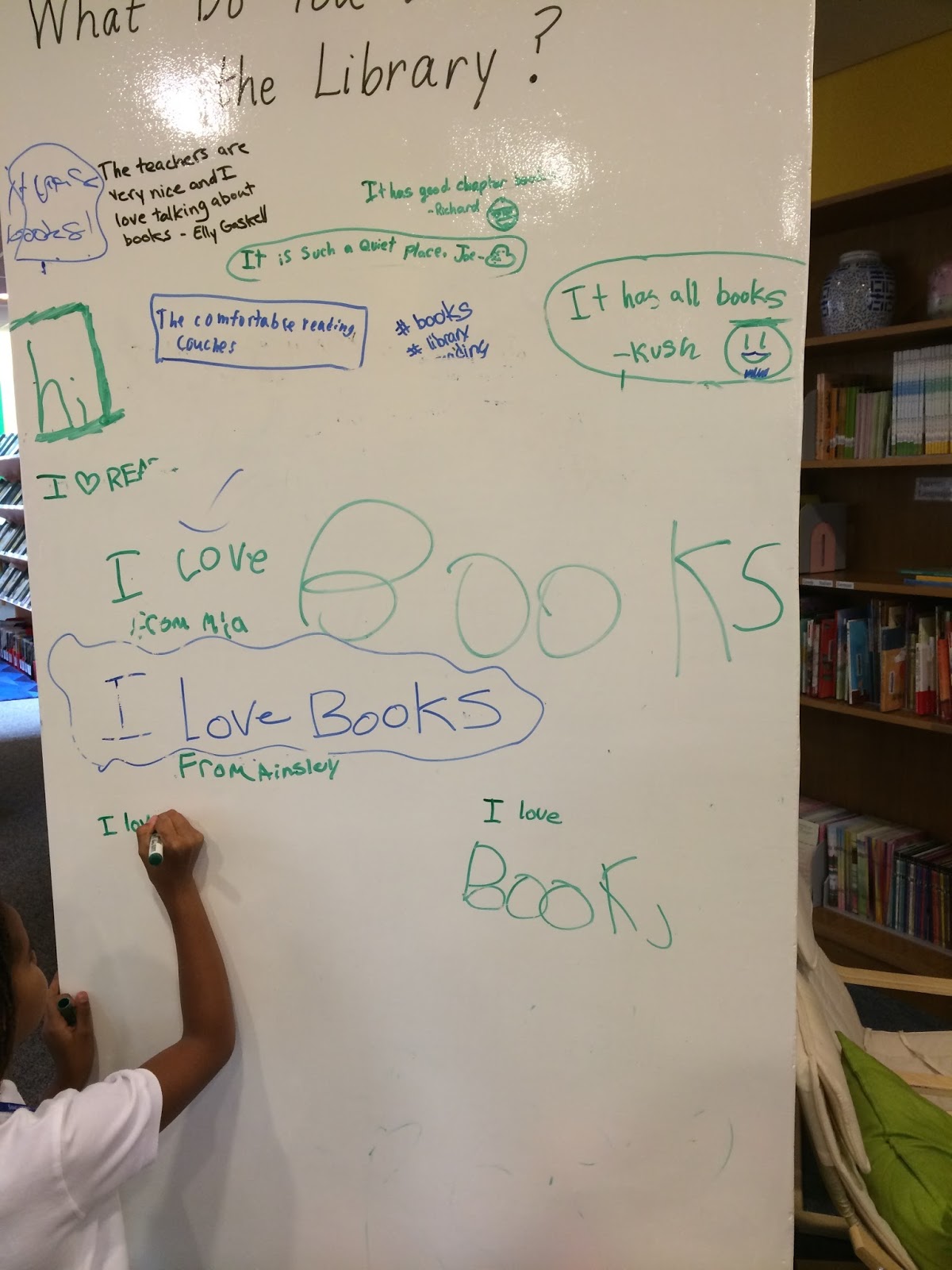
The creation of a “writing wall”
was a parent volunteer idea
Besides the parents, the High School pupils can also sign up to be library volunteers as part of their service program.  A similar training program is given to them, and they are also encouraged to be ‘book buddies’ with the younger students.
It is emphasized that although this is a volunteer position, the library is counting on the commitment of the volunteers, and should they not be able to come for whatever reason, it is their responsibility to find a replacement, from the list of trained volunteers, to take their place.  Volunteers are also required to commit to a minimum of 3 hours per week on a consistent basis.  The volunteer roster is changed every 3 or 4 months giving new volunteers a chance to join up and also to change around times should situations change or if people are found not to work well with each other (e.g. friends spending too much time chatting rather than volunteering!).  Volunteers are encouraged to be active readers so as to better understand children’s literature, the needs of young readers and the availability of books of different genres and difficulty in the collection.

The types of tasks volunteers do:

Parents assisted with the genrefication
of the picture book collection
Although the primary task is shelving, and with the huge collection the school has this is a very important task, it is acknowledged that it is not the most exciting task and needs to be interspersed with other tasks that may be more stimulating.  For example parents help with include circulation – checking in and out of books either at the check-out desk or using the mobile apps the school have. Parents are also involved in longer term projects such as the current genrefication of the library, pushing books out of the library to classroom libraries, documenting and photographing the puppet and soft-toy collection into a visual album.  Depending on their skills and interest, parents also create displays, help with signage and other graphic design, and help children in the shelves with choosing books, or with occasional story telling and reading.  Annual special events such as the Battle of the Books, the Red Dot Awards, author and illustrator visits and the Readers’ Cup Challenge also provide the opportunity for parents to take ownership of a project and help the library in this way. For example during an author or illustrator visit, the volunteers will manage the ordering process.  Parents also do “shelf-reading” to ensure that books are properly shelved and to check missing or damaged inventory. A new project coming up is the creation and maintenance of a makerspace area, and volunteers will definitely be involved in that.
Sorting and organising special materials
Parents are asked on signup if they have specific skills or preferences, including foreign language skills where they can help with cataloguing, shelving and ordering of LOTE (languages other than English) materials.  Even stay-at-home-parents are catered for!  Parents who want to volunteer but cannot come into the library due to younger children or other difficulties have tasks sent home to them like creating resource lists or checking inventory and creating order spreadsheets from mark-ups in the SLJ or other book reviews.

Potential problems and pitfalls

Occasionally parents may be motivated by less altruistic ideals, and exhibit behaviors such as just assisting their own children in the library, or may have a hidden agenda, such as censoring books in the collection. Kate emphasized that this was extremely rare, but had to be dealt with firmly.  At all times the fact that it is a partnership for the benefit of all children. Most problems can be pre-empted by being clear about expectations during the initial in-service training. Common etiquette things such as not using mobile phones, deferring to the librarians and teachers, not interfering with the class experience, not disciplining or shaming children, maintaining respect and supporting all children are clearly outlined.  The three month volunteer cycle also allows for a review of which volunteers are in which roles and at what times and this can be changed if necessary.

Showing appreciation

The library hosts two parties during the year, one before Christmas and one at year end.  Catering part of the library budget and parents are given small thank-you gifts such as flowers or vouchers for Starbucks or movies, candles and holiday bookmarks.  They are also given first choice in books that are being weeded from the collections.
During the year, the librarians take regular snapshots of the volunteers that are then made into an appreciation video that is shown at year-end, and some photos are put in the annual yearbook.
ALA Book on managing Volunteers
After a tour of the library and seeing some volunteers at work, Kate then very kindly lent me the new ALA book “Managing Library Volunteers” so that I could look through it while I was in the process of setting up our volunteer program at school.

Library 2.0

ACTIVITY
View this YouTube video called ‘Building Academic Library 2.0’. This is part of a symposium sponsored by Librarians Association of the University of California, Berkeley Division in 2007. While this presentation is over one (1) hour in duration, there are a number of key points raised by a number of speakers, including the keynote speaker Meredith Farkas, that relate to any library or information agency that is trying to transform their library into a 2.0 Library.
Consider advice provided by one or more of the speakers in terms of a library and information agency that you know (as an employee or user). Select five (5) key pieces of advice from these speakers, and consider how these may be applied to your library to help it embrace a Library 2.0 ethos. Write up your findings as a post (of no more than 350 words in your OLJ).
 

Although the library I am working in can be considered to have embraced Library 2.0 in all of its aspects, that doesn’t mean that there isn’t a possibility for improvement.  After listening to the talk, the following 5 points struck a chord with me.

1.  Use of microblogging to communicate within areas of the library – since our campus has two libraries and the college has a sister college who we co-operate closely with, also with two libraries setting up some kind of professional micro-blogging knowledge exchange would have potential benefit.  
2.  The fact that current students often turn to their parents as their first port of call.  I think we could be much more proactive in involving parents in understanding how the library can help the academic success of their children.  A few sessions aimed at parents explaining how libguides work, how the catalogue works and how to search academic articles through our journal databases and a bit on citation and social/academic bookmarking would be very helpful and possibly lead to a higher take-up.
3.  “Go where the user is” – we have started greater co-operation with subject teachers through creating LibGuides with help of their input. It would be useful to also have subject specific Diigo accounts where students, teachers and the library can all tag useful links to articles and information.
4. How do we classify? We have already separated out parts of the collection, such as playscripts, biographies, graphic books, poetry.  We are also creating special areas for the IB subjects where we keep multiple copies of “hot reads” where books are no longer purely in the Dewey System. I can only think this process will continue, perhaps to the fiction area where genres are separated out.
5. Time taken to implement.  A number of times the talk mentioned that take-up time for any technology could be in the region of 18 months.  I think we have a bit of a mentality that “build it and they will come” and perhaps we need to spend even more time on user education and encouragement to use the wonderful tools we have created.

Here is a link to a summary of the talk.

References:

Farkas, M. (2007). Building Academic Library 2.0 [YouTube]. Retrieved January 30, 2014, from http://www.youtube.com/watch?v=q_uOKFhoznI
University of California Berkeley Library. (2007). Academic Libraries 2.0 Keynote – Meredith Farkas [Blog]. Retrieved January 30, 2014, from http://blogs.lib.berkeley.edu/newdirections.php/academic_libraries_2_0_keynote_meredith_