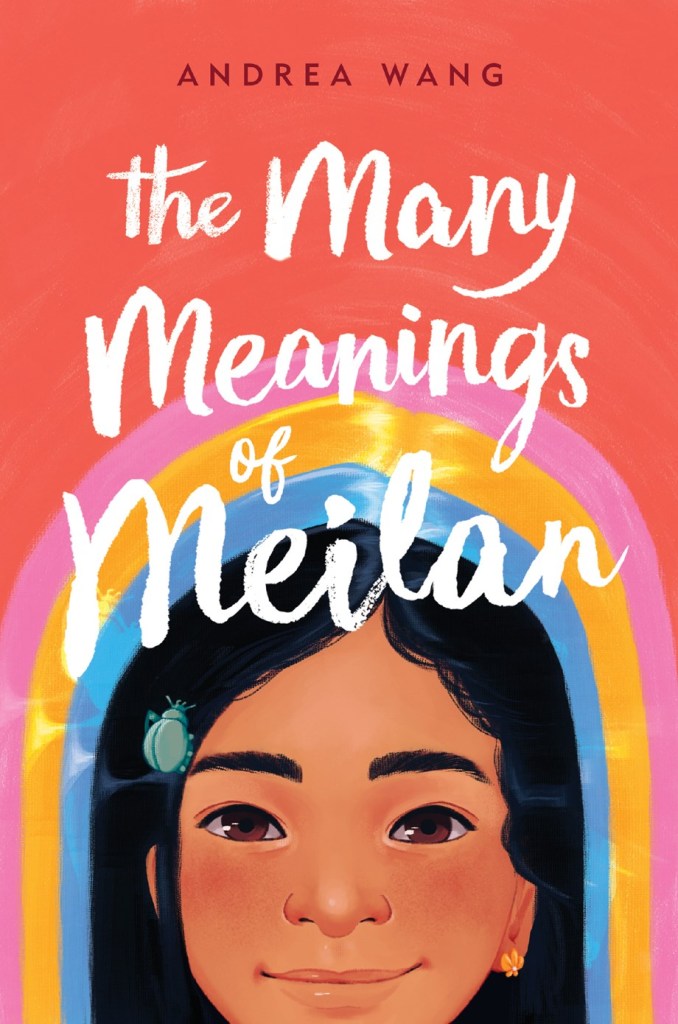
I’ve just finished reading the really well written “The Many Meanings of Meilan” by Andrea Wang. Having spent 16 of the last 20 years in Hong Kong, Singapore and China it was a reminder of so much of my time there and the discoveries of the language, literature, poetry and idiom.
There’s a lot happening in this book, but what I enjoyed most is the idea of naming and meaning and the ambiguity of sound and meaning in the homonyms of the Chinese language. I loved how she wrapped herself in the different meanings of “Lan” depending on the character, so as to adjust herself to the interpretations of herself of others around her, while discovering who she really was and claiming herself.
It also reminded me of the first time I came across the 塞翁失馬 (sai weng shi ma) chengyu – enjoy.
From November 2009
Today a story. Here is the famous story which is commonly interpreted as saying that “every cloud has a silver lining” This is the version from YellowBridge. Certainly in my own life in the long run this parable has proven to be true. But as impulsive as I am emotionally I don’t always recognise it at the time!
“A man who lived on the northern frontier of China was skilled in interpreting events. One day for no reason, his horse ran away to the nomads across the border. Everyone tried to console him, but his father said, “What makes you so sure this isn’t a blessing?” Some months later his horse returned, bringing a splendid nomad stallion. Everyone congratulated him, but his father said, “What makes you so sure this isn’t a disaster?” Their household was richer by a fine horse, which the son loved to ride. One day he fell and broke his hip. Everyone tried to console him, but his father said, “What makes you so sure this isn’t a blessing?”
A year later the nomads came in force across the border, and every able-bodied man took his bow and went into battle. The Chinese frontiersmen lost nine of every ten men. Only because the son was lame did father and son survive to take care of each other. Truly, blessing turns to disaster, and disaster to blessing: the changes have no end, nor can the mystery be fathomed.
塞翁失馬 (sai weng shi ma), the title of this story, is actually a commonly used Chinese idiom or chengyu . It literally translates as “Old Sai loses a horse”. Old Sai is the wise man in the fable. The expression is used to remind others to take life in stride because things aren’t really as good (or bad) as they seem. Certainly seems like a wise advice for a society that lives only for the present.”
When my kids were very little, we lived in Spain, and since there wasn’t a local kindergarten, we’d drive about 30 minutes to the closest (Spanish) kindergarten and during that drive I’d have them listen to the wonderful Naxos collections. Besides learning about famous composers, great scientists and a bunch of other stories like Professor Branestawm who they could never get enough of, they also got a diet of Fairytales from Grimm, Andersen and Myths and Legends including Greek, Norse and Heroes and Heroines from Classic Tales. Neither of them remember much about living in Spain, and my daughter swears high and low she can’t speak a word of Spanish (despite 2 years immersion in it) but they remember the stories. And I still have the CDs. Perhaps as we continued to play them in the car on holidays and in Hong Kong and Singapore.
Today I’ve been making a poster of fractured fairytales in the fantasy genre. In a multi-cultural environment you can’t take for granted that students would have been exposed to some or even any of the tales that their educators grew up on, and I also did a bit of research on the types of (Western) fairytale collectors, editors and scribes and found this great little blog on some I was not aware of, or vaguely knew. When you look at the poster you can see the prolific Jacob & Wilhelm Grimm feature a lot (with over 200 tales and 10 children’s legends) as well as Hans Cristian Andersen’s 156 stories and Charles Perrault with his 8 Mother Goose tales punches above his weight in terms of retellings (thanks to Disney).
One of the most fantastic retellings ever of Little Red Riding Hood has to be the book “Picture this by Molly Bang” where she explains elements of Design using the tale. It’s one of the first books I buy in every library I work, if it’s not already on the shelves. Even if you ignore every other book in this post – that’s one to make sure you have in your collection!
As a parting note, as I was saying these are definitely a “western” view of fairy tales, when I was working at UWCSEA East with Katie Day and Maya Thiagarajan one of the amazing things they worked on was helping students recognise the “foundational texts” of their cultures. These are the texts that shape the culture and literature of that culture and that if you’ve not had the opportunity to access that text you may find it hard to read other works from that region because you’re not aware of the references, directly or indirectly. So for Western European culture it would be Aesop, Grimm and Anderson’s fairy tales, the Bible, Shakespeare, Austin etc. In India it would be the The Mahabharata, The Ramayana, in China it would be Romance of the Three Kingdoms and Journey to the West. Students were tasked with researching their cultural legacies and this is the libguide (thanks to webarchive) that was co-created with their IB literature class. But that’s a poster and discussion for another time.
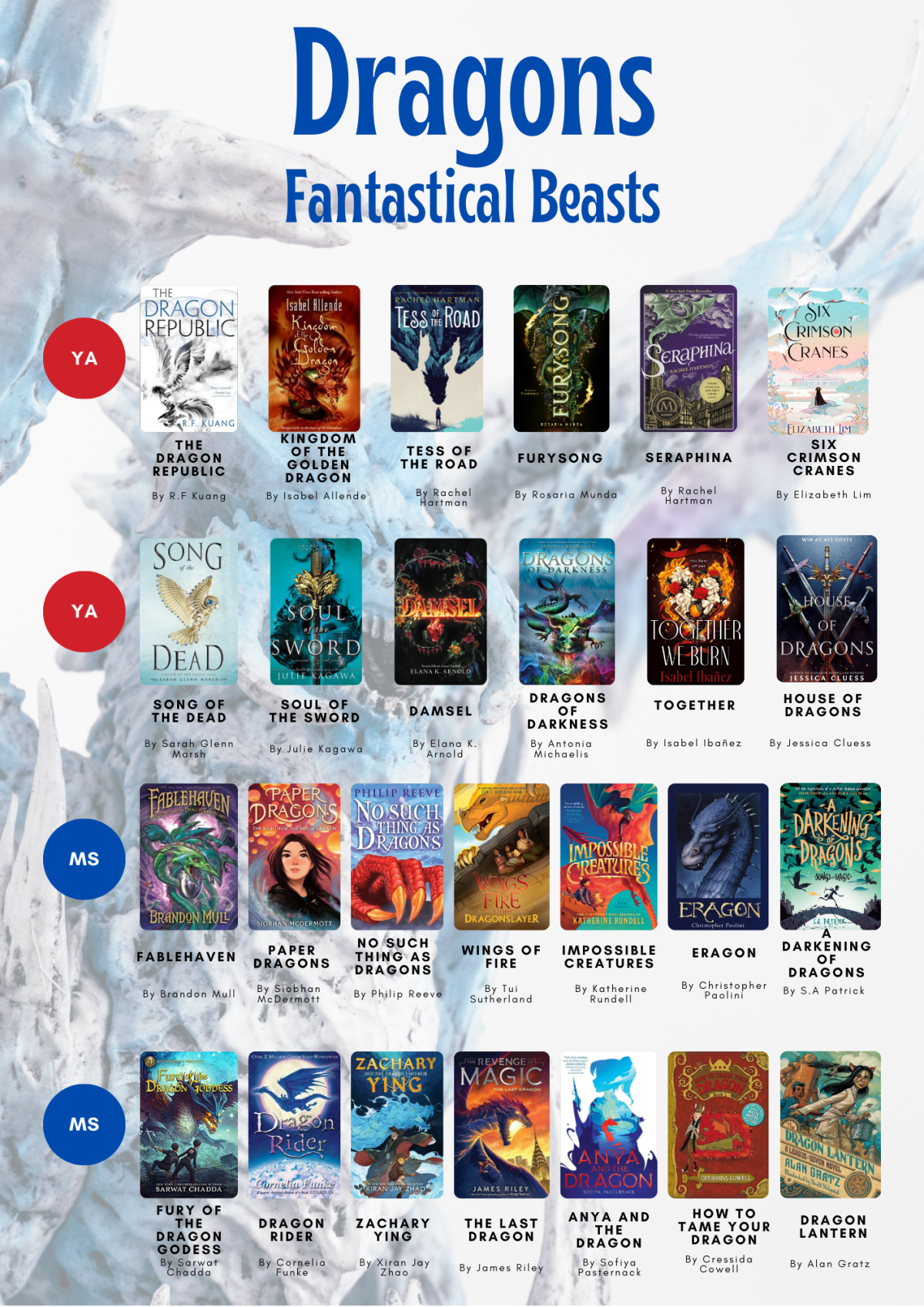
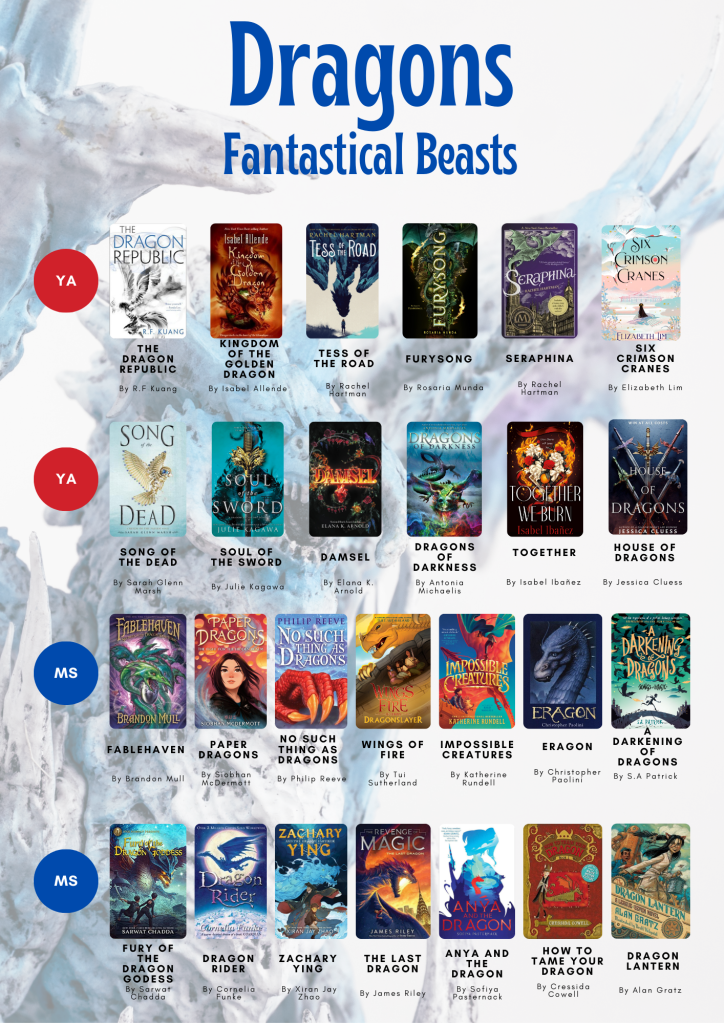
Like most school libraries I have a bunch of students who really like fantasy. But that’s a bit like saying they like chocolate. Chocolate is a blanket term that can mean different things to different people and tastes they do vary. Like my poster series for Dystopian fiction – I’m embarking slowly on a number of side projects to demystify other genres in the library so students can find the sub-genre they like most. These things take an enormous amount of time and thought and originally I wanted to present a “fait accompli” in my blog but decided as it would mean I wouldn’t be posting anything for just about forever, to do it page by page.
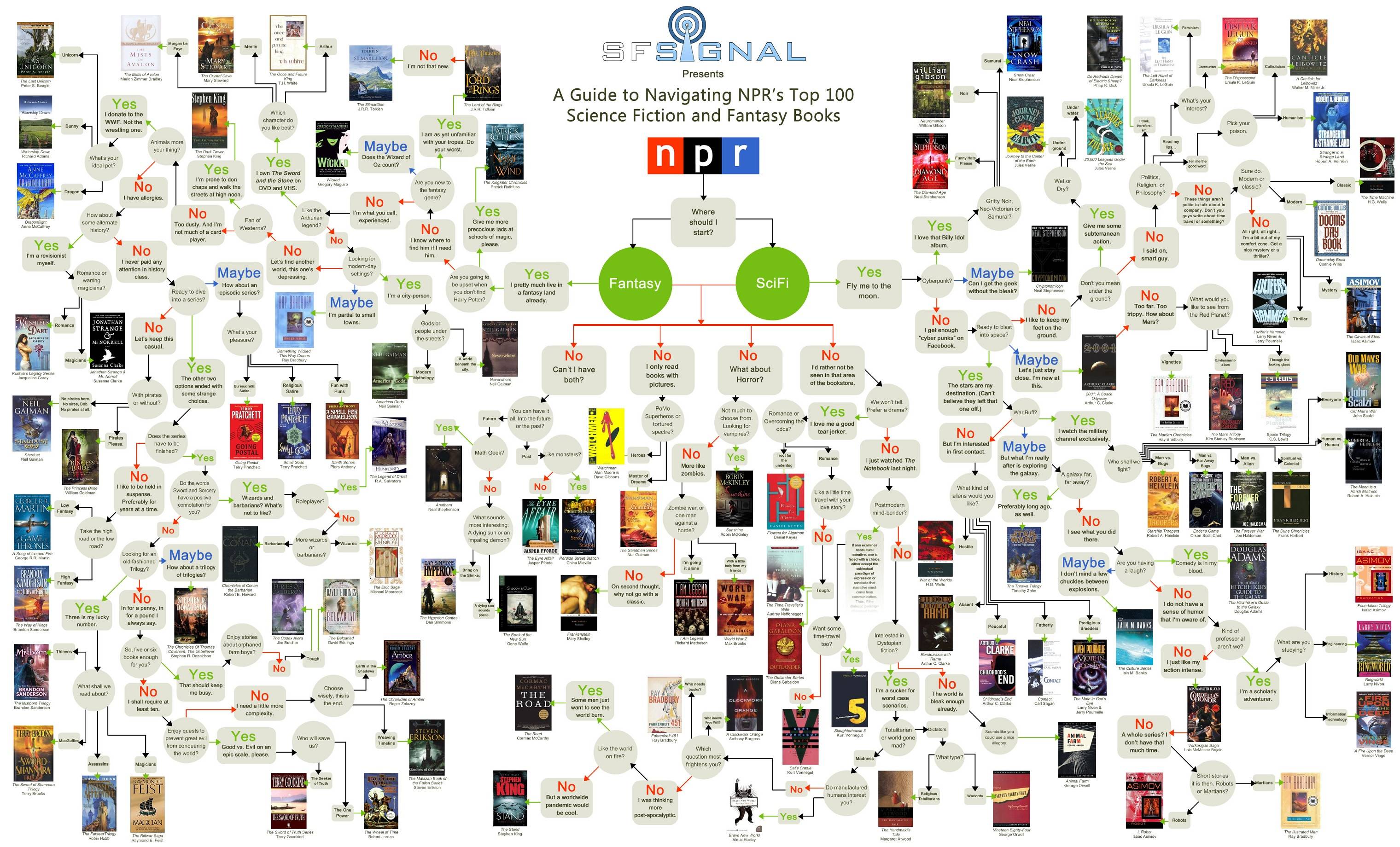
So the path I’m taking is, as usual being guided by my students and what they’re reading and asking for – which is why I started with “Fantastical Beasts – Dragons” because that’s what someone wanted today. Once I have a bunch of posters I’ll try and find a way to link them in some kind of flowchart / decision tree.
I’ve distinguished between YA and Middle Grade, as things can get quite spicy in the fantasy / romantasy etc realm – (you’ll notice my list doesn’t include the Fourth Wing (The Empyrean, #1) by Rebecca Yarros – yet). Usually I indicate whether a book is part of a series in my posters – however one of the great things about fantasy is that nearly all books are part of a series (I’ve generally chosen either the first in the series for my image or the most dragony title). Books is a series is the library equivalent of “all you can eat buffet” as with a little bit of luck the minute they’ve had a taste of the first book they just keep going.
So far, based on my collection and student interest I’ve identified the following areas, romantasy, dystopian, high/low fantasy, magic realism, paranormal, fracture fairytales, mythology, alt. history, animals / fantastical beasts, schools of magic.
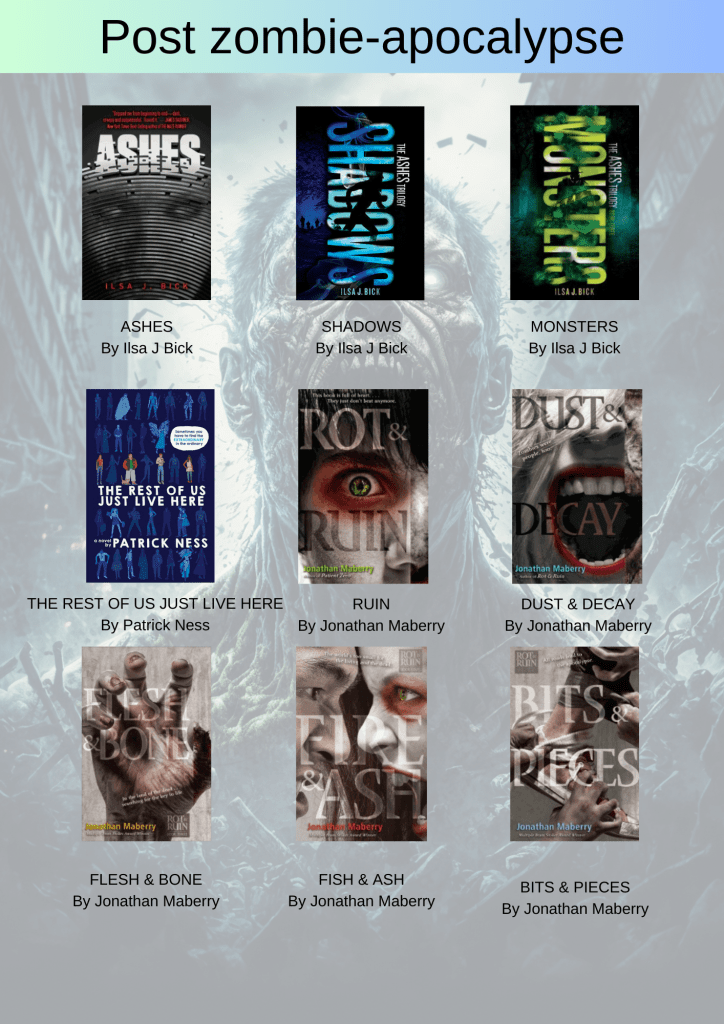
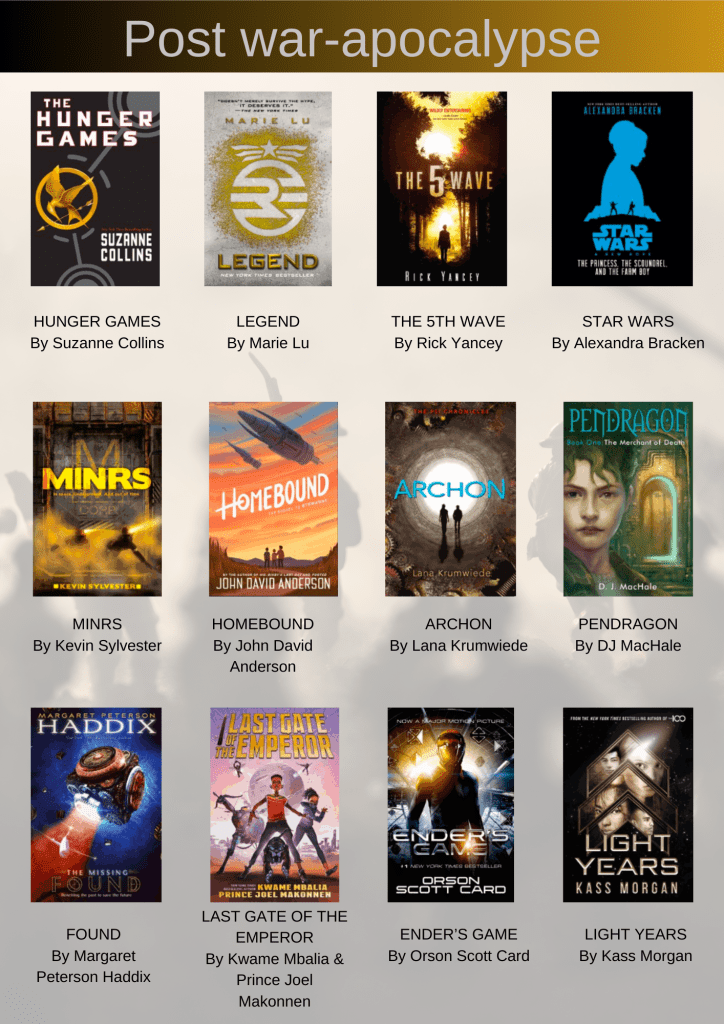
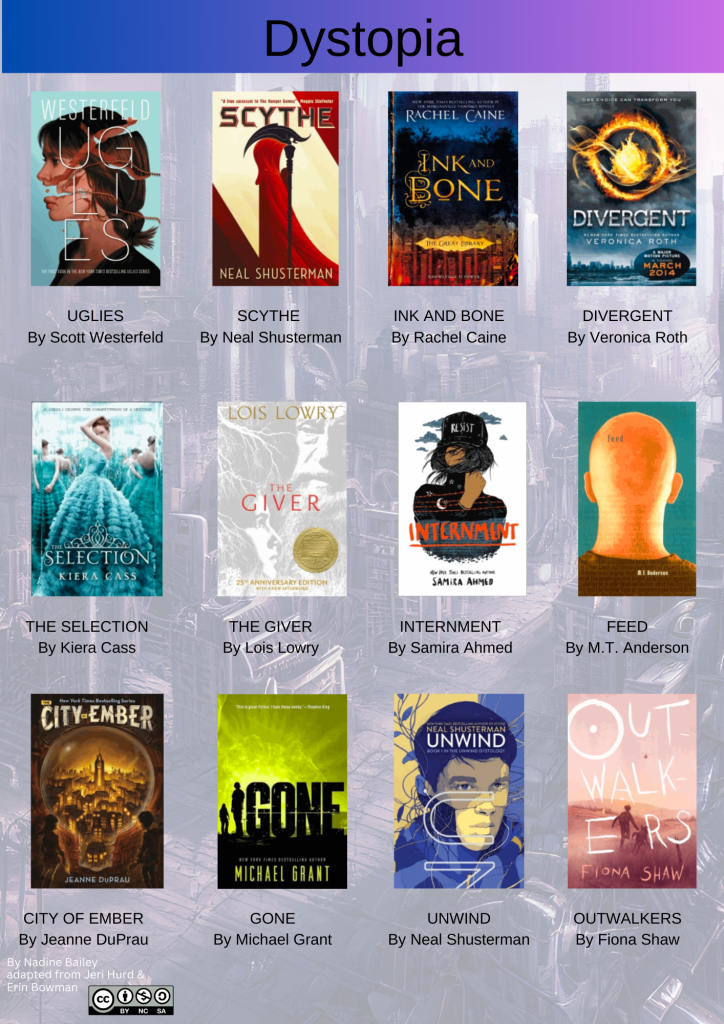
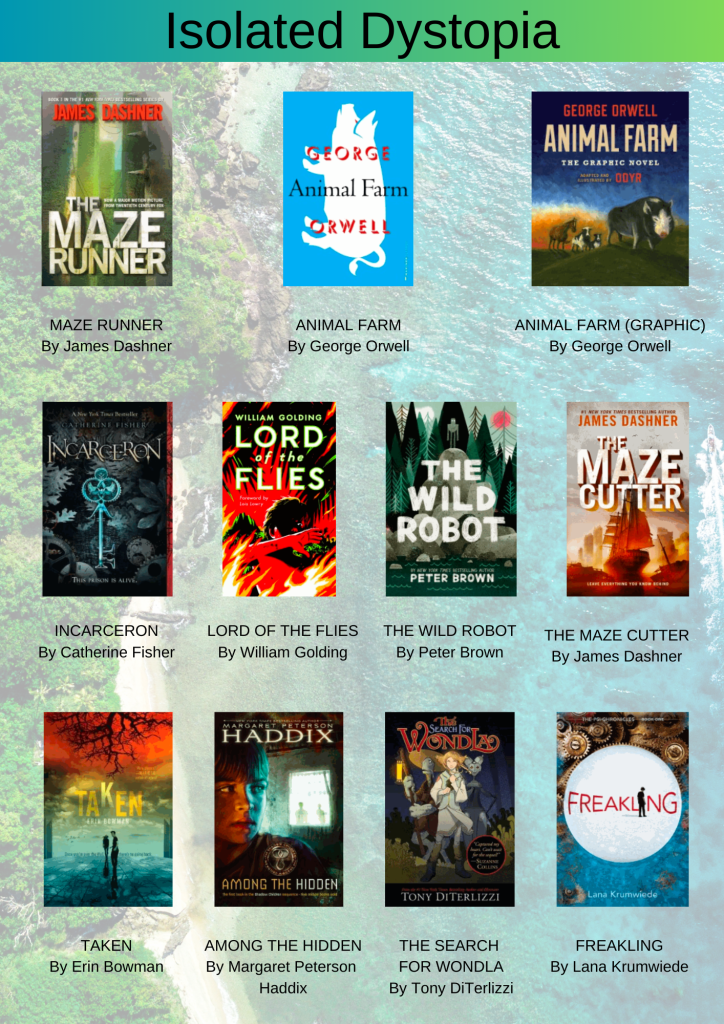
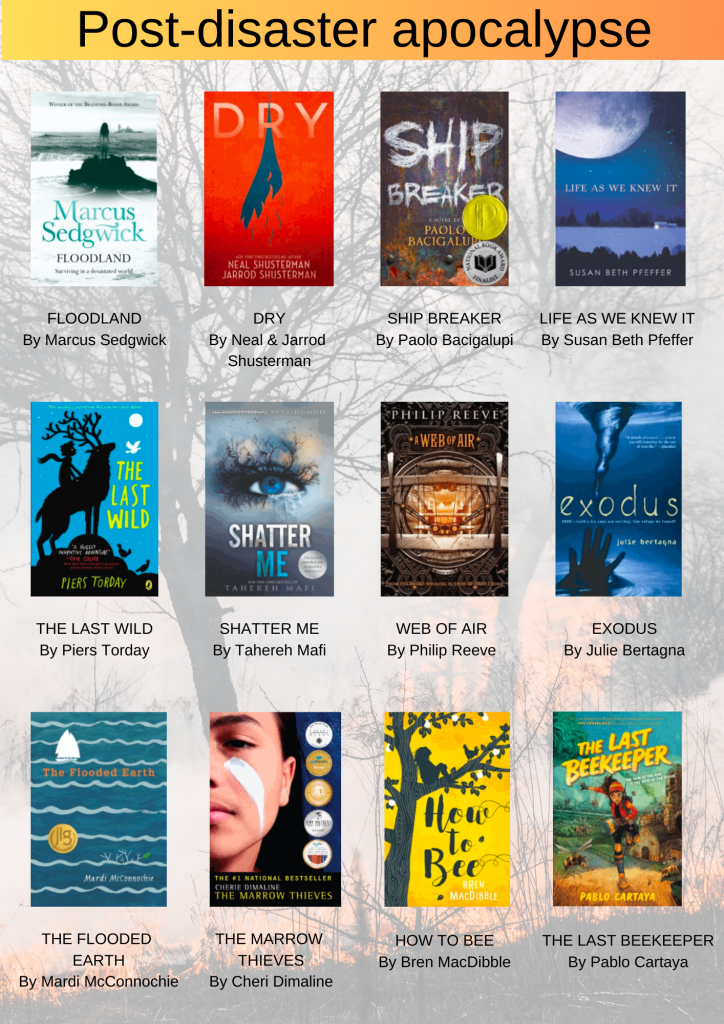
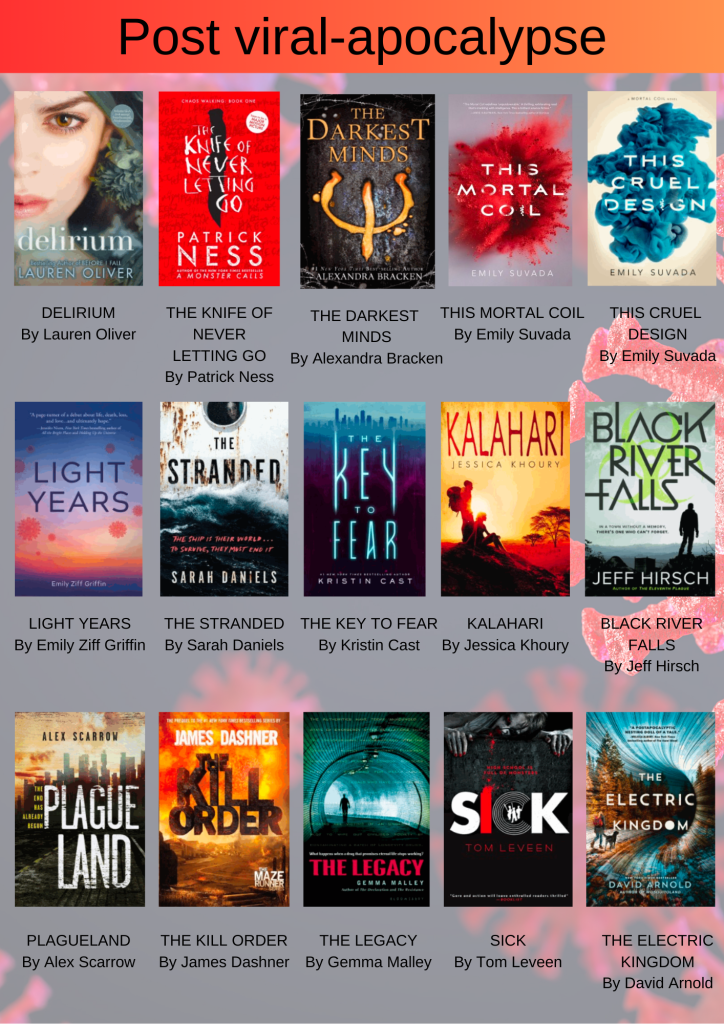
Our Grade 7 students do a dystopian unit in their English Language Arts (ELA) class, and I came across this nifty categorisation in a poster by Jeri Hurd (sans the sub-pages / images). Since I find our students are increasingly stimulated by imagery, rather than just text, I adapted the poster to include 7 sub-posters combining the books in our collection to the suggestions.
It’s not always easy to find middle grade appropriate science fiction, so this collection includes some YA works – particularly in the “Zombie apocalypse” section.
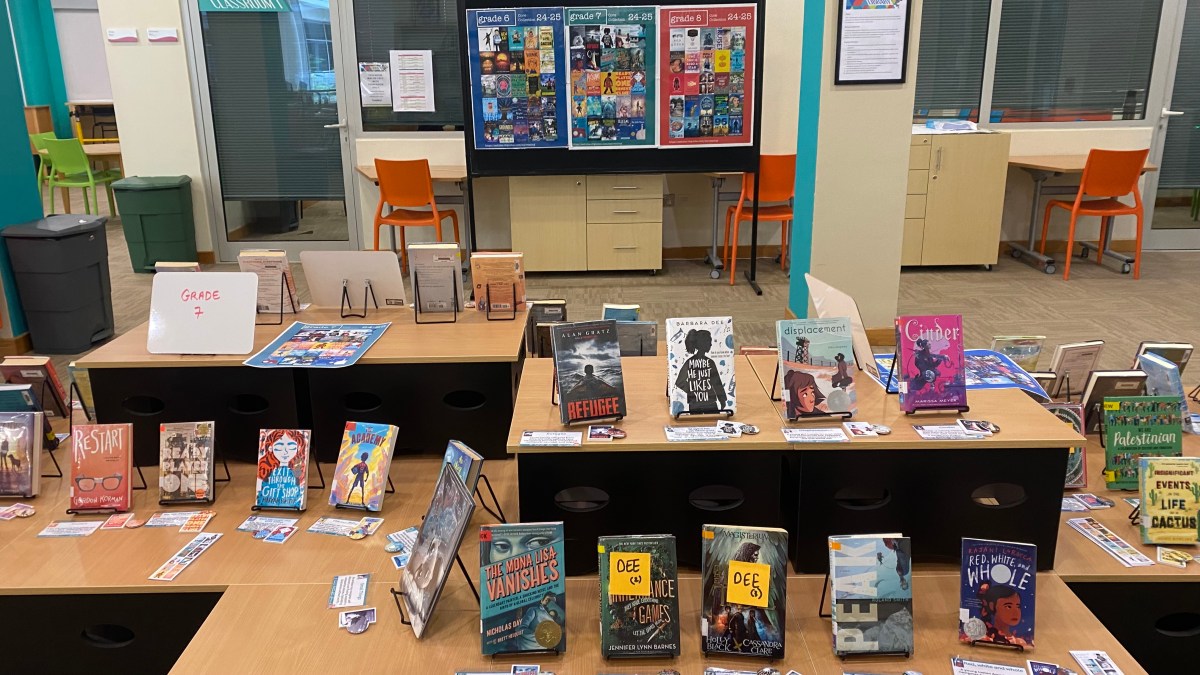
During a recent library visit after the students had completed their bookclubs with their chosen books, we had tables set out with the posters and the related books so they could further explore the various sub-sets of the genre.
If you are really interested in Utopian / dystopian literature and have quite a few hours to spare (like in the upcoming Spring break) I’d highly recommend Pamela Bedore’s “Great Utopian and Dystopian Works of Literature” from The Great Courses.
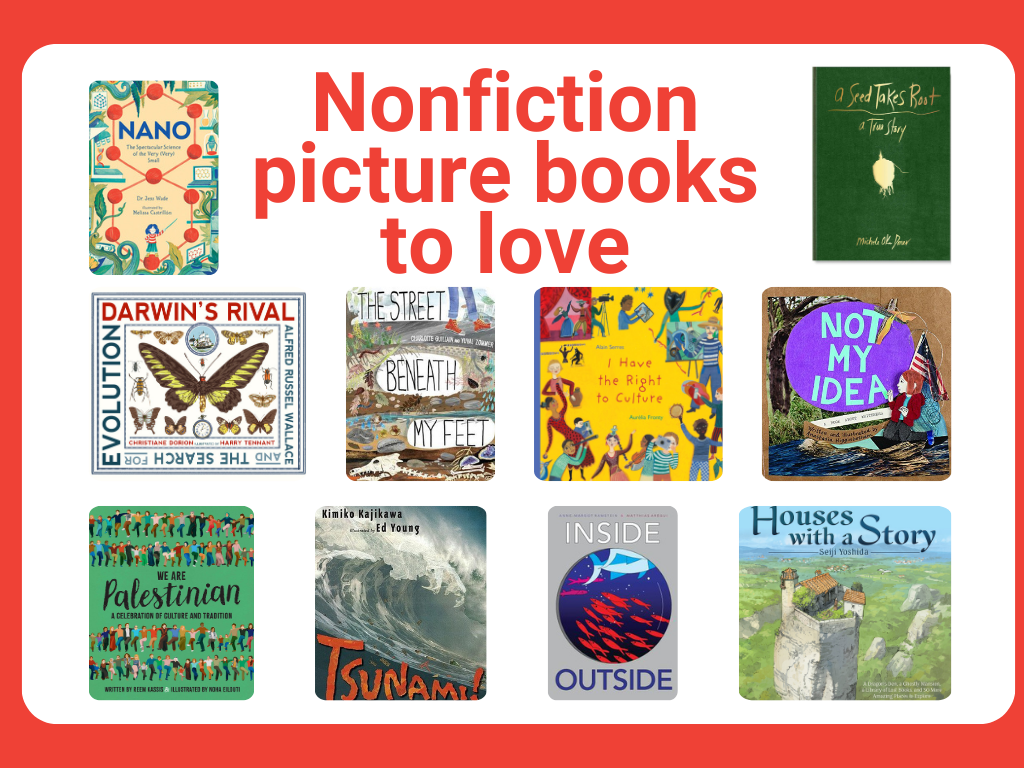
I was just passing our picture book shelf and decided the nonfiction picture books need a bit of love and attention. Here are a few I love for their amazing illustrations and beautiful messages written all within a couple of handfuls of pages.
Picture books are so like poetry – so much can be said with so few choice words. Which reminds me of a beautiful piece I read recently about poetry by Larson Langston
In English, we say: “I miss you.” But in poetry, we say: “I trace the shape of your absence in the spaces where your laughter used to linger, and let the echoes of you fill the hollow hours.”
In English, we say: “I don’t know how to let go.” But in poetry, we say: “I carry you in my chest like a stone— heavy, unyielding, and carved with the sharp edges of what once was.”
In English, we say: “I feel lost.” But in poetry, we say: “The compass of my heart spins wildly now, its needle drawn to places it can no longer call home.”
In English, we say: “I wish it were different.” But in poetry, we say: “I water the garden of could-have-beens with tears, waiting for flowers that refuse to bloom.”
In English, we say: “I hope you’re happy.” But in poetry, we say: “May the sun that warms your days be as kind to you as the first kiss of dew on the dawning light upon the leaves of the laurel that we once made love under”
In English, we say: “You hurt me.” But in poetry, we say: “You planted thorns in my chest with hands I once trusted, and now every breath feels like an apology I shouldn’t owe.”
In English, we say: “I wanted to stay.” But in poetry, we say: “I lingered at the edge of your world, a star burning quietly, unnoticed in your vast, indifferent sky.”
In English, we say: “I’m trying to move on.” But in poetry, we say: “I untangle your name from my veins each morning, only to find it woven into my dreams again at night.”
In English, we say: “I’ll be okay.” But in poetry, we say: “I gather the shattered pieces of myself like broken glass, knowing someday, even scars can catch the light.”
With poetry I write paths through gardens of grace with words in ways my body dare not go as a whole.
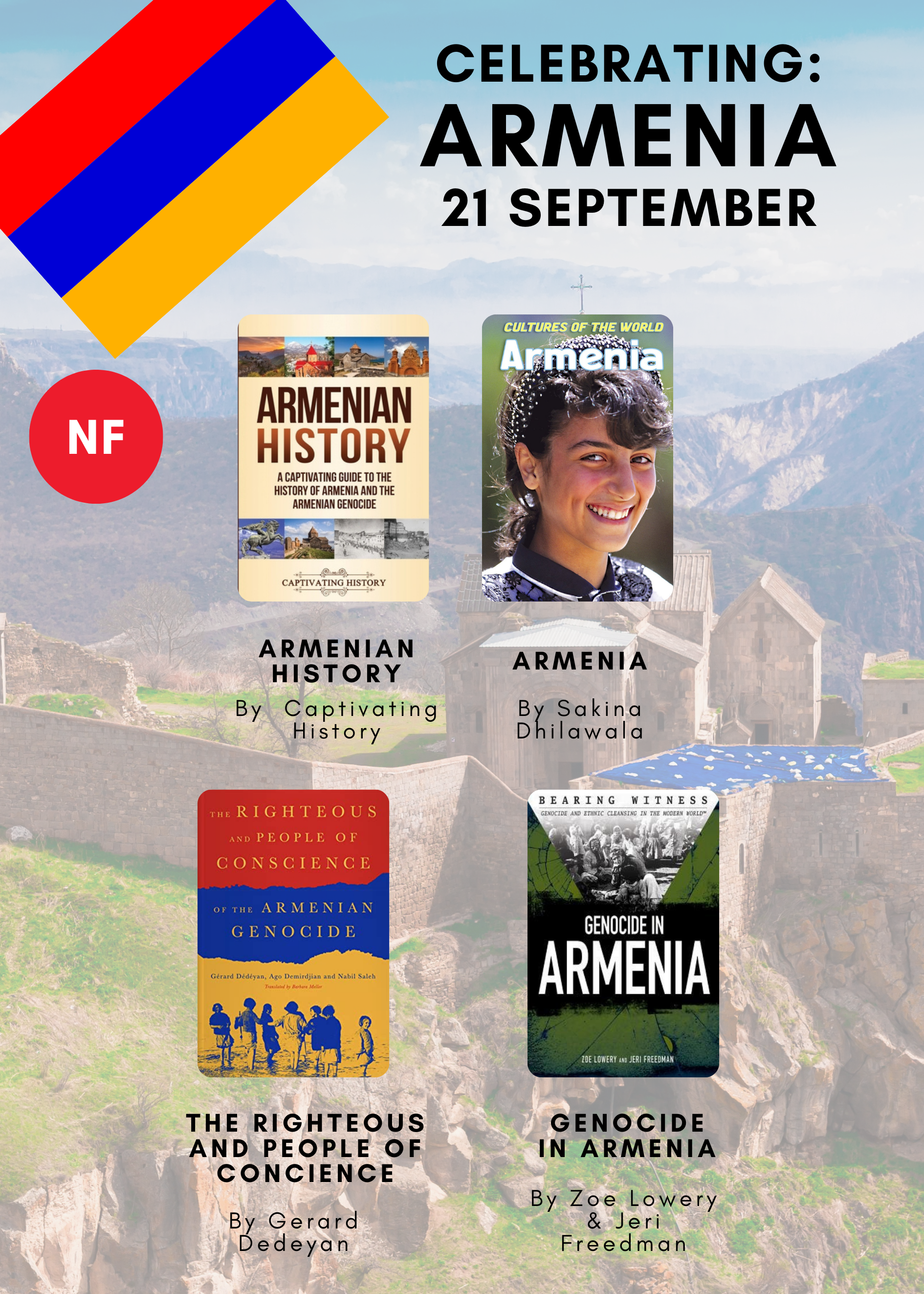
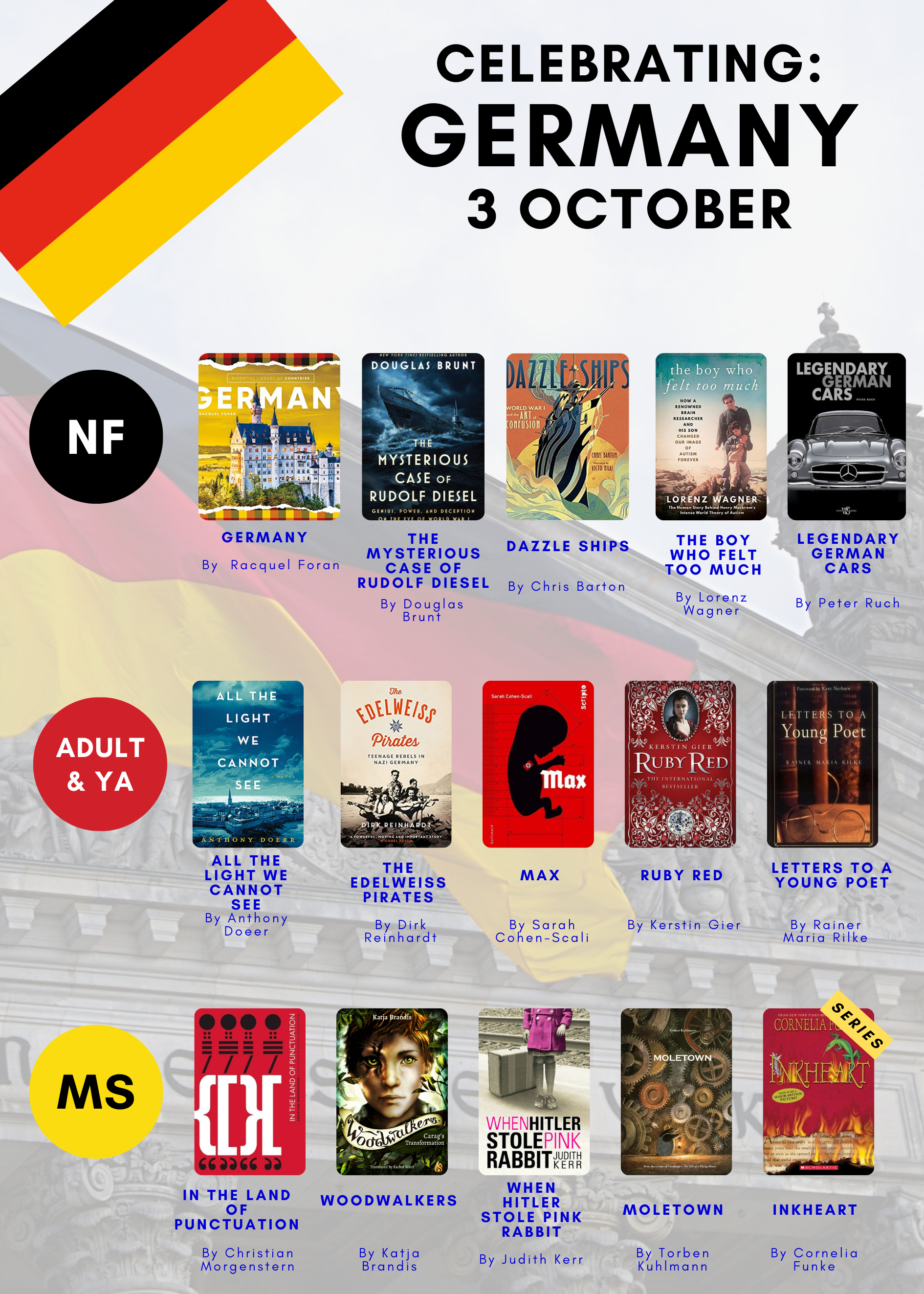
For a while now I’ve been wanting to highlight the curation of books related to the countries and cultures of our students, and finally this year I got around to creating posters “Celebrating xxx” which I post to our school bulletins for students and adults respectively. It’s been a bit of a chicken and egg project – knowing how many students we have from each country / culture – which in itself is truly not as simple a task as it may appear. We use the proxy of first, second and third passports, but as anyone who lives internationally knows, life is a tangle of multiple strands with immigration, migration, expatriation, languages, refugees, fleeing and arriving, births and marriages and transferences and identities. So in the last two years, using this list I’ve been scouring book lists, book catalogues, recommendations, book prizes to where we finally have, for most of the countries with more than 2 students, at least a couple of books besides a travel guide.
A couple of books. How easy that rolls of the tongue. But anyone with a conscience and an iota of empathy will know that that is another potential landmine. I have carried shame for my country of birth, South Africa, for decades, and still often have trouble admitting to its citizenship since I still feel the personal burden of all the wrongs committed by people of my race. It is right that a representative sampling of literature of my country includes reference, analysis and depictions of the pain and despair that apartheid has wrought. But that is not all we are as a nation and people.
I have not yet made the list for South Africa. But that was the dilemma I faced when curating the poster for Germany. A country with a 1000 years of literature beginning with the Nibelungenlied. Whose literature I studied in translation at UCT while ignoring my true passions suppressed doing a commerce degree. Yet looking at the books we have in the library, it appears that the war years, in particular the second world war, and specifically the war atrocities, is the primary lens through which our students form their Germanic world view. Again, it is right and proper that authors, beginning with people like Günter Grass, who, in his time was vilified for daring to address the near past, should shine a light on a terrible past. But that is not all by which they should be known. And more than anything students need to become aware of nuance. By the realisation that it is possible to hold two opposing views in one’s mind simultaneously. And if not through literature, how will they learn that? How sad is it too, that all the books we have about Armenia are about the genocide?
So far I have received nothing but gratitude from our community for both curating / purchasing these books and highlighting them as their national days come by. It is I who is filled with doubt and desire to be able to offer more. And despair that in many cases there isn’t more as countries are ravaged by war and poverty – at times literally with bombs and other times with the devastation of censorship, cultural and monetary poverty and lack of access to publishing and translation of the words that need to be heard by their people, its diaspora and the rest of the worlds children and young adults / adults. We deserve more than the “lonely planet” and “countries of the world” as nice as it is to at least have that.
Yet again an article despairing how kids are not reading “For Too Many Kids, Books Are Uncool and Unread” with all sorts of “reasons” and little in the way of solutions. So here are a few people / places / organisations who are trying to do something and a little on the work I was doing recently.
Engage everyone
While language arts / language and literature teachers and particularly librarians are often called upon or take it upon themselves to play a role in turning out literate students who hopefully also enjoy reading – it is a mistake to pigeonhole the efforts onto a few people. Just like I spend quite a few hours of my week engaged in coaching students in sport I like to think that my colleagues in other subject areas – including Physical Education etc. could spend a bit of time encouraging students to read. Particularly PHE teachers – since as my now young adult son (previously reluctant reader middle school son) told me “give up mom, middle schoolers don’t listen to anyone except maybe their PHE teachers and sports coaches”.
Last year I started having a core collection (an idea initially started in the UK by CLPE, and carried on internationally by Katie Day) of 25 books per grade for our middle school. We invested in at least 3 copies of most of the books and the books were promoted in the ELA (English Language Arts) classes and the library. Having a narrower selection of books to focus on meant that as a group we could try and read as many of these as possible and “sell” them to students. The news crew of our “Falcon Flyer” also helped with promotion by featuring the books, and they were also displayed on our internal TV screens in the library and MS corridor. A weekly quiz via google forms and the “Battle of Core” assembly were less successful than I’d have liked – but let’s say it was something to build on. However when I analysed the circulations from these 75 books I was positively surprised and just how many had circulated. As can be seen – kids still prefer print, and audio is their least preferred medium.
In my discussion with the ELA department about declining reading there was a strong feeling that promoting the books shouldn’t just be on them – and I took that thought to heart and just before the summer in our last staff meeting with the support of our admin launched the “staff summer reading challenge”
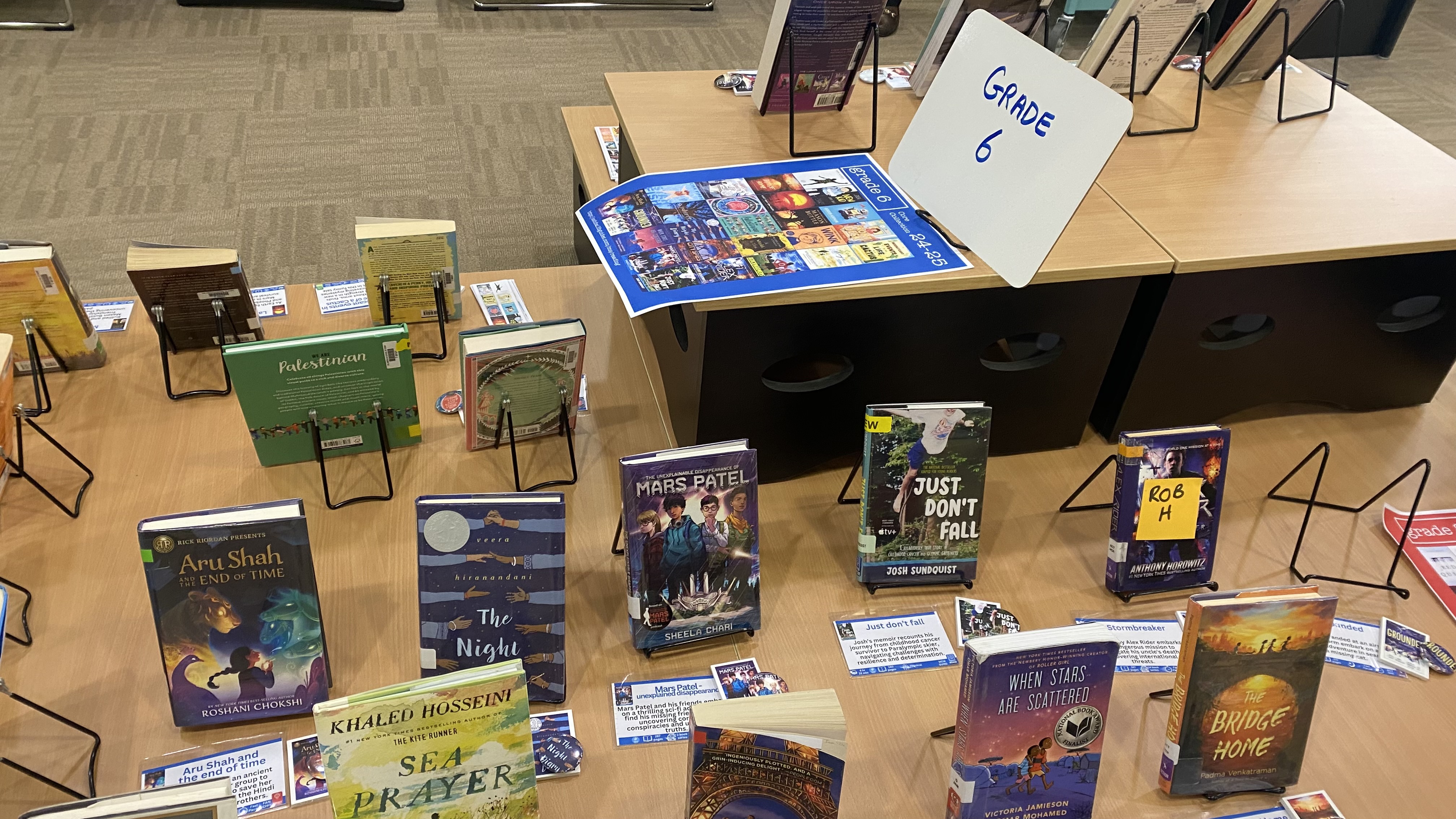
This involved quite a bit of preparation work, starting about 6 weeks before the end of term, including updating the lists for the new year, taking out books that weren’t popular or didn’t resonate with students, getting suggestions from our most avid readers (and asking them to pre-read where I wasn’t sure which book would be better) and making sure we had coverage of genres, levels of difficulty and format (verse novel, graphic novel, nonfiction, memoir, fiction) and our books were reflective of our community – each grade having at least one book with a muslim perspective as we’re in the UAE. Our new list can be found on our reading libguide. Next up was making sure all the books were ordered so that they were available before the meeting and then making new posters, shelf-signs with a summary, badges and a “mini-book”.
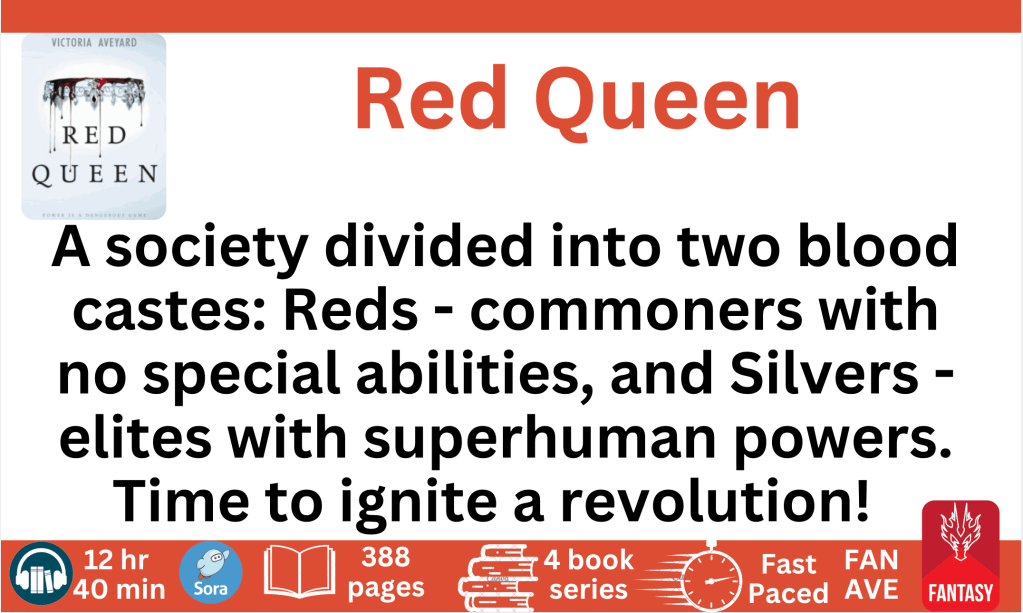
The shelf talker signs were based on inspiration from Kelsey Bogan but I wanted them to convey a little more information that I thought would be relevant in the “selling” process – first to our staff and then to our students, so I amended them a bit – the colouring corresponds to the grade, I added the book image and the genre image. Kept the blurb to 20-25 words (combination of publisher blurbs, Magic School AI summary powers and my knowledge of the book – AI can really get things badly wrong with what trigger words would encourage readers and be very repetitive with some phrasing!); I also added whether we had the eBook or Audiobook and the duration of the audio; pages of the book; whether it was part of a series, and the pacing.
Here are the canva files for our Grade 6; Grade 7 and Grade 8 lists – feel free to use or adjust as necessary.
The badges were made thanks to the loan of a badge maker by our design department and the “mini books” are images of the books on a piece of foam that the teachers can stick on their classroom door.
For the meeting, I put all the books on display with their paraphernalia, and the teachers were invited to select a book to borrow for the summer, commit to reading it and to help be the books “key account manager” for the coming year and promote it to students in the coming year. Our communications department helped by taking pictures of teachers with their chosen books (hiding the face) so we can use that for a little promotion guessing game in the new year); teachers borrowed the book and could put the badge on their lanyards. They “claimed” the book by putting a sticky note with their name on the poster. In the end, only 6 out of 52 staff members declined. Several teachers selected more than one book and our drama teacher selected 5 (and sent me a very enthusiastic voice mail last week to say she’d read them all and enjoyed them so much she’d also read all of the rest of the books in the various series, coming to a total of 17 books!).
So, watch this space and we’ll see if this has more of an impact in the coming year.
Other people / organisations making a big difference
Although not always realistic, I am a secret admirer of the “go big or go bust” approach to things. I suspect some times we are actually underestimating the abilities of our students by setting very low goals for them. There is a balance however between something being too daunting versus to infantile. Generally I suggest students should try and read a book a week – something quite manageable if one is truly spending 20-30 minutes a day in focused reading, perhaps combined with audiobooks and some manga / graphic novels. Also, our top readers (ironically – or not – none of whom have mobile phones) manage 2-3x that.
The Neev Reading challenge 2024 of 30 books over 3 months for grades 4-6 combined with author interactions, and a live quiz during the literature festival is a great example of setting a stretch goal, having competitive and noncompetitive tracks and a great starting point to select books. I just love how ideas grow and evolve. When I moved to Beijing in 2018, I was part of the 50 books Reader’s Challenge which I think the librarians at ISB started. In my role of juror for the Neev Children’s Book award, I was chatting to Neev about the challenge, and what worked and didn’t work quite as well – and they grabbed the ball, ran with it and now it’s this amazing thing!
I’ve blogged about the Global ReadAloud before, and still think this is a phenomenal way to involve students and teachers with books and connections with other readers and most importantly the “smelling salts” of reading aloud to them. Here are the selections for 2024. I particularly love “As long as the lemon trees grow” a book that’s on our core list and a fantastic read for older students.
At the end of the school year we have 6 library sessions involving our “upcoming” grade 5 into 6 students to introduce them to the Secondary School library. This year as an exit ticket I asked them to write down their favourite book / author / series. As I roamed around talking to them while they were doing this, I’d say that at least 75% of the books they said they loved the most were books that had been read to them by a teacher, parent, grandparent etc. Reading aloud matter.
Besides her work on the GRA – Pernille Ripp also has some great posters (and books) on encouraging a reading culture, such as the one on “Helping Home adults support adolescent readers”
That’s all I have time for today – if you’d like to have your initiative featured, please let me know!
One of my constant concerns as a librarian here in Singapore in an international school is that I don’t feel that my collection reflects the many rich and varied cultures and identities that my students have. So I must admit (selfishly) one of the first things that crossed my mind when I was invited was YAY, I don’t have to wait until ECISlibrary2018 to go on an Indian book buying spree for my library!
When I arrived on Thursday evening, I met up with Maya Thiagarajan, author of “Beyond the Tiger Mom“, friend, ex-colleague and fabulous once-a-month book-club member. Getting together is always so exciting as we have a million-and-one things to chat about, and her move to Chennai has created a huge gap for me, but is a wonderful thing for India as she can share her knowledge, experience and expertise with schools there. We brainstormed together for a presentation we were doing for parents and the public on “grow to read and read to grow” and then she gave me her perspectives as a classroom teacher on my workshop for teachers and administrators on Classroom libraries. Then we decided to do the workshop together instead of separately as it would add a multi-perspective to it!
On Friday, the first thing that struck me as I entered the school, besides the warm welcome, was the wonderful posters and signage and set up.
The Friday was set aside for celebrating storytelling, books and literature with children. I must say I was really happy to see the emphasis on storytelling, since it is the basis of everything. In fact, when I was asked to run a workshop for 5 year olds, that’s the first thing I thought of – using a wordless book as a prompt to encourage students to tell a story.
My session used the wordless books “Chalk” and “The Typewriter” by Bill Thomson to introduce the basic elements of a story – build up to a problem and a solution. First I told them they’d been tricked and I wasn’t going to read a story to them, but they were going to read to me (groans all around) and then they proceeded to do so, with “Chalk” lured by the images! We then spoke a little about the problem and solution and I said I had another book where something similar was going on and they could read it to me as well. I then projected “The Typewriter” (as I didn’t have a hardcopy) and we went through the same procedure, adding more prediction in this time. Then they went off to tables we’d set up with plain black goodie bags and cut out gold moons and stars to make their own “magic chalk” bag. They came back to the carpet and were told they were going to make their own story without words with magic chalk. We brainstormed some ideas of what kind of problems could happen and what their solutions would be. Such wonderful ideas, ranging from torrential rainstorms and flooding, to a meteorite crashing into earth, sharks attacking a mermaid, ghosts coming into the a house and scaring people etc.! We also chatted about how you would (in the case of the ghost story) show that time had passed and the ghost left and they came up with having a moon in some of the pictures with the ghost and a sun when the ghost fled. What was great was that some then said they wanted to do it in “teams”. Off they then went, armed with A1 black paper, folded into 6 panels and unfolded to de-mark scenes and lots of coloured chalk. As they were drawing I wandered the class with their teachers talking to them about the stories as they unfolded. 90 minutes without a break was barely enough to have everything finished and they proudly left with their magic bags and story creations.
The rest of the day flew by, popping in and out of classes and storytelling sessions, followed by the teacher workshop on classroom libraries. I’d somehow misheard that it was for 15/16 teachers… actually it was for 50-60 teachers – their whole staff! Maya and I had already (luckily, as that’s our philosophy) decided to take the tack that the existence or not of a classroom library was merely one part of creating a culture and eco-system of reading in a school. The session was lively and interactive. That’s one of the things I grew to really appreciate about what is going on a Neev academy – the vision of creating an alternative to traditional teaching and learning in their school, using the frameworks of the IB system and the encouragement of pleasure reading. As a non-international school they shine out as a beacon for local students.
Saturday’s sessions were opened to the wider community and public with a rousing speech by visionary Neev Academy founder Kavita Gupta Sabharwal.
Maya had the honour of being on a panel with Dr. Shyam Bhat and Sudha Murty and all three spoke of the importance of reading and storytelling, emotionally, from a neuro-science and educational point of view. My panel on “trends vs. traditions” co-hosted with Jane DeSouza with Ankit Chadha; Timeri Murari; Sohini Mitra and Reena Puri looked at the threats and potential of globalisation and the digital era on traditional storytelling, publishing and writing.
Then in-between another book buying spree at Lightroom Bookstore (who had a pop-up store at the festival). What a fabulous bookseller – I really really love independent bookstores with knowledgeable founders and staff who delight in the books as much as I do. Ones where you just have to start describing the book whose name you’ve forgotten and it’s suddenly in your hands! I had chance to meet up with the lovely librarians at both Neev Academy and Stonehill International School and we did what librarians do best – geek out on what our favourite resources were, what our websites included, how we resource our respective curricula and darn, there just wasn’t enough time so we have to continue our conversations online and through librarian facebook groups.
I then caught the tail end of a lively discussion “Should we fear the Dark?” that explored dark themes in children’s literature – luckily I shared a taxi with Paro Anand afterwards so we could continue the conversation together afterwards. I love fearless authors!
A dual author dual illustrator graphic novel
Maya and I shared the closing session of the day, focusing on how to hook children on reading and keep them reading with some great audience participation, and before we knew it, it was all over!
A great weekend, incredibly well organised and curated, buzzing with ideas and thought stimulation, discovering new books and authors. My biggest regret was the inability to clone myself so that I could join all the sessions simultaneously. Well done to Neev Academy and Kavita.
(PS Here is a selection of the book loot – invited our Singapore librarian network librarians around to have a look last week!
I had the privilege of attending a presentation by Dr. Myra Bacsal of the NIE at Tanglin Trust School last night about how picture books can be used to promote SEL (social and emotional learning) and the work she is doing to bring both the “hardware” and “software” into the Singaporean school system. I’m totally in awe of the scale of this project, and suspect the slick presentation she and her co-researchers gave is but a tip of the iceberg of what it must have taken to get to this point.
First there is the creation of a framework – as any librarian, or tech person or well, anyone who is capable of hierarchical thinking knows, it really helps to be able to have large conceptual boxes to throw things into. And making it up in an adhoc fashion as you go along (looking at my resource lists I have a distinct sinking feeling that’s what I’ve been engaged in) actually just doesn’t really cut it.
Then there is the curation. Yes I have lists. I have lots of kindness books. And friendship lists, and bullying and emotion books. But “a lot of” is sometimes too much of. Instead of 100 books, one perhaps needs multiple copies of the two or three books that really make a difference and that really touch kids (and their adults).
And the dissemination. Not just presenting to groups of librarians who know some or most of the books you’re introducing, but actually integrating it into the practice of teachers who may or may not be readers, may or may not have a library / teacher librarian on hand! That I think is harder than it seems. Like most things in education (and life), a lot depends on the goodwill of the people around you. On their openness and receptiveness. This morning I was lucky enough to bump into our school counsellor and mention to him that I’d been to the presentation. He got it immediately and we quickly went into my office to discuss how best we could create resource lists together, pool our budgets to ensure that copies of the most relevant books were both in his counselling room and in the library and then, once the infrastructure was in place, start rolling out the reading and introduction of the books in a pre-emptive manner.
I’ve had an ongoing challenge to find and introduce books outside of the BANA (British, Australian, North American) realm, and have been delighted with the books that I ordered from the USBBY 2016 list – as gratifyingly have my students (double win). Dr. Bacsal pointed out that the White Raven list was also worth looking at – particularly for International schools that could justify having excellent picture books in different languages. The European selections usually push the envelope (and a lot of buttons along the way) and as this article on the translation of Elena Ferrante’s Beach at Night show. Of course a sub-optimal translation is a by-product of a generally mono-lingual (mass) reading market needing a translation in the first place. She showed a short extract of an animated movie of the book Sinna Mann (Norway) that left us gasping.
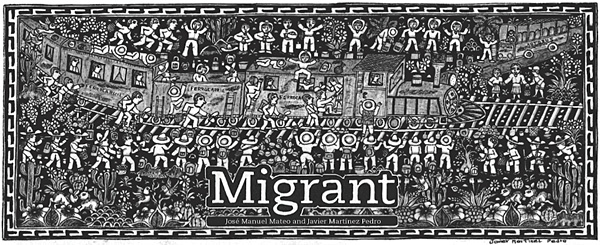
Another special book was “Migrant” by José Manuel Mateo and Javier Martínez Pedro a concertina style bilingual “codex”
Another very special thing was the interview Dr. Bacsal did with the author of Aristotle and Dante Discover the Secrets of the Universe – Benjamin Alire Sàenz – (see the details of it on her blog) – I’m so glad she’s said she wants to publish a transcript – it was one of those things where you kept thinking “what a wonderful quote” but I was too entranced watching and listening to actually take notes.
Well, my work is cut out for the next few weeks! Checking what I have, what will work in our context, what I need to put on my next book shopping list.
I’ve plunged into the abyss of reading 1,000’s of articles for my current course and next assignment. Well, not 1,000’s – my Evernote count tells me 333. Nice number. I’m also engaged in conversations, in real life with colleagues and ex-colleagues and online with my peers and people I’ve been introduced to by people who know I’ve entered this specific rabbit warren. Not that I know what this specific rabbit warren is or where it’s leading to. I have but a vague notion of where I think I’m directed, and until I’ve waded through those 333 thoughts that are other’s takes on 10,000’s more thoughts may I have an inkling of what my own thoughts may be.
Conversations? The idea that access to diverse / multicultural literature can be thought of as a venn diagram (thank you Katie Day). That perhaps we need to make sure that there is a minimum level of overlap between the world of the book/writing (it needn’t be a book) and the world of the reader. That idea of “personal connections” – below is this concept at a simplistic level
Image created by Stuck (2015)
Autobiography would be the ultimate overlap, while perhaps some of the literature we attempt to invoke on our students result in two circles that never meet – and thereby the student rejects not only the book itself – the physical manifestation, but the idea behind? I put that as a question – since as Maya Thiagarajan pointed out to my last post – we are planting seeds – in the hope (and what is literature for if not to provide hope (Michaels, 2004) that they will take. The conversation led me to Ass. Prof. Rhoda Myra Garces Bacsal of the NIE (National Institute of Education in Singapore) who is doing some fascinating research on just this topic, and has this great blog that led me to the the International Youth Library Munich (which has a fellowship for anyone who’s interested!)
So what are my thoughts? They are not yet in a coherent form, but the revolve around the ideas of socio-emotional development; developmental stages of children, the need for many or few books that point to moral lessons or anecdotes or examples of that aforementioned development. About what should drive that choice and how the collection should be curated and culled to fit the needs of your specific population, or even the specific needs of a specific child. About the knowledge and ability of teachers to do so. Through Cremin & Mottram (2008) writing on the literary knowledge of teachers with the idea of the ability of teachers to recommend books to individual readers and the personalisation and matching of readers to texts, I stumbled on Cox & Schaetzel (2007) writing about the characteristics of “teachers as readers in Singapore: Prolific, functional, or detached?”
I know in my library I have large lists of books curated to fit into the PYP learner profile(principled, caring, balanced, thinker, knowledgeable, communicator, inquirer, open-minded, risk taker & reflective) and the PYP attitudes (empathy, respect, appreciation, curiosity, enthusiasm, integrity, independence, confidence, creativity, commitment, tolerance & cooperation). 10 elements of the learner profile and 12 attitudes, – can a child realistically be expected to remember all 22, let alone apply them?
My lists were created way back when by who knows who, and are added to each year as we buy new books. What does the fact that we have 63 books in the list about “creativity” versus 15 books on “integrity” say about us as a school, the library as a repository of culture, the publishing industry as a disseminator of socio-cultural, value based literature? What is the right number of books to have anyway? 5 – 10 -50 – 100? Or maybe just one. Just one book that will really make a difference*. How many can our teachers / teacher-librarian absorb so as to be what we want them to be – and is that prolific or functional or impassioned, or perhaps just effective?
When I dig into the books I also wonder about that little venn diagram thing. Not having red pajamas is the least of my concerns. So much of my multi-cultural literature originates in the USA where multi-cultural is taken to mean Latino, Hispanic, African American, Native American or Asian-American. And the idea of a good tale entails the involvement of baseball or snow or backyards or pets or farms. None of those are part of my students’ current realities. Or even past realities. While reading I often ask my privileged third culture kids how many of them have ever been to a working farm, how many have a pet larger than a hamster? If I’m lucky I’ll see one or two hands raised, plus a plethora of those desiring a dog or cat or pony. They don’t fit neatly into cultural boxes either. Parents and grandparents are not a homogenous identifiable category, but rather a blend of East and West, of language and religion. Of nationality and residency and movement. That picture book of a black child with a baseball bat in his hand does not get borrowed, no matter how often I put it out on display. Am I allowed to say that? I say that a little in despair. One of my students researched Ebola in Africa – he presented his findings to me and I asked if he’d ever been to Africa. He hadn’t and it was obvious. His generalisations and thoughts and ideas even after weeks of so-called research were primitive and naive with all the characteristics of the “dangers of the single story“. I was torn between keeping the tone positive, remembering he was 11 and shouting “you have no idea” (sometimes I feel very African, even if I’ve not lived there for the last 25 years). A colleague just got back from Nigeria – she has a Nigerian partner, she’s travelled elsewhere in Africa. I asked her if it was anything like she’d pictured. No she said. Not at all. Not in any picture she’d had of what it may be like.
Travel. Travel through literature. Are our travels through literature too limited, too stereotypical, too simplistic, too attempting to be unique while still being representative and universal? Or is it a symptom of supply and demand where one reality is more publishable as it more closely reflects (our / the editor’s?) presumptions about how things are? See Michael’s (2004) discussion on the near-past “reality” of YA fiction in Australia in this respect. Certainly anyone reading that genre from that location for a period of time would have a very distinct view of growing up in Australia as an adolescent that is no less horrifying than being a child in Deborah Ellis’ “The Heaven Shop“.
Back to reading.
=====
* One of my G3 teachers has been reading “People of Sparks” to her class during the UOI on migration – that is one book that sure has made a difference – to their understanding of migration and hopefully to their empathy around the topic.
========
References:
Cox, R., & Schaetzel, K. (2007). A preliminary study of pre-service teachers as readers in Singapore: Prolific, functional, or detached? Language Teaching Research, 11(3), 301–317. http://doi.org/10.1177/1362168807077562
Cremin, T., Mottram, M., Bearne, E., & Goodwin, P. (2008). Exploring teachers’ knowledge of children’s literature. Cambridge Journal of Education, 38(4), 449–464. http://doi.org/10.1080/03057640802482363
Michaels, W. (2004). The realistic turn: Trends in recent Australian young adult fiction. Papers: Explorations into Children’s Literature, 14(1), 49–59.















 Informative Flights - Musings of a Teacher Librarian