#Language – IMTD 21 February

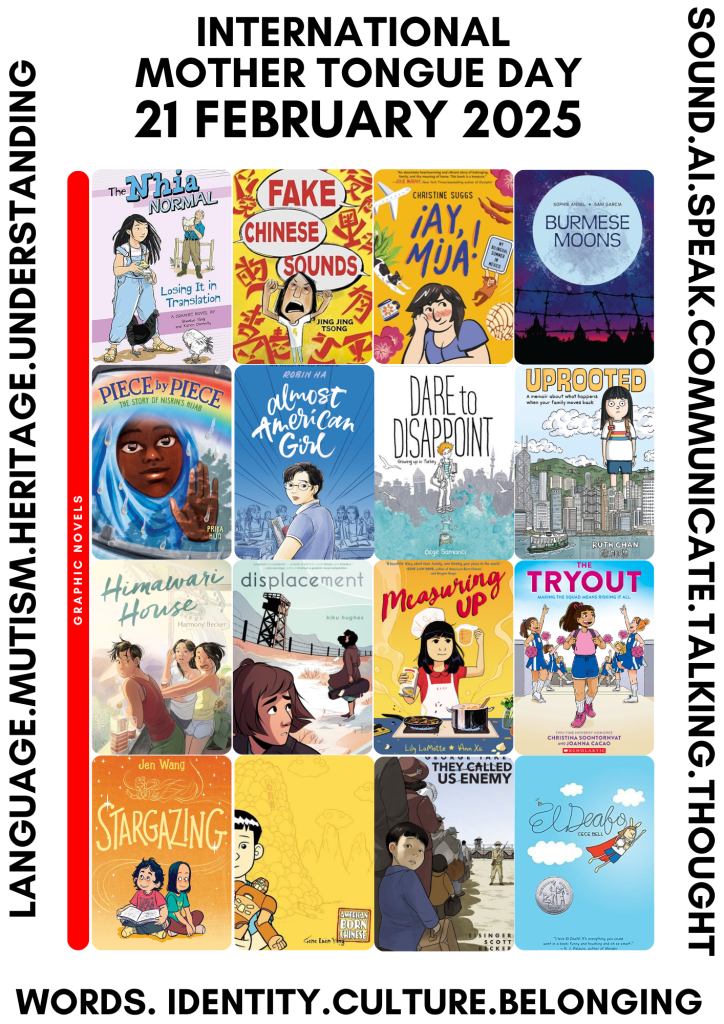
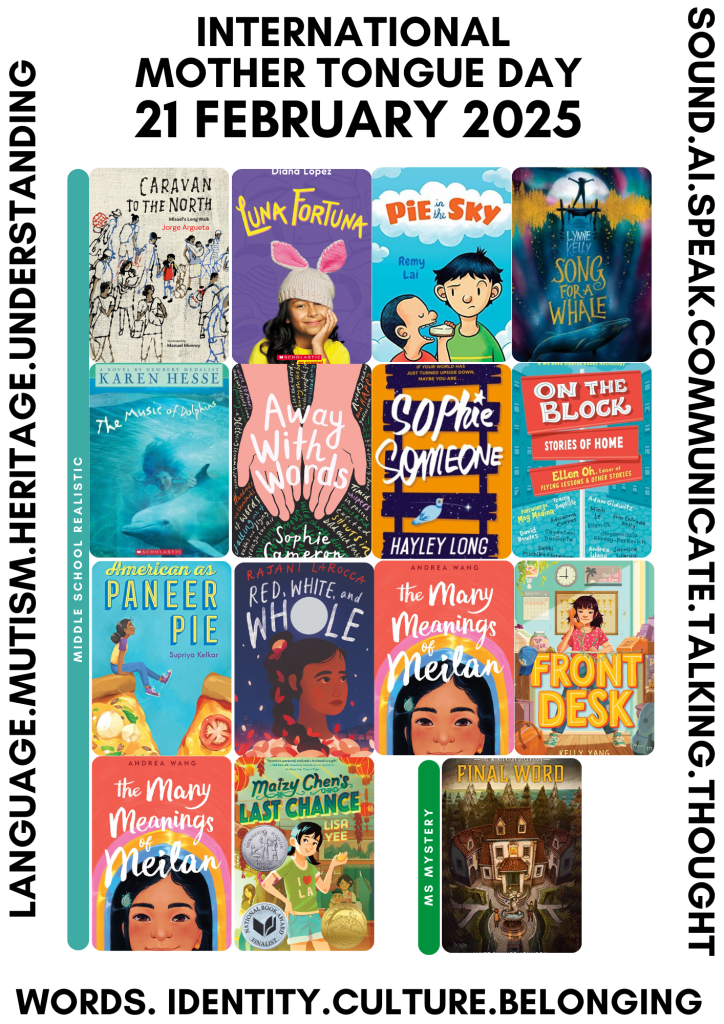
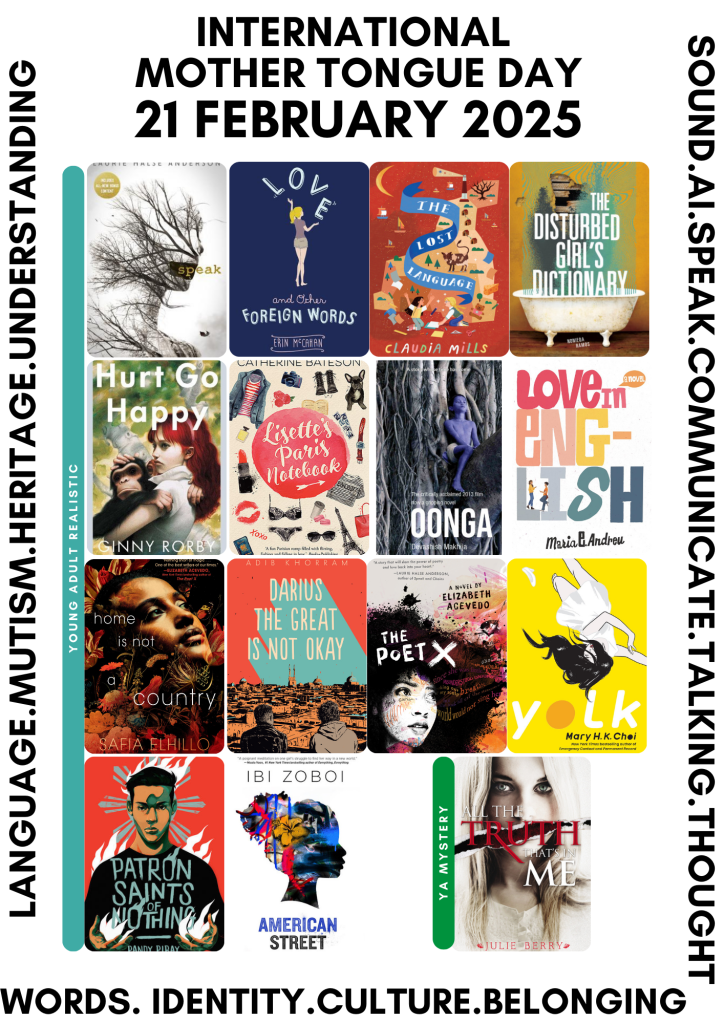
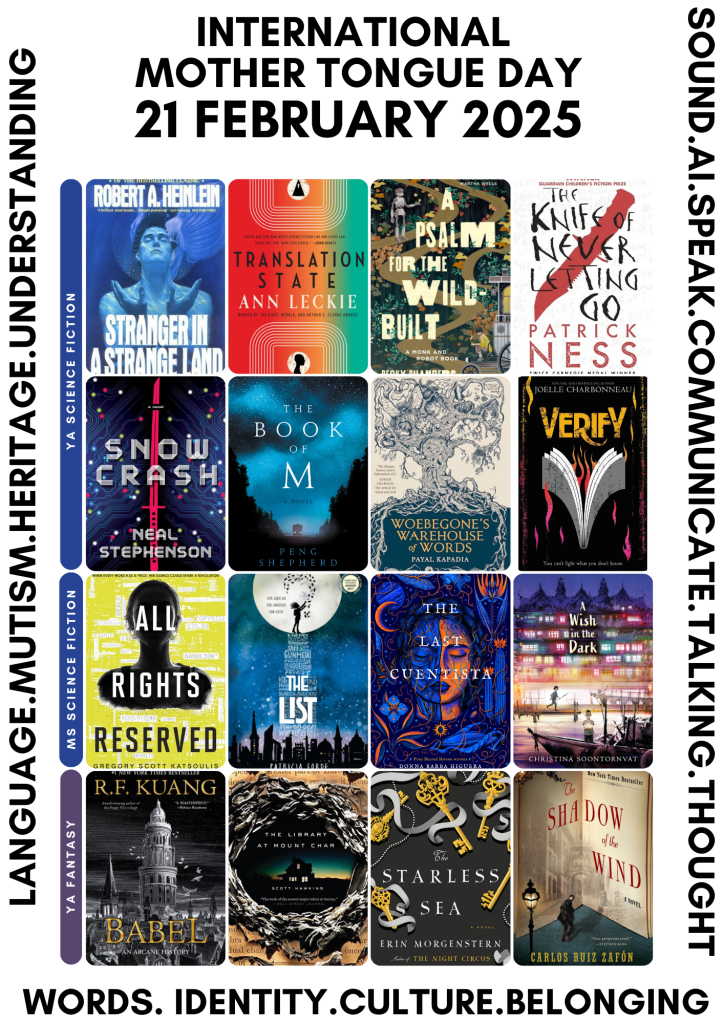
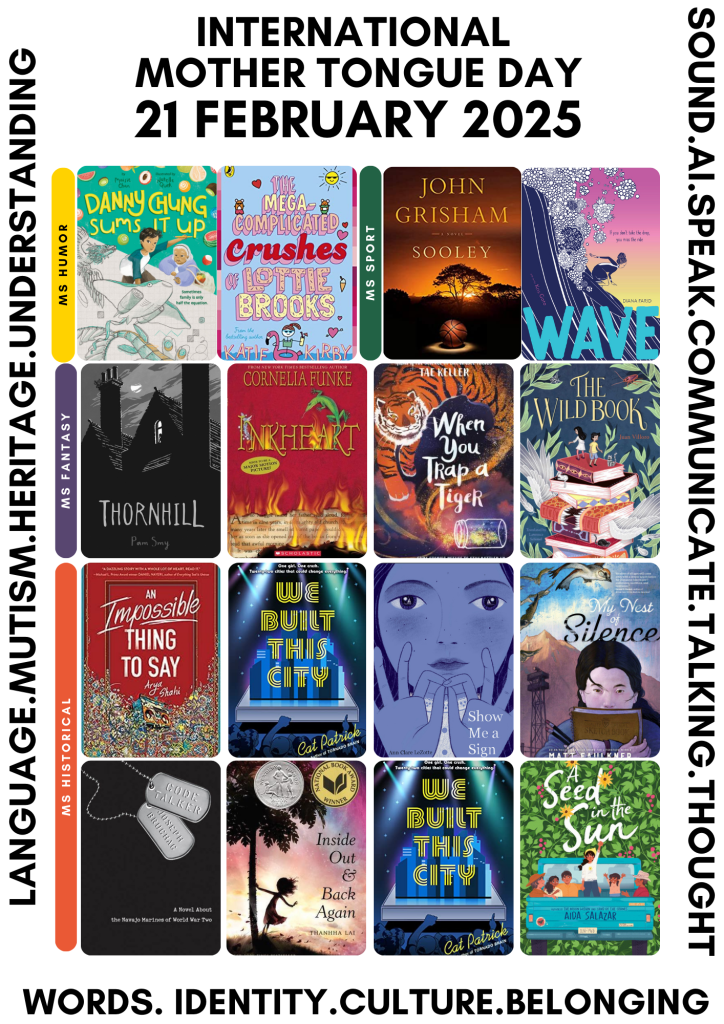
International Mother Tongue Day is next week Friday, but my students and I will be embarking on their annual Week Without Walls trip so I’m a week early with this post – hopefully it will be of some use to those of you planning on celebrating it in the library. I will be upfront about my objection to it being called Mother Tongue Day – as it denies all the families where the language of other significant family members are spoken at home. I prefer the term “home language”. This year is the silver jubilee of the event. Despite all efforts, languages are becoming extinct at an ever increasing rate, and unfortunately this doesn’t attract quite as much attention as pictures of cute or not so cute animal. Schools and other educational institutions are complicit in this – something I’ve been banging on about for years, the lack of multiple-lingual home and heritage language education I still see as a failure of imagination rather than a failure of resources in this day and age. Ok, off my soap box and back to the practical.

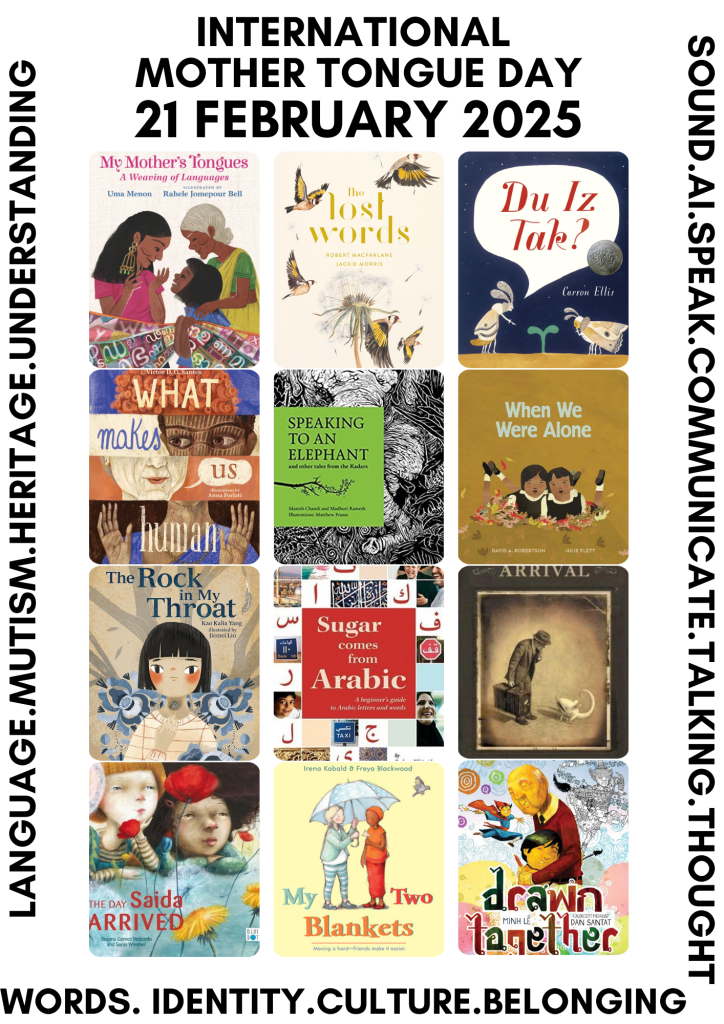
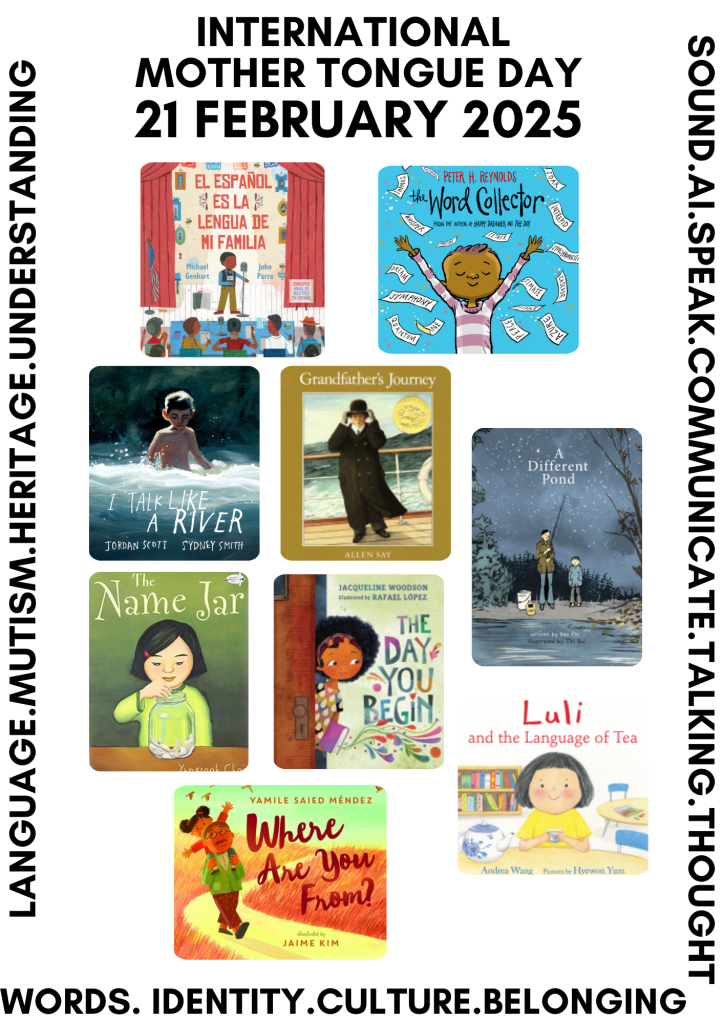
These lists started with a casual conversation with KD as to what I had planned for the day, as my passion for language is well known. Which led to a discussion on which books one would consider and then, as usual things got a little out of hand and now I have 9 pages of posters of books that feature language. Language in all its glorious and inglorious forms. Learning language, struggling with a language, speaking or not speaking. Sign language. Heritage language. Language and thought, language and power or control. Selective mutism. Denial of language, erasure and extinction of language.

As for what to do – if I were here, these are the things I would do.

Have big sheets of paper our where the community could write down the languages they speak / read / write. The languages they’re learning. The languages of their fathers, mothers, grandparents.

I’d have them make a language family tree. Have a poster with a QR code that led to this quirky test on Language.

There are some more ideas on this site (annoying pop-ups for an app though).

As usual here is the link to the template / books used. In return I’d love some comments on the books you recognise and the link to language! And any displays or activities you’re planning. And of course if you have suggestions of books I’ve missed I’d appreciate you adding them in a comment.
Assessment Item 6: Digital Storytelling Topic Proposal

“Knowledge, then, is experiences and stories, and intelligence is the apt use of experience, and the creation and telling of stories. Memory is memory for stories, and the major processes of memory are the creation, storage, and retrieval of stories.”(Schank & Abelson, 1995, p. 8)

red dragon

Red Dragon Wallpaper Download. (2011)

Proposal Topic:

“追龍 – Chasing the Dragon*
a family’s story of language and identity”

From 2006 to 2011 our family was engaged in learning Chinese in one form or another including language classes, attending a bilingual immersion school and following a university degree – with nearly devastating consequences for one child. This digital story weaves together extracts from blog entries written at the time, digital photos and videos, images of school books and writing and interviews as each child and the family grappled and came to terms with who they were and how language shaped that identity.

Proposed digital tools and/or spaces to be used:

iMovie, Blogger, twitter, facebook, digital photos and videos, memorabilia

Rationale for topic focus

In Asia, particularly Hong Kong, where parenting is a competitive sport, giving your children the opportunity to learn Chinese has become the holy grail of expatriate parenting. Children are enrolled in language programs and immersion schools without much understanding or consideration of the possible consequences.

Research is scant and evidence, mainly anecdotal, focuses on the positive success stories.  A climate of shame, and fear of it reflecting badly on the parent, prevents openness when children do not succeed.

Our family’s story of “chasing the dragon” is one of success, failure and ultimate triumph. In this project, I hope to use storytelling as a way of making sense of events and experiences and communicating this (Botturi, Bramani, & Corbino, 2012) to others in a similar situation.

The affordance of digital storytelling is to incorporate multi semiotic systems that ‘allow for the linking and integration of cognitive, tacit, affective, cultural, personal, graphic and photographic ways of exploring, articulating, expressing and representing sense-making about learning and identity’ (Williams, 2009, cited in Walker, Jameson, & Ryan, 2010, p. 219). It is a warning story and also a story of hope.

Finally, I am considering putting in a proposal to present at a conference on language next year. I would like to use this story as the basis of adding context to academic theory on mother-tongue, language learning and identity so that educators and parents alike not only have an intellectual understanding of the theories but an emotional response through this story to the platitude that “every child is unique”.


====================================================

* “chasing the dragon” is a Hong Kong slang term referring to inhaling opium vapour – the metaphorical meaning includes the elusive pursuit of an ultimate high.  For the purposes of this story it’s the elusive pursuit of mastering the Chinese language.

====================================================

References:

Botturi, L., Bramani, C., & Corbino, S. (2012). Finding Your Voice Through Digital Storytelling. TechTrends, 56(3), 10–11. doi:10.1007/s11528-012-0569-1

Red Dragon Wallpaper Download. (2011). Retrieved September 14, 2014, from http://www.wallpaperhere.com/Red_Dragon_81049/download_1920x1440

Schank, R. C., & Abelson, R. P. (1995). Knowledge and Memory:  The Real Story. In R. S. Wyer (Ed.), Knowledge and Memory: The Real Story (Vol. VIII, pp. 1–85). Hillsdale, NJ: Lawrence Erlbaum Associates. Retrieved from http://cogprints.org/636/1/KnowledgeMemory_SchankAbelson_d.html

Walker, S., Jameson, J., & Ryan, M. (2010). Skills and strategies for e-learning in a participatory culture (Ch. 15). In R. Sharpe, H. Beetham, & S. Freitas (Eds.), Rethinking learning for a digital age: How learners are shaping their own experiences (pp. 212–224). New York, NY: Routledge.


Module 6: INFORMATION POLICY – Identity, privacy, security and trust

Task
Explore some of these following readings regarding the issues of identity, privacy, security and trust:

De Rosa, C., Cantrell, J., Havens, A., Hawk, J. & Jenkins, L. (2007). Section 3: Privacy, Security    and Trust. In Sharing privacy and trust in our networked world: A report to the OCLC                membership. Dublin, Ohio: OCLC. [ebook]                                                        
   Available http://www.oclc.org/reports/pdfs/sharing_part3.pdf
Mallan, K. & Giardina, N. (2009). Wikidentities: Young people collaborating on virtual identities      in social network sites, First Monday, 14(6), 1 June. Available
   http://firstmonday.org/htbin/cgiwrap/bin/ojs/index.php/fm/article/viewArticle/2445/2213
Raynes-Goldie, K. (2010). Aliases, creeping, and wall cleaning: Understanding privacy in the age    of Facebook, First Monday, 15(1), 4 January.                                            
Pearson, J. (2009). Life as a dog: Personal identity and the internet. Meanjin, 68(2), 67-77.    
Davis, L. (2009). 8 tools to track your footprints on the Web, February 1. 

Based on your reading of three (3) of the above readings on issues related to online identity, privacy and/or trust. Think about online identity in relation to both individuals and organisations:
  • what is important in terms of how we present and manage those identities online?
  • what can we share and what should we retain as private to the online world?
Post a 350 word summary of important issues around online identity to your learning journal.

===========================================================

Reading Module 6 this week comes at a very interesting time as it coincides with some real-life learning about the power of social media in Singapore where I live.  

To briefly summarise the case, a British Expatriate Banker, Anton Casey, made inappropriate and offensive comments relating to Singaporeans, in particular, poor Singaporeans on Facebook and on YouTube. These comments got out to the press, went viral and resulted in thousands of comments, police reports being filed, death threats to Mr. Casey, and ultimately resulted in him losing his job and having to leave Singapore. [Disclaimer – I think what he said is deplorable and casts a shadow over all expatriates in Singapore, however this is an exercise in Social Media safety not ethics or morality and will be discussed as such].

I’ll discuss each of the aspects of Identity, privacy, security and trust in turn, with reference to this case. However each of these are intimately related to the other, and none can be assumed.

Identity: Mr. Casey appears to be among the third of people who are “comfortable sharing their true personalities online as in person” (De Rosa, etal, 2007, p. 3-11) and based on hearsay had “the same personalities online and offline” (De Rosa, etal, 2007, p. 3-13). This is something that Pearson (2009) writes about, which can be summarised as “they know you’re a dog” and “we know you’re a dog”.

Privacy: As the OCLC report states that most people think it is important to have control over their personal information, however, goes on to say “Respondents frequently do not take advantage of privacy controls that are available.”  It took less than a day for the posts on what one would assume to be a private Facebook account to go viral.  And subsequent to that all other aspects of Mr. Casey’s life were made public, his address and phone number, his email, name of employer, his supervisor, details of his wife and child, his car registration number, the school he attended. As Lim Swee Say states on Channel News Asia (CNA) in relation to another Facebook incident, “There is no such thing as a private space in the social media. In fact, social media is public. Therefore, it is important that whatever we say and express in the social media should be done knowing that it would become public.” (CNA, 2012)


Security:  In his “apology”, Mr. Casey mentions a security breach in Facebook, in reality it was more likely a breach of trust in his “friendship” circle. Rayes-Goldie (2010) touches on the concept of “social privacy” and how Facebook users both circumvent Facebook controls, and protect their own social privacy through the use of alias, deleting posts and “wall cleaning”.  In this blog post, an educator gives “9 points to consider before posting on Social Media” – something that not only students, but everyone needs to think about.

There is also the question of Social media and the law.  In the UK at least, some posts in Social Media could land the person in jail. This brief infographic itemises a few incidences of this occurring with a brief summary of the law on “improper use of public electronic communications network

Finally, the 8 tools of Davis (2009) were used, checking the footprint of “Anton Casey” and yielded the following results:
Blogpulse: – no longer exists
Boardtracker: new version “coming soon”
monitter: no longer works as Twitter changed its API
Socialmention: analysis seems rather poor as comments were deemed to be largely “neutral” 
Serph: no longer works
Spy: not a very graphically / link friendly site. 
Pipl: not only are his Facebook and Twitter account revealed (both disabled) but those of his friends as well.  And his friends (or ex-friends) seem to be equally careless about privacy as this screen shot shows (I blanked out the names in order to protect the privacy they’re obviously not protecting themselves)

since these tools are 3-4 years old and , Topsy.com and Twitter were also checked:

Topsy.com: 2756 tweets in 7 days, 
Twitter.com search: there is a new hashtag: #antoncasey

Finally – here is a slightly frightening video on the “RIOT” technology for tracking people.


In this post, I’ve just touched on personal identity, privacy, security and trust. This incident in Singapore also had implications on the corporation where Mr. Casey was working, highlighting the need of companies to monitor not only their corporate online presence in social media, but also that of their employees, and to have appropriate policies in place.


==========================

References:

Anton Casey loses job over derisive comments. (2014, January 25). Channel NewsAsia. Retrieved January 25, 2014, from http://www.channelnewsasia.com/news/singapore/anton-casey-loses-job/967580.html
C, D. (2014, January 26). 9 Points to Consider Before Posting on Social Media. Edubabbling for the Masses. Retrieved January 29, 2014, from http://www.edubabbling.com/9-points-to-consider-before-posting-on-social-media/
Channel News Asia. (2012, October 9). NTUC Chief Lim Swee Say: Firing Amy Cheong Was One of the Most Difficult Decisions. Facebook. Retrieved January 25, 2014, from https://www.facebook.com/notes/channel-newsasia-singapore/ntuc-chief-lim-swee-say-firing-amy-cheong-was-one-of-the-most-difficult-decision/10151292389877845
De Rosa, C., Cantrell, J., Havens, A., Hawk, J., & Jenkins, L. (2007). Section 3: Privacy, Security and Trust. In In Sharing privacy and trust in our networked world: A report to the OCLC membership. Dublin, Ohio: OCLC. Retrieved from http://www.oclc.org/reports/pdfs/sharing_part3.pdf
OCLC. (2007). Sharing, privacy and trust in our networked world: a report to the OCLC membership. Dublin, Ohio, USA: OCLC.

Pearson, J. (n.d.). Life as a Dog [online]. Meanjin, 68(2), 67–77.

Raynes-Goldie, K. (2010). Aliases, creeping, and wall cleaning: Understanding privacy in the age of Facebook. First Monday, 15(1). Retrieved from http://firstmonday.org/htbin/cgiwrap/bin/ojs/index.php/fm/article/view/2775/2432

Rich Foreigner labels Singaporeans who take Public Transport as “Poor People.” (2014, January 20). The Real Singapore. Retrieved January 25, 2014, from http://therealsingapore.com/content/rich-foreigner-labels-singaporeans-who-take-public-transport-poor-people
Tadeo, M. (2014, January 22). British expat banker Anton Casey causes uproar in Singapore after mocking “poor people” calling a taxi driver a “retard.” The Independent Business News. Retrieved January 25, 2014, from http://www.independent.co.uk/news/business/news/british-expat-anton-casey-causes-uproar-in-singapore-after-mocking-poor-people-calling-a-taxi-driver-a-retard-9077795.html
Tan, J. (2014, January 25). Anton Casey leaves for Perth with family, hopes to return “when we feel safe.” Yahoo News Singapore. Retrieved January 25, 2014, from http://sg.news.yahoo.com/anton-casey-leaves-for-perth-with-family–offers-to-do-community-work–report-015614740.html


Cultural Exercises

These are the cultural exercises we were required to consider prior to the trip.  I found both the readings and the exercises quite challenging – not in the difficulty sense, but in the sense of confronting your own views and culture.
The chapter that the exercises were taken from is : What is Culture? from  “Culture and Education” which is now on my list of books to read.

==================================================

Exercise 1.1 – You are what you buy.

In a table like the one below, list 10 items that you see as essential to your day-to-day life. Then, for each item, provide the reasons why you bought it and list the effects (as many as you can think of) it has on your identity.
Item
Purpose for buying
How does this shape who you are?
Mobile phone
Communicating – I need it to talk to my friends – they all have one
I’m part of the group and not left out. I’ve got the latest ringtones so I’m pretty up-to-date.
Adapted from Wadham, B. A., Pudsey, J., & Boyd, R. M. (2007). Culture and education. Frenchs Forest, N.S.W.: Pearson Education Australia (p. 3).

Exercise 1.6 – Evaluating Values

Make a table like the one below and list all the values you think you hold. These might be ethical values, but they also might be ‘things’, such as family or education. Then list where you think you go them from and you you engage in these values on a day-to-day level.
Values
Where you go this from
How you ‘practise’ it
Freedom
Authority
Justice
Equality
Education
Your parents
Go to university
Adapted from Wadham, B. A., Pudsey, J., & Boyd, R. M. (2007). Culture and education. Frenchs Forest, N.S.W.: Pearson Education Australia (p. 10).

Exercise 1.7 – My Family Culture
In a table like the one below, insert elements from your own family’s activities to get a sense of the culture of your family.
Elements of Culture
My family’s examples
Symbols and signs
My dad wearing a kilt to Sunday lunches at Grandma’s house.
Language
Values
Beliefs
Norms
Rituals
Sunday lunch with Grandma; attendance at school 5 days a week, for around 12 years
Material objects
Adapted from Wadham, B. A., Pudsey, J., & Boyd, R. M. (2007). Culture and education. Frenchs Forest, N.S.W.: Pearson Education Australia (p. 12).

Exercise 1.10 – The ‘Who am I?’ test

Write down here the first 20 statements you think of about what makes you the person you are. You might want to think about how the context of doing this exercise is shaping your choice of identity markers about yourself.
Who am I? Statements about what makes me, me.
1.
2.
3.
4.
5.
6.
7.
8.
9.
10.
11.
12.
13.
14.
15.
16.
17.
18.
19.
20.
Adapted from Wadham, B. A., Pudsey, J., & Boyd, R. M. (2007). Culture and education. Frenchs Forest, N.S.W.: Pearson Education Australia (p. 14).