#sensemaking Demystifying mystery

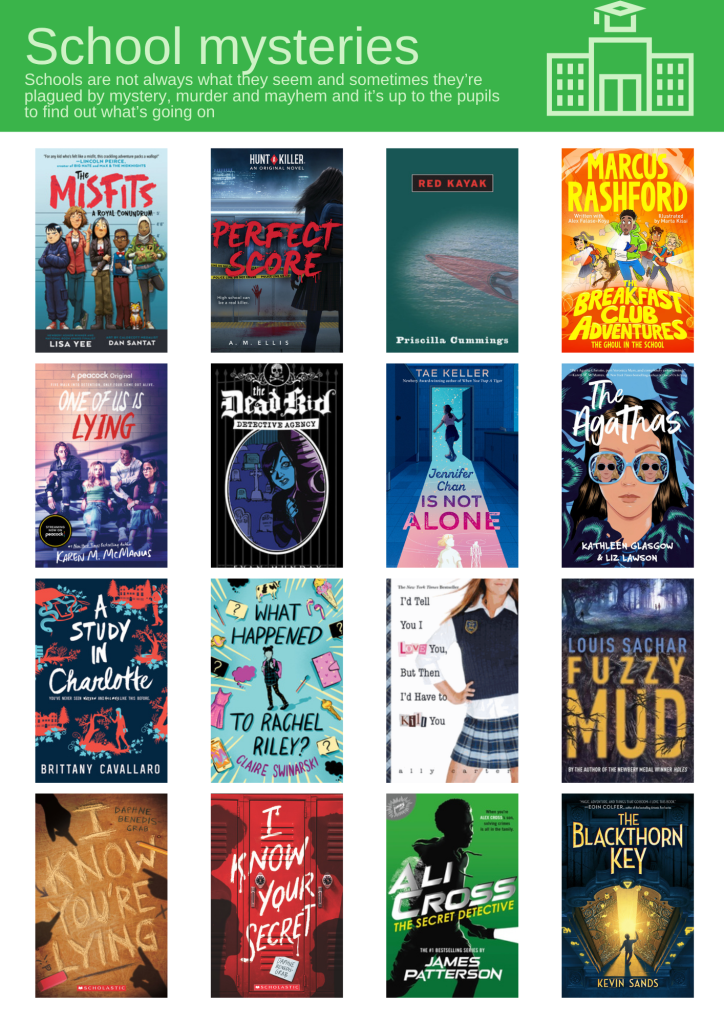
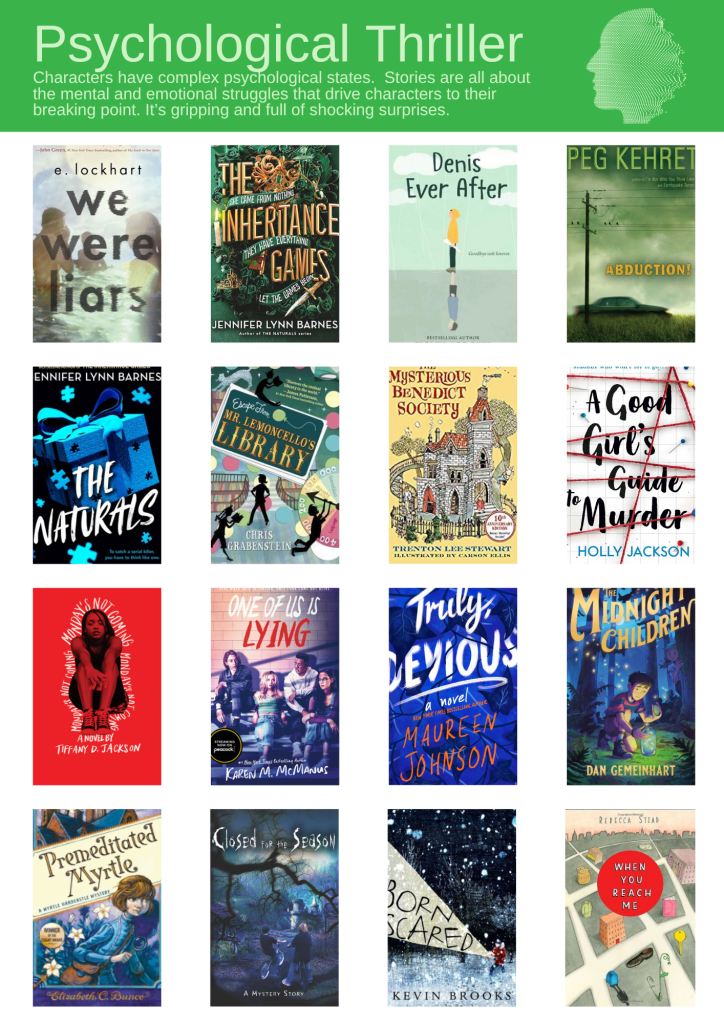
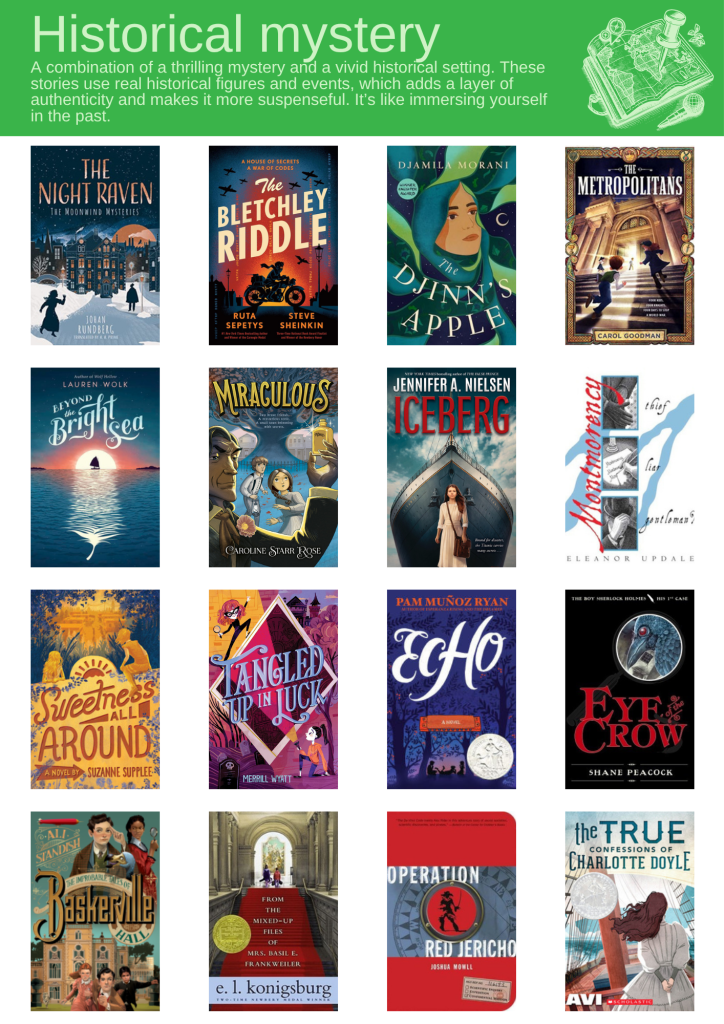
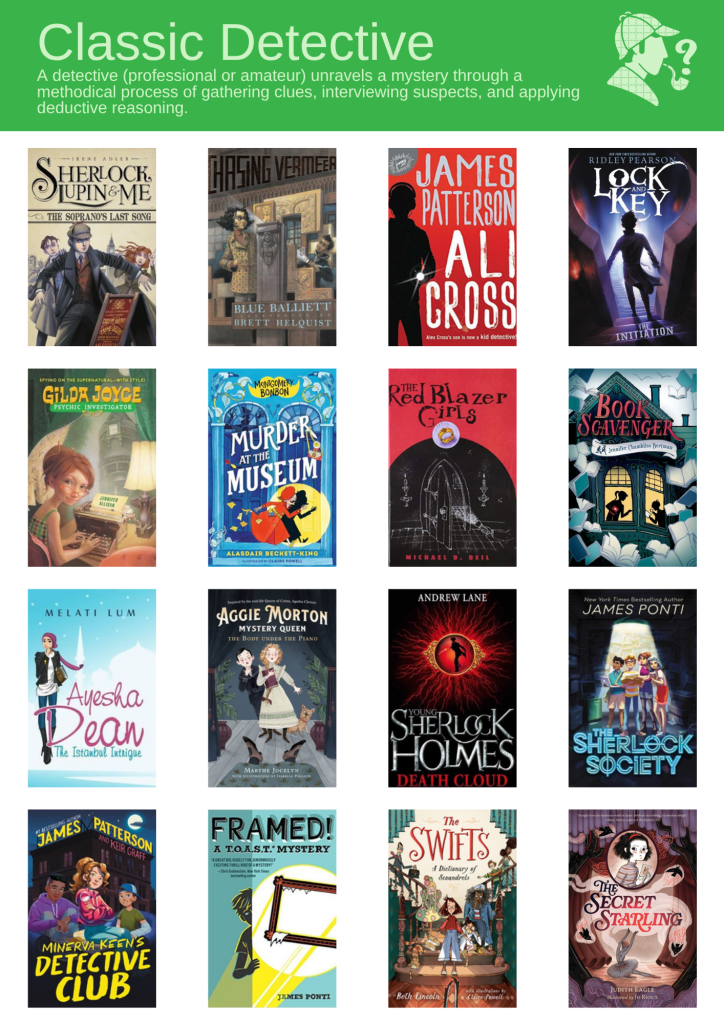
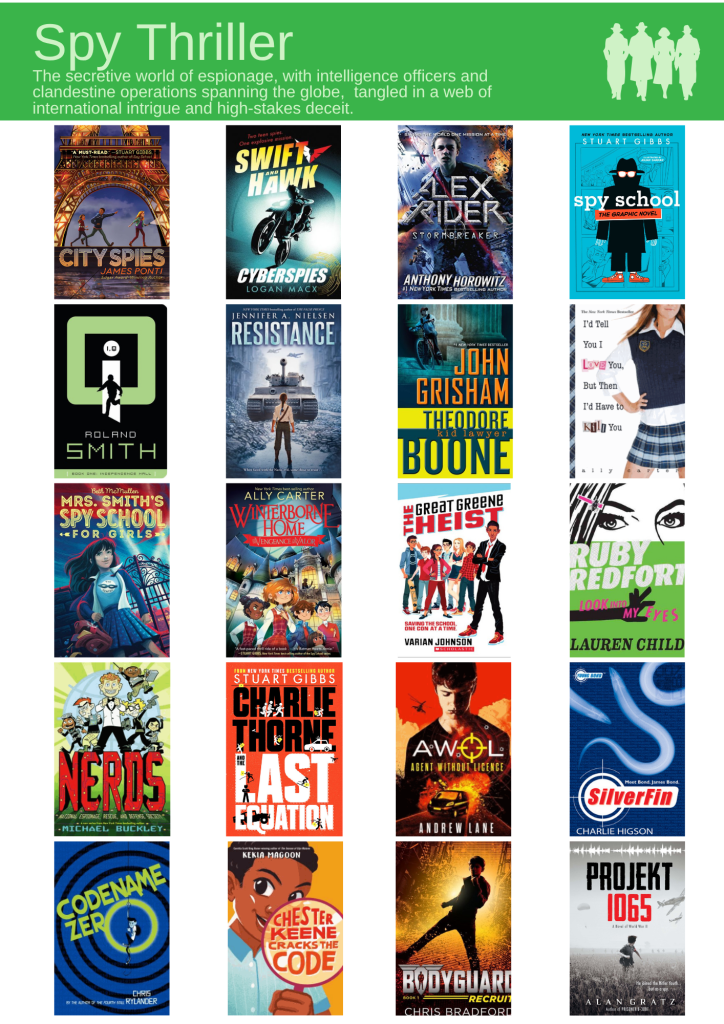
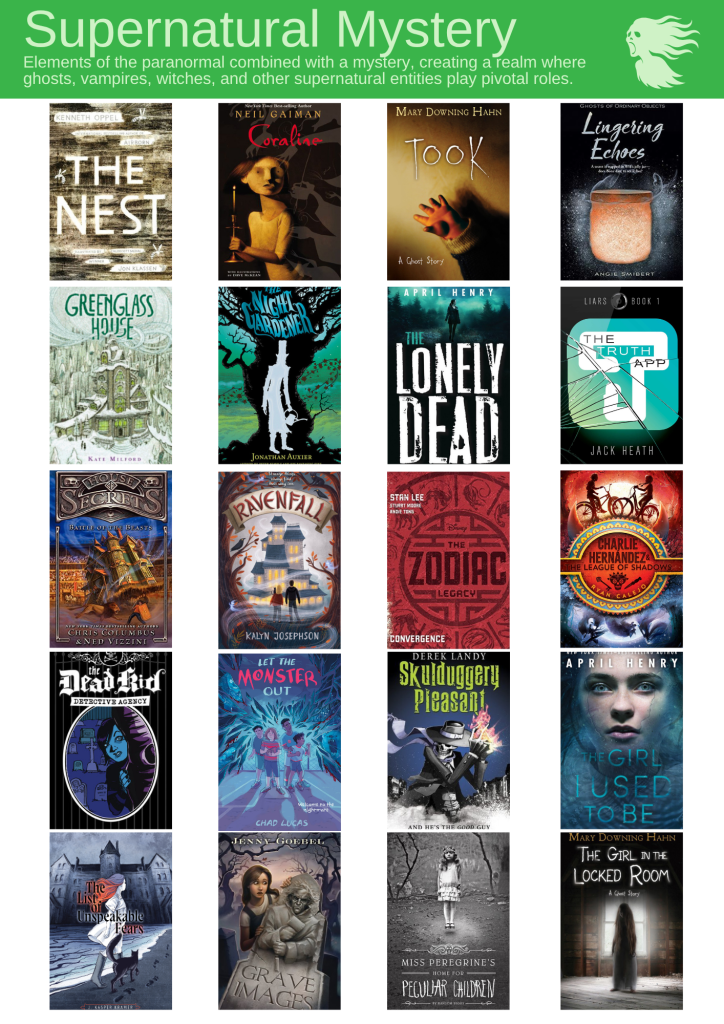
At the moment the Mystery genre is getting a lot of love from everyone from middle school to adult and a lot of great books are being released. Since we’re in a middle/high school library I wanted to showcase the mystery books that are not too spicy / intense. In our G8 core library we have “We were liars” and “The Naturals” which is probably at the upper level particularly in the later books in the series.

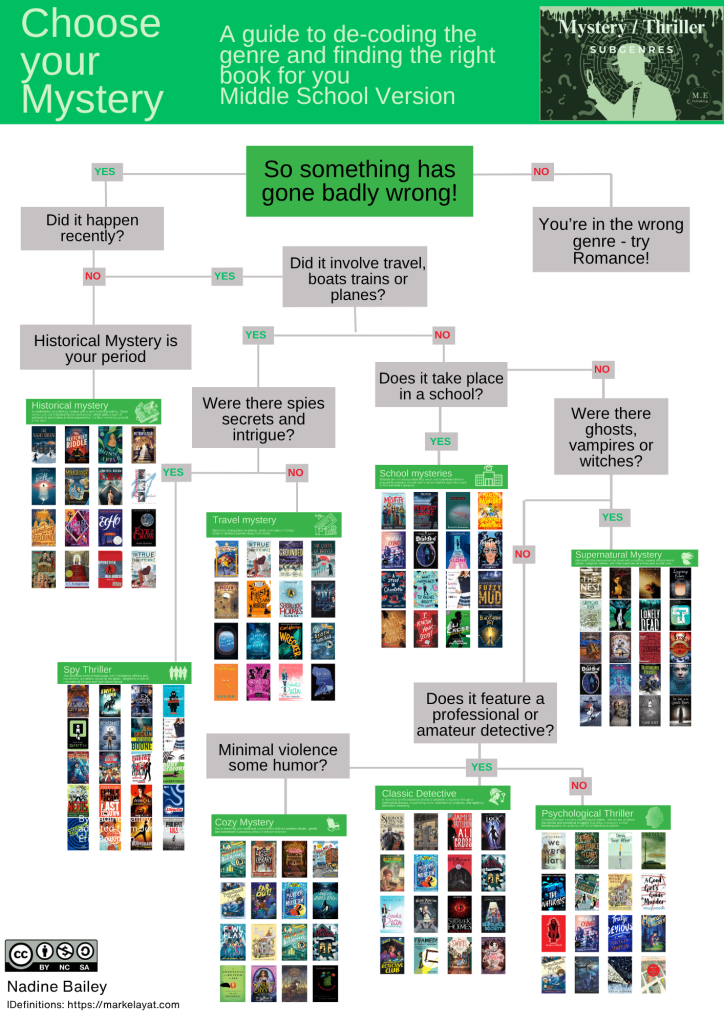
Along the lines of the work I did a couple of years back on Dystopian Fiction, I started to work on doing the same for sub-genres of Mystery. This time around I didn’t have some flowchart work others had already prepared to riff-off and I wanted to focus particularly on books suitable for middle school. I’ve relied on the excellent sub-genre descriptions of Mark Eleyat (who also has great pages on other genres and subgenres) and tried to make some kind of a flow to it. Somehow so many other things have intervened so it’s taken months to get to this point. I would love some feedback / suggestions for improvement on the flowchart.

And I’ve created these Middle School posters. The Canva Template is available for you to adapt to your situation – one day I hope to be able to expand it for YA and even adult, as I’m personally a big mystery/thriller. If you create anything based on this for YA or adult please feel free to share in a comment.

Make-over update

When I tell people we’re getting to renovate and extend our library their first reaction is “wow, that’s amazing, you’re so lucky!”. And yes, prima facie it is so. But right now it’s feeling rather overwhelming. And ironically most of that is not so much to do with the change as the amount of preparation that needs to be done. Speaking of change – you HAVE to get “Bug in a Vacuum”

I am a veteran of moving. 10 countries in 24 years plus countless internal moves in those countries and 3 moves in the last 5 years. I know it pays to be prepared and to clean and clear before the move. And as I remarked in my last post, a lot of that cleaning and clearing happens behind the scene.  Things are slightly more complicated as well due to well, life. Unforeseen circumstances. Like one staff member on maternity and another on hospitalisation leave. And part of my gratitude thoughts each day are for my remaining staff member who is picking up a lot of the slack and the temporary staff member who is happy to learn the ropes and keep things ticking over. And the other temp who has been coming in and the occasional parent or volunteer for their kindness.  But it does slow things down as we adapt and learn.

So, significant but time consuming things that have been done this week – including taking up time in my weekends – those weekends that I thought would be computer and work free now that I’ve finished my M.Ed!

  • Putting patron photos into FollettDestiny  – easy in theory but quite a lot of preparation work – including learning all sorts of new Excel tricks on how to add things before and after text in cells!  And of course 90% goes well, but the 10% that bombs out, takes 90% of your time to trace why an upload didn’t work, what went wrong and how to remedy it.
  • Cleaning up patron data.  After the last patron update I found about nine pages of patron data that just wasn’t right. Parents marked as students or staff, students who had left years ago, staff who had left, incorrect emails etc.  Now bear in mind, when I prepare these lists, I then go into school with a full teaching schedule and it literally took 2 people 2 days to clear it all up in-between their regular tasks of circulation, shelving and THE PREP
  • Yes, the PREP. we have 9 different grades from Pre-Kindergarten to Grade 6, and each of those have 4 (Kindergarten) -6 (the rest) UOIs. The library has to be vacated by next Friday. Most UOI’s are changing over on Monday coming. Many UOIs have changed this year. So that means checking the central idea etc. checking previous year’s lists, quickly checking with the lead that my understanding of where the topic /theme / concept is going is the same as theirs, making new lists and then packing up 18 boxes of books and DVDs – 9 for the coming week when we’ll have over 1000 books returned from the last units and 9 for the first weeks of January 2017 – just in case. Because of course our handover of an empty library to the designers / constructors is 1 December and of course their hand-back to us is 1 January. But I am of little faith that things are flawless. So I err on the side of caution.  And bear in mind, we’re still having our 35 classes a week, plus all sorts of meetings that are using the library so we’re configuring and reconfiguring the space and arranging catchup classes…
  • The new books. And the wrongly processed books. I still hold vestiges of anger on our last big book order with Follett that went horribly wrong in every which way it could have gone wrong. They didn’t deliver on time or as arranged, they catalogued incorrectly, spine labels were wrong etc. So we’re still sorting out that mess. And then I put in a couple of other smaller orders, but our cataloguer is off on hospitalisation leave so we’re cataloging on the fly.  Now this is a GOOD thing I keep on telling myself. I’m all for final responsibility for tasks and work flow, but I’m also all for everyone pitching in and helping and knowing all aspects of the process. It’s been a little peeve of mine in the library world that there is so much segregation of duties and these past weeks have just proven that given the chance people can do way more than they or anyone else may have thought. But it is extra work – did I mention what else was going on?
  • The weeding. Saying goodbye is so hard to do!  I must admit having absolutely no problems ditching the disney fairy series that no-one was looking at or borrowing. But then there are other books – Michael Rosen’s “Sad”. I’m sad that no-one seems to have ever borrowed that. And I feel bad that I’ve not marketed it, or allowed it to see the light of day and be nurtured and treasured. Perhaps if I pair it with Bug in a Vacuum?  Weeding is sweet sorrow. It highlights our failings as book pushers. I feel like a neglectful parent when a book that’s been bought doesn’t get the attention it needs. I spend time with each of them and ponder whether putting them on a resource list would help. (No jokes about “will this bring me or someone else joy) Or perhaps asking students and teachers to ponder their fate. And I do both, and some survive for another day.
  • Acquisition plan – my kids ask me “if we’re getting a new library does that mean we’re getting new books?” This is the double edged sword of money and budget. I was talking to some fellow librarians last week – their budgets are double mine. Sometimes less is more. Our students and our teachers probably only have capacity for perhaps one really good reading book a week. Each. What should that book be? And for research / nonfiction? It’s so hard. I try so hard, but this week it has been stingrays and grasshoppers. Boats and jet planes. Last week it was fast cars and how to make your own vegetable garden (try getting one of those for an equatorial climate, suitable for G2 level), dinosaurs are totally out of favour. They want tornados and not hurricanes.  And “Miss where are your Indian books?”  and “there’s nothing on Bangladesh” I’m trying to diversify. They deserve Indian books, and overseas Chinese but not ABC (American born Chinese) books, and Korean protagonists and Japanese heroes. The triplet sister of acquisition and weeding is discoverability. I need to crack that nut in the new library. Does that mean genrefying, through label or location? Does it mean more work on resource lists or libguides or other pathfinders?

The problem with grappling with all these things is that they take up a lot of brainspace and thought space and discussion space. All of which is being take up by doing. I’m looking forward to the library being boxed up and having time to be more strategic, having time to go into classrooms and observe and understand.


What is twitterature?

Exploring storytelling using twitter is one of the many new “genres” in digital storytelling.  Here is Andrew Fitzgerald explaining what it is:

https://embed-ssl.ted.com/talks/andrew_fitzgerald_adventures_in_twitter_fiction.html

Viking / Penguin have taken the lead in this new format and there is a dedicated website to some of the best examples.

Activity 2: Interview – running a successful parent volunteer program in a school library

Libraries in general, and some school libraries in particular are not known for having a surplus in staff. Many therefore consider turning to parent volunteers to help out with a variety of tasks.  
Some libraries manage this better than others, and here in Singapore, the Singapore American School is known in our network for having a very well run, well functioning library parent volunteer program. They have 35-40 regular weekly parent volunteers and more than 50 parents who are involved in one-way or another in the library as well as a group of committed high school student volunteers. 
So this morning, I went over to interview Kate Brundage, the Elementary School Librarian who has been running a successful program for the last five years.
In answering all my questions and showing me the library she explained the process of recruiting and training volunteers, the type of tasks that volunteers do, potential problems and pitfalls and how to handle them and how to show your appreciation. We ended with a tour of the library.

The process of recruiting and training volunteers

Parent volunteer form
Recruitment generally takes place at the beginning of the school year when sign-up forms are distributed during open-house sessions, back to school night, the first parent coffee mornings and are also shared with classroom teachers.  The library hosts a parent coffee morning and talks to the parents about library service and the benefits of being a volunteer.  During the school year, the librarians have an active partnership with classroom teachers, whereby parents who tend to “hover” or want to be overly involved in the classroom have their energies directed to the library where they can make a meaningful contribution to the school as a whole.
The initial in-service training takes 90 minutes and parents are introduced to the library organization, explanations on shelving are given and parents are given guidelines on what to do with damaged books and other commonly encountered problems.  The desk and mobile circulation systems are explained and other projects and service opportunities are introduced.  New parents are then buddied with existing volunteers who provide further training “on the job”.
Parents are also encouraged to team up with close friends or with people who speak the same language as themselves, if they are not comfortable or fluent in English. Depending on their volunteer role and interest, some volunteers also receive training in FollettDestiny (the library system) and are given restricted rights based on what they need to accomplish.
The library makes it clear on the form, and in their talks that the main priority for volunteers is shelving, as this frees up the librarians to spend more time teaching and interacting with the children and transferring their librarian knowledge and expertise.
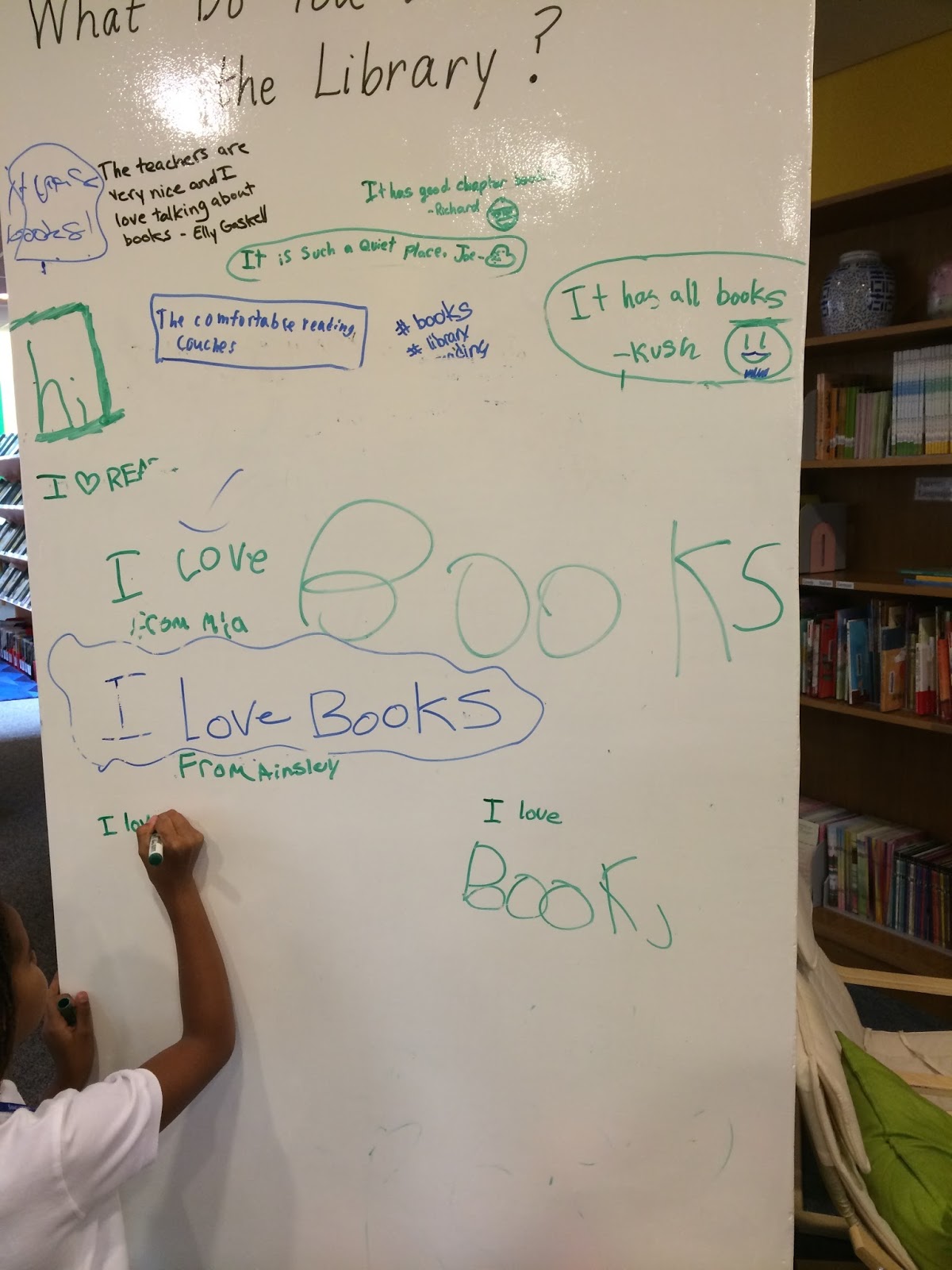
The creation of a “writing wall”
was a parent volunteer idea
Besides the parents, the High School pupils can also sign up to be library volunteers as part of their service program.  A similar training program is given to them, and they are also encouraged to be ‘book buddies’ with the younger students.
It is emphasized that although this is a volunteer position, the library is counting on the commitment of the volunteers, and should they not be able to come for whatever reason, it is their responsibility to find a replacement, from the list of trained volunteers, to take their place.  Volunteers are also required to commit to a minimum of 3 hours per week on a consistent basis.  The volunteer roster is changed every 3 or 4 months giving new volunteers a chance to join up and also to change around times should situations change or if people are found not to work well with each other (e.g. friends spending too much time chatting rather than volunteering!).  Volunteers are encouraged to be active readers so as to better understand children’s literature, the needs of young readers and the availability of books of different genres and difficulty in the collection.

The types of tasks volunteers do:

Parents assisted with the genrefication
of the picture book collection
Although the primary task is shelving, and with the huge collection the school has this is a very important task, it is acknowledged that it is not the most exciting task and needs to be interspersed with other tasks that may be more stimulating.  For example parents help with include circulation – checking in and out of books either at the check-out desk or using the mobile apps the school have. Parents are also involved in longer term projects such as the current genrefication of the library, pushing books out of the library to classroom libraries, documenting and photographing the puppet and soft-toy collection into a visual album.  Depending on their skills and interest, parents also create displays, help with signage and other graphic design, and help children in the shelves with choosing books, or with occasional story telling and reading.  Annual special events such as the Battle of the Books, the Red Dot Awards, author and illustrator visits and the Readers’ Cup Challenge also provide the opportunity for parents to take ownership of a project and help the library in this way. For example during an author or illustrator visit, the volunteers will manage the ordering process.  Parents also do “shelf-reading” to ensure that books are properly shelved and to check missing or damaged inventory. A new project coming up is the creation and maintenance of a makerspace area, and volunteers will definitely be involved in that.
Sorting and organising special materials
Parents are asked on signup if they have specific skills or preferences, including foreign language skills where they can help with cataloguing, shelving and ordering of LOTE (languages other than English) materials.  Even stay-at-home-parents are catered for!  Parents who want to volunteer but cannot come into the library due to younger children or other difficulties have tasks sent home to them like creating resource lists or checking inventory and creating order spreadsheets from mark-ups in the SLJ or other book reviews.

Potential problems and pitfalls

Occasionally parents may be motivated by less altruistic ideals, and exhibit behaviors such as just assisting their own children in the library, or may have a hidden agenda, such as censoring books in the collection. Kate emphasized that this was extremely rare, but had to be dealt with firmly.  At all times the fact that it is a partnership for the benefit of all children. Most problems can be pre-empted by being clear about expectations during the initial in-service training. Common etiquette things such as not using mobile phones, deferring to the librarians and teachers, not interfering with the class experience, not disciplining or shaming children, maintaining respect and supporting all children are clearly outlined.  The three month volunteer cycle also allows for a review of which volunteers are in which roles and at what times and this can be changed if necessary.

Showing appreciation

The library hosts two parties during the year, one before Christmas and one at year end.  Catering part of the library budget and parents are given small thank-you gifts such as flowers or vouchers for Starbucks or movies, candles and holiday bookmarks.  They are also given first choice in books that are being weeded from the collections.
During the year, the librarians take regular snapshots of the volunteers that are then made into an appreciation video that is shown at year-end, and some photos are put in the annual yearbook.
ALA Book on managing Volunteers
After a tour of the library and seeing some volunteers at work, Kate then very kindly lent me the new ALA book “Managing Library Volunteers” so that I could look through it while I was in the process of setting up our volunteer program at school.
Dewey didn’t do Geography

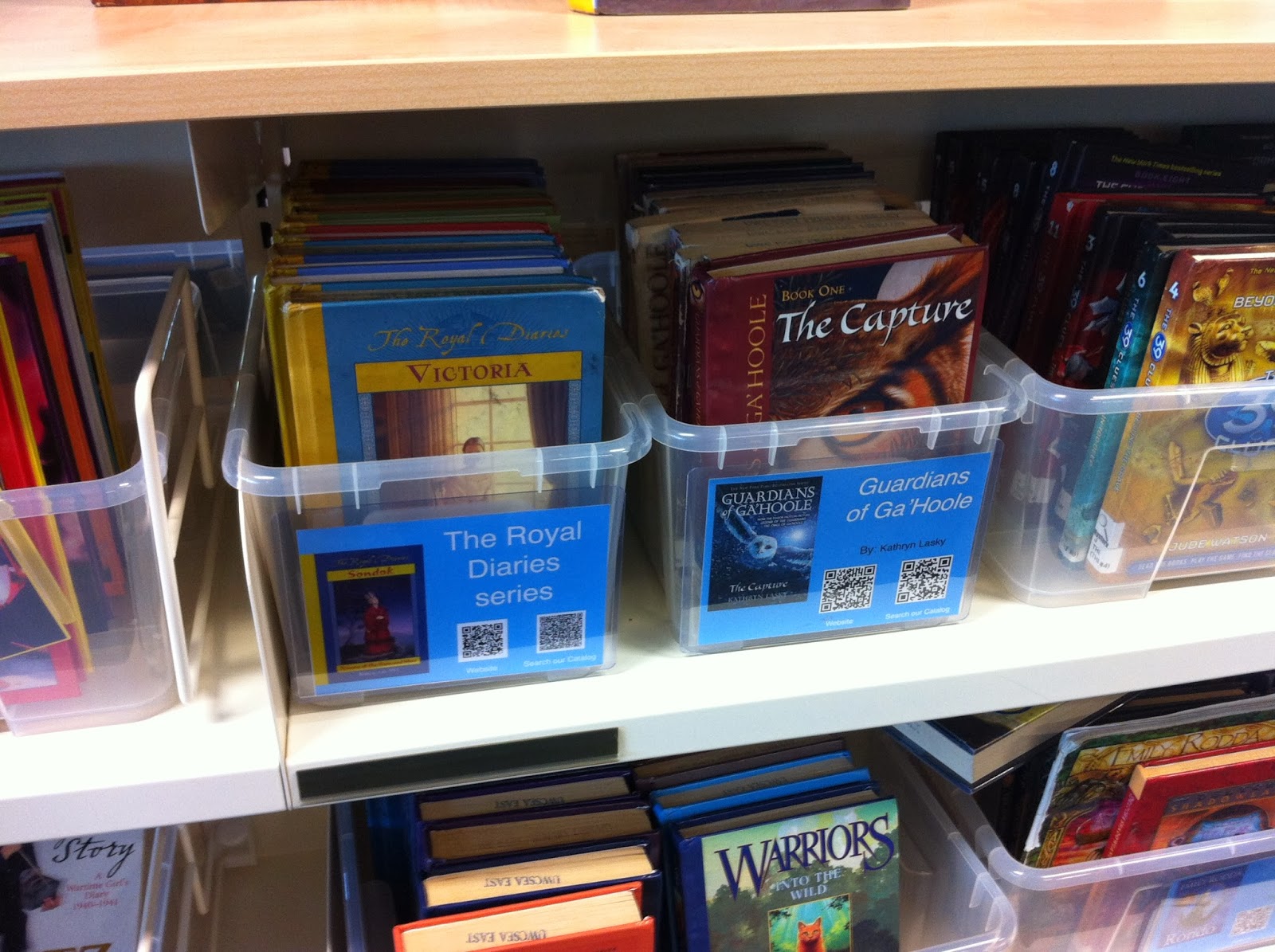
Series

There’s been quite a bit of chatter about the “de-dewification” of the library, if that’s the way to write it. Of course that all started way back, when people pulled their fiction out of the 800’s and sorted it by author, but the trickle seems to be turning into a flow.

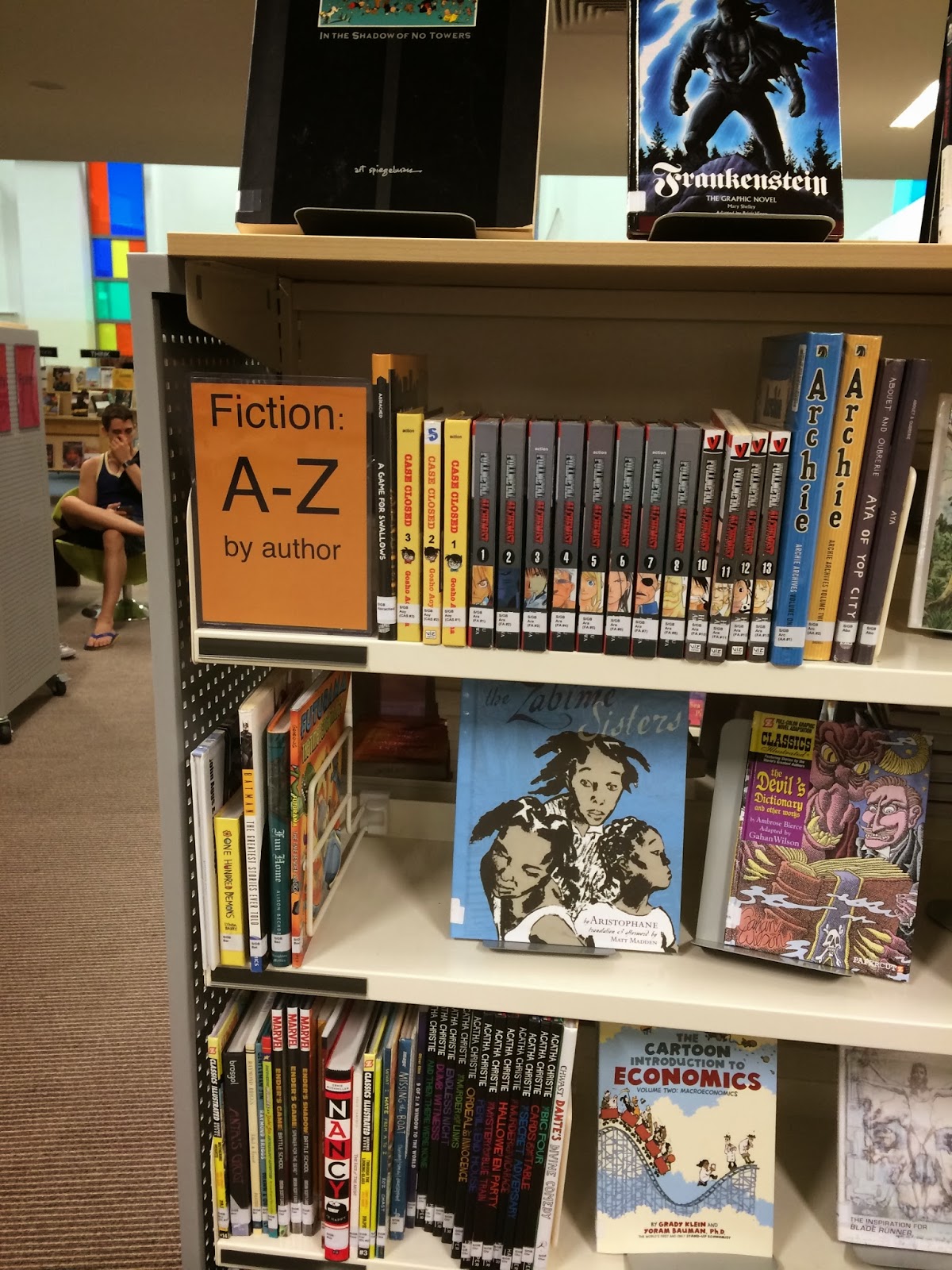
Graphic book Section

While I was on the Singapore Study Visit, Ngee Ann Poly was one of the many libraries who have moved towards a bookstore concept for their lifestyle books.  Library Grits wrote about the topic this week, referring to the AASL13. Where I work, in Secondary, we’ve pulled out Biography, Playscripts, Graphic Books, and Poetry.   In primary, we’ve got boxes for series and have pulled out Graphic Books.When I did my Libguide for Development Economics, and we wanted to link the physical to the virtual, we were pulling books out of various sub-classifications and putting them together (in DDC order in the Economics section, but not in Economics order – if that makes sense!).  That was reasonably manageable and not to way out.

The Princess Book Section

But then last week I started work on the Geography Libguide.  Boy o boy, Dewey didn’t do Geography.  Or at least not in any form that a modern geographer or geography student would recognise it these days.  A complete aside, but Ms. Katie was then telling me why Geography is not such a big deal at American universities as it could be, or is in the rest of the world.  So, what did Dewey allow us?

910 Geography & travel 
911 Historical geography
912 Graphic representations of earth, atlases
913 Ancient world
914 Europe 
915 Asia 
916 Africa
917 North America 
918 South America
919 Other areas

And what do we need?  – This is a little topic list from our school’s IB syllabus:


People on the move: Migration
Global Climate change: causes and consequences
Demography
Resource consumption and the environment: Making a difference
The big Blue: Ocean morphology and Climate Connections
Where land meets sea: coast
Resources and marine ecosystems
Urban Environments
The Melaka fieldtrip unit
IBiodiversity and tropical ecosystems
Soil resource management
Water on tap: water resource management
Development Disparities: Measuring the differences, disparities within communities and responses
Life on the edge: Hazard perception and vulnerability
Global Interactions: Globalization

So it looks like we’re going to have to work with a separate shelf plus some kind of sticker identification on the spine of the books.

Anyone else there struggling with Geography?