
I am thinking a LOT about AI. My participation in thinking and reading as a factor of my actual usage would be something in the realm of 1 million to 1 at the moment. Save for some tedious bits and pieces like analysing surveys and the occasional laziness in making very short book summaries (which I then have to correct extensively anyway) I’m just not feeling the joy. Please do not construe in any way that I am therefore “feeling the fear”. No. I’m just spending a lot of time exploring and thinking about it. And what it means. And in particular what it means for the current generation of students / young people.
I started blogging in 2003, and blogged about losing my identity as a person while I spent time being a SAHM, holding the threads of my existence together through bringing up children internationally, nuturing bilingual and multi-cultural beings. I then deleted that blog as it had become too personal, too well known and I had become too identifiable and my children had become adolescents and had a right to their own privacy and thoughts and being. Then I started studying to become an educator and librarian and spent four years in academic pursuit, where for many of my courses, blogging was a course requirement. It was a really good thing to make reflections on learning via blogs a course requirement. At WAB (my previous school) elementary students also blogged and I think there can be nothing as wonderful as seeing the thoughts, words and intellectual development of young people developing and maturing and growing over time. Nothing makes better writers than doing a lot of writing. And through writing, one does tend to become a better writer and find your “writers voice”.
Last week our school shut Grammarly off for students. It’s a tool that has always personally irritated me, as I still grew up with the luxury of uninterrupted schooling where we went to school for our lessons, did all our sports and activities after school at school, had no internet, and government controlled TV that only came in after I turned 12. It was a plain vanilla, no frills government school and there wasn’t even enough money for an arts programme. Yes, huge deficits in my education but I did get grammar. The old fashioned way. Swings and roundabouts.
What did Grammarly do? Well, the new update allows students to highlight a paragraph and request Grammarly to rephrase or improve their writing three times a day for free using AI. And teachers were being given work that didn’t reflect the thoughts, intents, abilities or voice of their students. Teachers care. They care deeply that tools can be used to aid the students that need it the most. They also care that tools don’t get in the way of intellectual and skill development. Writing well takes a LOT of practice and also a LOT of reading and if there are any short cuts I’m not aware of them.
The word of the year in 2023 was “Enshittification“, a termed coined by Cory Doctrow and explains the process of platforms first being good for their users, then abusing the users so businesses can make money off the users, then abusing the businesses go get a piece of the pie and then dying. It is the first two parts of the equation that are of most interest to me viz a viz education and AI.
“Being good for their users” needs a modifier – “appearing to be good for their users”. In his long form article Andrew Nikiforuk touches on “whole foods are being replaced by ultra-processed stuff” which was exactly the analogy I was thinking of while reading NYTimes wellness challenge of this week – the article talking about “Are ultraprocessed foods really that delicious?” and asking readers to compare an ultraprocessed product to its natural equivalent. Unfortunately for many young people when they compare their complex pubescent self to what media is telling them is “the real thing” they feel like they come up short, not the artificial reality. One of the disturbing trends with young people is their anxiety and obsession with being perfect (and not just academic – look at the beauty / makeup thing – talk about a distraction) – some of which is parent / adult driven through a failure to understand or recognise that young people are not hatched with perfect writing, grammar, thought, and research skills. That is the whole point of being at school. We’re seeing a bunch of ultra-processed writing and assignments and research at the moment and I’m not sure that it’s leading to better learning.
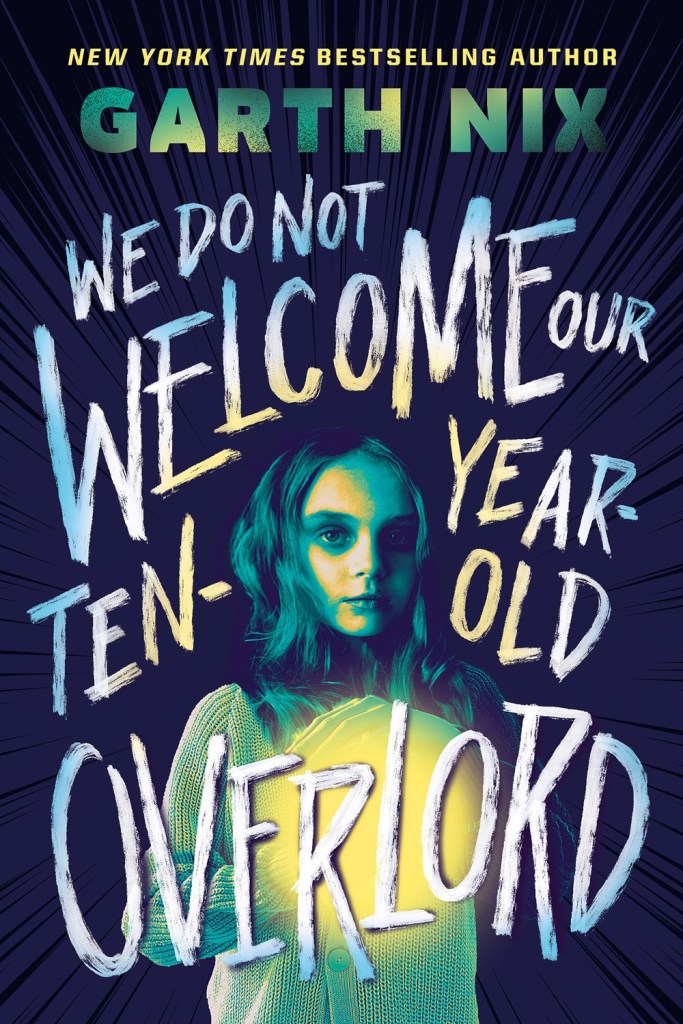
I’m currently reading “We do not welcome our 10-year-old Overlord by Garth Nix” – it’s a great middle grade version of this process of something external to humanity trying to take over under the auspices of “being good and doing good”. What I see, even with the most simple of all tools – a spelling check – is that students will type without any attention to spelling or capitalisation and expect the computer to mop up after them. And the next time the word / phrase is used they will continue to use it incorrectly and have auto-correct sort it out. The question then is whether there is any learning happening. And the meta question whether that learning needs to occur or not? Do we enter dangerous territory when we start deciding which students need to know things or not, develop skills in certain areas or not? We do not know what we don’t know and they definitely don’t. It would be way to easy to decide that perhaps some students don’t need to develop a writing voice and that it’s all so hard for them that it’s OK for AI or other tools to just take care of writing and editing what that tool thinks it is that the student is trying to express. Can you see where this is going? Because if we are not exposed to many ideas and thoughts and schools of thought and philosophies and histories how can we have enough information and knowledge under our belts to know what it is that we want to express? How can we know what OUR thoughts and feelings are when we’re in a feedback loop echo-chamber?
Back a little to the blogging thing – if students reflect on blogs that are open to the community it is so much easier to see what is normal and appropriate for each age group. Now we have writing that is largely hidden except to the teacher and their peers if they do comparative grading, and perhaps the adults in the lives of some of the students who will judge it by their adult standards AND whatever tools that are on student computers that again will transform the writing to some external adult standard. I’m also fascinated with, within the context of the apparent need for grading and scoring the work of students how granularity has decreased to the absurd point of students getting a score out of 4 for their efforts. Really? While packing up my life yet again for the move from China to Dubai I came across my old school reports. Everything was graded from 0-100 and there was plenty of room to improve from say a 69 to a 75 or an 89 to a 95 and no one ever ever ever got 100%. There was nuance. A lot of nuance. In the IB system scoring is to 8 and now in the American system it’s to 4. Talk about a blunt tool with which to sculpt learning!
I was just listening to Maggie Appleton (whose writings, as a cultural anthropologist turned Tech person on AI I really appreciate – particularly this one on the dark forest and generative AI) on the HanselMinutes podcast and I love her ideas about using AI for rubberducking – not just for IT debugging but for debugging your ideas and thoughts – although as she says it’s not really built for that as it’s more inclined to “yes AND” than to be a critical partner. I’m so long in the tooth that I remember when blogging was the medium for rubberducking your thoughts and every post got good handfuls of thoughtful comments by real people who would challenge or corroborate on your thinking. I made a lot of IRL friends off the back of blogging back in the day!
I’m fascinated about what other people think about student writing and student voice in writing as opposed to all that is being written about adult voice being taken over by AI – it is terrible, but how fortunate we have been to be allowed to develop a voice in the first place. Are we denying that to this generation of potential writers? Here is a link to one article in Writer’s Digest – of interest are all the other related articles at the bottom including some on maintaining voice as a comedian.
 Informative Flights - Musings of a Teacher Librarian