ETL402 Critical Reflection

Reading Haven (2007) was a great way to set the scene for this course. Even if we were not all literature “converts” before starting the course, understanding the research behind the power of stories would make us so. Of all the themes I think the second module – concerning diversity – was the one that engaged me most passionately and emotionally. Smolen and Oswalds’ (2011) book was instrumental in expanding my knowledge on this topic.


Reviewing my blog posts The Best of Times, the Worst of Times; if you name it will it come; Conversations and thoughts about diversity in literature; It can’t get any worse … can it? and The right to write as well as my first assessment The Power and Potential of Multicultural Diverse Literature I realise they all concerned themselves with this topic. In practise, despite best intentions and efforts, large international communities of practise, the so called “global librarian networks” it is still difficult to source and purchase diverse literature of the quality and quantity necessary.


Looking at the collection, the teacher librarian (TL) walks several tightropes simultaneously – balancing curriculum needs with literacy needs with pleasure “fast food” reading needs as well as parental and societal expectations and biases makes for interesting tension. All while ensuring that literature can fulfil its destiny without losing a generation of potential readers. Personal observations reinforced the need for positive role models and personal – particularly peer –recommendations (Marcoux & Loertscher, 2009). Attempts to transform a physical library space were documented in a number of blog posts summarised here. Both Travers and Travers (2008) and Elizabeth and Selman (2012) cast an important biopsychosocial developmental lens on the subject of literature in schools.


With respect to the digital experience, as a colleague remarked to me “we are the first generation of teacher librarians and parents dealing with the internet, and we don’t know what we’re doing or what the long term effects will be”. Of course there are more than enough naysayers (Carr, 2013; Mangen, Walgermo, & Brønnick, 2013) and cheerleaders (Cornis-Pope & Woodlief, 2000) to balance each other out and the jury is out on the matter. At the end of the day it is important to meet the students where they are – whether that is in the land of text, live or digital and embrace the benefits of interaction, self-directed learning with creative opportunities (Anstey & Bull, 2006).


Finally, as they say – the proof of the pudding is in the eating – or in this instance, the proof of the learning is in how it can be applied in the teaching and promotion of literature in schools. Changing the culture in any learning environment is a slow process, where one has to learn to trust one’s instincts and trust the students, alternate between catching one’s breath in horror and outrage at the utterances of some teachers and parents while being in awe of the skill and depth of understanding and good practice of others, all moments from each other. It’s quite a ride.


References:

Anstey, M., & Bull, G. (2006). Defining multiliteracies. In Teaching and learning multiliteracies : changing times, changing literacies (pp. 19–55). Newark, Del: International Reading Association.

Carr, N. (2013, January 5). Don’t burn your books—print Is here to stay [WSJ.com]. Retrieved 22 May 2014, from http://online.wsj.com/news/articles/SB10001424127887323874204578219563353697002

Cornis-Pope, M., & Woodlief, A. (2000, Fall). The rereading/rewriting process: Theory and collaborative, on-line pedagogy. Retrieved 17 January 2016, from http://www.vcu.edu/engweb/ReReadingTheorychapter.htm

Elizabeth, T., & Selman, R. L. (2012). The role of social development in elementary school curricula: Past, present, and future. Saperstein Associates. Retrieved from http://www.sapersteinassociates.com/downloads/2012_Elizabeth_and_Selman_SD_Whitepaper.pdf

Haven, K. F. (2007). Story proof: the science behind the startling power of story. Westport, Conn: Libraries Unlimited. Retrieved from EBook Library

Mangen, A., Walgermo, B. R., & Brønnick, K. (2013). Reading linear texts on paper versus computer screen: Effects on reading comprehension. International Journal of Educational Research, 58, 61–68. http://doi.org/10.1016/j.ijer.2012.12.002

Marcoux, E., & Loertscher, D. V. (2009). The role of a school library in a school’s reading program. Teacher Librarian, 37(1), 8–14,84.

Smolen, L. A., & Oswald, R. A. (Eds.). (2011). Multicultural literature and response: Affirming diverse voices. Santa Barbara, California: Libraries Unlimited. Retrieved from EBook Library

Travers, B. E., & Travers, J. F. (2008). Children, literature and development: Interactions and insights. In Children’s literature: a developmental perspective (pp. 2–17). Hoboken, NJ: John Wiley & Sons.

when the library is more than a library

In some ways libraries have never just been about the books or the building.  Even since the first libraries they’ve been about a certain idealism, a world view, a concept of teaching, learning, enquiry, culturalisation, what ever you may call it.

So yesterday it shouldn’t have taken me by surprise with Ms. S asked me in a little bit of a panic what should be done with the books on the human body.  Of course once a library starts to become an organised entity, it is easier to find things.   And when one is a G5 boy (or girl) it seems that there are pressing questions that need to be answered.  And perhaps these questions are not being answered at home or at school, so in steps the library and books (thank goodness I’d say).   Luckily Ms. S was of the same opinion as me, but the question was what to do about the fact that some rather indignant parents had been ringing the school to find out what and why and how their kids were reading all this “stuff”. (Ironically of course those very children who had the most pressing need to be reading these books).

Now Ms. S is an experienced teacher who has dealt with things that I hope never to have to deal with, she’s open-minded, and recognises an education moment for an education moment.  But she’s had this library thing only a short while.  Even shorter than me.  So it’s hard to distinguish where her responsibility begins and ends.  Our discussion was a little about flipping the question.  Does the school have a counsellor?  Does it have a structured “personal and social education” curriculum? When does this start, what is dealt with when?  And how does that tie into the resources, book and otherwise that the school has available to its students and teachers.

Of course there are much bigger questions – like that of censorship. Like school policies on what is accessible to which age groups and in what context.  None of this can be decided in isolation.  I suggested to her she needed to involve the counsellor and the head of primary and the school have a “party line” so that when parents or teachers or children ask about the existence or not of materials they can refer to a policy or group decision and speak with one voice.

International Experience Portfolio

The entries below constitute the International experience Portfolio.   First a summary of each organisation is presented through the Study Visit report, and then the aspects I wish to highlight are presented.
 

Although I’m living as an expatriate in Singapore, which is its own cultural experience, one realizes you can experience culture on a number of levels.  Each organisation we visited had their own unique culture and identity.  

 
In the libraries this was expressed through the design of the various spaces, the emphasis of the collection and the staffing choices.  At each organisation what was very striking was the way in which employees expressed their identity through the organisation of their desks.  At Singapore Press Holdings for example the open plan office was filled to the brim with hundreds of indoor plants of all descriptions.  There was even an aquarium on one desk.  At Singapore Polytechnic, employees had used the desk lamps to hang a myriad of little figurines and toys and all attempts to create a truly open plan office were being thwarted by staff needs for privacy and their own space. 
 
Libraries where the head librarian was ‘politically’ well connected or where the organisation head was vested in a thriving information community were better staffed, better resourced and had more vibrant, innovative and enthusiastic feel to them.  That’s not to say that other libraries didn’t do an excellent job of managing their resources and putting library users first.
 
Instead of writing this chronologically, I’ve divided the experience into the areas that I found most interesting in the visit and where there were noticable differences between the libraries:
 
* Collection
* Reference Services
* Promotion
* Physical Environment

In conclusion the trip was extremely valuable both from a librarianship and a cultural point of view. 

Collection

Each library we visited went about creating, updating and weeding their collection in different ways.  On the one hand we had UWCSEA-East, where the librarian could build up a collection of 30,000 items from scratch, and had the luxury of being able to carefully consider the philosophy behind the collection.  On the other, we had the Institute of South East Asian Studies, with a 45 year history of receiving donations and making acquisitions and doing a stocktake and serious consideration of its collection for the first time this year.

Common themes were the shift from print to digital.  Each library had found their own balance between providing patrons with books and journals and enabling access to digital information.  Along with the shift to digital media came the responsibility of teaching information literacy (IL).  We were exposed to some innovative and very fun ways of teaching IL across the board where the emphasis was on making students comfortable with interacting with the librarians in the library setting, as well as being able to help themselves on line and in the book stacks.

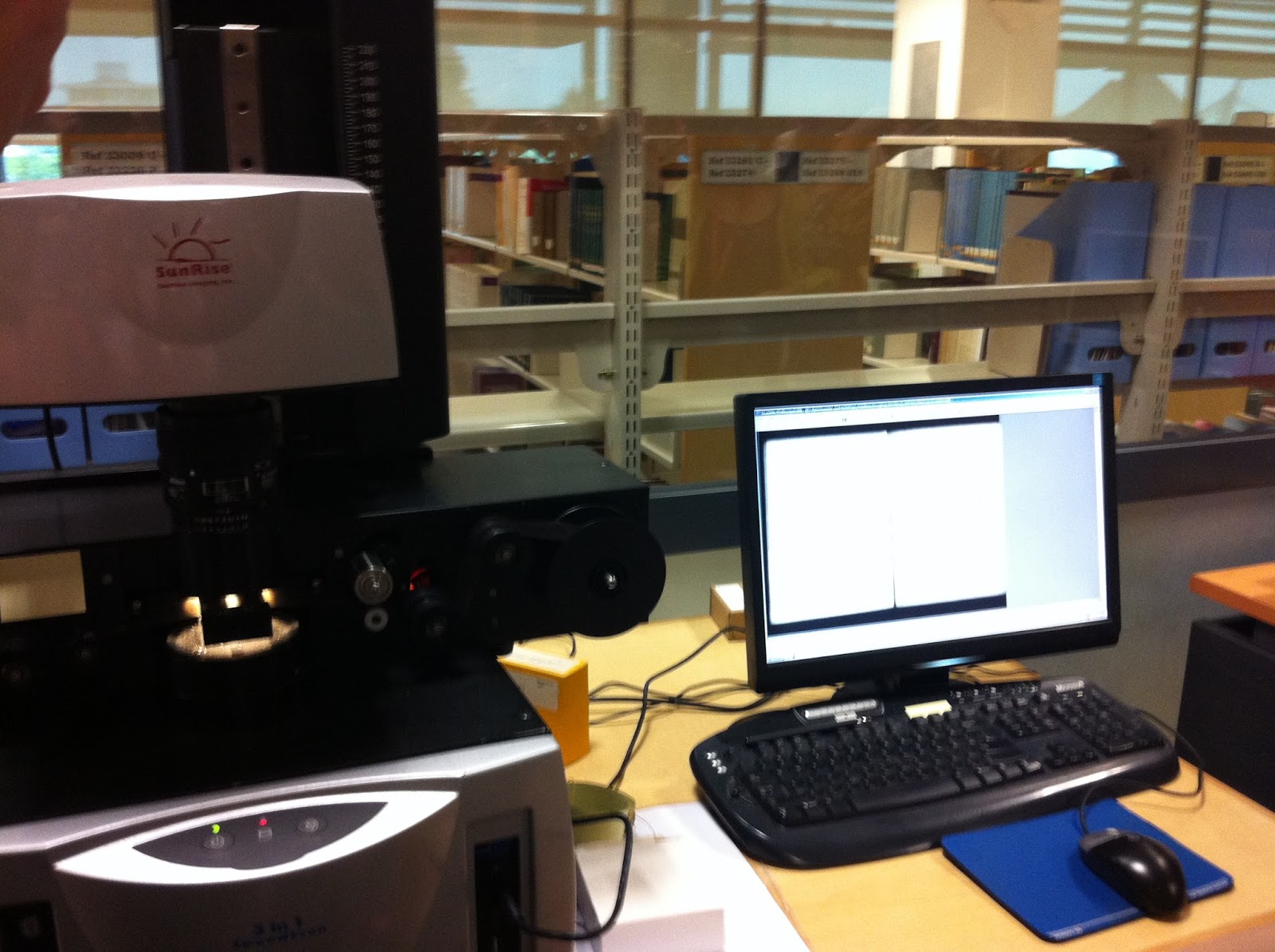
Preservation of collection was an important issue given the hot and humid climate of Singapore and the expense of air conditioning.  Books got infected by mold, mold is both contagious to other books, and a health and safety issue for employees and users.  It’s very expensive to treat.  Microfilm deteriorated, particularly the technologies prior to 1980.  Damp affect photos and films.  Digitization was expensive and time consuming and could result in the library running foul of copyright laws.  All this indicated that libraries needed to be extremely disciplined in their acquisition and weeding with some good co-ordination and networking to ensure that sufficient copies of valuable materials were available and preserved but without unnecessary duplication.

It was interesting to see how the different libraries managed their life style collection.  For some, like Ngee Ann Polytechnic, it was a drawcard for their students, located on the first floor with a very welcoming interactive bookstore / cafe type concept.  For Temasek, it was on a higher level, and less well patronized – in fact the librarian mentioned that sometimes students came there as it was quieter than the quiet / academic parts of the library.

Weeding policies differed by institution from a strict “anything older than 12 years gets thrown” to “we’ve never weeded”. SMU had a sophisticated set of RUF (relative use factor) statistics which it used for purchasing profiling its collection and weeding.
 How does a library deal with it’s unwanted books?  UWCSEA-East had created a read-and-recycle program outside the library, where the school community was welcome to take books and pass them on.  NLB had a bookcross and book sale scheme to get books out into the Singaporean community.

Most libraries were shifting towards an on-demand as opposed to “just in case”  collection development policy.  Collections were added to on recommendation from lecturers and students who were also invited to attend book fairs held by trade and public suppliers.