Module 4.1: What questions or answers do you have in relation to digital storytelling?

What questions (or answers) have formed in your mind in relation to digital storytelling? How does social media fit into the mix for you? What are the most important connections to learning overall?

=================================

I guess my prime question after watching these extracts of digital storytelling is: “how the heck do they do it?”

In some cases, like the twitterature it is obvious, But when I was watching “<a href=”http://pinepoint.nfb.ca/#/pinepoint&#8221; target=”_blank”>Welcome to PinePoint”</a> (Shoebottom and Simons, 2011) I really wanted them to tell me how to put something like that together, because it’s exactly the type of thing I’d like to do.

So I guess it’s that feeling of seeing something within grasp and realising its potential but not being able to catch hold of it and do something meaningful with it!

For me social media would be what I’d use to strew my “digital crumbs” and to leave me digital clues, as well as to provide a way for the audience to interact with the story, I particularly liked the summary of Locke & Ettinghausen on the 6 points of how we tell new stories;
1. Hide stories in unexpected places
2. Give yourself ridiculous constraints
3. Experiment outside your comfort zones
4. Invent a character without a storyline
5. Give fans stuff to play with
6. Create stories that people can binge on whenever they want” (Fora.TV, 2009)

References:

Fora.TV. (2009, September 23). Once Upon These Times: New Stories for New Audiences [Video file]. Retrieved from http://fora.tv/2009/09/23/Once_Upon_These_Times_New_Stories_for_New_Audiences
Shoebridge, P., & Simons, M. (2011). Welcome to PinePoint [Digital Novel]. Retrieved September 10, 2014, from http://pinepoint.nfb.ca/#/pinepoint

Assessment item 5: Blog task 3

Response comment to: Bec Spink – Reflecting on Digital Literature

I was most interested in your observations on incorporating digital literature in the classroom.  And yet, as I attempt to respond to your posting, after a few minutes of futile scrolling up and down as I tried to reply and refer back to what you have written, in an attempt to resist printing out your post in order to do this successfully (how did everyone else do this?) dual screen compromiseI have taken an interlude to email myself with my fellow student’s blog post addresses and to open the posts on my iPad and with twisted neck and dual screens perched in discomfort I continue*.  And there lies the rub, that so many have hiccupped against – that lack of linearity, the unfamiliarity, the medium (Cull, 2011; Liu, Liao, & Guo, 2009; Nilsson, 2010; Skains, 2010; Walker, Jameson, & Ryan, 2010; Walsh, 2013).  That need to jump around, and while jumping find the train of thought has escaped, perhaps to be regained perhaps not.

I digress. I cannot avoid, you are right. But should I have tweeted my response? I just did. Because I could

“@MissB6_2 I have read and appreciate your “Reflecting on Digital Literature” we are getting there, but the journey is arduous. #INF533″

tweet to Bec
tweet to Bec

I see teachers all around me tweeting. But not to / with their students. I ask them about digital literature, and they look horrified. Too new, too experimental. It’s hard enough getting parents to appreciate YA ala John Green or Sherman Alexie (what is it with all that swearing? What about the classics? Why can’t they do Jane Austen?) – #Beow100 (Madrigal, 2014; Treharne, 2014) or The Lizzie Bennet diary (Francus, 2013; Pemberley Digital, 2013; Su, Noble, Rorick, & Austen, 2014) won’t cut it. And the students, they’re blogging! But they can’t write a letter or an essay. And the spelling is appalling. In my day…


And yet it is wonderful. But. I think educators are afraid.  And perhaps justifiably so. Sure, there are some for whom this is so distant that it may not exist. There are some with an inkling, some exposure and the tingling of excitement. They can incorporate what someone else has done into their lessons. The librarians can put bits of multi-media and multi-modality into their libguides (I know I do).  But in attempting to create full blown authentic edutainment, the type that needs a cast of thousands and not “Captain my captain” standing on a table we are powerless.  We do not lack in imagination, nor dreaming or envisioning the possibilities. We lack in the skills, the time, the patience to fiddle around and budgets to bring them to fruition.  So we languish with other’s interpretations and like a person in a dark corridor with one faint glimmer of light, knock our heads and stub our toes, bumping alternately between our students who demand and need more and different and administrators and parents who hanker after a more certain and fixed past.

Cull, B. . (2011). Reading revolutions: Online digital text and implications for reading in academe | Cull | First Monday. First Monday, 16(6). Retrieved from http://firstmonday.org/ojs/index.php/fm/article/view/3340/2985

Francus, M. (2013, October 22). Pride and Prejudice Goes Interactive: “The Lizzie Bennet Diaries.” Video presented at the Pride and Prejudice: The Bicentennial, Paper 5. Retrieved from http://corescholar.libraries.wright.edu/celia_pride/conference/october11/5

Liu, S., Liao, S., & Guo, J. (2009). Surviving in the digital age by utilizing libraries’ distinctive advantages. The Electronic Library, 27(2), 298–307. doi:10.1108/02640470910947647

Madrigal, A. (2014, January 10). The Elegance of Beowulf in 100 Tweets – The Atlantic. Retrieved August 19, 2014, from http://www.theatlantic.com/technology/archive/2014/01/the-elegance-of-beowulf-in-100-tweets/282989/

Nilsson, M. (2010). Developing Voice in Digital Storytelling Through Creativity, Narrative and Multimodality. International Journal of Media, Technology and Lifelong Learning, 6(2), 148–160. Retrieved from http://seminar.net/index.php/volume-6-issue-2-2010/154-developing-voice-in-digital-storytelling-through-creativity-narrative-and-multimodality

Pemberley Digital. (2013, August 22). Emmy Award Winning, Interactive Web Series “The Lizzie Bennet Diaries” Immerses Fans into Jane Austen’s Timeless Classic [Press Release]. Retrieved August 20, 2014, from http://www.lizziebennet.com/press-release/

Skains, R. L. (2010). The Shifting Author–Reader Dynamic: Online Novel Communities as a Bridge from Print to Digital Literature. Convergence: The International Journal of Research into New Media Technologies, 16(1), 95–111. doi:10.1177/1354856509347713

Su, B., Noble, K., Rorick, K., & Austen, J. (2014). The secret diary of Lizzie Bennet. London ; Sydney: Simon & Schuster.

Treharne, E. (2014, January 9). Beowulf in a Hundred Tweets : #Beow100 [[Web log post]]. Retrieved August 20, 2014, from http://historyoftexttechnologies.blogspot.sg/2014/01/beowulf-in-hundred-tweets-beow100.html

Walker, S., Jameson, J., & Ryan, M. (2010). Skills and strategies for e-learning in a participatory culture (Ch. 15). In R. Sharpe, H. Beetham, & S. Freitas (Eds.), Rethinking learning for a digital age: How learners are shaping their own experiences (pp. 212–224). New York, NY: Routledge.

Walsh, M. (2013). Literature in a digital environment. In L. McDonald (Ed.), A literature companion for teachers (pp. 181–194). Marrickville, NSW: Primary English Teaching Association Australia (PETAA).


* I cannot even workout why my image isn’t upright and how to fix it quickly. What hope is there for me to create a singing and dancing multi-modal digital story?

Blog post 3: Write a book review – Diversity

1. A detailed description of the activity undertaken

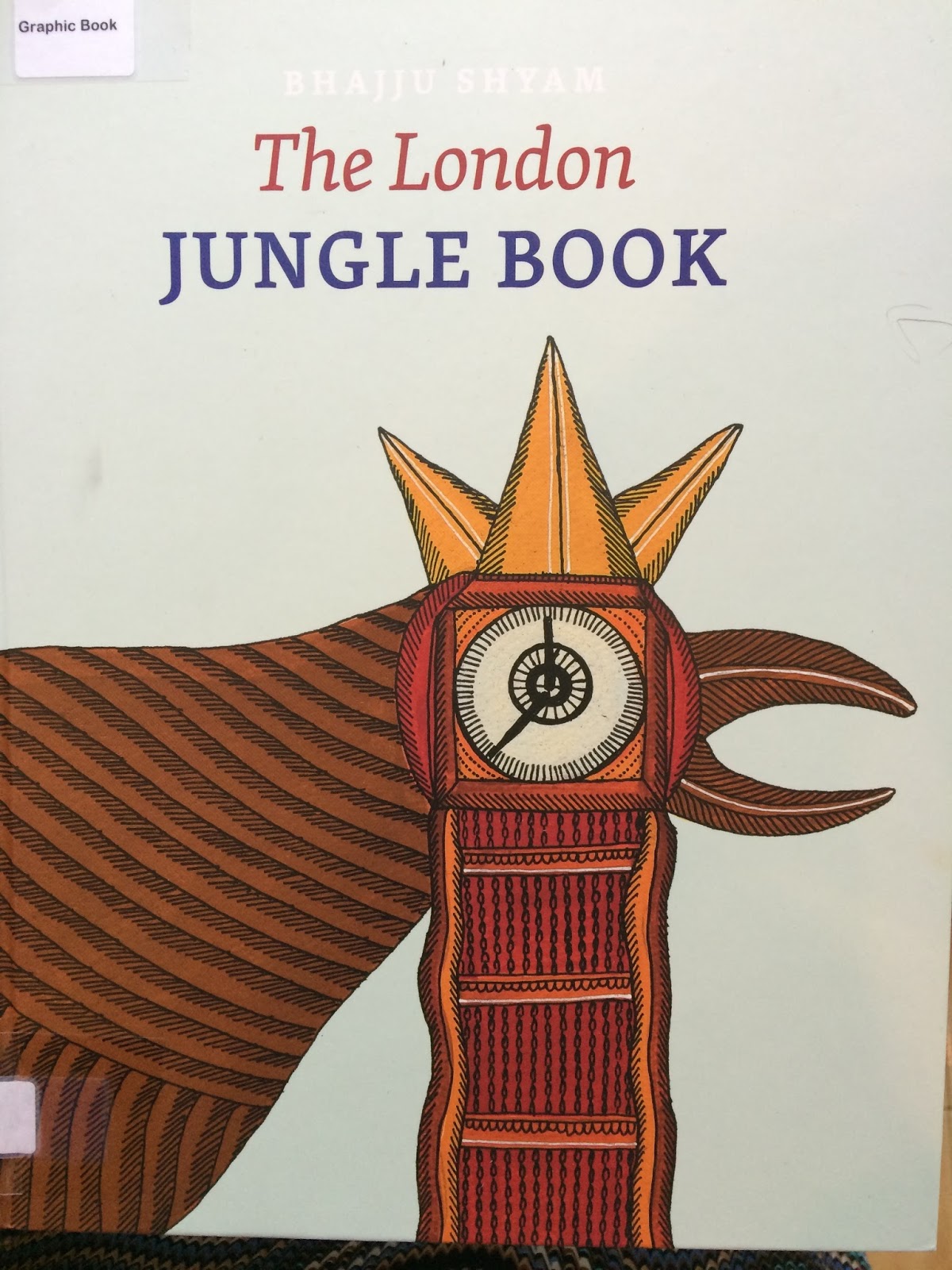
The visually stunning book: The London Jungle Book by Bhajju Shyam (Shyam, Rao, & Wolf, 2014) was reviewed.  In this recently republished book, an Indian artist from the Gond tribe creates a visual travelogue of his experiences in London where he lives for two months to paint murals in an Indian restaurant.  The title refers back to Rudyard Kipling’s Jungle book – a juxtaposition where an Englishman travelled to the jungle area where Shyam lives and wrote of his experiences there.

The visual story and text / Explanation of drawings

Besides the wonderful illustrations and the poignant but perceptive comments on London and its people, I particularly liked the fact that the book could be read on multi-levels and is therefore suitable for readers of all ages. There is a visual story accompanied by text in translation from his oral storytelling that will appeal as he simply recounts experiences and observations of a foreign land. Then the artist explains his choices of drawing as he breaks with traditional communal symbols and traditions in order to tell a unique and personal story. An additional level is added by the reader, who while reading this will no doubt reflect on his or her own travel experience or knowledge and feelings about London.
Extension activities for students could include investigating and comparing Kipling’s book with this as well as the works of the anthropologist Verrier Elwin who lived with the Gond tribe.

2. Answers to the following questions:

What did you learn?

In the first place I realized that although I’ve been reviewing books informally (in my Goodreads profile, or on my blog) for a while, I didn’t actually know what the principles of a good review were, so I had to first do some research on that. I found three good reputable resources, Owl Purdue writing lab (Brizee, 2012); BookTrust (Playa, 2014) and Scholastic (Philbrick, 2014) and compared the elements.

How was the activity relevant to your professional practice?

As a librarian I am often asked my opinion on books or need to write brief reviews. I had not approached this in a structural way before, so it is good to have a review “template” in mind when talking about a book. I can encourage students to write reviews on the books they have read, and give them tips on how to do so.

Were any gaps in your knowledge revealed? How might you fill those gaps?

At first the illustrations struck me as being reminiscent of Australian Aboriginal art, so I did some more research on the Gond Tribe and ethnic minorities in India. About 30% of our students are Indian, and I recognised that I know very little about India and its vast diversity in language, culture, art and literary traditions. I can fill the gaps in my knowledge both by reading up about the country and its people and by having conversations with students and their parents to better understand the nation.

3. References:

Brizee, A. (2012, September 19). Purdue OWL: Book Review. Retrieved September 7, 2014, from https://owl.english.purdue.edu/owl/resource/704/01/

Philbrick, R. (2014). Writing with Writers: Writing a Book Review. Retrieved September 7, 2014, from http://teacher.scholastic.com/writewit/bookrev/

Playa, L. (2014). Tips for writing book reviews [Article]. Retrieved September 7, 2014, from http://www.booktrust.org.uk/books/teenagers/writing-tips/tips-for-writing-book-reviews/

Shyam, B., Rao, S., & Wolf, G. (2014). The London jungle book. India: Tara Books.

Assessment Item 4: Critical Reflection of Digital Literature Experiences

What makes a good digital text

Despite Goodreads’ narrow interpretation of a book as being something with an ISBN number, “the book as a physical object with paper pages is now only one version of what a book might be” (Hancox, 2013, para. 7). As many have discussed before, a digital text can take many formats and permutations (James & de Kock, 2013; Parker, 2013; Sadokierski, 2013b; Walsh, 2013).

Various criteria exist as to what constitutes a good digital text.  Its ability to engage, enhance, experience, elucidate, explain and entertain (James & de Kock, 2013; Miller, 2011); the use of multiple media and a single unified story without redundancy between media (Phillips, 2012; Walker et al., 2010); a linear yet enhanced reading experience, engaging multiple literacy and learning styles with intelligent, flexible and intuitive design with longevity (Parrott, 2011). To this can be added the potential to cater for different ability and facility with language and technology and preferred multi-sensory behaviour while bridging participatory skills and social needs with academic skills (Anstey & Bull, 2012; Roskos, Burstein, Shang, & Gray, 2014; Walker et al., 2010). Finally a good text, digital or otherwise will immerse and absorb the reader while allowing them to interact with the world and others, or an alternate reality, vicariously and integrate new knowledge and understanding into their existing schema or worldview (Fuhler, 2010; Ryan & Ryan, n.d.).

Compare experience digital versus print

In any comparison of the print / digital experience it should be emphasized that neither has moral nor educational superiority, but rather fulfil different functions and meet different literary, literacy and learning needs.

The most obvious difference is the format, though the non-linear nature of digital media is often commented on with its potential to disrupt the reading process and the need to have a strategy to stay on track and the necessity of learning and incorporating new conventions and practices in experiencing digital literature (Anstey & Bull, 2012; Chuk, Hoetzlein, Kim, & Panko, 2012; Francus, 2013; James & de Kock, 2013; Roskos et al., 2014; Skains, 2010). Digital features can create an enticement to buy, assist with the appreciation of literature, facilitate interpretation and understanding or motivate adjunct composition (Unsworth, 2006).

Experimentation with digital literature will, after a while, create a sense of discomfort in a self-aware educator as it becomes obvious that “their” pedagogical functions of elucidation and enhancing understanding of literature are usurped by the medium which can offer these benefits in a manner that fits with a learners’ preferred learning style and mode at a personalized pace. However, one’s role as a curator, guide and co-collaborator in all literary and literacy aspects of learning is enhanced (Lamb, 2011; Leu et al., 2011; Mills & Levido, 2011). Finally, the teacher can use the digital affordances to enhance student’s 21st century literacy skills as they come to grips with understanding the codes and conventions, functions and aspects of all semiotic systems (Anstey & Bull, 2012; Bowler, Morris, Cheng, Al-Issa, & Leiberling, 2012; Malita & Martin, 2010; Walker et al., 2010).

Incorporation of a text into a learning program

One of the digital texts I most enjoyed was First World War: the story of a global conflict‘ (Panetta, 2014a).

Screen Shot 2014-08-28 at 1.16.57 pm

The scope of this interactive documentary is such that it could be used in a variety of classroom settings, however the one I would choose would be the unit on “Memoir writing” in the Grade 7 English Unit where students are encouraged to explore a variety of compelling narratives and to create their own story (UWCSEA-East Campus, 2013). The students are from many different countries and cultures, including around one third from India, and the documentary, in particular the “Empire” chapter could form the basis for curating works of literature, poetry, music and art created in times of conflict and war. Students could bring examples of narratives and art forms from their own cultures that either relates to World War 1 or other conflicts to supplement material introduced by the teacher such as examples from the “The Disasters of War, 1800-2014,” show (Rubin, 2014). This would align with the concept of the teacher being a facilitator and curator who shares and highlights aspects of the curriculum in a multi-modal and social context allowing students to extrapolate to their own learning and literacy (Fuhler, 2010; Mitra, 2013; Serafini & Youngs, 2013) and ties in with the concepts of design thinking in education where “The focus is on processes – producing, assessing, developing, creating, revisiting,  revising. Learning content becomes secondary to developing the how-to skills for how to be a learner in the 21st century” (Gerstein, 2014).

https://embed-ssl.ted.com/talks/sugata_mitra_build_a_school_in_the_cloud.html

References:

Anstey, M., & Bull, G. (2012). Using multimodal factual texts during the inquiry process. PETAA, 184, 1–12. Retrieved from http://chpsliteracy.wikispaces.com/file/view/PETAA+Paper+No.184.pdf

Bowler, L., Morris, R., Cheng, I.-L., Al-Issa, R., & Leiberling, L. (2012). Multimodal stories: LIS students explore reading, literacy, and library service through the lens of “The 39 Clues.” Journal of Education for Library and Information Science, 53(1), 32–48.

Chuk, E., Hoetzlein, R., Kim, D., & Panko, J. (2012). Creating socially networked knowledge through interdisciplinary collaboration. Arts and Humanities in Higher Education, 11(1-2), 93–108. doi:10.1177/1474022211426906

Francus, M. (2013, October 22). Pride and Prejudice Goes Interactive: “The Lizzie Bennet Diaries.” Video presented at the Pride and Prejudice: The Bicentennial, Paper 5. Retrieved from http://corescholar.libraries.wright.edu/celia_pride/conference/october11/5

Fuhler, C. J. (2010). Using primary-source documents and digital storytelling as a catalyst for writing historical fiction in the fourth grade. In B. Moss & D. Lapp (Eds.), Teaching new literacies in grades 4-6: Resources for 21st-century classrooms (pp. 136–150). New York, NY: Guilford Press.

Gerstein, J. (2014, August 27). The Educator as a Design Thinker [Web log post]. Retrieved August 30, 2014, from http://usergeneratededucation.wordpress.com/2014/08/27/the-educator-as-a-design-thinker/

Hancox, D. (2013, December 13). When books go digital: The Kills and the future of the novel. Retrieved August 29, 2014, from http://theconversation.com/when-books-go-digital-the-kills-and-the-future-of-the-novel-20098

James, R., & de Kock, L. (2013). The Digital David and the Gutenberg Goliath: The Rise of the “Enhanced” e-book. English Academy Review, 30(1), 107–123. doi:10.1080/10131752.2013.783394

Lamb, A. (2011). Reading redefined for a transmedia universe. Learning and Leading with Technology, 39(3), 12–17. Retrieved from http://ezproxy.csu.edu.au/login?url=http://search.ebscohost.com/ login.aspx?direct=true&db=ehh&AN=67371172&site=ehost-live

Leu, D. J., McVerry, J. G., O’Byrne, W. I., Kiili, C., Zawilinski, L., Everett-Cacopardo, H., … Forzani, E. (2011). The new literacies of online reading comprehension: Expanding the literacy and learning curriculum. Journal of Adolescent & Adult Literacy, 55(1), 5–14. doi:10.1598/JAAL.55.1.1

Malita, L., & Martin, C. (2010). Digital Storytelling as web passport to success in the 21st Century. Procedia – Social and Behavioral Sciences, 2(2), 3060–3064. doi:10.1016/j.sbspro.2010.03.465

Miller, L. (2011, June 15). “The Waste Land”: T.S. Eliot takes the app store [Review]. Retrieved August 27, 2014, from http://www.salon.com/2011/06/15/the_waste_land/

Mills, K. A., & Levido, A. (2011). iPed: pedagogy for digital text production. The Reading Teacher, 65(1), 80–91. doi:10.1598/RT.65.1.11

Mitra, S. (2013, February). Sugata Mitra: Build a School in the Cloud [Talk Video]. Retrieved August 29, 2014, from http://www.ted.com/talks/sugata_mitra_build_a_school_in_the_cloud

Panetta, F. (2014). A global guide to the First World War [Interactive documentary]. Retrieved from http://www.theguardian.com/world/ng-interactive/2014/jul/23/a-global-guide-to-the-first-world-war-interactive-documentary

Parker, J. (2013, December 18). When stories are more than paper: Transmedia trends in Young Adult Literature. Presentation presented at the YALSA 2012 YA Literature Symposium, St. Louis, MO. Retrieved from http://prezi.com/l0j03_mb1dma/when-stories-are-more-than-paper-transmedia-trends-in-young-adult- literature/

Parrott, K. (2011, July 18). 5 Questions to Ask When Evaluating Apps and Ebooks [Web log post]. Retrieved August 31, 2014, from http://www.alsc.ala.org/blog/2011/07/5-questions-to-ask-when-evaluating-apps-and-ebooks/

Phillips, A. (2012). A creator’s guide to transmedia storytelling: how to captivate and engage audiences across multiple platforms. New York: McGraw-Hill.

Roskos, K., Burstein, K., Shang, Y., & Gray, E. (2014). Young Children’s Engagement With E-Books at School: Does Device Matter? SAGE Open, 4(1). doi:10.1177/2158244013517244

Rubin, A. (2014, August 28). Horror Is a Constant, as Artists Depict War [Review]. Retrieved August 31, 2014, from http://www.nytimes.com/2014/08/31/arts/design/horror-is-a-constant-as-artists-depict-war.html?emc=edit_th_20140831&nl=todaysheadlines&nlid=69344483

Ryan, S., & Ryan, D. (n.d.). What is literature? Retrieved August 31, 2014, from http://dlibrary.acu.edu.au/staffhome/siryan/academy/foundation/what_is_literature.htm

Sadokierski, Z. (2013, November 12). What is a book in the digital age? [Web log post]. Retrieved August 29, 2014, from http://theconversation.com/what-is-a-book-in-the-digital-age-19071

Serafini, F., & Youngs, S. (2013). Reading Workshop 2.0. Reading Teacher, 66(5), 401–404. Retrieved from http://ezproxy.csu.edu.au/login?url=http://search.ebscohost.com/login.aspx?direct=true&db=pbh&AN=92711892&site=ehost-live

Skains, R. L. (2010). The Shifting Author–Reader Dynamic: Online Novel Communities as a Bridge from Print to Digital Literature. Convergence: The International Journal of Research into New Media Technologies, 16(1), 95–111. doi:10.1177/1354856509347713

Unsworth, L. (2006). Learning through web contexts of book-based literary narratives. In E-literature for children enhancing digital literacy learning (pp. 29–43). London; New York: Routledge. Retrieved from http://public.eblib.com/choice/publicfullrecord.aspx?p=198496

UWCSEA-East Campus. (2013, August). Program Outline – Middle School English – Grade 7. Retrieved August 29, 2014, from https://sites.google.com/a/gapps.uwcsea.edu.sg/east-ms-english/header-3/unit-planners

Walker, S., Jameson, J., & Ryan, M. (2010). Skills and strategies for e-learning in a participatory culture (Ch. 15). In R. Sharpe, H. Beetham, & S. Freitas (Eds.), Rethinking learning for a digital age: How learners are shaping their own experiences (pp. 212–224). New York, NY: Routledge.

Walsh, M. (2013). Literature in a digital environment. In L. McDonald (Ed.), A literature companion for teachers (pp. 181–194). Marrickville, NSW: Primary English Teaching Association Australia (PETAA).

 

What I love about 21st century learning

This is one of those somewhat arbitrary posts, tangentially related to the topic.

One of the things that excites me about learning now, versus when I was at school or my parents were at school is just how accessible everything and everyone is. One just has to be slightly motivated to want to know something, have access to high speed internet and the world is literally your oyster.

I have a brother with ADHD and I have a son with ADHD. Their learning worlds could not be more different.  If my son struggles with a textbook or a mathematically concept or wants to learn something but the books available are too hard for him, he has so many other options. He can go onto Kahn Academy. He can search for youtube tutorials, he can Skype and chat to a friend or relative.  And of course, if your attempts at getting information are so richly rewarded, you are much more motivated as a learner to keep learning.

And now my experience. When writing my last blog post I was interested in Dr. Francus’ talk, and dug out her contact details and asked her for a transcript.  Unlike my son, I prefer reading text to watching a video.  She replied right back to me, and then even went to the trouble of reading my blog post and writing a very thoughtful reply to me, confirming my suspicion that the best part of interactive media is to be interactive while it unfolds rather than in retrospect.

When I was growing up in South Africa, which then felt like the back of the beyond and may as well have been another planet, not just another country due to its self-imposed and sanction imposed isolation, I could never envisage a reality where an author or person of note would enter a dialogue with a learner.  That is today’s wonderful reality, there for the taking.  And digital literature is just a small part of it all!

Blog post 2: Interview – running a successful parent volunteer program in a school library

 1. A detailed description of the activity undertaken

The librarian of the Singapore American School was interviewed on how to run a successful parent volunteer program. In answering all my questions and showing me the library she explained the process of recruiting and training volunteers, the type of tasks that volunteers do, potential problems and pitfalls and how to handle them and how to show your appreciation. We ended with a tour of the library.


Recruitment takes place early in the year at events that are likely to attract a lot of parents.  The initial training is 90 minutes long and focuses mainly on library organization and the shelving of books and expectations of the volunteers including etiquette and behaviour. It was interesting to hear the expectations regarding commitment and responsibility to the role, and this one area our library has struggled with in the past.
 New recruits are initially paired with more experienced volunteers. Depending on their volunteer role and interest, some volunteers also receive training in FollettDestiny (the library system) and are given restricted rights based on what they need to accomplish.


Volunteers are also involved in longer term projects such as the collection genrefication and with special events such as the Red Dot awards, Readers’ Cup and Battle of the Books.

We concluded with a discussion on the importance of showing appreciation and the ways in which this could be done.

2. Answers to the following questions:

What did you learn?

Recruiting and supporting parent volunteers is an important task in a school library that is short staffed. If volunteers are able to take over some of the shelving and book processing tasks, librarians are freed up to spend more time teaching, performing reader advisory tasks and helping with curriculum related tasks. There is an art and a skill to keeping volunteers engaged and committed to helping in the library.

How was the activity relevant to your professional practice?


We have had parent volunteers but we have not been systematic in our recruitment, training and appreciation of them. As a result the program was not as successful as it could have been. I now have a better appreciation of the process and can apply it to our school situation.  

Were any gaps in your knowledge revealed? How might you fill those gaps?


I had many questions as to why our program was not working well, and through the interview and visit was able to answer many of them. In addition, the librarian lent me the ALA book: “Managing Library Volunteers” (Driggers, 2011) so I could read further on the matter.

3. References:


Driggers, P. F. (2011). Managing library volunteers (2nd ed.). Chicago: American Library Association. 

Activity 2: Interview – running a successful parent volunteer program in a school library

Libraries in general, and some school libraries in particular are not known for having a surplus in staff. Many therefore consider turning to parent volunteers to help out with a variety of tasks.  
Some libraries manage this better than others, and here in Singapore, the Singapore American School is known in our network for having a very well run, well functioning library parent volunteer program. They have 35-40 regular weekly parent volunteers and more than 50 parents who are involved in one-way or another in the library as well as a group of committed high school student volunteers. 
So this morning, I went over to interview Kate Brundage, the Elementary School Librarian who has been running a successful program for the last five years.
In answering all my questions and showing me the library she explained the process of recruiting and training volunteers, the type of tasks that volunteers do, potential problems and pitfalls and how to handle them and how to show your appreciation. We ended with a tour of the library.

The process of recruiting and training volunteers

Parent volunteer form
Recruitment generally takes place at the beginning of the school year when sign-up forms are distributed during open-house sessions, back to school night, the first parent coffee mornings and are also shared with classroom teachers.  The library hosts a parent coffee morning and talks to the parents about library service and the benefits of being a volunteer.  During the school year, the librarians have an active partnership with classroom teachers, whereby parents who tend to “hover” or want to be overly involved in the classroom have their energies directed to the library where they can make a meaningful contribution to the school as a whole.
The initial in-service training takes 90 minutes and parents are introduced to the library organization, explanations on shelving are given and parents are given guidelines on what to do with damaged books and other commonly encountered problems.  The desk and mobile circulation systems are explained and other projects and service opportunities are introduced.  New parents are then buddied with existing volunteers who provide further training “on the job”.
Parents are also encouraged to team up with close friends or with people who speak the same language as themselves, if they are not comfortable or fluent in English. Depending on their volunteer role and interest, some volunteers also receive training in FollettDestiny (the library system) and are given restricted rights based on what they need to accomplish.
The library makes it clear on the form, and in their talks that the main priority for volunteers is shelving, as this frees up the librarians to spend more time teaching and interacting with the children and transferring their librarian knowledge and expertise.
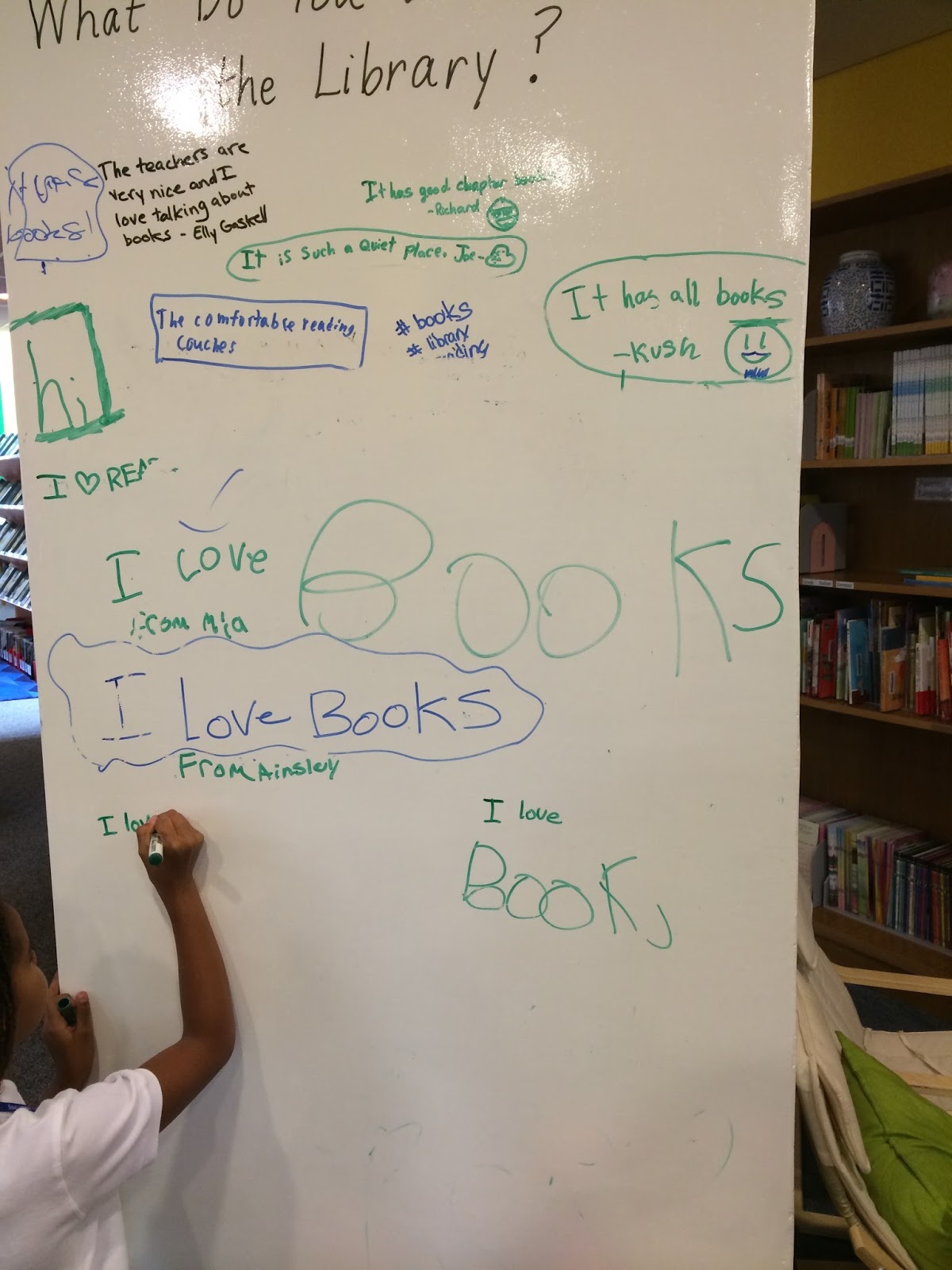
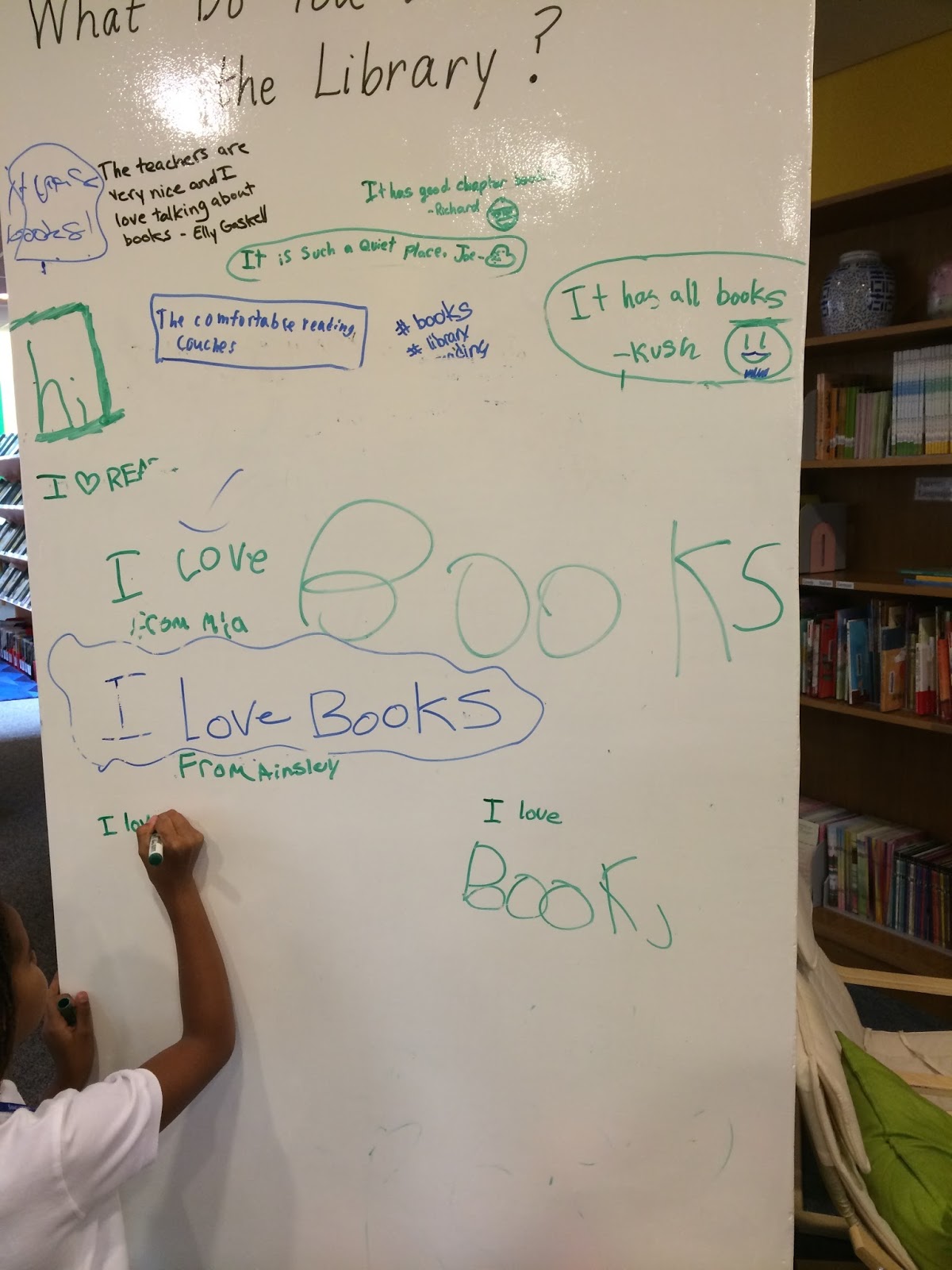
The creation of a “writing wall”
was a parent volunteer idea
Besides the parents, the High School pupils can also sign up to be library volunteers as part of their service program.  A similar training program is given to them, and they are also encouraged to be ‘book buddies’ with the younger students.
It is emphasized that although this is a volunteer position, the library is counting on the commitment of the volunteers, and should they not be able to come for whatever reason, it is their responsibility to find a replacement, from the list of trained volunteers, to take their place.  Volunteers are also required to commit to a minimum of 3 hours per week on a consistent basis.  The volunteer roster is changed every 3 or 4 months giving new volunteers a chance to join up and also to change around times should situations change or if people are found not to work well with each other (e.g. friends spending too much time chatting rather than volunteering!).  Volunteers are encouraged to be active readers so as to better understand children’s literature, the needs of young readers and the availability of books of different genres and difficulty in the collection.

The types of tasks volunteers do:

Parents assisted with the genrefication
of the picture book collection
Although the primary task is shelving, and with the huge collection the school has this is a very important task, it is acknowledged that it is not the most exciting task and needs to be interspersed with other tasks that may be more stimulating.  For example parents help with include circulation – checking in and out of books either at the check-out desk or using the mobile apps the school have. Parents are also involved in longer term projects such as the current genrefication of the library, pushing books out of the library to classroom libraries, documenting and photographing the puppet and soft-toy collection into a visual album.  Depending on their skills and interest, parents also create displays, help with signage and other graphic design, and help children in the shelves with choosing books, or with occasional story telling and reading.  Annual special events such as the Battle of the Books, the Red Dot Awards, author and illustrator visits and the Readers’ Cup Challenge also provide the opportunity for parents to take ownership of a project and help the library in this way. For example during an author or illustrator visit, the volunteers will manage the ordering process.  Parents also do “shelf-reading” to ensure that books are properly shelved and to check missing or damaged inventory. A new project coming up is the creation and maintenance of a makerspace area, and volunteers will definitely be involved in that.
Sorting and organising special materials
Parents are asked on signup if they have specific skills or preferences, including foreign language skills where they can help with cataloguing, shelving and ordering of LOTE (languages other than English) materials.  Even stay-at-home-parents are catered for!  Parents who want to volunteer but cannot come into the library due to younger children or other difficulties have tasks sent home to them like creating resource lists or checking inventory and creating order spreadsheets from mark-ups in the SLJ or other book reviews.

Potential problems and pitfalls

Occasionally parents may be motivated by less altruistic ideals, and exhibit behaviors such as just assisting their own children in the library, or may have a hidden agenda, such as censoring books in the collection. Kate emphasized that this was extremely rare, but had to be dealt with firmly.  At all times the fact that it is a partnership for the benefit of all children. Most problems can be pre-empted by being clear about expectations during the initial in-service training. Common etiquette things such as not using mobile phones, deferring to the librarians and teachers, not interfering with the class experience, not disciplining or shaming children, maintaining respect and supporting all children are clearly outlined.  The three month volunteer cycle also allows for a review of which volunteers are in which roles and at what times and this can be changed if necessary.

Showing appreciation

The library hosts two parties during the year, one before Christmas and one at year end.  Catering part of the library budget and parents are given small thank-you gifts such as flowers or vouchers for Starbucks or movies, candles and holiday bookmarks.  They are also given first choice in books that are being weeded from the collections.
During the year, the librarians take regular snapshots of the volunteers that are then made into an appreciation video that is shown at year-end, and some photos are put in the annual yearbook.
ALA Book on managing Volunteers
After a tour of the library and seeing some volunteers at work, Kate then very kindly lent me the new ALA book “Managing Library Volunteers” so that I could look through it while I was in the process of setting up our volunteer program at school.

When is it digital literature?

I’ve been busying myself with looking through a number of different formats of digital texts in order to write some reviews for my next assessment item.  According to the (adapted) criteria of Nesbit, Belfer and Leacock (2004) one can look at (cited in Leacock and Nesbit, 2007):

Category of resource

  • Content quality
  • Alignment with curriculum or program purpose
  • Value of digital affordances for the literature Possibilities for feedback and/or adaptation
  • Intrinsic motivation of the digital environment for users
  • Presentation design
  • Interaction and usability
  • Accessibility and reusability

Today I was looking at a few audio-visual formatted items.  A Calendar of Tales, Beowulf in a Hundred Tweets,and The Lizzie Bennet Diaries,  Each of these were in different resource categories, however they all overlapped in the fact that I could access and read them on my computer, and with the exception of the first two (Calendar of Tales and Beowulf) involved a greater percentage of looking and watching time than reading time.

I foundCalendar Tales a Calendar of Tales a wonderful selection of stories, and found the concept of basing writing on questions in tweets to be an interesting way of involving the audience.  Neil Gaiman writes very well, and the stories would stand up to literary scrutiny on their own without any digital bells and whistles. 

There was however a considerable amount of redundancy over formats – you could read the story online, you could read it as a pdf, or you could listen to it as an audio file.  So the various formats did not enhance the experience in a new or unexpected way.


Screen Shot 2014-08-19 at 5.48.45 pmAs someone who did not have prior literary knowledge of Beowulf, nor any particular interest in the poem / ancient English language, (shock horror!) I found the Twitter Beowulf to be an interesting experiment, but not one which I wanted to spend any amount of time reading through in detail.  It also didn’t pique my interest in the original text.  Which one would hope would be one of the aims of such an endeavour.  I can imagine this had a following and would be a useful addition to a curriculum, and apparently had a very avid following as it unfolded – I think also due to the (academic) authority of the author.


Lizzie Bennett Diaries The Lizzie Bennet diaries have had extraordinary success and won an Emmy Award in 2013– which recognises excellence excellence in the television industry. And that’s the point where I start to wonder where the line can be drawn between what is digital literature and what is an audio/visual/digital adaptation of literature.

Prima facie it is a Vlog (video blog) based adaptation of Pride and Prejudice.  The question is what makes it different from say the BBC series Pride and Prejudice, besides being updated to fit current times.


(Lizzie Bennet Diaries: http://www.youtube.com/watch?v=9ncnZjwF50k)

(BBC – Pride & Prejudice: http://www.youtube.com/watch?v=CgkS5_PTfZQ)

The interactive elements of the Lizzie Bennet diaries include: a twitter account and feed;  Facebook accounttumblr account,  google+, and pinterest.  Are these merely marketing devices in order to promote the main product – the videos – or those an integral part of the package?  Whereas one could watch all the videos and not feel a lack for having missed out on the other channels, I doubt the other channels would be equally “stand alone”.  However, the series has received some serious academic and literary interest, for example in this article from the Jane Austen Society of North America, as well as being the topic of various theses and a conference presentation.

In her presentation, Marilyn Francus made some interesting points about multiple levels of immersion in a literary work and how the unmediated interactive experience through the social media channels enhanced this immersion. This made me wonder if the experience and engagement is different if one is following and participating in the type of medium as it unfolds versus in retrospect as I have been doing.

All in all it has been an interesting experience and one that has perhaps raised more questions than answers for me.


References:

When is it digital literature?

I’ve been busying myself with looking through a number of different formats of digital texts in order to write some reviews for my next assessment item.  According to the (adapted) criteria of Nesbit, Belfer and Leacock (2004) one can look at (cited in Leacock and Nesbit, 2007):
Category of resource
  • Content quality
  • Alignment with curriculum or program purpose
  • Value of digital affordances for the literature Possibilities for feedback and/or adaptation
  • Intrinsic motivation of the digital environment for users
  • Presentation design
  • Interaction and usability
  • Accessibility and reusability
Today I was looking at a few audio-visual formatted items.  A Calendar of TalesBeowulf in a Hundred Tweets,and The Lizzie Bennet Diaries,  Each of these were in different resource categories, however they all overlapped in the fact that I could access and read them on my computer, and with the exception of the first two (Calendar of Tales and Beowulf) involved a greater percentage of looking and watching time than reading time.
I foundCalendar Tales a Calendar of Tales a wonderful selection of stories, and found the concept of basing writing on questions in tweets to be an interesting way of involving the audience.  Neil Gaiman writes very well, and the stories would stand up to literary scrutiny on their own without any digital bells and whistles. 
There was however a considerable amount of redundancy over formats – you could read the story online, you could read it as a pdf, or you could listen to it as an audio file.  So the various formats did not enhance the experience in a new or unexpected way.
Screen Shot 2014-08-19 at 5.48.45 pmAs someone who did not have prior literary knowledge of Beowulf, nor any particular interest in the poem / ancient English language, (shock horror!) I found the Twitter Beowulf to be an interesting experiment, but not one which I wanted to spend any amount of time reading through in detail.  It also didn’t pique my interest in the original text.  Which one would hope would be one of the aims of such an endeavour.  I can imagine this had a following and would be a useful addition to a curriculum, and apparently had a very avid following as it unfolded – I think also due to the (academic) authority of the author.
Lizzie Bennett Diaries The Lizzie Bennet diaries have had extraordinary success and won an Emmy Award in 2013– which recognises excellence excellence in the television industry. And that’s the point where I start to wonder where the line can be drawn between what is digital literature and what is an audio/visual/digital adaptation of literature.
Prima facie it is a Vlog (video blog) based adaptation of Pride and Prejudice.  The question is what makes it different from say the BBC series Pride and Prejudice, besides being updated to fit current times.
(BBC – Pride & Prejudice: http://www.youtube.com/watch?v=CgkS5_PTfZQ)
The interactive elements of the Lizzie Bennet diaries include: a twitter account and feed;  Facebook accounttumblr account,  google+, and pinterest.  Are these merely marketing devices in order to promote the main product – the videos – or those an integral part of the package?  Whereas one could watch all the videos and not feel a lack for having missed out on the other channels, I doubt the other channels would be equally “stand alone”.  However, the series has received some serious academic and literary interest, for example in this article from the Jane Austen Society of North America, as well as being the topic of various theses and a conference presentation.
In her presentation, Marilyn Francus made some interesting points about multiple levels of immersion in a literary work and how the unmediated interactive experience through the social media channels enhanced this immersion. This made me wonder if the experience and engagement is different if one is following and participating in the type of medium as it unfolds versus in retrospect as I have been doing.
All in all it has been an interesting experience and one that has perhaps raised more questions than answers for me.

References:

Blog Task #1 – state of current knowledge

 Blog Task #1

Using your readings and interaction with the subject to date, develop a statement about your current knowledge and understanding of concepts and practices in digital literature environments, tools and uses, within the context of your work or professional circumstances.

======================================================================

In this post I would like to reflect on a starting point of my knowledge and understanding (or lack thereof) about digital literature.  Reading and literature has an impact on my life – in my roles as a parent, a librarian, an educator and a reader and learner.

When embarking on this course, I considered what was meant by digital literature.  The first part – “digital” is possibly the easiest and most intuitive, as it speaks of the medium.  To answer this, various categories or types of digital formats or reading environments have been suggested, including e-books and e-readers (Doiron, 2011), e-stories for early readers, linear e-narratives, e-narratives and interactive story contexts, hypertext narratives, hypermedia narratives and electronic game narratives (Unsworth, 2006 cited in Walsh, 2013) or e-books, interactive storybooks, reference databases, hypertext and interactive fiction, and transmedia storytelling (Lamb, 2011).

In its definition of “E-lit”, the Electronic Literature Organization, emphasizes the literary aspect of Digital Literature (Electronic Literature Organization, n.d.), while James and de Kock ask about the role of the digital format in fiction (James & de Kock, 2013) –  this appears to be the exception.  Many other authors in the field appear to focus on the literacy aspect, and write about literacy and reading (Doiron, 2011; Edwards, 2013; Foley, 2012; Leu et al., 2011; Levy, 2009; Unsworth, 2008; Yokota & Teale, 2014),  e-learning (Walker, Jameson, & Ryan, 2010), and story-telling (Alexander, 2011; Malita & Martin, 2010; Yokota & Teale, 2014).

Just like there is endless pedantic discussion on the definitions, nuances and overlap between information, knowledge and wisdom, so too is there a blurring of the lines between what is meant by literature and at what point fiction, narrative text, novels, and storytelling becomes literature. I’ve noticed a presumption on the one hand that “literature” is the highest form, but on the other that “any reading is good” because parents, teachers and librarians want to “hook” children on reading.

I think where some of the confusion arises, is that like in my own family and with my own students, each individual is somewhere on the literacy / literary continuum – from beginning reader to being capable of a deep understanding and analysis of complex literature, and somewhere on the digital participation continuum –consumption, communication, collaboration and creation. In this course we are overlapping the two, and this coincidence can occur at so many different points we need to be able to cater for all alternatives and permutations.  We would be doing any learner a disservice if we did not meet them where they are and find a way guide them further.

It is an interesting process. I have one child who is fully engaged digitally and where I often bemoan him not sitting down with a book, and him retorting that I have no idea how much reading he’s doing each day, but that it’s just not in the traditional form.  I have another who prefers to be curled up with a book, if at all possible, an old musty edition of a “classic” from my youth, and who I continually have to remind of the treasures in information augmentation and enhancement that is available digitally.   I straddle the two, preferring some text digitally, and some in print.

So after the first few weeks of this course I think perhaps the name of the course is a slight misnomer, but that as other contenders – such as digital literacy – have their own meaning and body of research, I’m happy to ride with it and keep it as broad and all encompassing as it is.

References:

Alexander, B. (2011). Storytelling: A tale of two generations (Chapter 1). In The new digital storytelling: creating narratives with new media (pp. 3–15). Santa Barbara, Calif: Praeger.

Doiron, R. (2011). Using E-Books and E-Readers to Promote Reading in School Libraries: Lessons from the Field. In Student access to new and emerging technologies. Puerto Rico.

Edwards, J. T. (2013). Reading Beyond the Borders: Observations on Digital eBook Readers and Adolescent Reading Practices. In J. Whittingham, S. Huffman, W. Rickman, & C. Wiedmaier (Eds.), Technological Tools for the Literacy Classroom: (pp. 135–158). IGI Global. Retrieved from http://services.igi-global.com/resolvedoi/resolve.aspx?doi=10.4018/978-1-4666-3974-4

Electronic Literature Organization. (n.d.). What is E-Lit? Retrieved August 13, 2014, from http://eliterature.org/what-is-e-lit/

Foley, C. (2012). Ebooks for leisure and learning. Scan, 31, 6–14. Retrieved from http://www.curriculumsupport.education.nsw.gov.au/schoollibraries/assets/Foley_ebooks_Scan_31-4.pdf

James, R., & de Kock, L. (2013). The Digital David and the Gutenberg Goliath: The Rise of the “Enhanced” e-book. English Academy Review, 30(1), 107–123. doi:10.1080/10131752.2013.783394

Lamb, A. (2011). Reading redefined for a transmedia universe. Learning and Leading with Technology, 39(3), 12–17. Retrieved from http://ezproxy.csu.edu.au/login?url=http://search.ebscohost.com/ login.aspx?direct=true&db=ehh&AN=67371172&site=ehost-live

Leu, D. J., McVerry, J. G., O’Byrne, W. I., Kiili, C., Zawilinski, L., Everett-Cacopardo, H., … Forzani, E. (2011). The new literacies of online reading comprehension: Expanding the literacy and learning curriculum. Journal of Adolescent & Adult Literacy, 55(1), 5–14. doi:10.1598/JAAL.55.1.1

Levy, R. (2009). “You have to understand the words…but not read them”: young children becoming readers in a digital age. Journal of Research in Reading, 32(1), 75–91. doi:10.1111/j.1467-9817.01382.x

Malita, L., & Martin, C. (2010). Digital Storytelling as web passport to success in the 21st Century. Procedia – Social and Behavioral Sciences, 2(2), 3060–3064. doi:10.1016/j.sbspro.2010.03.465

Unsworth, L. (2008). Multiliteracies, E-literature and English Teaching. Language and Education, 22(1), 62–75. doi:10.2167/le726.0

Walker, S., Jameson, J., & Ryan, M. (2010). Skills and strategies for e-learning in a participatory culture (Ch. 15). In R. Sharpe, H. Beetham, & S. Freitas (Eds.), Rethinking learning for a digital age: How learners are shaping their own experiences (pp. 212–224). New York, NY: Routledge.

Walsh, M. (2013). Literature in a digital environment. In L. McDonald (Ed.), A literature companion for teachers (pp. 181–194). Marrickville, NSW: Primary English Teaching Association Australia (PETAA).

Yokota, J., & Teale, W. H. (2014). Picture Books and the Digital World: Educators Making Informed Choices. The Reading Teacher, 67(8), 577–585. doi:10.1002/trtr.1262