Robinson, W. Heath (William Heath), 1872-1944 (illustrator). Black and white illustration in Hans Andersen’s fairy tales (1913) London: Constable. – in public domain
I recently read a beautifully illustrated version of “The Emperor’s new Clothes” with my Grade 2 classes during their library period. I can’t but help feeling like that little boy all the time, first astonished and puzzled whether I’m the only one to notice that there are no clothes, then worried that my vision is inadequate to see, and then when I shout out “the emperor has no clothes” my cry is not caught up and echoed, but rather people turn or face down in embarrassment as if it were I caught naked in a public place. And so I began this course with a niggling sense of frustration in being an education professional and learner in a digital environment.
In my life-long learner / doing a distance education degree I’m frustrated by how ‘same old same old’ it is – what is given on the one hand – the convenience, the asynchronicity, the ‘flat world’, the connectivity, the access, is taken away on the other – the lack of intimacy, the limited discussions, the moving along at a clip, the lack of storming and norming and emphasis on performing (Carabajal, LaPointe, & Gunawardena, 2003). But I realize that it is the same as what Churchill said about democracy in 1947 “it is the worst form … except for all those other forms that have been tried from time to time”
I have to stay positive, must stay open to ideas and alternatives. I have to look to people who are chipping away and making a difference, like our colloquia guests – Pip Cleaves, Annabel Astbury, Simon Welsh and Rebecca Vivian. I must remember that Rome was not built in a day, that this life is lived in beta. And things that annoyed me in this course (like the late introduction of VoiceThread) are in fact things that I am now trying to introduce to my school, in this case during the Global Read-Aloud, and I’m being met with the same skepticism that I gave myself – the irony.
The case study has allowed me to become more knowledgeable and versed in a topic that I had a superficial understanding of. And again that frustration, that when initiating the topic – I did not know what I did not know – the anosognosic’s dilemma (Morris, 2010). As a result I perhaps did not ask the “right” questions, use the “right” survey, the “right” analysis. In the process I increased my knowledge, but the purpose was not to summarize what I now know, which is the beginning point of any expert in the field. It was to further knowledge by examining something through the case study method. I think I am now understanding how reading reluctance can be seen through a variety of lenses. I’m understanding the profound effect of unconditional fun on enjoyment, motivation and the desire to improve – and my wariness of data-analysis has been vindicated to a certain quantifiable extent.
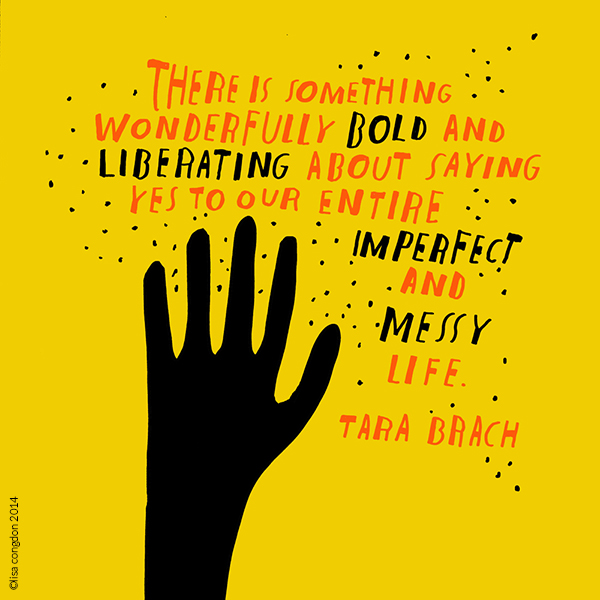
My wish for myself for the future is that I can both relax and be vigilant. Accept imperfection as I strive to be the best version of myself as an educator and to bring that out in my students, but in a joyful fun way. The middle way.
Carabajal, K., LaPointe, D., & Gunawardena, C. (2003). Group development in online learning communities. In M. G. Moore & W. G. Anderson (Eds.), Handbook of distance education (pp. 217–234). Mahwah, N.J: L. Erlbaum Associates.
I’m having a real hard time accepting the fact that the rest of the world doesn’t revolve around my research results! What are they thinking! In my mind I have some extremely small asks. Tiny surveys that won’t take more than 2/3 minutes of people’s time. Getting things on time. Or at all. And above me, around me I have this feeling like there is an enormous clock ticking ticking ticking.
Working 7 days a week doesn’t really help because it means there is no down time. My weeks are too busy with work and the daily everythings so I’m packing all the research into the weekends and occasional evenings.
I have to keep reminding myself that I need to be thankful for the 1/2 of students who did reply not be annoyed with the 1/2 who didn’t. To be happy with the teacher who DID have her students do the survey in class not cross with the other 2 who sent it home for them to do when they had time (duh.. as if any student would ever do it then?) I’m just mega frustrated as these are the bits that are preventing me from getting to a draft stage because there is just not enough data to make the comparisons and conclusions I want to make. I’m just glad I’m not writing this for a peer review journal because I can poke holes a million miles wide into my research at this point and I’m not satisfied.
Do I take the weekend off? Will that make it worse or better? Maybe it’s time for a list of the gaps, and some editing of what I have.
With view to the fact that our school is celebrating uniting nations week in October, this year we’re trying to add a literary bent to the proceedings.
There are a number of steps to this, which are easy or complicated, depending on how “ready” your collection is.
A little while back, I created resource lists on Destiny, and a visual search button for “read around the world”. Since I didn’t have a lot of time I grouped them by continent, with a separate section for Singapore which is where we live. It involved doing subject searches on our catalog for various countries on each continent and then grouping them together. Actually this wasn’t that easy. A book like “Inside out and Back again” – takes place in USA, about a Vietnamese immigrant – where do you put it and its ilk (of which we have many). What if an american author is writing about Africa? Generally I tended to put the books according to where they took place rather than the origin of the author. But I’ve allowed my students to decide how they want to categorise it when they add a comment to their shelfie (more later).
Before the summer break, I also ordered all the books suitable for primary school on the USBBY list for 2016 so they were ready for the school year. Again I didn’t have anything specific in mind, except to diversify my collection. As an aside – I must say I’m incredibly impressed with the selection in this list and I’m going to order from it again this year, and from the backlists of prior years. Books like “My Two Blankets” are just phenomenal and just so appropriate for a multi-lingual environment.
This term, I joined the UN committee and put my idea forward to do a “read around the world” as part of the activities so it would not just be a “costume, food and flags” affair. I also convinced the parade organisers that it may be a nice idea to parade by country grouped by continent (to tie in what was feasible in the library with my limited display space).
Next I created a library guide and a padlet so the students could put up their pictures (we’re an iPad school so that’s one of the easiest ways).
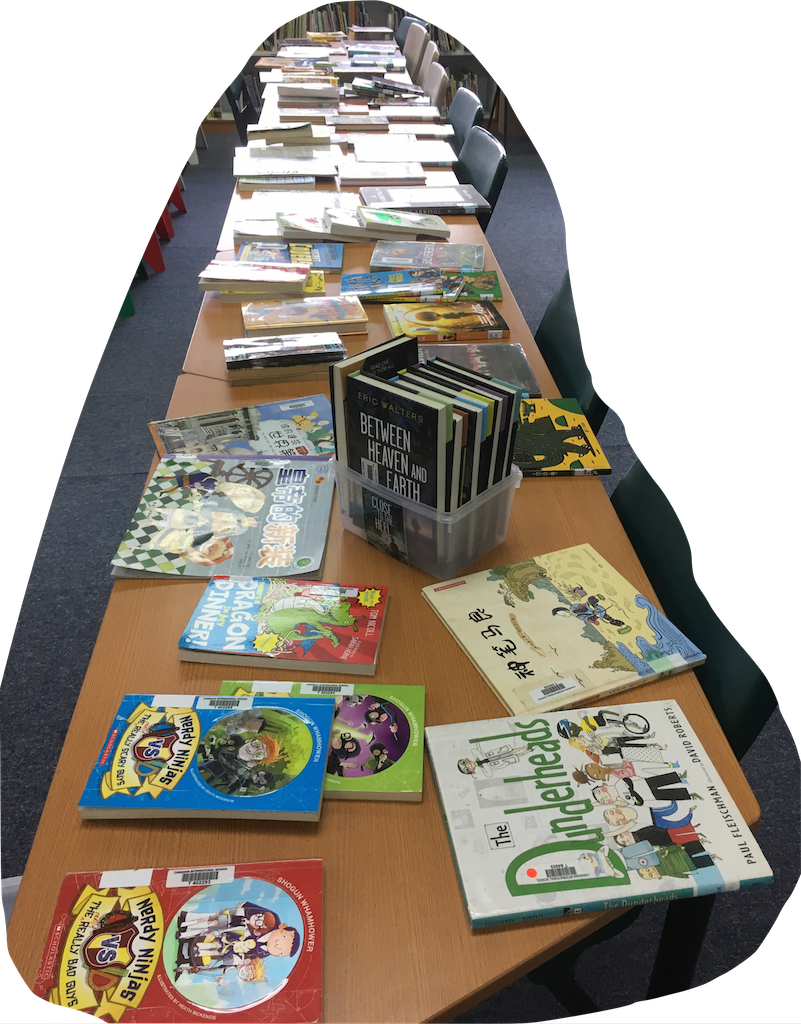
Then last week I started introducing the concept to my students in the library lesson. I adjusted it according to the age. For some, I asked how were ways we could find out about people around the world. We got the usual, go there, live their, eat food, have a friend etc. Then I introduced travelling their through books (depending on the age I told them the library was a magic travel machine), then I read a book from South Africa, my home country (Niki Daly’s “Where’s Jamela”), and then we had a tour around the world past all the displays and they could pick up a “souvenir” book on the way of whatever they liked.
For other classes my colleague met them at the door and said she was a tour guide and would take them around the world and they could pick up books along the way.
We then showed the library guide and explained how to get a picture onto padlet, and that they could then put a sticker on the map.
Some classes were more enthusiastic than others – generally the younger students were not very interested in books from other places, they wanted a book from the country they came from – fair enough.
It was interesting to see where students put books when they made a comment – the aforementioned “inside out” was labeled “Vietnam” by a student, while “Amulet” got a Japanese label based on the author name and origin (although born in Japan, he has lived in the USA since he was 10).
We’ve agreed that for the actual UN week each class well get a bundle of 20-30 books from various countries delivered to the classrooms to read during their DEAR time (they get 20 minutes a day).
Hopefully it will all work out! I’m also hoping our parents will want to get involved with their children.
I’ve been geeking out a little with some data in the last 24 hours, looking at the circulation stats of my blokes for the last 2 years plus the last month. Glancing through the table leads to the conclusion that they are in fact borrowing more books – I know that doesn’t necessarily lead to more reading, but I also know that just having books around is a good thing. One of the issues is that inherent in international schools is the fact that students come and go. Most of our students have been here for the last 2 years, and a few entered mid-way – so I averaged the monthly book borrowing by assuming 8 months of school (yup, we’re off for 16 weeks of the year), and then apportioned appropriately. (Note 2016/7 data needs to be updated at end of September to give the full 1.5 months).
But no-one likes looking at a table of data, so how to get this into a graph? Now even a 3rd grader would (hopefully) be able to tell you that discrete data = bar chart. So that leads to this:
That kind of shows you the picture – that the green bars are generally the highest (although maybe I need to invert the colours).
Now, let me show you another picture. This time I am quite incorrectly showing you a line graph. Why is it wrong – well because a line graph is to show the relationship between two sets of values, with one set being dependent on another. Well, as each point is a different child’s reading, and one child’s data has nothing to do with another child’s data, so obviously a line graph is nonsense. Except for the fact that it much more clearly shows that students have increased their borrowing since they’ve joined BWB. Quite wrong, but more graphically. I’ve been even more deceptive by ordering the data by number of books by date (mainly because the first 6 boys were not at the school in 2014/5 and the next 3 not last year so it made things look more confusing if I didn’t order it.
The next graph is even more pretty but it’s wrong wrong wrong and very deceptive – because I used a “stacked line” it’s no longer showing the boys who they read less than the previous year (s) as I’m adding up their reading over time.
No wonder they say “lie, damned lies and statistic” – maybe they need to add “graphs” to that one.
More problems with this type of data – it tells you about the quantity, but nothing about the quality of what’s being borrowed. If I drill into various circulation histories I see a lot of “churn” of graphic novels. I’m assuming the lads who’ve read 15 or 20 books in the past month are reading nearly one book a day. That’s assuming they’re reading them. In fact one of the boys who seems to be borrowing and reading less is the boy who is tackling much more sophisticated literature and longer books.
Which shows just how individualised one’s approach needs to be to students, and data, and even goals and aims. I like to think I’m employing a “bait and switch” tactic in the long term – I wonder if that can be quantified? Thinking aloud – if my books were lexiled and I could for each child see a lexile trail that gets stronger over time … unfortunately wishful thinking at this point as our books aren’t lexiled. I’m wondering if any longitudinal research has been done in this respect? I was watching a demo of Scholastic’s Literacy Pro yesterday and maybe that’s influencing my thinking. Because once you’re in that kind of program the program in itself corrupts the data by only feeding the student books in their lexile range, so you have animals in captivity rather than in the wild, if you see what I mean.
Now to see what the reading data tells me, and to see if there is any way to tie it all together in a pretty picture. I need a spare mathematician to guide me through this – first year university stats is just not going to cut it I fear!
Writing a case study with 3,000 words of which 80% are limited by procedural bits and pieces is proving to be a little frustrating because I am learning SO MUCH. So I thought I’d share some of it here, because heaven knows it could help someone somewhere somehow.
Remember the whole thing about motivation? That there was extrinsic and intrinsic and the latter was way way better? Turns out there are a lot more bits and pieces to motivation than psych 101 would have you believe. And more importantly there is such interplay between them and external factors and I’d like to add developmental ages and phases as well.
So with reading motivation we have:
Extrinsic (rewards, physical, achievement or emotional if you read more)
Intrinsic (reading is its own reward – interest, satisfaction etc.)
Social (currency gained by knowing stuff, sharing books and reading – turns negative around G5 with peer devaluation)
Self-efficacy (belief in ability – changes over time)
Work avoidance (starts in G2, avoid reading tasks due to low motivation and/or reading difficulties)
If you want to read just one study on the matter, I’d recommend Lee & Zentall (2015). They summarize most of the knowledge to date, have an excellent bibliography and most importantly add the longitudinal dimension. I really like longitudinal studies, and I know why they’re difficult and costly, but as a parent and an educator, what can be more valuable than recognizing and anticipating bumps along the road for what they are and taking preventative action before a student/child lands in a pot-hole?
I’d like to spend a little more time on self-efficacy. It has to do with self-concept as a reader (Förster & Souvignier, 2014; Proctor, Daley, Louick, Leider, & Gardner, 2014; Smith, Smith, Gilmore, & Jameson, 2012). I find it very interesting that self-efficacy takes a dive around Grade 3. Why? Because that is just the moment when the majority our self-confident readers, having spent 2 or 3 years soaring through the levels of their reading program are suddenly let loose into the big world of both “real chapter books” and needing to access their reading skills in order to “read to learn”. It’s that pivot point. The point at which I tell over anxious parents, “yes, now you can start worrying if the reading is not happening.”
So the question is what should our response be as parents and educators (another good point of the Lee & Zentall article – they add the “so what” bit). Remember the “terrible twos”? Well I think there is nothing more comforting in know that when behavior goes wonky, you have a frame of reference that says “oh, it’s this” accompanied by “I / my child / my student is not alone” and “this is normal” plus, hopefully some strategies in place that can be applied. I’ve just sent my blokes with books a set of positive affirmations that he can use in the Blokes with books club. It was one of a set of resources included in this very handy, practical and readable guide from Ireland (NEPS, 2012).
Then looking at the skill side of things. This is dangerous ground, because if a child is reading below the 30% percentile, (and they’re not 3 or 4 years old – I kid you not – I’ve had pre-kindergarten parents concerned their children are not reading yet – on that topic, please read this article (Suggate, Schaughency, & Reese, 2013)) and they’re over 8 years old, then there may be a problem.
What is the problem – well I’ll say mainly “beware, there be EGOS”. When there is a reading skill issue it is probably as a result of an experiential instructional deficit or a reading related cognitive problem (Scanlon, Gelzheiser, Vellutino, Schatschneider, & Sweeney, 2008). To put it simply, either they haven’t been taught properly at school or the home situation isn’t reinforcing adequately (hear those egos bristling), OR, the child has a reading related cognitive problem (Reading Disability – RD). This can be in decoding (like dyslexia); comprehension or retention and each have a different (here is a lay-person’s article) set of signs and ways of being addressed.
So, what does one do in this case – I like the NEPS article because they call for short, one-on-one or one-on-few and limited interventions of around 12 weeks. Obviously one can start with trying to overcome any instructional deficit, and if that fails, to move onto educational testing and specific RD related interventions. Once again there be Egos in the way – and if it helps at all, I can say “been there, done that, got the tears to prove it”. It’s hard to acknowledge that your child is anything than perfect, or at a pinch that they’re “normally” imperfect. But denial leads to more harm that good, and particularly because early intervention is so much more effective. Embedded in this article on dyslexia (Korbey, 2015) is an awesome scientific journal article (free to read! Yay) on RD, by Norton and Wolf that is very dense and brain spinning, but very good (Norton & Wolf, 2012). Personally I found the discussion on colour naming to be very interesting – talk about an early warning sign that we noticed but didn’t know was important.
I’m going to stop at this point – happy reading in the mean time. As always, interested in your thoughts and comments.
References:
Förster, N., & Souvignier, E. (2014). Learning progress assessment and goal setting: Effects on reading achievement, reading motivation and reading self-concept. Learning and Instruction, 32, 91–100. http://doi.org/10.1016/j.learninstruc.2014.02.002
Lee, J., & Zentall, S. S. (2015). Reading motivation and later reading achievement for students with reading disabilities and comparison groups (ADHD and typical): A 3-year longitudinal study. Contemporary Educational Psychology. http://doi.org/10.1016/j.cedpsych.2015.11.001
Norton, E. S., & Wolf, M. (2012). Rapid automatized naming (RAN) and reading fluency: Implications for understanding and treatment of reading disabilities. Annual Review of Psychology, 63(1), 427–452. http://doi.org/10.1146/annurev-psych-120710-100431
Proctor, C. P., Daley, S., Louick, R., Leider, C. M., & Gardner, G. L. (2014). How motivation and engagement predict reading comprehension among native English-speaking and English-learning middle school students with disabilities in a remedial reading curriculum. Learning and Individual Differences, 36, 76–83. http://doi.org/10.1016/j.lindif.2014.10.014
Scanlon, D. M., Gelzheiser, L. M., Vellutino, F. R., Schatschneider, C., & Sweeney, J. M. (2008). Reducing the incidence of early reading difficulties: Professional Development for classroom teachers versus direct interventions for children. Learning and Individual Differences, 18(3), 346–359. http://doi.org/10.1016/j.lindif.2008.05.002
Smith, J. K., Smith, L. F., Gilmore, A., & Jameson, M. (2012). Students’ self-perception of reading ability, enjoyment of reading and reading achievement. Learning and Individual Differences, 22(2), 202–206. http://doi.org/10.1016/j.lindif.2011.04.010
Suggate, S. P., Schaughency, E. A., & Reese, E. (2013). Children learning to read later catch up to children reading earlier. Early Childhood Research Quarterly, 28(1), 33–48. http://doi.org/10.1016/j.ecresq.2012.04.004
Early into my new job as a newly minted Teacher Librarian I started noticing the “lost boys” of the library. Those souls who would wander around and between the stacks with a dazed look on their faces. Or they’d be flicking through books without actually registering the contents. Or they’d just park themselves on a chair with the (too popular to let them be borrowed) Guinness Books of records and sit and talk through with “oohs and aahs” with their like-minded mates. Obviously something.needed.to.be.done.
But equally obvious to my middle aged, white, female mind, I was not the one to do it. Or at least, not to appear to be the one to do it. But should it be a teacher? If so, which teacher? My criteria was young and male, but I didn’t know my new colleagues all that well… I settled on our EdTech coach, Tim. An extremely busy and popular educator, with experience in the classroom and, since moving into the new role with all the classrooms, he was enthusiastic when I suggested it. (Phew).
We collaborated on lesson plan ideas, and books that may “hook” the students. And we were open for business. We emailed teachers from Grades 3-6 and asked if they had any students who they thought may benefit from this group. Most teachers had 1 or 2 students. The first session started with about 8 students. And quickly word spread that this was a really fun thing to be involved with. Group members had their own membership badges and a special “learning agreement” for their time in the library. Teachers reported back that the students were more motivated to borrow books and were super enthusiastic about going to the sessions which were held once a week on a Wednesday during the last period (a 40 minute period reserved for literacy leadership). A couple of ELL students were identified who would also benefit from being “one of the blokes” even though their language level wasn’t that high and they joined in as well.
The year ended with a bang when I chanced on reading of a book review of “Adventures of a Kid Magician” in February or March. Then of course it was a case of getting Tim’s mother to buy 5 copies of the book from Walmart – the only stockist at the time and shipping it to Singapore. It was as if we’d set off fireworks in the library. Basically each chapter leads to clues which unlocks a code to a youtube video showing how to do a magical trick. So the rest of the year involved multiple read-alouds of the chapters and hunting the clues down and desperate attempts by our blokes to be the next in line to read the book! Talk about a magic formula to combine the physical and digital (my review here),
We started school on the 15th August and unfortunately the first few weeks our literacy period has been occupied by assemblies and other “housekeeping” matters like fire-drills. But the requests and the demands from our blokes were so incessant that we did a “soft launch” of the club during DEAR/SSR time. When I say “we” – I’m definitely the ghost in the machine and very much in the background and 99% of the credit for the magic that is happening is due to Tim. When I handed out the permission forms for the surveys, nearly every boy (it’s grown to 25 boys!) returned the signed form the next day! Any teacher trying to get back permission forms can attest to how unusual that is.
Today was our first official day, starting with going over the essential agreements, one boy who insisted on doing a book talk on a book he was loving (Things Explainer – I’ve ordered a copy for the library now ) an ice-breaker of Zip Zap Zop followed by “Book Speed Dating” – 3 rounds of 5 minutes of “dating” a book after which the favourite was chosen (or not) for checkout.
Initial Lesson plans (2015/6):
Lesson #
Ice Breaker
Activities
1
Staring Contest
-Choose a Book Any Funny Book/read
-Read in the Dark/ Tent
-Find a girly book competition/read
-Find a manly book competition/ read
2
Spot The Difference
-Ben Cooperman Read Aloud his book “Gabriel and Five Joshuas”
3
Charades (written on note cards)
-Discuss adventures/ what kind of adventures there are
-Read choose your own adventure book
4
Crocodile Tooth Game
Graphic Novels
5
Zip Zap Zop
-Judge A Book By It’s Cover
6
Toilet Paper Mummy
-Monster Books
7
Drawing Charades
-Joke Books
8
Draw Yourself As Cartoon
-Dewey Grams
-write down the number of book and to hand to someone else
-Use scholastic.com to make a Christmas book wishlist
Did I ever mention how sweet my blokes are? And it must also be in large part since they have great supportive parents. Isn’t it super when a parent sends in a permission form with this on the back?
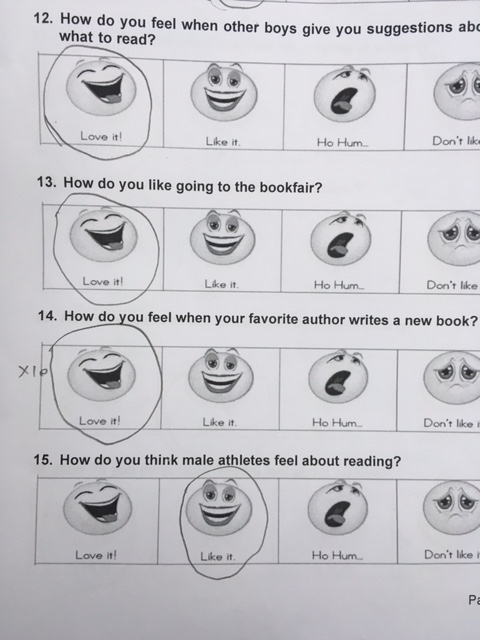
And when your students have been filling in a survey form on a lickert scale and they just can’t resist adding their own opinion – I mean how limiting can we sometimes be? Take note authors – they don’t just LOVE IT! when you write a new book they Love it 10x!
and then when I was administering the survey to a group of 5 of the boys who were absent when the rest were surveyed, there was a long discussion after around whether male readers liked reading or not. The gist being that they probably had to do a heck of a lot of reading, but that the topics and types of reading were probably not under their control or choice and that may result in them disliking reading instead of loving it! Oh boys you are SO right! That’s the whole point of FVR (free voluntary reading). Moments like that I wish I had my camera / microphone on and recording! But of course I didn’t because I was doing a survey and not an interview…
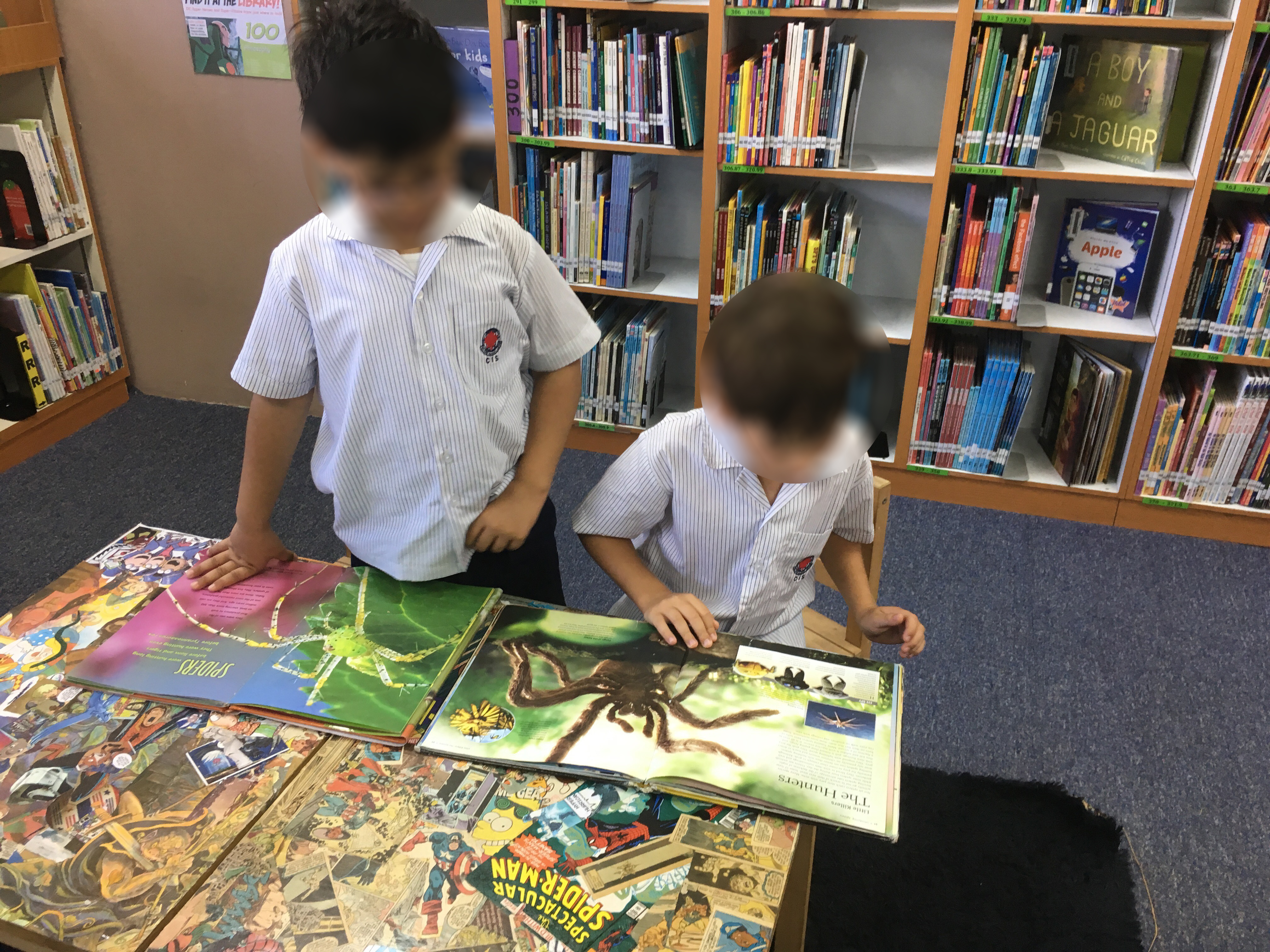
As I wander around my library during recess and lunchtime, before and after school, I realise more and more than reading is not the solitary quiet activity that it’s usually purported to be. I’ve taken to trying to capture this by photographing the communal reading that is going on – which takes me to an article that I’ve been reading that I think is quite important when thinking about boys’ literacy pursuits – “Morphing literacy: Boys reshaping their school-based literacy practices” (Blair & Sanford, 2004).
Who can relate to this in their school libraries?
A cluster of boys sitting around a boy with the Guinness Book of Records – pointing and chatting and oohing and aahing about some record or another, followed by a debate about if it has been surpassed, and grabbing the next years book?
Two or 3 boys sitting with a Minecraft or lego book trying to find out how to do something?
A couple of younger boys reading the same graphic novel (usually squish or lunch lady) and turning the pages at the same time or waiting to turn the page so they can read the same thing at the same time?
Requests for books that tell them how to progress in computer / online games
Needing books about the 2nd world war because their grandfather or great-grandfather fought in it?
Blair and Sanford (2004) relate boys’ reading to their need to acquire social-cultural capital – i.e. they read as long as it enhances their peers and their own view of themselves as “acceptable masculine beings” and creates connection, collaboration and camaraderie between themselves and their friends. The authors refer to “team-like literacy” involving participation and interaction that is purposeful.
In terms of the kinds of texts that engage and fulfil these needs, the “rules” are simple
action > relationships
excitement > unfolding characters
need to suit personal interests / fact finding / purpose / sharing information
humour and fun ++++ important
I would suggest that the literary market / publishing is NOT catering for these needs adequately or at all in fact. Let’s take “Jets” for example. The current obsession of the Grade 1 / 2 students in my school at the moment. The available books we have are dumb. They’re not information rich enough and the publishers cater to their reading level rather than their interest level. They’re dated before they even hit the shelves. They want elaborate up to date images with lots of numbers and facts – never mind the silly narrative “here is a pilot” “this is the instrument console”. Ditto Lego – I’ve said this a million times and I’ll say it again. There is nothing inbetween the little books “castles, towns, 101 things to make” and “Lego StarWars” that is so big and bulky and hard to take home. Make each chapter into a book FFS. How much time do publishers even spend walking around school libraries and talking to boys? (or even librarians? or teachers? or parents?).
This type of article also explains why our “Blokes with Books” and “Readers’ Cup” clubs work so well at school. Connection, affinity, literacies growing out of relationships.
Now to make sure we leverage that in the classrooms and at home.
References:
Blair, H. A., & Sanford, K. (2004). Morphing literacy: Boys reshaping their school-based literacy practices. Language Arts, 81(6), 452.
The parameters of scholarship in education are often based on Boyer’s (1990) dimensions of discovery, integration, application and teaching. Healey further expands on the scholarship of teaching to include “research into teaching and learning, critical reflection of practice and communication and dissemination about the practice of one’s subject” (2000, p. 169).
Broadening the discussion to include the transformational aspects of “digital” technology, educational scholarship has been enriched through open data, open publishing, a blurring of the academic and ‘real’ world, open teaching and learning and a movement from the individual to the distributed scholar and global access (Pearce, Weller, Scanlon, & Kinsley, 2012). However, Pearce etal. (2012, p. 169) cautioned that technology is “a necessary but not sufficient condition” for true scholarship. The question is, given the potential and reality of technology, what else is needed to fulfil the obligations of a modern ‘digital’ scholar?
Argument statement
This essay will argue that the dominance of a Western cognitive constructivist tradition in online and offline education, led by British, Australasian and North American (BANA) institutions limits knowledge, understanding and progress not only of its students, but of its scholars as well in exploiting the true potential of open educational tools and resources.
There are four main reasons for situating this essay in the context of teaching and learning, in particular, a critical reflection of digital scholarship practice in relation to multi-cultural multi-lingual (MCML) learning environments. Firstly, demographic shifts in education are occurring at an unprecedented rate as a result of globalisation, immigration, migration, and war (Boelens, 2010; Boelens, Cherek, Tilke, & Bailey, 2015). Secondly a significant shift to online education where the global market is showing a 9.2% five year annual compound growth rate and is now worth $107 billion led by India and China (Pappas, 2015). Thirdly, work and employment increasingly is global, remote and disaggregated with globally mobile and fluid workforce and both employers and employees requiring “just in time” rather than “just in case” skills and knowledge. Finally, and perhaps most importantly, there is a moral, ethical and value-based argument. On the one hand, MCML students are prejudiced by the dominance of a Western cognitive constructivist tradition in education (Catterick, 2007; Sadykova, 2014; Zhang & Kenny, 2010) and on the other, ignoring the MCML dimension limits critical reflective practice, the potential of international digital scholarship and knowledge and understanding of a large part of the educational scholars’ field.
Interpretive Discussion
Background
Traditionally, creating culturally-responsive accommodations for MLMC students has faced considerable institutional opposition. The response of educational institutions, comprised a narrow range between non-accommodation and intervention in the form of student induction into ‘the system’ i.e. modify the student not the program (Catterick, 2007; Parrish & Linder-VanBerschot, 2010). Arguments against interventions cite costs, quality control, and expectations of the students themselves and their future employers that they are “Westernised” as a by-product of their education (Catterick, 2007).
Parrish and Linder-VanBerschot (2010) acknowledge these issues and suggest that institutions distinguish between entrenched cultural values and superficial practices, and create interventions with constructivist and instructivist alternatives or choices in learning activities and instructional format only where these are critical to learning success. Researchers sound a word of caution against cultural generalizations that lead to stereotyping and discrimination (Gazi, 2014; Hardy & Tolhurst, 2014; Parrish & Linder-VanBerschot, 2010). This can be ameliorated through a combination of embedding cultural considerations in each stage of the instructional design process, ensuring an iterative practice of reflection and modification and encouraging student interaction and feedback (Parrish & Linder-VanBerschot, 2010; Young, 2009).
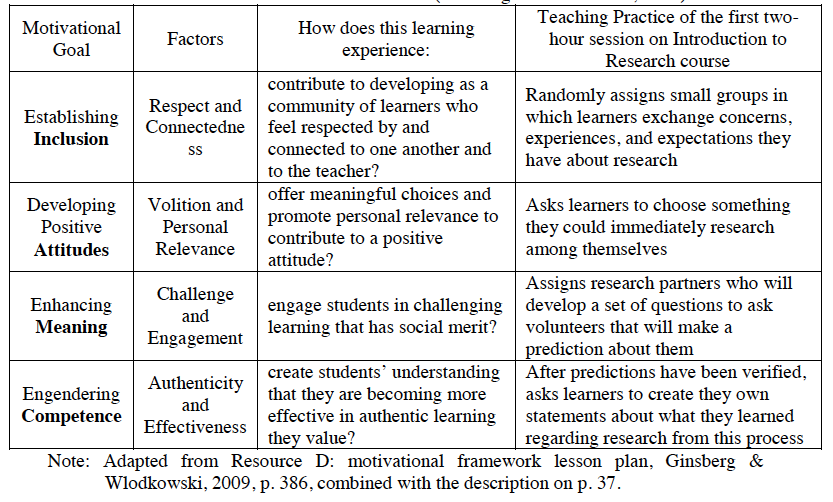
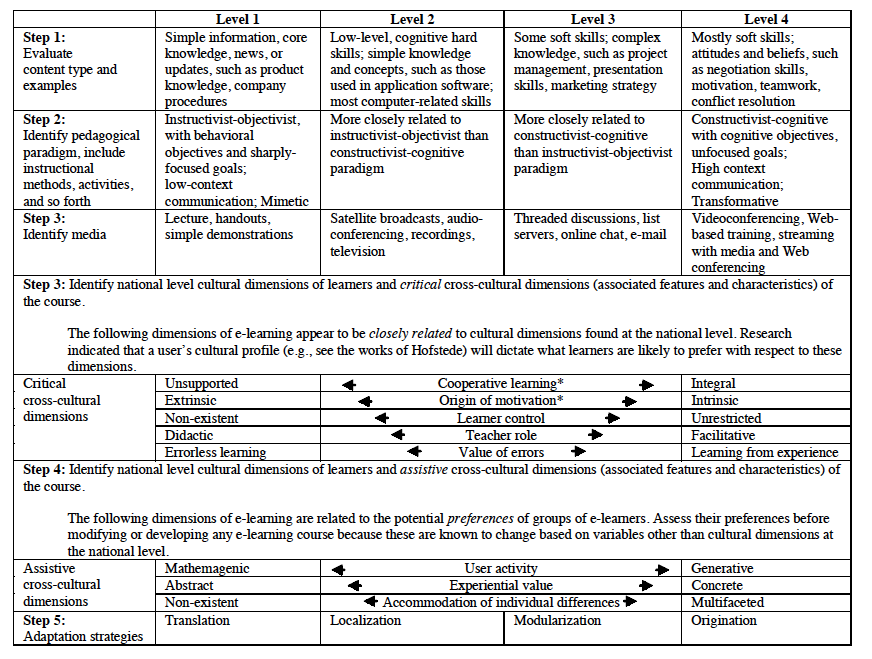
Models designed to foster awareness of cultural implications in education vary in their orientation. Initially research done in corporations (Hofstede, Hofstede, & Minkov, 2010) and physical classrooms led to classroom or systemsoriginated and oriented models such as the Inclusion, Attitude, Meaning, Competence (IAMC) model of Ginsberg & Wlodkowski (2009, cited in Suzuki & Nemoto, 2012) and the Cultural Dimensions Learning Framework (CDLF) (Parrish & Linder-VanBerschot, 2010) which were adapted for online learning.
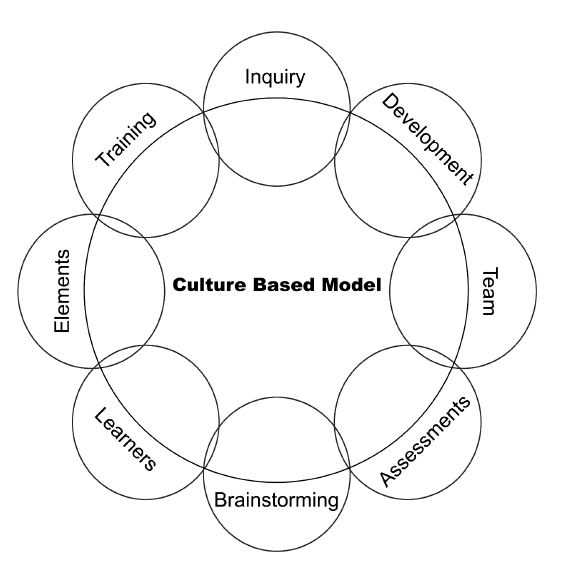
In contrast, the Culture Based Model (CBM) framework of Young (2009) and the Cultural Adaptation Process (CAP) model (Edmundson, 2007b) are product oriented with the aim of guiding designers to incorporate culture in the design of digital and online educational products. (See Appendix 1 for illustrations of these models).
Reflection on teaching and learning in a multi-cultural environment
Educational institutions are not the only suppliers of teaching and learning. Commercial entities, particularly multinational companies, go to an enormous amount of effort in creating culturally compatible user interfaces – see Edmundson’s (2007a) book “Globalized e-learning cultural challenges”. One could argue that this effort directly benefits their bottom line, however all institutions would benefit from this approach.
Fortunately there are some researchers open-minded enough to examine the assumptions of their own culture, reflect on the embedded cultural practices of teaching and learning and those of the digital platforms and applications and thoughtfully researching ways to reconcile the two so as to optimise the learning of their students (Chan & Rao, 2010; Looker, 2011; Ren & Montgomery, 2015; Sadykova, 2014). Critical examination of one’s own culture and introducing new technologies in a more considered and less forceful way, appears to result in more success and acceptance. Pedagogy aligned with sociocultural context allows scaffolding of current to new practice and understanding (Chan, 2010; Chan & Rao, 2010; Law et al., 2010; Rao & Chan, 2010).
Chan (2010) demonstrated aspects of the Confucian approach to teaching and learning were highly compatible with the values of digital scholarship, and showed how modifications in the way technological tools for collaborative learning were introduced positively impacted their acceptance by teachers and students in a high school setting.
More recently, in examining Korean students’ experiences of Massive Open Online Courses (MOOCs), Ahn, Yyon and Cha (2015) built on the CDLF of Parrish & Linder-VanBerschot (2010) showing how awareness, cultural sensitivity and relatively minor adjustments could enhance the online learning experience of such students without detracting from the quality and substance of the courses.
The introduction of digital innovation in the learning environment does not automatically lead to universal acceptance, but can resoundingly be rejected in any culture when it is felt basic assumptions and expectations are being violated – as the study of an online peer-to-peer review workshop tool revealed (Wilson, Diao, & Huang, 2015). Even if peer-to-peer review and data analytics have meta-cognitive benefits, their implementation is often poor and occurs within a context where cooperation and collaboration is espoused but underlying assumptions and pressures of competition and the importance of good grades prevail (Durall & Gros, 2014; Wilson et al., 2015). Similarly, suboptimal outcomes are seen if the social-emotional needs and group formation process is neglected in online scholarship or learning and made subservient to certification and task performance (Carabajal, LaPointe, & Gunawardena, 2003).
Current trends, futurist predictions, theoretical perspectives
Disaggregation and re-aggregation appears to be a theme in many of the discussions on trends and the future of education – something technology allows in ways previously not possible.
Ware, writing in 2011, predicted that the publication of academic research would be disaggregated between the repository process of registration and dissemination of work and the certification process which includes peer review and branding – an idea that harks back to the learned societies of the 18th and 19th centuries. (Ware, 2011). Four years later this is the reality in open access repositories in China (Ren & Montgomery, 2015). Retractions of research papers have also resulted in the calls for the publication of the complete research work flow including raw data – something that is now technologically possible and feasible as interrogation and data analytic tools develop (Larsen, 2008; Oransky & Marcus, 2010; Ware, 2011).
Technology enhances the agency of the self-directed learner (SDL) to re-aggregate OER to suit their learning needs. Mike Caulfield’s idea of choral explanations in OER textbooks:
“the text branches off into multiple available explanations of the same concept, explanations authored individually by a wide range of instructors, researchers, and students. You can keep reading until you find the explanation that makes sense, or you can start with simpler explanations and work your way to nuance.” (Caulfield, 2016, para. 63)
opens many possibilities for expanding textbooks to accommodate linguistic and cultural diversity – something international students already do when they purchase two (physical) textbooks, one that is not only in their home language but also in their home pedagogical culture (Bailey, 2016; Kim & Mizuishi, 2014)
Bates cautions that there is still an agency role to structure and accredit that knowledge acquisition (Bates, 2011), but in a globally mobile and fluid workforce, those aggregators will need to accommodate different cultures of learning. Public/private educational entities such as Singapore’s Institute of Technical Education are taking a regional lead in exporting their vocational training through their educational services division (Chong, 2014; ITEES, 2015; Li, Yao, & Chen, 2014).
Similarly consideration could be given to using the models and algorithms in the field of adaptive learning (Charles Sturt University, n.d.) and personalisation in order to create cultural adaptations based on parameters set by students.
Two universities, although very different in design are using innovative online technology, Kiron University to give refugees the opportunity to further their education (Bates, 2015) and Minerva University to give fee paying students a global education that is location independent for both students and professors (Wood, 2014). Such disruptive models of higher education raise all kinds of questions on the implications of digital learning including whether scholarship and research will continue if scholarship is not directly visible or rewarded (Harry Lewis, cited by Wood, 2014).
Implications for scholarly practice
In order to understand the role of technology, Kalantzis and Cope (2015) go back to the etymology of ‘media’ as agents bridging meaning across space and time to facilitate communication, understanding and learning. This has huge implications for scholarly practice.
Literature on global collaboration in the classroom (Higgitt et al., 2008; Thombs, Ivarsson, & Gillis, 2011), the research process (Siemens & Burr, 2013; Siemens, Cunningham, Duff, & Warwick, 2011) and online conferencing (LaPointe & Gunawardena, 2004) enumerates many benefits of such collaboration. These include but are not limited to the opening of and access to new knowledge; flattening of hierarchies, easier discovery and connection mechanisms; extending the reach and equity of scholars and reducing costs. Some of the problems however, include issues with technological difficulties and failure, differences in equipment standards and capabilities, scheduling issues due to time differences, misunderstandings due to language, the nature of computer-mediated communication including its text-basis, time-independence, asynchronous nature and inability to interpret culturally based non-verbal cues (Pearce et al., 2012; Selwyn, 2010; Veletsianos & Kimmons, 2012a, 2012b; Weller, 2011).
Of these, language remains a significant barrier to open access international research and learning. Even where all members of a research team are proficient in a language (usually English), research in other languages may not be accessible to non-speakers (Loan & Sheikh, 2016; Ren & Montgomery, 2015), and language and cultural norms may be intertwined where nuance can result in misunderstanding (Siemens & Burr, 2013). As translation software continue to evolve will more students be able to study and do internationally recognised and disseminated research in their home language, (Cheesman et al., 2016; Palaiologou, 2007; Sadykova, 2014)? Or will the dominance of English prevail – albeit with a move to “global English” as envisioned by Schell (2007) and what will be lost as a result?
Conclusion
Digital scholarship within the context of international and globalised education could benefit from additional critical reflection into the assumptions concerning and attitudes towards multi-cultural and multi-lingual students and fellow researchers. Given the plethora of technological tools, research, knowledge and practice in non-BANA educational institutions, of intrepid researchers in BANA institutions and of multi-national corporations there are ample examples of best practice and the potential to positively impact student learning and educational scholarship in the digital realm.
References
Ahn, M. L., Yoon, H. S., & Cha, H. J. (2015). Cultural sensitivity and design implications of MOOCs from Korean learners’ perspectives: Case studies on edX and Coursera. Educational Technology International, 16(2), 201–229. Retrieved from http://www.kset.or.kr/eti_ojs/index.php/instruction/article/viewFile/49/pdf_15
Bates, T. (2011). Understanding Web 2.0 and its implications for e-learning. In M. J. W. Lee & C. McLoughlin (Eds.), Web 2.0-Based E-Learning: Applying Social Informatics for Tertiary Teaching (pp. 20–42). Hershey, PA: Information Science Reference. Retrieved from 10.4018/978-1-60566-294-7
Boelens, H. (2010). The evolving role of the school library and information centre in education in digital Europe (PhD Thesis). Middlesex University. Retrieved from http://eprints.mdx.ac.uk/7329/
Boelens, H., Cherek, J., Tilke, A., & Bailey, N. (2015). Communicating across cultures: Cultural identity issues and the role of the multicultural, multilingual school library within the school community. Presented at the ‘The school library rocks’ IASL 2015, Maastricht, Netherlands.
Boyer, E. L. (1990). Scholarship reconsidered: priorities of the professoriate. Princeton, N.J: Carnegie Foundation for the Advancement of Teaching.
Carabajal, K., LaPointe, D., & Gunawardena, C. (2003). Group development in online learning communities. In M. G. Moore & W. G. Anderson (Eds.), Handbook of distance education (pp. 217–234). Mahwah, N.J: L. Erlbaum Associates.
Catterick, D. (2007). Do the philosophical foundations of online learning disadvantage non-western students? In A. Edmundson (Ed.), Globalized E-Learning Cultural Challenges: (pp. 116–129). Hershey, PA: Information Science Pub.
Chan, C. K. K. (2010). Classroom innovation for the Chinese learner: Transcending dichotomies and transforming pedagogy. In C. K. K. Chan & N. Rao (Eds.), Revisiting The Chinese Learner (pp. 169–210). Dordrecht: Springer Netherlands.
Chan, C. K. K., & Rao, N. (Eds.). (2010). Revisiting the Chinese learner: changing contexts, changing education. Dordrecht: Springer.
Cheesman, T., Flanagan, K., Thiel, S., Rybicki, J., Laramee, R. S., Hope, J., & Roos, A. (2016). Multi-retranslation corpora: Visibility, variation, value, and virtue. Digital Scholarship in the Humanities. http://doi.org/10.1093/llc/fqw027
Chong, T. (2014). Vocational education in Singapore: meritocracy and hidden narratives. Discourse: Studies in the Cultural Politics of Education, 35(5), 637–648. http://doi.org/10.1080/01596306.2014.927165
Durall, E., & Gros, B. (2014). Learning analytics as a metacognitive tool (pp. 380–384). Presented at the CSEDU 2014 – 6th International Conference on Computer Supported Education.
Edmundson, A. (Ed.). (2007a). Globalized e-learning cultural challenges. Hershey, PA: Information Science Pub.
Edmundson, A. (2007b). The cultural adaptation process (CAP) model: Designing E-learning for another culture. In A. Edmundson (Ed.), Globalized E-Learning Cultural Challenges: (pp. 267–290). Hershey, PA: Information Science Pub.
Hardy, C., & Tolhurst, D. (2014). Epistemological beliefs and cultural diversity matters in management education and learning: A critical review and future directions. Academy of Management Learning & Education, 13(2), 265–289. http://doi.org/10.5465/amle.2012.0063
Healey, M. (2000). Developing the scholarship of teaching in higher education: A discipline-based approach. Higher Education Research & Development, 19(2), 169–189. http://doi.org/10.1080/072943600445637
Higgitt, D., Donert, K., Healey, M., Klein, P., Solem, M., & Vajoczki, S. (2008). Developing and enhancing international collaborative learning. Journal of Geography in Higher Education, 32(1), 121–133. http://doi.org/10.1080/03098260701731629
Hofstede, G. H., Hofstede, G. J., & Minkov, M. (2010). Cultures and organizations: software of the mind: intercultural cooperation and its importance for survival (3rd ed). New York: McGraw-Hill.
ITEES. (2015). About ITE Education Services. Retrieved 27 August 2016, from http://www.itees.com.sg/
Kim, M., & Mizuishi, K. (2014, December). Language and cultural differences and barriers in an international school setting – personal experiences and reflections. UWCSEA-East.
LaPointe, D. K., & Gunawardena, C. N. (2004). Developing, testing and refining of a model to understand the relationship between peer interaction and learning outcomes in computer‐mediated conferencing. Distance Education, 25(1), 83–106. http://doi.org/10.1080/0158791042000212477
Law, N. W. Y., Yuen, A. H. K., Chan, C. K. K., Yuen, J. K. L., Pan, N. F. C., Lai, M., & Lee, V. S. L. (2010). New experiences, new epistemology, and the pressures of change: The Chinese learner in transition. In C. K. K. Chan & N. Rao (Eds.), Revisiting The Chinese Learner (pp. 89–129). Dordrecht: Springer Netherlands.
Loan, F. A., & Sheikh, S. (2016). Analytical study of open access health and medical repositories. The Electronic Library, 34(3), 419–434. http://doi.org/10.1108/EL-01-2015-0012
Looker, P. (2011). Globalising the local: The scholarship of teaching and learning in a larger context. Journal of the NUS Teaching Academy, 1(1), 21–31.
Palaiologou, N. (2007). Intercultural dimensions in the information society: Reflections on designing and developing culturally-oriented learning. In A. Edmundson (Ed.), Globalized E-Learning Cultural Challenges: (pp. 267–290). Hershey, PA: Information Science Pub.
Parrish, P., & Linder-VanBerschot, J. A. (2010). Cultural dimensions of learning: Addressing the challenges of multicultural instruction. International Review of Research in Open & Distance Learning, 11(2), 1–19.
Pearce, N., Weller, M., Scanlon, E., & Kinsley, S. (2012). Digital scholarship considered: How new technologies could transform academic work. In Education, 16(1). Retrieved from http://ineducation.ca/ineducation/article/view/44
Rao, N., & Chan, C. K. K. (2010). Moving Beyond paradoxes: Understanding Chinese learners and their teachers. In C. K. K. Chan & N. Rao (Eds.), Revisiting The Chinese Learner (pp. 3–32). Dordrecht: Springer Netherlands.
Ren, X., & Montgomery, L. (2015). Open access and soft power: Chinese voices in international scholarship. Media, Culture & Society, 37(3), 394–408. http://doi.org/10.1177/0163443714567019
Sadykova, G. (2014). Mediating knowledge through peer-to-peer interaction in a multicultural online learning environment: A case of international students in the US. The International Review of Research in Open and Distributed Learning, 15(3).
Schell, M. (2007). How to globalize online course content. In A. Edmundson (Ed.), Globalized E-Learning Cultural Challenges: (pp. 155–167). Hershey, PA: Information Science Pub.
Selwyn, N. (2010). Looking beyond learning: notes towards the critical study of educational technology. Journal of Computer Assisted Learning, 26(1), 65–73. http://doi.org/10.1111/j.1365-2729.2009.00338.x
Siemens, L., & Burr, E. (2013). A trip around the world: Accommodating geographical, linguistic and cultural diversity in academic research teams. Literary and Linguistic Computing, 28(2), 331–343. http://doi.org/10.1093/llc/fqs018
Siemens, L., Cunningham, R., Duff, W., & Warwick, C. (2011). A tale of two cities: implications of the similarities and differences in collaborative approaches within the digital libraries and digital humanities communities. Literary and Linguistic Computing, 26(3), 335–348. http://doi.org/10.1093/llc/fqr028
Suzuki, K., & Nemoto, J. (2012). Cultural and social frameworks of instructional design (pp. 22–24). Presented at the 10th International Conference for Media in Education, Beijing.
Thombs, M., Ivarsson, L., & Gillis, M. (2011). Building bridges across the Atlantic: The impact of technology facilitated classroom partnerships on cultural competency and language skills. In M. Bhattacharya, N. Mach, & M. Moallem (Eds.), Emerging Technologies in Learning: Impact on Cognition and Culture (pp. 35–44). Association for the Advancement of Computing in Education (AACE). Retrieved from https://www.learntechlib.org/p/39252
Wilson, M. J., Diao, M. M., & Huang, L. (2015). ‘I’m not here to learn how to mark someone else’s stuff’: an investigation of an online peer-to-peer review workshop tool. Assessment & Evaluation in Higher Education, 40(1), 15–32. http://doi.org/10.1080/02602938.2014.881980
Young, P. A. (2009). The Culture-Based Model framework. In P. A. Young, Instructional Design Frameworks and Intercultural Models: (pp. 37–53). Hershey, PA: IGI Global. Retrieved from 10.4018/978-1-60566-426-2.ch003
Zhang, Z., & Kenny, R. F. (2010). Learning in an online distance education course: Experiences of three international students. International Review of Research in Open and Distance Learning, 11(1). Retrieved from http://www.irrodl.org/index.php/irrodl/article/view/775/1481
Appendix 1: Illustrations of Models
Figure 1: IAMC model Ginsberg & Wlodkowski, 2009 (cited in Suzuki & Nemoto, 2012 p. 25)
Figure 2: Cultural Dimensions Learning Framework (Parrish & Linder-VanBerschot, 2010, summarized in Ahn, Yoon & Cha, 2015, p.207)
Figure 3: Culture Based Model, Young, 2009, p. 38
Figure 4: Cultural Adaptation Process (Edmundson, 2007b, p. 269)
Just came across this very interesting infographic while trying to justify a moral gut-feeling on why we need to care about multi-cultural, multi-lingual (MCML) learning environment accommodation for all students. If nothing else – it impacts on the bottom line!











 Informative Flights - Musings of a Teacher Librarian
