Professional Development

I’m really bad at keeping my professional development clocked, so decided to use this post to just put pretty pictures of my certificates in, so they’re all in one place when I need to refer to them!

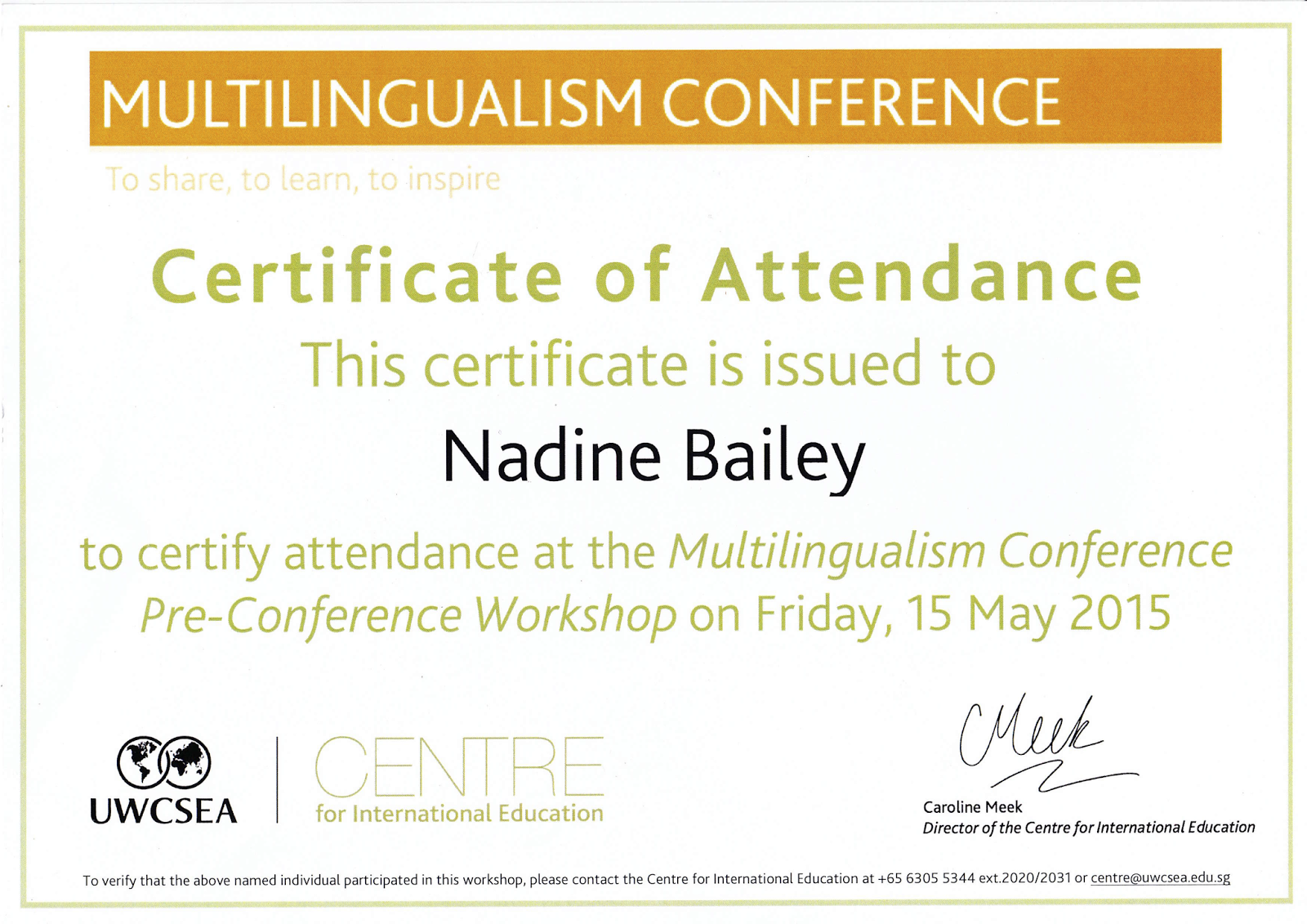
Multilingualism Conference
Pre-conference Workshop
MAY 15 – 2015
UWCSEA-East
Singapore
https://www.uwcsea.edu.sg/centre/multilingual-conf-2015
Workshop: Eithne Gallagher – Equal rights to the curriculum: Promoting home languages in all classrooms – from theory to practice


Multilingualism Conference
MAY 16-17 – 2015
UWCSEA-East
Singapore
https://www.uwcsea.edu.sg/centre/multilingual-conf-2015
Sharing Workshop: Librarians
Presentation: Chasing the Chinese Dragon

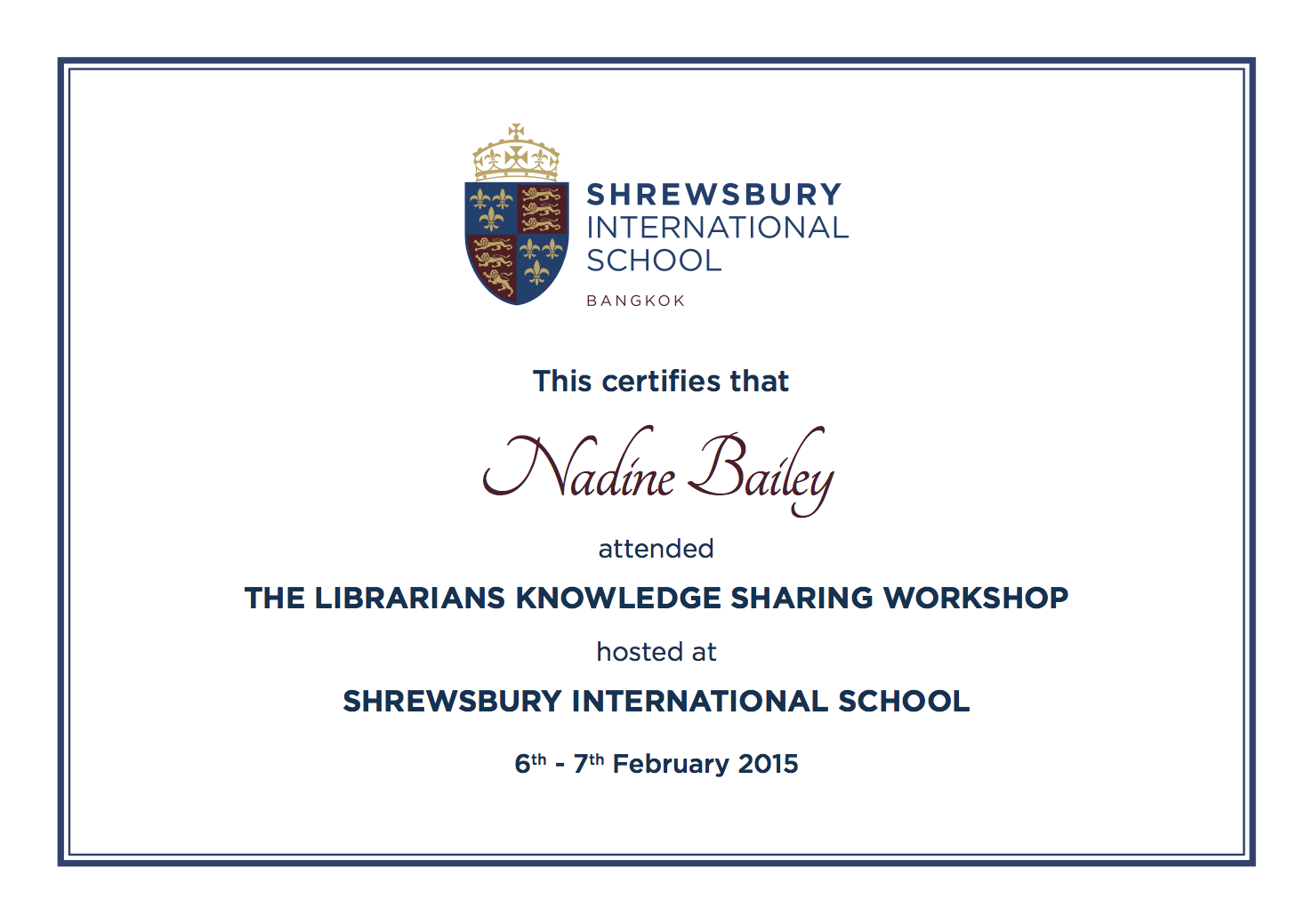
Librarian’s Knowledge Sharing Workshop (LKSW)
FEBRUARY 6-7  2015
Shrewsbury International School
Bangkok
http://blogs.shrewsbury.ac.th/lksw/
Presentation: Information Literacy – Beyond Search and Cite.

IL Seminar 2015 – We are teaching but are they learning?
JANUARY 29  2015
Singapore Management University (SMU)
Singapore
https://storify.com/rockbrarian/information-literacy-seminar-2015

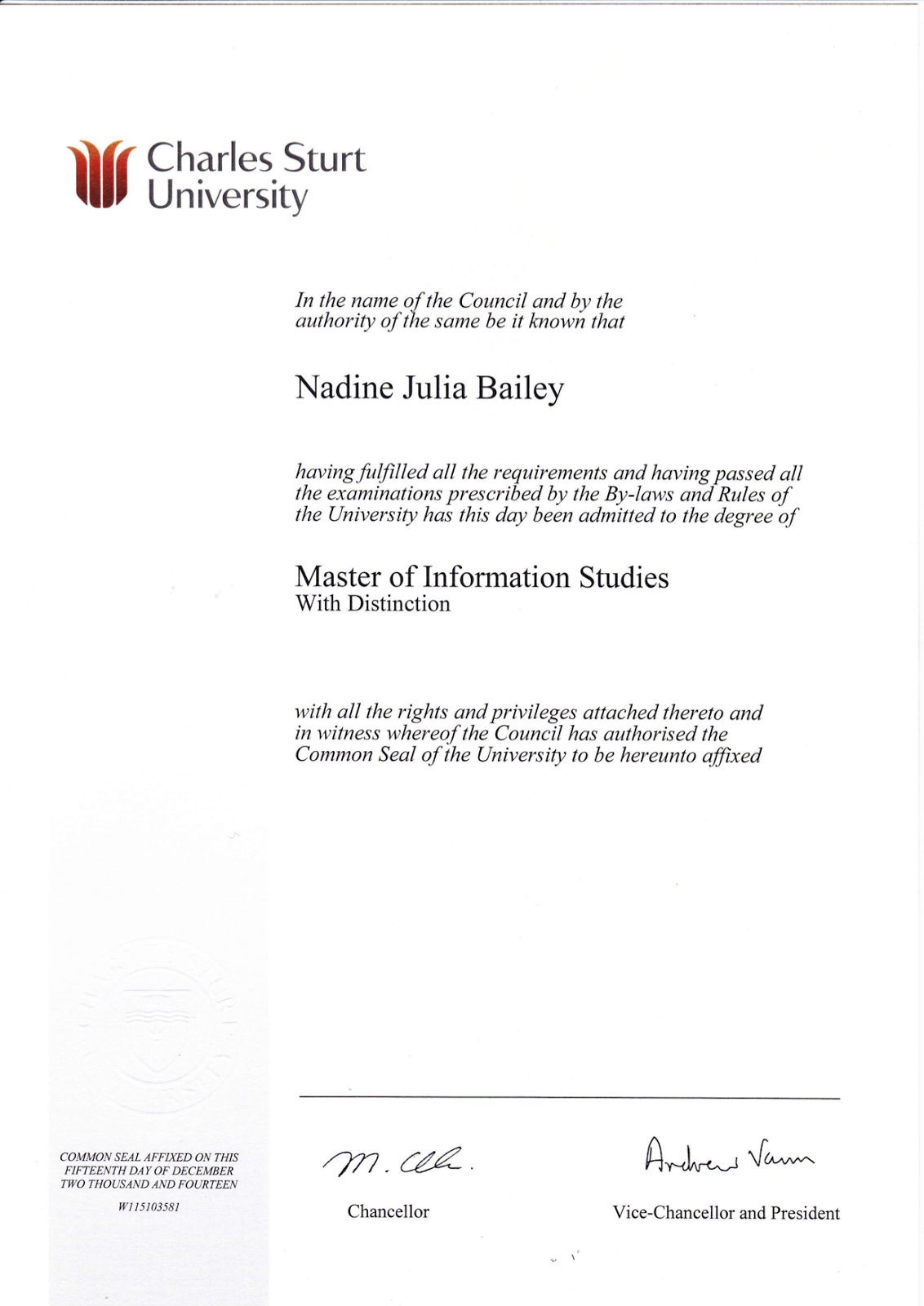
Master in Information Studies
DECEMBER 2014
Charles Sturt University
Australia

The South East Asian School Librarian Connection
Sharing for learning, come and be in the room
NOVEMBER 21-22 2014
Renaissance College Library
Ma On Shan
Hong Kong
http://www.schoollibrarianconnection.com 
Presentation: Digital Storytelling.

Information Literacy Job Alike Workshop (JAW)
NOVEMBER 7-8,  2014
Tanglin Trust School
Singapore

Librarian’s Knowledge Sharing Workshop (LKSW)
FEBRUARY 21-22 2014
Juradong International School
Brunei
http://libguides.jis.edu.bn/lksw

LKSW Brunei February 2014

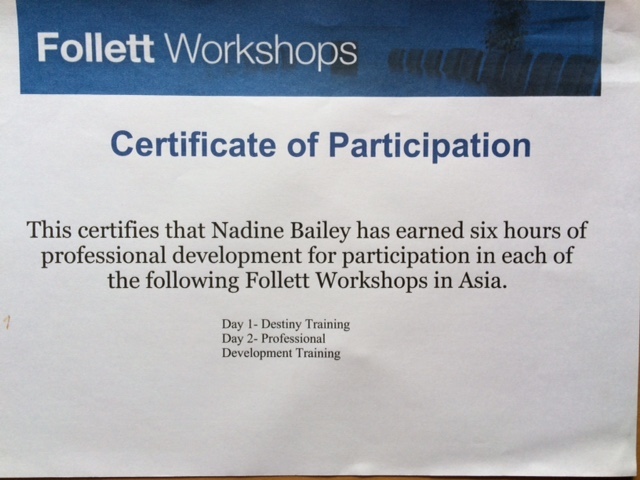
Follett Workshop

DECEMBER 7, 2013
UWCSEA East

Follett Workshop December 2013
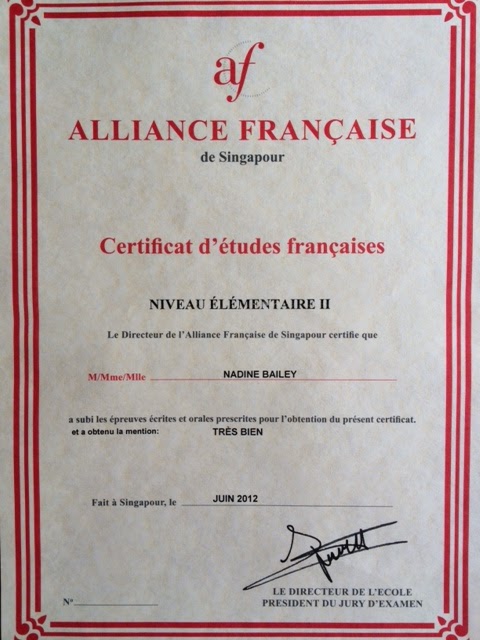
Certificate in French June 2012

The role of the TL in practise with regard to the convergence of literacies in the 21st Century

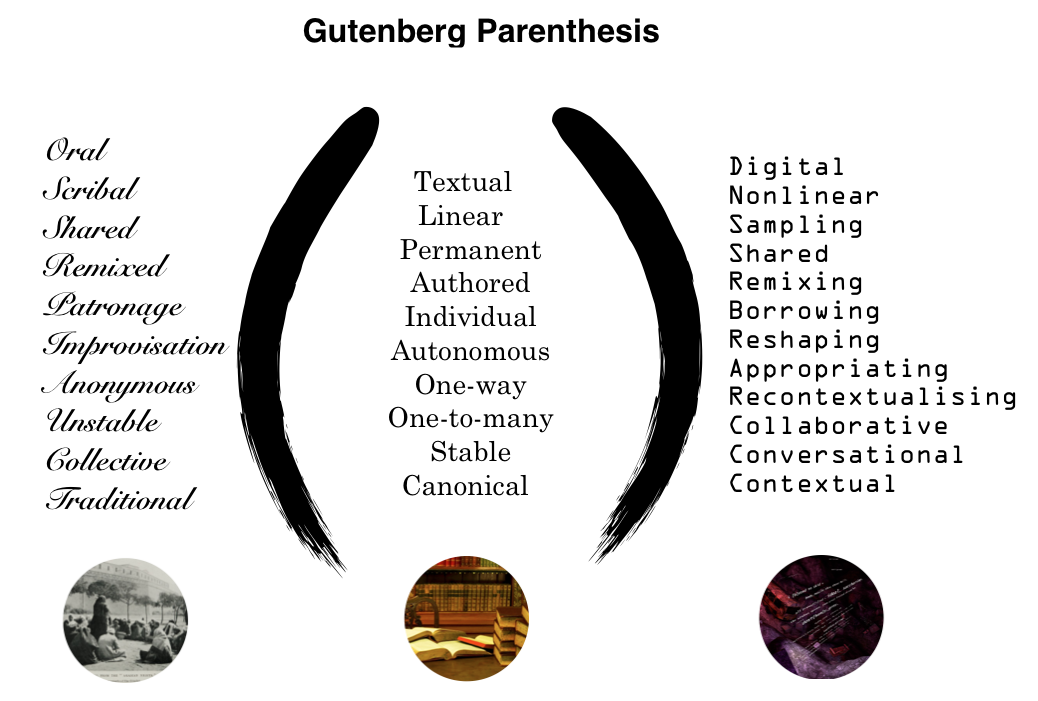
In what authors are referring to as the post Gutenberg parenthesis society, (Kenny, 2011; Pettitt, Donaldson, & Paradis, 2010), an emphasis on textual literacy is no longer sufficient. Shifts in technology, particularly with the advent of Web 2.0 and its social media affordances mean that literacy has become a dynamic and multifaceted concept that goes beyond information literacy but incorporates digital, visual, media and a multitude of other literacies under the umbrella term multi-literacy (Mackey & Jacobson, 2011). Trans-literacy as a concept, attempts to map meaning and interaction across these literacies and different media, including social media (Ipri, 2010).


gutenberg parenthesis


O’Connell (2012) suggests the teacher librarian (TL) respond along three strategic dimensions. Firstly through an involvement strategy whereby the TL “meets students where they are”, secondly with a responsive information strategy that filters, curates, and shares content and finally through a leadership strategy by taking leadership in curriculum, broaching the digital divide, championing digital citizenship and global sharing. While she encourages TL’s to create a personal learning environment (PLE), utilize their personal learning network (PLN) and personal web tools (PWT), it can be posited that the TL has to go beyond creating and using these tools personally, but to ensure educators and students in the community can also tap into their power.

Information literacy concerns itself with the selection, evaluation and use of information to solve a problem or research question, however, trans-literacy goes beyond this paradigm to the creation and sharing of ideas and the importance of social connections. Besides constructivism, the TL should incorporate principles of connectivism in their teaching approach, emphasizing the connections between the individual, data and others in the current networked culture (McBride, 2011). This principle is wonderfully illustrated by Joyce Valenza in her video “See Sally Research” (Valenza, 2011), which also highlights the importance of TLs creating an environment in which students go beyond using information for personal research but as a means of expressing themselves as digital citizens. Waters (2012) expounds on the theme of digital citizenship and rightly points out that this should go beyond behaviours and prohibitions creating a safe and civil digital environment but that TLs should encourage their students to participate as producers and managers of information and perspectives in a globally socially responsible manner.


In their book “Literacy is not enough”, Crockett, Jukes and Church (2011) create a conceptual model incorporating information, solution, creativity, collaboration and media fluency and provide the educator or TL with suggested processes and scaffolds for teaching each (reviewed by Loertscher & Marcoux, 2013). In his talk, Lee Crockett emphasizes that these fluencies are important to the 21st-Century learner independent of the amount of digital technology employed, something that is often neglected when technology dominates the conversations (Crockett, 2013).

As TLs we need to be aware of all these discussions around the various iterations of literacies as well as taking leadership in our learning environments and ensuring our teaching and assessments follow the latest standards where these are available.

References:

Crockett, L. (2013, February 28). Literacy is NOT Enough: 21st Century Fluencies for the Digital Age [Streaming Video]. Retrieved January 4, 2015, from https://www.youtube.com/watch?v=N8DEeR1sraA

Crockett, L., Jukes, I., & Churches, A. (2011). Literacy is not enough: 21st-century fluencies for the digital age. Kelowna, B.C. : Thousand Oaks, Calif.: 21st Century Fluency Project ; Corwin.

Ipri, T. (2010). Introducing transliteracy: What does it mean to academic libraries? College & Research Libraries News, 71(10), 532–567. Retrieved from http://crln.acrl.org/content/71/10/532.short

Kenny, R. F. (2011). Beyond the Gutenberg Parenthesis: Exploring New Paradigms in Media and Learning. Journal of Media Literacy Education, 3(1), 32–46. Retrieved from http://www.jmle.org

Loertscher, D. V., & Marcoux, E. (2013). Literacy is not enough: 21st-century fluencies for the digital age. Teacher Librarian, 40(3), 42–42,71.

Mackey, T. P., & Jacobson, T. E. (2011). Reframing Information Literacy as a Metaliteracy. College & Research Libraries, 72(1), 62–78. doi:10.5860/crl-76r1

McBride, M. F. (2011). Reconsidering Information Literacy in the 21st Century: The Redesign of an Information Literacy Class. Journal of Educational Technology Systems, 40(3), 287–300.

O’Connell, J. (2012). Change has arrived at an iSchool library near you. In Information literacy beyond library 2.0 (pp. 215–228). London: Facet.

Pettitt, T., Donaldson, P., & Paradis, J. (2010, April 1). The Gutenberg Parenthesis: oral tradition and digital technologies. Retrieved August 29, 2014, from http://web.mit.edu/comm-forum/forums/gutenberg_parenthesis.html

Valenza, J. (2011). See Sally Research @TEDxPhillyED [Streaming Video]. Retrieved May 22, 2014, from http://blogs.slj.com/neverendingsearch/2011/09/05/see-sally-research-tedxphillyed/

Waters, J. K. (2012, September 4). Turning Students into Good Digital Citizens. Retrieved January 2, 2015, from http://thejournal.com/Articles/2012/04/09/Rethinking-digital-citizenship.aspx


School Librarian Connections – My presentation(s)

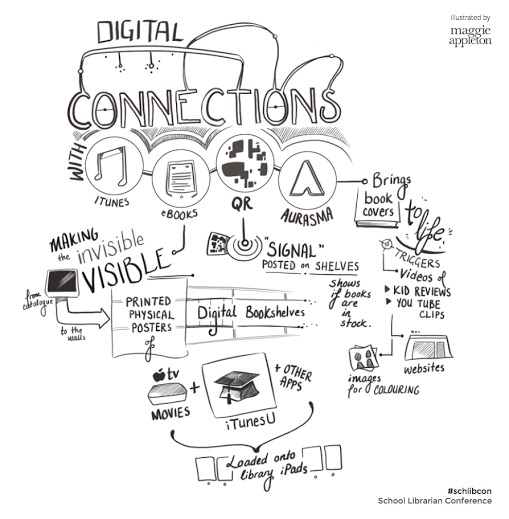
I contributed to two presentations at the conference over the weekend, one as part of our school library team on “Making the invisible visible” which was how through the use of posters, placeholders and QR codes we try to show our patrons and users what our digital tools and resources are.  The other was to highlight some aspects of INF533 on digital literature and to encourage teacher librarians to think about how digital story telling could be incorporated into library programs or at least to build some awareness of its potential.

Katie, Barb, Nadine DigiConnections


My presentation is here (my other professional blog), and I also put up some resources and further reading as I only had a 5 minute presentation!

School Librarian Connection Conference Hong Kong

Over the weekend I was fortunate enough to attend some professional development in Hong Kong, SCHOOL LIBRARIAN CONNECTION created and co-ordinated by the super-librarian Dianne McKenzie of LibraryGrits fame (subscribe to her blog – it keeps me learning and thinking inbetween formal conference opportunities – she also writes some very interesting reflections as part of her COETAIL learning experience in “Wagging my Coetail”).

All the presentations were excellent, and Dianne had done a great job on creating themes around which the presentations were grouped. We also had the very talented Maggie Appleton doing some visual note taking (see below)

Image by Maggie Appleton


which was an exciting new development in PD for me – enhanced by Shirley Chan telling us how to involve our students (and ourselves) in visual note taking with some hand tips and tools of implementation.  For example, a visual notetaking blog and a rather nice video for getting started

Other interesting bits and pieces were the talk on library advocacy – using the 6 principles of influence of Cialdini Reciprocity; Commitment (and Consistency); Social Proof; Liking; Authority and Scarcity from a course by Wendy Newman in Edx.

The ongoing genrefication of the non-fiction section.


Building a LOTE collection at an International School

Most international schools have a sizeable student population who speak a language other than English (LOTE), and offer language instruction in either mother tongue or second language at various levels. The question then is what role the school library plays in building a LOTE collection and how this can be financed and what other options exist.

Both the IBO (International Baccalaureate Organisation) and UNESCO encourage schools and learning communities to provide active support to promote learning and maintenance of mother tongue (Morley, 2006; UNESCO Bangkok, 2007). A school library’s aim should be to ensure that the LOTE collection supports the aims of the school for classroom instruction and external examination, pleasure reading and exposure to the literature of the various cultures of the campus community.

IMG_8834

A review of the LOTE collection can be undertaken in the following steps: an overview of the existing collection; information gathering on the language profiles of the school community (students, parents, educators); understanding of the language provision at the school including mother tongue and second language acquisition; reviewing LOTE collections in the community; creating a LOTE collection development policy and other considerations.

Overview of the existing collection

Initially it is important to gain an overview of the school’s existing collection and how that is catalogued. If our school is anything to go by, there will be reading books, language text books (temporarily as they get loaned out at the start of the school year), and language teaching resources for teachers in the library. Those are the books we know of. However, depending on how tightly or loosely the library manages resources, individual language departments or teachers may have anything from vast to tiny collections in their classrooms purchased by departmental budgets (or often the purse of the teacher) which are neither catalogued by the library nor even known of outside of that department. This will differ from school to school depending on the amount of control the library has over resource budgets, the amount of sharing that goes on and the co-operation between the library and departments.

Even finding out the extent and location of resources can potentially be a political minefield, so proceed with caution and bear in mind what may seem to be an innocent question / request on your side may be misinterpreted on theirs …

Language profile of the school community

Try to understand the language profile of your school community. Are there any significant language groups within the student, parent or educator body? Think carefully where you get this information from – for example if the school is English medium, parents may put “English” as the mother tongue and the mother tongue as a second language or even omit other languages spoken at home completely in any admissions documents. Hopefully the school does some kind of census that is separate from the admissions process. Does the Parent Association have language or nationality representatives who can support the library, financially or otherwise?

Understanding school’s language provision

In addition you need to establish how many students follow which language streams in the various sections of the school, and gain an understanding of the various levels. Hopefully language teachers are cooperative and enthusiastic in explaining the needs of their students for books that encourage reading outside and around the curriculum and for pleasure, not just what is required in the classroom. They should also be able to help with the levelling of materials to ensure a culture of reading is sustained in all languages not just English and students are not frustrated with the complexity of materials available but the library has a range of materials at all difficultly levels.

IMG_8856

Reviewing LOTE collections in the community

In the International / expatriate community, LOTE collections often exist outside of the school. Need for LOTE resources in a particular language is not necessarily a function of number of L1 (mother tongue) or L2 (second language) speakers. For example in Singapore, a few sizeable language communities (Korean, Japanese, and to a certain extent Dutch and French) rely on language and culture centres in Singapore spo

nsored in part by their National Governments, while the Singapore National Library holds Chinese, Malay and Tamil books. The role of the library would be one of collaboration and directing these populations to the relevant resource, (e.g. through the website and inter-library loans) rather than building up a potentially redundant collection. If the community has any International schools that focus primarily on one language (in Singapore this includes the German, French, Dutch, Korean and Japanese schools each with their own library), they could be approached for reciprocal borrowing or interlibrary loan privileges. Embassy and cultural attaches may be another source of funding or resources.

Creating a LOTE collection development policy

Depending on the size and status of the LOTE collection, it may not be necessary to create a separate LOTE collection development policy (CDP). LOTE collection issues can be dealt with within the overall CDP.

For example, the library strives to a goal of up to 20 books, excluding textbooks, per student. LOTE books can be expressed as a meaningful percentage per language of this aim.

Provision should be made for language teachers selecting books with input from parents or native speakers in the college community. Use can made of various recommendation lists including that of the IB Organisation (IBO) and collaborative lists of the International School Library Networks and language specialist schools.

Acquisition may be a tricky areas where books are either not available locally, are prohibitively expensive or are not shipped to the country. Provision often needs to be made for the acquisition by teachers, parents or students during home leave and reimbursed by the school. However, the budget and type of books needs to be vetted in advance so that there is little chance of miscommunication on either the cost or type of books thus acquired. A LOTE selection profile, such as that created by Caval Languages Direct (Caval. n.d.) can be adapted to fit the school’s needs.

IMG_8846

As far as possible, it would be helpful if the library processes and catalogues all books which the school has paid for, irrespective of whether it came from the library budget or not. In this way, the real collection is transparent, searchable and available to the whole community (on request obviously for classroom / department materials) and to avoid duplication in acquisition or under-utilisation of materials.

Cataloguing LOTE materials can be a challenge, particularly if they are not in Latin script. It is important to still have cataloguing guidelines that are followed to ensure consistency and ease of search and retrieval. Our school makes use of parent volunteers and teachers who fill the data into a spreadsheet that is then imported into our OPAC system. Our convention is to have the title details in script, followed by transliteration, followed by translation in English. Search terms need to be agreed with by the LOTE collection users, such as language teachers and students.

As far as donations are concerned, the library still needs to have a clear policy on what books they accept and in what condition. Although donated books may be “free”, they are not without cost, including processing and cataloguing cost.

Apart from physical books, it is worthwhile looking at what resources are available online either as eBooks or as other digital resources. For example BookFlix and TumbleBooks offer materials in Spanish. Often individual language departments maintain their own lists and links to digital resources, which could be incorporated into a Library Guide and made available to the whole community.

Budget may be a contentious area and often language material discussions occur at administration or department level without the involvement of the library and an expectation may exist that the library will provide LOTE “leisure reading” materials within its overall resource budget perhaps without an explicit discussion on the matter or a breakdown between resources and budget of the various languages.

Other considerations

International schools are a dynamic environment, and a language group may be dominant for a period of time and then disappear completely due to the investment or disinvestment of multi-national companies in the area. IB schools face the need to provide for self-taught languages and any changes made by the IBO and the school from time to time. The IBO currently offers 55 languages, which theoretically could be chosen. The IBO introduced changes in its language curriculum in 2011, substantially increasing the number of works that need to be studied in the original language rather than in translation. This places an additional burden on the library to have sufficient texts in the correct language available on time.

The socio-economic demographic of students with LOTE needs should also be considered. If most of the student body comes from a privileged background where LOTE books are purchased during home leave, the school could institute donation drives where “outgrown” books are donated to the school. It would be more equitable to use resources for scholarship students in order to maintain their L1 even if these languages do not form a large part of the communities’ LOTE.

The quality of materials in Southeast Asian languages is generally extremely poor. The cost of acquiring, processing and cataloguing the materials far exceeds the purchase price and books deteriorate rapidly. There is considerable scope for moving to digital materials, however the availability, format, access, licensing issues and compatibility will have to be investigated.

Schools, in conjunction with parents, needs to consider language provision for students who plan on returning to a LOTE university after graduation.

Centres of Excellence

A literature review suggests that the centre for excellence and expertise in building LOTE collections is Victoria Australia, (Library and Archives Canada, 2009), in fact the International Federation of Library Associations and Institutions (IFLA) Multicultural Communities Guidelines for Library services is based on their guidelines (IFLA, 1996). These guidelines suggest the four steps of; needs identification and continual assessment, service planning for the range of resource and service need, plan implementation and service evaluation.

Some LOTE Digital resources

http://librivox.org/about-listening-to-librivox/

http://www.radiobooks.eu/index.php?lang=EN

http://www.booksshouldbefree.com/language/Dutch

http://albalearning.com

http://www.wdl.org/en/

http://www.childrenslibrary.org/icdl/SimpleSearchCategory

http://www.dawcl.com

http://unterm.un.org

Library services

http://www.lote-librariesdirect.com.au/contact/

http://www.caval.edu.au/solutions/language-resources

http://education.qld.gov.au/curriculum/lotelibrary/index.html

http://www.sl.nsw.gov.au/services/multicultural/multicultural_services_public_libraries.html

http://www.reforma.org/content.asp?pl=9&sl=59&contentid=59

http://www.cacaoproject.eu

http://chopac.org/cgi-bin/tools/azorder.pl

http://civicalld.com/our-services/collection-services

References

American Library Association. (2007). How to Serve the World @ your library. Retrieved January 4, 2013, from http://www.ala.org/offices/olos/toolkits/servetheworld/servetheworldhome

International Baccalaureate Organisation. (2011). Guide for governments and universities on the changes in the Diploma Programme groups 1 and 2. IBO. Retrieved from http://www.ibo.org/recognition/dpchanges/documents/Guide_e.pdf

International Federation of Library Associations and Institutions. (1996). Multicultural Communities Guideline for Library Services. Retrieved January 4, 2013, from http://archive.ifla.org/VII/s32/pub/guide-e.htm

Kennedy, J., & Charles Sturt University. Centre for Information Studies. (2006). Collection management : a concise introduction. Wagga Wagga, N.S.W.: Centre for Information Studies, Charles Sturt University.

Library and Archives Canada. (2009). Multicultural Resources and Services – Toolkit – Developing Multicultural Collections. Retrieved January 4, 2013, from http://www.collectionscanada.gc.ca/multicultural/005007-302-e.html

Morley, K. (2006). Mother Tongue Maintenance – Schools Assisted Self-Taught A1 Languages. Presented at the Global Convention on Language Issues and Bilingual Education, Singapore. Retrieved from http://www.ibo.org/news/documents/morley2.pdf

Reference & User Services Association. (1997). Guidelines for the Development and Promotion of Multilingual Collections and Services. Retrieved January 4, 2013, from http://www.ala.org/rusa/resources/guidelines/guidemultilingual

UNESCO Bangkok. (2008). Improving the Quality of Mother Tongue-based Literacy and Learning Case Studies from Asia, Africa and South America. UNESCO Bangkok Asia and Pacific Regional Bureau for Education Asia-Pacific Programme of Education for All (APPEAL). Retrieved from http://unesdoc.unesco.org/images/0017/001777/177738e.pdf

Creative Commons License

This work by Nadine Bailey is licensed under a Creative Commons Attribution-NonCommercial-ShareAlike 4.0 International License.
And an extra blog post …

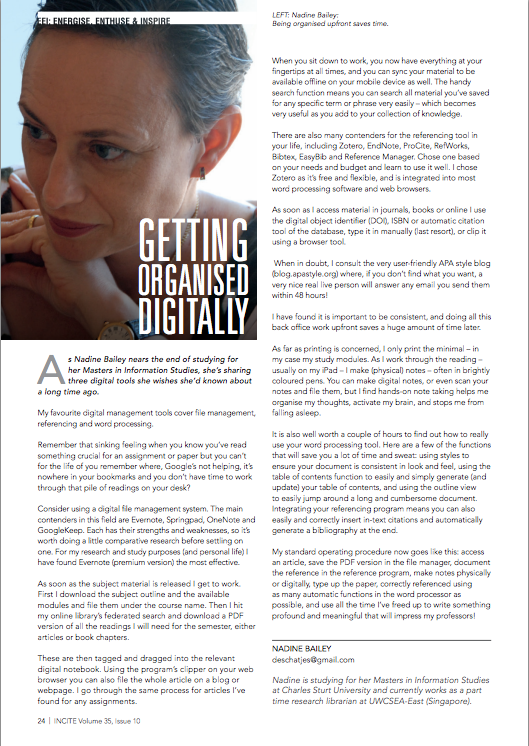
Here is an article I wrote for Incite on getting organised for studying – it was aimed at students and professionals but could be adapted for younger students.  Writing an article is an interesting process as you have a very tight word limit and need to conform to what the journal or magazine considers the correct format / design.

For example, in my first draft, I had a lot of images and it was more a “step-by-step” process type article of how to use 3 specific tools.

The editors didn’t want to be endorsing any specific tools, so I needed to do some more research and make the tools more generic and the article more general, which I can understand, but at the same time I think it made it less concrete and useful for students who don’t want to over think the matter and just want to take a tool and learn how to use it.

If it were up to me I DEFINITELY would not have had my picture taking up 1/4 of the valuable space!  Like I said earlier, I’d have put in more images on how to use the tools with screen shots etc.

All in all it was a valuable experience, and I was very gratified to see the positive responses it garnered, I was even approached by someone from UNESCO to request permission to post it on their UNESCO’s WSIS Information Literacy listserv (thank you Judy O’Connell for promoting the article).

Blog post 5: Review an electronic resource about delivering services to children or young adults – Asian Young People’s Book Awards

1. A detailed description of the activity undertaken:

A new young people’s book award has recently been set up in Hong Kong – the Golden Dragon Book Award. I decided to review the website supporting the award and to compare and contrast that with the websites supporting the other young people’s book awards in Asia, namely the Panda Book Awards (China), Red Dot Book Awards (Singapore) and the Sakura Medal (Japan). What all these book awards have in common is that they have been created for young people attending International Schools, and they therefore feature English Language Books, not necessarily the language of the “host” country of the award, except for the Sakura Medal, which has Japanese books.

Golden Dragon Book Awards
Panda Book Awards
Red Dot Book Awards
Sakura Medal
URL
Type of site
Weebly
Wikispace
Google Sites
Weebly
Country
Hong Kong
China
Singapore
Japan
Founders/Run by
Association of Librarians in English Speaking Schools (ALESS) in Hong Kong

International librarians throughout China

 International school librarians Network (ISLN) in Singapore

Librarians from international schools

Year Started
2014
2009
2009
2006
Categories
Four  (ages 4-6; 7- 10; 11-14; 15-18)
Four  (Younger Readers; Middle Readers; Older Readers; Mature Readers)
Four  (Early Years; Younger Readers; Older Readers; Mature Readers)
Nine  (Picture Books; Graphic Novels; Chapter Books; Middle School; High School; Japanese Picture Books; Japanese Chapter Books; Japanese Middle School; and Japanese High School)
# Schools
Not mentioned
32
Not mentioned
20
# Students
Not mentioned
Not mentioned
Not mentioned
15,000
Criteria
Not mentioned
No more than 2 years old
Published in English in the last 4 years
No more than 2 years old
Long List
8 books per category
8-10 books per category
8 books per category
25-30 books per category
Resources
Promotional Material including Brochures, Stickers, Book ordering, video, slideshow
Promotion materials including: voting posters, category posters, stickers for books and badges, bookmarks, printers for big posters, videos / slideshows / images
Interactive elements
Not on site – see social media
None
Not on site – see social media
Commenting allowed on site (moderated)
Related competition?
None
None
Related social media
None
The first thing that strikes one is that the websites are fairly comprehensive, but are very much geared toward the librarian rather than the students. Resources are geared towards promotional material such as brochures, stickers and bookmarks.  The Golden Dragon and Red Dot sites had some videos, slideshows and images, however it was not apparent that these were created for students or for the teacher / librarian. Further, none of the sites had any real interactive elements, where available, these were taken “off-site” to Twitter, Goodreads, Facebook or Diigo – again these elements were geared mainly to the teacher / librarian rather than the students.

The nominations or selections for the long-lists was not explicit on any of the sites but appears to be something done by a committee, whereas the voting for the award winners occurs physically at the various schools by the pupils with a variety of criteria (such as students having read a number of the books).


2. Answers to the following questions:

What did you learn?


A website that serves teachers / librarians indirectly is a resource for children or young adults inasmuch as it supports them in delivering a service – in this case access to recent, high quality books as part of a book award selection process.


How was the activity relevant to your professional practice?


In my practice I will probably assist with either the nomination or selection of a long list as well as with the promotion of long-list books and the encouraging of students to read. 


Were any gaps in your knowledge revealed? How might you fill those gaps?


Comparing different awards in Asia has allowed me to reflect on the award we run in Singapore and particularly to consider how sites could be made more interactive and more relevant to our students, not just indirectly through helping the teacher / librarians but more directly.

3. References

About – Golden Dragon Book Awards. (n.d.). Retrieved September 30, 2014, from http://www.hkgoldendragonawards.org/about.html


Panda Book Awards – home. (n.d.). Retrieved September 30, 2014, from http://pandabookawards.wikispaces.com/


Red Dot Book Awards 2013-2014. (n.d.). Retrieved September 30, 2014, from http://www.reddotawards.com/home


Sakura Medal  – Sakuramedal. (n.d.). Retrieved September 30, 2014, from http://www.sakuramedal.com/sakura-medal.html


Blog post 4: Analysis of a peer-reviewed journal article – Censorship & Diversity

1. A detailed description of the activity undertaken

In July 2014 the Singapore National Library censored, removed and pulped all copies of three children’s books with a gay-theme (Lee, 2014; Vincent, 2014). This created quite a lot of news and brought to light the question of public interest and individual right of access to diverse material versus majority consensus and community values (Schrader, 2009; Weisman, 2009).

I wanted to read more about the impact of public opinion on censorship and how librarians could best understand and counteract attempts to remove books from the library, and therefore chose the article: “Removal of Gay-Themed Materials from Public Libraries: Public Opinion Trends, 1973-2006” (Burke, 2008) for review. 

In the article, the author examines data from the General Social Survey (GSS), in the USA over the indicated period, related to survey answers on the removal of a homosexually themed book, and attempts to relate this to other questions on demographic and geographic factors and personal belief.  She concludes that people are becoming less conservative viz a viz homosexuality and even if people do not believe homosexuality is wrong, they generally do not support the removal of gay-themed books and the trend is downwards in all groups. Higher educated and younger people were less likely to support removal and the largest variation in data was to be found in people from different religious backgrounds and between denominations, with people self-reporting stronger beliefs more likely to support removal.  Gender and political party affiliation was neutral.

In relation to the Singapore situation, the relationship between belief and supporting removal is the most relevant.  Singapore is known as a strongly religious community and it has been implied that political and social power is concentrated in conservative Christianity (Waipang, 2011).  It also appears that the books were removed under pressure from a targeted campaign originating in one of the religious organisations. 

2. Answers to the following questions:

What did you learn?

The most interesting finding from the article was that although people may not accept homosexuality, they still did not believe that books with homosexual themes should be removed from library collections and thereby not be accessible to those with lifestyles different to them.

How was the activity relevant to your professional practice?

Reading the article (Burke, 2008) and also reading related articles (Gutman, 2010; Lukenbill & Lukenbill, 2007; Schrader, 2009; Weisman, 2009) gave me a better insight into censorship challenges to books and the positive and professional duties of a librarian within the framework of ethics, inclusive service, access to information and guarding against discriminatory or censorship practices. 

Were any gaps in your knowledge revealed? How might you fill those gaps?

Until now I didn’t have a very clearly articulated view on censorship beyond the fact that I didn’t think it was appropriate. The articles I have read have given me some concrete strategies for dealing with challenges to books in the library as well as an opportunity to revisit our collection in the light of recommended books.


3. References

Burke, S. K. (2008). Removal of Gay‐Themed Materials from Public Libraries: Public Opinion Trends, 1973–2006. Public Library Quarterly, 27(3), 247–264. doi:10.1080/01616840802229552

Gutman, D. (2010). How I Corrupted America’s Youth. School Library Journal, 56(5), 28. Retrieved from http://ezproxy.csu.edu.au/login?url=http://search.ebscohost.com/login.aspx?direct=true&db=ulh&AN=50337475&site=ehost-live

Lee, P. (2014, July 13). 400 gather outside National Library for reading event in response to NLB’s removal of three books. Retrieved August 8, 2014, from http://www.straitstimes.com/news/singapore/more-singapore-stories/story/250-gather-outside-national-library-reading-event-respon

Lukenbill, W. B., & Lukenbill, J. F. (2007). Censorship: What Do School Library Specialists Really Know? A Consideration of Students’ Rights, the Law and Implications for a New Education Paradigm. School Library Media Research, 10.

Schrader, A. M. (2009). Challenging Silence, Challenging Censorship, Building Resilience: LGBTQ Services and Collections in Public, School and Post-Secondary Libraries. Feliciter, 55(3), 107–108.

Vincent, A. (2014, July 11). Singapore pulps childrens books about gay parenting [News report]. Retrieved August 8, 2014, from http://www.telegraph.co.uk/culture/books/booknews/10961880/Singapore-pulps-childrens-books-about-gay-parenting.html

Waipang, A. (2011, August 6). Singapore’s religious landscape from Census 2010 [Weblog post]. Retrieved September 18, 2014, from http://yawningbread.wordpress.com/2011/08/06/singapores-religious-landscape-from-census-2010/

Weisman, S. (2009). A Review of “Challenging Silence, Challenging Censorship”: Shrader, A. and Wells, K. (2007). Ottawa, Canada: Canadian Teachers, Federation. Journal of LGBT Youth, 6(1), 92–96. doi:10.1080/19361650802379805

Blog post 2: Interview – running a successful parent volunteer program in a school library

 1. A detailed description of the activity undertaken

The librarian of the Singapore American School was interviewed on how to run a successful parent volunteer program. In answering all my questions and showing me the library she explained the process of recruiting and training volunteers, the type of tasks that volunteers do, potential problems and pitfalls and how to handle them and how to show your appreciation. We ended with a tour of the library.


Recruitment takes place early in the year at events that are likely to attract a lot of parents.  The initial training is 90 minutes long and focuses mainly on library organization and the shelving of books and expectations of the volunteers including etiquette and behaviour. It was interesting to hear the expectations regarding commitment and responsibility to the role, and this one area our library has struggled with in the past.
 New recruits are initially paired with more experienced volunteers. Depending on their volunteer role and interest, some volunteers also receive training in FollettDestiny (the library system) and are given restricted rights based on what they need to accomplish.


Volunteers are also involved in longer term projects such as the collection genrefication and with special events such as the Red Dot awards, Readers’ Cup and Battle of the Books.

We concluded with a discussion on the importance of showing appreciation and the ways in which this could be done.

2. Answers to the following questions:

What did you learn?

Recruiting and supporting parent volunteers is an important task in a school library that is short staffed. If volunteers are able to take over some of the shelving and book processing tasks, librarians are freed up to spend more time teaching, performing reader advisory tasks and helping with curriculum related tasks. There is an art and a skill to keeping volunteers engaged and committed to helping in the library.

How was the activity relevant to your professional practice?


We have had parent volunteers but we have not been systematic in our recruitment, training and appreciation of them. As a result the program was not as successful as it could have been. I now have a better appreciation of the process and can apply it to our school situation.  

Were any gaps in your knowledge revealed? How might you fill those gaps?


I had many questions as to why our program was not working well, and through the interview and visit was able to answer many of them. In addition, the librarian lent me the ALA book: “Managing Library Volunteers” (Driggers, 2011) so I could read further on the matter.

3. References:


Driggers, P. F. (2011). Managing library volunteers (2nd ed.). Chicago: American Library Association. 

Activity 2: Interview – running a successful parent volunteer program in a school library

Libraries in general, and some school libraries in particular are not known for having a surplus in staff. Many therefore consider turning to parent volunteers to help out with a variety of tasks.  
Some libraries manage this better than others, and here in Singapore, the Singapore American School is known in our network for having a very well run, well functioning library parent volunteer program. They have 35-40 regular weekly parent volunteers and more than 50 parents who are involved in one-way or another in the library as well as a group of committed high school student volunteers. 
So this morning, I went over to interview Kate Brundage, the Elementary School Librarian who has been running a successful program for the last five years.
In answering all my questions and showing me the library she explained the process of recruiting and training volunteers, the type of tasks that volunteers do, potential problems and pitfalls and how to handle them and how to show your appreciation. We ended with a tour of the library.

The process of recruiting and training volunteers

Parent volunteer form
Recruitment generally takes place at the beginning of the school year when sign-up forms are distributed during open-house sessions, back to school night, the first parent coffee mornings and are also shared with classroom teachers.  The library hosts a parent coffee morning and talks to the parents about library service and the benefits of being a volunteer.  During the school year, the librarians have an active partnership with classroom teachers, whereby parents who tend to “hover” or want to be overly involved in the classroom have their energies directed to the library where they can make a meaningful contribution to the school as a whole.
The initial in-service training takes 90 minutes and parents are introduced to the library organization, explanations on shelving are given and parents are given guidelines on what to do with damaged books and other commonly encountered problems.  The desk and mobile circulation systems are explained and other projects and service opportunities are introduced.  New parents are then buddied with existing volunteers who provide further training “on the job”.
Parents are also encouraged to team up with close friends or with people who speak the same language as themselves, if they are not comfortable or fluent in English. Depending on their volunteer role and interest, some volunteers also receive training in FollettDestiny (the library system) and are given restricted rights based on what they need to accomplish.
The library makes it clear on the form, and in their talks that the main priority for volunteers is shelving, as this frees up the librarians to spend more time teaching and interacting with the children and transferring their librarian knowledge and expertise.
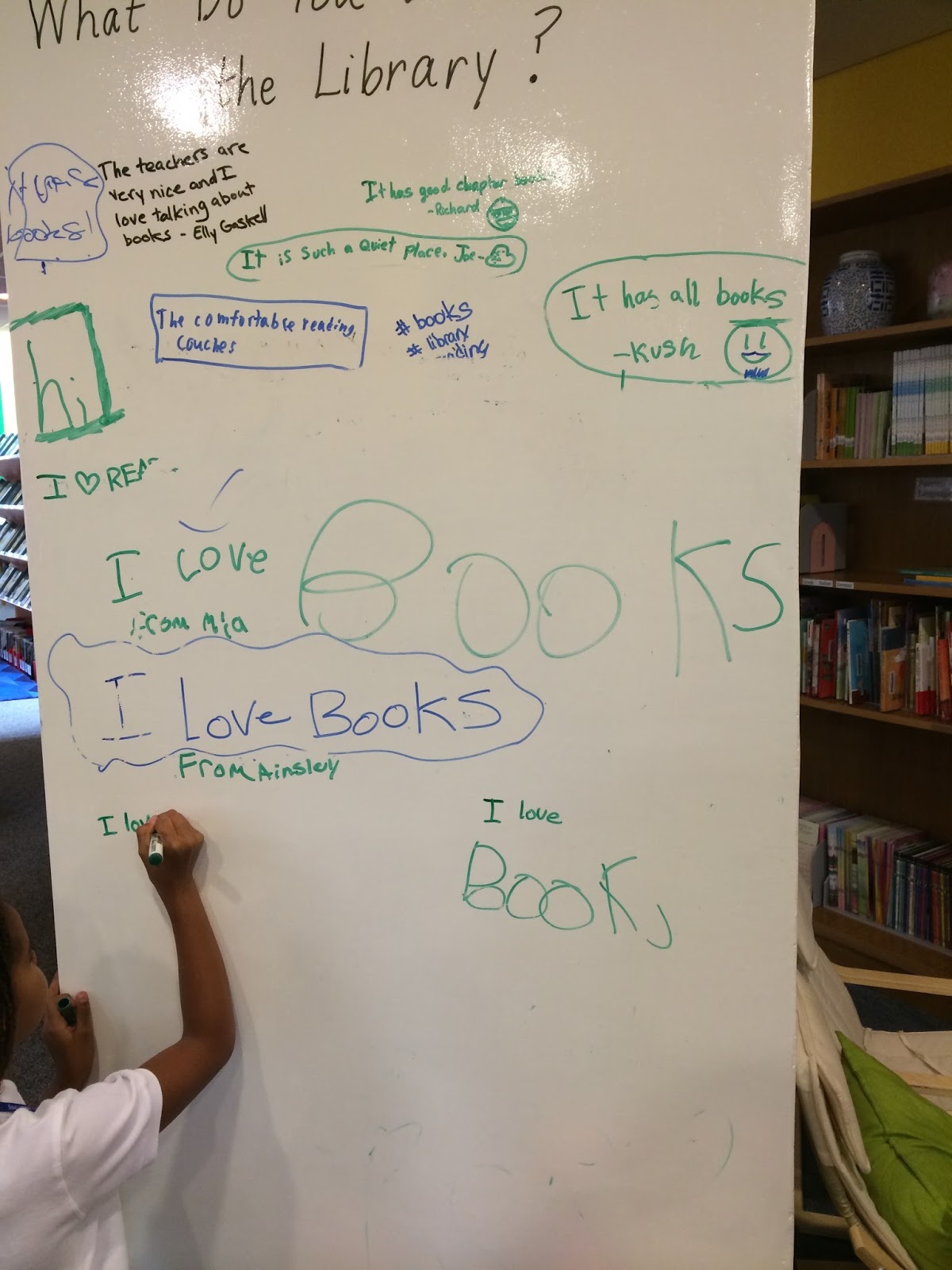
The creation of a “writing wall”
was a parent volunteer idea
Besides the parents, the High School pupils can also sign up to be library volunteers as part of their service program.  A similar training program is given to them, and they are also encouraged to be ‘book buddies’ with the younger students.
It is emphasized that although this is a volunteer position, the library is counting on the commitment of the volunteers, and should they not be able to come for whatever reason, it is their responsibility to find a replacement, from the list of trained volunteers, to take their place.  Volunteers are also required to commit to a minimum of 3 hours per week on a consistent basis.  The volunteer roster is changed every 3 or 4 months giving new volunteers a chance to join up and also to change around times should situations change or if people are found not to work well with each other (e.g. friends spending too much time chatting rather than volunteering!).  Volunteers are encouraged to be active readers so as to better understand children’s literature, the needs of young readers and the availability of books of different genres and difficulty in the collection.

The types of tasks volunteers do:

Parents assisted with the genrefication
of the picture book collection
Although the primary task is shelving, and with the huge collection the school has this is a very important task, it is acknowledged that it is not the most exciting task and needs to be interspersed with other tasks that may be more stimulating.  For example parents help with include circulation – checking in and out of books either at the check-out desk or using the mobile apps the school have. Parents are also involved in longer term projects such as the current genrefication of the library, pushing books out of the library to classroom libraries, documenting and photographing the puppet and soft-toy collection into a visual album.  Depending on their skills and interest, parents also create displays, help with signage and other graphic design, and help children in the shelves with choosing books, or with occasional story telling and reading.  Annual special events such as the Battle of the Books, the Red Dot Awards, author and illustrator visits and the Readers’ Cup Challenge also provide the opportunity for parents to take ownership of a project and help the library in this way. For example during an author or illustrator visit, the volunteers will manage the ordering process.  Parents also do “shelf-reading” to ensure that books are properly shelved and to check missing or damaged inventory. A new project coming up is the creation and maintenance of a makerspace area, and volunteers will definitely be involved in that.
Sorting and organising special materials
Parents are asked on signup if they have specific skills or preferences, including foreign language skills where they can help with cataloguing, shelving and ordering of LOTE (languages other than English) materials.  Even stay-at-home-parents are catered for!  Parents who want to volunteer but cannot come into the library due to younger children or other difficulties have tasks sent home to them like creating resource lists or checking inventory and creating order spreadsheets from mark-ups in the SLJ or other book reviews.

Potential problems and pitfalls

Occasionally parents may be motivated by less altruistic ideals, and exhibit behaviors such as just assisting their own children in the library, or may have a hidden agenda, such as censoring books in the collection. Kate emphasized that this was extremely rare, but had to be dealt with firmly.  At all times the fact that it is a partnership for the benefit of all children. Most problems can be pre-empted by being clear about expectations during the initial in-service training. Common etiquette things such as not using mobile phones, deferring to the librarians and teachers, not interfering with the class experience, not disciplining or shaming children, maintaining respect and supporting all children are clearly outlined.  The three month volunteer cycle also allows for a review of which volunteers are in which roles and at what times and this can be changed if necessary.

Showing appreciation

The library hosts two parties during the year, one before Christmas and one at year end.  Catering part of the library budget and parents are given small thank-you gifts such as flowers or vouchers for Starbucks or movies, candles and holiday bookmarks.  They are also given first choice in books that are being weeded from the collections.
During the year, the librarians take regular snapshots of the volunteers that are then made into an appreciation video that is shown at year-end, and some photos are put in the annual yearbook.
ALA Book on managing Volunteers
After a tour of the library and seeing some volunteers at work, Kate then very kindly lent me the new ALA book “Managing Library Volunteers” so that I could look through it while I was in the process of setting up our volunteer program at school.