Storage, seating and signage

I’ve been meaning to write this for the longest time – after the library renovation / redesign what is working and what isn’t. For the history have a look under make-over or library design posts and categories.

I was prompted to write this really due to three main questions that have been floating around the Facebook librarian groups that I’m a member of. The questions of storage, seating and signage.

Storage:

There was a question this morning about an administrator who expected the new school library to have no storage except a desk with two drawers …


Screen Shot 2017-08-12 at 4.00.04 PM

Now I’ve never seen this in a library, BUT when I went for a tour of the Lego regional hub in Singapore where each employee is give a 30cm2 cubby for all personal things and for the rest

IMG_3268

of the time they just hot-desk it. Any desk left unoccupied for more than 30 minutes gets its stuff removed! It did look very sleek, but sounded like something that would be pretty hard to adapt to.

I did try in our library to have the ability to hide the things that don’t need to be seen, while ensure that my staff and I still had a workable situation given the fact that a lot of what happens in libraries is about processing and storage!

First off the circulation desk. This is one of the prime examples of something that looks good but isn’t very functional. It’s a case where design won over best practice according to the literature and best instinct according to what was logical. But it looks nice. Says everyone who sees it.

It’s circular. It looks nice. But one of the first things they warn you against in library design 101 as it’s not very practical. And on the right side, instead of having the circle go to the wall I insisted out of health and safety concerns (we’re a primary library) that we could “get out” to attend to the “floor” very quickly. So it had to be open on both sides. So that means we lost about 50cm on the side. Which meant that the 3 chairs are pretty squishy next to each other. Which is good and bad – good because it means that it’s not really comfortable so you’re kind of forced to be up and moving and on the floor and doing people/book type things. Not so good because when 3 of you need to be there for a big class or year end check ins, there just is not enough space.

And the drawers. They don’t all open at once, so it’s a case of “you first, no you first” – luckily my ladies have a sense of humour and get on with each other.

We have some good processing space at the back, with a sliding surface that pops out to create extra space when you need it. That’s handy.

Cupboard storage

I had all those boxes of literature circle multiple copy books in my room and I didn’t want them in a space that students and teachers didn’t consider to be public. But we didn’t want boxes and boxes cluttering the space. some of the nicer spaces I saw had used sliding doors with writable surfaces in their classes or libraries, so we used that idea. The top and right photos is the storage with and without doors.  What you can’t see in the photo is that the projector screen comes down in front of the cupboards during presentations and the doors can be shifted to the sides for writing on while projecting. The bottom photo the sliding cabinets where all the PM readers are kept in a side class.

Good and bad of this – I love the fact that it looks so neat. But the doors have a habit of “jumping” their tracks and since the writeable surface is glass I’m nervous of kids opening it without an adult around. Also the glass surface can only be written on in black or dark blue – other colours don’t show up.

Seating

Way back in the day all I wanted was better seating where the chairs legs didn’t stick out with everyone tripping over them all the time (top left photo). Then I got a complete renovation and someone (not me) left the seating out of the budget. Then I got the budget and my seating! Yay!

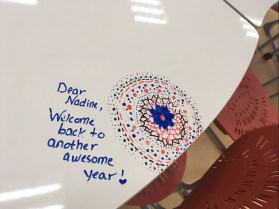
I must admit I really love my Furnware chairs and tables. My students love them too and my teachers are just a little big jealous of them – but they’re still sweet enough to leave me nice notes
img_5927.jpg

on the writeable surface! The chairs are quite heavy, but stackable and the “rocky” children love the fact that they can wiggle without falling over backward.

The beanbags are a mixed bag. Another no-no if you ask librarians, but on the balance I’d say I’m glad we have them. We have 12, and so far only one has had an issue with a zip, and that’s been repairable. My students were warned that if they “died” an unnatural death due to abuse they wouldn’t be replaced and they’ve been fairly good about policing each other about the usage. They’re super light and moveable, and it’s lovely to see how the students create their own spaces either sociable or isolated by the positioning of themselves relative to the bag and other bags and people.

We have 2 of the green armchairs, which are good for adult sized people and a couch in the classroom. Since it’s a primary school though – they also spend a lot of time sprawled out on the floor or on the mats. (Don’t you love the sense of humour – some of my kids left Bear reading a book after recess one day).

There is of course a lot of dragging bag back into place after recess ready for class, and I really need some kind of solution for my side classroom as it’s not ideal, but I need time to think about it and live in it more first.

Signage

We went with Merchandising Libraries for our signage and on a whole I’m quite pleased with how it turned out. We used their shelf-talkers, fiction section dividers and junior section dividers. We used plain black with white to go with our corporate look and feel. for the “inbetween” bits I use old VCR holders and print out the signage black background, white lettering. Cheap and good looking.

I had to order in a hurry to have it ready, and order everything at once and I only had the catalog rather than physical objects to go by.  This is what it looks like:

If I had to do it over, I’d stay with the Junior section dividers and the alphabet for my fiction sections but another solution for the picture books and junior section as the A-Z tends to stick out too much for little people with a poor sense of  proprioception. I also regret the fact that I don’t really have a good place to signal dewey. I’m still thinking about hanging something from the ceiling, but I hated that when I first arrived, so I’m going to have to think some more.

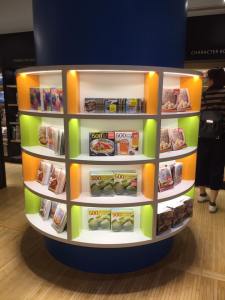
Part of signage is display space, and I’m really happy with that. The thin slats at the door and space above allow really flexible displays of books and student work.  And I love my pillar disguising round display space. Yes the variable signage above the slats could be better than just print outs on paper – ideas?

Next project – well, my children’s orthodontist had THIS in his surgery – talking to our open-minds coordinator about doing something similar when our G2’s have their plants unit …


Reduce, reuse, recycle and repurpose

One of the advantages of being on a tight budget with constraints, as I’ve written about before, is that it forces one into being thrifty and eco-conscious.  I just wanted to say a few words here about ways in which we managed to employ the 4R’s in our library renovation.

Library shelving is very very expensive. And there is a reason for this – it has to withstand a lot of wear and tear, be constantly shifted around and then

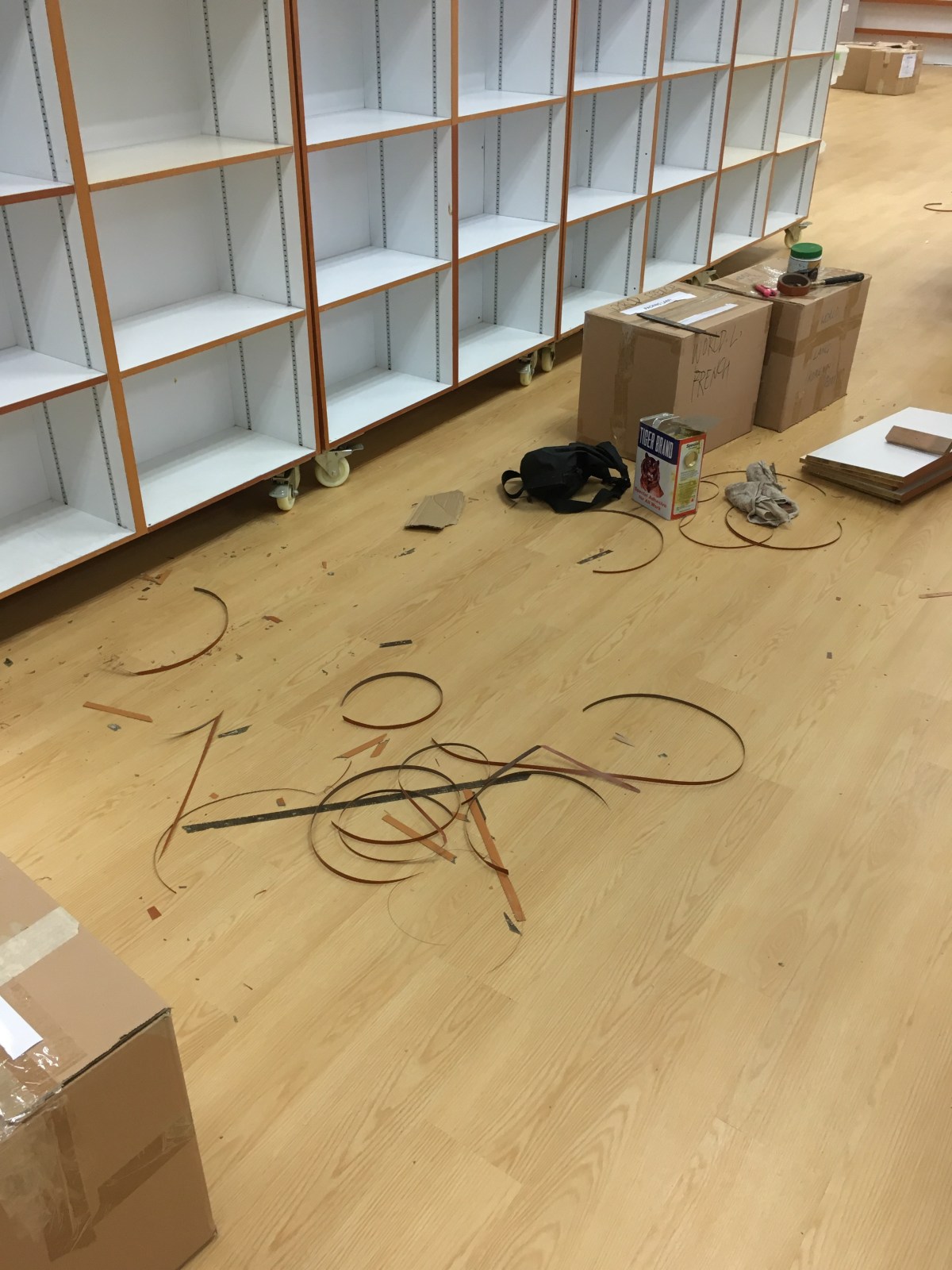
there is the question of load bearing (something our designers didn’t always take into account). Bottom line, we basically had to make do with most of the shelving we already had, and reuse it.  Not all of it was in great condition. So as part of the design brief we asked the contractor to refurbish the broken bits by re-lamination. Unfortunately this is not a very ‘sexy’ part of a renovation project, and we’re still chasing up on bits and pieces that need to be done! Most of it is looking pretty good though.

The green chairs were donated to us from our other campus, and the black shelving, and some other shelving that didn’t fit into the new design were donated by us to other classrooms and campus areas that needed it.

Other little things – our “fiction” etc. signs had a green border that looked out of place with the rebranding, so we just got some black electrical tape and taped over the green, so it looks black now. The non-glass doors got a new layer of paint, and larger glass pane windows.

The shelving above that used to hold picture books now is part of the junior section (I wanted more front facing space for our early chapter books to make them more enticing) so we inserted an extra shelf to each row to accommodate smaller books and the boxes in series.  One of our trolleys got donated to the IT department and the oldest saddest one got a new lick of paint in the same grey colour of our doors (part of the new branding) and looks just great now! The red plastic baskets found a new home in a classroom and was replaced by a wicker basket while we wait for the drop box to be completed. All our weeded books went to the PTA for their second-hand sale. And our old VCR boxes are still in use as alphabet markers in smaller collections – like Chinese fiction.

At the end of the day, besides the old tile carpeting in fact, very little ended up in the scrap heap. In fact many people when they come in have to ask what is actually new, because while everything looks new and different and lighter, they still recognise bits and pieces from the past.  I don’t think that’s a bad thing.


Firmware (& Software)

Planning for a library expansion and renovation involves considerable time, thought and work on the “hardware” of the physical building. Including last week’s work of packing up the books and getting them put into storage. I’d blogged a little about how just prior to that we’d done a lot of weeding, and sorting out patron data on our system, as somehow the physical sorting out led to a drive for digital sort out and housekeeping.

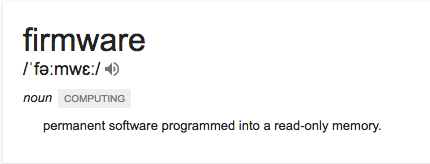
I’ve been promising for a while that I’ll talk a little about the “digital” side of the library, but first I’d like to talk about what I’d refer to as “Firmware”

screen-shot-2016-12-04-at-9-58-00-am

A characteristic of most international schools is the transience of its students, and often teaching staff. Naturally this includes the library.  In my current position I’m aware of the fact that I’m just one in a long line of librarians who have come and gone. I’m also extremely grateful to our permanent library staff, who keep things ticking over as teacher librarians come and go, each trying to put their mark on the physical and teaching environment.  They have institutional knowledge. They know what has been tried and worked or failed, and a pretty good idea of why.  I admire their unrelenting politeness and helpfulness as they cope with the latest “new broom” .

When you speak to other librarians, inevitably the conversation will come around to the fact that they’d like their staff to take more initiative, or upgrade their skills beyond shelving and circulation and basic queries.  But that is harder to realise than one would think. There appears to be a reluctance that sometimes is hard to fathom.  Some librarians have taken great initiatives in this direction – like the KL librarians under Robert George with their JAWs (Job Alike Workshop), and more recently the similar sessions initiated by Barb Reid in Singapore.  The problem with any professional development at any level is that there needs to be a compelling reason to take the learning and put it into action as soon as possible. But invariably the day-to-day tasks take over and there just isn’t enough space between relentless shelving and picking books for the next (18) Units to get the practise …

However in the last month, we’ve had to challenge the “read-only” part of the definition to its limits, with one staff member on maternity leave and the other on hospitalisation leave, and as a result, that once in a blue moon occurrence – a “firmware update” has become the new norm. So suddenly business as usual hasn’t been usual, and everyone has had to do everything all the time, with a lot of compromise and cobbling things together as we go along.  We haven’t had the luxury of designated tasks and roles, and suddenly we are all cataloguers, and weeders, and resource list creators.

I’d set aside a week for packing up the library. But I’d not calculated on the energy and enthusiasm of my staff and the maintenance staff, and the help of our Grade 5 students who made a “book train” from the library upstairs, so by the end of Tuesday we were pretty much done (and not dusted – boy oh boy, did we discover dirt and dust…). So I declared Wednesday to be systems and PD day, kept back 3 tables and chairs and we sat down and I taught everyone how to use Libguides.   We probably only spent about two hours on learning the basics, and that’s really all that is needed, because with everything it’s not about the theory it’s about using it.   Then back to some more boring stuff, getting images onto books in the collection.

And then more important, but still a little bit tedious – especially if you’re using Follett – checking through resource lists and updating visual search for all the UOIs.   Oh gosh, I’m embarrassed to say how many links were old or incorrect.

Next up was making resource lists for all the books related to all the countries our students came from. For Uniting Nations day I had made a cursory start by grouping books into continents as it was a “quick and dirty” way of getting lists out there for our “read around the world” challenge.  Now I wanted to dig deeper, so I took the list of all the student nationalities and we divided it up and started searching and added. We quickly saw the countries that were under-represented, or not even represented at all – books from / about Bulgaria anyone?

I also spent the better part of a day sorting out and adding books related to Social and Emotional Learning  based on the handout of Dr. Myra Bacsal after her talk. It also entailed adding nearly US$2,000 worth of books to a “to purchase” list, as I realised that while we did have many of the books recommended, we were also lacking in a few – and particularly in more diverse and more recent books.

Our final day in the library, around rapidly diminishing furniture – including at one point our desks, was spent putting the libguide PD into practice, as the 3 of us sat with a list of all units, all guides made and guides to be made and started putting libguides together!

screen-shot-2016-12-04-at-10-36-11-am

The previous day while my staff was helping their colleagues at our other campus, I’d been sitting with the librarians, helping them extend their knowledge of libguides, and us brainstorming ways of presenting physical and digital resources in the guides in such a way that it was easy to navigate and would ensure that students could benefit from knowing what books we had and also how to access other QUALITY resources (i.e. not just google) that we were paying for but were perhaps not being well utilized.

We decided on

  • having the central idea at the top in a floating box
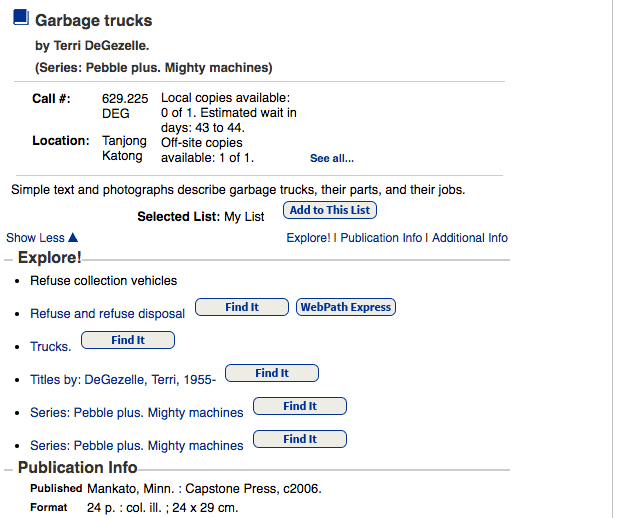
  • on the left – having a scrolling bookshelf of our unit books – using the Library Thing for Libraries book display unit. That way teachers and students could see all available books in a unit, even if they were distributed in a different classroom – and clicking on the link would take them to the book in the catalog – AND if they looked at the subject headings under Explore! would hopefully have a Webpath Express link to click on.
  • Putting some videos in the middle for our more visual / video liking students – also very handy for our ELL students with the paired speaking / images.
  • On the right having a tabbed box that could alternate between Brainpop (a staple in primary), Epic Books (easy to access and great free selection of nonfiction books for easy projection & assignment in class), Britannica (because Encyclopedia) and other links.

screen-shot-2016-12-04-at-10-40-52-am

screen-shot-2016-12-04-at-10-48-31-am

Of course nothing is simple – and even now as I look over the units, I see that some units have the UOI books around the central idea and inquiry in them and some have that plus what-ever literacy / math connection is being made (so more than half of the books are poetry for example). In the medium term all that needs to be straightened out and sorted out as well.

Also before you can add a scrolling list of books, you need a list of books … and to know how to get the books into Library things, and then into a book display widget – so I made a little screencast on how to do that!

The wonderful thing about all of this is the obvious enjoyment and pride that my staff got out of researching units and finding resources and adding them to a guide – they kept on saying “this is so interesting”, and “this is so creative”.  Of course it is not a “quick” thing, I’d say on average a very basic guide at primary level that is reasonably complete will take around 3 to 4 hours. And then one just has to hope that the units don’t change every year!

All in all, and incredibly productive week, and also my staff finally “gets” the fact that my drive for automating student update and photo import etc. etc. is not to put them out of a job, but to free them up to do more interesting and meaningful work.  After we talked about that, one staff member said “and now to automate the shelving!” amen to that!


Make-over update

When I tell people we’re getting to renovate and extend our library their first reaction is “wow, that’s amazing, you’re so lucky!”. And yes, prima facie it is so. But right now it’s feeling rather overwhelming. And ironically most of that is not so much to do with the change as the amount of preparation that needs to be done. Speaking of change – you HAVE to get “Bug in a Vacuum”

I am a veteran of moving. 10 countries in 24 years plus countless internal moves in those countries and 3 moves in the last 5 years. I know it pays to be prepared and to clean and clear before the move. And as I remarked in my last post, a lot of that cleaning and clearing happens behind the scene.  Things are slightly more complicated as well due to well, life. Unforeseen circumstances. Like one staff member on maternity and another on hospitalisation leave. And part of my gratitude thoughts each day are for my remaining staff member who is picking up a lot of the slack and the temporary staff member who is happy to learn the ropes and keep things ticking over. And the other temp who has been coming in and the occasional parent or volunteer for their kindness.  But it does slow things down as we adapt and learn.

So, significant but time consuming things that have been done this week – including taking up time in my weekends – those weekends that I thought would be computer and work free now that I’ve finished my M.Ed!

  • Putting patron photos into FollettDestiny  – easy in theory but quite a lot of preparation work – including learning all sorts of new Excel tricks on how to add things before and after text in cells!  And of course 90% goes well, but the 10% that bombs out, takes 90% of your time to trace why an upload didn’t work, what went wrong and how to remedy it.
  • Cleaning up patron data.  After the last patron update I found about nine pages of patron data that just wasn’t right. Parents marked as students or staff, students who had left years ago, staff who had left, incorrect emails etc.  Now bear in mind, when I prepare these lists, I then go into school with a full teaching schedule and it literally took 2 people 2 days to clear it all up in-between their regular tasks of circulation, shelving and THE PREP
  • Yes, the PREP. we have 9 different grades from Pre-Kindergarten to Grade 6, and each of those have 4 (Kindergarten) -6 (the rest) UOIs. The library has to be vacated by next Friday. Most UOI’s are changing over on Monday coming. Many UOIs have changed this year. So that means checking the central idea etc. checking previous year’s lists, quickly checking with the lead that my understanding of where the topic /theme / concept is going is the same as theirs, making new lists and then packing up 18 boxes of books and DVDs – 9 for the coming week when we’ll have over 1000 books returned from the last units and 9 for the first weeks of January 2017 – just in case. Because of course our handover of an empty library to the designers / constructors is 1 December and of course their hand-back to us is 1 January. But I am of little faith that things are flawless. So I err on the side of caution.  And bear in mind, we’re still having our 35 classes a week, plus all sorts of meetings that are using the library so we’re configuring and reconfiguring the space and arranging catchup classes…
  • The new books. And the wrongly processed books. I still hold vestiges of anger on our last big book order with Follett that went horribly wrong in every which way it could have gone wrong. They didn’t deliver on time or as arranged, they catalogued incorrectly, spine labels were wrong etc. So we’re still sorting out that mess. And then I put in a couple of other smaller orders, but our cataloguer is off on hospitalisation leave so we’re cataloging on the fly.  Now this is a GOOD thing I keep on telling myself. I’m all for final responsibility for tasks and work flow, but I’m also all for everyone pitching in and helping and knowing all aspects of the process. It’s been a little peeve of mine in the library world that there is so much segregation of duties and these past weeks have just proven that given the chance people can do way more than they or anyone else may have thought. But it is extra work – did I mention what else was going on?
  • The weeding. Saying goodbye is so hard to do!  I must admit having absolutely no problems ditching the disney fairy series that no-one was looking at or borrowing. But then there are other books – Michael Rosen’s “Sad”. I’m sad that no-one seems to have ever borrowed that. And I feel bad that I’ve not marketed it, or allowed it to see the light of day and be nurtured and treasured. Perhaps if I pair it with Bug in a Vacuum?  Weeding is sweet sorrow. It highlights our failings as book pushers. I feel like a neglectful parent when a book that’s been bought doesn’t get the attention it needs. I spend time with each of them and ponder whether putting them on a resource list would help. (No jokes about “will this bring me or someone else joy) Or perhaps asking students and teachers to ponder their fate. And I do both, and some survive for another day.
  • Acquisition plan – my kids ask me “if we’re getting a new library does that mean we’re getting new books?” This is the double edged sword of money and budget. I was talking to some fellow librarians last week – their budgets are double mine. Sometimes less is more. Our students and our teachers probably only have capacity for perhaps one really good reading book a week. Each. What should that book be? And for research / nonfiction? It’s so hard. I try so hard, but this week it has been stingrays and grasshoppers. Boats and jet planes. Last week it was fast cars and how to make your own vegetable garden (try getting one of those for an equatorial climate, suitable for G2 level), dinosaurs are totally out of favour. They want tornados and not hurricanes.  And “Miss where are your Indian books?”  and “there’s nothing on Bangladesh” I’m trying to diversify. They deserve Indian books, and overseas Chinese but not ABC (American born Chinese) books, and Korean protagonists and Japanese heroes. The triplet sister of acquisition and weeding is discoverability. I need to crack that nut in the new library. Does that mean genrefying, through label or location? Does it mean more work on resource lists or libguides or other pathfinders?

The problem with grappling with all these things is that they take up a lot of brainspace and thought space and discussion space. All of which is being take up by doing. I’m looking forward to the library being boxed up and having time to be more strategic, having time to go into classrooms and observe and understand.


Library redesign – checklist

One of the librarians on a FB group I’m in asked me if I had a check-list for our library redesign.  Which made me realise that no, I didn’t. I’ve more or less had a running checklist in my mind all year, and particularly since I did INF536 – Designing Spaces for Learning (you can see more posts under category INF536). But I think it’s probably time to get all that stuff out of the swirling mind space and onto paper – and please – if I’ve missed anything feel free to add in some comments below.

(and please read this article – it’s gold! : Schlipf, F. (2011). The dark side of library architecture: The persistence of dysfunctional designs. Library Trends, 60(1), 227–255. Retrieved from http://search.proquest.com/docview/903205684?accountid=10344; another ‘must read’ is “design thinking for libraries“)

Pre-design

  1. Know your current space
  2. Know your usage / pathways
  3. Know your collection

Communication

  1. Write it down
  2. Take photos (of what you have and what you want)
  3. Take videos (time lapse)
  4. Walk people through it
  5. Invite them to spend time in the space
  6. Have a shared (google) document / folder
  7. Involve everyone who uses the space in the process

Design iteration

  1. Make sure everything is as flexible / moveable as possible
  2. For the immovable / inflexible bits keep asking for second / third / fourth / 99th opinions – you don’t want to get that wrong
  3. Keep on finding and showing them pictures of what’s in your head – make it really concrete, so that you can go back and say “not like that, like this”
  4. Don’t be scared to ask for changes now – before it’s too late
  5. Be careful you don’t create book/people ghettos if you have multiple physical spaces
  6. Don’t forget the furniture
  7. Involve the marketing department and admissions – the library is a showcase and they’re going to want to have a say in the look and feel
  8. Involve your staff – often they’ve been around longer than you have!
  9. Involve students and parents – it’s their space too

Elements – Space

In my previous post I wrote at length about the space we have and the issues it has.

One of the things that we will have in the enlarged space is one wall will be knocked down, but another wall is structural, so that’s going to create a classroom space. The designers put bookshelves on both of the side walls, but that created the problem of which part of my collection I’d actually put into that space (see my comment about creating a book / person ghetto.

As a result I went back and had a relook at my collections.  This involved me looking at all parts of my collection,

  1.  Itemising how many physical books there were in that part of the collection (i.e. for us that was board books, picture books; junior fiction; junior series; fiction; fiction series; world language; nonfiction; literacy circle kits; graphic novels; reference; teacher resources; “too hot to loan” read in the library books; picture books for older students; wordless books; Chinese collection; poetry; fairy tales and legends; etc )- now is your time to genrify or to group or extract parts of the collection as you’d desire.
  2. Working out how much shelf space (length, breadth, height) each part of the collection needs typically (bearing in mind how much of the collection is in circulation at any time). Height is particularly relevant for the picture books and junior books. Accessibility is always an issue. Also think about having enough space for front facing books at the end of each shelf section, how much space boxes take up for your series so you can adjust your requested shelf length (I have wasted space here).  In the first design iteration, the designers gave me 49m2 of shelf space, and we calculated we had 72m2 of space in use… Don’t assume they’re going to measure and calculate – check! Even after the third lot of design drawings I was chasing them to put shelf heights in the drawings.
  3. Think about how you want to group bits of your collection. Besides the obvious zone of Kindergarten /  lower elementary / upper elementary and nonfiction, I want to keep my board books “fun to read in the library” books like graphic novels, “too hot”, poetry, wordless and picture books for older students books together. And ensure the latter are near a seating zone.
  4. Weed, weed, weed. I still need to do more of this, and the deadline is looming. I need to get rid of all the “just in case” books, all the ugly discoloured no-one wants to borrow books. All the books about baseball (no one ever borrows anything where baseball is a main feature). All the books that are great for a North American environment but fail to find an audience here – even amongst our North American students.

That’s left me with the question what to put in the “classroom” shelves – and that also affects the type of shelving. Then at the 11th hour, the principal decided that all the “learning to read” PM readers; all 350 boxes of them, also had to come into the library. Well, that solved the problem of what to put in that space, but also meant that those shelves would need (sliding) doors so they weren’t an eye-sore of file boxes.  It also meant we needed more shelving in the main part of the library to make up our needed M2 of shelving.

Elements – furniture

If I hadfliptable no money for anything else, and the whole thing fell apart, the one thing I would still try to do is to get better (non-shelving) furniture in the library. I get the feeling we’ve been a bit of the “hand-me-down” zone, and the furniture is just not appropriate. My checklist for furniture would be:

  1. Light – little people need to be able to move it around
  2. Moveable and stackable – chairs should be stackable and tables should be able to be locked vertically
  3. Size-appropriate – all our tables and chairs are adult size, since we cater for 3-13 year olds, we’ll need to hit around the 9-10 year mark (the littlies usually don’t use the tables and chairs)
  4. Safe – no bits sticking out, everything must be tucked in under the tables, nothing to trip over. The first 3-D images showed big bean-bag chairs and my first thought was –  they’ll be used as slides and launching pads to jump off of! Think like a 6 year old when reviewing this.
  5. Clusterable – communal reading is a big thing in our library. Very few students sit down and read on their own (and most who do will go into the swivel chair and swing it to face the wall).

Elements – flow

This really has three parts

  1. the flow in the library – entry and exit (especially if one class is trying to check-out / line-up / exit at the same time as another class is trying to enter / check-in / sit down.
  2. The work process flow – circulation, shelving, curating books for UOIs / classrooms / processing new books
  3. The flow during recess / break-time and after or before school. (I have videos, but my wordpress free plan won’t let me upload them!)

Elements – Signage and discoverability

As I write this, I realise that we haven’t paid nearly enough attention to this in the design phase. At the back of my mind I have the idea that this can be an “add-on” at least for the physical bits. In a sense you create discoverability by ensuring your “pathways” are logical and you group elements of your collection together.  But discoverability is a never-ending issue in all libraries.  Our current signage is terrible. I particularly like how HKA has done their signage – big and yellow and unmissable.

Elements – lighting

display-with-lighting
Page one Hong Kong (picture by Dianne Mackenzie)

This is really big, and I really don’t know enough about it all, and that’s worrying me. Schlipf (2011) writes about it at length in his article. On the one hand I’m glad it’s not that complicated in our case, in the other … how to set right what’s pretty bad. We have florescent downlighting, light from windows on three sides (one of which will be blocked by shelving).

One really has to spend time in stores, particularly book stores to see the ones who get it right. I keep on telling my designers “I’m selling books, treat me like a retailer”!

I’m going to go back and re-read the library design-thinking handbook to see if I’ve missed anything.

PLEASE comment! I’m so terribly scared I’m missing anything and I’ll get it all wrong!

(here is the completed series of posts:

https://informativeflights.wordpress.com/2016/10/30/library-redesign-current-issues/

https://informativeflights.wordpress.com/2016/10/30/library-redesign-checklist/

https://informativeflights.wordpress.com/2016/11/19/make-over-update/

https://informativeflights.wordpress.com/2017/01/08/90-there/

https://informativeflights.wordpress.com/2017/01/21/reduce-reuse-recycle-and-repurpose/

Library redesign – current issues

As librarians we often make it our life and vacation’s mission to visit other libraries and drool over what they have (or haven’t got), how they’re organised things, what their displays look like – how the signage works out etc etc. and then we come home and try and adapt our current situation to optimise our own assets and spaces into something even more user friendly, accessible, with better book visibility etc. etc.

It’s not often we have a chance to go back to the drawing board and redo it. And then, suddenly you get what you wish for!  For the last year I’ve been tweaking and rearranging and moving things (documented here – see all 4 posts for the progression). Now finally we’ve had the funding approved to break through a wall and expand the library and to reconfigure it so that it better fits the needs of (must I say it?) 21C learning. Of course we’re still waiting for Government approval – so I better not count my chickens …

Ok, let’s say that in normal terms.  I’ve got a lovely library. It’s a bit cosy and run down, and a lot of things are improvised, but I love it, and (most) my students love it. It does have several rather important detracting factors though:

Instructional space

I have 35 classes a week, ranging from 20 to 40 minutes or sometimes longer depending on teacher needs. During that time, I typically give a micro-lesson (5 minutes) involving storytelling, a provocation, a video clip, booktalk by students or myself, or a slightly longer lesson that can involve explanation followed by a task, right up to a full 40 minute information literacy session that includes teaching and skill development.

But I don’t have an instructional space. I have a beat up, heavy black leather couch, next to a pull down projector screen (which is permanently down), next to a window without any blinds, behind glaring florescent lighting that has to be switched off. And nothing to write on, unless I drag a heavy flipboard in front of the screen and crouch down to write on it, as it’s not on adult human height.   My students sit on the mat on the carpet, or on too high chairs with legs that jut out and trip people up as they walk past, and write on too high tables.  And it’s OK. We do just fine.  But it could be a lot better.

Communal space

I just love the fact that the library is (my own quote) “the centre of the universe” in our school. But the disadvantage is that it gets used a lot for all sorts of other things. It doesn’t help that our school hall is enormous and acoustically dysfunctional, so any smaller gatherings get diverted to the library.

Fortunately, a far sighted predecessor made sure all the bookshelves were on wheels, so the library can relatively quickly be transformed into a biggish but comfortable open space. Unfortunately, that often occurs when actually, one of my classes has a library lesson, so they end up missing the lesson or having to reschedule. Rescheduling is a real issue when my calendar is pretty filled to the brim!

Display space

Short answer now – there isn’t really any. I’ve cleared a few shelves in the bookcase at the entrance, and eliminated a computer at the OPAC pillar, but it’s not enough, it’s not nice, it’s not visible and students don’t gravitate to it. I have a notice board at the entrance, but it’s not really in the line of sight, and only one wall is not covered with bookshelves.

Seating

We have the aforementioned awful leg-sticking-out chairs, a big heavy black leather couch, with a matching big heavy armchair, 6 little Ikea pool chairs, 2 long floor cushions, 2 little Ikea wooden tables and chairs.  Funnily enough, everytime I put down a floor rug (hand-me-downs from home) a new “reading / lounging” zone is created.

Shelving

Nice that it’s on wheels. Not always fit for purpose in that some of the kindergarten and junior elementary shelving is just too high for the students who are supposed to be using it. Further the dimensions are such that a lot of space is wasted when I put my series “boxes” in, as only two fit per shelf rather than three.

Returns / Circulation / Processing

IMG_0466Returns are plonked into two little red baskets – which overflow in the shortest possible time.

Not enough space around the front desk to form multiple check-out lines without blocking access to library entrance / rest of library.

Not enough space on front desk to even process check-in and check-out – especially when multiple copies are being processed – like the check-in/out of UOI resources.

Not enough space for book processing (cataloguing, stickering, stamping, etc.)

Cupboards behind desk inadequate in size and no doors, so look untidy when they’re not.

Back Office

I’ll be the first to admit that I’m not the tidiest person on the planet, but what-a-mess! It’s an office, a dump, a store-room, a place for our literature kits and DVDs, a place for processing, for meetings, for privacy and tears (yes teachers sometimes need to cry, as do students and my office has tissues and sympathy/empathy).

Issues that were, and still remain – no visibility over library when in office, no space at desk to be out of office! No working space in office, too much junk. Not enough planning / writing space.

Meeting table / chair takes up too much space as chairs can’t be tucked underneath. Need space for “pending books” – the one’s I’m reading / reviewing / about to use in lessons. Don’t need big fat filing cabinet.

Conclusion

I’m happy I’ve had a year to be in the space, make the changes I could make, observe how the library is used, consider the problems and what does work before having to consider how I’d like it differently.

Next blog – the design process ….

(here is the completed series of posts:

https://informativeflights.wordpress.com/2016/10/30/library-redesign-current-issues/

https://informativeflights.wordpress.com/2016/10/30/library-redesign-checklist/

https://informativeflights.wordpress.com/2016/11/19/make-over-update/

https://informativeflights.wordpress.com/2017/01/08/90-there/

https://informativeflights.wordpress.com/2017/01/21/reduce-reuse-recycle-and-repurpose/

Progress!

The great thing about being away on vacation is that sometimes (at least when you have great staff) you come back and amazing things have been achieved.  Here are some pictures from the library yesterday. Books are in a logical order, most shelves are labeled, the NLB books have arrived and been checked and scanned into Delicious Monster.   AND … big bonus … the ladies from kindergarten and the head were around to have a good look at the “store” room and “cupboards” where all sorts of stuff was being stored in not related to the library and BINGO – they’ve agreed to move them upstairs to the kindergarten area.  As that was one of my “nice to have” items on my transformation plan it feels even better.

Also, we met up with the IT / Systems guy to have a look at the catalogue.  That’s a hmmm.  They’ve got a sort of home made database that they’ve managed to populate with the library book list from about a year ago.  The potential fields they have are:
* Book ID (automatically generated)
* ISBN
* Title
* Category
* Loan type
* Loan status
* Location
* Ownership

Of which only the Book ID and Title is filled in!  Eek!  After being used to working with Follett Dynasty and another systems as a user, it’s rather lean.  I then have to take a step back and ask myself what is really really needed and why.  Our task is going to be to scan all the books in that can be scanned in (seems only English at this point), and then do some kind of export to excel and field match and discard the ones that are missing and add the ones that are new.  Joy.  And tell them what additional fields we’d like to see – like “author” may come in handy.

Ms. Katie forwarded me an email from LibraryWorld who is offering a month’s free trail for their online system. It’s certainly not terribly expensive, but of course it’s more than an in-house home made system.  I tried to export the 2000 odd books we’d scanned into Delicious and immediately ran into the age old library barrier of MARC.  It only reads MARC … so I contacted them, sure they could convert – for $300 – now that ain’t gonna happen I can tell you now.  Second problem I ran into is that it didn’t recognise the ISBN of our Chinese or Korean Books and third was I couldn’t find a logical spot to distinguish between NLB and own books.    May I make a comment as a “not yet quite librarian” – really you need to make things simpler and more intuitive and exchangeable.  I know I know I know about MARC and spent a whole semester getting intimately acquainted with him and his mates Z39.50 etc.  But to tell me in your manual there is no get around having to pay you to convert my data, when it’s a simple database matching exercise …  nope.  If contact software can covert from one to another with ease this isn’t all that much more difficult – especially since all you really really need is the ISBN number to get going.

Anyway, let’s keep positive, and here are some very pretty pictures!

NLB boxes – 3 of those our old books!
Ordering our PYP books
Primary books getting in shape

2ndary books all sorted by call number
Shelves moved passage either side
NLB books on shelf
Hardcovers on display

Moving the deck chairs – well at least the shelves

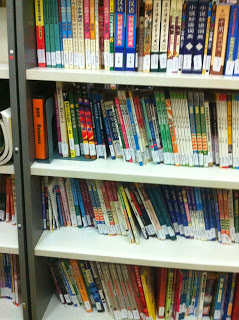
Old VCR boxes as flexible shelf labeling

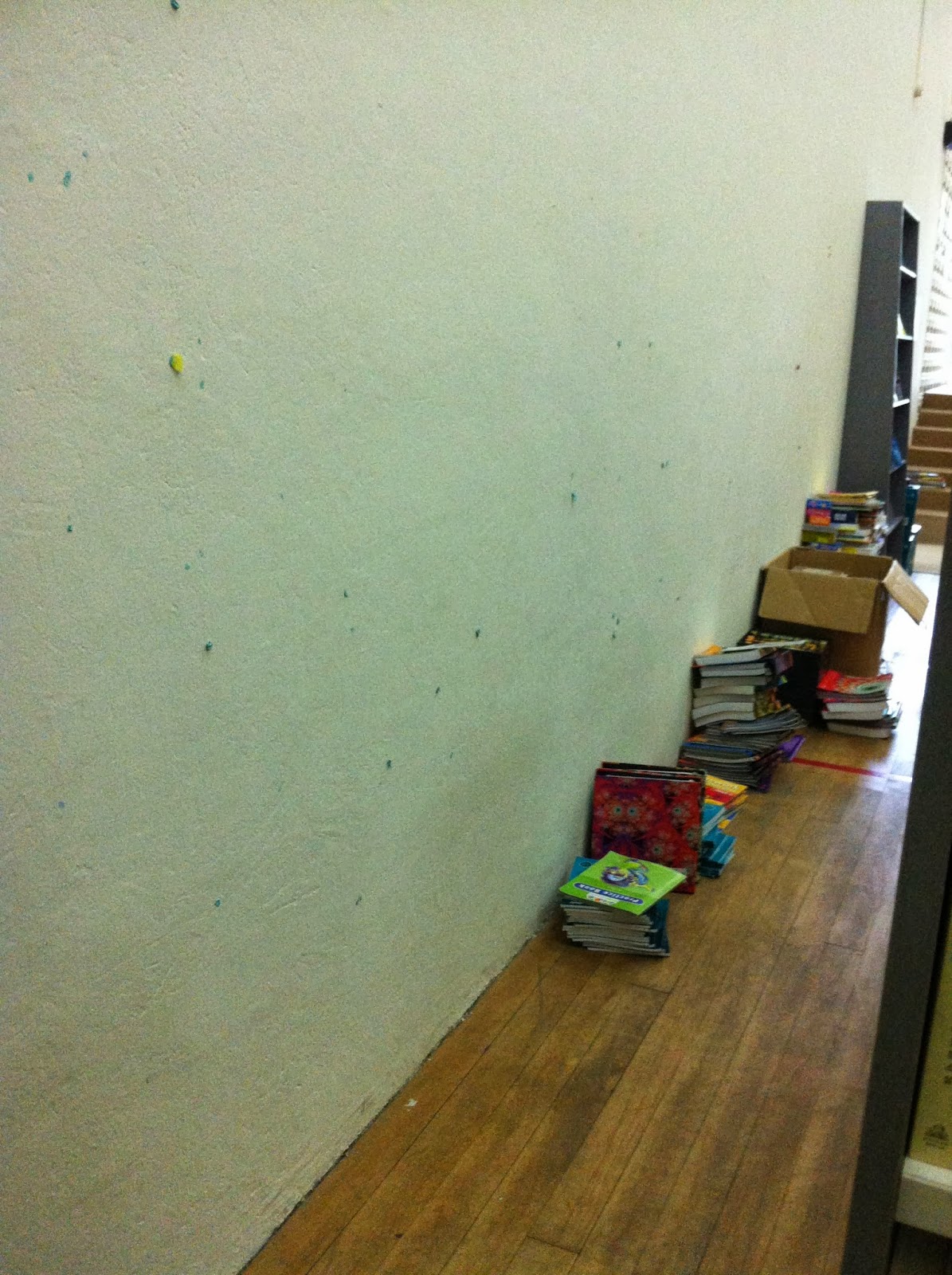
A huge amount of progress has been made by Ms. Sheryl who has managed to get rid of the boxes cluttering up the floors and to start sorting those books which have any type of DDC number on the spine into DDC number order.  But there still are piles and piles of orphan textbooks that no-one appears to particularly want to use.  We’ve been lugging them from shelf to shelf it seems each time trying to find a logical space while we sort out the rest of the library, when actually the only logical place for them is ANYWHERE but the library…. which is why I titled this moving the deck chairs…

Yay an empty wall

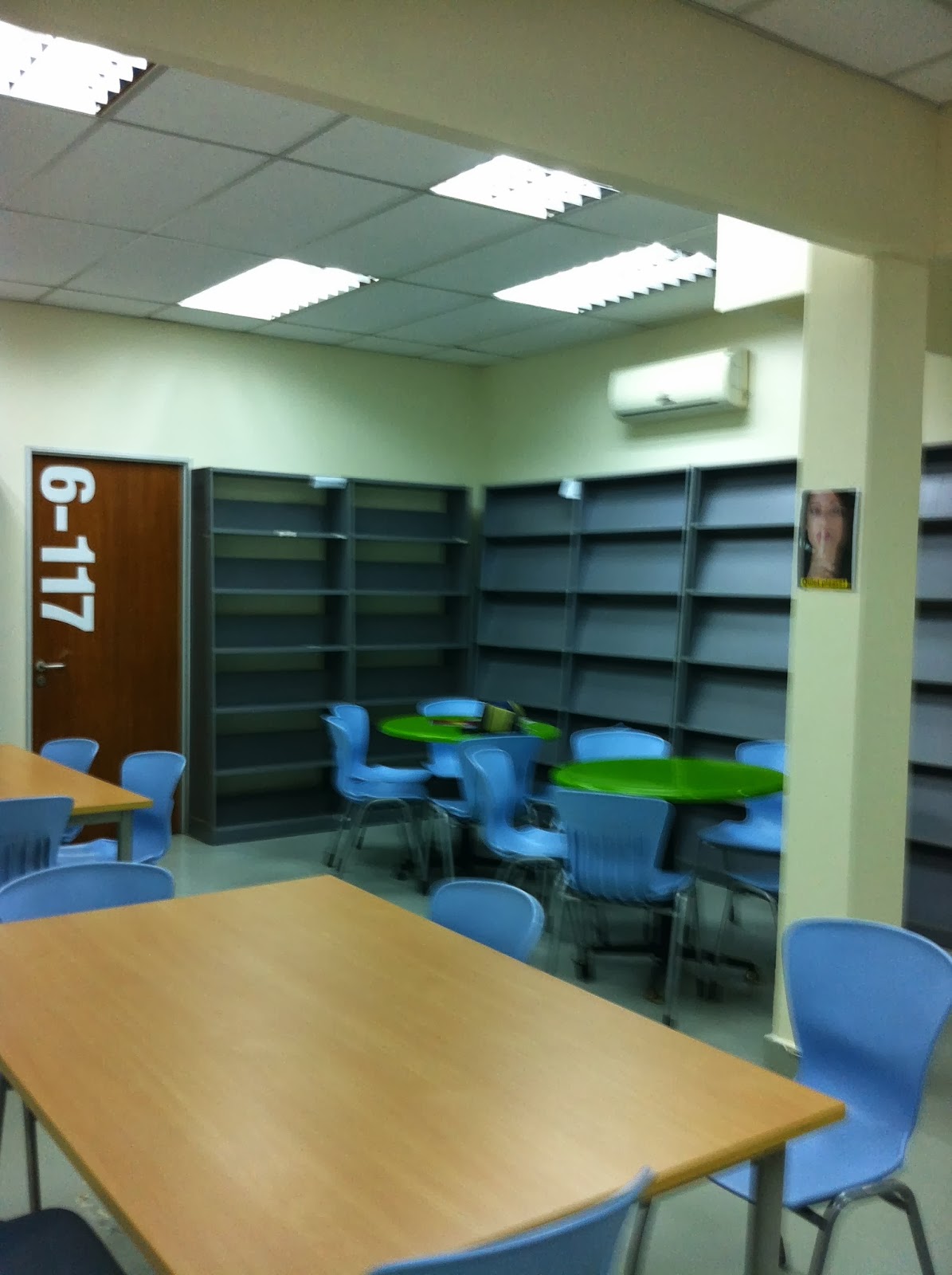
In order to make the library shelves a bit more accessible physically we decided to move the magazine shelves out. Another factor was that due to the humidity, anything displayed on them started to have curling corners.  Since we wanted it done sooner rather than later, we just rolled up our sleeves and played moving ladies ourselves.  As you can see from the photo it’s looking good – albeit empty. These are the shelves where the NLB books which arrive next Thursday (whoopee) will be located so they don’t get all mixed up with our own collection.

Shelves ready and waiting for NLB delivery

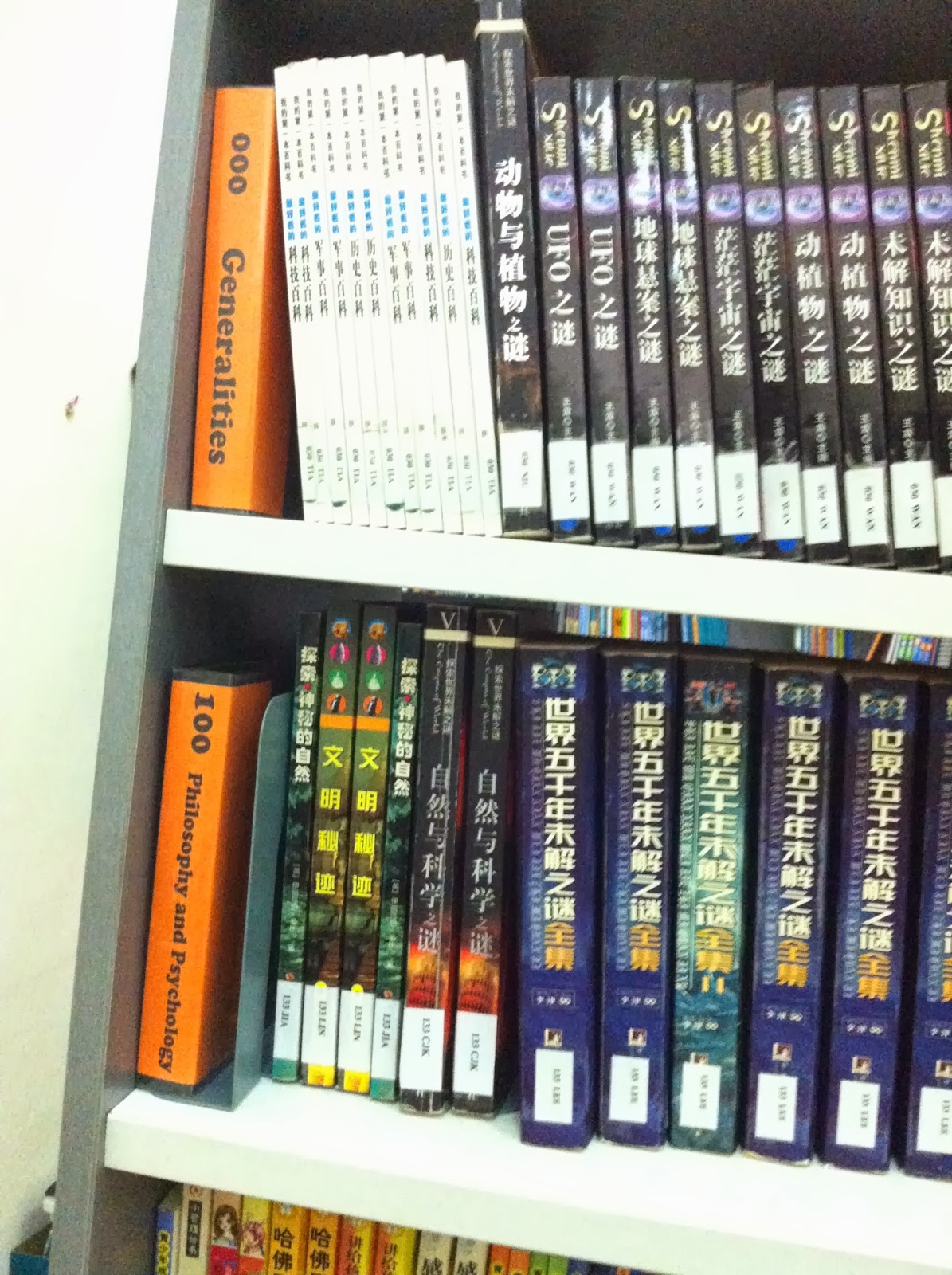
We managed to finish sorting and shelving the 000-300 DDC sections using the old VCR covers kindly donated by Ms. Katie.  It’s looking like a real library – at least on those six shelves!  Did I mention that the library is really quite dusty and everything has to be cleaned and wiped down as we go?

Progress:100-300 in Chinese sorted and shelved
delicious Monster 3.0 as a temporary solution

 The biggest issue right now is the arrival of the NLB books next week and we still haven’t managed to locate the old catalogue, nor the cataloguing system, nor does it look like anything will be in place on time.  That called for a quick meeting with the HOS to talk about a plan B.   Which had to be quick and easy and cheap.  I brought along my laptop with my home system – yes ironically at this point, my home books and CDs and DVDs are better catalogued than the schools.  I’ve been using Delicious Monster 2.0 and quickly upgrade to 3.0 in order to show the potential for doing something, that would be better than handwritten lists and checking.  At $25 it was somewhat a no-brainer, but it had to happen and be confirmed. I also broached the question of cleaning … (captive audience) and got permission to exchange some of the duplicate Korean and Chinese books with Ms. Katie for some of her surplus donated books that were needed, particularly in the primary section.  At this rate of shelf and book and box of book moving I’m going to be able to cancel my subscription to the gym!

Hurry up and wait

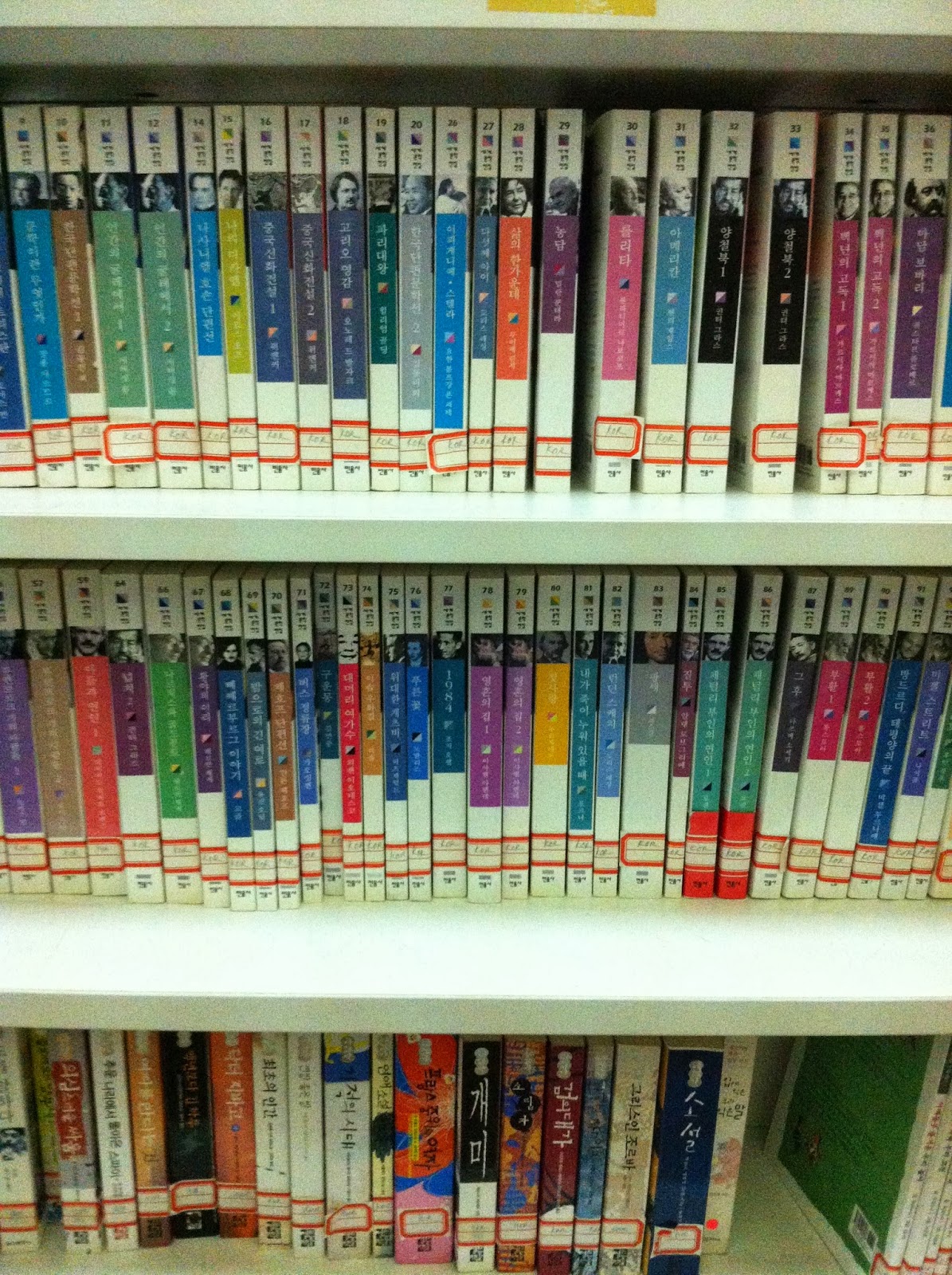
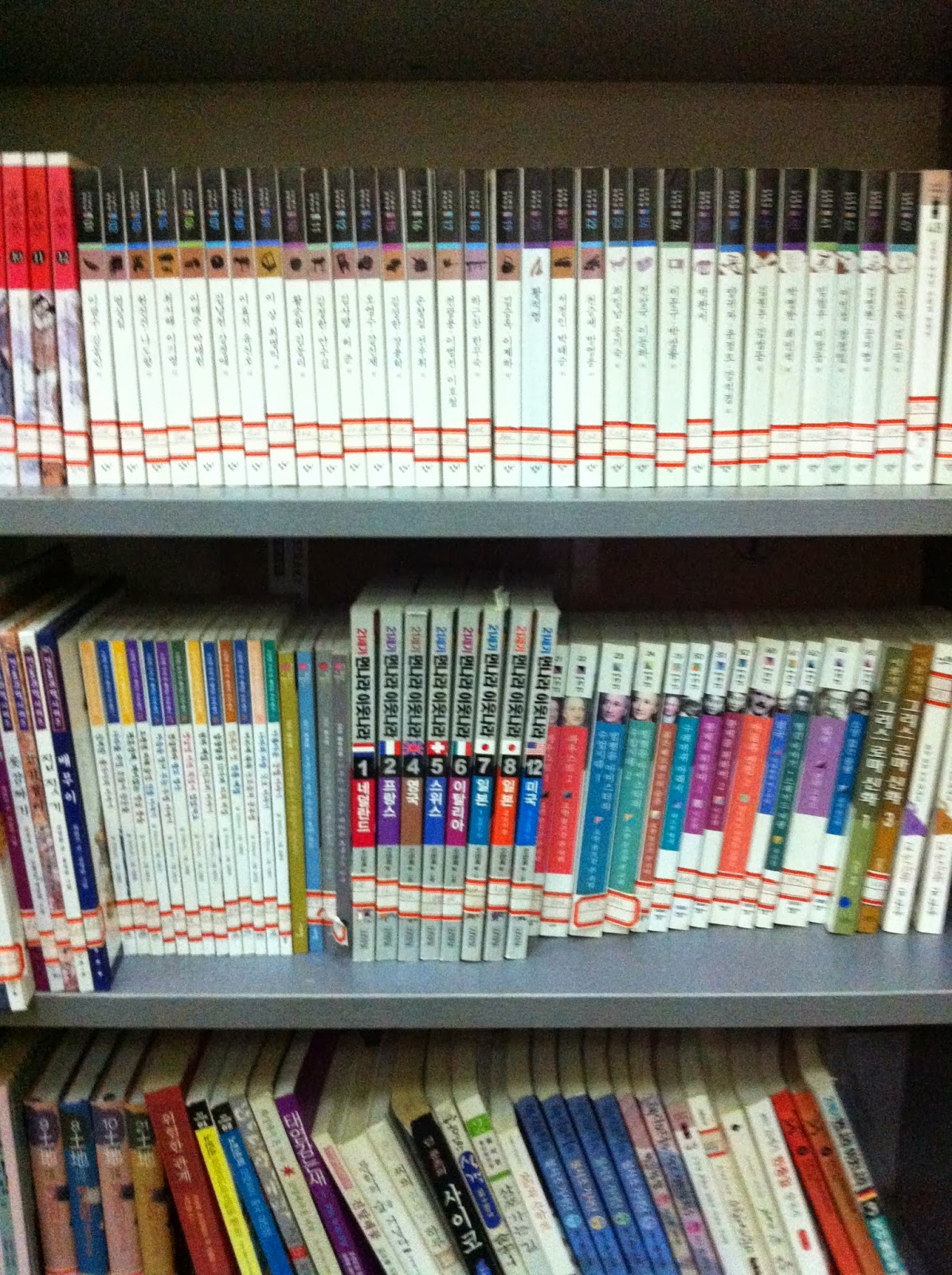
Lots and lots of Korean books

Today I get to the library to meet a rather frustrated Ms. Sheryl.  There has been progress, but she’s rather frustrated at the pace.  The boxes of old books that we want to swop in the Book Cross scheme still haven’t been claimed and it looks like the process will take longer than first thought – so an intermediate storage space has been found for them, but not a strong person who’s able and willing and has time to move them.  I can see those boxes really annoy her.  Luckily I only have to see them once a week, and hopefully they’ll be gone before my next visit.

Oh No! The boxes are still here …

The first shelf has a huge collection of Korean books.  She’s asked the Korean students what they are and why and it seems they’re mainly Korean fiction from a time that some students were studying Korean.  I snap a picture and send to Ms. Katie with the question of whether her IB Korean students / teachers would be interested.  Yes they would.  Another “swop” opportunity. So we need to clear it with the HOS and Korean community to see what is needed and what can be missed.  In the mean time, the books are relocated to a less prominent position.

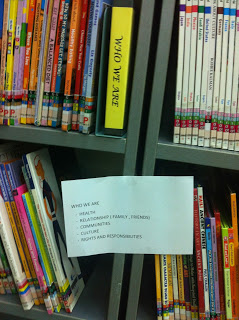
 Ms. Sheryl asks if I’d mind reading to a P2 class who’s about to come in.  Oops, how am I going to find a book that’s appropriate?  What unit were they doing again?  It’s “who we are”and the teacher is talking about feelings and emotions in the classroom.  I have a quick look through the picture books – luckily Ms. Sheryl has sorted them between Nursery to P2 and P3-6, so I can hit the right shelves.  No catalogue means no quick look up, and no shelf labeling or organisation means taking the books out a pile at a time and manually looking through them.  I find a nice little book about Anger and another about a boy who can’t sit still in class and put them aside.  Then I go back to my library exploration tour and find a pile of PYP books hidden in the back.   Sort those out to put them on the front (ex-Korean) shelf.   But in walk the kids – oops there goes my sorting and lots of little hands grope the piles with “can I have this one, what’s this …” the teacher quickly gets into action and announces that they’re going to get a story and I start with the “can’t sit still one” which works a treat for getting them seated and listening.  The Angry book gets lots of (solicited) information about tiresome younger and older siblings and how they manage feeling mad.  

Yippie! Some of the teachers want some of the text books
Then they’re let loose to borrow some books, which they then have to write down on a borrowing list.  Yup, we’re very manual for the time being.

As soon as they leave, I comb through all the junior books for early readers and reading schemes and find a mish-mash of Oxford Reading Tree, “I can read” PYP readers, ladybird books and anything and everything else.  I put these aside for the next request.  But the shelf I’ve just emptied is filthy, there have been some issues with the cleaners – another of Ms. Sheryl’s frustrations that needs to be sorted out.  She gets me a bowl of water and a cloth and soap and I set about wiping down the shelf.  Little by little we’ll get the place spick and span and then the maintenance won’t be so hard.
Meanwhile Ms. Sheryl does a little bit of networking around the classrooms to find some candidates for some of the many text-books clogging up the shelves.  In a few weeks we’ll have 2000 books arriving that are relevant and needed, so there is not much space for all those text books.  She finds takers for the Science and English textbooks and workbooks.  Luckily – that saves about 2 or 3 shelves.  
I attack the magazine rack – not a good option in this climate.  The books and magazines on display are looking rather sad with curled up corners.  Some of the magazines have been there since 2004 – I find a box for items to be binned and in they go.  The books get reshelved and the rack is slowly cleared.  It will probably be put outside the library for some “lifestyle” items.
Then we get a nice surprise – someone comes to collect the ‘claimed’ text books, they’re off the floor now, and we get a delivery of old VCR boxes that Ms. Katie used to use for her moveable bookshelf labeling!  Ms. Sheryl gets to work making labels.  We decide at this point the DDC is a remote dream, and we’ll start by labeling the primary section by unit of enquiry.  The secondary can get the DDC.  
They’re everywhere, they’re everywhere!  Just as I want to leave, I find another 6 shelves full of Korean books – Ms. Sheryl agrees that it would be a good idea to weed the collection and replace it with books that are in shorter supply at the school.  We have a new mission!  


Just before I leave I find even more Korean books

 The teacher approaches me for some easy phonic based reading books in English for a new Chinese student who is learning to read in English – oh dear, we have to do the sort through piles thing again to find something.

Presentation of the plan

Today was the day to present the plan!  But first we spent some time going around the school meeting teachers and heads of department and finding out the scheduling of the various units of enquiry, which units were to be studied and what the information needs would be.  Our first concrete action was going to be getting a selection of books from the NLB through their DEAR scheme.

The DEAR scheme is a bulk lending programme, whereby:

    “The NLB welcomes schools and learning centres, social, welfare, and community organisations which are embarking on the promotion of reading initiatives to borrow books in bulk for their members’ use. This service, called DEAR@Schools and DEAR@Community, is provided free of charge and subjected for renewal on a yearly basis.

    All DEAR@Schools and DEAR@Community members are entitled to borrow up to a maximum of 2,000 books for a loan period of 84 days (12 weeks).”

For a school on a limited budget and limited resources (physical and staffing) this is a great way to get resources up and running in a short time frame. 

Then the meeting with the Head of School (HOS) to see if we had support for our ambitious plans!   Luckily we did, however, not everything could be achieved at once, so we needed to work step-by-step.
The first priority was ordering the books the teachers needed for delivery as soon as possible.  We’d arranged a slot with the NLB to do that tomorrow.  Then while we are waiting for the book delivery we have to work hard to make sure we have the physical space and the logistics in place for receiving, storing, disbursing, returning and sending the books back to the NLB.