Panda Madness

As we move into Week 5 of online learning I had a yearning to return to my librarian roots. I was prompted by our librarian network sending out a notice for the voting for the annual Panda Book Awards. Despite the closures the voting will continue. In my previous incarnation as a PYP librarian in Singapore I found it a lot easier to promote the Red Dot Book awards – you have a weekly captured audience in primary, plus we had our after school reading club geared towards preparing for the annual Readers’ Cup.

Things change in Middle School – puberty seems to affect the reading muscle as much as it does every other aspect of being. Also in China we have the “Kids Read” competition for middle schoolers, which is considerably more daunting – 100 books in teams of four.

Another aspect of online learning is that it is really hard for everyone to stay motivated. Our daily entry point each day is the Mentor discussion forum on Moodle. As much as Moodle is extremely robust, it’s also very old fashioned and clunky, so driving traffic there is a chore.

I’d been seeing a lot on my twitter feed on US librarians setting up for “March Madness” and that inspired me to get a “Panda Madness” going for March. Besides the voting I also wanted to put in some challenges for points with a couple of aims:

  • getting students onto our online reading platform Sora
  • getting students reading online generally
  • getting students reading the Panda Books
  • getting students to promote books through FlipGrid and book reviews on Oliver
  • making the daily sign-in to their mentor groups a bit more motivating and of course
  • having some fun

First off was selecting the books – in MS we’re literally in the middle of the reading spectrum so I could select from both the “middle” and “older” reader lists. I selected 16 of the books, leaving out a couple of picture books and trying to use books that were available on Sora so they could still be read.
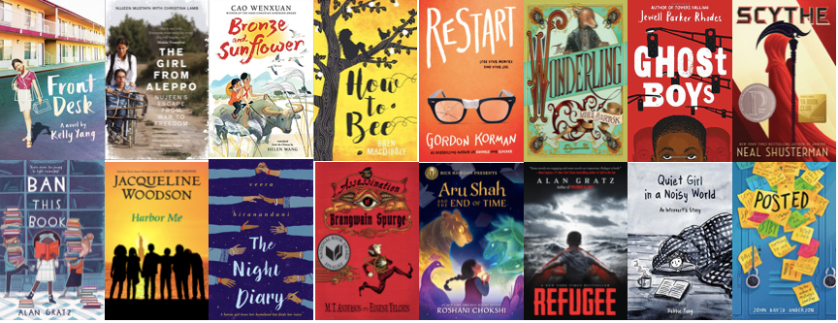
Panda Knockout covers The complication in China is that not only do books have to be available with rights in China, they also have to be approved by an agency for use.  So the hurdles we climb (besides expensive platform fees and expensive digital rights that disappear after 12/24/26 months or 26 checkouts are:

  • lack of a digital version,
  • georights, or
  • publisher preferences. For example, the publisher Hachette Livre (one of the “Big Five”), don’t sell their ebooks to schools or libraries outside of the US.

Then there’s weird stuff, like “Front Desk” is available as an audiobook but not an eBook … usually it’s the other way around, books are available as an eBook but not audiobook (which kind of makes sense as there are extra costs and efforts involved recording an audiobook). I’ve reached out to Kelly Yang and she’s looking into it (love authors who are invested in helping one out!)

In the Older list we’re missing “How to Bee” and “The Assassination of Brangwain Spurge” I’ve reached out on Twitter to both sets of authors but not heard anything back yet. In the Middle list we’re covered, although it would be nice to have “Front Desk” as an eBook – there’s a hierarchy of how students like to read

  1. Not at all (lol)
  2. Physical Copy
  3. eBook
  4. Audiobook

Next step was making the knockout lists. That was a tough one. Which books to pair against each other to make it a little bit exciting – I must admit to have spent way too much time on overthinking this one.


Then I didn’t want to start the voting straight away, so for Friday (we have virtual WEIRD every Friday where I lead the Mentor discussion) I started with the motivation and getting ready bit. In order to do that I needed to set up a point system*, Libguide, Flipgrid and Microsoft Team, plus all the graphics. Needless to say that consumed all of Thursday in-between the usual Tech troubleshooting.

Moodle Message

And then it was a case of waiting with baited breath as to the response – luckily it was extremely positive – by the time I woke up at 6am European time, my “copilot” on the MSTeam had approved 83 students and by the end of the day we had 121 students and teachers signed up (over 1/3 of our student population).

IMG_6210

Yesterday I wanted to sort out the leaderboard and the scoring … that was another full day task – mainly because there is so much to set up – a current and reliable student/mentor group spreadsheet (yes, we’ve had a few poor souls who joined the school just prior to, or during the closure period), getting all the data of who had signed up to Sora – with proof, and then the most time consuming – going through the library records of each of the 16 books to award points to the consistent readers who’ve been reading the books since the start of the school year in August! A very manual procedure.

Another thing one would expect would be easy but wasn’t is extracting a list of “members” from a MS team! There’s no way to export that – so I had to copy and past from the list into excel and then sort it out and match to my master sheet.

Another thing that I spent way too much time on of course was creating the graphic of the leaderboard.  I must admit to having found one I quite liked and then adapting it. On the first day students had gained 872 points and we had a history of the books being read 129 times. A lot of students / groups tied as it was the first day.
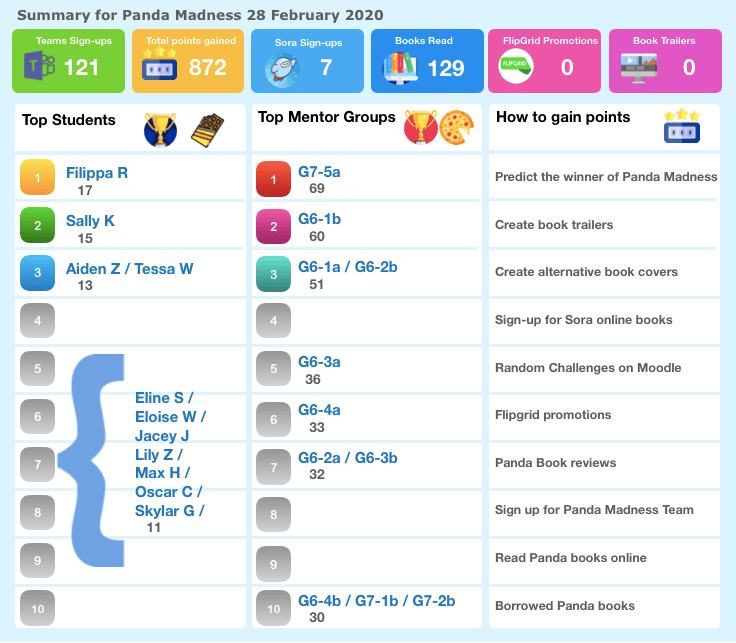
Panda Madness Leaderboard 280220

Then rubrics / criteria for the Book Trailers and alternative book covers were created. Luckily I only had to adapt these from the ISLN Readers’ Cup that I was heavily involved in during my time there, and Barb Reid kindly sent me the latest versions.

The last thing was to create a Form for students to predict the winner and to post the updated status to the Moodle announcement for Monday.

Hopefully the rest will just be maintaining the scoresheet each week and monitoring the Flipgrid; student book reviews on Oliver; and entries for the book cover competition and book trailers… The first knockout vote will be on Friday.

Let’s see how this goes and if we can achieve our aims!  Already the teams who have teachers involved (they can take part with their group) are the leading teams… says something!  Happy to share everything created with other schools affected by the closure – just flip me an email or PM on twitter with your email. Everything is on Pages and can easily be adapted / changed for different books.

==========================

*Points for now – I’ll add to this as we go on

  • 5 points for taking part
  • 5 points per Flipgrid promotion of a book (multiple promotions possible – but you must have read the book)
  • 5 points for a one paragraph review of a Panda book on Oliver
  • 2 points for every Panda book you borrowed before school closed
  • 2 points for signing into Sora (upload a screenshot to Moodle to gain the point)
  • 5 points for borrowing and reading a Panda eBook on Sora (screenshot and summary to gain the points)
  • 5 points for borrowing and listening to a Panda AudioBook on Sora (screenshot and summary to gain the points)
  • 10 points for predicting the winner
  • 5 points for predicting one of the 1/2 finalists
  • 2 points for predicting one of the 1/4 finalists
  • 1 point for predicting one of the 1/8 finalists
  • 5 points per good quality book trailer following criteria
  • 5 points per good quality alternative book cover following criteria
  • Each week new random bonus points will be awarded based on new challenges

Digital Storytelling – The role of the library – presentation for School Librarian Connection Conference Hong Kong November 2014

Classical retellings

Here are some great examples of where digital storytelling can allow literature to be updated, recontexualised and adapted to modern times and short attention spans.  Most of these formats are also easily adopted by students to create their own versions of the classics.


Green Gables Fables (Anne of Green Gables)

https://www.youtube.com/user/greengablesfables


Lizzie Bennet Diaries (Pride and Prejudice)


http://www.pemberleydigital.com/the-lizzie-bennet-diaries/


Frankenstein – Inkle Studios

http://www.inklestudios.com/frankenstein/

Frankenstein MD – Vlog

http://www.pemberleydigital.com/frankenstein-md/


Greek Myths – Twitterature 

https://storify.com/CrownPublishing/100-greek-myths-retold-in-100-tweets


Greek Myths – retold by vegetables

http://www.openculture.com/2014/08/the-story-of-oedipus-retold-with-vegetables-in-starring-roles.html

Digital literature – Interactive documentaries

I’m going to do a couple of posts highlighting good examples of digital literature, divided into different genres / types.

Here are a few interactive documentaries I think are particularly good.

The Guardian  – First World War


http://www.theguardian.com/world/ng-interactive/2014/jul/23/a-global-guide-to-the-first-world-war-interactive-documentary


New York Times – Story of the high rise

http://www.nytimes.com/projects/2013/high-rise/
A short history of the high rise

Welcome to Pine Point NFB Canada

http://pinepoint.nfb.ca/#/pinepoint


Firestorm – The Guardian

When is it digital literature?

I’ve been busying myself with looking through a number of different formats of digital texts in order to write some reviews for my next assessment item.  According to the (adapted) criteria of Nesbit, Belfer and Leacock (2004) one can look at (cited in Leacock and Nesbit, 2007):
Category of resource
  • Content quality
  • Alignment with curriculum or program purpose
  • Value of digital affordances for the literature Possibilities for feedback and/or adaptation
  • Intrinsic motivation of the digital environment for users
  • Presentation design
  • Interaction and usability
  • Accessibility and reusability
Today I was looking at a few audio-visual formatted items.  A Calendar of TalesBeowulf in a Hundred Tweets,and The Lizzie Bennet Diaries,  Each of these were in different resource categories, however they all overlapped in the fact that I could access and read them on my computer, and with the exception of the first two (Calendar of Tales and Beowulf) involved a greater percentage of looking and watching time than reading time.
I foundCalendar Tales a Calendar of Tales a wonderful selection of stories, and found the concept of basing writing on questions in tweets to be an interesting way of involving the audience.  Neil Gaiman writes very well, and the stories would stand up to literary scrutiny on their own without any digital bells and whistles. 
There was however a considerable amount of redundancy over formats – you could read the story online, you could read it as a pdf, or you could listen to it as an audio file.  So the various formats did not enhance the experience in a new or unexpected way.
Screen Shot 2014-08-19 at 5.48.45 pmAs someone who did not have prior literary knowledge of Beowulf, nor any particular interest in the poem / ancient English language, (shock horror!) I found the Twitter Beowulf to be an interesting experiment, but not one which I wanted to spend any amount of time reading through in detail.  It also didn’t pique my interest in the original text.  Which one would hope would be one of the aims of such an endeavour.  I can imagine this had a following and would be a useful addition to a curriculum, and apparently had a very avid following as it unfolded – I think also due to the (academic) authority of the author.
Lizzie Bennett Diaries The Lizzie Bennet diaries have had extraordinary success and won an Emmy Award in 2013– which recognises excellence excellence in the television industry. And that’s the point where I start to wonder where the line can be drawn between what is digital literature and what is an audio/visual/digital adaptation of literature.
Prima facie it is a Vlog (video blog) based adaptation of Pride and Prejudice.  The question is what makes it different from say the BBC series Pride and Prejudice, besides being updated to fit current times.
(BBC – Pride & Prejudice: http://www.youtube.com/watch?v=CgkS5_PTfZQ)
The interactive elements of the Lizzie Bennet diaries include: a twitter account and feed;  Facebook accounttumblr account,  google+, and pinterest.  Are these merely marketing devices in order to promote the main product – the videos – or those an integral part of the package?  Whereas one could watch all the videos and not feel a lack for having missed out on the other channels, I doubt the other channels would be equally “stand alone”.  However, the series has received some serious academic and literary interest, for example in this article from the Jane Austen Society of North America, as well as being the topic of various theses and a conference presentation.
In her presentation, Marilyn Francus made some interesting points about multiple levels of immersion in a literary work and how the unmediated interactive experience through the social media channels enhanced this immersion. This made me wonder if the experience and engagement is different if one is following and participating in the type of medium as it unfolds versus in retrospect as I have been doing.
All in all it has been an interesting experience and one that has perhaps raised more questions than answers for me.

References:

Blog Task #1 – state of current knowledge

Blog Task #1

Using your readings and interaction with the subject to date, develop a statement about your current knowledge and understanding of concepts and practices in digital literature environments, tools and uses, within the context of your work or professional circumstances.
======================================================================
In this post I would like to reflect on a starting point of my knowledge and understanding (or lack thereof) about digital literature.  Reading and literature has an impact on my life – in my roles as a parent, a librarian, an educator and a reader and learner.
When embarking on this course, I considered what was meant by digital literature.  The first part – “digital” is possibly the easiest and most intuitive, as it speaks of the medium.  To answer this, various categories or types of digital formats or reading environments have been suggested, including e-books and e-readers (Doiron, 2011), e-stories for early readers, linear e-narratives, e-narratives and interactive story contexts, hypertext narratives, hypermedia narratives and electronic game narratives (Unsworth, 2006 cited in Walsh, 2013) or e-books, interactive storybooks, reference databases, hypertext and interactive fiction, and transmedia storytelling (Lamb, 2011).
In its definition of “E-lit”, the Electronic Literature Organization, emphasizes the literary aspect of Digital Literature (Electronic Literature Organization, n.d.), while James and de Kock ask about the role of the digital format in fiction (James & de Kock, 2013) –  this appears to be the exception.  Many other authors in the field appear to focus on the literacy aspect, and write about literacy and reading (Doiron, 2011; Edwards, 2013; Foley, 2012; Leu et al., 2011; Levy, 2009; Unsworth, 2008; Yokota & Teale, 2014),  e-learning (Walker, Jameson, & Ryan, 2010), and story-telling (Alexander, 2011; Malita & Martin, 2010; Yokota & Teale, 2014).
Just like there is endless pedantic discussion on the definitions, nuances and overlap between information, knowledge and wisdom, so too is there a blurring of the lines between what is meant by literature and at what point fiction, narrative text, novels, and storytelling becomes literature. I’ve noticed a presumption on the one hand that “literature” is the highest form, but on the other that “any reading is good” because parents, teachers and librarians want to “hook” children on reading.
I think where some of the confusion arises, is that like in my own family and with my own students, each individual is somewhere on the literacy / literary continuum – from beginning reader to being capable of a deep understanding and analysis of complex literature, and somewhere on the digital participation continuum –consumption, communication, collaboration and creation. In this course we are overlapping the two, and this coincidence can occur at so many different points we need to be able to cater for all alternatives and permutations.  We would be doing any learner a disservice if we did not meet them where they are and find a way guide them further.
It is an interesting process. I have one child who is fully engaged digitally and where I often bemoan him not sitting down with a book, and him retorting that I have no idea how much reading he’s doing each day, but that it’s just not in the traditional form.  I have another who prefers to be curled up with a book, if at all possible, an old musty edition of a “classic” from my youth, and who I continually have to remind of the treasures in information augmentation and enhancement that is available digitally.   I straddle the two, preferring some text digitally, and some in print.
So after the first few weeks of this course I think perhaps the name of the course is a slight misnomer, but that as other contenders – such as digital literacy – have their own meaning and body of research, I’m happy to ride with it and keep it as broad and all encompassing as it is.

References:

Alexander, B. (2011). Storytelling: A tale of two generations (Chapter 1). In The new digital storytelling: creating narratives with new media (pp. 3–15). Santa Barbara, Calif: Praeger.
Doiron, R. (2011). Using E-Books and E-Readers to Promote Reading in School Libraries: Lessons from the Field. In Student access to new and emerging technologies. Puerto Rico.
Edwards, J. T. (2013). Reading Beyond the Borders: Observations on Digital eBook Readers and Adolescent Reading Practices. In J. Whittingham, S. Huffman, W. Rickman, & C. Wiedmaier (Eds.), Technological Tools for the Literacy Classroom: (pp. 135–158). IGI Global. Retrieved from http://services.igi-global.com/resolvedoi/resolve.aspx?doi=10.4018/978-1-4666-3974-4
Electronic Literature Organization. (n.d.). What is E-Lit? Retrieved August 13, 2014, from http://eliterature.org/what-is-e-lit/
Foley, C. (2012). Ebooks for leisure and learning. Scan31, 6–14. Retrieved from http://www.curriculumsupport.education.nsw.gov.au/schoollibraries/assets/Foley_ebooks_Scan_31-4.pdf
James, R., & de Kock, L. (2013). The Digital David and the Gutenberg Goliath: The Rise of the “Enhanced” e-book. English Academy Review30(1), 107–123. doi:10.1080/10131752.2013.783394
Lamb, A. (2011). Reading redefined for a transmedia universe. Learning and Leading with Technology39(3), 12–17. Retrieved from http://ezproxy.csu.edu.au/login?url=http://search.ebscohost.com/ login.aspx?direct=true&db=ehh&AN=67371172&site=ehost-live
Leu, D. J., McVerry, J. G., O’Byrne, W. I., Kiili, C., Zawilinski, L., Everett-Cacopardo, H., … Forzani, E. (2011). The new literacies of online reading comprehension: Expanding the literacy and learning curriculum. Journal of Adolescent & Adult Literacy55(1), 5–14. doi:10.1598/JAAL.55.1.1
Levy, R. (2009). “You have to understand the words…but not read them”: young children becoming readers in a digital age. Journal of Research in Reading32(1), 75–91. doi:10.1111/j.1467-9817.01382.x
Malita, L., & Martin, C. (2010). Digital Storytelling as web passport to success in the 21st Century. Procedia – Social and Behavioral Sciences2(2), 3060–3064. doi:10.1016/j.sbspro.2010.03.465
Unsworth, L. (2008). Multiliteracies, E-literature and English Teaching. Language and Education22(1), 62–75. doi:10.2167/le726.0
Walker, S., Jameson, J., & Ryan, M. (2010). Skills and strategies for e-learning in a participatory culture (Ch. 15). In R. Sharpe, H. Beetham, & S. Freitas (Eds.), Rethinking learning for a digital age: How learners are shaping their own experiences (pp. 212–224). New York, NY: Routledge.
Walsh, M. (2013). Literature in a digital environment. In L. McDonald (Ed.), A literature companion for teachers (pp. 181–194). Marrickville, NSW: Primary English Teaching Association Australia (PETAA).
Yokota, J., & Teale, W. H. (2014). Picture Books and the Digital World: Educators Making Informed Choices. The Reading Teacher67(8), 577–585. doi:10.1002/trtr.1262

Day 2: ebooks & audiobooks

This is a tough one.  The library I’m with at school hasn’t jumped on board.  And all for very good reasons.  Personally though, in my home library I’ve been embracing audio books ever since my kids were very small – (about 10 years ago) when we were living in Spain and I had a long commute to take them to and from kindergarten every day.  We started off with Peter Pan, and we’ve never stopped since then.  Even now when we drive from Netherlands to Switzerland in the summer – a good 8 hour trip we’ll arrive at the destination and they’ll clamour to stay in the car until the chapter is over.  It’s always been Naxos audio-books, as they have such wonderful voice artists, and we must have the CD of just about everything they’ve ever published (and if I ever have to listen to Professor Branestawn which has been on repeat mode for about 1 million time … again ….).  I also listen to the adult ones, and “A history of the world in 10 1/2 chapters” must be one of my all time favourites – it almost demands to be read aloud.   We had a subscription to the Naxos spoken word library – and that was wonderful – the kids used to dip in and out of books every evening before going to bed – particularly the children’s poetry – again something that is wonderful to hear rather than to read.

eBooks – I was an early kindle adopter, and I’m slowly but surely replacing all my old mouldy and yellowing classics with the online versions.  I love it for holiday.  I also have “overdrive” on my ipad, where I borrow books non-stop from the NLB, particularly when I’m travelling.  They also have audio-books for kids and my kids had great fun listening to the “Just William” books.

As a consumer therefore, yes, but as a librarian I know there are all sorts of issues with rights and ownership, not even to mention needing to train staff to train clients on the use thereof.  So that concludes day 2 of the challenge.

And if anyone knows how to get Gutenberg books into your Follett Destiny Catalogue – I’m all ears!