#Language – IMTD 21 February

International Mother Tongue Day is next week Friday, but my students and I will be embarking on their annual Week Without Walls trip so I’m a week early with this post – hopefully it will be of some use to those of you planning on celebrating it in the library. I will be upfront about my objection to it being called Mother Tongue Day – as it denies all the families where the language of other significant family members are spoken at home. I prefer the term “home language”. This year is the silver jubilee of the event. Despite all efforts, languages are becoming extinct at an ever increasing rate, and unfortunately this doesn’t attract quite as much attention as pictures of cute or not so cute animal. Schools and other educational institutions are complicit in this – something I’ve been banging on about for years, the lack of multiple-lingual home and heritage language education I still see as a failure of imagination rather than a failure of resources in this day and age. Ok, off my soap box and back to the practical.

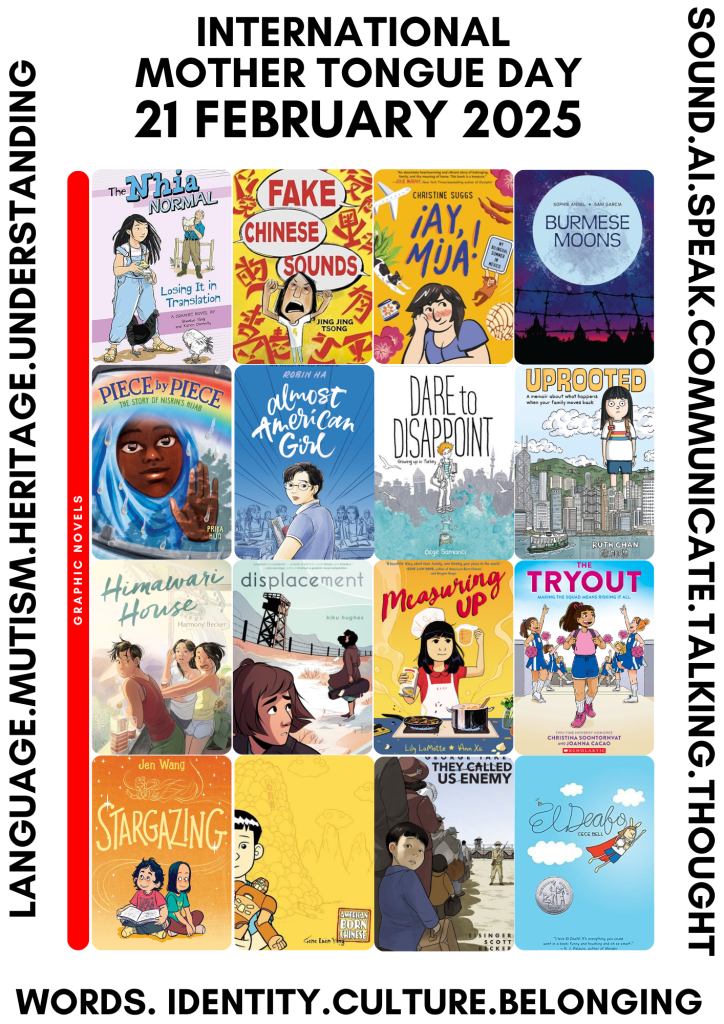
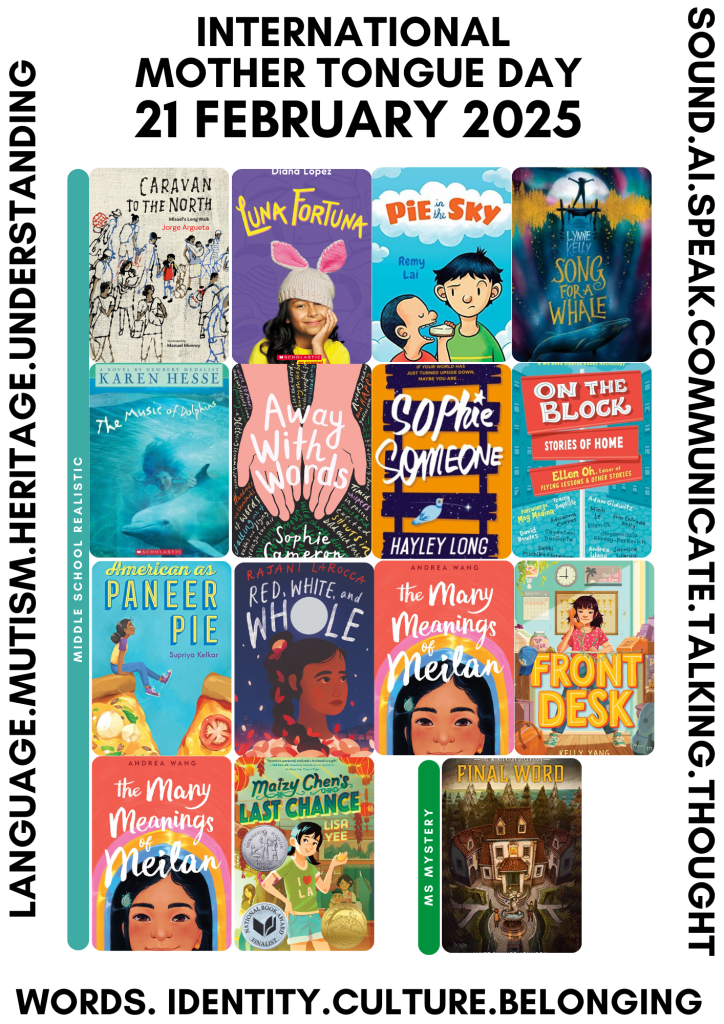
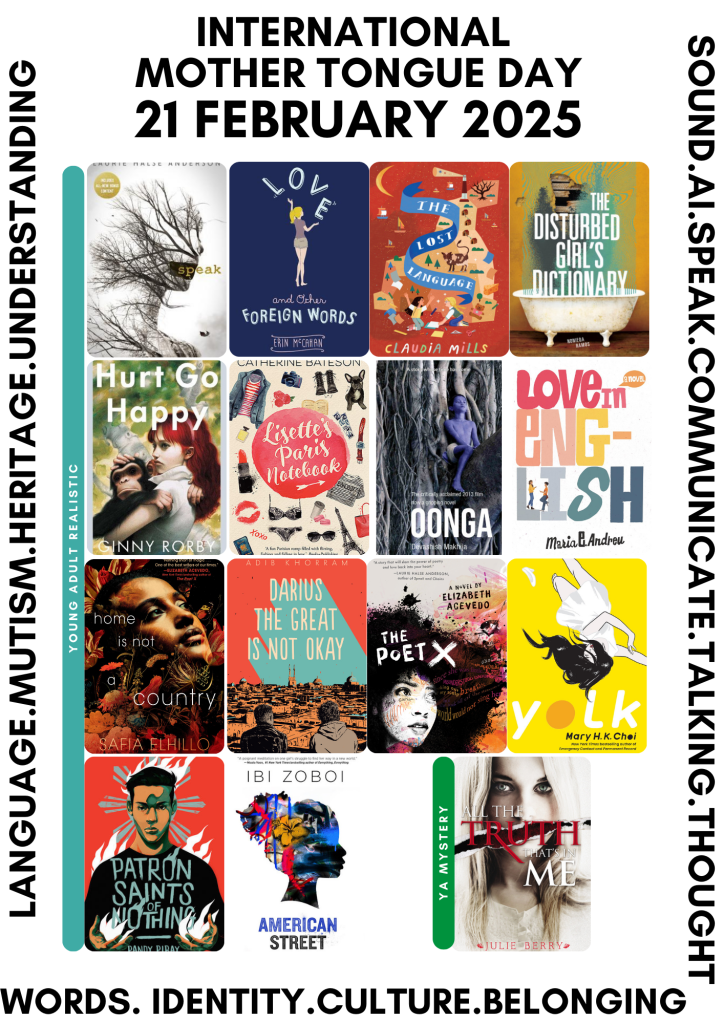
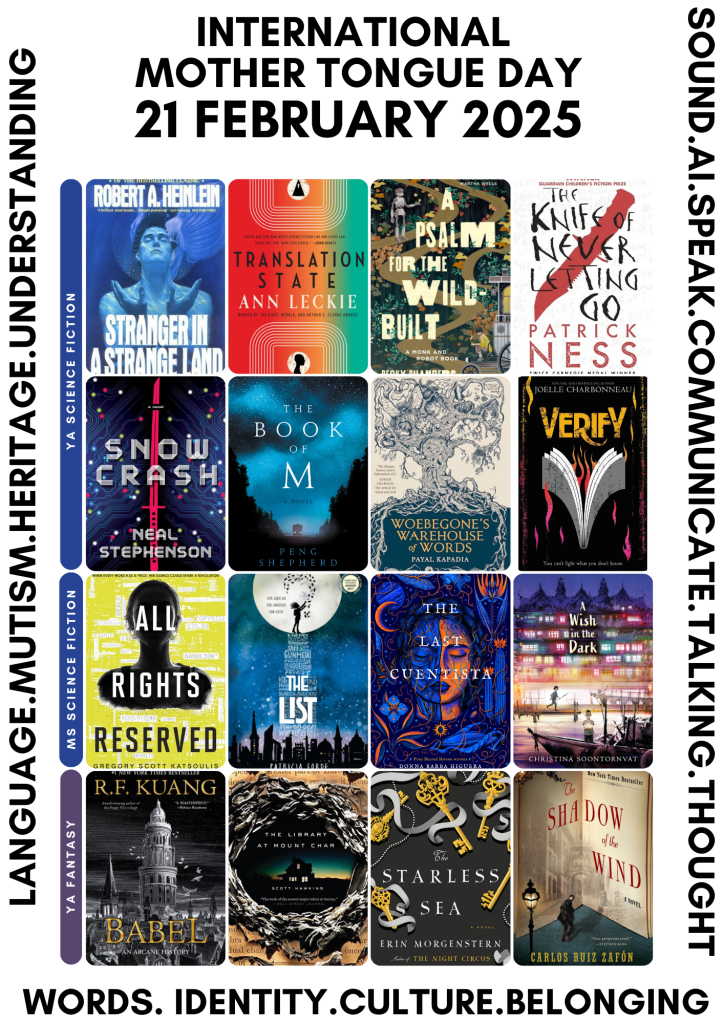
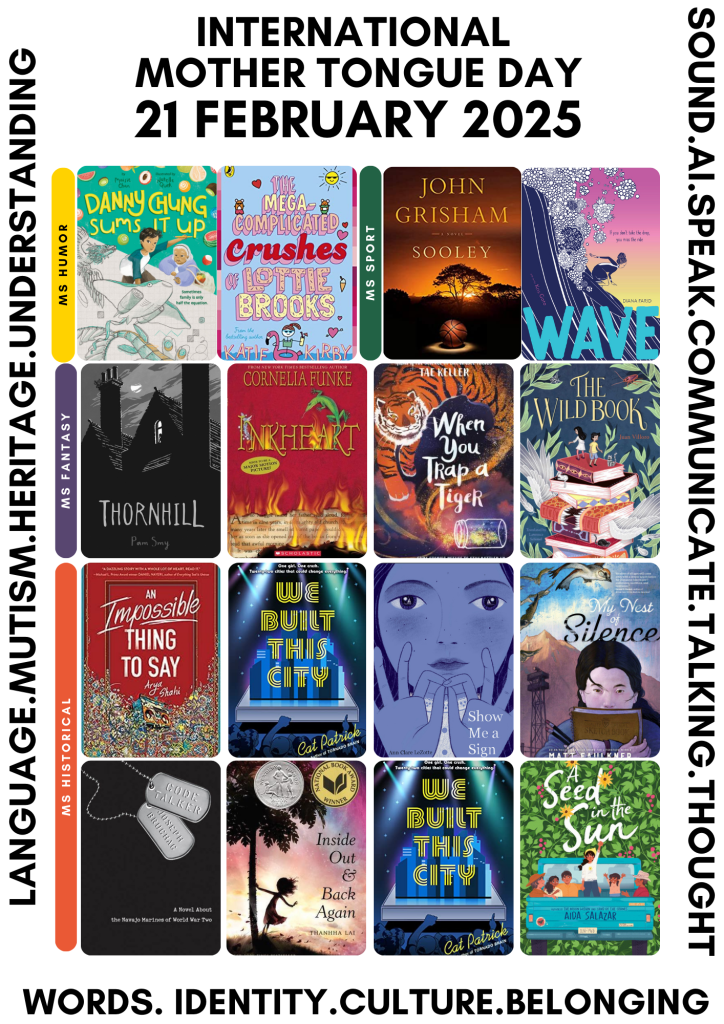
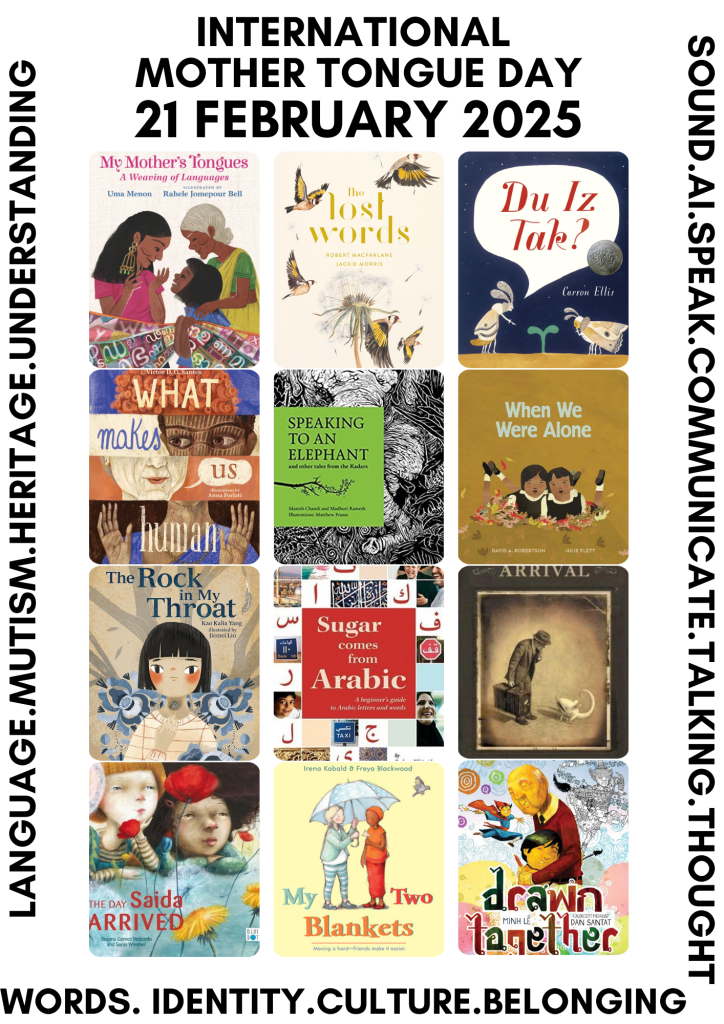
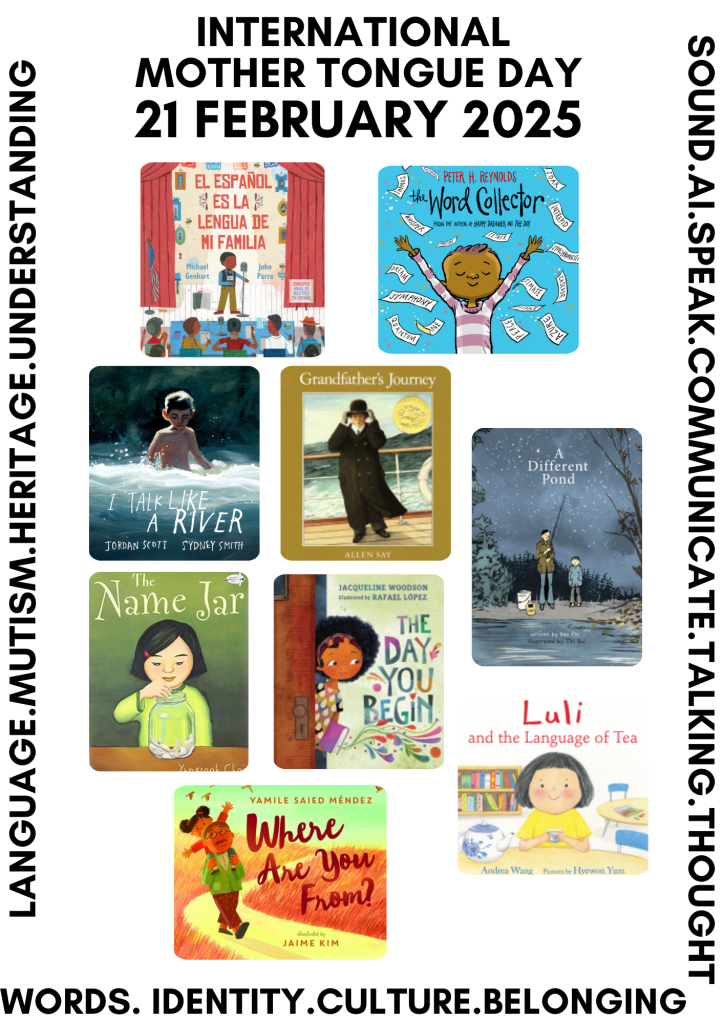
These lists started with a casual conversation with KD as to what I had planned for the day, as my passion for language is well known. Which led to a discussion on which books one would consider and then, as usual things got a little out of hand and now I have 9 pages of posters of books that feature language. Language in all its glorious and inglorious forms. Learning language, struggling with a language, speaking or not speaking. Sign language. Heritage language. Language and thought, language and power or control. Selective mutism. Denial of language, erasure and extinction of language.

As for what to do – if I were here, these are the things I would do.

Have big sheets of paper our where the community could write down the languages they speak / read / write. The languages they’re learning. The languages of their fathers, mothers, grandparents.

I’d have them make a language family tree. Have a poster with a QR code that led to this quirky test on Language.

There are some more ideas on this site (annoying pop-ups for an app though).

As usual here is the link to the template / books used. In return I’d love some comments on the books you recognise and the link to language! And any displays or activities you’re planning. And of course if you have suggestions of books I’ve missed I’d appreciate you adding them in a comment.
In finding the middle way

Robinson, W. Heath (William Heath), 1872-1944 (illustrator). Black and white illustration in Hans Andersen's fairy tales (1913) London: Constable. - in public domain
Robinson, W. Heath (William Heath), 1872-1944 (illustrator). Black and white illustration in Hans Andersen’s fairy tales (1913) London: Constable. – in public domain

I recently read a beautifully illustrated version of “The Emperor’s new Clothes” with my Grade 2 classes during their library period. I can’t but help feeling like that little boy all the time, first astonished and puzzled whether I’m the only one to notice that there are no clothes, then worried that my vision is inadequate to see, and then when I shout out “the emperor has no clothes” my cry is not caught up and echoed, but rather people turn or face down in embarrassment as if it were I caught naked in a public place. And so I began this course with a niggling sense of frustration in being an education professional and learner in a digital environment.

In my life-long learner / doing a distance education degree I’m frustrated by how ‘same old same old’ it is – what is given on the one hand – the convenience, the asynchronicity, the ‘flat world’, the connectivity, the access, is taken away on the other – the lack of intimacy, the limited discussions, the moving along at a clip, the lack of storming and norming and emphasis on performing (Carabajal, LaPointe, & Gunawardena, 2003). But I realize that it is the same as what Churchill said about democracy in 1947 “it is the worst form … except for all those other forms that have been tried from time to time”

I have to stay positive, must stay open to ideas and alternatives. I have to look to people who are chipping away and making a difference, like our colloquia guests – Pip Cleaves, Annabel Astbury, Simon Welsh and Rebecca Vivian. I must remember that Rome was not built in a day, that this life is lived in beta. And things that annoyed me in this course (like the late introduction of VoiceThread) are in fact things that I am now trying to introduce to my school, in this case during the Global Read-Aloud, and I’m being met with the same skepticism that I gave myself – the irony.

The case study has allowed me to become more knowledgeable and versed in a topic that I had a superficial understanding of. And again that frustration, that when initiating the topic – I did not know what I did not know – the anosognosic’s dilemma (Morris, 2010). As a result I perhaps did not ask the “right” questions, use the “right” survey, the “right” analysis. In the process I increased my knowledge, but the purpose was not to summarize what I now know, which is the beginning point of any expert in the field. It was to further knowledge by examining something through the case study method. I think I am now understanding how reading reluctance can be seen through a variety of lenses. I’m understanding the profound effect of unconditional fun on enjoyment, motivation and the desire to improve – and my wariness of data-analysis has been vindicated to a certain quantifiable extent.

My wish for myself for the future is that I can both relax and be vigilant. Accept imperfection as I strive to be the best version of myself as an educator and to bring that out in my students, but in a joyful fun way. The middle way.

Image from: http://lisacongdon.com/blog/wp-content/uploads/2014/11/brave_quote45_lowres1.jpg

References

Carabajal, K., LaPointe, D., & Gunawardena, C. (2003). Group development in online learning communities. In M. G. Moore & W. G. Anderson (Eds.), Handbook of distance education (pp. 217–234). Mahwah, N.J: L. Erlbaum Associates.

Morris, E. (2010, June 20). The anosognosic’s dilemma: Something’s wrong but you’ll never know what it is (Part 1). Retrieved 4 February 2014, from http://opinionator.blogs.nytimes.com/2010/06/20/the-anosognosics-dilemma-1/?_php=true&_type=blogs&_php=true&_type=blogs&_r=1