What lies beneath

what-librarians-do

Just a quick post here, based on a bunch of letters I got from my G1 students asking what the “roles and responsibilities of a librarian were” – I had to very quickly cobble it together in about 3 minutes I had between classes, so I’m sure I’ve forgotten tons. What I wanted to bring across is that what you see is just a fraction of what you get with a teacher-librarian. And even so, it’s just so frustrating that whenever I’m doing one thing, it means I’m not doing something else that I probably should / could / have to / ought to/ be doing.

Fortunately I’d just been reading Nasreddine that morning – I’ve taken to reading a couple of picture books while I have my breakfast to set my day off, and it was the perfect antidote to that feeling of hopelessness.


Role of the TL trends and more assignment

I’m in the process of complete immersion and drowning in information, data points, ideas, readings literature, to do my latest assignments. I’ve been trying mind mapping – does that make any sense? It does to me it’s life the universe and everything of TLship.  The issue is to translate that into 2500 words, no more no less appropriately referenced.

TL


I also have other stuff. Lots and lots of other stuff.  Way too much stuff. Like the matrix I made of all the issues around being a TL. Beautifully referenced even.

Issue Implication Response
Demographic shift to students with more linguistic and cultural diversity (Australian Bureau of Statistics, 2013; “Canadian Demographics at a Glance: Some facts about the demographic and ethnocultural composition of the population,” n.d.; Center for Public Education, 2012; Ho, 2011) Issues around equity and access to learning and resources (Mestre, 2009)Teaching strategies to address strengths and needs of students (Australian School Library Association, 2014) Resources, staffing and collections necessary to reflect diversity of students and scaffold to language of instruction (Center for Public Education, 2012) 
CCSS and other centrally determined standards and assessment (Dow, 2013; Lewis & Loertscher, 2014) 

Emphasis on testing / learning outcomes (Weaver, 2010)

Need strategies and deep understanding of standardsProvide teacher support & student instruction


TL should show how their existence enhances testing / learning outcomes


10 initiatives to put library at center of learning (Lewis & Loertscher, 2014)Content and inquiry skills support opportunities by TL (Todd, 2012)

Examine ways to integrate resources / tools in teacher in learning

Extend textbook

Teach IL – retrieval / search terms

Tap into discussion at national and professional level

Librarian as co-teacher with curriculum overview

Show importance of reading to academic success

Focus on learner needs


Budgetary constraints coupled with under-estimating value of TL (Weaver, 2010) 


Return on Investment (ROI) for TL needs to be evident (Gillespie & Hughes, 2014)

Staffing shifted to teachers, aides, or librarians rather than teacher librarians 

Accountability and evidence based practice


Reconsider time and priority managementMaximize opportunity for adding value

Outsource / terminate or streamline activities not focused on learner needs

Provide qualitative and quantitative evidence of impact

Only librarian at a school (Valenza, 2011)  Cannot fulfil all aspects of role / spread thin across school Mastery of publishing platforms to enhance website and web-based path-finders

And how about the current and future trends?  All there.

Trend Implication TL response
Shift to inquiry based learning / project based learning / resource based learning (Boss & Krauss, 2007) Curriculum resourcing needs to be more sophisticatedLearning not limited by time or space Guide process with teachersCreate guides / pathways

Integrate technology

Networks for meaningful collaboration

Technology integration in classrooms; BYOD; 1:1 programs (Everhart, Mardis, & Johnston, 2010; Johnston, 2012; Lagarde & Johnson, 2014) 


Part of collection is digital (particularly non-fiction)

Physical space (Lagarde & Johnson, 2014)

LT’s need to have knowledge, skills and strategies to assume leadershipIssues with DRM (digital rights management), academic honesty, intellectual property,

Ethical and plagiarism issues due to ease of copying

Information literacy becomes more important

Use of space in library changes – fewer stacks more collaborative spaces; change in balance from “consumption” to “creation”


Lead / teach teachers and students, be positive role model / expertUnderstand DRM and IP

Ensure digital collection is visible

Teach searching internet  & databases

Teaching and coaching academic honesty

Rethink collection and space

Shift to flexible teaching, meeting, collaborating and presentation space (Hay & Todd, 2010)

Rethink promotion and display

Think also about psychological space – not just physical (Todd, 2012)


5 Trends (International society for technology in Education)

  • Big data
  • Augmented reality
  • Semantic Web
  • BYOD
  • Transmedia story telling (Marcoux, 2014)
Easy to be overwhelmed hard to discern what is effective / fits learning needs / goals Know what is trending and what the implication is for teaching / learning / information literacyBe discerning, what is valuable / effective for learning

Network / make connections

Deconstruct technology

Access to all and any information (Marcoux, 2014) Possibility of students using irrelevant / incorrect or unsafe information Information literacy instruction, separate, embedded in curriculum, learning themes, at every opportunity
Inter-textuality, transmediation and semiotics (Schmit, 2013) 

Post literate society (Todd, 2012)


Gutenberg parenthesis (Pettitt, Donaldson, & Paradis, 2010)


Shift from Information literacy to meta-literacy (O’Connell, 2012b)

Shift from text to other sign symbols (audio, spatial, visual, gestural, linguistic) 

Change in type and media of collections


Adapt (information) literacy teaching


Literacy and text definition expanded to “architecture, art, dance, drama, mathematics, kinaesthetic, play, technology, and so forth,” (Schmit, 2013, p. 44), transmediation in curriculum and lesson planning, use of technology, digital storytelling.
Distance Learning / MOOC (Massive Open Online Courses)/ Professional learning communities (PLC) / Professional Learning Networks (PLN) and Communities of practice (COP) (Lagarde & Johnson, 2014) Learning no longer bounded by time, space and location

And all useless. Totally totally useless.  I just can’t find a structure. I can’t find a thread, meaning, a theme, something to tie it all together. Something wonderful and powerful and amazing.  It is too much. It’s probably enough for a dozen blog posts and 4 articles.

I know. Simplify. Stick to one or two things. Let the rest go.  But I don’t have any clarity yet…


References:


Australian Bureau of Statistics. (2013). Australian Social Trends, April 2013. Retrieved December 14, 2014, from http://www.abs.gov.au/AUSSTATS/abs@.nsf/Lookup/4102.0Main+Features30April+2013

Australian School Library Association. (2014, January). Evidence Guide for Teacher Librarians in the Highly Accomplished Career Stage. Australian School Library Association.

Boss, S., & Krauss, J. (2007). Mapping the Journey – Seeing the Big Picture. In Reinventing Project Based Learning: Your Field Guide to Real-World Projects in the Digital Age (pp. 11–24). Eugene, OR: International Society for Technology in Education. Retrieved from http://www.iste.org/images/excerpts/REINVT-excerpt.pdf

Canadian Demographics at a Glance: Some facts about the demographic and ethnocultural composition of the population. (n.d.). Retrieved December 14, 2014, from http://www.statcan.gc.ca/pub/91-003-x/2007001/4129904-eng.htm

Center for Public Education. (2012, May). The United States of education: The changing demographics of the United States and their schools. Retrieved December 14, 2014, from http://www.centerforpubliceducation.org/You-May-Also-Be-Interested-In-landing-page-level/Organizing-a-School-YMABI/The-United-States-of-education-The-changing-demographics-of-the-United-States-and-their-schools.html

Dow, M. J. (2013). Meeting Needs: Effective Use of First Principles of Instruction. School Library Monthly, 29(8), 8–10. Retrieved from http://ezproxy.csu.edu.au/login?url=http://search.ebscohost.com/login.aspx?direct=true&db=iih&AN=87773552&site=ehost-live

Everhart, N., Mardis, M. A., & Johnston, M. P. (2010). Diversity Challenge Resilience: School Libraries in Action. In Proceedings of the 12th Biennial School Library Association of Queensland. Brisbane, Australia: IASL.

Gillespie, A., & Hughes, H. (2014). Snapshots of teacher librarians as evidence-based practitioners [online]. Access, 28(3), 26–40. Retrieved from http://search.informit.com.au.ezproxy.csu.edu.au/documentSummary;dn=589128468876375;res=IELAPA

Hay, L., & Todd, R. (2010). School libraries 21C : the conversation begins. Scan, 29(1), 30–42. Retrieved from http://search.informit.com.au.ezproxy.csu.edu.au/fullText;dn=183676;res=AEIPT

Ho, C. (2011). “My School” and others: Segregation and white flight. Australian Review of Public Affairs, 10(1). Retrieved from http://www.australianreview.net/digest/2011/05/ho.html

Johnston, M. P. (2012). School Librarians as Technology Integration Leaders: Enablers and Barriers to Leadership Enactment. School Library Research, 15, 1–33. Retrieved from http://ezproxy.csu.edu.au/login?url=http://search.ebscohost.com/login.aspx?direct=true&db=ehh&AN=82442509&site=ehost-live

Lagarde, J., & Johnson, D. (2014). Why Do I Still Need a Library When I Have One in My Pocket? The Teacher Librarian’s Role in 1:1/BYOD Learning Environments. Teacher Librarian, 41(5), 40–44. Retrieved from http://search.proquest.com/docview/1548230103?accountid=10344

Lewis, K. R., & Loertscher, D. V. (2014). The Possible Is Now: The CCSS Moves Librarians to the Center of Teaching and Learning. Teacher Librarian, 41(3), 48–52,67. Retrieved from http://search.proquest.com/docview/1504428059?accountid=10344

Marcoux, E. “Betty.” (2014). When Winning Doesn’t Mean Getting Everything. Teacher Librarian, 41(4), 61–63. Retrieved from http://search.proquest.com/docview/1523915729?accountid=10344

Mestre, L. (2009). Culturally responsive instruction for teacher-librarians. Teacher Librarian, 36(3), 8–12. Retrieved from http://go.galegroup.com.ezproxy.csu.edu.au/ps/i.do?id=GALE%7CA195325714&v=2.1&u=csu_au&it=r&p=EAIM&sw=w&asid=fc46665000eaf30a53c320a0b77bc226

O’Connell, J. (2012). Learning without frontiers: School libraries and meta-literacy in action. Access, 26(1), 4–7. Retrieved from http://search.proquest.com/docview/934355007?accountid=10344

Pettitt, T., Donaldson, P., & Paradis, J. (2010, April 1). The Gutenberg Parenthesis: oral tradition and digital technologies. Retrieved August 29, 2014, from http://web.mit.edu/comm-forum/forums/gutenberg_parenthesis.html

Schmit, K. M. (2013). Making the Connection: Transmediation and Children’s Literature in Library Settings. New Review of Children’s Literature and Librarianship, 19(1), 33–46. doi:10.1080/13614541.2013.752667

Todd, R. J. (2012). Visibility, Core Standards, and the Power of the Story: Creating a Visible Future for School Libraries. Teacher Librarian, 39(6), 8–14. Retrieved from http://web.b.ebscohost.com.ezproxy.csu.edu.au/ehost/detail/detail?sid=db2eaed5-c51c-48a2-adf5-8caa9a624d24%40sessionmgr113&vid=0&hid=115&bdata=JnNpdGU9ZWhvc3QtbGl2ZQ%3d%3d

Valenza, J. (2011). Fully Loaded: Outfitting a Teacher Librarian for the 21st Century. Here’s What It Takes. School Library Journal, 57(1), 36–38. Retrieved from http://search.proquest.com/docview/881456147?accountid=10344

Weaver, A. (2010). Teacher librarians: polymaths or dinosaurs? Access, 24(1), 18–19. Retrieved from http://search.proquest.com/docview/219618343?accountid=10344

ETL401 Blog Task 1: The role of the TL in schools

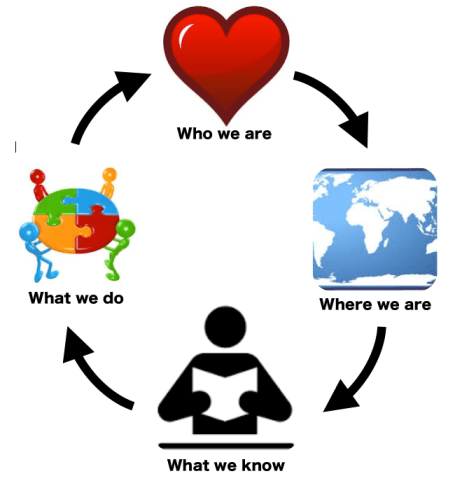
The role of the teacher librarian (TL) can broadly be understood by looking at the elements of:

  • Who we are
  • Where we are
  • What we need to know and
  • What we need to do.

Screen Shot 2014-12-07 at 10.12.01 am

Who we are

To misquote Karl Menninger “What the teacher (librarian) is, is more important than what he teaches.” (“Karl A. Menninger Quote,” n.d.).  It is the way in which individuals fulfil their role as TL that defines how both the profession and the individual is viewed. Aspects of this include strength of character (Bonanno, 2011), communication, cooperation, collaboration, interaction and relationships with those they come in contact with including students, teachers, principals and other members of the school community (Bonanno, 2011; Farmer, 2007; Gong, 2013; Lamb & Johnson, 2004a; Morris & Packard, 2007; Oberg, 2006, 2007; Valenza, 2010).  Being a positive role model as a life long learner, inquirer and innovator with impeccable honesty and ethics is considered to be at the basis of who a TL is (Farmer, 2007; Lamb & Johnson, 2004b; Oberg, 2006; Valenza, 2010). Drawing from research in the corporate world, it would appear that likeability is more important than competence in fostering collaboration and working relationships (Casciaro & Lobo, 2005).

Where we are

The context within which the TL operates cannot be ignored (Bonanno, 2011; Morris & Packard, 2007).  This includes the national educational or LIS (Library Information Science) ideology or systems and the background and personal experiences of all the school library stakeholders. Even within the relatively homogenous environment of a single country and culture, differences exist from school to school while in the context of an International school this can be amplified (Tilke, 2009).

When looking at the literature on school libraries in less developed economies, with single textbook, chalk and talk teaching methods, where there is an absence of policy and research, lack of specialist staff in either the teaching or librarian sphere, and a weak or neglected presence in the information society, (Abdullahi, 2009; Alomran, 2009; Odongo, 2009; Rengifo, 2009) the old Persian proverb “I cried because I had no shoes, until I met a man who had no feet” rings true.

What we need to know

The TL is expected to be a specialist both in teaching and in LIS. They need to combine knowledge, skills and experience in collection and resource management, information literacy, technology integration, curriculum and learning (Herring, 2007; Kaplan, 2007; O’Connell, 2012, 2014; Purcell, 2010; Valenza, 2010a). Various national and international professional organisations attempt to codify the skills and knowledge required in their standards and benchmarks for school librarians and set aspirational standards of excellence (ASLA, n.d.; “Australian School Library Association,” n.d., “International Association of School Librarianship – IASL,” n.d., “SLASA School Library Association of SA,” n.d.; IFLA, n.d.; Kaplan, 2007).

What we need to do

The core of what the TL does is advance school goals in an evidence based and accountable manner (Everhart, 2006; Farmer, 2007; Lamb & Johnson, 2004a; Oberg, 2002; R. Todd, 2003; R. J. Todd, 2007). The principal way in which these goals are achieved is through teaching and collaborating with other teachers (Herring, 2007; Purcell, 2010; Valenza, 2010). In addition, TLs managing people, resources and facilities (Everhart, 2006; Farmer, 2007; Tilke, 2009; Valenza, 2010).

In conclusion, the role of the TL is multi-faceted and dynamic as it continually adapts to the environment.   In each of our individual contexts it is worth taking heed of S.I. Hayakawa’s comment that “Good teachers never teach anything. What they do is create the conditions under which learning takes place.”  Those conditions are a combination of attitude, knowledge, skills and actions.

References

Abdullahi, I. (Ed.). (2009). Global library and information science: a textbook for students and educators: with contributions from Africa, Asia, Australia, New Zealand, Europe, Latin America and the Caribbean, the Middle East, and North America. München: K.G. Saur.

Alomran, H. I. (2009). Middle East: School libraries. In I. Abdullahi (Ed.), Global library and information science: a textbook for students and educators: with contributions from Africa, Asia, Australia, New Zealand, Europe, Latin America and the Caribbean, the Middle East, and North America (pp. 467–473). München: K.G. Saur.

ASLA. (n.d.). Standards of professional excellence for teacher librarians. Retrieved November 26, 2014, from http://www.asla.org.au/policy/standards.aspx

Australian School Library Association. (n.d.). Retrieved December 6, 2014, from http://www.asla.org.au/

Bonanno, K. (2011). A profession at the tipping point: Time to change the game plan. Keynote speaker: ASLA 2011 [Vimeo]. Retrieved December 4, 2014, from https://vimeo.com/31003940

Casciaro, T., & Lobo, M. S. (2005). Competent Jerks, Lovable Fools, and the Formation of Social Networks. Harvard Business Review, 83(6), 92–100. Retrieved from https://hbr.org/2005/06/competent-jerks-lovable-fools-and-the-formation-of-social-networks/ar/1

Everhart, N. (2006). Principals’ Evaluation of School Librarians: A Study of Strategic and Nonstrategic Evidence-based Approaches. School Libraries Worldwide, 12(2), 38–51. Retrieved from http://ezproxy.csu.edu.au/login?url=http://search.ebscohost.com/login.aspx?direct=true&db=lih&AN=24234089&site=ehost-live

Farmer, L. (2007). Principals: Catalysts for Collaboration. School Libraries Worldwide, 13(1), 56–65. Retrieved from http://ezproxy.csu.edu.au/login?url=http://search.ebscohost.com/login.aspx?direct=true&db=lih&AN=25545935&site=ehost-live

Gong, L. (2013). Technicality, humanity and spirituality – 3-dimensional proactive library service toward lifelong learning. Presented at the LIANZA Conference, Hamilton, New Zealand. Retrieved from http://www.lianza.org.nz/sites/default/files/Lidu%20Gong%20-%20Technicality%20humanity%20and%20spirituality%20-%203%20dimensional%20proactive%20library%20service%20toward%20lifelong%20learning.pdf

Herring, J. E. (2007). Teacher librarians and the school library. In S. Ferguson (Ed.), Libraries in the twenty-first century : charting new directions in information (pp. 27–42). Wagga Wagga, N.S.W: Centre for Information Studies, Charles Sturt University.

IFLA. (n.d.). IFLA/UNESCO School Library Manifesto. Retrieved November 26, 2014, from http://archive.ifla.org/VII/s11/pubs/manifest.htm

International Association of School Librarianship – IASL. (n.d.). Retrieved November 26, 2014, from http://www.iasl-online.org/about/handbook/policysl.html

Kaplan, A. G. (2007). Is Your School Librarian “Highly Qualified”? Phi Delta Kappan, 89(4), 300–303. Retrieved from http://ezproxy.csu.edu.au/login?url=http://search.ebscohost.com/login.aspx?direct=true&db=a9h&AN=27757339&site=ehost-live

Karl A. Menninger Quote. (n.d.). Retrieved December 6, 2014, from http://izquotes.com/quote/290881

Lamb, A., & Johnson, L. (2004a, 2014). Library Media Program: Accountability. Retrieved November 25, 2014, from http://eduscapes.com/sms/program/accountability.html

Lamb, A., & Johnson, L. (2004b, 2014). Library Media Program: Evaluation. Retrieved November 25, 2014, from http://eduscapes.com/sms/program/evaluation.html

Morris, B. J., & Packard, A. (2007). The Principal’s Support of Classroom Teacher-Media Specialist Collaboration. School Libraries Worldwide, 13(1), 36–55. Retrieved from http://ezproxy.csu.edu.au/login?url=http://search.ebscohost.com/login.aspx?direct=true&db=lih&AN=25545934&site=ehost-live

Oberg, D. (2002). Looking for the evidence: Do school libraries improve student achievement? School Libraries in Canada, 22(2), 10–13+. Retrieved from http://search.proquest.com/docview/222527406?accountid=10344

Oberg, D. (2006). Developing the respect and support of school administrators. Teacher Librarian, 33(3), 13–18. Retrieved from http://search.proquest.com/docview/224879111?accountid=10344

Oberg, D. (2007). Taking the Library Out of the Library into the School. School Libraries Worldwide, 13(2), i–ii. Retrieved from http://ezproxy.csu.edu.au/login?url=http://search.ebscohost.com/login.aspx?direct=true&db=lih&AN=28746574&site=ehost-live

O’Connell, J. (2012). So you think they can learn. Scan, 31(May), 5–11. Retrieved from http://heyjude.files.wordpress.com/2006/06/joc_scan_may-2012.pdf

O’Connell, J. (2014). Researcher’s Perspective: Is Teacher Librarianship in Crisis in Digital Environments? An Australian Perspective. School Libraries Worldwide, 20(1), 1–19. Retrieved from http://search.proquest.com/docview/1543805459?accountid=10344

Odongo, R. I. (2009). Africa: School Libraries. In I. Abdullahi (Ed.), Global library and information science: a textbook for students and educators: with contributions from Africa, Asia, Australia, New Zealand, Europe, Latin America and the Caribbean, the Middle East, and North America (pp. 91–107). München: K.G. Saur.

Purcell, M. (2010). All Librarians Do Is Check Out Books, Right? A Look at the Roles of a School Library Media Specialist. Library Media Connection, 29(3), 30. Retrieved from http://ezproxy.csu.edu.au/login?url=http://search.ebscohost.com/login.aspx?direct=true&db=f5h&AN=55822153&site=ehost-live

Rengifo, M. G. (2009). Latin America: School Libraries. In I. Abdullahi (Ed.), Global library and information science: a textbook for students and educators: with contributions from Africa, Asia, Australia, New Zealand, Europe, Latin America and the Caribbean, the Middle East, and North America. München: K.G. Saur.

SLASA School Library Association of SA. (n.d.). Retrieved November 26, 2014, from http://www.slasa.asn.au/Advocacy/rolestatement.html

Tilke, A. (2009, September). Factors affecting the impact of a library and information service on the International Baccalaureate Diploma Programme in an international school: A constructivist grounded theory approach. (A thesis submitted for the degree of Doctor of Philosophy). Charles Sturt University, Wagga Wagga, N.S.W.

Todd, R. (2003). Irrefutable evidence: how to prove you boost student achievement. (Cover Story). School Library Journal, 49(4), 52+. Retrieved from http://go.galegroup.com.ezproxy.csu.edu.au/ps/i.do?id=GALE%7CA100608794&v=2.1&u=csu_au&it=r&p=EAIM&sw=w&asid=194fea091c82b000bb3b69ca05004411

Todd, R. J. (2007). Evidenced-based practice and school libraries : from advocacy to action. In S. Hughes-Hassell & V. H. Harada (Eds.), School reform and the school library media  specialist (pp. 57–78). Westport, CY: Libraries Unlimited.

Valenza, J. (2010, December). A revised manifesto [Web Log]. Retrieved May 21, 2014, from http://blogs.slj.com/neverendingsearch/2010/12/03/a-revised-manifesto/

Image Credits:

Teamwork: http://upload.wikimedia.org/wikipedia/commons/b/ba/Working_Together_Teamwork_Puzzle_Concept.jpg

Heart: https://openclipart.org/detail/-by-pianobrad-137125

World map:  http://upload.wikimedia.org/wikipedia/commons/4/43/World_Map_Icon.svg

Knowledge:  https://openclipart.org/image/300px/svg_to_png/184627/learn-icon.png