Educational advice – from Facebook?

I subscribe to way too many Facebook groups. I need to stop it actually, they’ve become like women’s magazines. But worse. You keep seeing the same things come up over and over again, but instead of ignoring them you can actually have a say, which is giving yourself the delusion of helpfulness, but actually the smartest person in the room of Facebook groups is not the room itself, to misquote David Weinberger.

Some of the smartest people I know don’t do Facebook and when they do, they’re lurkers not participators. So I guess that’s making me stupid. I just can’t help myself because the fact that someone may actually genuinely want an accurate answer AND follow up is illusionary enough to put up with the ignorance of echo-chambers and the chance that you may learn something.

No where is worse than education groups, and within those groups nothing is worse than questions and answers about bilingualism and language. Except perhaps dinner parties between parents of children of roughly the same age that are excruciating examples of passive aggressive one-upmanship.  Right now the sum of my parenting advice can be summed up as:

  • It’s hard to kill a baby (i.e. CTFD)
  • Regularity, sleep and reading (and don’t be too poor)
  • Avoid dinner parties with other parents unless their children are at least 10 years older than yours
  • Pick two languages and give them all you’ve got

It’s the last point I’d like to write about today. On one of the groups the following was posted:

2yr old (born NOV 2015) who is trilingual (if you can even say this about a 2yr old). German mum, French dad, English spoken with nanny and language between parents. I’m looking for kindergarten options from around next summer … have no idea where to start.
No preference towards public/private or towards any language even though I’m wondering if adding mandarin might be a bit confusing given that there are already the other 3. What do you think? Focus is more on play/social activities rather than academics

This is a pretty typical question and the answers were also pretty typical – a combination of shouting out school names that have either French or German, alternating with saying that children can easily learn any amount of languages (the number 12 was even suggested), compared with humblebrags about how “fluent” their 5 year old was in any number of languages.

I must admit to entering the fray and suggesting that they chose the language of the school based on their future plans if known – i.e. go back to a French / German speaking environment or continue in the international sphere, and based on who would be at home to support the homework and reading. And to choose 2 languages and do them properly.  There are language experts who can help people on this. There are books and research papers written on this.  And don’t ask parents of young children – they know not what they say. Don’t even talk to educators in primary schools.  speak to parents with teenagers, preferably at the point where they have to choose their IB language. Talk to teenagers, and talk to teachers of IB languages.

Being bilingual is NOT just speaking a language. It is reading and writing. Being literate. And that takes formal lesson time, time spent reading and writing AT grade level. There are so many barriers to that. I’m now talking general international schools, of course there are exceptions / bilingual schools. If you’re lucky you’ll get 40 minutes a day in the language at school.  Probably in that language as a SECOND language, i.e. language learning may just be a combination of groundhog day (learning the same things year after year) and/or teaching to the lowest common denominator.  So you’re going to have to supplement at home. Either by classes in the afternoon / weekends, online or with a tutor. Besides having to read to and with your child in that language. And dedicate at least part of your holidays to immersion in that language environment.  As one expert who recently visited our school said “language is not buy one, get one free”. My personal statement is always “you don’t learn a language by breathing the same air as others who speak it”. Bottom line is it takes planning, time and money.

As I write (Saturday afternoon) my husband is in my son’s room reading in Dutch with him. He’s 14. He has in-school after hours Dutch classes for 3 hours a week plus out-of-school additional tutoring for about 2 hours a week / fortnight depending on his needs. According to his Dutch teacher there are many students who cannot enter the program as the level of their “literate” Dutch is too low.  And many of the students in the program are doing Dutch at a much lower level than their chronological age.  We took action when he was 9 and started intensive work on his Dutch after he was failing at Chinese. It’s been expensive and time-consuming but he’s on track for a bilingual diploma plus he can communicate with his Dutch family and if necessary could student there in Dutch at university level.

My daughter thrived in the bilingual English-Chinese environment in Hong Kong, hated the only alternative of Chinese second language at her primary school, Had me nagging her to continue reading and writing chinese in her spare time with a tutor until middle school, got into the native stream for middle school / iGCSE where she’s the only caucasian / non-Chinese-heritage child left in a class of about 8 students only.  This is only because she’s an exceptionally diligent child and kept up her reading and writing. She bemoans the low expectations and standards at school. Most of the students in her class are only doing Chinese on the insistence of their parents. She may do first language IB and has been recommended for it, but has lost motivation.

All of my French friends who have had children come up the system internationally have, to their regret, children doing French second language.

If you’re interested in reading more on this topic, I’ve read, thought and written reams about it. 


ETL402 Critical Reflection

Reading Haven (2007) was a great way to set the scene for this course. Even if we were not all literature “converts” before starting the course, understanding the research behind the power of stories would make us so. Of all the themes I think the second module – concerning diversity – was the one that engaged me most passionately and emotionally. Smolen and Oswalds’ (2011) book was instrumental in expanding my knowledge on this topic.


Reviewing my blog posts The Best of Times, the Worst of Times; if you name it will it come; Conversations and thoughts about diversity in literature; It can’t get any worse … can it? and The right to write as well as my first assessment The Power and Potential of Multicultural Diverse Literature I realise they all concerned themselves with this topic. In practise, despite best intentions and efforts, large international communities of practise, the so called “global librarian networks” it is still difficult to source and purchase diverse literature of the quality and quantity necessary.


Looking at the collection, the teacher librarian (TL) walks several tightropes simultaneously – balancing curriculum needs with literacy needs with pleasure “fast food” reading needs as well as parental and societal expectations and biases makes for interesting tension. All while ensuring that literature can fulfil its destiny without losing a generation of potential readers. Personal observations reinforced the need for positive role models and personal – particularly peer –recommendations (Marcoux & Loertscher, 2009). Attempts to transform a physical library space were documented in a number of blog posts summarised here. Both Travers and Travers (2008) and Elizabeth and Selman (2012) cast an important biopsychosocial developmental lens on the subject of literature in schools.


With respect to the digital experience, as a colleague remarked to me “we are the first generation of teacher librarians and parents dealing with the internet, and we don’t know what we’re doing or what the long term effects will be”. Of course there are more than enough naysayers (Carr, 2013; Mangen, Walgermo, & Brønnick, 2013) and cheerleaders (Cornis-Pope & Woodlief, 2000) to balance each other out and the jury is out on the matter. At the end of the day it is important to meet the students where they are – whether that is in the land of text, live or digital and embrace the benefits of interaction, self-directed learning with creative opportunities (Anstey & Bull, 2006).


Finally, as they say – the proof of the pudding is in the eating – or in this instance, the proof of the learning is in how it can be applied in the teaching and promotion of literature in schools. Changing the culture in any learning environment is a slow process, where one has to learn to trust one’s instincts and trust the students, alternate between catching one’s breath in horror and outrage at the utterances of some teachers and parents while being in awe of the skill and depth of understanding and good practice of others, all moments from each other. It’s quite a ride.


References:

Anstey, M., & Bull, G. (2006). Defining multiliteracies. In Teaching and learning multiliteracies : changing times, changing literacies (pp. 19–55). Newark, Del: International Reading Association.

Carr, N. (2013, January 5). Don’t burn your books—print Is here to stay [WSJ.com]. Retrieved 22 May 2014, from http://online.wsj.com/news/articles/SB10001424127887323874204578219563353697002

Cornis-Pope, M., & Woodlief, A. (2000, Fall). The rereading/rewriting process: Theory and collaborative, on-line pedagogy. Retrieved 17 January 2016, from http://www.vcu.edu/engweb/ReReadingTheorychapter.htm

Elizabeth, T., & Selman, R. L. (2012). The role of social development in elementary school curricula: Past, present, and future. Saperstein Associates. Retrieved from http://www.sapersteinassociates.com/downloads/2012_Elizabeth_and_Selman_SD_Whitepaper.pdf

Haven, K. F. (2007). Story proof: the science behind the startling power of story. Westport, Conn: Libraries Unlimited. Retrieved from EBook Library

Mangen, A., Walgermo, B. R., & Brønnick, K. (2013). Reading linear texts on paper versus computer screen: Effects on reading comprehension. International Journal of Educational Research, 58, 61–68. http://doi.org/10.1016/j.ijer.2012.12.002

Marcoux, E., & Loertscher, D. V. (2009). The role of a school library in a school’s reading program. Teacher Librarian, 37(1), 8–14,84.

Smolen, L. A., & Oswald, R. A. (Eds.). (2011). Multicultural literature and response: Affirming diverse voices. Santa Barbara, California: Libraries Unlimited. Retrieved from EBook Library

Travers, B. E., & Travers, J. F. (2008). Children, literature and development: Interactions and insights. In Children’s literature: a developmental perspective (pp. 2–17). Hoboken, NJ: John Wiley & Sons.

The role of the TL in practise with regard to the convergence of literacies in the 21st Century

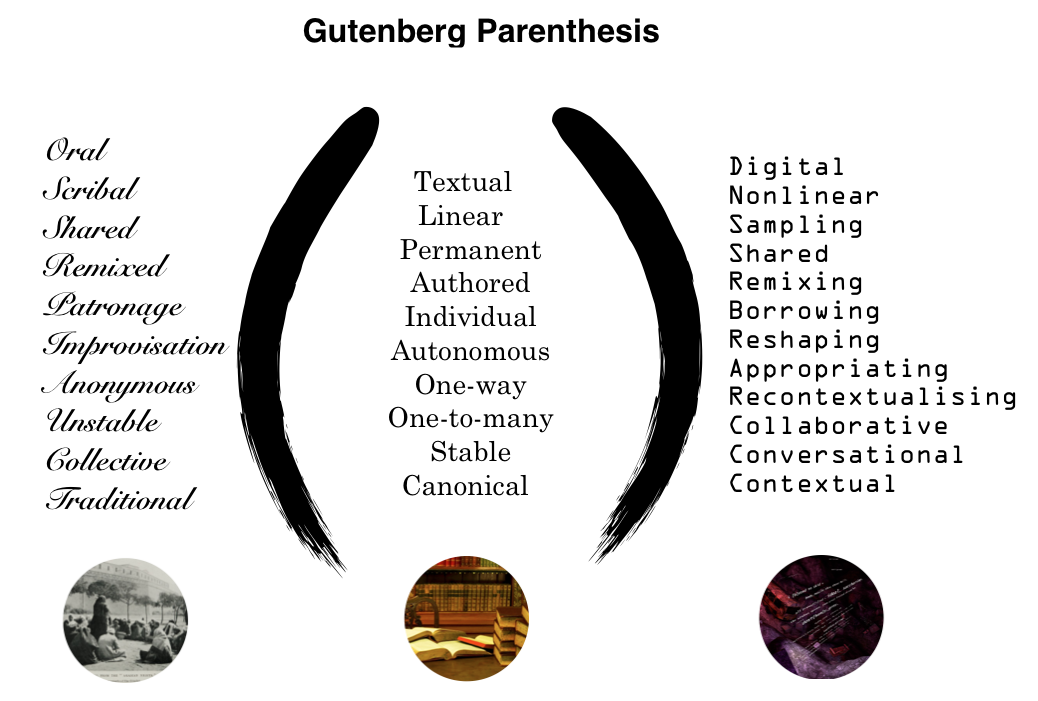
In what authors are referring to as the post Gutenberg parenthesis society, (Kenny, 2011; Pettitt, Donaldson, & Paradis, 2010), an emphasis on textual literacy is no longer sufficient. Shifts in technology, particularly with the advent of Web 2.0 and its social media affordances mean that literacy has become a dynamic and multifaceted concept that goes beyond information literacy but incorporates digital, visual, media and a multitude of other literacies under the umbrella term multi-literacy (Mackey & Jacobson, 2011). Trans-literacy as a concept, attempts to map meaning and interaction across these literacies and different media, including social media (Ipri, 2010).


gutenberg parenthesis


O’Connell (2012) suggests the teacher librarian (TL) respond along three strategic dimensions. Firstly through an involvement strategy whereby the TL “meets students where they are”, secondly with a responsive information strategy that filters, curates, and shares content and finally through a leadership strategy by taking leadership in curriculum, broaching the digital divide, championing digital citizenship and global sharing. While she encourages TL’s to create a personal learning environment (PLE), utilize their personal learning network (PLN) and personal web tools (PWT), it can be posited that the TL has to go beyond creating and using these tools personally, but to ensure educators and students in the community can also tap into their power.

Information literacy concerns itself with the selection, evaluation and use of information to solve a problem or research question, however, trans-literacy goes beyond this paradigm to the creation and sharing of ideas and the importance of social connections. Besides constructivism, the TL should incorporate principles of connectivism in their teaching approach, emphasizing the connections between the individual, data and others in the current networked culture (McBride, 2011). This principle is wonderfully illustrated by Joyce Valenza in her video “See Sally Research” (Valenza, 2011), which also highlights the importance of TLs creating an environment in which students go beyond using information for personal research but as a means of expressing themselves as digital citizens. Waters (2012) expounds on the theme of digital citizenship and rightly points out that this should go beyond behaviours and prohibitions creating a safe and civil digital environment but that TLs should encourage their students to participate as producers and managers of information and perspectives in a globally socially responsible manner.


In their book “Literacy is not enough”, Crockett, Jukes and Church (2011) create a conceptual model incorporating information, solution, creativity, collaboration and media fluency and provide the educator or TL with suggested processes and scaffolds for teaching each (reviewed by Loertscher & Marcoux, 2013). In his talk, Lee Crockett emphasizes that these fluencies are important to the 21st-Century learner independent of the amount of digital technology employed, something that is often neglected when technology dominates the conversations (Crockett, 2013).

As TLs we need to be aware of all these discussions around the various iterations of literacies as well as taking leadership in our learning environments and ensuring our teaching and assessments follow the latest standards where these are available.

References:

Crockett, L. (2013, February 28). Literacy is NOT Enough: 21st Century Fluencies for the Digital Age [Streaming Video]. Retrieved January 4, 2015, from https://www.youtube.com/watch?v=N8DEeR1sraA

Crockett, L., Jukes, I., & Churches, A. (2011). Literacy is not enough: 21st-century fluencies for the digital age. Kelowna, B.C. : Thousand Oaks, Calif.: 21st Century Fluency Project ; Corwin.

Ipri, T. (2010). Introducing transliteracy: What does it mean to academic libraries? College & Research Libraries News, 71(10), 532–567. Retrieved from http://crln.acrl.org/content/71/10/532.short

Kenny, R. F. (2011). Beyond the Gutenberg Parenthesis: Exploring New Paradigms in Media and Learning. Journal of Media Literacy Education, 3(1), 32–46. Retrieved from http://www.jmle.org

Loertscher, D. V., & Marcoux, E. (2013). Literacy is not enough: 21st-century fluencies for the digital age. Teacher Librarian, 40(3), 42–42,71.

Mackey, T. P., & Jacobson, T. E. (2011). Reframing Information Literacy as a Metaliteracy. College & Research Libraries, 72(1), 62–78. doi:10.5860/crl-76r1

McBride, M. F. (2011). Reconsidering Information Literacy in the 21st Century: The Redesign of an Information Literacy Class. Journal of Educational Technology Systems, 40(3), 287–300.

O’Connell, J. (2012). Change has arrived at an iSchool library near you. In Information literacy beyond library 2.0 (pp. 215–228). London: Facet.

Pettitt, T., Donaldson, P., & Paradis, J. (2010, April 1). The Gutenberg Parenthesis: oral tradition and digital technologies. Retrieved August 29, 2014, from http://web.mit.edu/comm-forum/forums/gutenberg_parenthesis.html

Valenza, J. (2011). See Sally Research @TEDxPhillyED [Streaming Video]. Retrieved May 22, 2014, from http://blogs.slj.com/neverendingsearch/2011/09/05/see-sally-research-tedxphillyed/

Waters, J. K. (2012, September 4). Turning Students into Good Digital Citizens. Retrieved January 2, 2015, from http://thejournal.com/Articles/2012/04/09/Rethinking-digital-citizenship.aspx