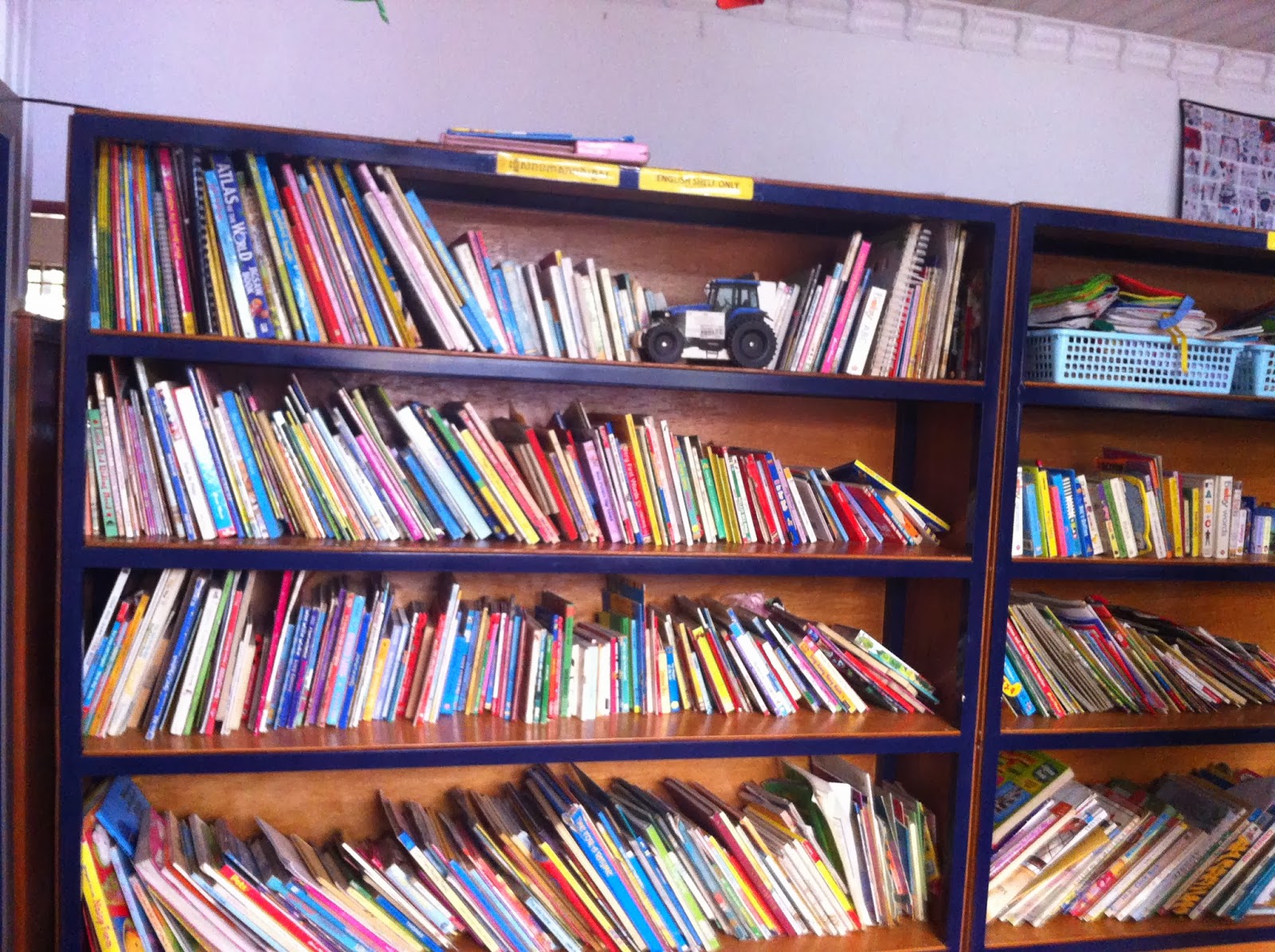
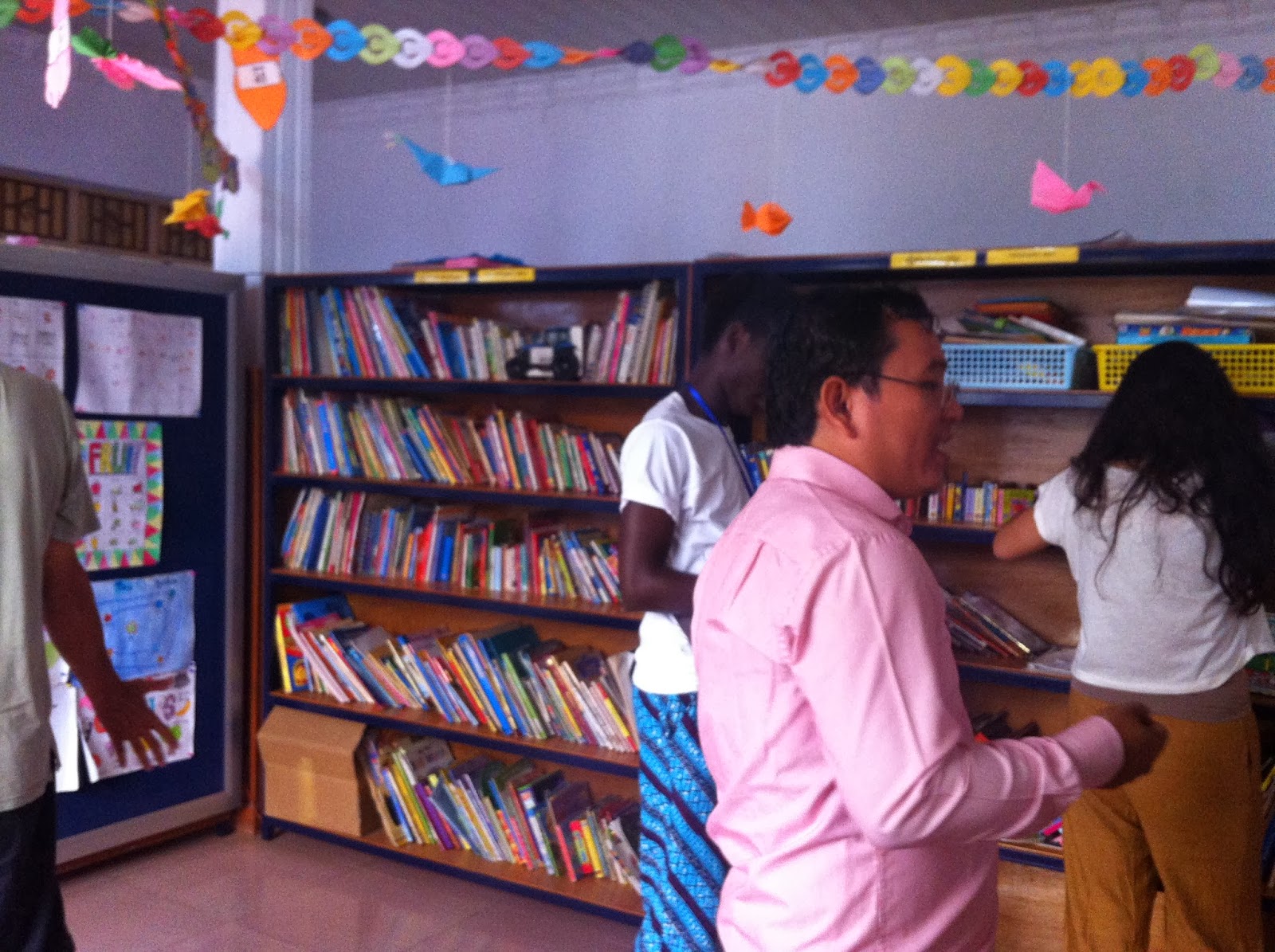
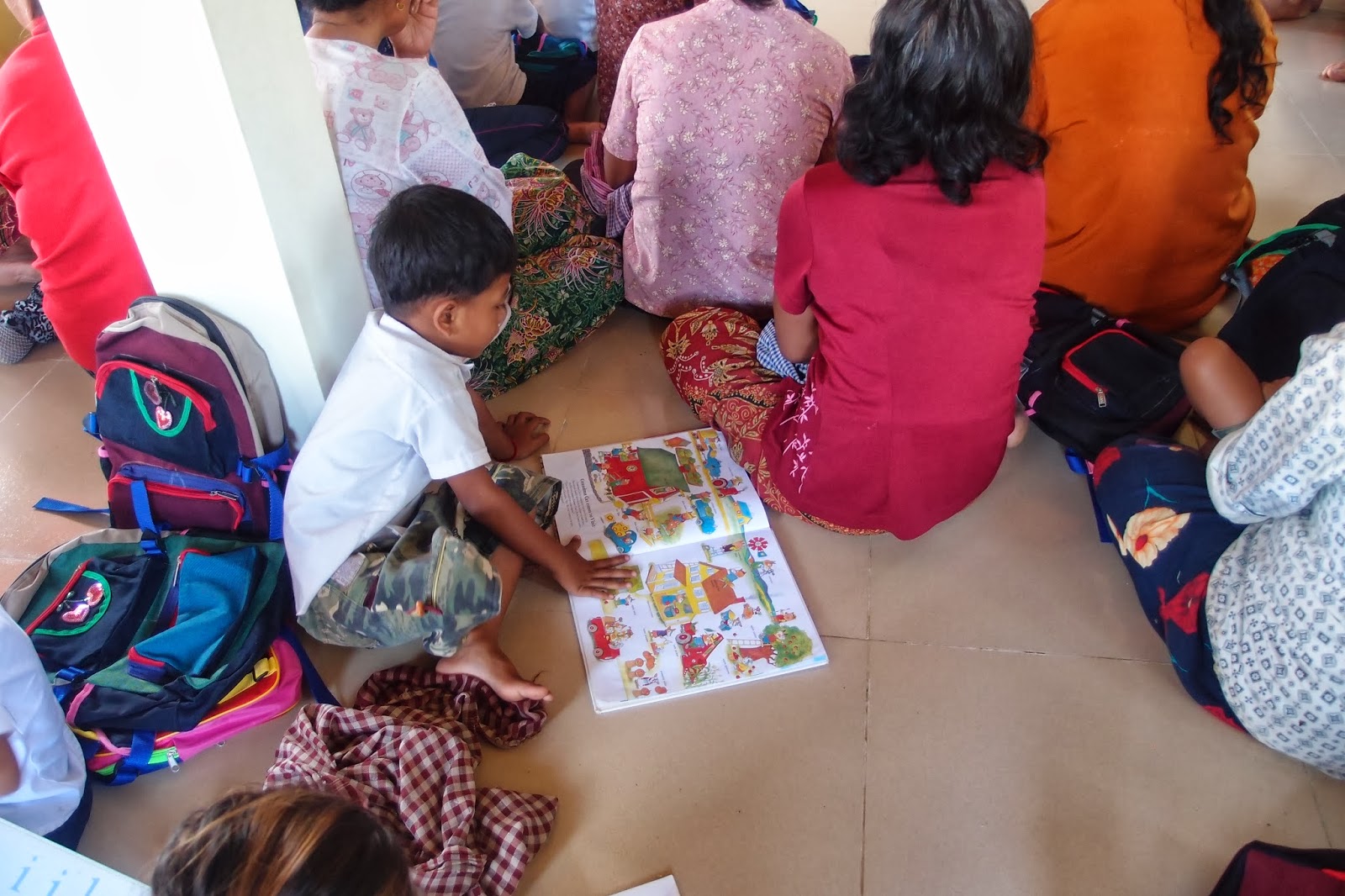
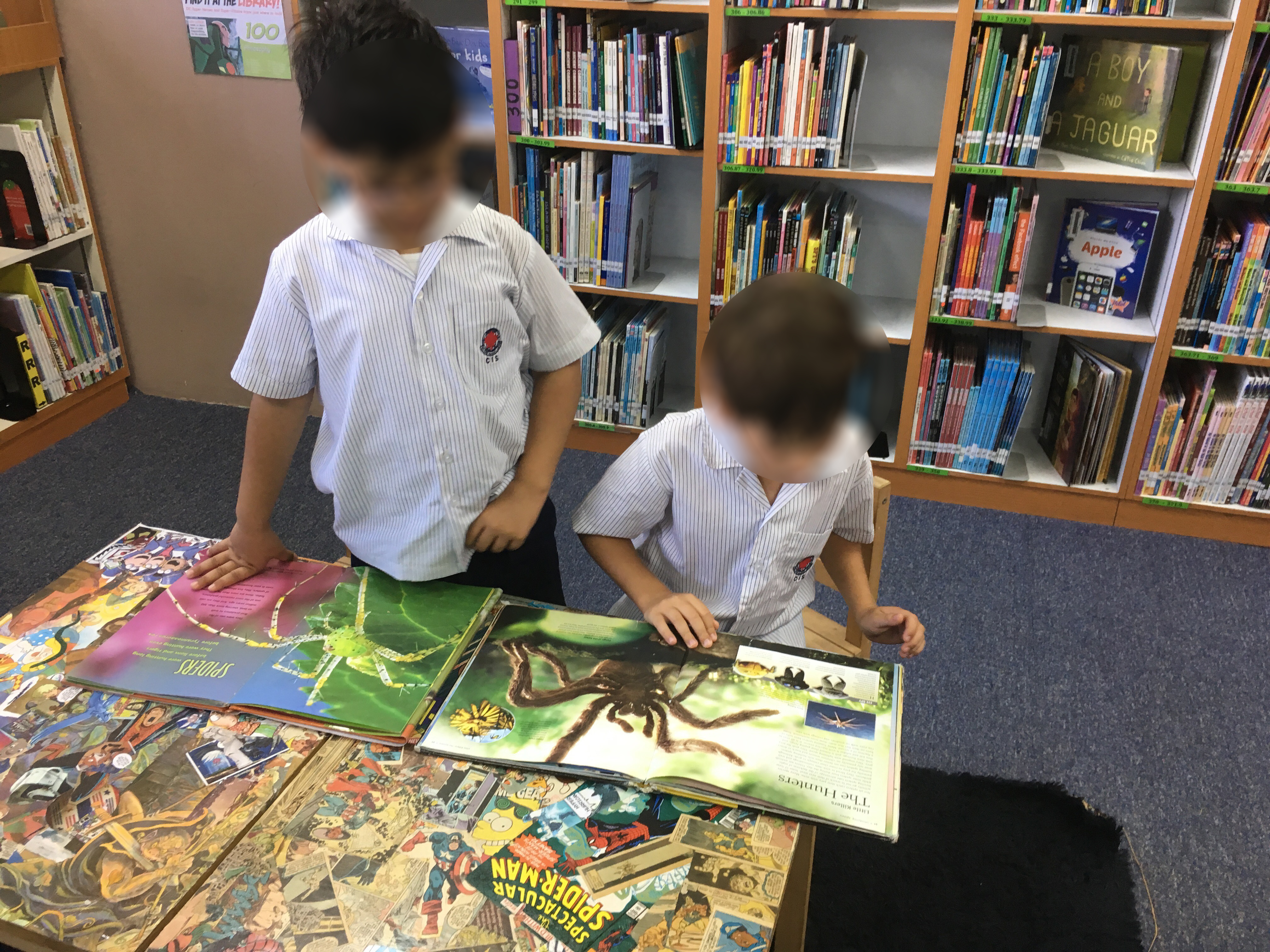
(Boys) Reading as a social activity

As I wander around my library during recess and lunchtime, before and after school, I realise more and more than reading is not the solitary quiet activity that it’s usually purported to be. I’ve taken to trying to capture this by photographing the communal reading that is going on – which takes me to an article that I’ve been reading that I think is quite important when thinking about boys’ literacy pursuits – “Morphing literacy: Boys reshaping their school-based literacy practices” (Blair & Sanford, 2004).

boys3


boys2 boys1


Who can relate to this in their school libraries?

  • A cluster of boys sitting around a boy with the Guinness Book of Records – pointing and chatting and oohing and aahing about some record or another, followed by a debate about if it has been surpassed, and grabbing the next years book?
  • Two or 3 boys sitting with a Minecraft or lego book trying to find out how to do something?
  • A couple of younger boys reading the same graphic novel (usually squish or lunch lady) and turning the pages at the same time or waiting to turn the page so they can read the same thing at the same time?
  • Requests for books that tell them how to progress in computer / online games
  • Needing books about the 2nd world war because their grandfather or great-grandfather fought in it?

Blair and Sanford (2004) relate boys’ reading to their need to acquire social-cultural capital – i.e. they read as long as it enhances their peers and their own view of themselves as “acceptable masculine beings” and creates connection, collaboration and camaraderie between themselves and their friends. The authors refer to “team-like literacy” involving participation and interaction that is purposeful.

In terms of the kinds of texts that engage and fulfil these needs, the “rules” are simple

  • action > relationships
  • excitement > unfolding characters
  • need to suit personal interests / fact finding / purpose / sharing information
  • humour and fun ++++ important

I would suggest that the literary market / publishing is NOT catering for these needs adequately or at all in fact. Let’s take “Jets” for example.  The current obsession of the Grade 1 / 2 students in my school at the moment. The available books we have are dumb. They’re not information rich enough and the publishers cater to their reading level rather than their interest level. They’re dated before they even hit the shelves. They want elaborate up to date images with lots of numbers and facts – never mind the silly narrative “here is a pilot” “this is the instrument console”.  Ditto Lego – I’ve said this a million times and I’ll say it again. There is nothing inbetween the little books “castles, towns, 101 things to make” and “Lego StarWars” that is so big and bulky and hard to take home.  Make each chapter into a book FFS. How much time do publishers even spend walking around school libraries and talking to boys? (or even librarians? or teachers? or parents?).

This type of article also explains why our “Blokes with Books” and “Readers’ Cup” clubs work so well at school. Connection, affinity, literacies growing out of relationships.

Now to make sure we leverage that in the classrooms and at home.

References:

Blair, H. A., & Sanford, K. (2004). Morphing literacy: Boys reshaping their school-based literacy practices. Language Arts, 81(6), 452.

Picking the locks one-by-one

A few months ago a tradesman came to the door to fix something. Here in Singapore such people are often Muslim and therefore petrified of dogs. So my helper put the dog in a separate part of the house and closed the door, not knowing that it was one of those doors that lock themselves if the button is pressed in, which it was for some inexplicable reason. And although that part of the house has two doors leading to outside which are usually open all day every day, they’d been closed and locked due to a late afternoon rainstorm accompanied by a lot of wind.  Before calling the landlord’s agent for a spare key, I did what every other independent woman would do, I googled “how to pick a lock”. The instructions, video and otherwise all boiled down to the same simple steps.

Since I could access the garage and all the tools and assorted things like paperclips and hairclips (grateful for once for stuff lying around the house instead of being tidied up) – I set to work. In the process I discovered that the lock was “the wrong way round” to my sensibilities – do you notice that – doors and locks having to be turned “the other way” to what you’re used to in your home country?
Needless to say, there is a good reason why I’m not a burglar, nor a locksmith and the spare key had to be called into action. If you want to find out more about locks and security – here’s a great episode of 99% invisible.
After that huge digression to come to my point. As I wrote earlier, I have a large population of ELL students who come through the library and I’m always trying to find “that” book that will unlock their desire to read in English (actually I’m trying that for everyone, just this population seems to have the highest and most immediate needs.
Sometimes things happen quite by accident.
My G4 classes have been doing a unit on poetry as part of “how we express ourselves” and besides some great activities with spine poetry (much to the horror of my library assistants who are not used to such free-wheeling attitudes to taking books off the shelf) one day I decided to promote verse novels.
I’ll be the first to admit that I’m no expert on any aspect of children’s literature, but I’m a keen learner, so I looked for some lists of verse novels for elementary students and then tried to see how many I had on hand. I’d read “inside out and back again” which is a fabulous book, so I felt it may work.
For each of my next G4 classes I had a pile of verse novels and I picked out one page to read from each.  Since my darling dog had just been put down the previous night, it was with a chocked voice I read from “Love that Dog” and luckily I had a whole pile of those to dish out since one of my predecessors had the foresight to order them in duplicate.
After the lesson a few of the books were borrowed and I didn’t think that much of it. Then a week later one of my Chinese students sidled up to me during lunch time and asked me for a book “like that dog” book, and I gave him “Hate that cat”, and yesterday he came to me and said he’d finished it and wanted more books like that.  I said “more about animals, or more like poetry” and he affirmed more like poetry, and I passed on “Inside out and back again” and told him it was one of my personal favourite – he quickly scanned inside the book and happily said “yes”.
And yes of course it would work.  I’ve not studied this stuff and I’m feeling my way along, but sometimes our students just help us to discover what it is they want and need.  Coming back to it rationally – verse is short and beautiful and evocative and free. And now it’s just one more tool in my arsenal of lock-picking equipment.
Here are some resources:


Literacy is not enough: Why we need to teach information literacy

Some weeks are just like hitting the jackpot in terms of the news and media world shouting out “yes, this is necessary” – although of course they don’t phrase it that way, and they certainly wouldn’t invoke libraries, librarians and information literacy in their communal hand wringing. But they should.

The first was the retraction of an article in Science. (Retraction watch – who knew that it even existed? And now I know it’s going to be on my reading list from time to time! They’re on twitter @RetractionWatch so that makes it easier – makes me think of “This idea must die” which is also on my reading list after hearing this talk).

Jesse Singal has written an excellent article – “The Case of the Amazing Gay-Marriage Data” – it really is worth reading the whole thing because it covers so many aspects of the world of academic publishing, how it can go badly wrong, and just how unlikely it is that it is found out and even if it’s found out, how hard it is to be a whistleblower.

The second, was about chocolate, and how unfortunately it doesn’t help in weight loss and in fact we’d all just been had as it was a bunch of science writers playing with journalists and our gullibility and lack of information literacy.  Here is John Bohannon, the culprit (?) ‘fessing up: “I Fooled Millions Into Thinking Chocolate Helps Weight Loss. Here’s How” and Rachel Ehrenberg’s indignant retort on behalf of journalists “Attempt to shame journalists with chocolate study is shameful
Obviously (one hopes) this is going to have repercussions in tertiary education and in journalism. But what can we learn from it in the K-12 environment?
Well a good place to start would probably be to introduce students to the concept of cognitive bias (and to do it WAY before they’re doing TOK at IB level).  Here is a great little article by George Dvorsky on the twelve most common cognitive biases. Let’s get everyone thinking – a little assignment for my readers – post in the comments what cognitive biases were present in each case! Just as we teach our G4’s about marketing tricks of the trade, I’m sure this can be presented in a way that is accessible and easy to understand and relate to their own lives. 
I’m also thinking about how we could expand the math curriculum to replace a fear of numbers and statistics with a healthy dose of scepticism and what questions to ask and how to dig behind the “headline” numbers. I sometimes wonder why it is that we don’t challenge our students more about their own data.  Thinking back to the exhibition presentations of our Grade 5’s – yes they did a great job, and it was amazing what they pulled together and the confidence with which they could present. But who was looking at the data? Each group had a mentor, who could (should?) challenge when things don’t add up, when what they’re saying and what they can back it up with doesn’t match. When things just don’t make common logical sense.   Now this is a tricky thing. A very tricky thing. We don’t like confrontation, and we’re not really good at it either.  Now look back at the first article.  If the co-author had applied a little common sense and said “hey, if you’ve sampled 100,000 people, how did you get the $1m budget? (simple multiplication / extrapolation)” 
… how about Brookman? Things don’t make sense to him, and what’s everyone saying? “don’t rock the boat”  And our students. Yes we want to created a safe learning environment where mistakes can be made.  BUT and this is a big BUT, we also want to be able to call them on their mistakes, give them a chance to correct them and build the resilience of being able to cope appropriately with (constructive) criticism AND the idea that this research thing is serious, and can and will be up to challenge, AND make them think more critically about how they interpret and use other’s research.  I was not a part of the whole process and I know our digital literacy coaches and librarian were involved, I’m wondering if the math coach was also involved or not?  And in a school without a math coach – who would be doing this?  How many teachers at any level feel comfortable and confident enough around numbers and the “math” side of research to assume this role?  I’d argue all should be, and if not that’s some PD that needs to be done as a priority. Because in the future and in the now, numbers are being used all around us, and the big big thing is “big data” and if we don’t know how to look at numbers and to ask the right kinds of questions we are going to be manipulated into making the wrong assumptions, making the wrong choices. This stuff is important. (See my favourite math blogger Mathbabe on this).
All of us are literate in the sense of reading and writing. And some of us are critical readers of literature, we can analyse and comment and dissect. And then we get into the realm of being information literate, on the basic level, the whole model thing of finding a question, finding information, interpreting and using it, reflecting etc.  And then only can we get to the point of understanding who is writing something and why and then really understanding the socio-cultural / political and meta-cognitive things that are going on behind information. And if we don’t start with the basics and make sure it’s embedded in everything we do, how will we ever get there?

Critical Reflection ETL401

In this course, what I have learnt in the library and information sphere is now placed in the context of the school library, which is where I hope to further my career. In doing so it has clarified and added detail to concepts such as the role of the teacher librarian (TL) and information literacy (IL), while making me aware of what I don’t know much about – particularly in the area of curriculum and learning theories. As such, I am in a slightly stronger position meta-cognitively in ‘knowing what I don’t know’ (Morris, 2010). The comments of my fellow students and the course co-ordinator in the online fora, who come from a teaching background have been invaluable in this respect.


The role of the teacher librarian is complex, multi-faceted and dependent on the school context – which I explored in my first blog post (Bailey, 2014). As I work in a large K-12 international school means that some of the roles are assumed by or shared with the literacy and digital literacy coaches, leading to the need for constant collaboration and partnership not only with classroom teachers, school leadership and administrators but also these coaches.


Evidence and accountability in our role is something I would like to explore further in my work, particularly as we start up new initiatives such as classroom libraries and continue existing work in creating library pathfinders and co-teaching in some humanities models. In this way we can ensure that we are strategic in our time and resource planning to optimise our efficacy.


One of the main themes of this course has been information literacy, where we were introduced to the main thought leaders in this area, including Kuhlthau (2010; 2012a, 2012b, 2012c), Herring (2011; Herring, Tarter, & Naylor, 2002), and Eisenberg (2008; Wolf, Brush, & Saye, 2003). While many of the models of information literacy focus on the scaffolding of skills, information literacy can be seen as having four dimensions: cognitive (skill based); meta-cognitive (reflective); affective (positive and negative emotions); and the socio-cultural, including digital citizenship and ethical use of information (Kong & Li, 2009; Kuhlthau, 2013; Waters, 2012). This, and the question of transferability is something I explored in my blog discussing why information literacy is more than a set of skills (Bailey, 2015b). Literacy convergence and the 21st Century learner are valid realities that rethink the ambit of literacy in an information society that doesn’t only rely on text, and has expectations for learners that go beyond the personal consumption of information to contributing to using knowledge for personal or social transformation (Bailey, 2015a). However they can also be used as buzz words that can obfuscate the essence of information literacy irrespective of the medium used for access and dissemination of information (Crockett, 2013).


Learning naturally goes on outside the (virtual) classroom, and I have learnt a considerable amount through attending TL conferences, work shares, knowledge exchange workshops and conversations with my peers and more experienced TLs. One such conversation led to me investigating the fascinating concept of Threshold Concepts, particularly as it relates to information literacy (Hofer, Townsend, & Brunetti, 2012; Tucker, Weedman, Bruce, & Edwards, 2014). Although most research is currently in tertiary education (Flanagan,2015) I would like to explore which concepts would be relevant for our students and at what level we could introduce them and the most effective activities to do so. I’d also like to investigate assessment tools to aid us in pinpointing the problematic concepts in new students who have not come through the Guided Inquiry process of the school.


Our collaboration is not just with students, teachers and administrators but also parents who are often the ones picking up the slack and tasked with helping frustrated children with assignments or homework (Hoover‐Dempsey et al., 2005; Kong & Li, 2009). I have started doing some outreach to parents through co-ordinating our parent volunteer program, and marketing our online resources but realise I can do far more in educating parents in IL concepts and how best to continue scaffolding these concepts at home and making them aware of how our resources can aid them in this process.


One of the most valuable parts of this course was gaining an understanding of my own learning including cognitive and affective processes in the past two years and reflecting on my attempts to go through this process effectively unscaffolded, relying on instinct and common sense! Perhaps my learning would have been more efficient and effective if I’d known this all at the start, but certainly now I will be better at passing on the knowledge and experience to my students and children.


References:

Bailey, N. (2014, December 7). ETL401 Blog Task 1: The role of the TL in schools [Web Log]. Retrieved January 24, 2015, from http://thinkspace.csu.edu.au/informativeflights/2014/12/07/etl401-blog-task-1-the-role-of-the-tl-in-schools/

Bailey, N. (2015a, January 4). The role of the TL in practise with regard to the convergence of literacies in the 21st Century [Web Log]. Retrieved January 24, 2015, from http://thinkspace.csu.edu.au/informativeflights/2015/01/04/the-role-of-the-tl-in-practise-with-regard-to-the-convergence-of-literacies-in-the-21st-century/

Bailey, N. (2015b, January 18). Blog task 3: Information Literacy is more than a set of skills [Web Log]. Retrieved January 24, 2015, from http://thinkspace.csu.edu.au/informativeflights/2015/01/18/blog-task-3-information-literacy-is-more-than-a-set-of-skills/

Crockett, L. (2013, February 28). Literacy is NOT Enough: 21st Century Fluencies for the Digital Age [Streaming Video]. Retrieved January 4, 2015, from https://www.youtube.com/watch?v=N8DEeR1sraA

Eisenberg, M. B. (2008). Information Literacy: Essential Skills for the Information Age. DESIDOC Journal of Library & Information Technology, 28(2), 39–47.

Flanagan, M. (2015, January 21). Threshold Concepts: Undergraduate Teaching, Postgraduate Training and Professional Development. A short introduction and bibliography [Website]. Retrieved January 25, 2015, from http://www.ee.ucl.ac.uk/~mflanaga/thresholds.html

Herring, J. E. (2011). Assumptions, Information Literacy and Transfer in High Schools. Teacher Librarian, 38(3), 32–36.

Herring, J. E., Tarter, A.-M., & Naylor, S. (2002). An evaluation of the use of the PLUS model to develop pupils’ information skills in a secondary school. School Libraries Worldwide, 8(1), 1.

Hofer, A. R., Townsend, L., & Brunetti, K. (2012). Troublesome Concepts and Information Literacy: Investigating Threshold Concepts for IL Instruction. Portal: Libraries and the Academy, 12(4), 387–405. doi:10.1353/pla.2012.0039

Hoover‐Dempsey, K. V., Walker, J. M. T., Sandler, H. M., Whetsel, D., Green, C. L., Wilkins, A. S., & Closson, K. (2005). Why Do Parents Become Involved? Research Findings and Implications. The Elementary School Journal, 106(2), 105–130. doi:10.1086/499194

Kong, S. C., & Li, K. M. (2009). Collaboration between school and parents to foster information literacy: Learning in the information society. Computers & Education, 52(2), 275–282. doi:10.1016/j.compedu.2008.08.004

Kuhlthau, C. C. (2013, October). Information Search Process [Website]. Retrieved from http://comminfo.rutgers.edu/~kuhlthau/information_search_process.htm

Kuhlthau, C. C., & Maniotes, L. K. (2010). Building Guided Inquiry Teams for 21st-Century Learners. School Library Monthly, 26(5), 18.

Kuhlthau, C. C., Maniotes, L. K., & Caspari, A. K. (2012a). Assessment in guided inquiry. In Guided inquiry design: a framework for inquiry in your school (pp. 111–131). Santa Barbara, California: Libraries Unlimited.

Kuhlthau, C. C., Maniotes, L. K., & Caspari, A. K. (2012b). Guided inquiry design: a framework for inquiry in your school. Santa Barbara, California: Libraries Unlimited.

Kuhlthau, C. C., Maniotes, L. K., & Caspari, A. K. (2012c). The research behind the design. In Guided inquiry design: a framework for inquiry in your school (pp. 17–36). Santa Barbara, California: Libraries Unlimited.

Morris, E. (2010, June 20). The Anosognosic’s Dilemma: Something’s Wrong but You’ll Never Know What It Is (Part 1). Retrieved February 4, 2014, from http://opinionator.blogs.nytimes.com/2010/06/20/the-anosognosics-dilemma-1/?_php=true&_type=blogs&_php=true&_type=blogs&_r=1

Tucker, V. M., Weedman, J., Bruce, C. S., & Edwards, S. L. (2014). Learning Portals: Analyzing Threshold Concept Theory for LIS Education. Journal of Education for Library and Information Science, 55(2), 150–165.

Waters, J. K. (2012, September 4). Turning Students into Good Digital Citizens. Retrieved January 2, 2015, from http://thejournal.com/Articles/2012/04/09/Rethinking-digital-citizenship.aspx

Wolf, S., Brush, T., & Saye, J. (2003). The Big Six Information Skills As a Metacognitive Scaffold: A Case Study. School Library Media Research, 6, 1–24. Retrieved from http://www.ala.org/aasl/sites/ala.org.aasl/files/content/aaslpubsandjournals/slr/vol6/SLMR_BigSixInfoSkills_V6.pdf


Assessment Item 4: Critical Reflection of Digital Literature Experiences

What makes a good digital text

Despite Goodreads’ narrow interpretation of a book as being something with an ISBN number, “the book as a physical object with paper pages is now only one version of what a book might be” (Hancox, 2013, para. 7). As many have discussed before, a digital text can take many formats and permutations (James & de Kock, 2013; Parker, 2013; Sadokierski, 2013b; Walsh, 2013).

Various criteria exist as to what constitutes a good digital text.  Its ability to engage, enhance, experience, elucidate, explain and entertain (James & de Kock, 2013; Miller, 2011); the use of multiple media and a single unified story without redundancy between media (Phillips, 2012; Walker et al., 2010); a linear yet enhanced reading experience, engaging multiple literacy and learning styles with intelligent, flexible and intuitive design with longevity (Parrott, 2011). To this can be added the potential to cater for different ability and facility with language and technology and preferred multi-sensory behaviour while bridging participatory skills and social needs with academic skills (Anstey & Bull, 2012; Roskos, Burstein, Shang, & Gray, 2014; Walker et al., 2010). Finally a good text, digital or otherwise will immerse and absorb the reader while allowing them to interact with the world and others, or an alternate reality, vicariously and integrate new knowledge and understanding into their existing schema or worldview (Fuhler, 2010; Ryan & Ryan, n.d.).

Compare experience digital versus print

In any comparison of the print / digital experience it should be emphasized that neither has moral nor educational superiority, but rather fulfil different functions and meet different literary, literacy and learning needs.

The most obvious difference is the format, though the non-linear nature of digital media is often commented on with its potential to disrupt the reading process and the need to have a strategy to stay on track and the necessity of learning and incorporating new conventions and practices in experiencing digital literature (Anstey & Bull, 2012; Chuk, Hoetzlein, Kim, & Panko, 2012; Francus, 2013; James & de Kock, 2013; Roskos et al., 2014; Skains, 2010). Digital features can create an enticement to buy, assist with the appreciation of literature, facilitate interpretation and understanding or motivate adjunct composition (Unsworth, 2006).

Experimentation with digital literature will, after a while, create a sense of discomfort in a self-aware educator as it becomes obvious that “their” pedagogical functions of elucidation and enhancing understanding of literature are usurped by the medium which can offer these benefits in a manner that fits with a learners’ preferred learning style and mode at a personalized pace. However, one’s role as a curator, guide and co-collaborator in all literary and literacy aspects of learning is enhanced (Lamb, 2011; Leu et al., 2011; Mills & Levido, 2011). Finally, the teacher can use the digital affordances to enhance student’s 21st century literacy skills as they come to grips with understanding the codes and conventions, functions and aspects of all semiotic systems (Anstey & Bull, 2012; Bowler, Morris, Cheng, Al-Issa, & Leiberling, 2012; Malita & Martin, 2010; Walker et al., 2010).

Incorporation of a text into a learning program

One of the digital texts I most enjoyed was First World War: the story of a global conflict‘ (Panetta, 2014a).

Screen Shot 2014-08-28 at 1.16.57 pm

The scope of this interactive documentary is such that it could be used in a variety of classroom settings, however the one I would choose would be the unit on “Memoir writing” in the Grade 7 English Unit where students are encouraged to explore a variety of compelling narratives and to create their own story (UWCSEA-East Campus, 2013). The students are from many different countries and cultures, including around one third from India, and the documentary, in particular the “Empire” chapter could form the basis for curating works of literature, poetry, music and art created in times of conflict and war. Students could bring examples of narratives and art forms from their own cultures that either relates to World War 1 or other conflicts to supplement material introduced by the teacher such as examples from the “The Disasters of War, 1800-2014,” show (Rubin, 2014). This would align with the concept of the teacher being a facilitator and curator who shares and highlights aspects of the curriculum in a multi-modal and social context allowing students to extrapolate to their own learning and literacy (Fuhler, 2010; Mitra, 2013; Serafini & Youngs, 2013) and ties in with the concepts of design thinking in education where “The focus is on processes – producing, assessing, developing, creating, revisiting,  revising. Learning content becomes secondary to developing the how-to skills for how to be a learner in the 21st century” (Gerstein, 2014).

https://embed-ssl.ted.com/talks/sugata_mitra_build_a_school_in_the_cloud.html

References:

Anstey, M., & Bull, G. (2012). Using multimodal factual texts during the inquiry process. PETAA, 184, 1–12. Retrieved from http://chpsliteracy.wikispaces.com/file/view/PETAA+Paper+No.184.pdf

Bowler, L., Morris, R., Cheng, I.-L., Al-Issa, R., & Leiberling, L. (2012). Multimodal stories: LIS students explore reading, literacy, and library service through the lens of “The 39 Clues.” Journal of Education for Library and Information Science, 53(1), 32–48.

Chuk, E., Hoetzlein, R., Kim, D., & Panko, J. (2012). Creating socially networked knowledge through interdisciplinary collaboration. Arts and Humanities in Higher Education, 11(1-2), 93–108. doi:10.1177/1474022211426906

Francus, M. (2013, October 22). Pride and Prejudice Goes Interactive: “The Lizzie Bennet Diaries.” Video presented at the Pride and Prejudice: The Bicentennial, Paper 5. Retrieved from http://corescholar.libraries.wright.edu/celia_pride/conference/october11/5

Fuhler, C. J. (2010). Using primary-source documents and digital storytelling as a catalyst for writing historical fiction in the fourth grade. In B. Moss & D. Lapp (Eds.), Teaching new literacies in grades 4-6: Resources for 21st-century classrooms (pp. 136–150). New York, NY: Guilford Press.

Gerstein, J. (2014, August 27). The Educator as a Design Thinker [Web log post]. Retrieved August 30, 2014, from http://usergeneratededucation.wordpress.com/2014/08/27/the-educator-as-a-design-thinker/

Hancox, D. (2013, December 13). When books go digital: The Kills and the future of the novel. Retrieved August 29, 2014, from http://theconversation.com/when-books-go-digital-the-kills-and-the-future-of-the-novel-20098

James, R., & de Kock, L. (2013). The Digital David and the Gutenberg Goliath: The Rise of the “Enhanced” e-book. English Academy Review, 30(1), 107–123. doi:10.1080/10131752.2013.783394

Lamb, A. (2011). Reading redefined for a transmedia universe. Learning and Leading with Technology, 39(3), 12–17. Retrieved from http://ezproxy.csu.edu.au/login?url=http://search.ebscohost.com/ login.aspx?direct=true&db=ehh&AN=67371172&site=ehost-live

Leu, D. J., McVerry, J. G., O’Byrne, W. I., Kiili, C., Zawilinski, L., Everett-Cacopardo, H., … Forzani, E. (2011). The new literacies of online reading comprehension: Expanding the literacy and learning curriculum. Journal of Adolescent & Adult Literacy, 55(1), 5–14. doi:10.1598/JAAL.55.1.1

Malita, L., & Martin, C. (2010). Digital Storytelling as web passport to success in the 21st Century. Procedia – Social and Behavioral Sciences, 2(2), 3060–3064. doi:10.1016/j.sbspro.2010.03.465

Miller, L. (2011, June 15). “The Waste Land”: T.S. Eliot takes the app store [Review]. Retrieved August 27, 2014, from http://www.salon.com/2011/06/15/the_waste_land/

Mills, K. A., & Levido, A. (2011). iPed: pedagogy for digital text production. The Reading Teacher, 65(1), 80–91. doi:10.1598/RT.65.1.11

Mitra, S. (2013, February). Sugata Mitra: Build a School in the Cloud [Talk Video]. Retrieved August 29, 2014, from http://www.ted.com/talks/sugata_mitra_build_a_school_in_the_cloud

Panetta, F. (2014). A global guide to the First World War [Interactive documentary]. Retrieved from http://www.theguardian.com/world/ng-interactive/2014/jul/23/a-global-guide-to-the-first-world-war-interactive-documentary

Parker, J. (2013, December 18). When stories are more than paper: Transmedia trends in Young Adult Literature. Presentation presented at the YALSA 2012 YA Literature Symposium, St. Louis, MO. Retrieved from http://prezi.com/l0j03_mb1dma/when-stories-are-more-than-paper-transmedia-trends-in-young-adult- literature/

Parrott, K. (2011, July 18). 5 Questions to Ask When Evaluating Apps and Ebooks [Web log post]. Retrieved August 31, 2014, from http://www.alsc.ala.org/blog/2011/07/5-questions-to-ask-when-evaluating-apps-and-ebooks/

Phillips, A. (2012). A creator’s guide to transmedia storytelling: how to captivate and engage audiences across multiple platforms. New York: McGraw-Hill.

Roskos, K., Burstein, K., Shang, Y., & Gray, E. (2014). Young Children’s Engagement With E-Books at School: Does Device Matter? SAGE Open, 4(1). doi:10.1177/2158244013517244

Rubin, A. (2014, August 28). Horror Is a Constant, as Artists Depict War [Review]. Retrieved August 31, 2014, from http://www.nytimes.com/2014/08/31/arts/design/horror-is-a-constant-as-artists-depict-war.html?emc=edit_th_20140831&nl=todaysheadlines&nlid=69344483

Ryan, S., & Ryan, D. (n.d.). What is literature? Retrieved August 31, 2014, from http://dlibrary.acu.edu.au/staffhome/siryan/academy/foundation/what_is_literature.htm

Sadokierski, Z. (2013, November 12). What is a book in the digital age? [Web log post]. Retrieved August 29, 2014, from http://theconversation.com/what-is-a-book-in-the-digital-age-19071

Serafini, F., & Youngs, S. (2013). Reading Workshop 2.0. Reading Teacher, 66(5), 401–404. Retrieved from http://ezproxy.csu.edu.au/login?url=http://search.ebscohost.com/login.aspx?direct=true&db=pbh&AN=92711892&site=ehost-live

Skains, R. L. (2010). The Shifting Author–Reader Dynamic: Online Novel Communities as a Bridge from Print to Digital Literature. Convergence: The International Journal of Research into New Media Technologies, 16(1), 95–111. doi:10.1177/1354856509347713

Unsworth, L. (2006). Learning through web contexts of book-based literary narratives. In E-literature for children enhancing digital literacy learning (pp. 29–43). London; New York: Routledge. Retrieved from http://public.eblib.com/choice/publicfullrecord.aspx?p=198496

UWCSEA-East Campus. (2013, August). Program Outline – Middle School English – Grade 7. Retrieved August 29, 2014, from https://sites.google.com/a/gapps.uwcsea.edu.sg/east-ms-english/header-3/unit-planners

Walker, S., Jameson, J., & Ryan, M. (2010). Skills and strategies for e-learning in a participatory culture (Ch. 15). In R. Sharpe, H. Beetham, & S. Freitas (Eds.), Rethinking learning for a digital age: How learners are shaping their own experiences (pp. 212–224). New York, NY: Routledge.

Walsh, M. (2013). Literature in a digital environment. In L. McDonald (Ed.), A literature companion for teachers (pp. 181–194). Marrickville, NSW: Primary English Teaching Association Australia (PETAA).


Blog Task #1 – state of current knowledge

 Blog Task #1

Using your readings and interaction with the subject to date, develop a statement about your current knowledge and understanding of concepts and practices in digital literature environments, tools and uses, within the context of your work or professional circumstances.

======================================================================

In this post I would like to reflect on a starting point of my knowledge and understanding (or lack thereof) about digital literature.  Reading and literature has an impact on my life – in my roles as a parent, a librarian, an educator and a reader and learner.

When embarking on this course, I considered what was meant by digital literature.  The first part – “digital” is possibly the easiest and most intuitive, as it speaks of the medium.  To answer this, various categories or types of digital formats or reading environments have been suggested, including e-books and e-readers (Doiron, 2011), e-stories for early readers, linear e-narratives, e-narratives and interactive story contexts, hypertext narratives, hypermedia narratives and electronic game narratives (Unsworth, 2006 cited in Walsh, 2013) or e-books, interactive storybooks, reference databases, hypertext and interactive fiction, and transmedia storytelling (Lamb, 2011).

In its definition of “E-lit”, the Electronic Literature Organization, emphasizes the literary aspect of Digital Literature (Electronic Literature Organization, n.d.), while James and de Kock ask about the role of the digital format in fiction (James & de Kock, 2013) –  this appears to be the exception.  Many other authors in the field appear to focus on the literacy aspect, and write about literacy and reading (Doiron, 2011; Edwards, 2013; Foley, 2012; Leu et al., 2011; Levy, 2009; Unsworth, 2008; Yokota & Teale, 2014),  e-learning (Walker, Jameson, & Ryan, 2010), and story-telling (Alexander, 2011; Malita & Martin, 2010; Yokota & Teale, 2014).

Just like there is endless pedantic discussion on the definitions, nuances and overlap between information, knowledge and wisdom, so too is there a blurring of the lines between what is meant by literature and at what point fiction, narrative text, novels, and storytelling becomes literature. I’ve noticed a presumption on the one hand that “literature” is the highest form, but on the other that “any reading is good” because parents, teachers and librarians want to “hook” children on reading.

I think where some of the confusion arises, is that like in my own family and with my own students, each individual is somewhere on the literacy / literary continuum – from beginning reader to being capable of a deep understanding and analysis of complex literature, and somewhere on the digital participation continuum –consumption, communication, collaboration and creation. In this course we are overlapping the two, and this coincidence can occur at so many different points we need to be able to cater for all alternatives and permutations.  We would be doing any learner a disservice if we did not meet them where they are and find a way guide them further.

It is an interesting process. I have one child who is fully engaged digitally and where I often bemoan him not sitting down with a book, and him retorting that I have no idea how much reading he’s doing each day, but that it’s just not in the traditional form.  I have another who prefers to be curled up with a book, if at all possible, an old musty edition of a “classic” from my youth, and who I continually have to remind of the treasures in information augmentation and enhancement that is available digitally.   I straddle the two, preferring some text digitally, and some in print.

So after the first few weeks of this course I think perhaps the name of the course is a slight misnomer, but that as other contenders – such as digital literacy – have their own meaning and body of research, I’m happy to ride with it and keep it as broad and all encompassing as it is.

References:

Alexander, B. (2011). Storytelling: A tale of two generations (Chapter 1). In The new digital storytelling: creating narratives with new media (pp. 3–15). Santa Barbara, Calif: Praeger.

Doiron, R. (2011). Using E-Books and E-Readers to Promote Reading in School Libraries: Lessons from the Field. In Student access to new and emerging technologies. Puerto Rico.

Edwards, J. T. (2013). Reading Beyond the Borders: Observations on Digital eBook Readers and Adolescent Reading Practices. In J. Whittingham, S. Huffman, W. Rickman, & C. Wiedmaier (Eds.), Technological Tools for the Literacy Classroom: (pp. 135–158). IGI Global. Retrieved from http://services.igi-global.com/resolvedoi/resolve.aspx?doi=10.4018/978-1-4666-3974-4

Electronic Literature Organization. (n.d.). What is E-Lit? Retrieved August 13, 2014, from http://eliterature.org/what-is-e-lit/

Foley, C. (2012). Ebooks for leisure and learning. Scan, 31, 6–14. Retrieved from http://www.curriculumsupport.education.nsw.gov.au/schoollibraries/assets/Foley_ebooks_Scan_31-4.pdf

James, R., & de Kock, L. (2013). The Digital David and the Gutenberg Goliath: The Rise of the “Enhanced” e-book. English Academy Review, 30(1), 107–123. doi:10.1080/10131752.2013.783394

Lamb, A. (2011). Reading redefined for a transmedia universe. Learning and Leading with Technology, 39(3), 12–17. Retrieved from http://ezproxy.csu.edu.au/login?url=http://search.ebscohost.com/ login.aspx?direct=true&db=ehh&AN=67371172&site=ehost-live

Leu, D. J., McVerry, J. G., O’Byrne, W. I., Kiili, C., Zawilinski, L., Everett-Cacopardo, H., … Forzani, E. (2011). The new literacies of online reading comprehension: Expanding the literacy and learning curriculum. Journal of Adolescent & Adult Literacy, 55(1), 5–14. doi:10.1598/JAAL.55.1.1

Levy, R. (2009). “You have to understand the words…but not read them”: young children becoming readers in a digital age. Journal of Research in Reading, 32(1), 75–91. doi:10.1111/j.1467-9817.01382.x

Malita, L., & Martin, C. (2010). Digital Storytelling as web passport to success in the 21st Century. Procedia – Social and Behavioral Sciences, 2(2), 3060–3064. doi:10.1016/j.sbspro.2010.03.465

Unsworth, L. (2008). Multiliteracies, E-literature and English Teaching. Language and Education, 22(1), 62–75. doi:10.2167/le726.0

Walker, S., Jameson, J., & Ryan, M. (2010). Skills and strategies for e-learning in a participatory culture (Ch. 15). In R. Sharpe, H. Beetham, & S. Freitas (Eds.), Rethinking learning for a digital age: How learners are shaping their own experiences (pp. 212–224). New York, NY: Routledge.

Walsh, M. (2013). Literature in a digital environment. In L. McDonald (Ed.), A literature companion for teachers (pp. 181–194). Marrickville, NSW: Primary English Teaching Association Australia (PETAA).
Yokota, J., & Teale, W. H. (2014). Picture Books and the Digital World: Educators Making Informed Choices. The Reading Teacher, 67(8), 577–585. doi:10.1002/trtr.1262

Haves or have nots?

Library at Kuma Cambodia – no borrowing only reading onsite

I’ve just spent 8 days in Cambodia on an extremely interesting services trip run by UWCSEA-East. During the time we were exposed to 5 of the Global Concerns that the school supports through its service program commencing in the infant school with Kuma Cambodia, Green Umbrella (grade 3), Epic Arts (grade 5) up to ISF (grade 6).

The focus of the trip was on exposing parents and students to the various organisations and to allow us to “get our hands dirty” – literally – we took part in a variety of activities ranging from playing football – where the most important attribute seemed to be a very muddy field, to arts and crafts, dancing, cycling, teaching English, making paper planes, and some back breaking work on building 2 houses for indigent families.

 Although the focus was not libraries, I couldn’t help taking a keen interest in what, if any books and in what type of storage or lending format these were presented.

Unfortunately my camera died early in the proceedings, and so I only have some iphone shots from later in the tour, so I’ll just have to describe.

The first organisation we visited, fresh off the plane after a 4am start was ISF and I was a little shocked to see a couple of shelves and a nice sign made of christmas tree glitter saying “library”  I admit to thinking “oh no, that’s it?”  As the day progressed and we went to the squatter camps where the children lived and saw the extreme poverty and deprivation that they were coming from, the existence of even one shelf of books would have put those kids into the category of “haves” rather than “have nots”.  Doubly so as they had books both in English and Khmer.

Books divided between English & Khmer

Donations are a double edged sword as many commentators have spoken of in the past.  In one sense, to have books, any books, is a wonderful thing.  There are caveats though.  One of these is that by bringing good into a country one stifles or overwhelms a local industry.  Another is the very important aspect of cultural relevancy – I had to laugh at the puzzled faces in an English class I was teaching as one of the kids in my team tried to explain “white” by reference to “snow”.

33 consonants and 23 vowels to deal with

However, I think the most important thing is that children are allowed to learn literacy in their mother tongue and that this is supported by sufficient books in that language AT ALL LEVELS – starting with simple picture books, to the graded readers, chapter books, young adult novels etc.  And of course the absolutely critical “hi lo” books with high interest level at a low reading requirement for children who have slipped behind or have the possibility of education at a later age.  This site provides some fantastic strategies for struggling readers, aside from true disability, it is rather ironic that the “developed” world camps with “reluctant” readers, while the “developing” has children desperate to learn and enthusiastic learners without the resources that could take them where they need to be.

When I started researching this to write this blog post I found there is plenty happening in this area – it’s probably more a question of gathering the information together, sifting through it and deciding what is the nice to have, need to have, affordable, practical and any other criteria that an organisation can use to judge where their literacy spend goes.
In no particular order, here are some of the things I found:

Bookshelf @ Green Umbrella
Worldreader: operates mainly in Africa and Since we started our efforts to eradicate illiteracy, Worldreader has been committed to gauging our impact through extensive monitoring and evaluation activities, which measure the number of books read before and after deployment, students’ reading ability, as well as own ability to provide delivery and support. We’ve been research focused since day one and have a long term track record of examining what works and what doesn’t when it comes to eradicating illiteracy. – See more at: http://www.worldreader.org/what-we-do/#sthash.JXXgifyJ.dpuf”


Books treated with great respect
 Room to read, with their publishing arm: “One of the greatest challenges to early adoption of the habit of reading in developing countries is a lack of high-quality, age-appropriate children’s books in the local language. Often, the few books that are available are either second-hand books in foreign languages or low-quality, black and white books for more mature readers. Room to Read responded to this need by going into the publishing business. Our Book Publishing program is committed to providing children with materials that will inspire them to read, expand their minds, and develop a lifelong love for reading and learning.”

Sipar is a charity which “For over 20 years, has helped Cambodia fight illiteracy and develop school and public reading. An enrichment to this program has been the establishment of a publishing branch for books in khmer ten years ago.  What has been accomplished to date ?
  • 230 school libraries opened containing 2000 books each.
  • 2000 school librarians trained. 
  • 8 mobile libraries set in service and circulate in the poorer areas of Phnom Penh in order to introduce book-based activities. 
  • 26 public Reading Centers established as meeting places for exchange of ideas and knowledge for all ages.
  • 10 projects of communal educational services development set up in 2 provinces 
  • 95 titles for children and young people published in the khmer language, adding up to a grand total of 1 001 500 copies, thus reviving reading and writing in Cambodia.
  • 86 000 books donated to Teacher’s Training College.”
Richard Scarry a hit – pictures say it all

Lists are always good – here is one by Playing by the Book – of various literacy charities around the world. Most probably not completely relevant to this article, but good for borrowing and adaptation of ideas.

Children delighting in books –
even if some were upside down and being read back to front

 There is no harm in being critical, nor in asking for evidence of success in intervention.  This article by “GiveWell” provides some research on various aspects of developing-world education.  And I admit some bias as it quotes my favourite development economist – Esther Duflo.

 It is easy for me to maintain my book and library bias in all of this, but I guess there are hard questions to ask.  If I have a dollar, do I spend it on a book, on deworming a student, on a school uniform, on improving a teachers salary, on feeding a child?  Here’s a great video from Esther Duflo giving a TED talk …

Look carefully at the choice of word for this
alphabet poster – what were they thinking?
And no, it doesn’t make sense in Khmer either,
I checked.
I guess my visit resulted in more questions than answers. And especially me questioning my “developed world” assumptions.