Critical Reflection ETL401

In this course, what I have learnt in the library and information sphere is now placed in the context of the school library, which is where I hope to further my career. In doing so it has clarified and added detail to concepts such as the role of the teacher librarian (TL) and information literacy (IL), while making me aware of what I don’t know much about – particularly in the area of curriculum and learning theories. As such, I am in a slightly stronger position meta-cognitively in ‘knowing what I don’t know’ (Morris, 2010). The comments of my fellow students and the course co-ordinator in the online fora, who come from a teaching background have been invaluable in this respect.


The role of the teacher librarian is complex, multi-faceted and dependent on the school context – which I explored in my first blog post (Bailey, 2014). As I work in a large K-12 international school means that some of the roles are assumed by or shared with the literacy and digital literacy coaches, leading to the need for constant collaboration and partnership not only with classroom teachers, school leadership and administrators but also these coaches.


Evidence and accountability in our role is something I would like to explore further in my work, particularly as we start up new initiatives such as classroom libraries and continue existing work in creating library pathfinders and co-teaching in some humanities models. In this way we can ensure that we are strategic in our time and resource planning to optimise our efficacy.


One of the main themes of this course has been information literacy, where we were introduced to the main thought leaders in this area, including Kuhlthau (2010; 2012a, 2012b, 2012c), Herring (2011; Herring, Tarter, & Naylor, 2002), and Eisenberg (2008; Wolf, Brush, & Saye, 2003). While many of the models of information literacy focus on the scaffolding of skills, information literacy can be seen as having four dimensions: cognitive (skill based); meta-cognitive (reflective); affective (positive and negative emotions); and the socio-cultural, including digital citizenship and ethical use of information (Kong & Li, 2009; Kuhlthau, 2013; Waters, 2012). This, and the question of transferability is something I explored in my blog discussing why information literacy is more than a set of skills (Bailey, 2015b). Literacy convergence and the 21st Century learner are valid realities that rethink the ambit of literacy in an information society that doesn’t only rely on text, and has expectations for learners that go beyond the personal consumption of information to contributing to using knowledge for personal or social transformation (Bailey, 2015a). However they can also be used as buzz words that can obfuscate the essence of information literacy irrespective of the medium used for access and dissemination of information (Crockett, 2013).


Learning naturally goes on outside the (virtual) classroom, and I have learnt a considerable amount through attending TL conferences, work shares, knowledge exchange workshops and conversations with my peers and more experienced TLs. One such conversation led to me investigating the fascinating concept of Threshold Concepts, particularly as it relates to information literacy (Hofer, Townsend, & Brunetti, 2012; Tucker, Weedman, Bruce, & Edwards, 2014). Although most research is currently in tertiary education (Flanagan,2015) I would like to explore which concepts would be relevant for our students and at what level we could introduce them and the most effective activities to do so. I’d also like to investigate assessment tools to aid us in pinpointing the problematic concepts in new students who have not come through the Guided Inquiry process of the school.


Our collaboration is not just with students, teachers and administrators but also parents who are often the ones picking up the slack and tasked with helping frustrated children with assignments or homework (Hoover‐Dempsey et al., 2005; Kong & Li, 2009). I have started doing some outreach to parents through co-ordinating our parent volunteer program, and marketing our online resources but realise I can do far more in educating parents in IL concepts and how best to continue scaffolding these concepts at home and making them aware of how our resources can aid them in this process.


One of the most valuable parts of this course was gaining an understanding of my own learning including cognitive and affective processes in the past two years and reflecting on my attempts to go through this process effectively unscaffolded, relying on instinct and common sense! Perhaps my learning would have been more efficient and effective if I’d known this all at the start, but certainly now I will be better at passing on the knowledge and experience to my students and children.


References:

Bailey, N. (2014, December 7). ETL401 Blog Task 1: The role of the TL in schools [Web Log]. Retrieved January 24, 2015, from http://thinkspace.csu.edu.au/informativeflights/2014/12/07/etl401-blog-task-1-the-role-of-the-tl-in-schools/

Bailey, N. (2015a, January 4). The role of the TL in practise with regard to the convergence of literacies in the 21st Century [Web Log]. Retrieved January 24, 2015, from http://thinkspace.csu.edu.au/informativeflights/2015/01/04/the-role-of-the-tl-in-practise-with-regard-to-the-convergence-of-literacies-in-the-21st-century/

Bailey, N. (2015b, January 18). Blog task 3: Information Literacy is more than a set of skills [Web Log]. Retrieved January 24, 2015, from http://thinkspace.csu.edu.au/informativeflights/2015/01/18/blog-task-3-information-literacy-is-more-than-a-set-of-skills/

Crockett, L. (2013, February 28). Literacy is NOT Enough: 21st Century Fluencies for the Digital Age [Streaming Video]. Retrieved January 4, 2015, from https://www.youtube.com/watch?v=N8DEeR1sraA

Eisenberg, M. B. (2008). Information Literacy: Essential Skills for the Information Age. DESIDOC Journal of Library & Information Technology, 28(2), 39–47.

Flanagan, M. (2015, January 21). Threshold Concepts: Undergraduate Teaching, Postgraduate Training and Professional Development. A short introduction and bibliography [Website]. Retrieved January 25, 2015, from http://www.ee.ucl.ac.uk/~mflanaga/thresholds.html

Herring, J. E. (2011). Assumptions, Information Literacy and Transfer in High Schools. Teacher Librarian, 38(3), 32–36.

Herring, J. E., Tarter, A.-M., & Naylor, S. (2002). An evaluation of the use of the PLUS model to develop pupils’ information skills in a secondary school. School Libraries Worldwide, 8(1), 1.

Hofer, A. R., Townsend, L., & Brunetti, K. (2012). Troublesome Concepts and Information Literacy: Investigating Threshold Concepts for IL Instruction. Portal: Libraries and the Academy, 12(4), 387–405. doi:10.1353/pla.2012.0039

Hoover‐Dempsey, K. V., Walker, J. M. T., Sandler, H. M., Whetsel, D., Green, C. L., Wilkins, A. S., & Closson, K. (2005). Why Do Parents Become Involved? Research Findings and Implications. The Elementary School Journal, 106(2), 105–130. doi:10.1086/499194

Kong, S. C., & Li, K. M. (2009). Collaboration between school and parents to foster information literacy: Learning in the information society. Computers & Education, 52(2), 275–282. doi:10.1016/j.compedu.2008.08.004

Kuhlthau, C. C. (2013, October). Information Search Process [Website]. Retrieved from http://comminfo.rutgers.edu/~kuhlthau/information_search_process.htm

Kuhlthau, C. C., & Maniotes, L. K. (2010). Building Guided Inquiry Teams for 21st-Century Learners. School Library Monthly, 26(5), 18.

Kuhlthau, C. C., Maniotes, L. K., & Caspari, A. K. (2012a). Assessment in guided inquiry. In Guided inquiry design: a framework for inquiry in your school (pp. 111–131). Santa Barbara, California: Libraries Unlimited.

Kuhlthau, C. C., Maniotes, L. K., & Caspari, A. K. (2012b). Guided inquiry design: a framework for inquiry in your school. Santa Barbara, California: Libraries Unlimited.

Kuhlthau, C. C., Maniotes, L. K., & Caspari, A. K. (2012c). The research behind the design. In Guided inquiry design: a framework for inquiry in your school (pp. 17–36). Santa Barbara, California: Libraries Unlimited.

Morris, E. (2010, June 20). The Anosognosic’s Dilemma: Something’s Wrong but You’ll Never Know What It Is (Part 1). Retrieved February 4, 2014, from http://opinionator.blogs.nytimes.com/2010/06/20/the-anosognosics-dilemma-1/?_php=true&_type=blogs&_php=true&_type=blogs&_r=1

Tucker, V. M., Weedman, J., Bruce, C. S., & Edwards, S. L. (2014). Learning Portals: Analyzing Threshold Concept Theory for LIS Education. Journal of Education for Library and Information Science, 55(2), 150–165.

Waters, J. K. (2012, September 4). Turning Students into Good Digital Citizens. Retrieved January 2, 2015, from http://thejournal.com/Articles/2012/04/09/Rethinking-digital-citizenship.aspx

Wolf, S., Brush, T., & Saye, J. (2003). The Big Six Information Skills As a Metacognitive Scaffold: A Case Study. School Library Media Research, 6, 1–24. Retrieved from http://www.ala.org/aasl/sites/ala.org.aasl/files/content/aaslpubsandjournals/slr/vol6/SLMR_BigSixInfoSkills_V6.pdf
 

The role of the TL in practise with regard to the convergence of literacies in the 21st Century

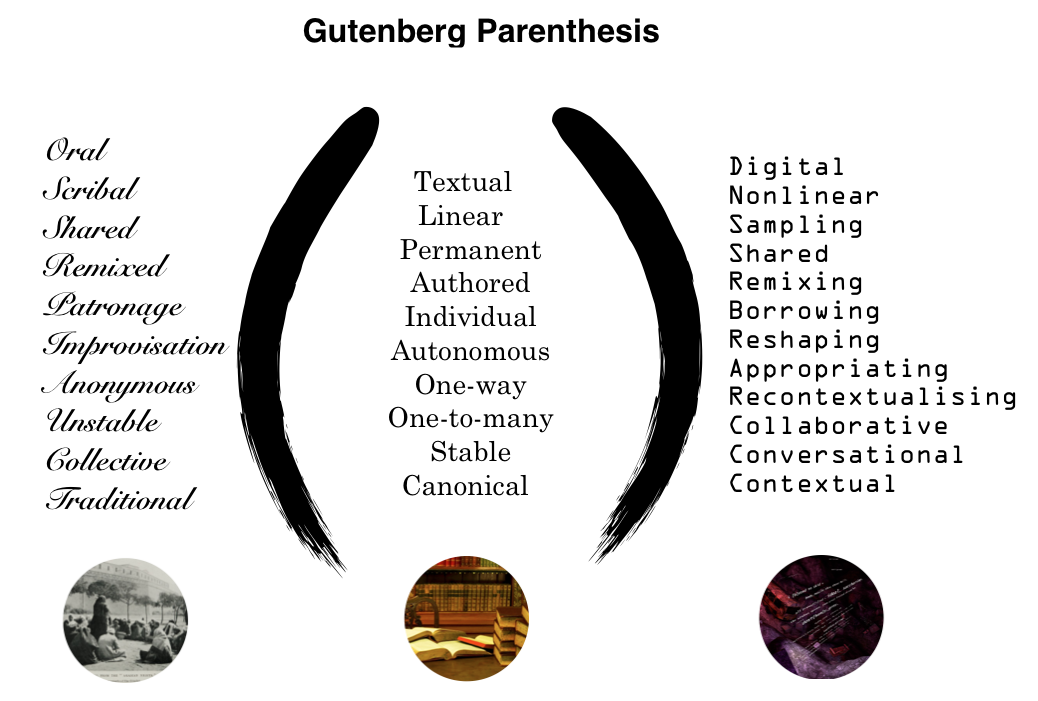
In what authors are referring to as the post Gutenberg parenthesis society, (Kenny, 2011; Pettitt, Donaldson, & Paradis, 2010), an emphasis on textual literacy is no longer sufficient. Shifts in technology, particularly with the advent of Web 2.0 and its social media affordances mean that literacy has become a dynamic and multifaceted concept that goes beyond information literacy but incorporates digital, visual, media and a multitude of other literacies under the umbrella term multi-literacy (Mackey & Jacobson, 2011). Trans-literacy as a concept, attempts to map meaning and interaction across these literacies and different media, including social media (Ipri, 2010).


gutenberg parenthesis


O’Connell (2012) suggests the teacher librarian (TL) respond along three strategic dimensions. Firstly through an involvement strategy whereby the TL “meets students where they are”, secondly with a responsive information strategy that filters, curates, and shares content and finally through a leadership strategy by taking leadership in curriculum, broaching the digital divide, championing digital citizenship and global sharing. While she encourages TL’s to create a personal learning environment (PLE), utilize their personal learning network (PLN) and personal web tools (PWT), it can be posited that the TL has to go beyond creating and using these tools personally, but to ensure educators and students in the community can also tap into their power.

Information literacy concerns itself with the selection, evaluation and use of information to solve a problem or research question, however, trans-literacy goes beyond this paradigm to the creation and sharing of ideas and the importance of social connections. Besides constructivism, the TL should incorporate principles of connectivism in their teaching approach, emphasizing the connections between the individual, data and others in the current networked culture (McBride, 2011). This principle is wonderfully illustrated by Joyce Valenza in her video “See Sally Research” (Valenza, 2011), which also highlights the importance of TLs creating an environment in which students go beyond using information for personal research but as a means of expressing themselves as digital citizens. Waters (2012) expounds on the theme of digital citizenship and rightly points out that this should go beyond behaviours and prohibitions creating a safe and civil digital environment but that TLs should encourage their students to participate as producers and managers of information and perspectives in a globally socially responsible manner.


In their book “Literacy is not enough”, Crockett, Jukes and Church (2011) create a conceptual model incorporating information, solution, creativity, collaboration and media fluency and provide the educator or TL with suggested processes and scaffolds for teaching each (reviewed by Loertscher & Marcoux, 2013). In his talk, Lee Crockett emphasizes that these fluencies are important to the 21st-Century learner independent of the amount of digital technology employed, something that is often neglected when technology dominates the conversations (Crockett, 2013).

As TLs we need to be aware of all these discussions around the various iterations of literacies as well as taking leadership in our learning environments and ensuring our teaching and assessments follow the latest standards where these are available.

References:

Crockett, L. (2013, February 28). Literacy is NOT Enough: 21st Century Fluencies for the Digital Age [Streaming Video]. Retrieved January 4, 2015, from https://www.youtube.com/watch?v=N8DEeR1sraA

Crockett, L., Jukes, I., & Churches, A. (2011). Literacy is not enough: 21st-century fluencies for the digital age. Kelowna, B.C. : Thousand Oaks, Calif.: 21st Century Fluency Project ; Corwin.

Ipri, T. (2010). Introducing transliteracy: What does it mean to academic libraries? College & Research Libraries News, 71(10), 532–567. Retrieved from http://crln.acrl.org/content/71/10/532.short

Kenny, R. F. (2011). Beyond the Gutenberg Parenthesis: Exploring New Paradigms in Media and Learning. Journal of Media Literacy Education, 3(1), 32–46. Retrieved from http://www.jmle.org

Loertscher, D. V., & Marcoux, E. (2013). Literacy is not enough: 21st-century fluencies for the digital age. Teacher Librarian, 40(3), 42–42,71.

Mackey, T. P., & Jacobson, T. E. (2011). Reframing Information Literacy as a Metaliteracy. College & Research Libraries, 72(1), 62–78. doi:10.5860/crl-76r1

McBride, M. F. (2011). Reconsidering Information Literacy in the 21st Century: The Redesign of an Information Literacy Class. Journal of Educational Technology Systems, 40(3), 287–300.

O’Connell, J. (2012). Change has arrived at an iSchool library near you. In Information literacy beyond library 2.0 (pp. 215–228). London: Facet.

Pettitt, T., Donaldson, P., & Paradis, J. (2010, April 1). The Gutenberg Parenthesis: oral tradition and digital technologies. Retrieved August 29, 2014, from http://web.mit.edu/comm-forum/forums/gutenberg_parenthesis.html

Valenza, J. (2011). See Sally Research @TEDxPhillyED [Streaming Video]. Retrieved May 22, 2014, from http://blogs.slj.com/neverendingsearch/2011/09/05/see-sally-research-tedxphillyed/

Waters, J. K. (2012, September 4). Turning Students into Good Digital Citizens. Retrieved January 2, 2015, from http://thejournal.com/Articles/2012/04/09/Rethinking-digital-citizenship.aspx


What I love about 21st century learning

This is one of those somewhat arbitrary posts, tangentially related to the topic.

One of the things that excites me about learning now, versus when I was at school or my parents were at school is just how accessible everything and everyone is. One just has to be slightly motivated to want to know something, have access to high speed internet and the world is literally your oyster.

I have a brother with ADHD and I have a son with ADHD. Their learning worlds could not be more different.  If my son struggles with a textbook or a mathematically concept or wants to learn something but the books available are too hard for him, he has so many other options. He can go onto Kahn Academy. He can search for youtube tutorials, he can Skype and chat to a friend or relative.  And of course, if your attempts at getting information are so richly rewarded, you are much more motivated as a learner to keep learning.

And now my experience. When writing my last blog post I was interested in Dr. Francus’ talk, and dug out her contact details and asked her for a transcript.  Unlike my son, I prefer reading text to watching a video.  She replied right back to me, and then even went to the trouble of reading my blog post and writing a very thoughtful reply to me, confirming my suspicion that the best part of interactive media is to be interactive while it unfolds rather than in retrospect.

When I was growing up in South Africa, which then felt like the back of the beyond and may as well have been another planet, not just another country due to its self-imposed and sanction imposed isolation, I could never envisage a reality where an author or person of note would enter a dialogue with a learner.  That is today’s wonderful reality, there for the taking.  And digital literature is just a small part of it all!

When is it digital literature?

I’ve been busying myself with looking through a number of different formats of digital texts in order to write some reviews for my next assessment item.  According to the (adapted) criteria of Nesbit, Belfer and Leacock (2004) one can look at (cited in Leacock and Nesbit, 2007):

Category of resource

  • Content quality
  • Alignment with curriculum or program purpose
  • Value of digital affordances for the literature Possibilities for feedback and/or adaptation
  • Intrinsic motivation of the digital environment for users
  • Presentation design
  • Interaction and usability
  • Accessibility and reusability

Today I was looking at a few audio-visual formatted items.  A Calendar of Tales, Beowulf in a Hundred Tweets,and The Lizzie Bennet Diaries,  Each of these were in different resource categories, however they all overlapped in the fact that I could access and read them on my computer, and with the exception of the first two (Calendar of Tales and Beowulf) involved a greater percentage of looking and watching time than reading time.

I foundCalendar Tales a Calendar of Tales a wonderful selection of stories, and found the concept of basing writing on questions in tweets to be an interesting way of involving the audience.  Neil Gaiman writes very well, and the stories would stand up to literary scrutiny on their own without any digital bells and whistles. 

There was however a considerable amount of redundancy over formats – you could read the story online, you could read it as a pdf, or you could listen to it as an audio file.  So the various formats did not enhance the experience in a new or unexpected way.


Screen Shot 2014-08-19 at 5.48.45 pmAs someone who did not have prior literary knowledge of Beowulf, nor any particular interest in the poem / ancient English language, (shock horror!) I found the Twitter Beowulf to be an interesting experiment, but not one which I wanted to spend any amount of time reading through in detail.  It also didn’t pique my interest in the original text.  Which one would hope would be one of the aims of such an endeavour.  I can imagine this had a following and would be a useful addition to a curriculum, and apparently had a very avid following as it unfolded – I think also due to the (academic) authority of the author.


Lizzie Bennett Diaries The Lizzie Bennet diaries have had extraordinary success and won an Emmy Award in 2013– which recognises excellence excellence in the television industry. And that’s the point where I start to wonder where the line can be drawn between what is digital literature and what is an audio/visual/digital adaptation of literature.

Prima facie it is a Vlog (video blog) based adaptation of Pride and Prejudice.  The question is what makes it different from say the BBC series Pride and Prejudice, besides being updated to fit current times.


(Lizzie Bennet Diaries: http://www.youtube.com/watch?v=9ncnZjwF50k)

(BBC – Pride & Prejudice: http://www.youtube.com/watch?v=CgkS5_PTfZQ)

The interactive elements of the Lizzie Bennet diaries include: a twitter account and feed;  Facebook accounttumblr account,  google+, and pinterest.  Are these merely marketing devices in order to promote the main product – the videos – or those an integral part of the package?  Whereas one could watch all the videos and not feel a lack for having missed out on the other channels, I doubt the other channels would be equally “stand alone”.  However, the series has received some serious academic and literary interest, for example in this article from the Jane Austen Society of North America, as well as being the topic of various theses and a conference presentation.

In her presentation, Marilyn Francus made some interesting points about multiple levels of immersion in a literary work and how the unmediated interactive experience through the social media channels enhanced this immersion. This made me wonder if the experience and engagement is different if one is following and participating in the type of medium as it unfolds versus in retrospect as I have been doing.

All in all it has been an interesting experience and one that has perhaps raised more questions than answers for me.


References: