
Well we’re getting close to completion (all the yellow stickers are things the contractor needs to work on and the pink ones, things we need to do!) on our library project (more links to the history here, here and here) and I’m feeling a little more relaxed. And even in the mood to discuss what has gone well (and what didn’t go so well / what I would have done differently will be the next post).
I’ve added 3 pano photos, from the front and back of the library and from our new “classroom” space.


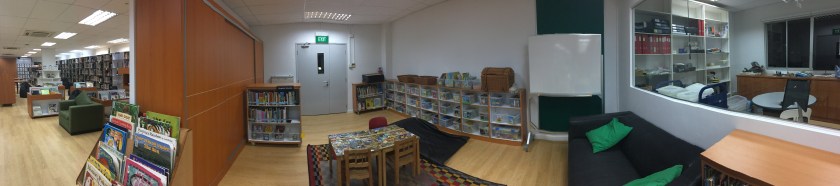
Let me start and devote this blog post with what I’m happy with – a comment from one of my Facebook groups prompted me to start with this, because I’m beginning to realise I’m way too much of a glass 1/2 empty kind of person, and if I have anything in the way of resolutions this year it is to be more positive! I’ll put some before / during and after shots in so you can see the difference!
I’m loving:
That I was fully part of the design process – in fact I was the designer and I only have myself (or maybe budget constraints or misinterpretations) to blame for what didn’t work out. Plus my principal was immensely supportive all along the way, pretty much gave me free reign and was there when I needed her as a sounding board or to confirm a decision.
The wooden floors
Oh I hated our old carpeting. Despite the fact that it was only about 2 years old it was pretty dirty and yucky – we get a lot of kids through the library each week and kids ain’t (and shouldn’t be) clean beasts. And because they were floor tiles, they could replace them, which meant colour differences, and that picky kid fingers could lift them up so they had to be re-glued regularly.


The extra display space
We librarians love to display and show case our collections. Whether it’s for a special event or to highlight new books, kindness week, a particular theme, whatever. I had no display space except for that which I’d artificially created by leaving shelves empty, and removing a computer from the dreaded pillar! In the new configuration I’ve been able to convert the pillar to a wonderful wrap around display space. I’ve also copied an idea from UWCSEA-East primary and added book ledges at the front door (they’re not perfect yet – too big and heavy on themselves but that’s another story).


Teaching spaces
I don’t have great pictures of before, or actually of after, so I’ll have to add these later. Basically my teaching space was a couch and a pulldown screen and a heavy very low flipboard I could drag out of my office when I needed to write anything, but couldn’t leave anywhere because there was no space for it! Now there is not just one, but two teaching spaces as we knocked down the wall between the library and the staff room and the staff room was divided into a classroom and workroom. Each has a projector with apple TV and each has a whiteboard space – the classroom a portable whiteboard and the main library will have two writeable glass sliding doors on either side of the projector screen on which to write. As a bonus, they’ve put blinds in front of all the windows that we can pull down so that the audience can also see what’s on the screen after 2pm!


Front Desk
I have very conscientious and neat staff, but open cupboards and a lack of space and no book drop meant that the front desk always looked messy even if it was actually pretty organised. We went for a curved desk, for the show. I wasn’t 100% happy with that but it looks pretty good. I really like the design and the work surface (the top drawers are actually pull out work spaces) extra cupboard space and the fact that the cupboards have doors. I’ve very worried that the seating space is going to be very tight for three staff members, even if they’re all very petite. The compromise was I wanted the desk to be open on both sides because when (not if) there’s a “situation” on the library floor staff needs to be able to get to it very quickly.


White walls
Did I ever mention how much I hated the babypoop and maroon colour combination? Initially all I really really wanted was a paint-job and different seating furniture – but I got spoilt and got a whole new library! Having white walls and light floor makes the whole space so much lighter – even though we’ve blocked off the windows on one side.


Collection flow
As the school has grown, so too had the collection. And choices I made last year on where to put what helped some parts of the collection (Fiction and Junior fiction) at a cost to others – nonfiction – where I split 000-399 and 400-999. Now each part of my collection has it’s own section and I have an entire wall of nonfiction 000-999. It’s impressive even if I say so myself. And it’s “overzichtelijk” a wonderful word for which the English translation is apparently “clear” but what it really means is that you can take everything in in one glance.
There is also enough space on each shelf that books are not crammed together and we can put out front facing book(s) at the end.
I also ordered signage from Merchandising Libraries, both for A-Z for each fiction collection and with words and pictures for the nonfiction section and “shelf talkers” for various sections.


Another good thing is behind the teaching space / projector sliding doors we can now put in all the “kit” boxes – the multiple copies for literature circles and communal reading. Our school is in an old building so we don’t have grade pods or communal areas so all these books are stored in the library, and were stored in my office. I didn’t like this because it meant they were out of sight and mind of teachers and students and the door was a bit of a barrier (especially in the beginning when they didn’t know me) for them to come and browse the books. Now the office space can be used for sorting UOI books (so they won’t be on the floor in front of the main desk anymore), and the books will be easily accessed by everyone.
Teachers’ resources are also all together at adult height!


That’s all I have time for today. I’ll talk furniture and what could have gone better in the next post.

 Informative Flights - Musings of a Teacher Librarian