A linguistic Trio – part 2 Crisfield

Crisfield (Blog)

Like Rojas, Crisfield began by dispelling some of the common “mummy myths” around language, particularly that it was easier to learn for children – she said something that every parent with older children will have personal experience of – “no it’s still hard, but they’re just too small to complain”. Although they are more phonetically sensitive and therefore more likely to speak other languages without an accent. She emphasized that the role of parents was to ensure that we make our children’s language journeys as easy as possible, and to do this we have 6 tasks:

1. Learn the theory
2. Set Goals
3. Plan to achieve the goals
4. Communicate with our children
5. Communicate with others
6. Know when to get help.

Learn the theory

We commenced with a little bit of jargon, what is mother tongue, L1, home language etc. (see my glossary here for a complete vocabulary).

One of the most important things she touched on is how we need to take care of the messages (verbal, non-verbal and behavioural) we give our children about the relative importance of our mother tongue and our attitudes towards it, particularly in the case of languages with a lower status.

Set Goals

This was a discussion on what level of mastery of language (communicative and literary) was aimed for and why.  It was important to think the whole language journey through (or at least while they were students). While it was possible to impose our language expectations on our children while they were younger, we would need to be able to communicate a valid good reason for continuing the regime as they matured and formed their own opinions. In the case of multiple languages we needed to order our priorities and give reasons for them.

In setting goals, we should ensure we have the necessary knowledge and support network to support those goals and that the goals are realistic (I’ve written more on this here in theory, and as it relates to my family situation).

Plan to achieve the goals

Here the concept of a COP (community of practise) was introduced – i.e. is there a linguistic community around you that you can get help from.  The smaller the COP, the more planning and logistics were required.

The most fundamental issue was planning for enough language input.  According to Crisfield, research showed that for bi/tri-lingualism children needed around 30-35% of their linguistic input to be in the target language. (You will note I’ve said bi/tri-lingualism rather than multi-lingualism, which is what I used to say … I’d not heard the 30-35% statistic before and need to follow up on this). She stated that if language input was only say 20%, the child would understand the language but would most likely become a passive bilingual.  The 30-35% targeted input suggests that three languages are the most realistic option initially – with the caveat that this could change as the child got older.

In the case of language, it appeared that “less is more” should be our motto to ensure our time and effort is focused and is not spread too thinly.

It was also paramount to plan for multiple literacy, so that the language would not be lost over time and children could continue to resource their language maintenance on their own through reading and writing.  Once again, the reminder that BICS (conversational) language takes 1-2 years while CALP was a 3-9 year process (I’ve heard 5-7 years more commonly used).  She also cautioned that problems in other subjects may be masking a problem in language or a learning difficulty.

And in our globally mobile environment – we needed to think about a future in different countries or environments and how this would impact our plan and resourcing.  Language acquisition and sustainability was a long term process that couldn’t rely on one school or community if this was not likely to be permanent.

Communicate with our children

As mentioned earlier, at a certain point we will need to justify our choices to our children and to ensure that they are part of the discussion / conversation around language, and who speaks what and why in the family.  Choices are valid, but they should be properly communicated.

Communicate with others

One should communicate language goals, expectations and intentions with people around you. Like grandparents and other family, babysitters and others in the community to ensure their actions and language they speak are aligned. School teachers and administrators need to be kept in the loop about what is happening linguistically at home.

Know when to get help

If children are exhibiting delays in speech and language, or learning issues it’s important to look at all languages globally and not just at the dominant language. Any therapist, professional or doctor needs to understand the developmental and educational issues around bilingualism so that a proper assessment can be made. It is not good practise for a professional to suggest that one language should be stopped (e.g. to stop the home language to encourage the school language).

5 further issues were also discussed, literacy, content, cognitive development, confidence and social development.

Literacy

Children were learning to read and write in two or more languages.  In doing so, they could use translanguaging, which is where one language is used to help or scaffold the other, languages are used together and used strategically. This did not imply mixing languages or inserting words or sentences of one language into conversations randomly, but rather a strategic use in order to bridge gaps.

In order to become literate, children needed to go beyond merely being able to read in both languages to comprehending and understanding the content. Parents needed to check for understanding after reading to children or when children read to them.  This may require the reading of a story in both languages to ensure that meaning is conveyed, or reading the story more than once.  Reading to children in all languages was fundamental.  And, ironically children could often write before they could read, if they know letter formation and are left to creative phonetic spelling without correction.  Experience rather than accuracy should be emphasized.

Literacy in both languages could be simultaneous (at the same time) or sequential (where reading and writing of one language is started with and then the next added). In the case of a third language it is usually advisable to give children a mental break before adding the literacy of a third language.

Talk about the second language in the MT, compare and contrast and mediate in order to clarify similarities and differences.

Content

If the school language is different to the home language, one should support content at home using the home language with the help of websites or textbooks (in the home language). Conversations at home should include what is being learnt at school so that children gain vocabulary in the home language and make links between the school language and home language. This will enhance the quality of conversation in the home language as well.

Cognitive Development

Research has show that achievement in the school language is dependant on keeping up literacy in the mother tongue, and that if children are incapable of doing things in the mother tongue, they may struggle to do it in any language. It is the mother tongue that pulls all other languages up and if MT is not maintained there will be gaps in cognitive development and difficulties in conceptual thought and conversation.

Confidence

The use of MT encourages confidence in self and in one’s cultural identity.  It encourages cognitive growth and learning and allows children to experience competence at home and at school.  Children are not as resilient as we’d like to think they are, and we need to help them in their language journeys so it is not a case of sink or swim.

Social development

Encourage using the MT socially, during holidays and with family.
In conclusion this was a talk with a lot of very practical advice and tips for families around bringing up children in a bilingual environment, whether the result of two parents speaking different languages, or a child going to school with a non-home language, or even where three languages (mother, father and school) were involved.

Building a LOTE collection at an International School

Most international schools have a sizeable student population who speak a language other than English (LOTE), and offer language instruction in either mother tongue or second language at various levels. The question then is what role the school library plays in building a LOTE collection and how this can be financed and what other options exist.

Both the IBO (International Baccalaureate Organisation) and UNESCO encourage schools and learning communities to provide active support to promote learning and maintenance of mother tongue (Morley, 2006; UNESCO Bangkok, 2007). A school library’s aim should be to ensure that the LOTE collection supports the aims of the school for classroom instruction and external examination, pleasure reading and exposure to the literature of the various cultures of the campus community.

IMG_8834

A review of the LOTE collection can be undertaken in the following steps: an overview of the existing collection; information gathering on the language profiles of the school community (students, parents, educators); understanding of the language provision at the school including mother tongue and second language acquisition; reviewing LOTE collections in the community; creating a LOTE collection development policy and other considerations.

Overview of the existing collection

Initially it is important to gain an overview of the school’s existing collection and how that is catalogued. If our school is anything to go by, there will be reading books, language text books (temporarily as they get loaned out at the start of the school year), and language teaching resources for teachers in the library. Those are the books we know of. However, depending on how tightly or loosely the library manages resources, individual language departments or teachers may have anything from vast to tiny collections in their classrooms purchased by departmental budgets (or often the purse of the teacher) which are neither catalogued by the library nor even known of outside of that department. This will differ from school to school depending on the amount of control the library has over resource budgets, the amount of sharing that goes on and the co-operation between the library and departments.

Even finding out the extent and location of resources can potentially be a political minefield, so proceed with caution and bear in mind what may seem to be an innocent question / request on your side may be misinterpreted on theirs …

Language profile of the school community

Try to understand the language profile of your school community. Are there any significant language groups within the student, parent or educator body? Think carefully where you get this information from – for example if the school is English medium, parents may put “English” as the mother tongue and the mother tongue as a second language or even omit other languages spoken at home completely in any admissions documents. Hopefully the school does some kind of census that is separate from the admissions process. Does the Parent Association have language or nationality representatives who can support the library, financially or otherwise?

Understanding school’s language provision

In addition you need to establish how many students follow which language streams in the various sections of the school, and gain an understanding of the various levels. Hopefully language teachers are cooperative and enthusiastic in explaining the needs of their students for books that encourage reading outside and around the curriculum and for pleasure, not just what is required in the classroom. They should also be able to help with the levelling of materials to ensure a culture of reading is sustained in all languages not just English and students are not frustrated with the complexity of materials available but the library has a range of materials at all difficultly levels.

IMG_8856

Reviewing LOTE collections in the community

In the International / expatriate community, LOTE collections often exist outside of the school. Need for LOTE resources in a particular language is not necessarily a function of number of L1 (mother tongue) or L2 (second language) speakers. For example in Singapore, a few sizeable language communities (Korean, Japanese, and to a certain extent Dutch and French) rely on language and culture centres in Singapore spo

nsored in part by their National Governments, while the Singapore National Library holds Chinese, Malay and Tamil books. The role of the library would be one of collaboration and directing these populations to the relevant resource, (e.g. through the website and inter-library loans) rather than building up a potentially redundant collection. If the community has any International schools that focus primarily on one language (in Singapore this includes the German, French, Dutch, Korean and Japanese schools each with their own library), they could be approached for reciprocal borrowing or interlibrary loan privileges. Embassy and cultural attaches may be another source of funding or resources.

Creating a LOTE collection development policy

Depending on the size and status of the LOTE collection, it may not be necessary to create a separate LOTE collection development policy (CDP). LOTE collection issues can be dealt with within the overall CDP.

For example, the library strives to a goal of up to 20 books, excluding textbooks, per student. LOTE books can be expressed as a meaningful percentage per language of this aim.

Provision should be made for language teachers selecting books with input from parents or native speakers in the college community. Use can made of various recommendation lists including that of the IB Organisation (IBO) and collaborative lists of the International School Library Networks and language specialist schools.

Acquisition may be a tricky areas where books are either not available locally, are prohibitively expensive or are not shipped to the country. Provision often needs to be made for the acquisition by teachers, parents or students during home leave and reimbursed by the school. However, the budget and type of books needs to be vetted in advance so that there is little chance of miscommunication on either the cost or type of books thus acquired. A LOTE selection profile, such as that created by Caval Languages Direct (Caval. n.d.) can be adapted to fit the school’s needs.

IMG_8846

As far as possible, it would be helpful if the library processes and catalogues all books which the school has paid for, irrespective of whether it came from the library budget or not. In this way, the real collection is transparent, searchable and available to the whole community (on request obviously for classroom / department materials) and to avoid duplication in acquisition or under-utilisation of materials.

Cataloguing LOTE materials can be a challenge, particularly if they are not in Latin script. It is important to still have cataloguing guidelines that are followed to ensure consistency and ease of search and retrieval. Our school makes use of parent volunteers and teachers who fill the data into a spreadsheet that is then imported into our OPAC system. Our convention is to have the title details in script, followed by transliteration, followed by translation in English. Search terms need to be agreed with by the LOTE collection users, such as language teachers and students.

As far as donations are concerned, the library still needs to have a clear policy on what books they accept and in what condition. Although donated books may be “free”, they are not without cost, including processing and cataloguing cost.

Apart from physical books, it is worthwhile looking at what resources are available online either as eBooks or as other digital resources. For example BookFlix and TumbleBooks offer materials in Spanish. Often individual language departments maintain their own lists and links to digital resources, which could be incorporated into a Library Guide and made available to the whole community.

Budget may be a contentious area and often language material discussions occur at administration or department level without the involvement of the library and an expectation may exist that the library will provide LOTE “leisure reading” materials within its overall resource budget perhaps without an explicit discussion on the matter or a breakdown between resources and budget of the various languages.

Other considerations

International schools are a dynamic environment, and a language group may be dominant for a period of time and then disappear completely due to the investment or disinvestment of multi-national companies in the area. IB schools face the need to provide for self-taught languages and any changes made by the IBO and the school from time to time. The IBO currently offers 55 languages, which theoretically could be chosen. The IBO introduced changes in its language curriculum in 2011, substantially increasing the number of works that need to be studied in the original language rather than in translation. This places an additional burden on the library to have sufficient texts in the correct language available on time.

The socio-economic demographic of students with LOTE needs should also be considered. If most of the student body comes from a privileged background where LOTE books are purchased during home leave, the school could institute donation drives where “outgrown” books are donated to the school. It would be more equitable to use resources for scholarship students in order to maintain their L1 even if these languages do not form a large part of the communities’ LOTE.

The quality of materials in Southeast Asian languages is generally extremely poor. The cost of acquiring, processing and cataloguing the materials far exceeds the purchase price and books deteriorate rapidly. There is considerable scope for moving to digital materials, however the availability, format, access, licensing issues and compatibility will have to be investigated.

Schools, in conjunction with parents, needs to consider language provision for students who plan on returning to a LOTE university after graduation.

Centres of Excellence

A literature review suggests that the centre for excellence and expertise in building LOTE collections is Victoria Australia, (Library and Archives Canada, 2009), in fact the International Federation of Library Associations and Institutions (IFLA) Multicultural Communities Guidelines for Library services is based on their guidelines (IFLA, 1996). These guidelines suggest the four steps of; needs identification and continual assessment, service planning for the range of resource and service need, plan implementation and service evaluation.

Some LOTE Digital resources

http://librivox.org/about-listening-to-librivox/

http://www.radiobooks.eu/index.php?lang=EN

http://www.booksshouldbefree.com/language/Dutch

http://albalearning.com

http://www.wdl.org/en/

http://www.childrenslibrary.org/icdl/SimpleSearchCategory

http://www.dawcl.com

http://unterm.un.org

Library services

http://www.lote-librariesdirect.com.au/contact/

http://www.caval.edu.au/solutions/language-resources

http://education.qld.gov.au/curriculum/lotelibrary/index.html

http://www.sl.nsw.gov.au/services/multicultural/multicultural_services_public_libraries.html

http://www.reforma.org/content.asp?pl=9&sl=59&contentid=59

http://www.cacaoproject.eu

http://chopac.org/cgi-bin/tools/azorder.pl

http://civicalld.com/our-services/collection-services

References

American Library Association. (2007). How to Serve the World @ your library. Retrieved January 4, 2013, from http://www.ala.org/offices/olos/toolkits/servetheworld/servetheworldhome

International Baccalaureate Organisation. (2011). Guide for governments and universities on the changes in the Diploma Programme groups 1 and 2. IBO. Retrieved from http://www.ibo.org/recognition/dpchanges/documents/Guide_e.pdf

International Federation of Library Associations and Institutions. (1996). Multicultural Communities Guideline for Library Services. Retrieved January 4, 2013, from http://archive.ifla.org/VII/s32/pub/guide-e.htm

Kennedy, J., & Charles Sturt University. Centre for Information Studies. (2006). Collection management : a concise introduction. Wagga Wagga, N.S.W.: Centre for Information Studies, Charles Sturt University.

Library and Archives Canada. (2009). Multicultural Resources and Services – Toolkit – Developing Multicultural Collections. Retrieved January 4, 2013, from http://www.collectionscanada.gc.ca/multicultural/005007-302-e.html

Morley, K. (2006). Mother Tongue Maintenance – Schools Assisted Self-Taught A1 Languages. Presented at the Global Convention on Language Issues and Bilingual Education, Singapore. Retrieved from http://www.ibo.org/news/documents/morley2.pdf

Reference & User Services Association. (1997). Guidelines for the Development and Promotion of Multilingual Collections and Services. Retrieved January 4, 2013, from http://www.ala.org/rusa/resources/guidelines/guidemultilingual

UNESCO Bangkok. (2008). Improving the Quality of Mother Tongue-based Literacy and Learning Case Studies from Asia, Africa and South America. UNESCO Bangkok Asia and Pacific Regional Bureau for Education Asia-Pacific Programme of Education for All (APPEAL). Retrieved from http://unesdoc.unesco.org/images/0017/001777/177738e.pdf

Creative Commons License

This work by Nadine Bailey is licensed under a Creative Commons Attribution-NonCommercial-ShareAlike 4.0 International License.

Language, Bilingualism and Multi-lingualism in the news

I’ve started curating all the information I can find on the topic of language, language learning, and bilingualism into a Flipboard.  Flipboard is great for reading content on your iPad without any clutter or interference from advertisements and distractions.

There is a lot of information out there (I’ve found 575 articles in the last year alone), and there is a lot of repetition and there is a lot of nonsense, but plenty of gems as well.  Published “as it comes” and up to the reader to educate themselves and separate the hype from the reality.

Get flipboard here: https://about.flipboard.com/

And follow this board here: https://flipboard.com/section/bilingualism%2C-mother-tongue-%26-language-bxo7KX

Mother Tongue – How to assess your likelihood of success

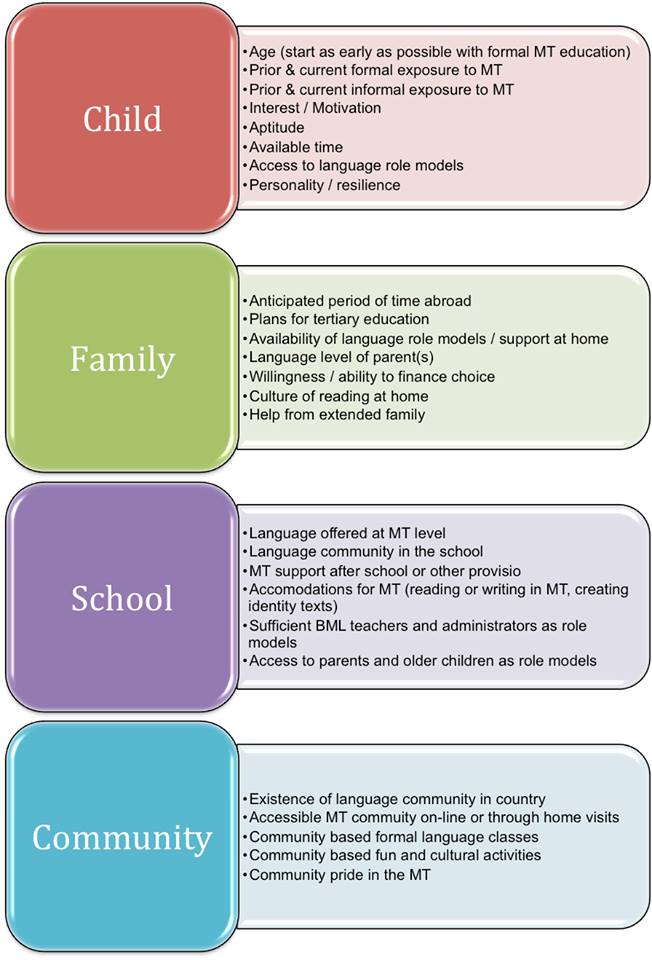
One of the things I did as part of my research was to summarise the factors that contributed to a family being able to teach and maintain their mother tongue in their children while living / being educated in an English dominant environment.

First I present the table of factors, and then I present myself filling in this table as an exercise in my own home.

Analysis: The theories of MT acquisition and maintenance versus the reality of our situation

Theory
Reality – Chinese
Reality – Dutch
Child
Age (start as early as possible with formal MT education)
Both started Chinese immersion in Grade 1 (age 6)
Son started formal Dutch in Grade 5 (age 10)
Prior & current formal exposure to MT
1 hour per day class in International School
None
Prior & current informal exposure to MT
Not much – Hong Kong is Cantonese not Mandarin speaking. Daughter did learn characters through observation on the street.
Dutch spoken at home, exposure through paternal grandparents, aunts, uncles and cousins.
Interest / Motivation
Daughter – High;
Son – Low
Daughter not particularly interested, speaks on holiday and to family
Son – High
Aptitude
Daughter – excellent memory which is necessary for amount of memorization necessary
Son – difficulties with working memory due to ADHD doesn’t rely on memory for learning
Son – very good ear and pronunciation, has taken well to spelling and grammar as it’s taught in a formal structured way (unlike English)
Available time
In HK had ample time (27/28 hours a week in class plus a lot of homework)
Daughter: in SG 5x 40 minutes a week class time, 90 minutes a week tutoring, 100 minutes a week required homework plus whatever time she has for self-motivated study and reading
5 x 40 minutes a week class time (1x of which is self-study)
1 x 120 minutes after school tutoring.
Homework around 60 minutes
Daily reading expected 15-20 minutes (doesn’t always happen)
Access to language role models
Limited to school and tutor and one family friend who we see irregularly
Parents speak Dutch at home to each other, Father speaks Dutch to him, Mother speaks English unless in Dutch context
Personality / resilience
Very determined, sees events as challenges rather than setbacks, competitive, responds well to reward systems, perfectionist, introverted and shy
Very sociable, extroverted, not scared of making mistakes. Quite emotional, inclined to give up when things get difficult, or need help to keep going
Family
Anticipated period of time abroad
Indefinite
Indefinite
Plans for tertiary education
Undecided, probably English medium
Considering studying film or photography in Netherlands (early thoughts)
Availability of language role models / support at home
Mother studied Chinese but level is not sufficient to support high level language and literacy needs practically, only in abstract
Both Mother and father speak Dutch in the home
Language level of parent(s)
Mother – Low level
Father – none
Mother – Fluent speaking reading, listening, written poor
Father – Fluent speaking, reading, listening, writing
Willingness / ability to finance choice
Yes
Yes
Culture of reading at home
Yes – but needs prompting and encouragement as slow difficult process and access to the right leveled material is difficult.
Yes – when father is home do co-reading as well
Help from extended family
None, only moral support
Yes – regular phone calls / FaceTime, visits during vacation and go to school with cousins for a few days
School
Language offered at MT level
Yes in theory.  However in practice the amount of time and level is not adequate, plus not enough leveled reading resources and mentoring
None in curriculum until G9. In G7 & G8 offered after school.  His Dutch classes are an exception and privately arranged and funded
Language community in the school
Yes, however she is not particularly a part of it.
Yes
MT support after school or other proviso
Yes, 90 minutes private tutoring after school, school provides walk in clinics 2x a week
Only from G7, however he’s not at the level required yet
Accommodations for MT (reading or writing in MT, creating identity texts)
Yes, in school (since middle school only) and tutor supplements
Yes, but still limited due to level
Sufficient BML teachers and administrators as role models
Administration & non-language teachers traditionally English / mono-lingual with some exceptions. This is changing a bit.
Access to parents and older children as role models
In principal – but need to tap into this more. No formal structures.
Yes, cultural events organized by Dutch Teacher.
Community
Existence of language community in country
Yes, large Chinese speaking population, however local families are not part of school
Yes, Dutch club and fair sized community with events
Accessible MT community on-line or through home visits
Possibly – not investigated yet
Yes
Community based formal language classes
Many tutoring schools that cater to the Chinese curriculum of local schools
Yes
Community based fun and cultural activities
Not as many as in Hong Kong
Yes through Dutch club and school
Community pride in the MT
Many classmates in MT group are not very motivated to learn Chinese, within SG community Mandarin is the formal standard Chinese while most families speak a dialect at home
Generally yes, however many Dutch people speak English well and will switch in mixed groups