Diversity and "multicultural" literature

Deep into my readings on this topic and it’s not making me feel particularly cheerful.  The statistics are appalling.
On the one hand one should be glad that there are enough people who care enough to keep count. On the other, it doesn’t appear that the counting leads to any measurable improvement.

Here are the statistics from 2002 to 2014 from Cooperative Children’s Book Center School of Education, University of Wisconsin-Madison.  And to take note of their criteria – it’s only the diversity of the United States that is counted – i.e. African / African Americans; American Indians; Asian Pacifics / Asian Pacific Americans and Latinos. The diversity in the rest of the world? Well who is counting? Who cares? Or are we just not able to access it?  What about the glory of the international librarian networks? Or are we really just still in our bubbles?

Looking at the translation scene in the USA via the Batchelder Awards; Garrison, Forest and Kimmel (2014) remark how:

“A brief skim of the most recent winners and honors shows that most of the books derive from European languages including French, German, and Dutch. The story settings show somewhat broader geographic diversity including places throughout Europe as well as Asia, Africa, and South America. Garrison and Kimmel (in press) found that a composite Batchelder Award winner or honor from the years 1997-­2013 would be a realistic fiction novel set in Western Europe featuring a male protagonist and dealing with a serious topic like World War II.” (Garrison, Forest & Kimmel, 2014, p. 72).
The absolute skewness in publishing is highlighted in this (dated, but probably still relevant and apparently not recently updated) dichotomy:
While children’s literature from so-called developing countries hardly ever reaches European and American readers, a recent survey revealed that 80 per cent of books for children set in non-European and non-American cultures are written by European and American authors (Fremde Welten 2001) (O’Sullivan, 2004, p.20)Alongside these countries which only export children’s books while almost failing entirely to import any are those which provide a market for the global corporations – 70 to 90 per cent of books available to reading children in non-European/American cultures are by European or American authors – but whose own books rarely cross the linguistic, political or cultural divide to partake in the Western market (O’Sullivan, 2004 p.22).”
Other low points include the depiction or even existence of racially / culturally mixed children or people (Chaudhri, 2013) – a reality that is strikingly obvious the moment you walk into any (international) school.
Onwards and upwards… it can’t get any worse after all.

References:

Chaudhri, A. (2013). Growing up mixed/up: Multiracial identity in children’s and young adult literature. In J. C. Naidoo & S. P. Dahlen (Eds.), Diversity in youth literature: opening doors through reading (pp. 95–123). Chicago, Ill: ALA-Ed.
Garrison, K. L., Forest, D. E., & Kimmel, S. C. (2014). Curation in translation: Promoting global citizenship through literature. School Libraries Worldwide20(1), 70–96. 
O’Sullivan, E. (2004). Internationalism, the universal child and the world of children’s literature. In P. Hunt (Ed.), International companion encyclopedia of children’s literature (2nd ed., pp. 13–25). London ; New York: Routledge. Retrieved from EBook Library


Picking the locks one-by-one

A few months ago a tradesman came to the door to fix something. Here in Singapore such people are often Muslim and therefore petrified of dogs. So my helper put the dog in a separate part of the house and closed the door, not knowing that it was one of those doors that lock themselves if the button is pressed in, which it was for some inexplicable reason. And although that part of the house has two doors leading to outside which are usually open all day every day, they’d been closed and locked due to a late afternoon rainstorm accompanied by a lot of wind.  Before calling the landlord’s agent for a spare key, I did what every other independent woman would do, I googled “how to pick a lock”. The instructions, video and otherwise all boiled down to the same simple steps.

Since I could access the garage and all the tools and assorted things like paperclips and hairclips (grateful for once for stuff lying around the house instead of being tidied up) – I set to work. In the process I discovered that the lock was “the wrong way round” to my sensibilities – do you notice that – doors and locks having to be turned “the other way” to what you’re used to in your home country?
Needless to say, there is a good reason why I’m not a burglar, nor a locksmith and the spare key had to be called into action. If you want to find out more about locks and security – here’s a great episode of 99% invisible.
After that huge digression to come to my point. As I wrote earlier, I have a large population of ELL students who come through the library and I’m always trying to find “that” book that will unlock their desire to read in English (actually I’m trying that for everyone, just this population seems to have the highest and most immediate needs.
Sometimes things happen quite by accident.
My G4 classes have been doing a unit on poetry as part of “how we express ourselves” and besides some great activities with spine poetry (much to the horror of my library assistants who are not used to such free-wheeling attitudes to taking books off the shelf) one day I decided to promote verse novels.
I’ll be the first to admit that I’m no expert on any aspect of children’s literature, but I’m a keen learner, so I looked for some lists of verse novels for elementary students and then tried to see how many I had on hand. I’d read “inside out and back again” which is a fabulous book, so I felt it may work.
For each of my next G4 classes I had a pile of verse novels and I picked out one page to read from each.  Since my darling dog had just been put down the previous night, it was with a chocked voice I read from “Love that Dog” and luckily I had a whole pile of those to dish out since one of my predecessors had the foresight to order them in duplicate.
After the lesson a few of the books were borrowed and I didn’t think that much of it. Then a week later one of my Chinese students sidled up to me during lunch time and asked me for a book “like that dog” book, and I gave him “Hate that cat”, and yesterday he came to me and said he’d finished it and wanted more books like that.  I said “more about animals, or more like poetry” and he affirmed more like poetry, and I passed on “Inside out and back again” and told him it was one of my personal favourite – he quickly scanned inside the book and happily said “yes”.
And yes of course it would work.  I’ve not studied this stuff and I’m feeling my way along, but sometimes our students just help us to discover what it is they want and need.  Coming back to it rationally – verse is short and beautiful and evocative and free. And now it’s just one more tool in my arsenal of lock-picking equipment.
Here are some resources:


Taking ownership and control over language learning

I’m always somewhat surprised at how many parents assume that the school will take care of all aspects of their children’s education. Perhaps I’ve been around the block (or world) too long to take anything for granted, or maybe I care too much or have made too many mistakes along the way.  Or it could be that I’m at the point where a “little knowledge is a dangerous thing” (Alexander Pope, 1709).

Anyway, here are a couple of images from the parent’s forum I put together with our self-taught language coordinator (the whole presentation can be found here).   The main points I’d like to make are

  • Language pathways need to be planned consciously and not left to chance
  • you only have control over what and how much language your child is exposed to for a brief period of time – what then?
  • your language community is no longer bounded geographically
  • you have many community allies where you can exchange best practise irrespective of the language
  • Digital tools are not the enemy – you can use them to create a language immersion environment

 Avoid type 1 at all costs by investing in your mother tongue and working towards abstract language in both languages. Types 2 & 3 are OK, and result if you have up to 20% input in mother tongue. If you want types 4-6, ensure at least 30% input in the language that is not taught  / dominant at school. Work with the teachers on this. Can your child read 1:3 books in their mother tongue (MT)? Are their pieces of work they can research in their MT? Work with the system and enhance it.  There is no “better” type of bilingualism after 4, it’s semantics and circumstance.

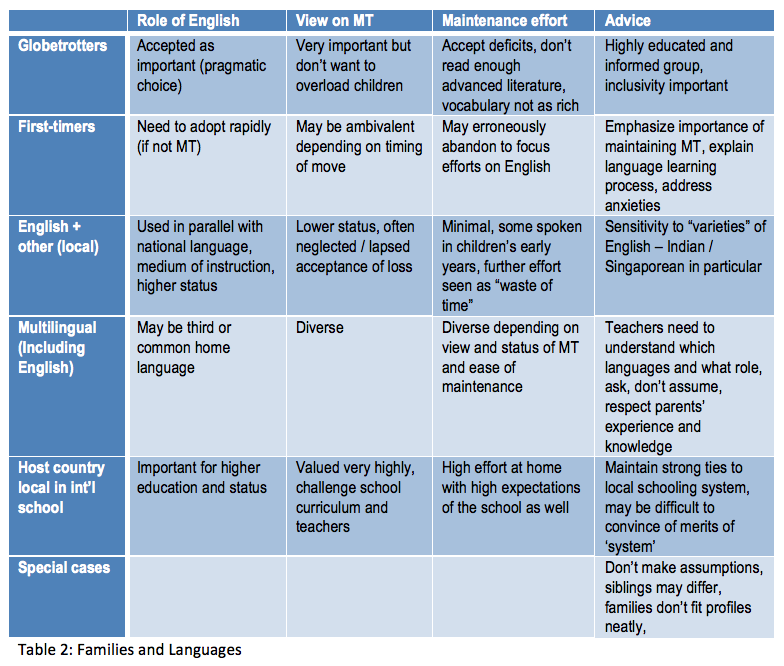
 Think about what type of family you are and what roles you assign to your language and to English.

Do a language audit for your family so you have a realistic idea of what you can do to ensure success. Look at all aspects that contribute to success including the child, family, school and community. Make some strategic choices and frame your goals and priorities as a result of this.  You can see my audit here.

Getting back to the question of control and ownership: 

Personal Learning Environment (PLE)

Use some digital tools to create your personal learning environment. You can ensure input and output for listening, speaking reading and writing. Do you know what the current best books are for your child right now? Does your language have literary prizes for picture books and young adult books? Are your children reading them? Are they keeping up to date with radio programs, TV shows? Movies?  

Personal Learning Network (PLN)

Which people and organisations are in your network? Both physical and virtual proximity can be created. Your students can find people to add to their community, from their family, peers, older or younger students in the same country or other countries. In their school and in other schools. 

Community of Practise (COP)

This is where you find out what is best practise and what other people are doing. The “experts” or people who may have experience in one or more aspects of learning. They may be people with children learning the same language, or other parents struggling with the same socio-emotional issues with priority setting and time and logistical constraints. 

There are a number of language communities online – you just need to find their champions and tap into their resources. And then it’s a question of sharing and community building.
On twitter try: #langchat (WL teachers) #frimm (French teachers)#ClavEd #WLteach #flteach

The two sites below have some great resources:
http://catherine-ousselin.org/technology.html 
http://www.cybraryman.com/foreignlanguagelinks.html

Digital Tools

Just because a tool was created in English doesn’t mean it’s exclusively for English use. The whole point of Web 2.0 is you can create and curate to suit your need in ANY language.   Don’t complain about a lack of (age appropriate) resources – create your own. Borrow and extrapolate from material in other languages. Share and share and share. This is not an exhaustive list, just a sampling.

Flipboard can be used to curate any digital material on any topic in any language. This one is specifically on bilingualism, mother tongue and language, however there is no limit! Football in Dutch, Fashion in French Philosophy in German, rock music in Swedish. Start a flipboard with your language community or have your kids start one with theirs.

 Subscription based apps like PressReader can provide families access to their local newspapers and magazines in their home language. It is also a useful tool in the language classroom.

A linguistic trio …

In the last few weeks I’ve been lucky to attend the lectures of three specialists in the field of language, bilingualism and mother tongue.  Before I forget the salient points of their presentations I thought I’d write it up and do a little compare and contrast and provide some links for further investigation and thought.

Does this have much / anything to do with the library? Well yes in the sense that language and literacy is at the core of what we provide. Particularly if we’re operating in a multi-lingual environment I believe it is our responsibility to have a background understanding of the current thinking on language and learning and education.  However I had to invite myself to two of the talks and was invited by a teacher to attend the third which was held at another international school … perhaps we are more marginal to the bigger picture than we’d like to imagine.

The three lectures were by: Virginia Rojas, Eowyn Crisfield,  and Bruno della Chiesa.

Since each posting will be fairly lengthy I’ve split them so that this post doesn’t not get made as it’s too long in the making!

Here are the links:

Rojas

Crisfield

Della Chiesa

A linguistic Trio – part 3 – della Chiesa

Bruno della Chiesa

If I may for a moment make a librarian analogy, the talk of della Chiesa compared to the other two was a bit like when I looked at information literacy from a more philosophical view rather than a model and implementation view.  Neither is more important than the other. Language doesn’t happen without the daily practicalities of getting enough speaking, reading and writing in, but it’s also necessary at times to look back at the cosmos and say “why do we bother anyway?”. Because let’s face it, at times it feels like a lot of work, a lot of time and a lot of money…

So this was a nice little reminder of why.

Della Chiesa warmed us up with some quotes and background to the idea that each additional language you speak adds to one’s ability to understanding and seeing patterns and enlarges our SCC (shared cultural charges). He introduced the concept of Doxa “the ‘box’ of ‘thinking outside the box'” and how language allows us to recognise the existence of Doxa.  He then contrasted the old ‘army’ method of learning language which relied on stimulus / response and contrasted that with a ‘motivational vortex hypothesis’ whereby learning language via immediate family, media exposure, formal and informal learning all contribute to a self-reinforcing intrinsic motivation to learn and improve.  His statement that the worst enemy of learning was fear, struck a deep and personal chord with me, reflecting on one of my children’s experiences of Chinese bilingual immersion.

However, the fear he was referring to also encompassed the fear of the “other” of “them”, a type of xenophobia which included the Doxa of superiority and contempt.  Although one of the ways in which national and cultural identity is formed and reinforced is through that very process of convincing one’s citizens of their commonality and superiority.

He then said that one had to “choose between being a good citizen and being a good human being”.  I found that very interesting given the ‘global nomad’ existence of our student population (and my family). Is it possible that in this group of people wandering around the world, where with each successive generation (and it does seem that third culture kids are somewhat more likely to keep roaming the world) there is less connection to the original idea of state, and therefore there is more possibility of being a good human being?  Or are we just a bunch of people seeking better economic possibility unfettered by the demands of identity and nationality and the potential of being called to the next location before making an impact on the last?

He then came up with some very magnificent spirals along 4 areas, space (as the ‘mathematical’ / real dimension), learning, language and culture and exposited how in each realm one moved from a “universal” potential to a “meta” or “supra” ability and then finally (this is very buddhist) got to the point where there was a superceding of individual excellence or ability to an awareness of the commonality in each realm.  This is rather poorly illustrated in the table below – with the promise that when we get access to the presentation I’ll make a better attempt.

Space
Learning
Language
Culture
0 / pre Dimension
Universal potential to learn
Universal grammar / potential to learn language
Universal habitus
Line
Information
Phoneme / grapheme / morpheme
Facts / patterns
Plane
Knowledge
Sentences
Behaviours
3rd Dimension
Skills & know how (creative)
Utterances
Habitus (integrated rules)
4th Dimension
Meta-cognition
Supra linguistic grammar (commonalities)
Supra cultural habitus
Tesseract
Self awareness
Meta-linguistic awareness
Global awareness

We then had an interesting but brief Q&A session where the role of language at the college and in our community was discussed. (An aside – a month or so ago, the head of our Dover campus wrote in his newsletter, a school can express its desire to make a impact in different ways. At UWCSEA it has been through service.  At his previous school it was through language.)

What do I think?  I think it’s great. I think that yet again it was a presentation to the wrong audience – our language teachers SO understand and get and know all this stuff.  But their hands are tied to 4 or 5 lesson periods a week and a place where language is just not a priority.

I also wonder if one could reach the “4th dimension” in any one of the realms (learning, language or culture) without reaching it in all.  This harps back to the whole Maurice Carder discussion of CALP – for if one doesn’t have a CALP level in language could you have it in thinking and learning, let alone culture?  So I think that every school would like to think that they are leading their students to the 4th dimension and beyond in what they do, I suspect for some this whole exercise results in remaining in the first circle of hell, the limbo of no sophisticated language or culture and where learning is stunted at factual knowledge or information stage.

Further reading:
Languages in a global world. 

A little on language

Anyone who’s known me longer than about 3 seconds will understand that besides knowledge and information the other great love of my life is language, bilingualism, multi-lingualism and all that goes with it. So I write quite a bit on the matter as a learner, as a parent, as a librarian.

Here is the introduction to three lectures I’ve recently attended, with a link to my summaries. 

A linguistic trio – Part 1 – Rojas

Virginia Rojas

Before I embark on my summary, here are a couple of links written by other people quoting her, from Patana, the Telegraph,  and some very useful myth busting on language (worth a read).

Rojas commenced her talk by going through the common myths on children and language (see myth busting above). She then explained the 5 types of bilinguals (for more you can read this summary)

  • Compound bilingual / Dominant Bilingual (A person being more proficient in one of the two languages).
  • Co-ordinate bilingual (person develops two parallel linguistic systems, usually when the two parents have different mother tongues and each parent speaks only his or her own mother tongue to the child. In response, the person constructs two separate linguistic systems and can handle each of them easily.)
  • Balanced bilingual (people who are more or less equally proficient in both languages, but will not necessarily pass for a native speaker in both languages).
  • Ambi-bilingual / Equilingual (person who passes in any situation in both languages for a native speaker, i.e. he or she is indistinguishable from a native speaker). 
  • Passive Bilingual (A person who is a native speaker in one and is capable of understanding but not speaking another language.)
  • Semi-bilingual (not strong in either language)
and explained that with the exception of semi-bilingual (not desirable at all), each the type of bilingualism your children ended up with was a matter of choice and planning for the families and children concerned depending on circumstances and goals.

At school

She went on to explain that every teacher is a language teacher – not just language teachers as language comes with content, and pointed to research done at Stanford University on language and literacy learning in the content areas.  A positive learning environment for bilinguals is one where the home language and culture is regarded as an asset, instruction is adapted to meet different needs, children are “immersed but not submersed”, progression is seen from speaking to reading and writing and the child is monitored to ensure growth and progress.  In a later session for teachers she went into detail about “being nice with high expectations” for students who were learning English, and distinguished between the three kinds of vocabulary: basic (T1); high frequency, multiple meaning, cross disciplinary (T2) and low frequency discipline specific (T3).  The most important were the T2 words, which were necessary for bilingualism and achievement and were transferable and allowed for connections (e.g. describe, observe, explain, illustrate, on the other hand, contrast, compare, similar, like, prove etc.). Strategies should include distinguishing between shades of meaning among verbs differing in manner and adjectives differing in intensity. T1 words were the domain of language teachers and T3 of subject specific teachers.

At home

Parents should work on maintaining and improving the home language and not leave this to the school (even if the school provides the language).  Children should be given a “wait-time” of 5-7 years for language to develop, allowing each child it’s own time and way of achieving bilingualism. Parents need to be informed and act accordingly, and to plan their childrens’ bilingualism. In her opinion at least 3 hours a week had to be spend on formal lessons in the home language including reading and writing with additional time during the summer vacation.  Texts and materials should be provided in the home language at home.

In the library

I asked her separately about the library and what role it could play. She reiterated the need for books in other languages to be visible, to have text books in mother tongue available, and to integrate (non-fiction) books into the collection.

Practically for us it wouldn’t make sense to integrate the non-fiction books as we’ve concentrated on fiction except for the odd donated book. It would probably be a good idea to try and get a used text-book donation drive to add to our collection.

A linguistic Trio – part 2 Crisfield

Crisfield (Blog)

Like Rojas, Crisfield began by dispelling some of the common “mummy myths” around language, particularly that it was easier to learn for children – she said something that every parent with older children will have personal experience of – “no it’s still hard, but they’re just too small to complain”. Although they are more phonetically sensitive and therefore more likely to speak other languages without an accent. She emphasized that the role of parents was to ensure that we make our children’s language journeys as easy as possible, and to do this we have 6 tasks:

1. Learn the theory
2. Set Goals
3. Plan to achieve the goals
4. Communicate with our children
5. Communicate with others
6. Know when to get help.

Learn the theory

We commenced with a little bit of jargon, what is mother tongue, L1, home language etc. (see my glossary here for a complete vocabulary).

One of the most important things she touched on is how we need to take care of the messages (verbal, non-verbal and behavioural) we give our children about the relative importance of our mother tongue and our attitudes towards it, particularly in the case of languages with a lower status.

Set Goals

This was a discussion on what level of mastery of language (communicative and literary) was aimed for and why.  It was important to think the whole language journey through (or at least while they were students). While it was possible to impose our language expectations on our children while they were younger, we would need to be able to communicate a valid good reason for continuing the regime as they matured and formed their own opinions. In the case of multiple languages we needed to order our priorities and give reasons for them.

In setting goals, we should ensure we have the necessary knowledge and support network to support those goals and that the goals are realistic (I’ve written more on this here in theory, and as it relates to my family situation).

Plan to achieve the goals

Here the concept of a COP (community of practise) was introduced – i.e. is there a linguistic community around you that you can get help from.  The smaller the COP, the more planning and logistics were required.

The most fundamental issue was planning for enough language input.  According to Crisfield, research showed that for bi/tri-lingualism children needed around 30-35% of their linguistic input to be in the target language. (You will note I’ve said bi/tri-lingualism rather than multi-lingualism, which is what I used to say … I’d not heard the 30-35% statistic before and need to follow up on this). She stated that if language input was only say 20%, the child would understand the language but would most likely become a passive bilingual.  The 30-35% targeted input suggests that three languages are the most realistic option initially – with the caveat that this could change as the child got older.

In the case of language, it appeared that “less is more” should be our motto to ensure our time and effort is focused and is not spread too thinly.

It was also paramount to plan for multiple literacy, so that the language would not be lost over time and children could continue to resource their language maintenance on their own through reading and writing.  Once again, the reminder that BICS (conversational) language takes 1-2 years while CALP was a 3-9 year process (I’ve heard 5-7 years more commonly used).  She also cautioned that problems in other subjects may be masking a problem in language or a learning difficulty.

And in our globally mobile environment – we needed to think about a future in different countries or environments and how this would impact our plan and resourcing.  Language acquisition and sustainability was a long term process that couldn’t rely on one school or community if this was not likely to be permanent.

Communicate with our children

As mentioned earlier, at a certain point we will need to justify our choices to our children and to ensure that they are part of the discussion / conversation around language, and who speaks what and why in the family.  Choices are valid, but they should be properly communicated.

Communicate with others

One should communicate language goals, expectations and intentions with people around you. Like grandparents and other family, babysitters and others in the community to ensure their actions and language they speak are aligned. School teachers and administrators need to be kept in the loop about what is happening linguistically at home.

Know when to get help

If children are exhibiting delays in speech and language, or learning issues it’s important to look at all languages globally and not just at the dominant language. Any therapist, professional or doctor needs to understand the developmental and educational issues around bilingualism so that a proper assessment can be made. It is not good practise for a professional to suggest that one language should be stopped (e.g. to stop the home language to encourage the school language).

5 further issues were also discussed, literacy, content, cognitive development, confidence and social development.

Literacy

Children were learning to read and write in two or more languages.  In doing so, they could use translanguaging, which is where one language is used to help or scaffold the other, languages are used together and used strategically. This did not imply mixing languages or inserting words or sentences of one language into conversations randomly, but rather a strategic use in order to bridge gaps.

In order to become literate, children needed to go beyond merely being able to read in both languages to comprehending and understanding the content. Parents needed to check for understanding after reading to children or when children read to them.  This may require the reading of a story in both languages to ensure that meaning is conveyed, or reading the story more than once.  Reading to children in all languages was fundamental.  And, ironically children could often write before they could read, if they know letter formation and are left to creative phonetic spelling without correction.  Experience rather than accuracy should be emphasized.

Literacy in both languages could be simultaneous (at the same time) or sequential (where reading and writing of one language is started with and then the next added). In the case of a third language it is usually advisable to give children a mental break before adding the literacy of a third language.

Talk about the second language in the MT, compare and contrast and mediate in order to clarify similarities and differences.

Content

If the school language is different to the home language, one should support content at home using the home language with the help of websites or textbooks (in the home language). Conversations at home should include what is being learnt at school so that children gain vocabulary in the home language and make links between the school language and home language. This will enhance the quality of conversation in the home language as well.

Cognitive Development

Research has show that achievement in the school language is dependant on keeping up literacy in the mother tongue, and that if children are incapable of doing things in the mother tongue, they may struggle to do it in any language. It is the mother tongue that pulls all other languages up and if MT is not maintained there will be gaps in cognitive development and difficulties in conceptual thought and conversation.

Confidence

The use of MT encourages confidence in self and in one’s cultural identity.  It encourages cognitive growth and learning and allows children to experience competence at home and at school.  Children are not as resilient as we’d like to think they are, and we need to help them in their language journeys so it is not a case of sink or swim.

Social development

Encourage using the MT socially, during holidays and with family.
In conclusion this was a talk with a lot of very practical advice and tips for families around bringing up children in a bilingual environment, whether the result of two parents speaking different languages, or a child going to school with a non-home language, or even where three languages (mother, father and school) were involved.

Language – Glossary, Definitions and Abbreviations


Active learners: students who take control of their own learning by monitoring their understanding and seeking out additional information and support if needed

Additive bilingualism:  the second language is learnt in addition to, and does not replace, the first language, and there are also cognitive and metalinguistic advantages.

Appropriate individualized learning environments: environments that support each individual student’s learning needs

Assessments: tools that measure the degree to which students have met learning outcomes

Audit: to take a course in which no grade is given. In order to receive credit, the course must be taken again and a passing grade must be earned

Authentic contexts: academic settings and practical situations in which language learning takes place

BICS: Basic interpersonal communication skills conversational fluency

Bilingual education: Use of two languages for literacy and instruction – Ideally, literacy and learning begin with the learner’s first language, and a second language is introduced gradually

Bilingual Individual: Ability to speak/understand (and sometimes read/ write) two languages

Bilingual Society: Presence of at least two language groups

CALL: Computer-assisted language learning

CALP: Cognitive Academic Language Proficiency – language needed to succeed academically. Academic language is often formal and abstract with technical vocabulary related to a discipline

CEFR: Common European Framework of Reference for Languages

CLIL: Content and Language Integrated Learning – teaching subjects such as science, history and geography to students through a foreign language. 

Cognitive ability: ability to perceive meaning, think critically, and reason logically

Compensation strategies: ways students can make up for their own weaknesses

Complementary classes: Language classes outside of the school curriculum not managed or paid for by the school

Content support: support in understanding the content or subject area concepts

Conversational fluency: basic language level necessary to make a person’s needs and wants known and communicate in familiar face-to-face situations

Core courses: grade level courses that students are required to take in MS and HS

Critical thinking: thinking that is beyond simple comprehension level, involving questioning, analyzing

Cross-cultural studies: the knowledge of how values, history, literature, religion and languages influence the interaction among diverse peoples

Dialect: Manner of speaking a language that varies according to region or social group (see also variety)

Differentiated instruction: instruction based on identifying different needs of the students and utilizing different strategies and adjusting the level of support

Dominant language: Language spoken by the dominant social group, or language that is seen as the main language of a country May have official or national language status even if it is not spoken by a numerical majority of the national population

EAL: English additional language

ELL: English Language Learning

English language proficiency: the overall ability to use English
ESL: English Second Language

ESL and content teacher collaboration: developing curricula and planning instruction of content and language together

Fluency of speech: the ease and facility with which a speaker uses the English language

Foreign language: Language that is not spoken in the immediate environment of the learner

Grade level outcomes: knowledge, skills and understandings students are expected to acquire or demonstrate at each grade level

Heritage language: Language of a person’s ancestors or ethnolinguistic group

High needs students: Students who need extra support in the classroom because of limited language proficiency, identified learning disabilities and/or social/behavioural issues

Home language: Language spoken in the home (see also L1, mother tongue), some people have more than one home language

Identity texts: positive statements that students make about themselves in the context of language and/or culture – these products can be written, spoken, visual, musical, dramatic, or multimodal combinations.

In-class ESL support: varied practices used by the ESL teacher to support student language and content learning, as well as student performance, in the content classroom

Interactive, communicative approach (to language learning): a method which focuses on speaking and listening skills, exchanging or sharing feelings, thoughts, or information with others

Key words: words that are essential to understanding a piece of writing or speech

L1: First language, native language (see also mother tongue, home language, local language). Refers to language or languages learned from birth

L2: Second language, non-native language, language of wider communication, or foreign language.  Often refers to contexts where the language is spoken in the wider society outside the home; in bilingual education, refers to second (official, foreign) language introduced after the L1

Language functions: the different purposes for which people use language

Language implications: the language demands of a unit of study inclusive of language functions, text types, language features, topic-specific/-complementary vocabulary, and cultural understandings

Language mastery: a stage at which an individual has acquired the ability to read, write, speak and listen on level with a native English speaker

Language of instruction: Language used for teaching and learning the school curriculum, also called medium of instruction

Language skills: skills in listening, speaking, reading and writing

Language support: support in developing language skills

Learning styles: The ways and conditions that best promote individual student learning

Levels of language ability: stages of language proficiency

Lingua franca: Widely spoken language used for communication between ethnolinguistic groups – for example: Tok Pisin in PNG

Literacy skills: skills needed to read and write

Local language: Language spoken in the immediate community. (May refer to languages that are not yet fully developed in written form).d

Mainstream classes: classes other than ESL classes

Majority language: spoken by the majority of people in a region/country

Metalinguistic awareness: one’s thinking about how languages work

MI: Medium of Instruction

Minority language: spoken by a social and/or ethnic minority group (Sometimes used to refer to the language of a numerically large group that is not dominant)

Modified homework: homework that has been changed to suit a student’s language abilities and/or language learning needs

Mother tongue (MT): First language, native language (see also L1, home language, local language) Language that a person: (a) has learnt first; (b) identifies with or is identified as a native speaker of by others; (c) knows best; or (d) uses most

Multilingual Individual: Ability to speak/understand (and sometimes read/ write) more than two languages

National language: considered to be an important, widely-spoken language in a country; sometimes also an official language – Example: India recognizes two official and 22 national languages

Non-verbal cues: ways of communicating without language such as gestures, facial expressions and body language

Official language: Language adopted by a country for public administrative and institutional use, often including schools. Example: India has Hindi and English as official languages of the country and a number of different official state languages

Outcomes: the learning goals for a course

Pass: an alternative grade given in place of a letter grade to show a student has met course requirements

Peer competitiveness: the ability of ESL students to keep up and be successful in the mainstream classes without ESL services

Pull-out program: (for ESL learners):a program where ESL students study language intensive subjects in classrooms separate from non-ESL students

Relevant language: language appropriate to specific social and academic settings

Scaffolding: supporting student learning by assessing current levels of understanding and/or ability and determining effective actions to help each individual reach his/her academic and social potential

SIM: Sheltered immersion model

SLIC: Second Language Instructional Competence

SLL: Second Language Learners

Socio-cultural factors: aspects such as cultural values, practices, stereotypes, attitudes and the process of acculturation which can have a positive or negative affect on language learning

Stage of language development: place a child is at, in terms of language proficiency

Subtractive bilingualism: the second language and culture are acquired with pressure to replace or demote the first language, possibly relating to a less positive self-concept, loss of cultural identity, and maybe alienation and the danger of failure in education.

TESOL: Teachers of English to Speakers of Other Languages (also name of an official qualification)

Unwritten language: spoken language, but not yet used for reading/writing

Variety: Manner of speaking a language that varies according to region or social group (see also dialect)

<!–[if supportFields]> ADDIN ZOTERO_ITEM CSL_CITATION {“citationID”:”12dgvmbbdn”,”properties”:{“formattedCitation”:”(Ball, 2011; Cummins, 1998; ISB, 2005; UNESCO Bangkok, 2007)”,”plainCitation”:”(Ball, 2011; Cummins, 1998; ISB, 2005; UNESCO Bangkok, 2007)”},”citationItems”:[{“id”:888,”uris”:[“http://zotero.org/users/1210720/items/TIVRESUM”%5D,”uri&#8221;:[“http://zotero.org/users/1210720/items/TIVRESUM”%5D,”itemData&#8221;:{“id”:888,”type”:”report”,”title”:”Enhancing learning of children from diverse language backgrounds: mother tongue-based bilingual or multilingual education in the early years”,”publisher”:”UNESCO Education Sector”,”author”:[{“family”:”Ball”,”given”:”Jessica”}],”issued”:{“date-parts”:[[“2011″]]}},”label”:”page”},{“id”:1193,”uris”:[“http://zotero.org/users/1210720/items/UE6FRNAZ”%5D,”uri&#8221;:[“http://zotero.org/users/1210720/items/UE6FRNAZ”%5D,”itemData&#8221;:{“id”:1193,”type”:”paper-conference”,”title”:”Immersion education for the millennium: What have we learned from 30 years of research on second language immersion?”,”container-title”:”Learning through two languages: Research and practice”,”publisher-place”:”Katoh Gakuen, Japan”,”page”:”34-47″,”event”:”Second Katoh Gakuen International Symposium on Immersion and Bilingual Education”,”event-place”:”Katoh Gakuen, Japan”,”author”:[{“family”:”Cummins”,”given”:”J”}],”editor”:[{“family”:”Childs”,”given”:”M. R”},{“family”:”Bostwick”,”given”:”R. M”}],”issued”:{“date-parts”:[[“1998″]]}},”label”:”page”},{“id”:1591,”uris”:[“http://zotero.org/users/1210720/items/KEQAAMHP”%5D,”uri&#8221;:[“http://zotero.org/users/1210720/items/KEQAAMHP”%5D,”itemData&#8221;:{“id”:1591,”type”:”article”,”title”:”ESL Handbook”,”publisher”:”International School Bangkok”,”URL”:”http://www.isb.ac.th/PDF/ESLhandbook2005.pdf&#8221;,”author”:[{“family”:”ISB”,”given”:””}],”issued”:{“date-parts”:[[“2005″]]}},”label”:”page”},{“id”:1583,”uris”:[“http://zotero.org/users/1210720/items/MG8758CK”%5D,”uri&#8221;:[“http://zotero.org/users/1210720/items/MG8758CK”%5D,”itemData&#8221;:{“id”:1583,”type”:”book”,”title”:”Advocacy kit for promoting multilingual education: including the excluded.”,”publisher”:”UNESCO”,”publisher-place”:”Bangkok”,”source”:”Open WorldCat”,”event-place”:”Bangkok”,”ISBN”:”9292231103 9789292231101″,”shortTitle”:”Advocacy kit for promoting multilingual education”,”language”:”English”,”author”:[{“family”:”UNESCO Bangkok”,”given”:””}],”issued”:{“date-parts”:[[“2007″]]}},”label”:”page”}],”schema”:”https://github.com/citation-style-language/schema/raw/master/csl-citation.json&#8221;} <![endif]–>(Ball, 2011; Cummins, 1998; ISB, 2005; UNESCO Bangkok, 2007)<!–[if supportFields]><![endif]–>

References:

Ball, J. (2011). Enhancing learning of children from diverse language backgrounds: mother tongue-based bilingual or multilingual education in the early years. UNESCO Education Sector.
Cummins, J. (1998). Immersion education for the millennium: What have we learned from 30 years of research on second language immersion? In M. R. Childs & R. M. Bostwick (Eds.), Learning through two languages: Research and practice (pp. 34–47). Katoh Gakuen, Japan.
ISB. (2005). ESL Handbook. International School Bangkok. Retrieved from http://www.isb.ac.th/PDF/ESLhandbook2005.pdf
UNESCO Bangkok. (2007). Advocacy kit for promoting multilingual education: including the excluded. Bangkok: UNESCO.