Unlikely new nonfiction

Our G6 Language & Literature classes have just started a unit on “Unlikely Heroes” and I must admit I’ve been having an amazing time finding some fantastic new biographies and memoirs to entice them into reading this genre and keeping an interest in the lives of people who may not always make the headlines, or who they may not be aware of, or who they only have an inkling of.

Two very interesting stories from the sporting realm are those of Jesselyn Silva with “My Corner of the Ring” (boxing) and Ibtihaj Muhammad with “Proud: living my American dream” (fencing). These are a double win to my mind featuring both lesser written about sports for middle grade students AND featuring young girls from non-traditional backgrounds in those sport – I have a daughter who fences and I know exactly how expensive (and sometimes snobby/exclusive) we’ve found it. There’s also the recent cliffhanger with young football players in Thailand, excellently written about by Marc Aronson in “Rising Water : The Story of the Thai Cave Rescue”.

Through my privileged connection with the Neev Children’s book awards, I’m able to encounter books that I wouldn’t otherwise be aware of such as “Like A Girl: Real Stories for Tough Kids” by Aparna Jain that showcases the lives of 56 Indian ladies, who may not be familiar to our students. Another book worth mentioning is the hybrid graphic novel / biography Indira by Devapriya Roy and Priya Kuriyan (Illustrator). What makes that book special is the way it weaves in how writing research is conducted in present day with the historical facts.

Our students are also living through history making by people in the here and now such as Autumn Peltier and Greta Thunberg (We Are All Greta: Be Inspired to Save the World by Valentina Giannella, Manuela Marazzi (Illustrator)). And our school is extremely lucky to have had a long-standing relationship with Jane Goodall who will be attending our FOEN conference next week (Hope for animals and their world. Unfortunately I wonder if that message of hope still stands ten years later).

Finally we’re also seeing more books either featuring LGBTQ+ heroes or where they are part of the narrative of other history. In a fairly conservative International environment there is always the question of how (not whether) one brings this up. I find that someone like Alan Turing is a wonderful segue into the area. (Alan Turing by Jim Eldridge; The imitation game : Alan Turing decoded written by Jim Ottaviani; Genius inventions : the stories behind history’s greatest technological breakthroughs by Jack Challoner; Stories for boys who dare to be different : true tales of amazing boys who changed the world without killing dragons by Ben Brooks ; illustrated by Quinton Winter and Queer heroes by Arabelle Sicardi ; illustrated by Sarah Tanat-Jones.)

The last three books, are ones where he is part of an anthology. One thing that we’ve started doing as part of this unit, is where there are a number of “heroes” in one book, we’ve added all the names in the table of contents to our cataloging record. That helps students to find different perspectives, formats, lengths of explanation and viewpoints of the same person. We’re hoping that some students will start with one of our many combined biographies, for example the great series of “Forgotten Women” by Zing Tsjeng or the “Goodnight Stories for Rebel Girls; or The Good Guys or Stories for Boys; or Stories for Kids; or “A History of the world with the women put back in” by Kerstin Lücker & Ute Daenschel and end up further researching one particular person who catches their interest.

An amazing thing has happened to nonfiction since around 2016. The visuals, design and layout has improved to no end, so books have become so much more enticing. I’m also loving the fact that biographies of women are no longer so ugly and we’re finding out about other amazing women such as Didda the ruler of Kashmir from 958 CE to 1003 CE (Queen of Ice by Devika Rangachari).

More of the wonderful books and how we categorised the various types of heroes around this unit can be found on our library guide. The revolving book lists (created with LibraryThing for Libraries) on each section lead back to our catalogue where students can see if the book is available and if necessary put the book on hold.

Next time I hope to write about some more fabulous nonfiction recent finds related to other curriculum units.


Advocacy is not enough we need power

Librarians are big on advocacy. Big on helping their peers when they’re not being heard in their communities or schools to build their “advocacy toolkit”. Most librarian courses include at least one module in one course on advocacy. Some academic librarians have built their careers on advocacy. But I’d like to cry foul. This has been going on for long enough.

Looking at advocacy it has a couple of tenants:

“Five Advocacy Tips
At the basic level advocacy is building relationships. The goal is to become a valuable resource for policymakers. No matter who the audience is, you should keep in mind the following:
1. Be confident.
2. Frame your message to answer the question, “So what?”
3. Plan and practice your message.
4. Present a clear and compelling message; less is more.
5. Offer yourself as an expert resource and provide examples from your community; stories are more compelling than statistics” (Advocacy toolkit).

I’d like to posit that the whole concept of advocacy is wrong. It is not advocacy that we need but a seat at the table. But the problem is that no one is going to shift over and make a place for people who are nicely, confidently giving compelling messages from experts. If anything after all these years of advocacy the situation has become worse rather than better. This is global, in all the countries that used to be bastions of (school / public) libraries and librarianship: the UK ; USA; Australia, and Canada.

I’d like to suggest that the decline in school libraries and school librarians is inversely correlated with the rise in EdTech or Digital Tech or Digital Literacy teams and resources. Those same UK schools claiming poverty when it comes to libraries have 900m to spend on edtech? And what I’m noticing is that the heads of these subsections do have a seat at the table, a link on the webpages and a say at every conceivable moment.  And I’m wondering, not saying this is a fact, just wondering out loud, whether it has anything to do with the fact that so many of those leading this corner of the education landscape are male as are most of the leadership in schools?  And while I’m a huge prosumer of tech and use it extensively in my teaching and learning, I’m suspecting it’s not really helping our students’ literacy – even their digital literacy ($129b pound investment by 2020 for students to have “basic” digital literacy and no one’s saying the numbers don’t add up?).

There have been two little discussions on the various librarian network groups I’m on that relate to these questions.

The first was about the merits of becoming Google Educator certified. It’s a push at most schools and apparently something sought after by  recruiters. I’m flabbergasted. Google is so frigging smart. And we’re being conned. And no one is crying foul. I grew up with computers as they burst into the scene in the early 80’s. I could use every iteration of word processing, presentation and spreadsheet tools from the very first most basic google librarytypes. When I say I can use, I REALLY can use. I know how to use templates, make an index, do auto-intext citation, add captions, make data tables, pivot tables, look ups, statistical analysis, import addresses into labels etc etc. And what I don’t know I know how to find out how to do, either online or because I know people who know their S*** around this type of stuff. People of my generation and younger. I also have an Education masters in knowledge networks and digital innovation and follow all sorts of trends and tools and try everything at least once.  I can use basic HTML and CSS and find out how to do anything if I get stuck. I know how to learn and where to learn anything I need to know and I’m prepared to put in the time to do so. This is in a “just-in- time-and-immediate-application-and-use-basis”, rather than a “just-in-case – and-I’ll-forget it-tomorrow-and-probably-never-use-it-basis”. So can you tell my why I would bother wasting my time and money becoming GAFE (or anything else) diploma’ed when the equivalent is for me to go from driving a high powered sports car to getting a tricycle license? I feel the same way about this as I feel about people saying you don’t need libraries now you have google. Well actually I feel stronger about it. It seems like every single for profit educational technology app or company is now convincing educators that the way for them to be taken seriously is to “certify” themselves on their tools, something that involves a couple of hours of mind-numbingly boring and simple video tutorials and/or multiple choice tests with or without a cheapish fee and then to add a row of downloadable certs into their email signatures like so many degree mill qualifications on a quack’s wall. And then these are held in higher regard (it seems) than the double masters degrees it takes to be a librarian??  Not a game I’m prepared to be playing.
Then next question was about an upcoming education conference – I’m not going to name names but it’s a biggie, and  one of my fellow (male) librarians managed to convince the organisers to include a library strand. Bravo for him – he’s obviously got a voice that’s being heard and this is a huge step forward. BUT, as he and I discussed off-line, privately, when I mentioned the word “echo-chamber” we’ll all be sitting at the wrong table. A nice table. An interesting table, a stimulating table, a worthwhile, practical, intelligent table with some wonderful people (librarians really are super people, I wish I’d discovered them a lot earlier), but the wrong table. And even if our “strand” is open to others, we’re in direct timetable competition with some pretty heavy hitters who are in other very enticing and compelling strands that just beg to be explored. Strands that I as a librarian with an M.Ed have covered in my degree with some of these hard hitting thought shapers. But I’ll not be at those tables, because I’ll be in the librarian strand, where we all agree, and where I can guarantee there will be some mutual hand wringing on budgets, staffing, literacy and advocacy issues. And I can almost certainly also guarantee that none of the librarian strand events will be attended by a single education powerbroker who is not a librarian (please prove me wrong – someone – anyone?).

So I’d say we don’t need advocacy we need power. And to get power we need to be political. And librarians, like language teachers are not very good at politics. We don’t like being unpopular, we want to be accepted and needed, but I would argue we no longer can ethically rely on advocacy, children’s literate lives are at stake, we have to enter the fray.

(I’ll add a personal disclaimer here, I work on a campus where my (female) leadership team is incredibly supportive of the library, invites me to leadership meetings and where I do have a seat on (some) tables. I also was highly flattered when one of the teachers rose up to bat for me last week on a visibility issue. But I’m aware that I’m probably in a minority, which is why I wrote this post).

Meting out diversity

The whole diversity thing bothers me. Has for some time. We seem to love the optics of diversity, but not so much the reality.  And so we mete out our diversity in acceptable chunks at acceptable moments. And in doing so we can fool ourselves – most of the time. We also mete out our encounters with diversity such that they don’t necessarily have to touch us in ways that are meaningful. We thereby send clear messages to all our students, diverse and – well what is the word not for diverse – dominant? Oh, begin to define dominant in an international school and don’t bother looking at the nationalities of the students, or pictures of them. You

meteprobably need only to look at a handful of people. Those in leadership. And chances are they’ll all be white male of a certain age, background and education, with a judicious sprinkling of women.


Before anyone gets excited about that, think about the following reported encounter by prospective parents in an ethnically mixed marriage. The primary school I’m at is wonderfully diverse in the composition of the teacher body. On entering a classroom with a caucasian teacher, one of the parents exclaimed “at last, a proper English teacher” (for the record, she wasn’t English, but obviously appearance counts). When at the Neev festival in Bangalore, I remarked to my friend how gorgeous and natural she looked in her salwar kameez and asked her why I hadn’t seen her wearing one at school in Singapore while working for a big name, self-proclaimed “diverse” school. She looked at me aghast and said there was no way it would have been possible outside of the UN celebrations and that all staff was expected to dress professionally and adopt the school values and world view irrespective of their personal beliefs or experience. Now this is a school that prides itself on the fact that they have a uniform but don’t police the interpretation of its manifestation. Where I attended a lecture today, and saw every possible variation in student “teen dress expression” but not so in the teaching body.

DiversityInChildrensBooks2015_f

So we get to the mundane part of throwing some books in the library that reflect the culture, language and backgrounds of our students. Can we even do that without breaking through the cultural myopia? I still have to keep thinking back to this experience when I realised that truly we are up against so much, and putting books in the library is a bandaid on the wound of an amputee. If we struggle even conceptually with putting textbooks from different countries whose educational philosophy we “disagree” with (how dare we?), what happens with literature, that is so much more subversive?


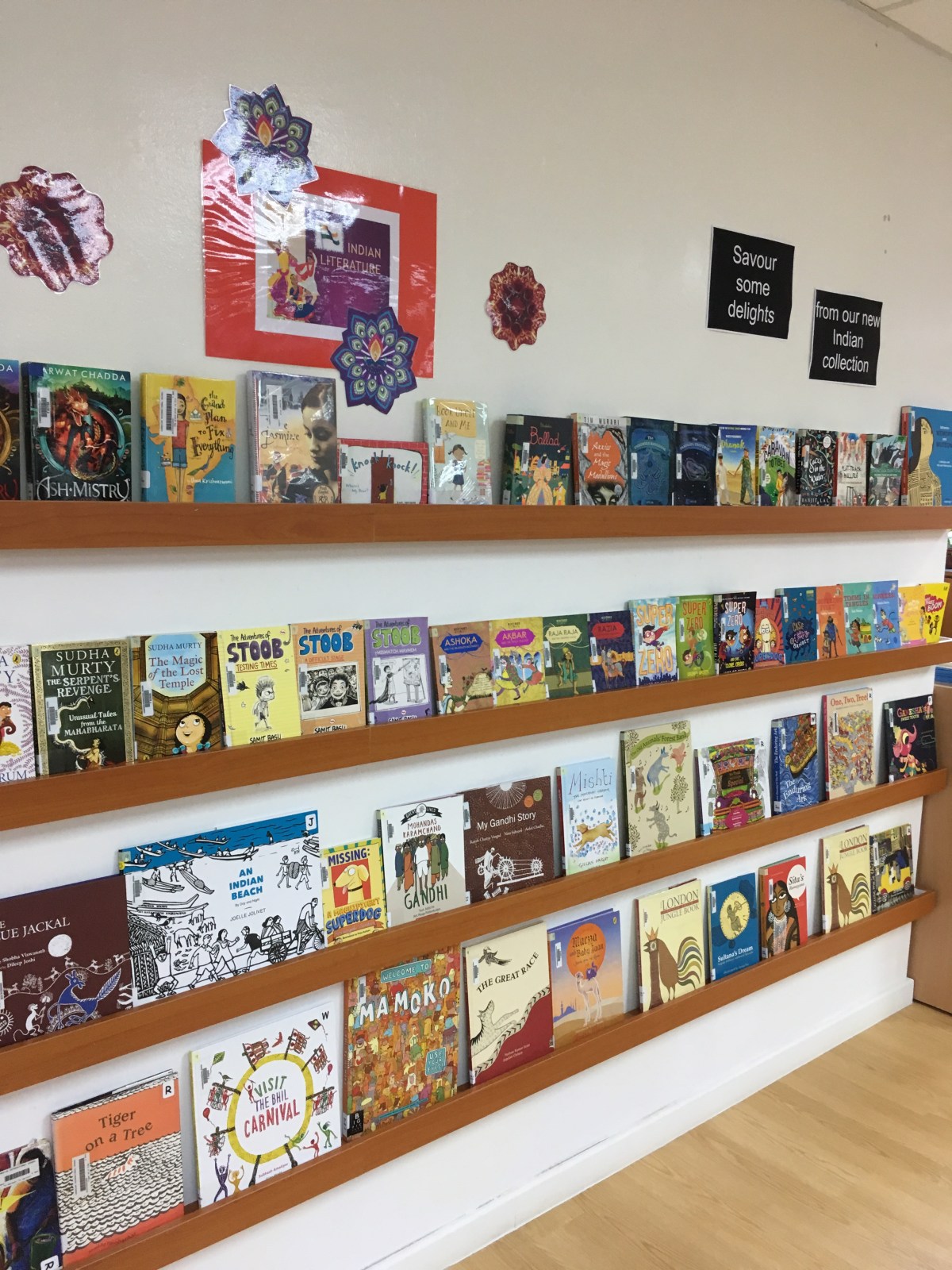
I recently purchased around 100 books written and/or illustrated by Indian authors. It was hard work “selling them” to my students. Even the Indian students. Especially the Indian students. I used the above infographic to explain to students how skewed their world view is.  And the worst of it all, is this in itself is a North American view. Let’s not even talk about the fact that most of the 73.3% white characters and 12.5% animal, truck etc. characters are male. By the end of the week, after discussions about being open-minded and balanced and being a risk-taker, most of my books were borrowed.

A few of my students exclaimed they “loved” one or another of the authors. Some parents expressed surprise that I had so many books, and amazement that I’d used my 30kg luggage allowance to lug back books. Now Indian books are possibly one of the lowest barrier “diverse” books an international school could add to their collection. Quite simply because English is a common language. No translation is required. There is a thriving publishing industry. A huge diaspora. Many schools have 25-30% of their student body from the Indian subcontinent. And yet, until a month ago I probably had fewer than 10 “Indian” books in my collection. Most of them picture books from Tara Books.  Little to nothing in Junior fiction and a few Ash Mistry books in fiction. And now? I have the books. Students have borrowed them once. Will they go back into the shelves along with the Diwali books only to make a reappearance next year this time when it’s acceptable to celebrate and embrace Indian culture?

Any literature on language and culture will quickly point to dominant / aspirational and socio-economic preferred language and culture. As a South African who spent most of her life mired in shame, unable and unwilling to admit to my heritage, I truly “get” the ambivalence (while remaining astounded by continued British bluster – particularly here in Asia).

And that is the problem with every article ever written about diversity. We lament the absence of the optic. We gloss over some of the “hardware” issues (authors, illustrators, translators), we may even get to structural problems (publishing houses, editors, market sizes). But we neglect to think about how the structure of our education and schools will support those tender shoots, will allow our communities to claim not just their heritage, but current philosophies. We close down libraries, we limit budgets, we operate in echo chambers, we fail to make library education affordable and accessible to local staff. We concentrate our online efforts to gadgets and gizmos instead of access, community and understanding.

What do I do in our library / school?

Of course the five f’s: food, fashion, famous people, festivals, and flags. Mea culpa here. I have books about (just about) every nation in our school, and scramble each year to make sure there’s at least one book by the time Uniting Nations comes around.

I buy all the books suitable for my elementary school from the USBBY list – cognisant of the fact that it is the US – i.e. pre-digested for USA sensibilities.

I follow blogs of avid supporters of diverse literature such as Dr. Myra Bacsal’s “Gathering Books” and Rachel Hildebrandt ‘s Global Literature in Libraries (seriously, I’m one of only 200 odd people following this AWESOME Blog??  – they also have a facebook page btw if that’s more your thing).  Who give exposure to people like Avery Fischer Udagawa with her new list for 2017 of 100 more works translated for kids, following Marcia Lynx Qualey’s 2016 100 Great Translated Children’s Books from Around the World.

Following what’s being published via the Bologna book fair. Reading reports such as those created by Wischenbart.

And then I devote part of my budget to buy the books, and make sure they’re slotted into resource lists for our units of inquiry, and read them aloud, and “sell” them to teachers and my PYP coordinators.

Put out google alerts for diverse books, join FB groups of librarians around the world. Ask, ask, ask, in the community, parents, librarians, teachers, students.

Write about it. Write about it again, and again.

What more can we do?

Hard stuff. Advocacy. Fostering a sense of national / cultural pride in all our students – not just those from the dominant / desirable communities. Conversations with teachers and administrators. Looking at what our students are writing about – who are the characters in their writing? Ignoring the deluge of books from BANA countries. Being tireless. Fighting even with institutions doing brilliant work like “Global Readaloud” about the choice of their books that are NOT global. Even when all of this is very very tiring and makes you seem like a harpy.

Right sentiment – wrong question

My husband and I attended a “school board of governors meets the parents” evening on Thursday night and one of the attendees asked what the school was doing to encourage more girls to go into STEM careers. There was also some discussion about the fact that even in this liberal high achieving school certain stereotypes of “boys being good at math” and “girls being good at the humanities” was panning out (if the ISA scores were an indication at least).

I am glad that type of question was asked, but I think we need to examine the whole gender thing far more deeply.  It’s not just about STEM. After the public forum, I confronted the head about the fact that except for this meeting and one other on “teens and technology”, every other public forum of the school had been held during working hours. Including the coming “meet the teacher” event. Which meant that either working parents couldn’t attend, or one or the other or both had to take leave. What kind of message are we sending our students – male and female – at this most formative time in their lives about who we allow and expect to be engaged in a child’s education?

If these meetings are not important – why hold them? If they are important, why are you excluding the economically active role models of your community and only including those who either have enough leisure, have the financial means to be free during working hours, or have chosen for one reason or another (including the reason that if they didn’t stay at home they couldn’t be a participant in their school community life) not to work full-time.

In the years that I chose not to work full-time, one of the over-riding factors in my choice was exactly that I wanted to be a part of my children’s school community and to contribute to their educational lives in this way.  Then I was thrust into full-time work out of economic necessity and no longer had the luxury of factoring this into my choice. And now I am one of the excluded.

Now as an excluded I wonder if I am the only one protesting, or if there are more like me, but we are just not aware of each other, since through our exclusion we are isolated voices that can be ignored.  I wonder how many tried, failed and gave up.  Because the school’s standard answer is that evening events / meetings are not well attended so they are not worth their while.  Is it the chicken or the egg. And more than anything else, what does that say to our daughters and sons about expectations of motherhood, careers, educators, participation in a community?