Taking ownership and control over language learning

I’m always somewhat surprised at how many parents assume that the school will take care of all aspects of their children’s education. Perhaps I’ve been around the block (or world) too long to take anything for granted, or maybe I care too much or have made too many mistakes along the way.  Or it could be that I’m at the point where a “little knowledge is a dangerous thing” (Alexander Pope, 1709).

Anyway, here are a couple of images from the parent’s forum I put together with our self-taught language coordinator (the whole presentation can be found here).   The main points I’d like to make are

  • Language pathways need to be planned consciously and not left to chance
  • you only have control over what and how much language your child is exposed to for a brief period of time – what then?
  • your language community is no longer bounded geographically
  • you have many community allies where you can exchange best practise irrespective of the language
  • Digital tools are not the enemy – you can use them to create a language immersion environment

 Avoid type 1 at all costs by investing in your mother tongue and working towards abstract language in both languages. Types 2 & 3 are OK, and result if you have up to 20% input in mother tongue. If you want types 4-6, ensure at least 30% input in the language that is not taught  / dominant at school. Work with the teachers on this. Can your child read 1:3 books in their mother tongue (MT)? Are their pieces of work they can research in their MT? Work with the system and enhance it.  There is no “better” type of bilingualism after 4, it’s semantics and circumstance.
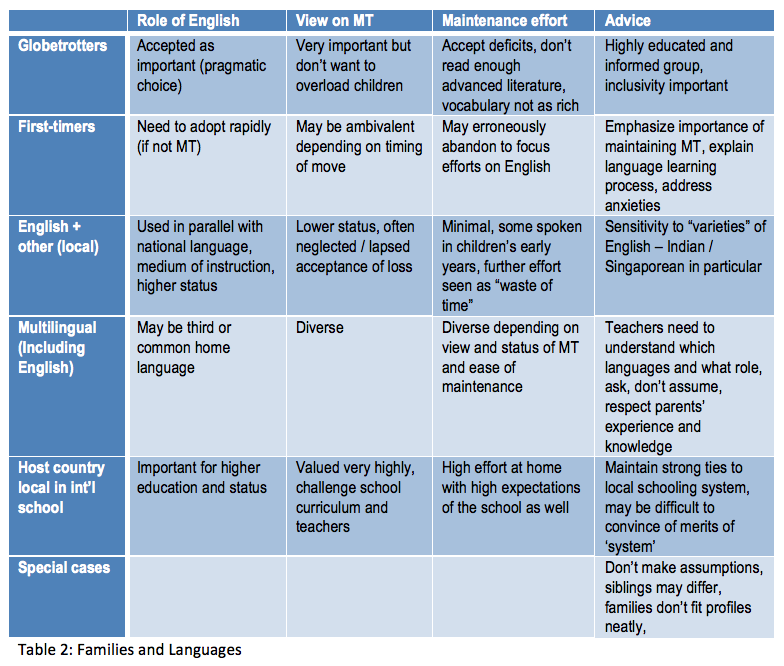
 Think about what type of family you are and what roles you assign to your language and to English.

Do a language audit for your family so you have a realistic idea of what you can do to ensure success. Look at all aspects that contribute to success including the child, family, school and community. Make some strategic choices and frame your goals and priorities as a result of this.  You can see my audit here.

Getting back to the question of control and ownership: 

Personal Learning Environment (PLE)

Use some digital tools to create your personal learning environment. You can ensure input and output for listening, speaking reading and writing. Do you know what the current best books are for your child right now? Does your language have literary prizes for picture books and young adult books? Are your children reading them? Are they keeping up to date with radio programs, TV shows? Movies?  

Personal Learning Network (PLN)

Which people and organisations are in your network? Both physical and virtual proximity can be created. Your students can find people to add to their community, from their family, peers, older or younger students in the same country or other countries. In their school and in other schools. 

Community of Practise (COP)

This is where you find out what is best practise and what other people are doing. The “experts” or people who may have experience in one or more aspects of learning. They may be people with children learning the same language, or other parents struggling with the same socio-emotional issues with priority setting and time and logistical constraints. 

There are a number of language communities online – you just need to find their champions and tap into their resources. And then it’s a question of sharing and community building.
On twitter try: #langchat (WL teachers) #frimm (French teachers)#ClavEd #WLteach #flteach

The two sites below have some great resources:
http://catherine-ousselin.org/technology.html 
http://www.cybraryman.com/foreignlanguagelinks.html

Digital Tools

Just because a tool was created in English doesn’t mean it’s exclusively for English use. The whole point of Web 2.0 is you can create and curate to suit your need in ANY language.   Don’t complain about a lack of (age appropriate) resources – create your own. Borrow and extrapolate from material in other languages. Share and share and share. This is not an exhaustive list, just a sampling.

Flipboard can be used to curate any digital material on any topic in any language. This one is specifically on bilingualism, mother tongue and language, however there is no limit! Football in Dutch, Fashion in French Philosophy in German, rock music in Swedish. Start a flipboard with your language community or have your kids start one with theirs.

 Subscription based apps like PressReader can provide families access to their local newspapers and magazines in their home language. It is also a useful tool in the language classroom.

The Teacher Librarian and multi-lingual environments – an opportunity

 One trend in education that has received limited attention in teacher librarian (TL) literature is the demographic shift in schools to more students with cultural and linguistic diversity. Statistics from the USA, Canada and Australia indicate around one in five students do not speak English – the language of school instruction at home (Australian Bureau of Statistics, 2013; “Canadian Demographics at a Glance: Some facts about the demographic and ethnocultural composition of the population,” n.d.; Center for Public Education, 2012). Data from Sydney University indicates that a national average of 21% disguises local figures at some (particularly state) schools with a range of 50-90% (Ho, 2011). International schools catering to an expatriate population are particularly diverse environments.

Practitioner literature generally concerns itself with cultural diversity in materials and the building of a world literature collection in response to student diversity or as part of a language / humanities curriculum (Garrison, Forest, & Kimmel, 2014). Some international or bilingual schools, build a “Languages other than English” (LOTE) collection.  Schools may try to recruit bilingual or minority TLs, or provide training in competencies in multicultural education (Colbert-Lewis & Colbert-Lewis, 2013; Everhart, Mardis, & Johnston, 2010; Mestre, 2009).

Within a school, the main educational and social issues are to ensure students acquire the language of instruction (English) as quickly as possible and adapt to the new learning environment without loss of educational momentum, while maintaining and developing their mother tongue (Kim & Mizuishi, 2014). Even though there is evidence that support and maintenance of mother tongue is the most effective way of scaffolding such students, schools place most of their effort and resources on English acquisition (Carder, 2007; Cummins, 2001, 2003).

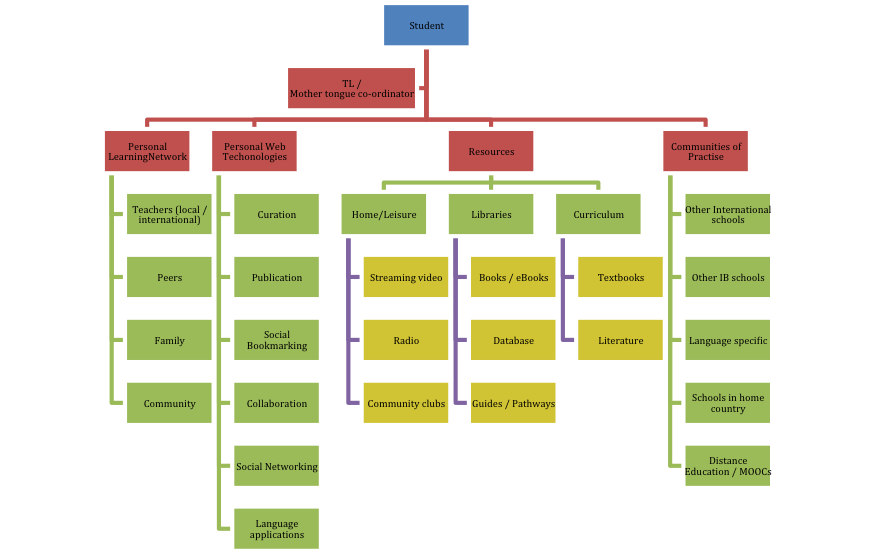
TLs in their own professional development are familiar with the use of geographically dispersed personal learning networks (PLNs) in order to create a personal learning environment (PLE) using a variety technological tools (McElvaney & Berge, 2009; O’Connell, 2014). They also have extensive networks both locally and internationally that can be tapped into. This provides TLs with an ideal opportunity of working with a group of students and teachers in creating their own PLE with a variety of resources, networks and personal web technologies (PWT) both in their mother tongue and the language of instruction.

Figure 1: PLE of an IB self-taught language student

The International Baccalaureate (IB) program allows mother tongue students the option of guided self-study if the school doesn’t offer the language.  Tapping into the experiences and communities of practise (COP) of distance education, massive open online courses (MOOCs), PLNs and PLEs could ameliorate the logistical, resourcing, teaching and learning difficulties of this option unbound by time and geography. A successful pilot scheme with one language group could be rolled out to other groups. Not only will this enhance the reputation of the TL in the school but will also contribute to the schools goals of equity in teaching and resources and ensure support and involvement by the whole school community.

References:

Australian Bureau of Statistics. (2013). Australian Social Trends, April 2013. Retrieved December
14, 2014, from http://www.abs.gov.au/AUSSTATS/abs@.nsf/Lookup/4102.0Main+Features
30April+2013

Canadian Demographics at a Glance: Some facts about the demographic and ethnocultural
composition of the population. (n.d.). Retrieved December 14, 2014, from
http://www.statcan.gc.ca/pub/91-003-x/2007001/4129904-eng.htm

Carder, M. (2007). Bilingualism in international schools: a model for enriching language education.
Clevedon; Buffalo: Multilingual Matters.

Center for Public Education. (2012, May). The United States of education: The changing
demographics of the United States and their schools. Retrieved December 14, 2014, from
http://www.centerforpubliceducation.org/You-May-Also-Be-Interested-In-landing-page-
level/Organizing-a-School-YMABI/The-United-States-of-education-The-changing-
demographics-of-the-United-States-and-their-schools.html

Colbert-Lewis, D., & Colbert-Lewis, S. (2013). The Role of Teacher-Librarians in Encouraging
Library Use by Multicultural Patrons. In C. Smallwood & K. Becnel (Eds.), Library services for
multicultural patrons: strategies to encourage library use
(pp. 73–81). Lanham: The Scarecrow
Press, Inc.

Cummins, J. (2001). Bilingual Children’s Mother Tongue: Why Is It Important for Education?
Retrieved May 27, 2014, from http://iteachilearn.org/cummins/mother.htm

Cummins, J. (2003). Putting Language Proficiency in Its Place: Responding to Critiques of the
Conversational – Academic Language Distinction. Retrieved May 27, 2014, from
http://iteachilearn.org/cummins/converacademlangdisti.html

Everhart, N., Mardis, M. A., & Johnston, M. P. (2010). Diversity Challenge Resilience: School
Libraries in Action. In Proceedings of the 12th Biennial School Library Association of
Queensland
. Brisbane, Australia: IASL.

Garrison, K. L., Forest, D. E., & Kimmel, S. C. (2014). Curation in Translation: Promoting Global
Citizenship through Literature. School Libraries Worldwide, 20(1), 70–96.

Ho, C. (2011). “My School” and others: Segregation and white flight. Australian Review of Public
Affairs
, 10(1). Retrieved from http://www.australianreview.net/digest/2011/05/ho.html

Kim, M., & Mizuishi, K. (2014, December 10). Language and Cultural Differences and Barriers in
an International School Setting – Personal Experiences and Reflections
[Presentation].
UWCSEA-East.

McElvaney, J., & Berge, Z. (2009). Weaving a Personal Web: Using online technologies to create
customized, connected, and dynamic learning environments. Canadian Journal of Learning and
Technology
, 35(2). Retrieved from http://www.cjlt.ca/index.php/cjlt/article/viewArticle/524/257

Mestre, L. (2009). Culturally responsive instruction for teacher-librarians. Teacher Librarian, 36(3),
8–12.

O’Connell, J. (2014). Researcher’s Perspective: Is Teacher Librarianship in Crisis in Digital
Environments? An Australian Perspective. School Libraries Worldwide, 20(1), 1–19.