
Every year around this time, some parent will ask the teacher or myself what their child should be reading.
The “correct” response to this question is that we don’t make reading lists of prescribed or recommended books but prefer students to come and have a chat to us about what they like reading, what hobbies or interested they have and based on that we can personalise some recommendations for them. That we believe in free voluntary reading.
How many of you have had a follow up on that with the student popping by for that exciting interaction? I started getting parents coming by personally around the end of my first year in my last job, and parents and children sometime in the second year and students on their own around the middle of my third year.
The truth is that people like lists and they like recommendations. This New Yorker article gives some ideas as to why lists matter – the most salient features are that lists “alleviates the paradox of choice” help with “reduction of uncertainty” and due to their finite nature are easier on the book budget both for school and home libraries!

So why are book awards important? According to Underdown: ‘
“Awards are important in children’s books. They tell publishers, writers, and illustrators what is considered to be “the best,” and thus the standards they must strive to attain. Many children’s book awards, though not all, are selected by librarians. Award-winners then get orders from … both libraries and bookstores. They will also stay in print longer. For writers and illustrators, getting to know the award-winning books … is one of the ways to understand what is considered to be the best today.“
The idea of finding out what the best is “today” rather than when authors / illustrators or publishers – or parents and librarians were children is very important. I’d love a dollar for each time a parent wants to force the literature of their youth onto their progeny. Reading through the long list of the Neev awards, there was also quite the body of what I’d call “nostalgic” storytelling. Which is really hard to carry off, and generally appeals more to adults than children. Which is why, it may be important to consider a children’s choice option when moving from a short-list to the finalists.
Following last year’s very successful initial Neev Festival, during the feedback discussions the idea of an Indian Children’s book award was floated. One of the driving ideas was that India had a large body of children’s literature, published in English, but not widely known nor distributed internationally. And selfishly, as librarians in an (Asian) international context with 40-50% Indian diaspora making up our student bodies, we were just not able to provide our students with the “mirrors, windows and glass sliding doors they deserved – mirrors for the Indian students, and windows and doors for the other students. Kavita Gupta Sabharwal is a very special person, both visionary and someone who makes things happen, including this book award, both from a logistical and a financial point of view. Each award carries a cash prize of Rs 1 lakh (around US$ 1,400 – a substantial amount in the Indian publishing world).
Already, just based on circulating the short-list in social media groups, there has been substantial interest from the librarian community. The prize-winners saw their books fly off the tables following the award ceremony, with all books sold-out by the end of the festival. An award sends a powerful signal to publishers and the public – one that says “pay attention” this has value, create more like this. The award stickers on the books a “buy me” beacon.
The final step in the equation and the gauntlet to be thrown is whether the publishing and distribution channels will be able to push these books out into the wider world where they deserve their moment(s) in the sun. And in the longer term, creating teacher guides and author visits, websites, hyperdocs, quizzes, eBooks and audio-books. For that is what the world has come to expect. But first the small steps, make the books available for every child, parent, teacher or librarian in the world who wants to push a “buy” button and have the book delivered to them, anywhere in the world.


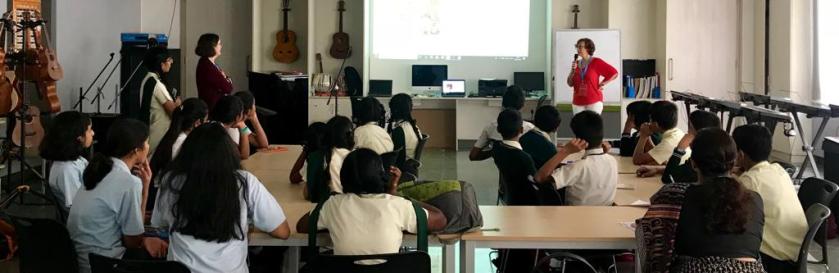 This time the exercise really did work – on reflection, the “warm up” possibly did help the success, despite not being optimal, because the students just weren’t used to giving their own views and in the first half kept looking to the adults for the “right / expected answer”. We had some powerful contributions from the groups, and some very interesting movement from utter condemnation for the father’s behaviour to understanding and empathy for the context and actions. And also the feeling that they could use this in their personal and academic lives.

 Informative Flights - Musings of a Teacher Librarian