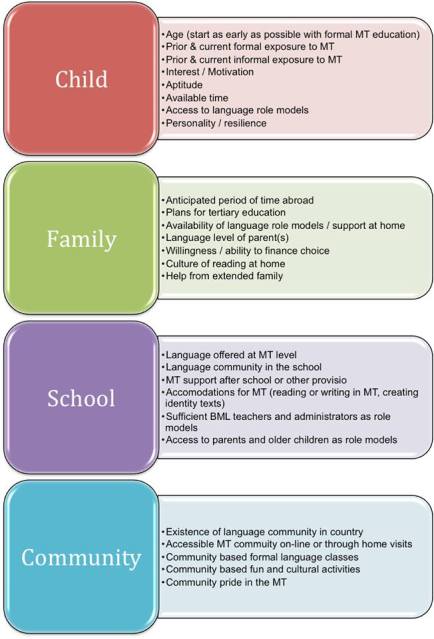
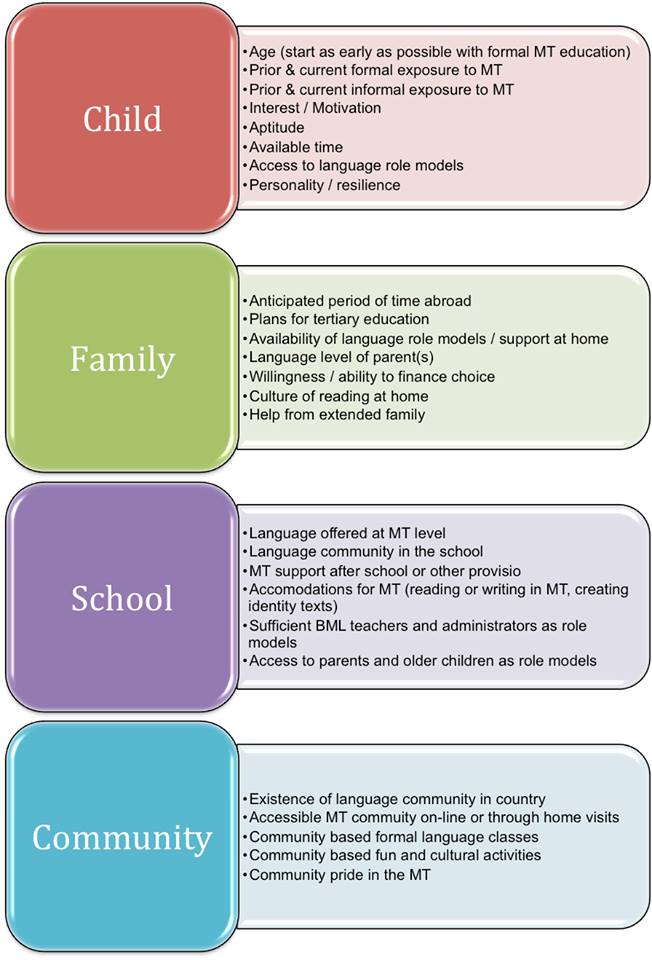
One of the things I did as part of my research was to summarise the factors that contributed to a family being able to teach and maintain their mother tongue in their children while living / being educated in an English dominant environment.

This work by Nadine Bailey is licensed under a Creative Commons Attribution-NonCommercial-ShareAlike 4.0 International License.
First I present the table of factors, and then I present myself filling in this table as an exercise in my own home.
Analysis: The theories of MT acquisition and maintenance versus the reality of our situation
|
Theory
|
Reality – Chinese
|
Reality – Dutch
|
|
|
Child
|
Age (start as early as possible with formal MT education)
|
Both started Chinese immersion in Grade 1 (age 6)
|
Son started formal Dutch in Grade 5 (age 10)
|
|
Prior & current formal exposure to MT
|
1 hour per day class in International School
|
None
|
|
|
Prior & current informal exposure to MT
|
Not much – Hong Kong is Cantonese not Mandarin speaking. Daughter did learn characters through observation on the street.
|
Dutch spoken at home, exposure through paternal grandparents, aunts, uncles and cousins.
|
|
|
Interest / Motivation
|
Daughter – High;
Son – Low |
Daughter not particularly interested, speaks on holiday and to family
Son – High
|
|
|
Aptitude
|
Daughter – excellent memory which is necessary for amount of memorization necessary
Son – difficulties with working memory due to ADHD doesn’t rely on memory for learning
|
Son – very good ear and pronunciation, has taken well to spelling and grammar as it’s taught in a formal structured way (unlike English)
|
|
|
Available time
|
In HK had ample time (27/28 hours a week in class plus a lot of homework)
Daughter: in SG 5x 40 minutes a week class time, 90 minutes a week tutoring, 100 minutes a week required homework plus whatever time she has for self-motivated study and reading
|
5 x 40 minutes a week class time (1x of which is self-study)
1 x 120 minutes after school tutoring.
Homework around 60 minutes
Daily reading expected 15-20 minutes (doesn’t always happen)
|
|
|
Access to language role models
|
Limited to school and tutor and one family friend who we see irregularly
|
Parents speak Dutch at home to each other, Father speaks Dutch to him, Mother speaks English unless in Dutch context
|
|
|
Personality / resilience
|
Very determined, sees events as challenges rather than setbacks, competitive, responds well to reward systems, perfectionist, introverted and shy
|
Very sociable, extroverted, not scared of making mistakes. Quite emotional, inclined to give up when things get difficult, or need help to keep going
|
|
|
Family
|
Anticipated period of time abroad
|
Indefinite
|
Indefinite
|
|
Plans for tertiary education
|
Undecided, probably English medium
|
Considering studying film or photography in Netherlands (early thoughts)
|
|
|
Availability of language role models / support at home
|
Mother studied Chinese but level is not sufficient to support high level language and literacy needs practically, only in abstract
|
Both Mother and father speak Dutch in the home
|
|
|
Language level of parent(s)
|
Mother – Low level
Father – none
|
Mother – Fluent speaking reading, listening, written poor
Father – Fluent speaking, reading, listening, writing
|
|
|
Willingness / ability to finance choice
|
Yes
|
Yes
|
|
|
Culture of reading at home
|
Yes – but needs prompting and encouragement as slow difficult process and access to the right leveled material is difficult.
|
Yes – when father is home do co-reading as well
|
|
|
Help from extended family
|
None, only moral support
|
Yes – regular phone calls / FaceTime, visits during vacation and go to school with cousins for a few days
|
|
|
School
|
Language offered at MT level
|
Yes in theory. However in practice the amount of time and level is not adequate, plus not enough leveled reading resources and mentoring
|
None in curriculum until G9. In G7 & G8 offered after school. His Dutch classes are an exception and privately arranged and funded
|
|
Language community in the school
|
Yes, however she is not particularly a part of it.
|
Yes
|
|
|
MT support after school or other proviso
|
Yes, 90 minutes private tutoring after school, school provides walk in clinics 2x a week
|
Only from G7, however he’s not at the level required yet
|
|
|
Accommodations for MT (reading or writing in MT, creating identity texts)
|
Yes, in school (since middle school only) and tutor supplements
|
Yes, but still limited due to level
|
|
|
Sufficient BML teachers and administrators as role models
|
Administration & non-language teachers traditionally English / mono-lingual with some exceptions. This is changing a bit.
|
Administration & non-language teachers traditionally English / mono-lingual with some exceptions. This is changing a bit.
|
|
|
Access to parents and older children as role models
|
In principal – but need to tap into this more. No formal structures.
|
Yes, cultural events organized by Dutch Teacher.
|
|
|
Community
|
Existence of language community in country
|
Yes, large Chinese speaking population, however local families are not part of school
|
Yes, Dutch club and fair sized community with events
|
|
Accessible MT community on-line or through home visits
|
Possibly – not investigated yet
|
Yes
|
|
|
Community based formal language classes
|
Many tutoring schools that cater to the Chinese curriculum of local schools
|
Yes
|
|
|
Community based fun and cultural activities
|
Not as many as in Hong Kong
|
Yes through Dutch club and school
|
|
|
Community pride in the MT
|
Many classmates in MT group are not very motivated to learn Chinese, within SG community Mandarin is the formal standard Chinese while most families speak a dialect at home
|
Generally yes, however many Dutch people speak English well and will switch in mixed groups
|
This work by Nadine Bailey is licensed under a Creative Commons Attribution-NonCommercial-ShareAlike 4.0 International License.
 Informative Flights - Musings of a Teacher Librarian