The whole diversity thing bothers me. Has for some time. We seem to love the optics of diversity, but not so much the reality. And so we mete out our diversity in acceptable chunks at acceptable moments. And in doing so we can fool ourselves – most of the time. We also mete out our encounters with diversity such that they don’t necessarily have to touch us in ways that are meaningful. We thereby send clear messages to all our students, diverse and – well what is the word not for diverse – dominant? Oh, begin to define dominant in an international school and don’t bother looking at the nationalities of the students, or pictures of them. You
 probably need only to look at a handful of people. Those in leadership. And chances are they’ll all be white male of a certain age, background and education, with a judicious sprinkling of women.
Before anyone gets excited about that, think about the following reported encounter by prospective parents in an ethnically mixed marriage. The primary school I’m at is wonderfully diverse in the composition of the teacher body. On entering a classroom with a caucasian teacher, one of the parents exclaimed “at last, a proper English teacher” (for the record, she wasn’t English, but obviously appearance counts). When at the Neev festival in Bangalore, I remarked to my friend how gorgeous and natural she looked in her salwar kameez and asked her why I hadn’t seen her wearing one at school in Singapore while working for a big name, self-proclaimed “diverse” school. She looked at me aghast and said there was no way it would have been possible outside of the UN celebrations and that all staff was expected to dress professionally and adopt the school values and world view irrespective of their personal beliefs or experience. Now this is a school that prides itself on the fact that they have a uniform but don’t police the interpretation of its manifestation. Where I attended a lecture today, and saw every possible variation in student “teen dress expression” but not so in the teaching body.

So we get to the mundane part of throwing some books in the library that reflect the culture, language and backgrounds of our students. Can we even do that without breaking through the cultural myopia? I still have to keep thinking back to this experience when I realised that truly we are up against so much, and putting books in the library is a bandaid on the wound of an amputee. If we struggle even conceptually with putting textbooks from different countries whose educational philosophy we “disagree” with (how dare we?), what happens with literature, that is so much more subversive?
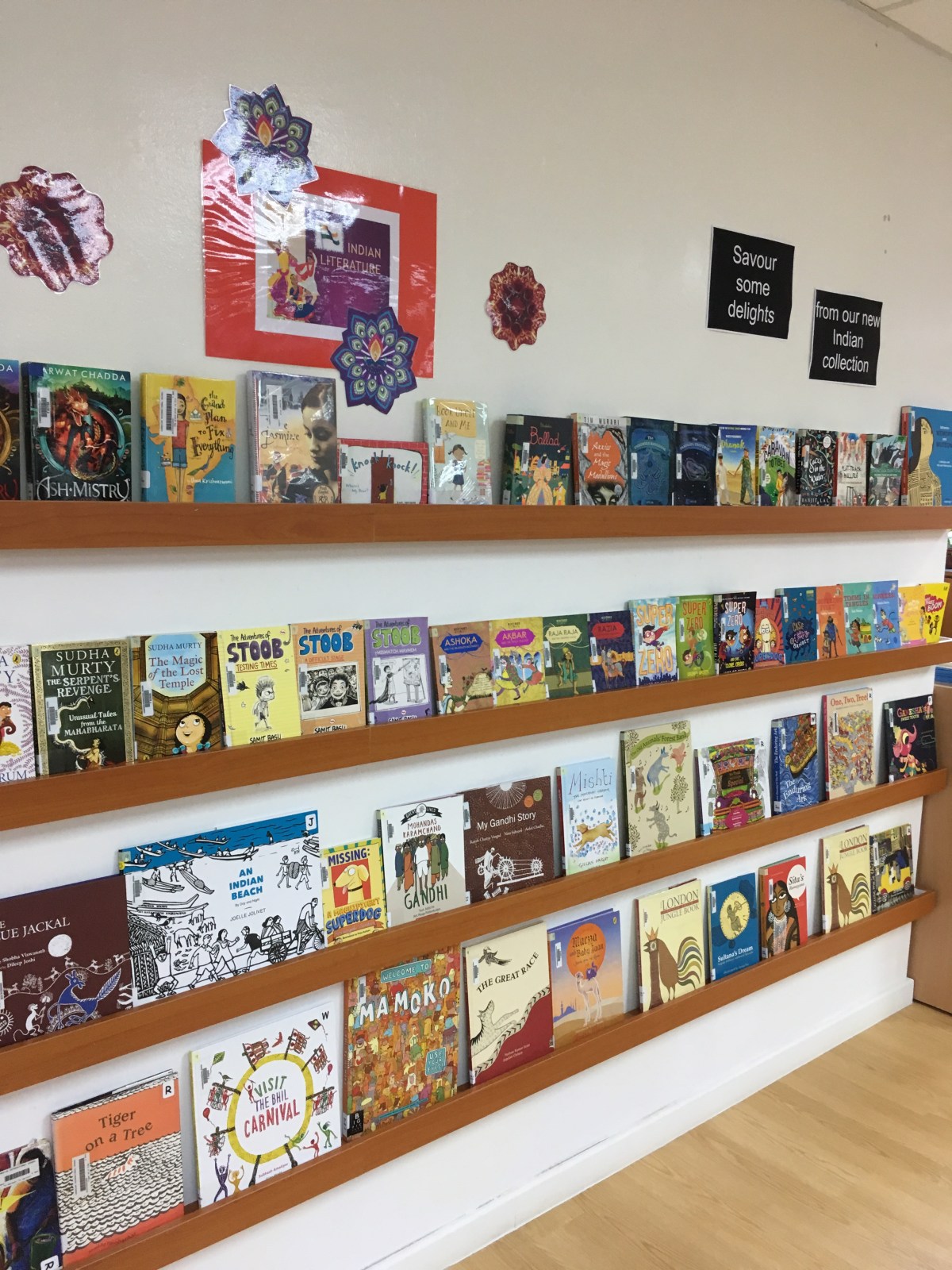
I recently purchased around 100 books written and/or illustrated by Indian authors. It was hard work “selling them” to my students. Even the Indian students. Especially the Indian students. I used the above infographic to explain to students how skewed their world view is. And the worst of it all, is this in itself is a North American view. Let’s not even talk about the fact that most of the 73.3% white characters and 12.5% animal, truck etc. characters are male. By the end of the week, after discussions about being open-minded and balanced and being a risk-taker, most of my books were borrowed.


A few of my students exclaimed they “loved” one or another of the authors. Some parents expressed surprise that I had so many books, and amazement that I’d used my 30kg luggage allowance to lug back books. Now Indian books are possibly one of the lowest barrier “diverse” books an international school could add to their collection. Quite simply because English is a common language. No translation is required. There is a thriving publishing industry. A huge diaspora. Many schools have 25-30% of their student body from the Indian subcontinent. And yet, until a month ago I probably had fewer than 10 “Indian” books in my collection. Most of them picture books from Tara Books. Little to nothing in Junior fiction and a few Ash Mistry books in fiction. And now? I have the books. Students have borrowed them once. Will they go back into the shelves along with the Diwali books only to make a reappearance next year this time when it’s acceptable to celebrate and embrace Indian culture?
Any literature on language and culture will quickly point to dominant / aspirational and socio-economic preferred language and culture. As a South African who spent most of her life mired in shame, unable and unwilling to admit to my heritage, I truly “get” the ambivalence (while remaining astounded by continued British bluster – particularly here in Asia).
And that is the problem with every article ever written about diversity. We lament the absence of the optic. We gloss over some of the “hardware” issues (authors, illustrators, translators), we may even get to structural problems (publishing houses, editors, market sizes). But we neglect to think about how the structure of our education and schools will support those tender shoots, will allow our communities to claim not just their heritage, but current philosophies. We close down libraries, we limit budgets, we operate in echo chambers, we fail to make library education affordable and accessible to local staff. We concentrate our online efforts to gadgets and gizmos instead of access, community and understanding.
What do I do in our library / school?
Of course the five f’s: food, fashion, famous people, festivals, and flags. Mea culpa here. I have books about (just about) every nation in our school, and scramble each year to make sure there’s at least one book by the time Uniting Nations comes around.
I buy all the books suitable for my elementary school from the USBBY list – cognisant of the fact that it is the US – i.e. pre-digested for USA sensibilities.
I follow blogs of avid supporters of diverse literature such as Dr. Myra Bacsal’s “Gathering Books” and Rachel Hildebrandt ‘s Global Literature in Libraries (seriously, I’m one of only 200 odd people following this AWESOME Blog?? – they also have a facebook page btw if that’s more your thing). Who give exposure to people like Avery Fischer Udagawa with her new list for 2017 of 100 more works translated for kids, following Marcia Lynx Qualey’s 2016 100 Great Translated Children’s Books from Around the World.
Following what’s being published via the Bologna book fair. Reading reports such as those created by Wischenbart.
And then I devote part of my budget to buy the books, and make sure they’re slotted into resource lists for our units of inquiry, and read them aloud, and “sell” them to teachers and my PYP coordinators.
Put out google alerts for diverse books, join FB groups of librarians around the world. Ask, ask, ask, in the community, parents, librarians, teachers, students.
Write about it. Write about it again, and again.
What more can we do?
Hard stuff. Advocacy. Fostering a sense of national / cultural pride in all our students – not just those from the dominant / desirable communities. Conversations with teachers and administrators. Looking at what our students are writing about – who are the characters in their writing? Ignoring the deluge of books from BANA countries. Being tireless. Fighting even with institutions doing brilliant work like “Global Readaloud” about the choice of their books that are NOT global. Even when all of this is very very tiring and makes you seem like a harpy.

 Informative Flights - Musings of a Teacher Librarian