Core Collection & teacher champions

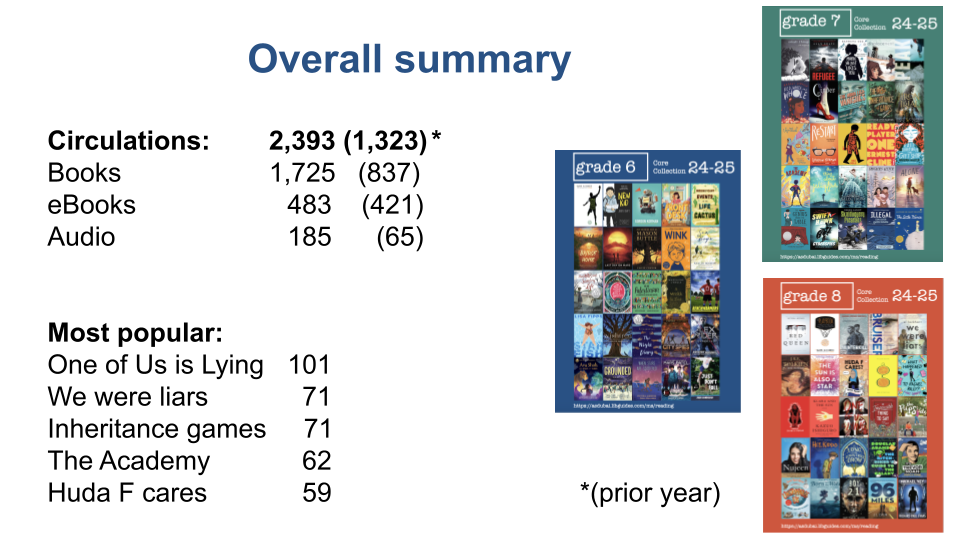
Last year I wrote about my initiative with our core collection and engaging our middle school teachers in “adopting” a book and helping to promote it. During the analytics for our annual report and to justify repeating the exercise in one of our last staff meetings this year, I put together some stats on the results.

Core Collection Summary

Given the dire state of the nation on reading overall for middle school with each grade reading less than in previous years, this is one small light at the end of the tunnel for me – showing that perhaps we need to narrow rather than continue to broaden our collection and focus on many copies of the most popular books?

Another amazing side effect has been the number of our faculty who are now fans of middle school / young adult literature and who have kept on coming back to finish series (I think it’s really important to have book 1 of as many enticing series as possible in the list). It really matters when not only the ELA teacher but also the PHE/Sports coaches and Drama and Science teachers are reading and recommending books.

Another interesting aspect has been that it seems we’ve arrived at a sort of tipping point of students accessing eBooks and AudioBooks in greater numbers than I’ve previously seen. Since we tend to only buy 3 or 4 of each of the core books (plus whatever ELA has a budget for to put in their class libraries) the most popular books tend to be out all the time, resulting in students then using the digital equivalent. I like AudioBooks as it means I can listen (often at 1.5-2x speed) and do my knitting, and I often have to persuade students that listening to audiobooks is also reading. In a culture where very few students are read to, I think it’s also important for them to hear stories – not the least to avoid embarrassing incidents with the pronunciation of words and names!

Of course I know that borrowing doesn’t always translate to reading (see the amazing way the great Nathan Pyle illustrates this below), but on the other hand I’m also comforted by the fact that our ELA classroom libraries have also stocked up on many of the core books and their circulations are not counted in my stats.

Image by Nathan W Pyle – buy his amazing books!

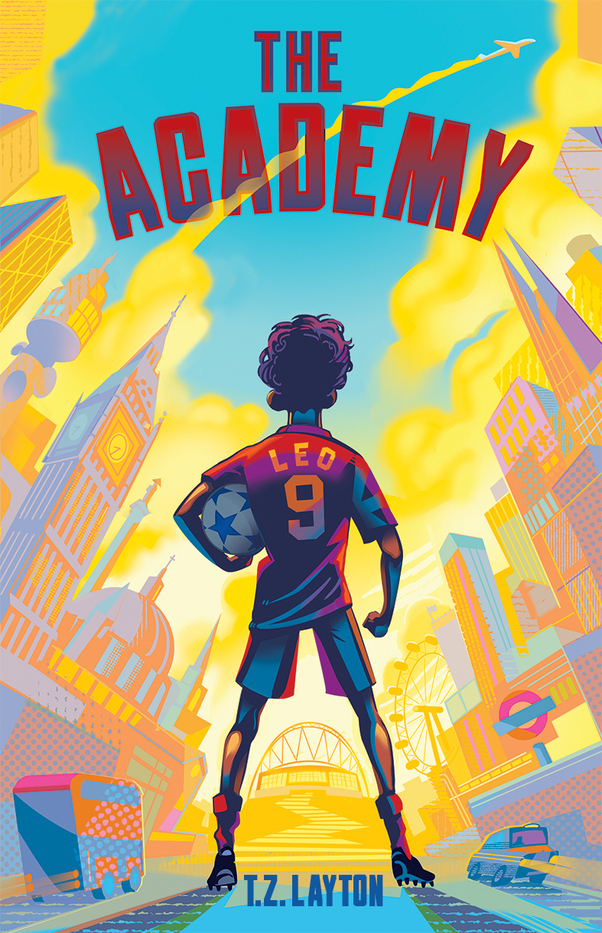
One of the runaway success books I’d like to highlight is “The Academy” by TZ Layton. In common I think with most 10-14 year olds, most of the young soccer players at our school are convinced it’s only a matter of time before they’re scouted into one of the youth leagues and this series feeds their dreams.

Actions & Activities

The actions and activities around the core books this year include:

  • Culling of the least popular (and some of the most popular*) books from the previous year
  • Book overviews on the middle school TV displays
  • Core list on Advisory Slides
  • “Core Wall” in library
  • ELA & MS teacher promotion
  • House points for book reviews
  • On libguide / recommended to parents during parent conferences
  • Weekly Kahoot quiz January – May (inter-house competition)
  • Battle of the Core live quiz assembly – 8 May (moved from January to increase exposure)

* while some of the books were taken out because they just didn’t fly for one reason or another (usually because I’d been misled by a good review without having been able to read the book first, or I misjudged the audience), some have been given wings and are flying on their own without the need to be on a list, or have been adopted by the ELA department as one of their book club books. Of course there is always great irony in choices. After not being able to successfully sell “The thing about jellyfish” by Ali Benjamin all year long, I took it off the list for next year and of COURSE then some young booktokker started recommending it and now everyone wants to read it!

Another side effect has been more faculty coming to me for recommendations for their own reading of for books for their younger kids or nieces / nephews – there is nothing more flattering, no greater gift you can give a librarian than ask for recommendations!

there is nothing more flattering, no greater gift you can give a librarian than ask for recommendations!

In conclusion I’d say if you’re in any doubt about the value of having a core collection, go ahead and try it out. It doesn’t have to be 25 books but it does help to have at least one representative of each genre. Including the first book in a series is always a good idea and I also try to have books that are fairly recent, include books from visiting authors if we have any and to try and tap into the zeitgeist.

#Sensemaking – Dystopian Fiction

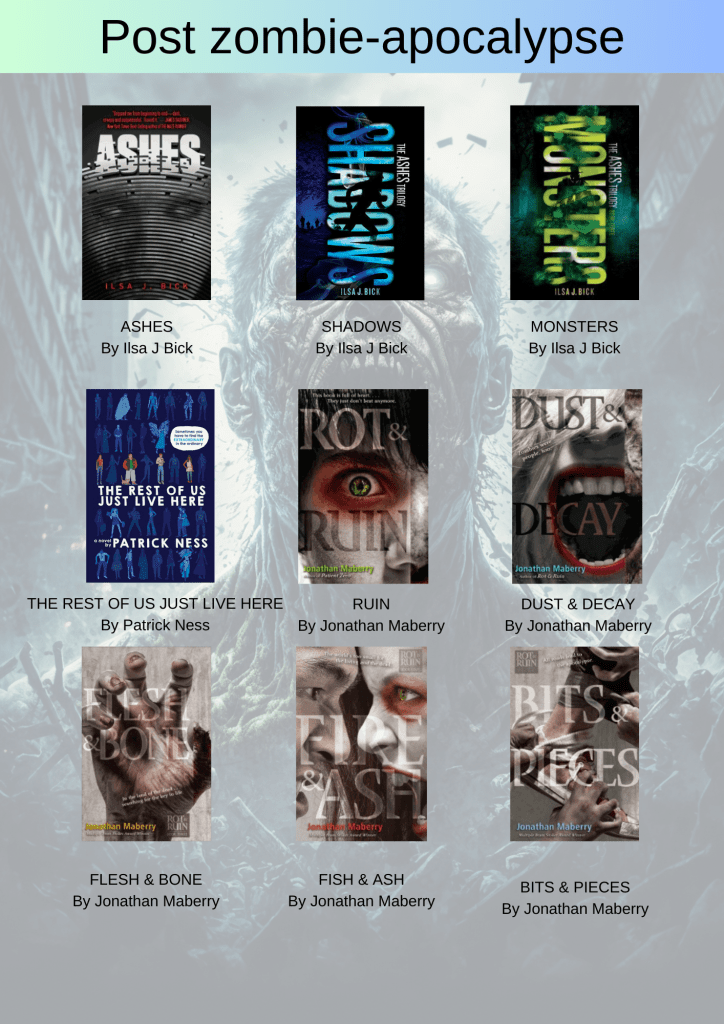
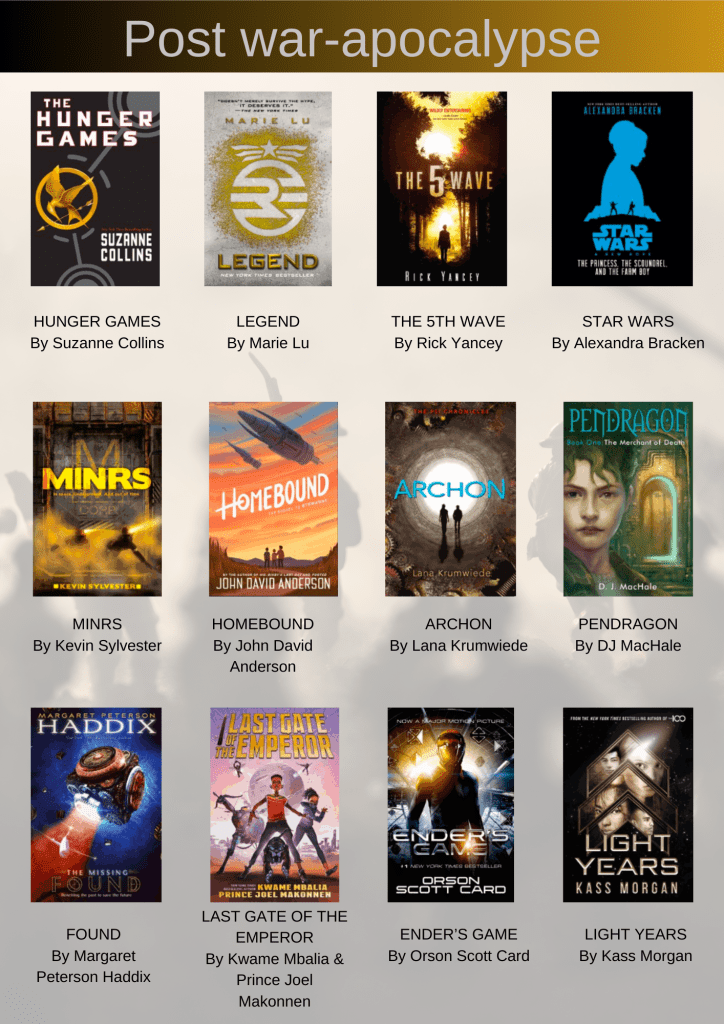
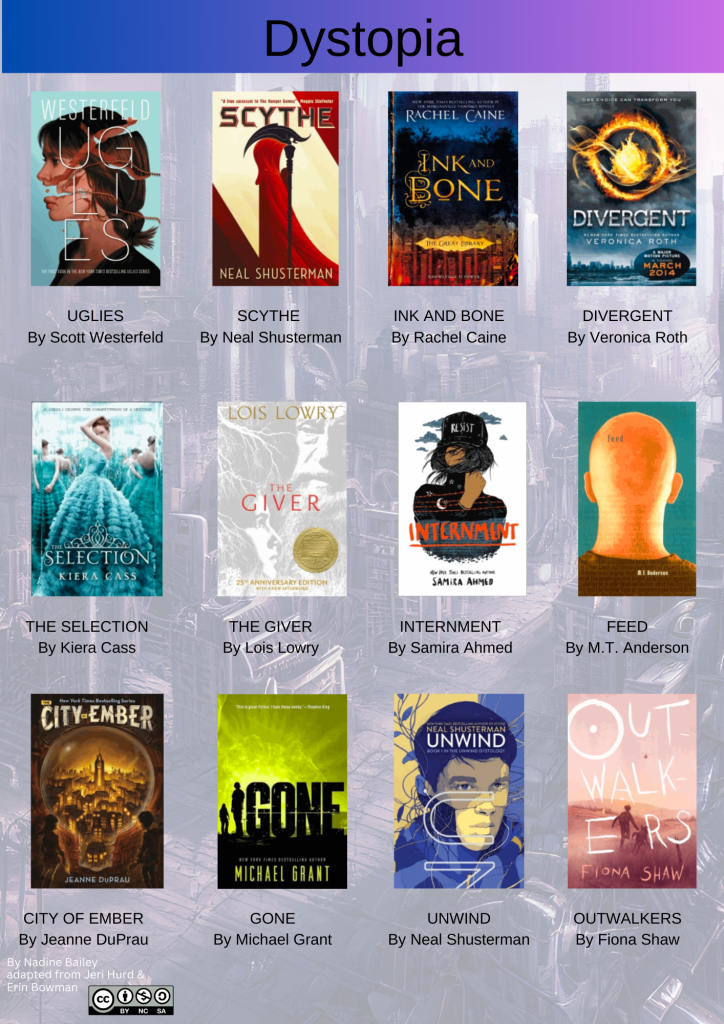
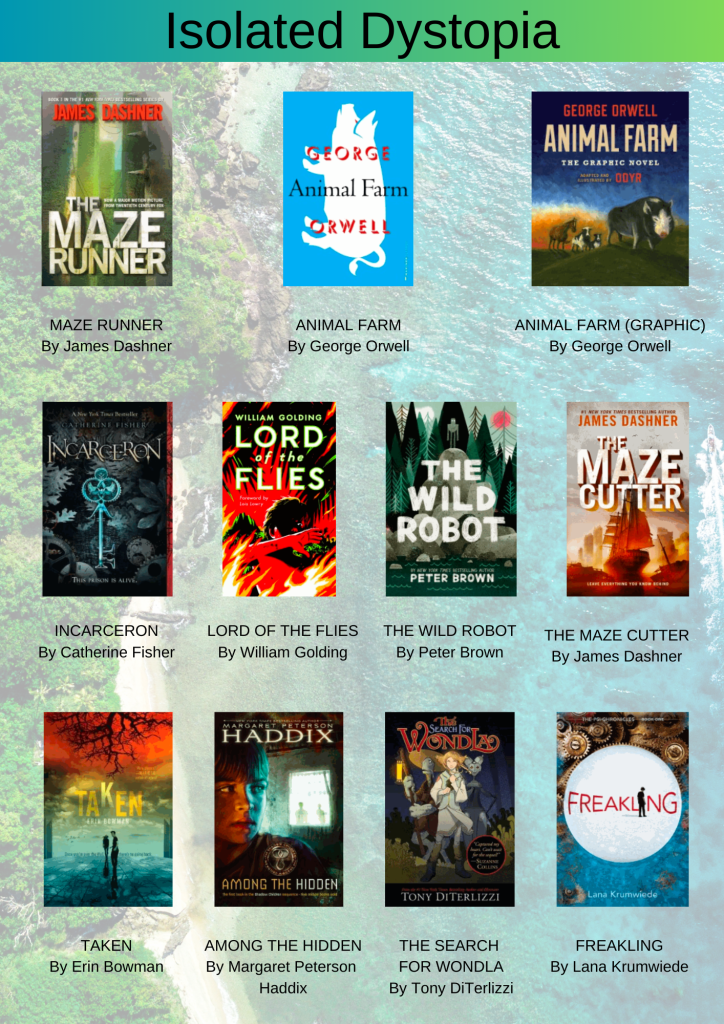
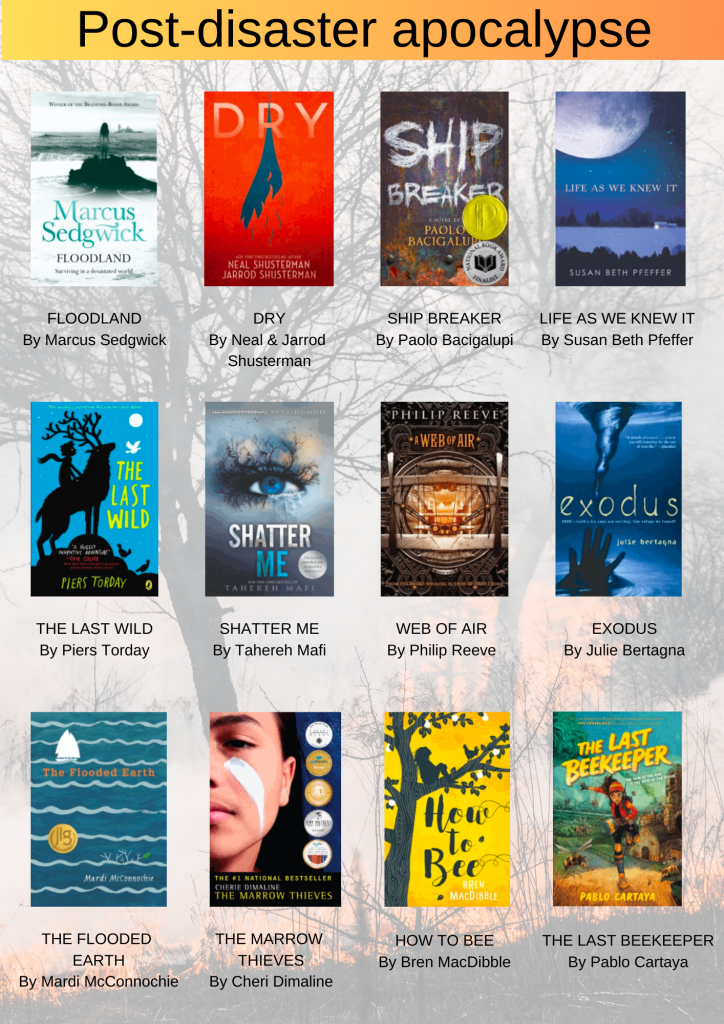
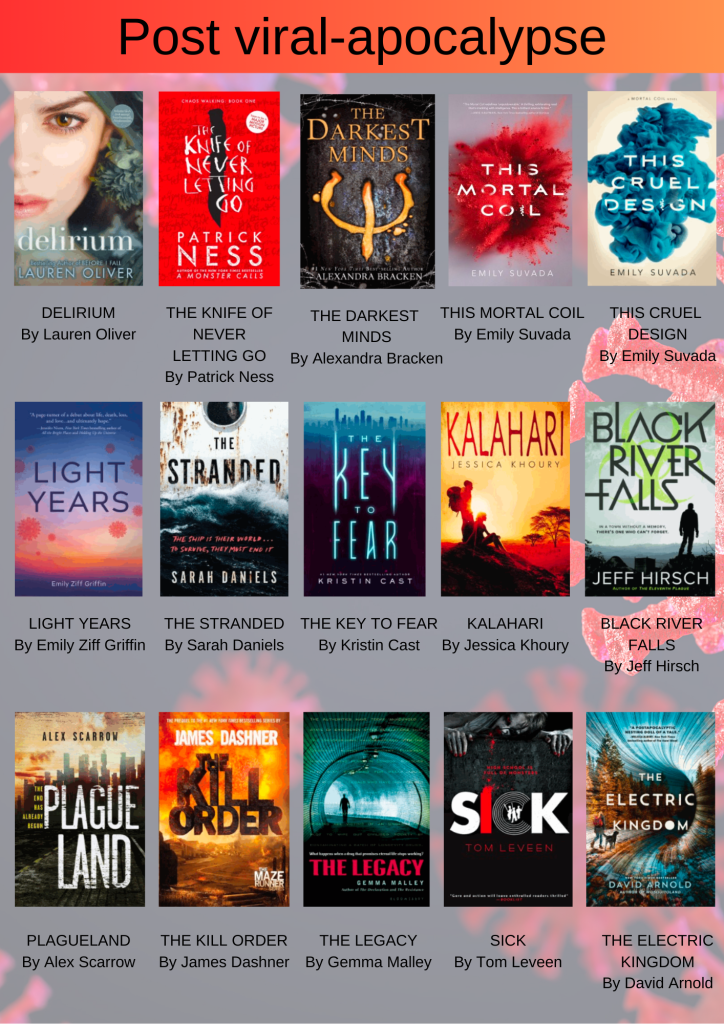
Our Grade 7 students do a dystopian unit in their English Language Arts (ELA) class, and I came across this nifty categorisation in a poster by Jeri Hurd (sans the sub-pages / images). Since I find our students are increasingly stimulated by imagery, rather than just text, I adapted the poster to include 7 sub-posters combining the books in our collection to the suggestions.

It’s not always easy to find middle grade appropriate science fiction, so this collection includes some YA works – particularly in the “Zombie apocalypse” section.

During a recent library visit after the students had completed their bookclubs with their chosen books, we had tables set out with the posters and the related books so they could further explore the various sub-sets of the genre.

If you are really interested in Utopian / dystopian literature and have quite a few hours to spare (like in the upcoming Spring break) I’d highly recommend Pamela Bedore’s “Great Utopian and Dystopian Works of Literature” from The Great Courses.

(Here is the link for the Canva template files of this series of posters – feel free to adjust according to your own collection)

Romance update

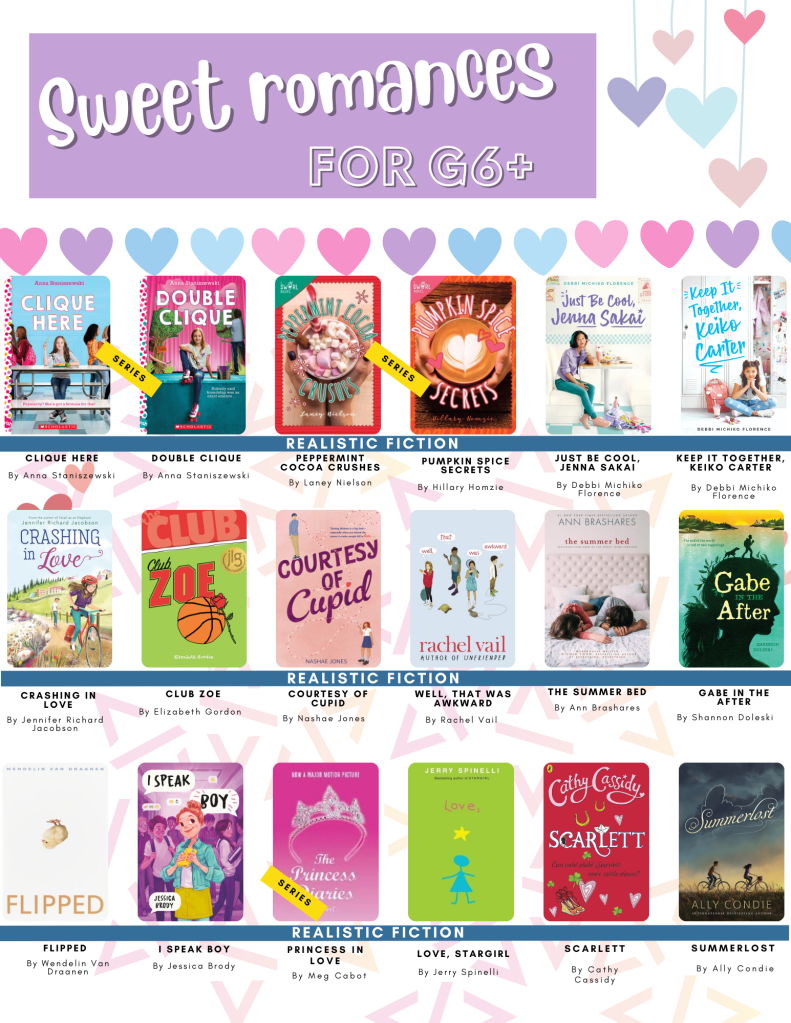
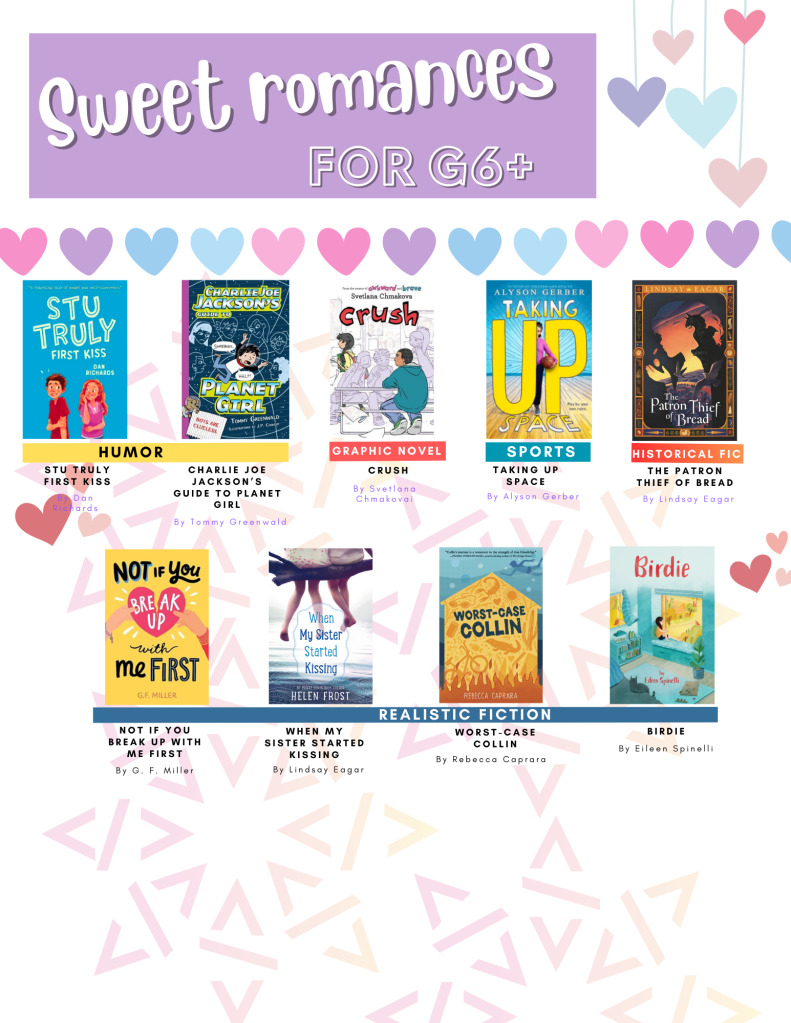
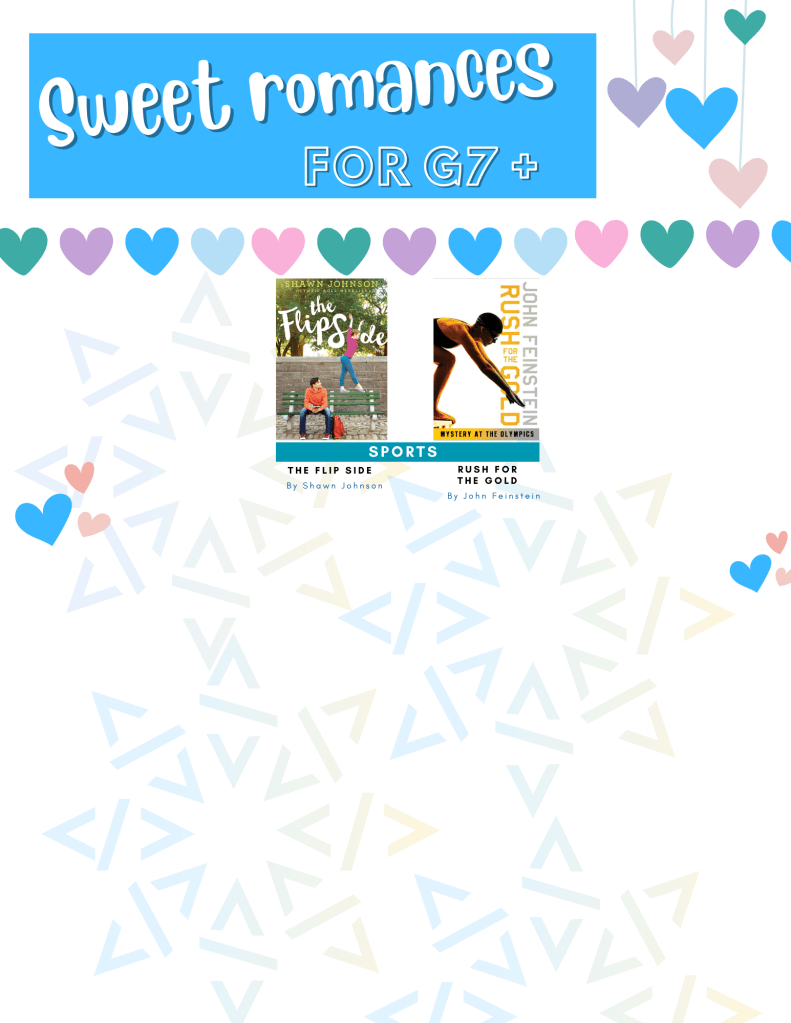
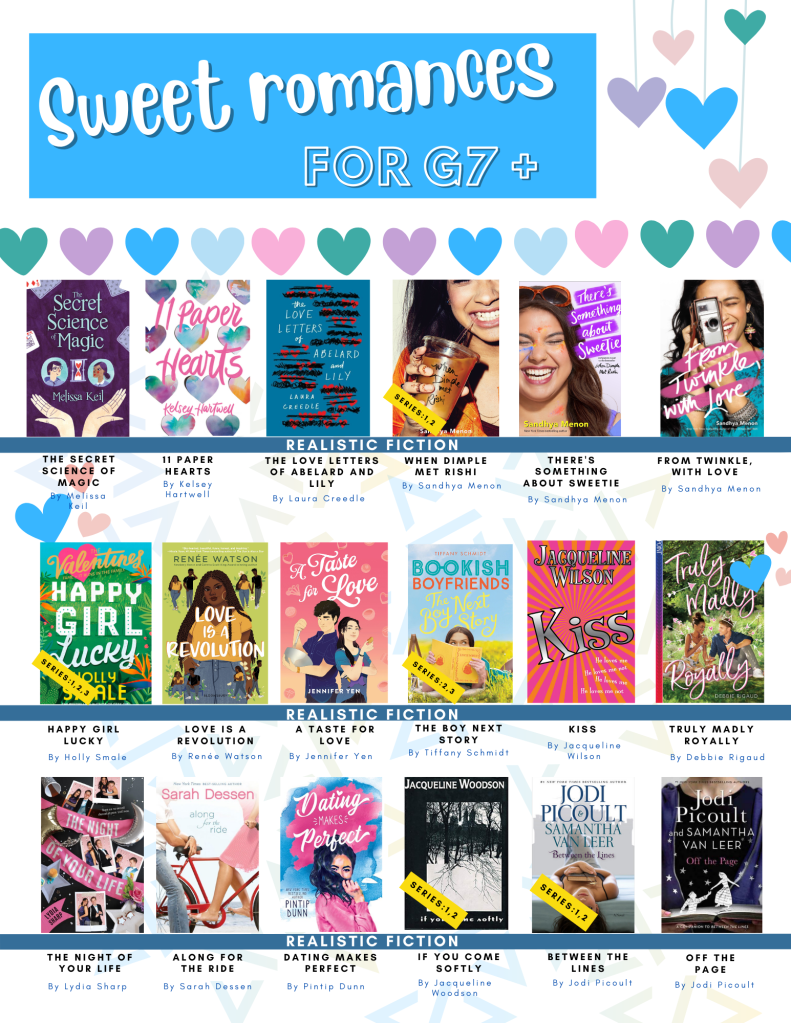
How easy it is to slip back into slothfulness – after a month of posting over at GLLI, today’s the first time I have had both the mindspace and timespace to do something on my own blog. Reading through various FB librarian spaces it seems that Romance is still doing the rounds and people are still looking for good, age appropriate romance novels that the parent-police / rabid-anti-readers / censors whatever are not going to object to, so I spent a few hours this week trying to find as many romance books as possible on Mackin.com that are rated respectively Grade 6+, Grade 7+ and Grade 8+. Now for all of you non-educators, non ex-parents of teenagers, non-working with teens people the distinction may appear ridiculous. But believe me, a 10/11 year old Grade 6 child is developmentally and emotionally ready for something quite different to a 13/14 year old. Or at least some of them / their parents and others that try to police their thoughts and reading.

I say this as an adult who has recently read “The Memory Police” by Yōko Ogawa and translated by Stephen Snyder and as a GenXer whose reading was not policed, except perhaps for “The Godfather” which my parents considered too violent, and therefor like every teen in my school read the whole sordid “Flowers in the Attic by V.C. Andrews series” before we really fully understood what incest was all about (an aside – read this Atlantic Article about just how prevalent it was / is).

I am also living in a region where even a mention of kissing could be construed as scandalous, but with students from all sorts of parenting, cultural, religious, regional, national and linguistic backgrounds. So tightrope, people. Tightrope. While doing my research I really had to wonder what exactly was the criteria to distinguish between suitability of the various age / grade boundaries. And I’m still wondering. There is a lot of talk about the age of the protagonists and whether or not there is kissing, hand holding, other touching, sexual encounters that are graphic or non-graphic or just hinted at but nada on where the lines are.

Back to library-land – why Mackin.com – well, unlike Follett which has very broad categorisation = Grades 3-6 / 5-8, 7-10 and YA, they are a little more granular so I poured over lists and lists of romance books and came up with the posters below. Also bear in mind these are inasmuch as I am aware all heterosexual in nature, again due to where I am living and trying to breathe and exist.

In another time and space I hope to have a far more inclusive list. And read my disclaimers below on this post. There is some nice cross-over in genres as well, getting into sport / fantasy / historical fiction with a brushing of romance – very important for our male-type patrons who are more likely to entertain the thought of romance in the context of anything but realistic fiction.

If you’d like to make a copy of these templates and expand / change for your context, here is the link. Feel free to comment with an image or link to any more inclusive posters you make.


Disclaimer: The views, opinions, and thoughts expressed in this blog post are solely my own and do not reflect the positions, policies, or opinions of any current or former employer. Any references or examples provided are intended for informational purposes only and should not be construed as endorsements or official statements from any organization I have been associated with.

Books I wish would be published

I’ve been asked to be on a panel at the AFCC to chat about “Books Teachers Wish Authors Would Write” from a teacher / librarian perspective. So I put the question out on one of my teacher-librarian networks (an international one) and these were the responses I received:
  • World war 2 in Asia- novel for 8-10 year olds (NF / NNF)
  • big shortage of narrative nonfiction that is NOT about the holocaust, slavery, the American great depression or US civil rights. Also shortage of intra-Asia migration stories not Asia to Europe / north America (NF / NNF)
  • Third culture kids as main characters (CD)
  • More stories about our present/ early future stories that include digital tools and behaviour (D)
  • I’m looking for things like “lego ideas / lego play” but in small manageable books that kids can take out without breaking their backs / the book
  • nonfiction – updated human rights / millennial goals / NGOs / Poverty etc. for G4 level (9 year old) mixed format, good graphic design, mix of narrative and fact (NF)
  • Middle school nonfiction – life in different economic / political systems – communist, socialist, social democracy etc. with a world wide unbiased view of positives and negatives with personal stories and data (NNF)
  • Books on gaming or from the creators of games like Minecraft, Roblox, etc. (D)
  • Conflicts over resources around the world – case studies that are elementary friendly (NF)
  • The next “The Outsiders.” Something to appeal to the teens who fall in love with it in class, and are looking for something like it.
  • Decent Biographies that are at elementary aged level & middle school level without being dumbed down – with more Asian protagonists! (CD / NF)
  • Books purposely written for upper ES that has appropriate content and reading “level” (ELL)
  • More ES novels featuring multicultural characters that are not related to war or historical events (CD)
  • Books about world topics that are appropriate for kinder/g2 (NF)
  • Modern urban indigenous stories – universal experiences in all first nations people. (CD)
  • Easy read stories that are well written & not dumbed down for teens. – yes! especially for our ELL students! And that don’t portray just the…..dark side of life? I feel like when I was purchasing for xxx, the high interest/low level books all were about gang members/drug dealers in the US. (ELL)
  • Science fiction for Elementary kids. (SF)
  • Middle Grade fiction with a Korean protagonist (My Name Was Keoko style) (CD)
  • Books with culturally diverse characters. I still remember teaching a boy could Yousef who threw the book down in disgust and said ‘Why can’t they give them normal names?’……the character was called Joseph. Which really isn’t that out there, unless you’re an Arab boy. Then it’s just weird. (CD)
  • LGBT books for tweens (G)
  • Definitely more emigration/immigration stories that are intra-Asia. There are so many diaspora stories to be told that have nothing to do with Europe or North America. (NF / NNF)
  • Does anyone want war stories set in Asia – like Japanese invasion/ Korean War / American or Vietnam war with perspective from the non-western side – or is that too sensitive? (NF / NNF)
  • My teachers want more World War 1 fiction for grades 6-8 and social justice books for middle schoolers.(NF / NFF)
  • My middle school girls want more heroes that are NOT princesses. (G)
  • My boys want fiction that has video game elements like Minecraft stories.(D)
  • All of my high schoolers want “classics” with better covers.
  • what about this: teachers, school, parents do not compare my score with others, do not give me homework, I want to play. (C)

I’ve tried to code the answers as follows:

  • NF / NNF: narrative nonfiction – 10x
  • CD: cultural diversity – 6x
  • D: digital / gaming element – 3x
  • G: Gender related – 2x
  • ELL: hi lo / books for English Language Learners – 2x
  • SF: Science fiction – 1x
  • C: cultural issue – 1x

Looking at these I think that the theme is a general frustration with a lack of books with an Asian context.  Particularly historical fiction / narrative nonfiction and culturally diverse characters. We all know that the USA dominates publishing, followed by the UK. Australia has some good stuff out but limits itself by its steep pricing, expensive shipping costs and insular publishing industry. China is a late entrant into children’s books and is making great inroads – but mainly in translation into Chinese. What is particularly commendable is that they are not just translating the (North) American staples but many of the brilliant and wonderful European offerings.

Then I did a similar exercise with the BWB (Blokes with Books) yesterday. I asked them to go in groups of 2-4 students and tell me what kind of book they were missing in their lives. Books they wish authors would write.   They were amazing – a couple of groups even started writing the books they wish were written (a nice outcome given the fact that teachers are now complaining that we’ve got them reading but their writing is still poor).

Their suggestions could also be broadly grouped:

  • Two groups wanted Harry Potter extensions or back stories – one wanted the parallel books that focused on the other houses, not just Gryffindor Tower. Another group was fascinated by the horcruxes and wanted a book on that.
  • One group wanted an elaborate Pokemon book that inverted some of the characters with unexpected twists.
  • One group combined the ideas of the three group members into a fantasy / reality mixture involving video games and rugby with a wimpy gaming protagonist being forced to play rugby by an over-zealous parent and learning tricks and manouvers in video games that led him to dominate on the real life rugby pitch.
  • One group wanted (and started outlining the chapters) of a Roblox user manual.
  • Quite a few of them agreed they’d like fiction books with colour pictures inside

I’d like to add a note to the above list – the students are not yet familiar with fan fiction, and I’m not sure they’ve looked into the Harry Potter wikis. In a sense that makes me happy that they’re still at that wonderful age where this type of magical immersive reading stuff is to be found in books rather than online. They are aware that there are user forums on these games and chat rooms etc. BUT THEY WANT TO READ ABOUT IT IN A BOOK. This is a GOOD thing. Whenever they ask for books about Minecraft and Roblox and video games and I tell them we have some of the storybook series, the Minecraft “how to” and “surely you can just ask online” they say “but we want a book”.  There are few Roblox books and they all seem to be eBook editions (publishing haste?). The Minecraft adventure books are not what they’re looking for – remember the colour pictures comment? They want more graphics! I think also as adults we see their online/offline selves as separate, whereas they don’t, and they want to see that new normal reflected in what they read. They’re all avid fantasy readers, and that I think is partially meeting their need for that online/offline fantasy/reality integration.

A caveat to all the comments (and a personal gripe) – above all children want a well written story. They don’t want to be preached to. They’re sophisticated and well- and globally read. And they can spot the fakes. As a teacher-librarian I get immensely frustrated by wanna-be and self-published authors who keep trying to foist their wares on me when it’s immediately apparent that they’re poorly written, even more badly illustrated, not edited and horribly and cheaply published. Writers need to read. They need to read a lot, they need to read widely. They need to research not just their topic but also who else has written about it, tangentially to it, similarly to it. If you want to self-publish, unless you’re a designer, pay someone to do your design for you. Unless you’re an author-illustrator find the best illustrator you can afford. And everyone, join a writing / critique group (like SCWBI) – honestly, other authors are not out to steal your ideas – they’re too busy working on their own passions. And when you think you’re done, get a good and critical editor. All authors need good editors, even great authors. Do yourself a favour and look at the interactive TS Eliot “The Wasteland” and see all the handwritten edits by Ezra Pound.

To come back to the forum and the original question that started all this:

“Creators can step into the shoes of a teacher for one hour and learn what makes a book a treasured find. From beautiful illustrations to didactic language, speakers discuss their views on relevant and useful books children need and love.”

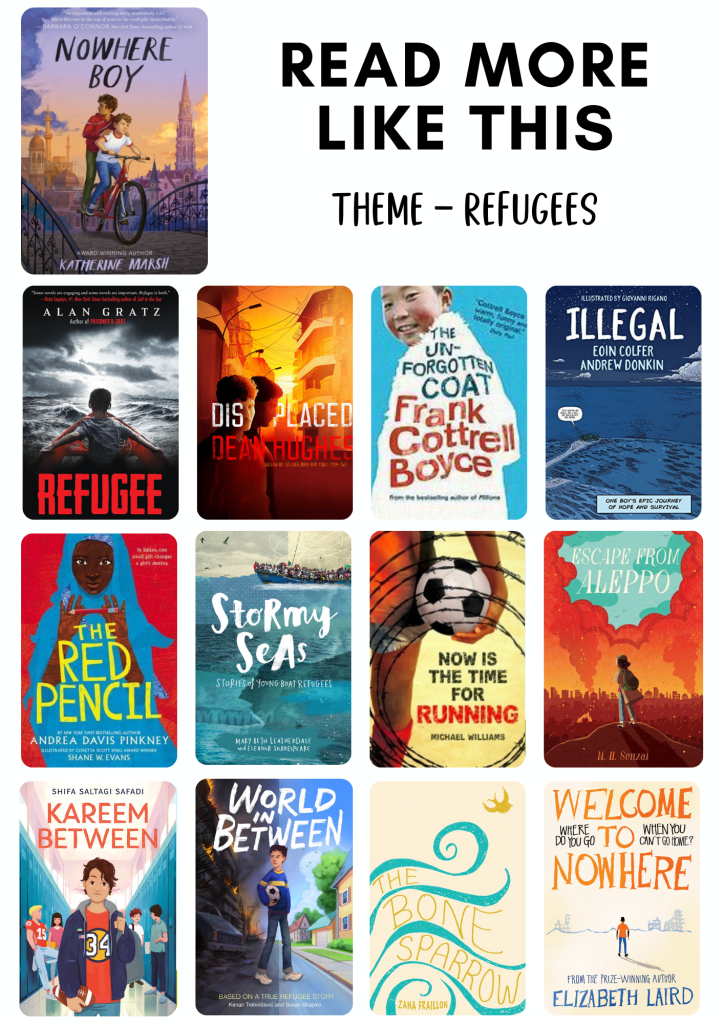
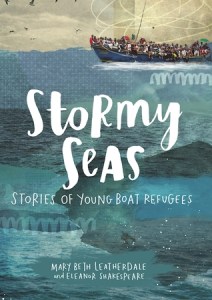
What a huge question. Relevant is not always pedagogically useful. Useful for whom? Relevant to what?  I’d like to end with the most relevant and useful and just plain wonderful book I’ve encountered this year – Stormy seas: stories of young boat refugees. 

31213610 Well done Annick Press (that does a lot of amazing things – particularly in nonfiction) It has become the new gold standard to which I will hold all nonfiction. The elements that make it so special:
  • Great graphics – combination of good design elements with original primary source photos
  • Easy to navigate blocks of text
  • Personal stories
  • Historical facts
  • Timelines
  • Maps

It is not out yet (April 2017) and I got a preview copy through Netgalley (sign up if you’re a teacher / librarian), I showed it to a couple of classes from G3-G6 and all were clamouring for a copy afterwards – something unusual for nonfiction. And when I couldn’t give them I copy I managed to “sell” some of my otherwise untouched narrative nonfiction / historic fiction books on WW2 etc.

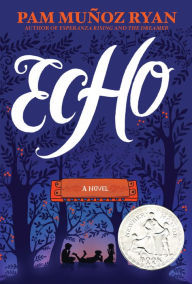
Another surprising (but not really because it’s so absolutely wonderful) hit has been Echo. It’s a huge book but every child and adult whose hand I’ve put 22749539it into  has just loved it – depite the fact that it takes a while to get through. Why – I suspect that the range and diversity of the characters and settings is satisfying to my international audience. But it is also great storytelling. And then they go on to read all the other Pam Muñoz Ryan books, which is also an excellent outcome.
 

What would you like to see more of that is “relevant and useful”?

Blog post 3: Write a book review – Diversity

1. A detailed description of the activity undertaken

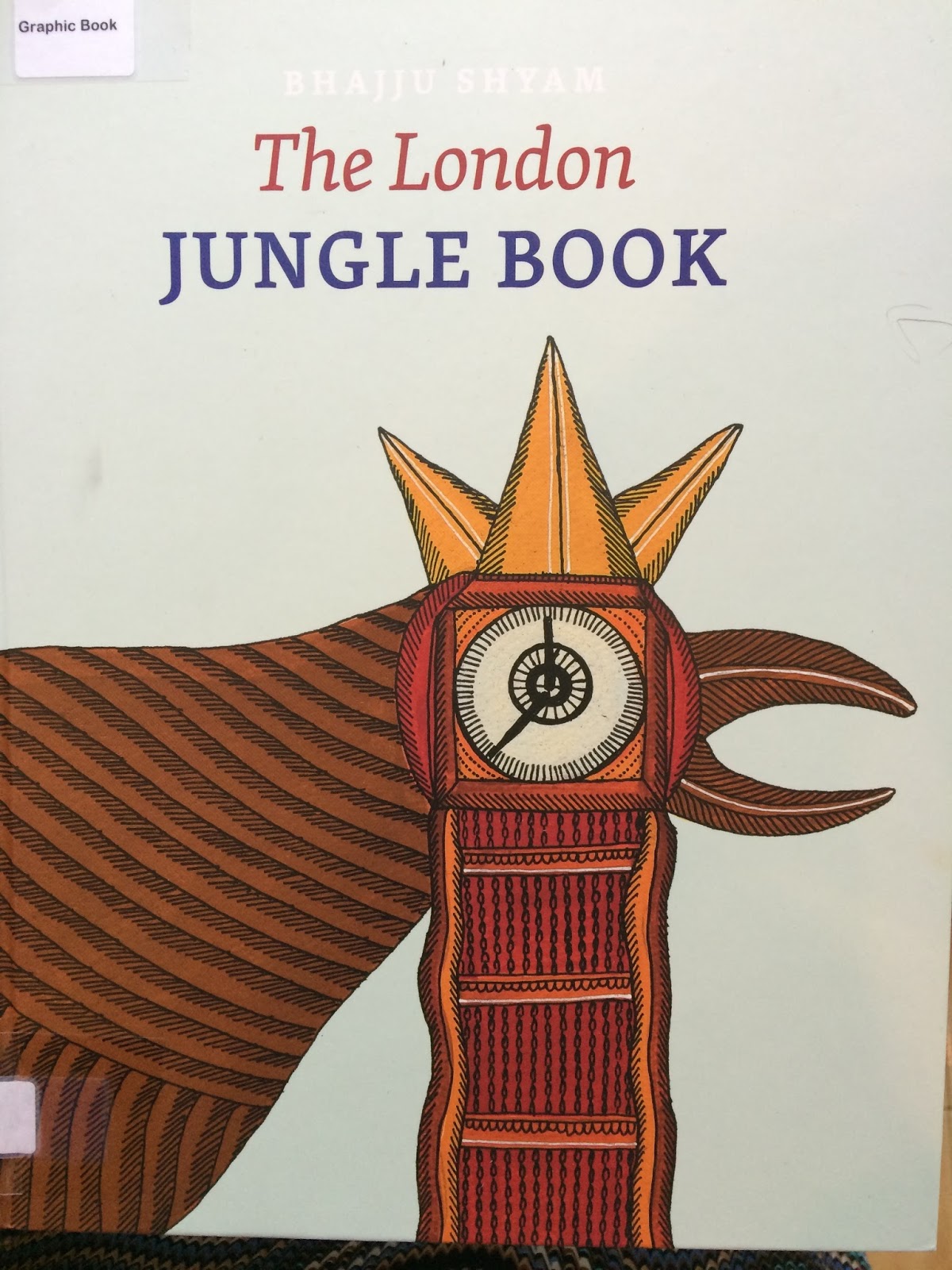
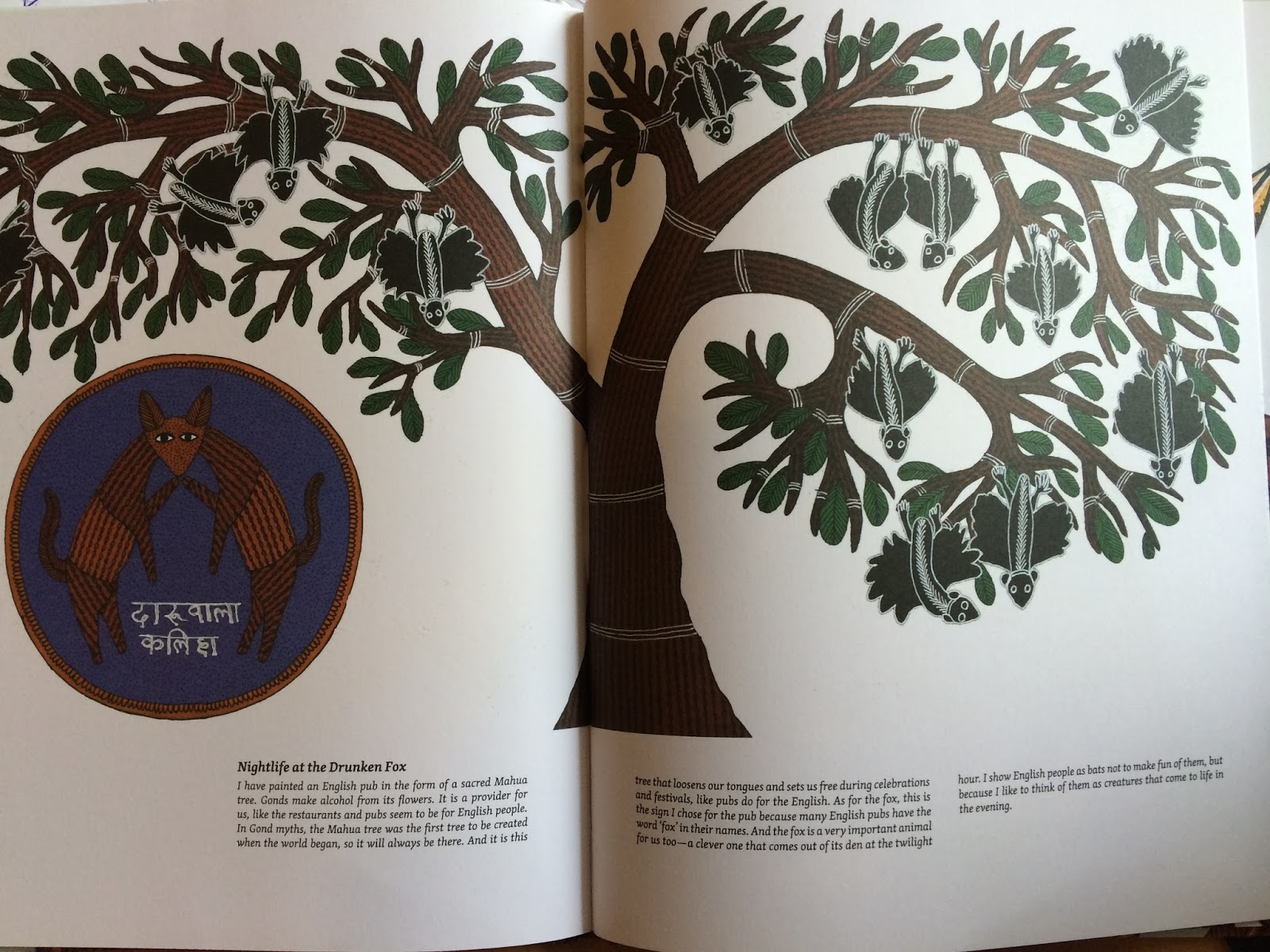
The visually stunning book: The London Jungle Book by Bhajju Shyam (Shyam, Rao, & Wolf, 2014) was reviewed.  In this recently republished book, an Indian artist from the Gond tribe creates a visual travelogue of his experiences in London where he lives for two months to paint murals in an Indian restaurant.  The title refers back to Rudyard Kipling’s Jungle book – a juxtaposition where an Englishman travelled to the jungle area where Shyam lives and wrote of his experiences there.

The visual story and text / Explanation of drawings

Besides the wonderful illustrations and the poignant but perceptive comments on London and its people, I particularly liked the fact that the book could be read on multi-levels and is therefore suitable for readers of all ages. There is a visual story accompanied by text in translation from his oral storytelling that will appeal as he simply recounts experiences and observations of a foreign land. Then the artist explains his choices of drawing as he breaks with traditional communal symbols and traditions in order to tell a unique and personal story. An additional level is added by the reader, who while reading this will no doubt reflect on his or her own travel experience or knowledge and feelings about London.
Extension activities for students could include investigating and comparing Kipling’s book with this as well as the works of the anthropologist Verrier Elwin who lived with the Gond tribe.

2. Answers to the following questions:

What did you learn?

In the first place I realized that although I’ve been reviewing books informally (in my Goodreads profile, or on my blog) for a while, I didn’t actually know what the principles of a good review were, so I had to first do some research on that. I found three good reputable resources, Owl Purdue writing lab (Brizee, 2012); BookTrust (Playa, 2014) and Scholastic (Philbrick, 2014) and compared the elements.

How was the activity relevant to your professional practice?

As a librarian I am often asked my opinion on books or need to write brief reviews. I had not approached this in a structural way before, so it is good to have a review “template” in mind when talking about a book. I can encourage students to write reviews on the books they have read, and give them tips on how to do so.

Were any gaps in your knowledge revealed? How might you fill those gaps?

At first the illustrations struck me as being reminiscent of Australian Aboriginal art, so I did some more research on the Gond Tribe and ethnic minorities in India. About 30% of our students are Indian, and I recognised that I know very little about India and its vast diversity in language, culture, art and literary traditions. I can fill the gaps in my knowledge both by reading up about the country and its people and by having conversations with students and their parents to better understand the nation.

3. References:

Brizee, A. (2012, September 19). Purdue OWL: Book Review. Retrieved September 7, 2014, from https://owl.english.purdue.edu/owl/resource/704/01/

Philbrick, R. (2014). Writing with Writers: Writing a Book Review. Retrieved September 7, 2014, from http://teacher.scholastic.com/writewit/bookrev/

Playa, L. (2014). Tips for writing book reviews [Article]. Retrieved September 7, 2014, from http://www.booktrust.org.uk/books/teenagers/writing-tips/tips-for-writing-book-reviews/

Shyam, B., Rao, S., & Wolf, G. (2014). The London jungle book. India: Tara Books.