Enough windows – where are the mirrors?

I was prompted to think about this again with the publication of the White Ravens 2019 list at the Frankfurt Book Fair. The issue of increasing diversity in an international school setting is a complex one, and something I’ve written about at length in the past.

In English

There’s the linguistic diversity bit – collections of books in “Languages other than English” (LOTE) (that post is getting a bit long in the tooth and probably needs updating) a more up to date article featuring Jeremy Willette can be found here.  Though I do object to the phrase “mother tongue” the reality of many of our dual language students is that the language other than English medium at school could be that of either parent, but is often that of the father. So I prefer to refer to “home language”. In 2014/15 I went through somewhat an obsession on language, researching it to death, you can find some of the posts on that here. The one thing I would definitely add to this conversation is that unless the LOTE collection is updated regularly and championed by teachers and parents or a language based club, they often don’t earn back the investment in purchasing and the real-estate they occupy. So if you want to invest in a linguistically diverse collection you also have to invest in a mindset of pride in home language and a sense of ownership over the collection and its maintenance within that linguistic community.

The hardest part internationally is that issue ofnot our diversity . If you have a moment, please read that post. Students who are in international education often defy the traditional (North American) definitions of diversity. They are not poor, black, hispanic, urban, immigrants. That is not to say that it’s unimportant for our students to be exposed to stories of all these groups of people and more. In fact their privilege demands that they access poverty, racism, immigration and need through the windows of literature. But those versions of diversity are not mirrors for them. With a great budget we have no shortage of windows. It’s the mirrors we lack.

And again, when we have these diverse books, we still need teachers and librarians and students and parents who will read them and champion them. Students who will dare to take a book with a cover of someone who doesn’t look like them and read it. Families and languages
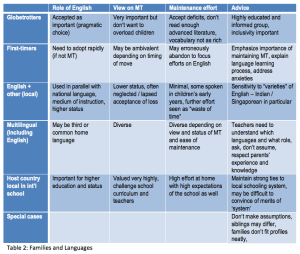
The thing with international students is their lack of homogeneity – something I encountered when looking at linguistic diversity. This table (from my 2015 research) speaks to some of the many variations. (Yes, in those days I also referred to MT /Mother Tongue). So one of the most important sources of mirrors for our students often is books in translation. Particularly for the “globetrotter” subsection of our students. Looking at the White Ravens list above doesn’t give me that much comfort I’m afraid.  The issue I have is that most of the books in 2019 are BANA originated (Britain, Australia/NZ & North America) with the exception of one from the Philippines and one from India.  2018 was a bit better (one from Romania, India, Ghana and Korea). The list is unwieldy, you can’t search by age group. And you can’t get a print out.

Some more sources of inspiration include the various IBBY organisations. Including USBBY – even though the criteria for inclusion on the list is includes:  Books that help American children see the world from other points of view; Books that provide a perspective or address a topic otherwise missing from children’s literature in the U.S; and Books that are accessible to American readers (where accessible can mean a multitude of things). Again, painfully it’s hard to get a simple list to down load – no I don’t want a pptx, or a bookmark, I just want a list to print out to buy from.  And IBBY UK. Their latest publication: Children’s Literature in a Multiliterate World looks to be particularly interesting. One lives in hope.

One of the many things that concerns me with all of this, is the emphasis on picture books. Don’t get me wrong, I’m a HUGE fan of picture books. But the over-reliance on translating picture books? It just adds a PB to the five F’s (food, fashion, festivals, folklore, and flags) of pretending we’re oh-so-international and inclusive.

The Global Literature in Libraries Initiative is more cause for hope. Particularly as they reach out and co-opt people in-situ to aid with their uncovering of local treasures.

In this diversity quest, one is often more of a sleuth than anything else. For example needing to have a look at awards like the Astrid Lindgren Memorial Award and then looking at names of authors and illustrators and seeing if any of their works are translated and available. And how sad it is that many of those authors and illustrators don’t even have a web presence? Isn’t that one way in which IBBY could assist them? Just like publishers have a page on their site for each of their authors couldn’t these nominated people each have some kind of a presence. And many of the links don’t even work.

The “and available” thing. Holy hannah publishers. Get with the global world please. Honestly it’s hard enough just getting to know about Australian and New Zealand and Canadian books, not even to mention anything that is not from USA or Britain. What ever happened to the whole “print on demand” movement. I could possibly understand why it’s hard to find picture books, but middle grade / young adult / junior fiction? Surely that’s not an issue?

How are the rest of you doing with your diversity collection? What “sells” to your students what do you need to work on promoting? Do your teachers gravitate to them / read them or do they need to be pushed?


Why awards?

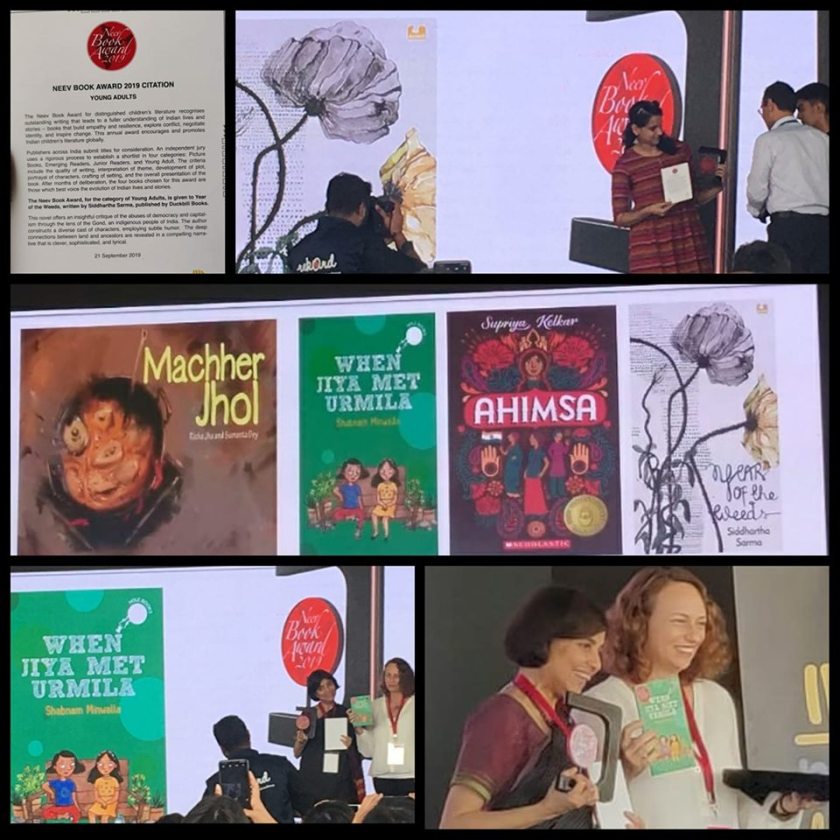
This week’s blog post will be very brief as a function of my extreme exhaustion – just been up and down to Bangalore for the Neev Literature Festival 2019. Beijing-Bangalore is not a commute I’d recommend to anyone who prizes their sleep or sanity but WOW what an intense 2 days it was.

The theme this year was “Taking Children’s Literature Seriously” and I’ll write a bit more about the rest of the festival another time.

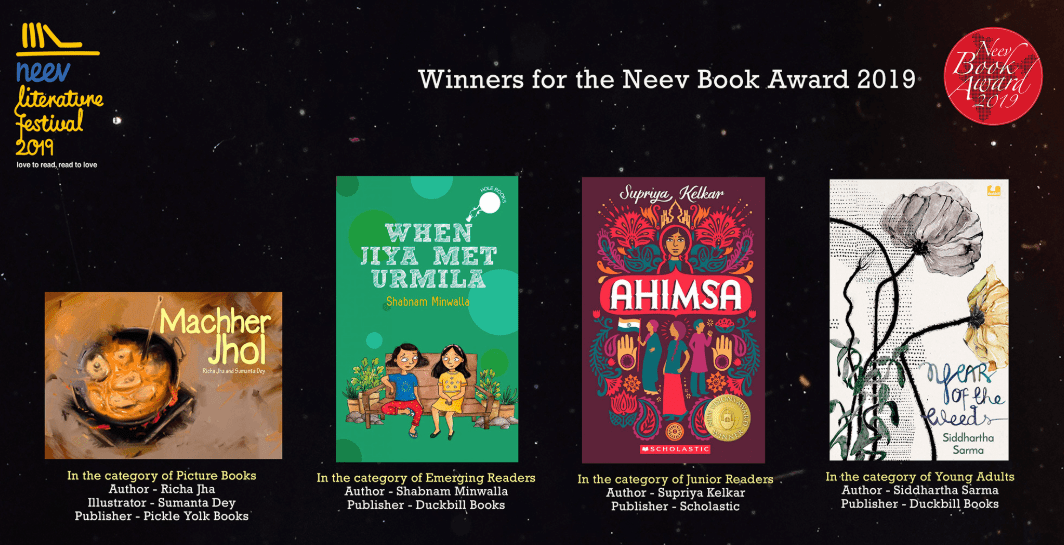
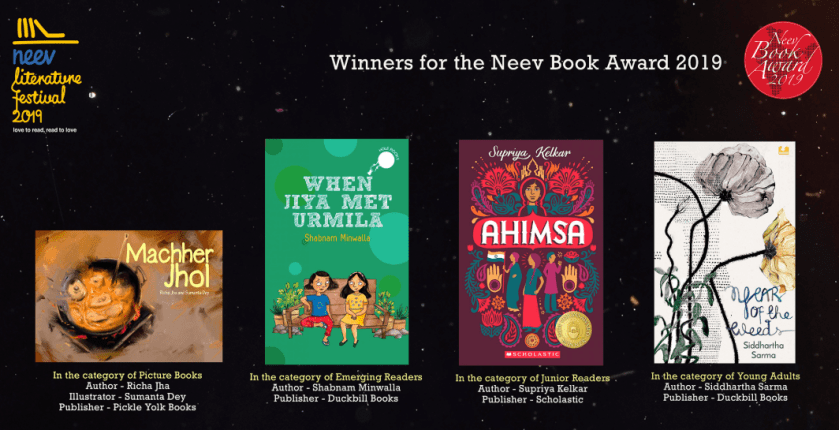
For now I just want to highlight the winners:

Screen Shot 2019-09-22 at 20.11.30

After a year of reading the long lists and short lists in four categories the awards were announced on Saturday for this year’s winners. I must say it was a surprisingly emotional moment even for me just as one of the jurors, I can’t imagine what it must be like for the authors!

There’s been a bit written recently about literary prizes – “Who Cares about Literary Prizes” is a wonderful article combining the idea of “canon” and popularity in this context with some very cool data representation. Book Prizes, the more the merrier, and A guide to the most prestigious prizes.

Book buyers, librarians, teachers, parents tend to rely on a fairly narrow range of sources for their book purchasing decisions. One of those is lists, and the other prize winners (and often lists of prize winners). In this context the existence of speciality or niche book prizes is incredibly important to shed light on otherwise neglected corners of excellent children’s literature.

Since Ahimsa is already relatively well known in international children’s literature circles, I’m going to just put in a few words about the other three books.

Machher Jhol is a richly illustrated book showing the journey of a young boy through the roads of Kolkata to get the ingredients for a fish stew for his father. There is a wonderful twist to this tale that will make it beloved of any class looking for books on resilience.

When Jiya met Urmila is written for that space of emerging readers where very few authors manage to successfully tell a great story but make the writing accessible to the beginning reader. The story gently probes how segregated childrens’ lives can be.

Year of the Weeds is one of those books that I can see becoming part of a canon of middle grade / young adult books that are used in the classroom to promote thinking about globalisation, sustainable development goals of economic growth (8); industry and infrastructure (9); sustainable cities and communities (11) responsible consumption and production (12); and Life on land (15) – while still being an excellent read.   The link above goes to a very interesting interview with the author.

neev awards.jpg

Another thing that awards do – reward publishers for taking chances on genres, topics and authors.  This year Duckbill publishers had two award winning books – here’s hoping they continue to bet on this calibre of writing AND even more importantly that their books get attention and distribution outside of India, because the world needs these books.

In response to requests – here is where to find the books:

Ahimsa

When Jiya Met Urmila

I will be sharing an email to contact if you are interested in buying the short-list or finalists in multiple copies.

In addition if you’re interested in other books:

Here is the short list:

Here is the complete LongList nominated by Indian publishers


Why lists and awards matter

Every year around this time, some parent will ask the teacher or myself what their child should be reading.

The “correct” response to this question is that we don’t make reading lists of prescribed or recommended books but prefer students to come and have a chat to us about what they like reading, what hobbies or interested they have and based on that we can personalise some recommendations for them. That we believe in free voluntary reading.

How many of you have had a follow up on that with the student popping by for that exciting interaction?  I started getting parents coming by personally around the end of my first year in my last job, and parents and children sometime in the second year and students on their own around the middle of my third year.

The truth is that people like lists and they like recommendations. This New Yorker article gives some ideas as to why lists matter – the most salient features are that lists “alleviates the paradox of choice” help with “reduction of uncertainty” and due to their finite nature are easier on the book budget both for school and home libraries!

Book Poster Neev Shortlist updated

So why are book awards important? According to Underdown:  ‘

“Awards are important in children’s books. They tell publishers, writers, and illustrators what is considered to be “the best,” and thus the standards they must strive to attain. Many children’s book awards, though not all, are selected by librarians. Award-winners then get orders from … both libraries and bookstores.  They will also stay in print longer. For writers and illustrators, getting to know the award-winning books … is one of the ways to understand what is considered to be the best today.

The idea of finding out what the best is “today” rather than when authors / illustrators or publishers – or parents and librarians were children is very important. I’d love a dollar for each time a parent wants to force the literature of their youth onto their progeny. Reading through the long list of the Neev awards, there was also quite the body of what I’d call “nostalgic” storytelling. Which is really hard to carry off, and generally appeals more to adults than children. Which is why, it may be important to consider a children’s choice option when moving from a short-list to the finalists.

Following last year’s very successful initial Neev Festival, during the feedback discussions the idea of an Indian Children’s book award was floated. One of the driving ideas was that India had a large body of children’s literature, published in English, but not widely known nor distributed internationally. And selfishly, as librarians in an (Asian) international context with 40-50% Indian diaspora making up our student bodies, we were just not able to provide our students with the “mirrors, windows and glass sliding doors they deserved – mirrors for the Indian students, and windows and doors for the other students. Kavita Gupta Sabharwal is a very special person, both visionary and someone who makes things happen, including this book award, both from a logistical and a financial point of view. Each award carries a cash prize of Rs 1 lakh (around US$ 1,400 – a substantial amount in the Indian publishing world).

Already, just based on circulating the short-list in social media groups, there has been substantial interest from the librarian community. The prize-winners saw their books fly off the tables following the award ceremony, with all books sold-out by the end of the festival. An award sends a powerful signal to publishers and the public – one that says “pay attention” this has value, create more like this. The award stickers on the books a “buy me” beacon.

The final step in the equation and the gauntlet to be thrown is whether the publishing and distribution channels will be able to push these books out into the wider world where they deserve their moment(s) in the sun. And in the longer term, creating teacher guides and author visits, websites, hyperdocs, quizzes, eBooks and audio-books. For that is what the world has come to expect. But first the small steps, make the books available for every child, parent, teacher or librarian in the world who wants to push a “buy” button and have the book delivered to them, anywhere in the world.

Activity ETL402: Children’s literary awards

One of the things we’ve been looking at as a class are the various children’s literary awards.  I’ll not dwell on the usual Caldecott / Newbery / Kate Greenaway type award, but would like to highlight a few of the awards the class suggested that particularly relate to socio-emotional or multi-cultural issues, as that is the direction that my interest is falling.

  • The Batchelder Award is given to the most outstanding children’s book originally published in a language other than English in a country other than the United States, and subsequently translated into English for publication in the United States.


    Green Earth Book Awards

    “The Green Earth Book Award is the nation’s first environmental stewardship book award for children and young adult books. Over 80 winning and honor books have been honored since 2005. The award continues to garner attention from the literary world as an esteemed award, bringing recognition to authors, but more importantly, providing the award-winning books to children.”

    Schneider Family Book Awards

    This is awarded to “an author or illustrator for a book that embodies an artistic expression of the disability experience for child and adolescent audiences”. It is divided into teen, middle school and children’s sections. Books are selected by a jury consisting of seven members of the American Library Association.

    Hans Christian Anderson Awards

    The Hans Christian Andersen Award is the highest international recognition given to an author and an illustrator of children’s books every second year. The recipient is selected by a jury of international children’s literature specialists.

    This award is made biennially by the South Australian State Group of the Psychologist for Peace Interest Group. The Children’s Peace Literature Award encourages the dissemination of information related to peaceful means of resolving conflict and promoting peace at the global, local and interpersonal level. There are books judged in 2 categories-Junior readers and Books for Older readers. The books are judged on the extent to which they promote peace as well as literary merit.


Blog post 5: Review an electronic resource about delivering services to children or young adults – Asian Young People’s Book Awards

1. A detailed description of the activity undertaken:

A new young people’s book award has recently been set up in Hong Kong – the Golden Dragon Book Award. I decided to review the website supporting the award and to compare and contrast that with the websites supporting the other young people’s book awards in Asia, namely the Panda Book Awards (China), Red Dot Book Awards (Singapore) and the Sakura Medal (Japan). What all these book awards have in common is that they have been created for young people attending International Schools, and they therefore feature English Language Books, not necessarily the language of the “host” country of the award, except for the Sakura Medal, which has Japanese books.

Golden Dragon Book Awards
Panda Book Awards
Red Dot Book Awards
Sakura Medal
URL
Type of site
Weebly
Wikispace
Google Sites
Weebly
Country
Hong Kong
China
Singapore
Japan
Founders/Run by
Association of Librarians in English Speaking Schools (ALESS) in Hong Kong

International librarians throughout China

 International school librarians Network (ISLN) in Singapore

Librarians from international schools

Year Started
2014
2009
2009
2006
Categories
Four  (ages 4-6; 7- 10; 11-14; 15-18)
Four  (Younger Readers; Middle Readers; Older Readers; Mature Readers)
Four  (Early Years; Younger Readers; Older Readers; Mature Readers)
Nine  (Picture Books; Graphic Novels; Chapter Books; Middle School; High School; Japanese Picture Books; Japanese Chapter Books; Japanese Middle School; and Japanese High School)
# Schools
Not mentioned
32
Not mentioned
20
# Students
Not mentioned
Not mentioned
Not mentioned
15,000
Criteria
Not mentioned
No more than 2 years old
Published in English in the last 4 years
No more than 2 years old
Long List
8 books per category
8-10 books per category
8 books per category
25-30 books per category
Resources
Promotional Material including Brochures, Stickers, Book ordering, video, slideshow
Promotion materials including: voting posters, category posters, stickers for books and badges, bookmarks, printers for big posters, videos / slideshows / images
Interactive elements
Not on site – see social media
None
Not on site – see social media
Commenting allowed on site (moderated)
Related competition?
None
None
Related social media
None
The first thing that strikes one is that the websites are fairly comprehensive, but are very much geared toward the librarian rather than the students. Resources are geared towards promotional material such as brochures, stickers and bookmarks.  The Golden Dragon and Red Dot sites had some videos, slideshows and images, however it was not apparent that these were created for students or for the teacher / librarian. Further, none of the sites had any real interactive elements, where available, these were taken “off-site” to Twitter, Goodreads, Facebook or Diigo – again these elements were geared mainly to the teacher / librarian rather than the students.

The nominations or selections for the long-lists was not explicit on any of the sites but appears to be something done by a committee, whereas the voting for the award winners occurs physically at the various schools by the pupils with a variety of criteria (such as students having read a number of the books).


2. Answers to the following questions:

What did you learn?


A website that serves teachers / librarians indirectly is a resource for children or young adults inasmuch as it supports them in delivering a service – in this case access to recent, high quality books as part of a book award selection process.


How was the activity relevant to your professional practice?


In my practice I will probably assist with either the nomination or selection of a long list as well as with the promotion of long-list books and the encouraging of students to read. 


Were any gaps in your knowledge revealed? How might you fill those gaps?


Comparing different awards in Asia has allowed me to reflect on the award we run in Singapore and particularly to consider how sites could be made more interactive and more relevant to our students, not just indirectly through helping the teacher / librarians but more directly.

3. References

About – Golden Dragon Book Awards. (n.d.). Retrieved September 30, 2014, from http://www.hkgoldendragonawards.org/about.html


Panda Book Awards – home. (n.d.). Retrieved September 30, 2014, from http://pandabookawards.wikispaces.com/


Red Dot Book Awards 2013-2014. (n.d.). Retrieved September 30, 2014, from http://www.reddotawards.com/home


Sakura Medal  – Sakuramedal. (n.d.). Retrieved September 30, 2014, from http://www.sakuramedal.com/sakura-medal.html