when the library is more than a library

In some ways libraries have never just been about the books or the building.  Even since the first libraries they’ve been about a certain idealism, a world view, a concept of teaching, learning, enquiry, culturalisation, what ever you may call it.

So yesterday it shouldn’t have taken me by surprise with Ms. S asked me in a little bit of a panic what should be done with the books on the human body.  Of course once a library starts to become an organised entity, it is easier to find things.   And when one is a G5 boy (or girl) it seems that there are pressing questions that need to be answered.  And perhaps these questions are not being answered at home or at school, so in steps the library and books (thank goodness I’d say).   Luckily Ms. S was of the same opinion as me, but the question was what to do about the fact that some rather indignant parents had been ringing the school to find out what and why and how their kids were reading all this “stuff”. (Ironically of course those very children who had the most pressing need to be reading these books).

Now Ms. S is an experienced teacher who has dealt with things that I hope never to have to deal with, she’s open-minded, and recognises an education moment for an education moment.  But she’s had this library thing only a short while.  Even shorter than me.  So it’s hard to distinguish where her responsibility begins and ends.  Our discussion was a little about flipping the question.  Does the school have a counsellor?  Does it have a structured “personal and social education” curriculum? When does this start, what is dealt with when?  And how does that tie into the resources, book and otherwise that the school has available to its students and teachers.

Of course there are much bigger questions – like that of censorship. Like school policies on what is accessible to which age groups and in what context.  None of this can be decided in isolation.  I suggested to her she needed to involve the counsellor and the head of primary and the school have a “party line” so that when parents or teachers or children ask about the existence or not of materials they can refer to a policy or group decision and speak with one voice.

Haves or have nots?

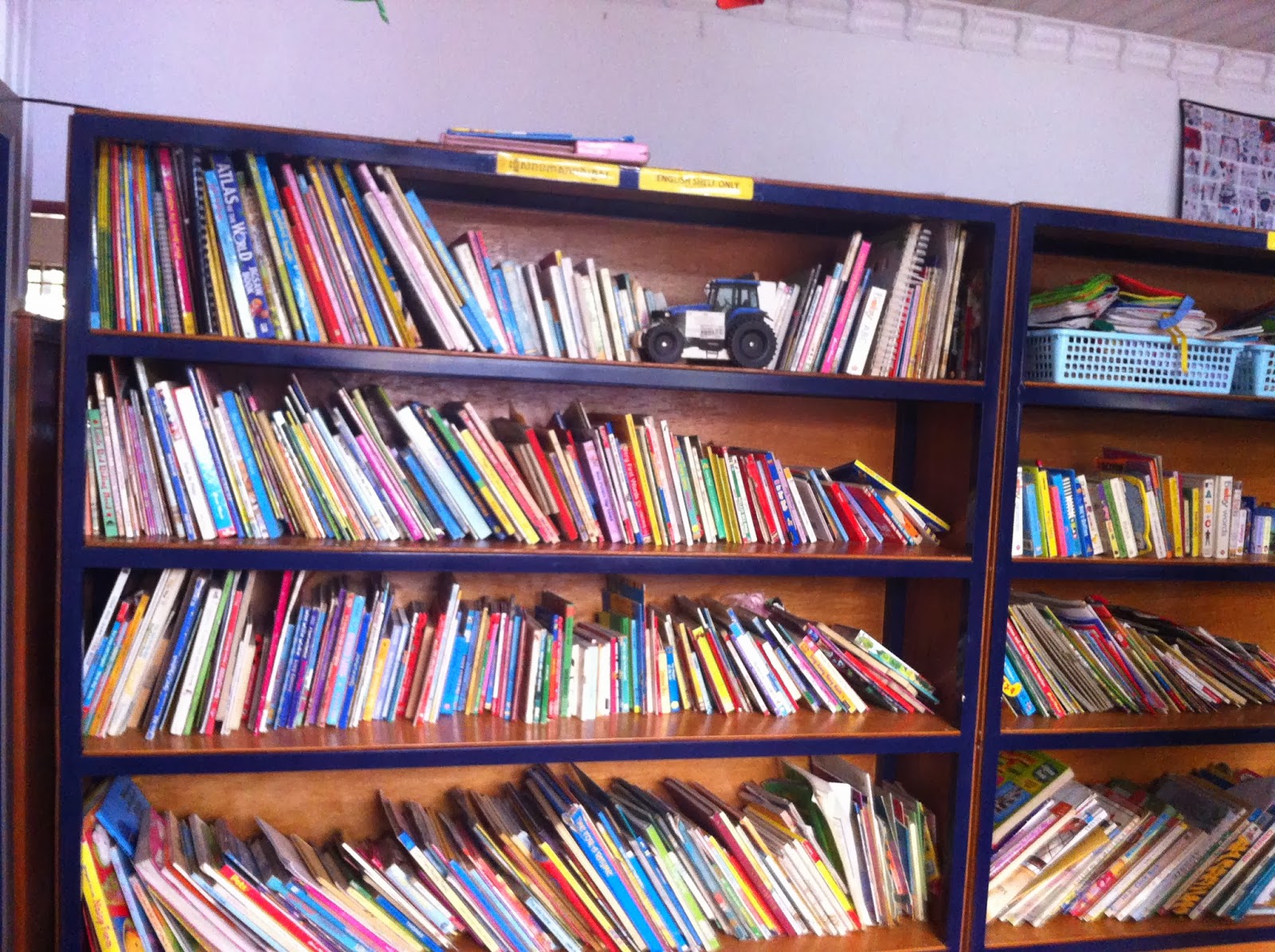
Library at Kuma Cambodia – no borrowing only reading onsite

I’ve just spent 8 days in Cambodia on an extremely interesting services trip run by UWCSEA-East. During the time we were exposed to 5 of the Global Concerns that the school supports through its service program commencing in the infant school with Kuma Cambodia, Green Umbrella (grade 3), Epic Arts (grade 5) up to ISF (grade 6).

The focus of the trip was on exposing parents and students to the various organisations and to allow us to “get our hands dirty” – literally – we took part in a variety of activities ranging from playing football – where the most important attribute seemed to be a very muddy field, to arts and crafts, dancing, cycling, teaching English, making paper planes, and some back breaking work on building 2 houses for indigent families.

 Although the focus was not libraries, I couldn’t help taking a keen interest in what, if any books and in what type of storage or lending format these were presented.

Unfortunately my camera died early in the proceedings, and so I only have some iphone shots from later in the tour, so I’ll just have to describe.

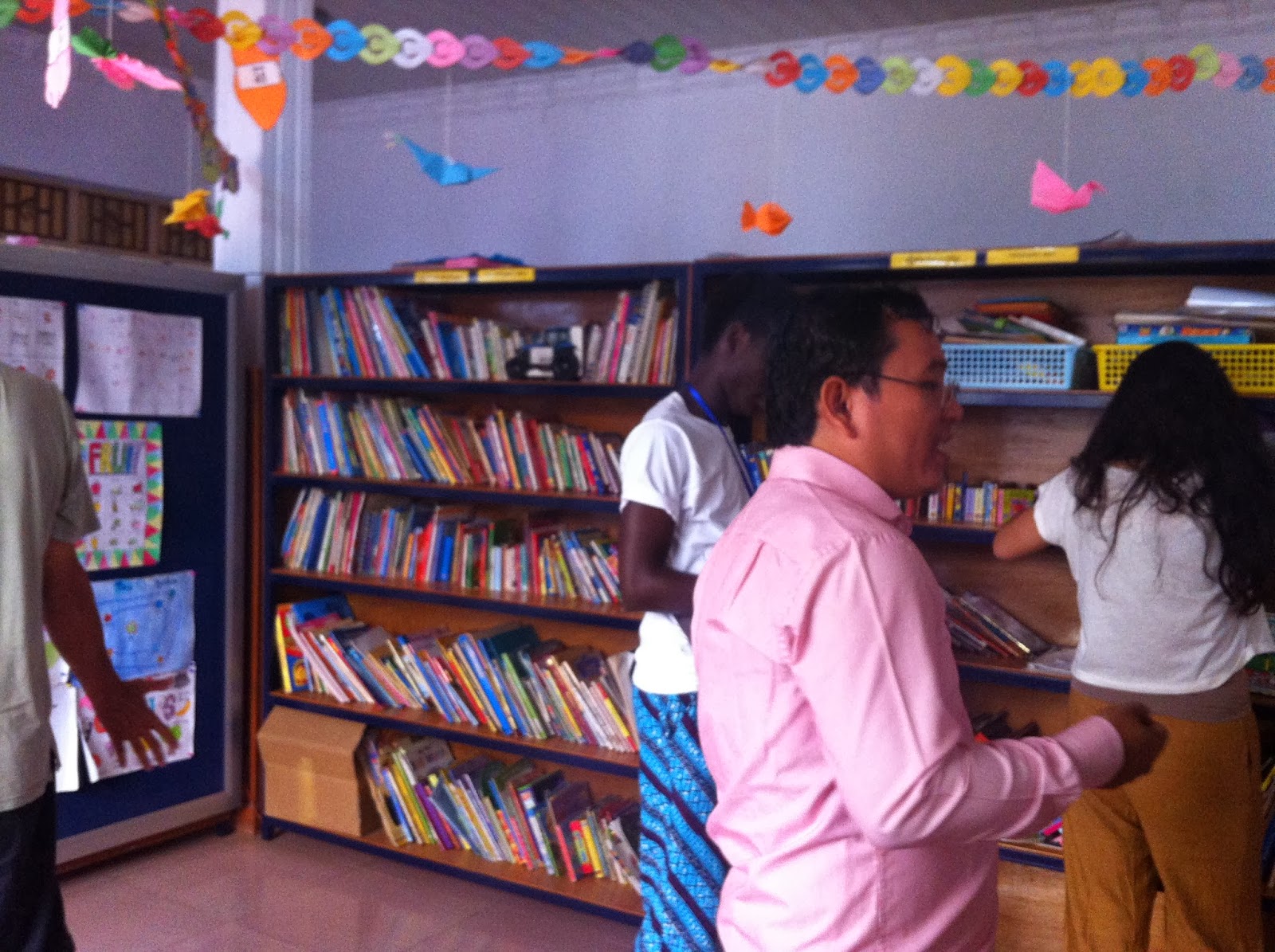
The first organisation we visited, fresh off the plane after a 4am start was ISF and I was a little shocked to see a couple of shelves and a nice sign made of christmas tree glitter saying “library”  I admit to thinking “oh no, that’s it?”  As the day progressed and we went to the squatter camps where the children lived and saw the extreme poverty and deprivation that they were coming from, the existence of even one shelf of books would have put those kids into the category of “haves” rather than “have nots”.  Doubly so as they had books both in English and Khmer.

Books divided between English & Khmer

Donations are a double edged sword as many commentators have spoken of in the past.  In one sense, to have books, any books, is a wonderful thing.  There are caveats though.  One of these is that by bringing good into a country one stifles or overwhelms a local industry.  Another is the very important aspect of cultural relevancy – I had to laugh at the puzzled faces in an English class I was teaching as one of the kids in my team tried to explain “white” by reference to “snow”.

33 consonants and 23 vowels to deal with

However, I think the most important thing is that children are allowed to learn literacy in their mother tongue and that this is supported by sufficient books in that language AT ALL LEVELS – starting with simple picture books, to the graded readers, chapter books, young adult novels etc.  And of course the absolutely critical “hi lo” books with high interest level at a low reading requirement for children who have slipped behind or have the possibility of education at a later age.  This site provides some fantastic strategies for struggling readers, aside from true disability, it is rather ironic that the “developed” world camps with “reluctant” readers, while the “developing” has children desperate to learn and enthusiastic learners without the resources that could take them where they need to be.

When I started researching this to write this blog post I found there is plenty happening in this area – it’s probably more a question of gathering the information together, sifting through it and deciding what is the nice to have, need to have, affordable, practical and any other criteria that an organisation can use to judge where their literacy spend goes.
In no particular order, here are some of the things I found:

Bookshelf @ Green Umbrella
Worldreader: operates mainly in Africa and Since we started our efforts to eradicate illiteracy, Worldreader has been committed to gauging our impact through extensive monitoring and evaluation activities, which measure the number of books read before and after deployment, students’ reading ability, as well as own ability to provide delivery and support. We’ve been research focused since day one and have a long term track record of examining what works and what doesn’t when it comes to eradicating illiteracy. – See more at: http://www.worldreader.org/what-we-do/#sthash.JXXgifyJ.dpuf”


Books treated with great respect
 Room to read, with their publishing arm: “One of the greatest challenges to early adoption of the habit of reading in developing countries is a lack of high-quality, age-appropriate children’s books in the local language. Often, the few books that are available are either second-hand books in foreign languages or low-quality, black and white books for more mature readers. Room to Read responded to this need by going into the publishing business. Our Book Publishing program is committed to providing children with materials that will inspire them to read, expand their minds, and develop a lifelong love for reading and learning.”

Sipar is a charity which “For over 20 years, has helped Cambodia fight illiteracy and develop school and public reading. An enrichment to this program has been the establishment of a publishing branch for books in khmer ten years ago.  What has been accomplished to date ?
  • 230 school libraries opened containing 2000 books each.
  • 2000 school librarians trained. 
  • 8 mobile libraries set in service and circulate in the poorer areas of Phnom Penh in order to introduce book-based activities. 
  • 26 public Reading Centers established as meeting places for exchange of ideas and knowledge for all ages.
  • 10 projects of communal educational services development set up in 2 provinces 
  • 95 titles for children and young people published in the khmer language, adding up to a grand total of 1 001 500 copies, thus reviving reading and writing in Cambodia.
  • 86 000 books donated to Teacher’s Training College.”
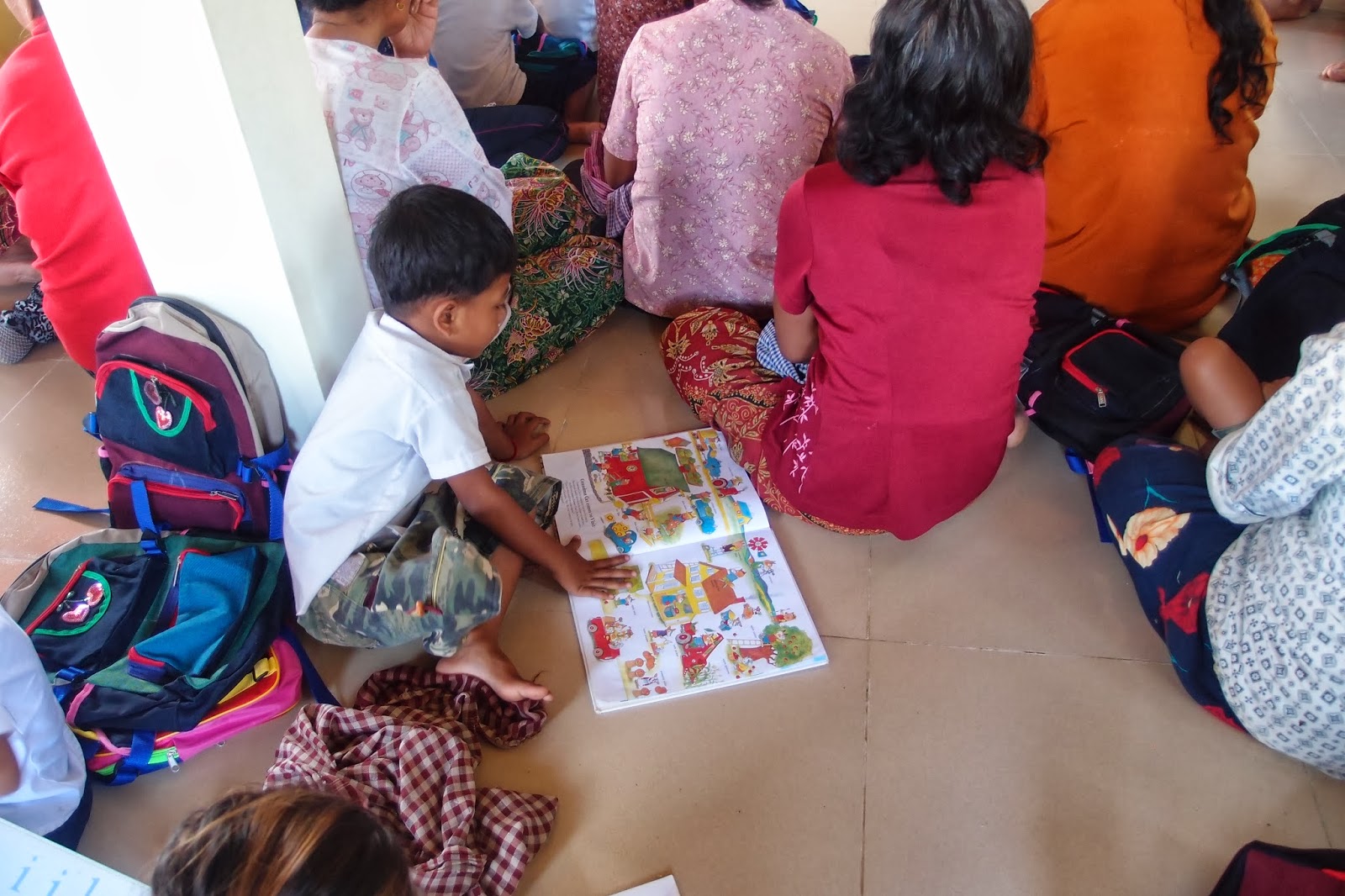
Richard Scarry a hit – pictures say it all

Lists are always good – here is one by Playing by the Book – of various literacy charities around the world. Most probably not completely relevant to this article, but good for borrowing and adaptation of ideas.

Children delighting in books –
even if some were upside down and being read back to front

 There is no harm in being critical, nor in asking for evidence of success in intervention.  This article by “GiveWell” provides some research on various aspects of developing-world education.  And I admit some bias as it quotes my favourite development economist – Esther Duflo.

 It is easy for me to maintain my book and library bias in all of this, but I guess there are hard questions to ask.  If I have a dollar, do I spend it on a book, on deworming a student, on a school uniform, on improving a teachers salary, on feeding a child?  Here’s a great video from Esther Duflo giving a TED talk …

Look carefully at the choice of word for this
alphabet poster – what were they thinking?
And no, it doesn’t make sense in Khmer either,
I checked.
I guess my visit resulted in more questions than answers. And especially me questioning my “developed world” assumptions.

Collection

Each library we visited went about creating, updating and weeding their collection in different ways.  On the one hand we had UWCSEA-East, where the librarian could build up a collection of 30,000 items from scratch, and had the luxury of being able to carefully consider the philosophy behind the collection.  On the other, we had the Institute of South East Asian Studies, with a 45 year history of receiving donations and making acquisitions and doing a stocktake and serious consideration of its collection for the first time this year.

Common themes were the shift from print to digital.  Each library had found their own balance between providing patrons with books and journals and enabling access to digital information.  Along with the shift to digital media came the responsibility of teaching information literacy (IL).  We were exposed to some innovative and very fun ways of teaching IL across the board where the emphasis was on making students comfortable with interacting with the librarians in the library setting, as well as being able to help themselves on line and in the book stacks.

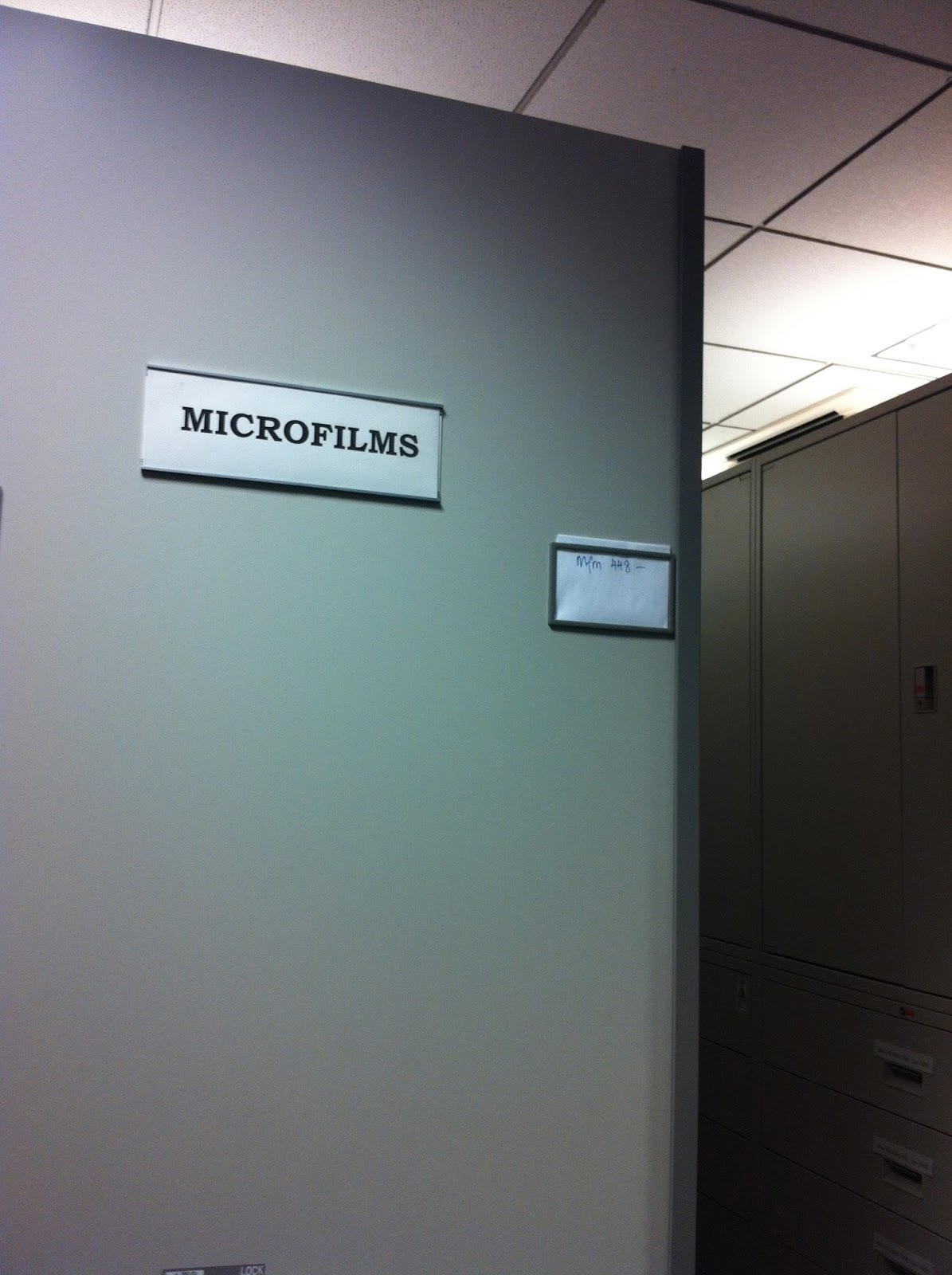
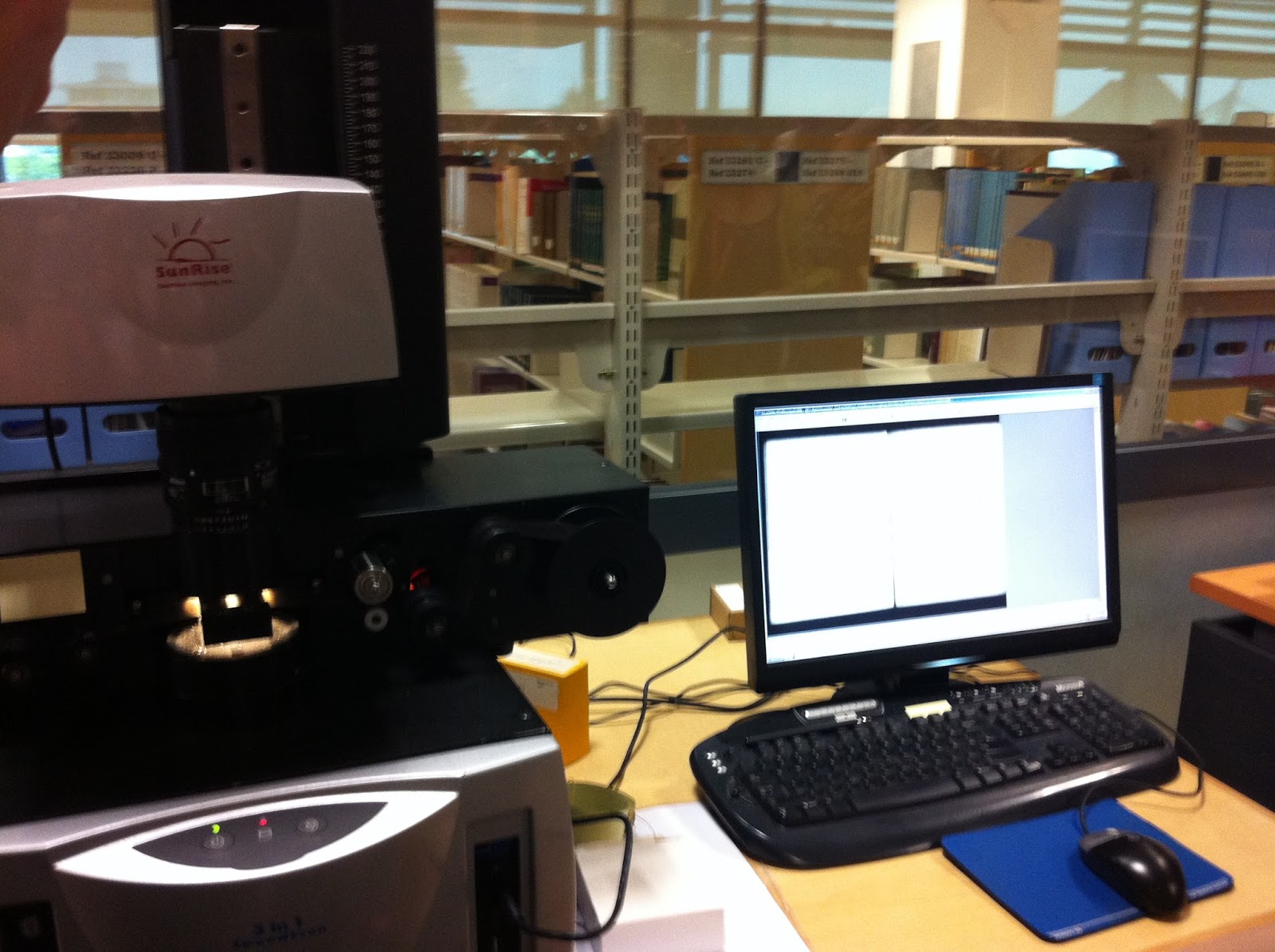
Preservation of collection was an important issue given the hot and humid climate of Singapore and the expense of air conditioning.  Books got infected by mold, mold is both contagious to other books, and a health and safety issue for employees and users.  It’s very expensive to treat.  Microfilm deteriorated, particularly the technologies prior to 1980.  Damp affect photos and films.  Digitization was expensive and time consuming and could result in the library running foul of copyright laws.  All this indicated that libraries needed to be extremely disciplined in their acquisition and weeding with some good co-ordination and networking to ensure that sufficient copies of valuable materials were available and preserved but without unnecessary duplication.

It was interesting to see how the different libraries managed their life style collection.  For some, like Ngee Ann Polytechnic, it was a drawcard for their students, located on the first floor with a very welcoming interactive bookstore / cafe type concept.  For Temasek, it was on a higher level, and less well patronized – in fact the librarian mentioned that sometimes students came there as it was quieter than the quiet / academic parts of the library.

Weeding policies differed by institution from a strict “anything older than 12 years gets thrown” to “we’ve never weeded”. SMU had a sophisticated set of RUF (relative use factor) statistics which it used for purchasing profiling its collection and weeding.
 How does a library deal with it’s unwanted books?  UWCSEA-East had created a read-and-recycle program outside the library, where the school community was welcome to take books and pass them on.  NLB had a bookcross and book sale scheme to get books out into the Singaporean community.

Most libraries were shifting towards an on-demand as opposed to “just in case”  collection development policy.  Collections were added to on recommendation from lecturers and students who were also invited to attend book fairs held by trade and public suppliers.  

Cultural Exercises

These are the cultural exercises we were required to consider prior to the trip.  I found both the readings and the exercises quite challenging – not in the difficulty sense, but in the sense of confronting your own views and culture.
The chapter that the exercises were taken from is : What is Culture? from  “Culture and Education” which is now on my list of books to read.

==================================================

Exercise 1.1 – You are what you buy.

In a table like the one below, list 10 items that you see as essential to your day-to-day life. Then, for each item, provide the reasons why you bought it and list the effects (as many as you can think of) it has on your identity.
Item
Purpose for buying
How does this shape who you are?
Mobile phone
Communicating – I need it to talk to my friends – they all have one
I’m part of the group and not left out. I’ve got the latest ringtones so I’m pretty up-to-date.
Adapted from Wadham, B. A., Pudsey, J., & Boyd, R. M. (2007). Culture and education. Frenchs Forest, N.S.W.: Pearson Education Australia (p. 3).

Exercise 1.6 – Evaluating Values

Make a table like the one below and list all the values you think you hold. These might be ethical values, but they also might be ‘things’, such as family or education. Then list where you think you go them from and you you engage in these values on a day-to-day level.
Values
Where you go this from
How you ‘practise’ it
Freedom
Authority
Justice
Equality
Education
Your parents
Go to university
Adapted from Wadham, B. A., Pudsey, J., & Boyd, R. M. (2007). Culture and education. Frenchs Forest, N.S.W.: Pearson Education Australia (p. 10).

Exercise 1.7 – My Family Culture
In a table like the one below, insert elements from your own family’s activities to get a sense of the culture of your family.
Elements of Culture
My family’s examples
Symbols and signs
My dad wearing a kilt to Sunday lunches at Grandma’s house.
Language
Values
Beliefs
Norms
Rituals
Sunday lunch with Grandma; attendance at school 5 days a week, for around 12 years
Material objects
Adapted from Wadham, B. A., Pudsey, J., & Boyd, R. M. (2007). Culture and education. Frenchs Forest, N.S.W.: Pearson Education Australia (p. 12).

Exercise 1.10 – The ‘Who am I?’ test

Write down here the first 20 statements you think of about what makes you the person you are. You might want to think about how the context of doing this exercise is shaping your choice of identity markers about yourself.
Who am I? Statements about what makes me, me.
1.
2.
3.
4.
5.
6.
7.
8.
9.
10.
11.
12.
13.
14.
15.
16.
17.
18.
19.
20.
Adapted from Wadham, B. A., Pudsey, J., & Boyd, R. M. (2007). Culture and education. Frenchs Forest, N.S.W.: Pearson Education Australia (p. 14).