Core Collection & teacher champions

Last year I wrote about my initiative with our core collection and engaging our middle school teachers in “adopting” a book and helping to promote it. During the analytics for our annual report and to justify repeating the exercise in one of our last staff meetings this year, I put together some stats on the results.

Core Collection Summary
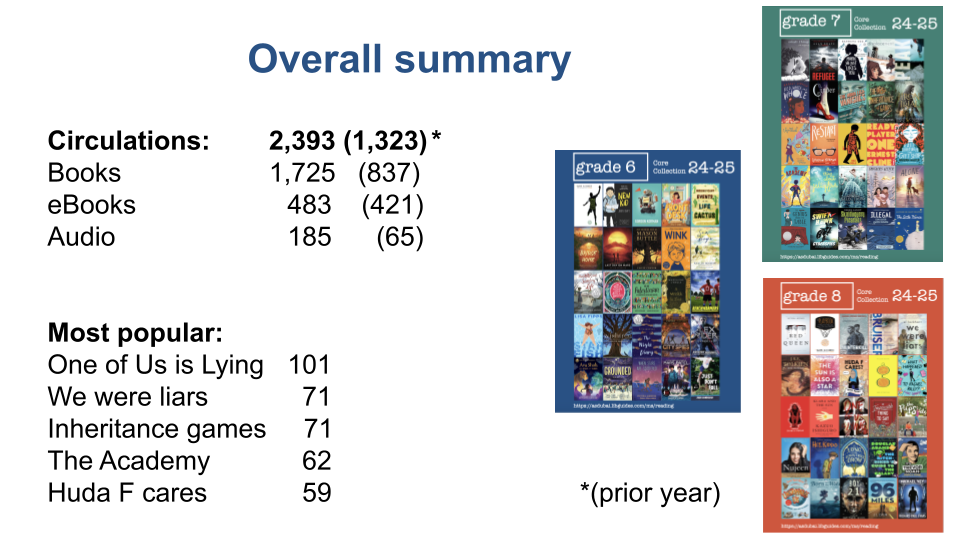
Given the dire state of the nation on reading overall for middle school with each grade reading less than in previous years, this is one small light at the end of the tunnel for me – showing that perhaps we need to narrow rather than continue to broaden our collection and focus on many copies of the most popular books?

Another amazing side effect has been the number of our faculty who are now fans of middle school / young adult literature and who have kept on coming back to finish series (I think it’s really important to have book 1 of as many enticing series as possible in the list). It really matters when not only the ELA teacher but also the PHE/Sports coaches and Drama and Science teachers are reading and recommending books.

Another interesting aspect has been that it seems we’ve arrived at a sort of tipping point of students accessing eBooks and AudioBooks in greater numbers than I’ve previously seen. Since we tend to only buy 3 or 4 of each of the core books (plus whatever ELA has a budget for to put in their class libraries) the most popular books tend to be out all the time, resulting in students then using the digital equivalent. I like AudioBooks as it means I can listen (often at 1.5-2x speed) and do my knitting, and I often have to persuade students that listening to audiobooks is also reading. In a culture where very few students are read to, I think it’s also important for them to hear stories – not the least to avoid embarrassing incidents with the pronunciation of words and names!

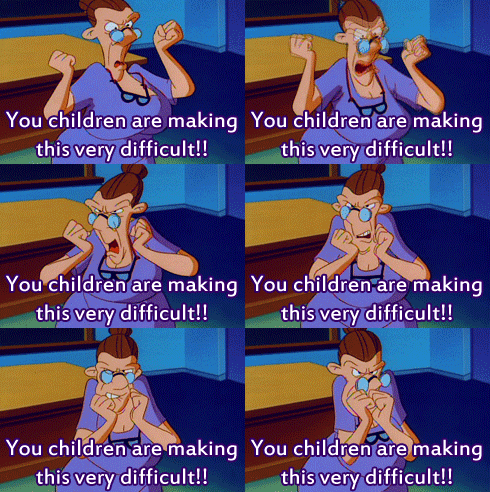
Of course I know that borrowing doesn’t always translate to reading (see the amazing way the great Nathan Pyle illustrates this below), but on the other hand I’m also comforted by the fact that our ELA classroom libraries have also stocked up on many of the core books and their circulations are not counted in my stats.

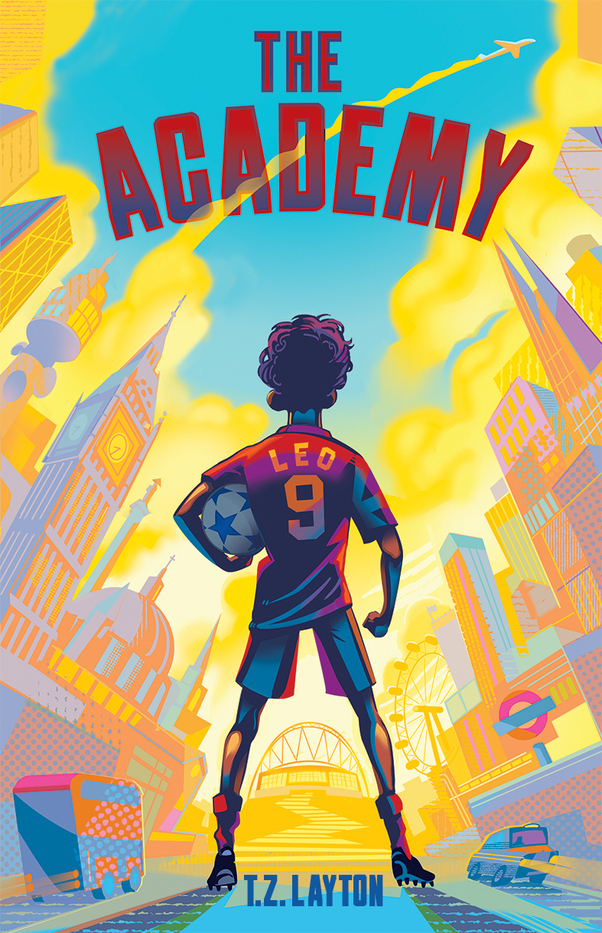
Image by Nathan W Pyle – buy his amazing books!

One of the runaway success books I’d like to highlight is “The Academy” by TZ Layton. In common I think with most 10-14 year olds, most of the young soccer players at our school are convinced it’s only a matter of time before they’re scouted into one of the youth leagues and this series feeds their dreams.

Actions & Activities

The actions and activities around the core books this year include:

  • Culling of the least popular (and some of the most popular*) books from the previous year
  • Book overviews on the middle school TV displays
  • Core list on Advisory Slides
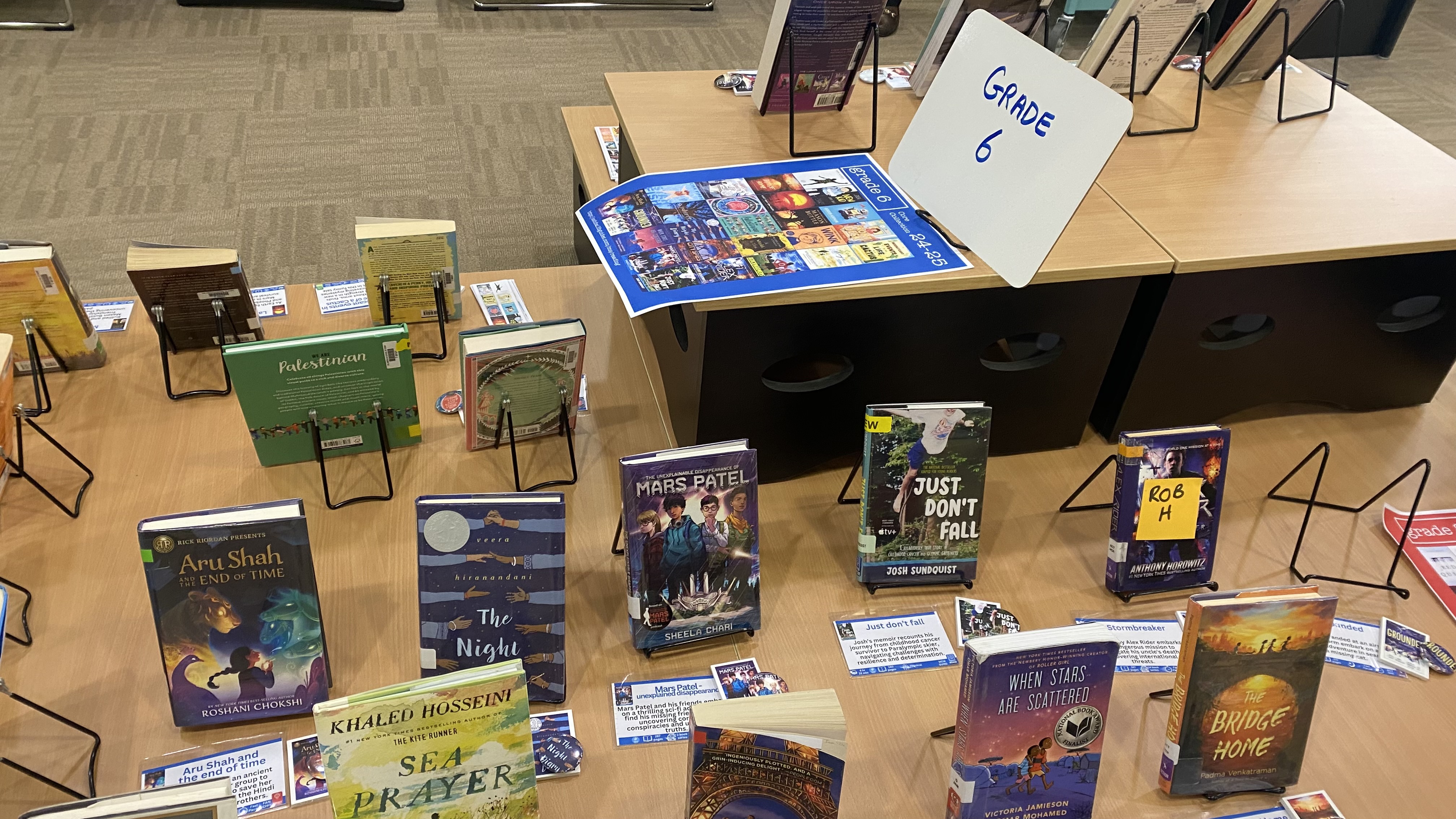
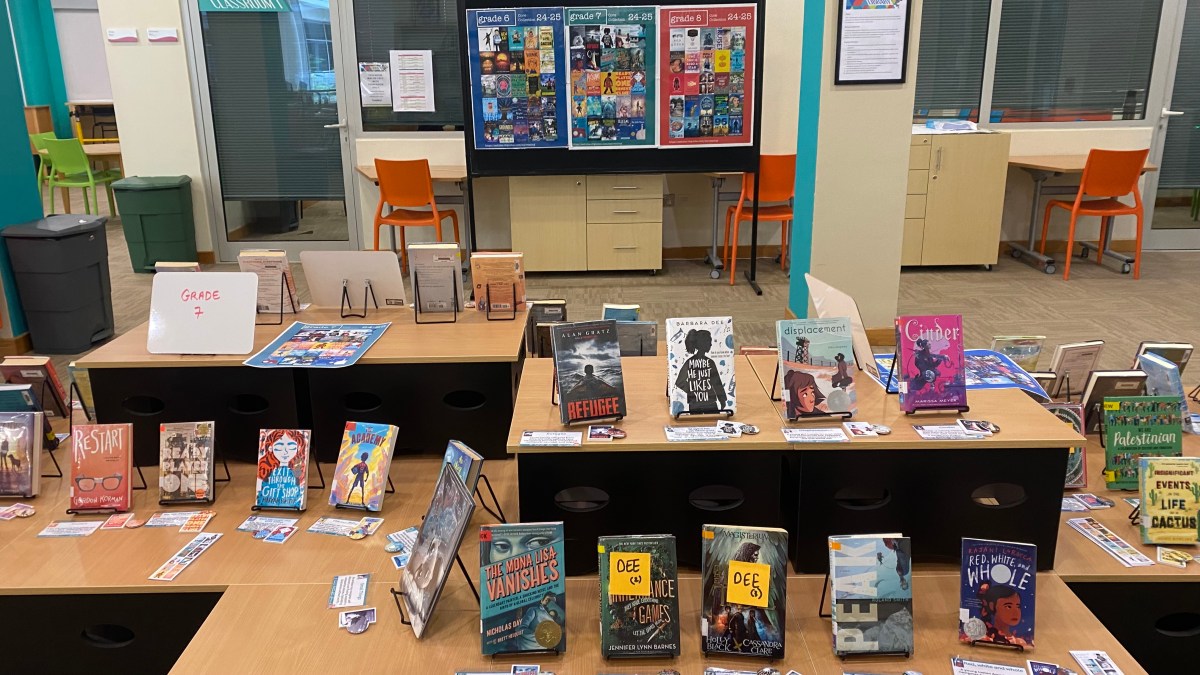
  • “Core Wall” in library
  • ELA & MS teacher promotion
  • House points for book reviews
  • On libguide / recommended to parents during parent conferences
  • Weekly Kahoot quiz January – May (inter-house competition)
  • Battle of the Core live quiz assembly – 8 May (moved from January to increase exposure)

* while some of the books were taken out because they just didn’t fly for one reason or another (usually because I’d been misled by a good review without having been able to read the book first, or I misjudged the audience), some have been given wings and are flying on their own without the need to be on a list, or have been adopted by the ELA department as one of their book club books. Of course there is always great irony in choices. After not being able to successfully sell “The thing about jellyfish” by Ali Benjamin all year long, I took it off the list for next year and of COURSE then some young booktokker started recommending it and now everyone wants to read it!

Another side effect has been more faculty coming to me for recommendations for their own reading of for books for their younger kids or nieces / nephews – there is nothing more flattering, no greater gift you can give a librarian than ask for recommendations!

there is nothing more flattering, no greater gift you can give a librarian than ask for recommendations!

In conclusion I’d say if you’re in any doubt about the value of having a core collection, go ahead and try it out. It doesn’t have to be 25 books but it does help to have at least one representative of each genre. Including the first book in a series is always a good idea and I also try to have books that are fairly recent, include books from visiting authors if we have any and to try and tap into the zeitgeist.

Stop the pearl clutching and bring out the smelling salts

Yet again an article despairing how kids are not reading “For Too Many Kids, Books Are Uncool and Unread” with all sorts of “reasons” and little in the way of solutions. So here are a few people / places / organisations who are trying to do something and a little on the work I was doing recently.

Engage everyone

While language arts / language and literature teachers and particularly librarians are often called upon or take it upon themselves to play a role in turning out literate students who hopefully also enjoy reading – it is a mistake to pigeonhole the efforts onto a few people. Just like I spend quite a few hours of my week engaged in coaching students in sport I like to think that my colleagues in other subject areas – including Physical Education etc. could spend a bit of time encouraging students to read. Particularly PHE teachers – since as my now young adult son (previously reluctant reader middle school son) told me “give up mom, middle schoolers don’t listen to anyone except maybe their PHE teachers and sports coaches”.

Last year I started having a core collection (an idea initially started in the UK by CLPE, and carried on internationally by Katie Day) of 25 books per grade for our middle school. We invested in at least 3 copies of most of the books and the books were promoted in the ELA (English Language Arts) classes and the library. Having a narrower selection of books to focus on meant that as a group we could try and read as many of these as possible and “sell” them to students. The news crew of our “Falcon Flyer” also helped with promotion by featuring the books, and they were also displayed on our internal TV screens in the library and MS corridor. A weekly quiz via google forms and the “Battle of Core” assembly were less successful than I’d have liked – but let’s say it was something to build on. However when I analysed the circulations from these 75 books I was positively surprised and just how many had circulated. As can be seen – kids still prefer print, and audio is their least preferred medium.

In my discussion with the ELA department about declining reading there was a strong feeling that promoting the books shouldn’t just be on them – and I took that thought to heart and just before the summer in our last staff meeting with the support of our admin launched the “staff summer reading challenge”

This involved quite a bit of preparation work, starting about 6 weeks before the end of term, including updating the lists for the new year, taking out books that weren’t popular or didn’t resonate with students, getting suggestions from our most avid readers (and asking them to pre-read where I wasn’t sure which book would be better) and making sure we had coverage of genres, levels of difficulty and format (verse novel, graphic novel, nonfiction, memoir, fiction) and our books were reflective of our community – each grade having at least one book with a muslim perspective as we’re in the UAE. Our new list can be found on our reading libguide. Next up was making sure all the books were ordered so that they were available before the meeting and then making new posters, shelf-signs with a summary, badges and a “mini-book”.

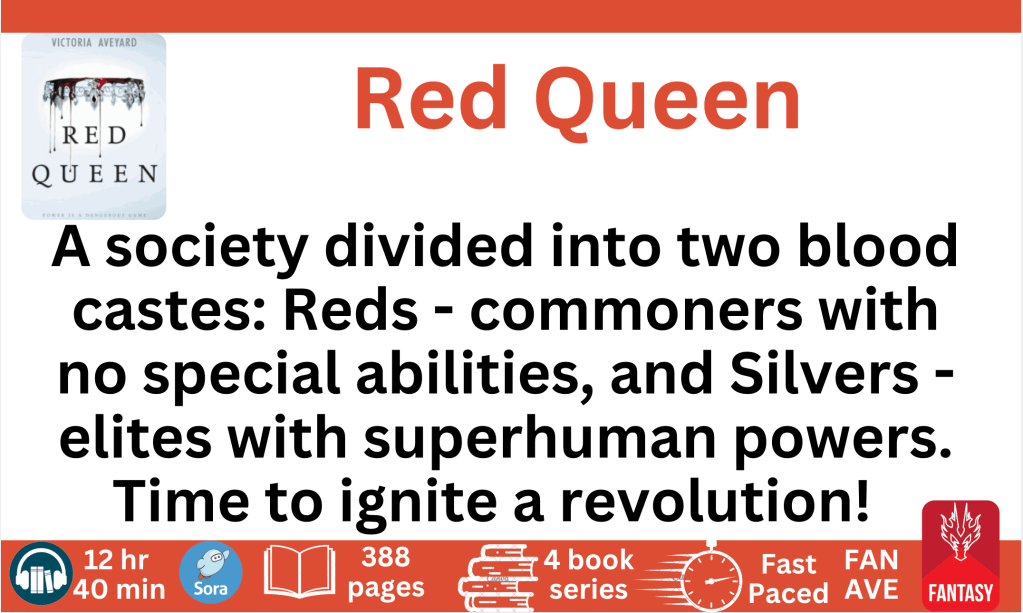
The shelf talker signs were based on inspiration from Kelsey Bogan but I wanted them to convey a little more information that I thought would be relevant in the “selling” process – first to our staff and then to our students, so I amended them a bit – the colouring corresponds to the grade, I added the book image and the genre image. Kept the blurb to 20-25 words (combination of publisher blurbs, Magic School AI summary powers and my knowledge of the book – AI can really get things badly wrong with what trigger words would encourage readers and be very repetitive with some phrasing!); I also added whether we had the eBook or Audiobook and the duration of the audio; pages of the book; whether it was part of a series, and the pacing.

Here are the canva files for our Grade 6; Grade 7 and Grade 8 lists – feel free to use or adjust as necessary.

The badges were made thanks to the loan of a badge maker by our design department and the “mini books” are images of the books on a piece of foam that the teachers can stick on their classroom door.

For the meeting, I put all the books on display with their paraphernalia, and the teachers were invited to select a book to borrow for the summer, commit to reading it and to help be the books “key account manager” for the coming year and promote it to students in the coming year. Our communications department helped by taking pictures of teachers with their chosen books (hiding the face) so we can use that for a little promotion guessing game in the new year); teachers borrowed the book and could put the badge on their lanyards. They “claimed” the book by putting a sticky note with their name on the poster. In the end, only 6 out of 52 staff members declined. Several teachers selected more than one book and our drama teacher selected 5 (and sent me a very enthusiastic voice mail last week to say she’d read them all and enjoyed them so much she’d also read all of the rest of the books in the various series, coming to a total of 17 books!).

So, watch this space and we’ll see if this has more of an impact in the coming year.

Other people / organisations making a big difference

Although not always realistic, I am a secret admirer of the “go big or go bust” approach to things. I suspect some times we are actually underestimating the abilities of our students by setting very low goals for them. There is a balance however between something being too daunting versus to infantile. Generally I suggest students should try and read a book a week – something quite manageable if one is truly spending 20-30 minutes a day in focused reading, perhaps combined with audiobooks and some manga / graphic novels. Also, our top readers (ironically – or not – none of whom have mobile phones) manage 2-3x that.

The Neev Reading challenge 2024 of 30 books over 3 months for grades 4-6 combined with author interactions, and a live quiz during the literature festival is a great example of setting a stretch goal, having competitive and noncompetitive tracks and a great starting point to select books. I just love how ideas grow and evolve. When I moved to Beijing in 2018, I was part of the 50 books Reader’s Challenge which I think the librarians at ISB started. In my role of juror for the Neev Children’s Book award, I was chatting to Neev about the challenge, and what worked and didn’t work quite as well – and they grabbed the ball, ran with it and now it’s this amazing thing!

I’ve blogged about the Global ReadAloud before, and still think this is a phenomenal way to involve students and teachers with books and connections with other readers and most importantly the “smelling salts” of reading aloud to them. Here are the selections for 2024. I particularly love “As long as the lemon trees grow” a book that’s on our core list and a fantastic read for older students.

At the end of the school year we have 6 library sessions involving our “upcoming” grade 5 into 6 students to introduce them to the Secondary School library. This year as an exit ticket I asked them to write down their favourite book / author / series. As I roamed around talking to them while they were doing this, I’d say that at least 75% of the books they said they loved the most were books that had been read to them by a teacher, parent, grandparent etc. Reading aloud matter.

Besides her work on the GRA – Pernille Ripp also has some great posters (and books) on encouraging a reading culture, such as the one on “Helping Home adults support adolescent readers”

That’s all I have time for today – if you’d like to have your initiative featured, please let me know!

796-799 Sports

The best compliment I’ve received in the last two years was from one of my (non reading) grade 8 books who said to me during an athletics event, “you know miss – I used to think you’re just the librarian, but now I know you’re so much more”. The history behind that is that after many years of being a middle of the pack longer distance runner (i.e after each event I was pretty much very much in the middle for my age group and distance), our athletics director at WAB was looking for some more coaching volunteers and I did some online certifications in track & field and cross country and joined the after/before school coaches as an extra warm body in Beijing. Here in Dubai I’ve mainly done track and in contrast with my teams in Beijing who were primarily the more academic types, I’m finding myself amongst some great kids who are very athletic but have an aversion to reading. Have I performed any miracles in making them readers? Well no, I don’t really think so. But I’d like to think I’ve gained some credibility and relationships that can open up conversations around what they could be reading. And it’s helped me in creating a new blended section in the library – our sports section.

New genre – sports

It started with noticing a lot of students were asking for books about “basketball” or “soccer” during our library classes, so initially a new genre of “sports” books was created split out of our realistic fiction section. That helped some during the first year in the new library. Then students were asking for more biographies of their favourite sports people and more books (nonfiction) on their favourite sports. Our nonfiction section in that regard needed some boosting, so we bought more books.

A new blended section – Sports

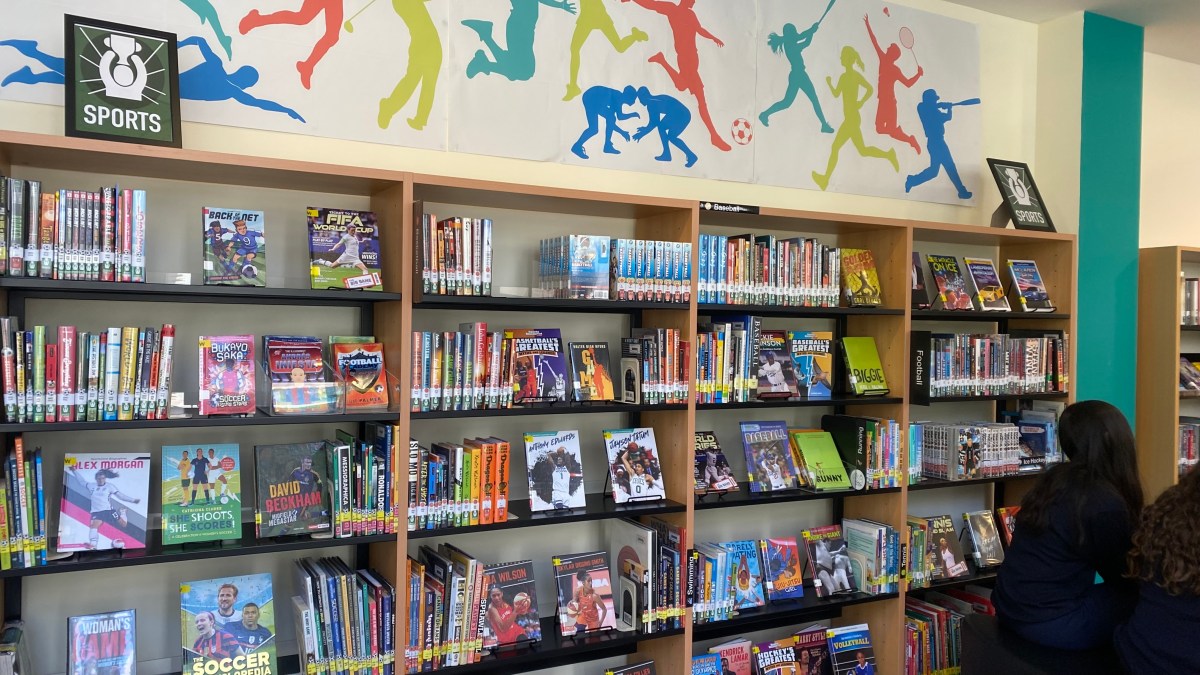
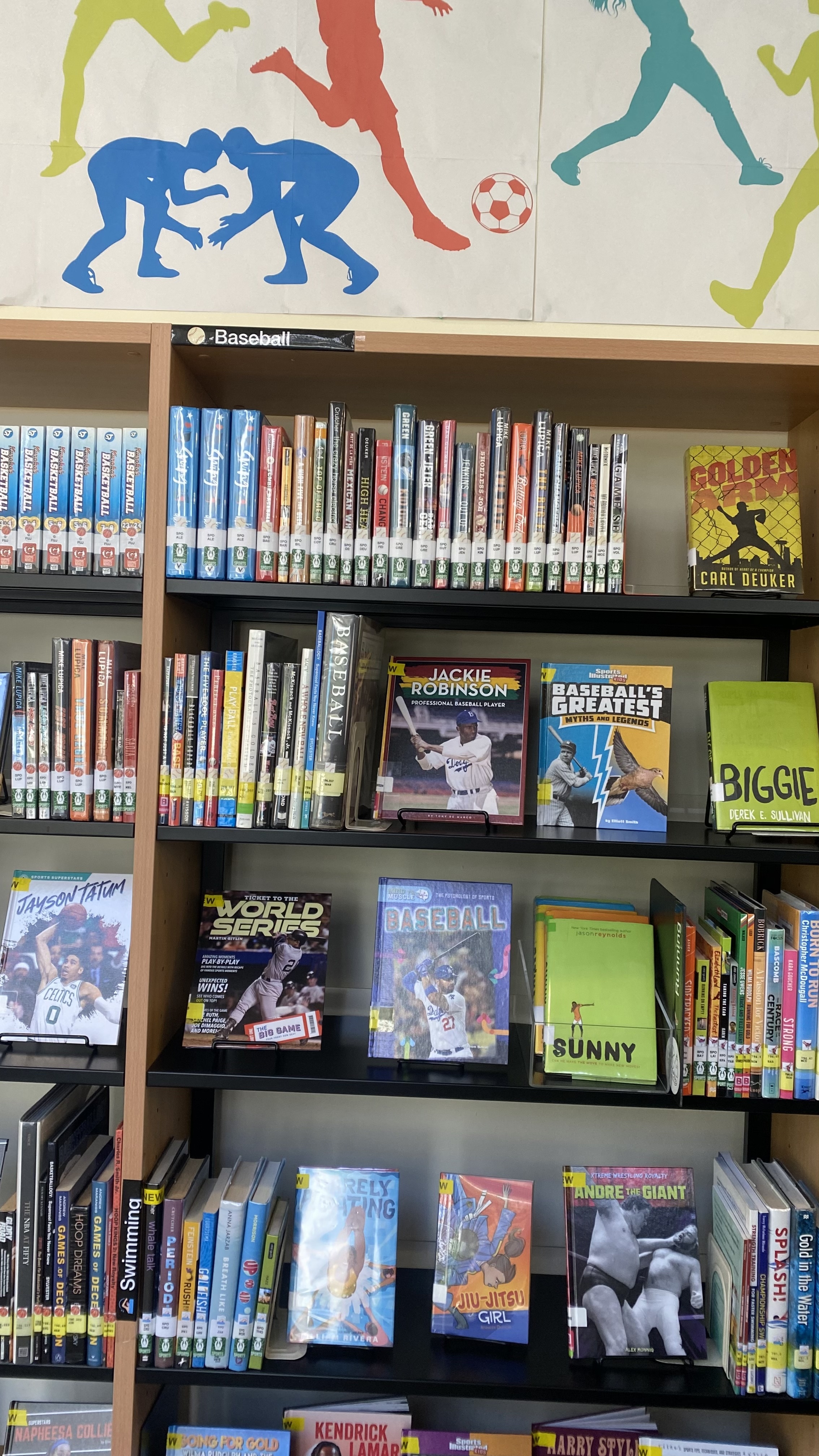
Since nonfiction, memoirs and biographies were upstairs and fiction sports downstairs it seemed logical to move them all to one place. So we trialed putting all our sports books together in a dedicated area. That meant pulling fiction, nonfiction, memoirs, biography, graphic novels and manga and sorting them by sport. Our poster was made in Canva in our library colours and is 3 panels representing the sports of our three sports seasons (template link). Our book spines have a small sticker of the sport represented to help with shelving.

We’ve probably doubled the circulation of our nonfiction sports books and it’s an area that garners a lot of attention. Unfortunately it is still really hard to find good fiction with sports themes. There are more good biographies and a small uptick in graphic novels and manga. Here are some of our best circulating titles.

Fiction

As you can see it’s heavily dominated by Jason Reynolds and Kwame Alexander. How I wish there were more authors writing shorter easy to ready and/or verse novels without naff babyish covers for this demographic!

  1. Ghost – Jason Reynolds
  2. The crossover – Kwame Alexander
  3. Booked – Kwame Alexander
  4. World in between : based on a true refugee story – Kenan Trebinčević
  5. Patina – Jason Reynolds
  6. Rebound Kwame Alexander
  7. Stanford Wong flunks big-time – Lisa Yee
  8. Defending champ – Mike Lupica
  9. Boy 21 – Matthew Quick
  10. Sunny – Jason Reynolds

Memoirs & Biographies

In particular the series by Matt and Tom Oldfield (from the playground to the pitch) and any of the Luca Caioli books are popular. And if you’re wondering who the GOAT is according to our students – Neymar and/or Ronaldo books outrank all the others.

Nonfiction

Anything soccer seems to dominate with basketball and F1 making an appearance. I was pleased to see one of my personal favourites – “The boys in the boat” tying with “The Barcelona complex” for 10th place as I’ve been promoting it heavily this year – I’m hoping the release of the movie will help it along as well.

  1. Stars of world soccer – Jökulsson Illugi
  2. The official history of the FIFA World Cup – FIFA World Football Museum
  3. Outcasts united : the story of a refugee soccer team that changed a town – Warren St. John
  4. THE FOOTBALL BOOK : the leagues, the teams, the tactics, the laws – David Goldblatt
  5. Return of the king : Lebron James, the Cleveland Cavaliers, and the greatest comeback in NBA history – Brian Windhorst
  6. The rise : Kobe Bryant and the pursuit of immortality – Mike Sielski
  7. All thirteen : the incredible cave rescue of the Thai boys’ soccer team – Christina Soontornvat
  8. F1 : the pinnacle : the pivotal events that made F1 the greatest motorsport series – Simon Arron
  9. The race of the century : the battle to break the four-minute mile – Neal Bascomb
  10. The Barcelona complex : Lionel Messi and the making–and unmaking–of the world’s greatest soccer club – Simon Kuper
  11. The boys in the boat : the true story of an American team’s epic journey to win gold at the 1936 Olympics – Daniel James Brown (we have both the YA and the original version)

What are we missing?

All the books by Mike Lupica / John Feinstein / John Coy are unfortunately showing their age now and are also very much written for an American rather than international audience.

We’ve had some more interest in cricket recently and just haven’t found enough books – fiction or nonfiction to meet that need. While there are more graphic novels coming up we need more of them.

If you have any great suggestions I’d love to hear them.

Dyslexia – don’t make it about you

I had lunch with an old friend of mine yesterday. We’ve kept in touch over the last 20+ years when we did an MBA together. She’s had a successful career in finance while I’ve had a liquorice all-sorts type of constantly changing occupational therapy for a mind that can’t stay at rest too long.

Anyway, she of the child-free existence still dotes on the children of others and takes a keen interest in how the offspring of her friends are doing, and, knowing both my current librarian / teaching situation and the background of the fact that I have a SEN (ADHD) teen asked me about the potential dyslexia of the son of a close friend. The issue was typical and one that I come across often enough that I could be quite wealthy if I got a dollar each time I encountered it, or a variant in any area of educational need.

Child has an undefined issue with reading / spelling / learning. Otherwise bright. Mom / school / teacher thinks that he should be tested. Dad is totally against it. Because he doesn’t want the “label”. Because he’s going to take it upon himself to teach his 8 year old to read.

My friend stressed this was a father who truly loved his son. Who had the means, financial and otherwise to get the best help for his son if it was needed. As long as it didn’t involved testing and a diagnosis. She was asking me of the ways to make sure the son got what he needed.

I gave her the usual. The positive messages. You wouldn’t prevent a child from having an eye-test and getting glasses if they couldn’t see properly. The earlier you understand what is going on the better in terms of interventions, help, accommodations etc. We know so much more about the reading brain than we ever did before, that it’s not a calamity. I also mentioned that I’d just been through some of Microsoft Education’s Educator courses on inclusive and assistive technology and that he may want to have a look at the interventions available.

And then I hit hard with the real issues. At 8 years old, you have a compliant child, willing to please the adults around him. You have a surrounding where children are all over the shop still with reading. But you have the beginning of the big academic sorting. Between those who are learning to read and those who are reading to learn. And that divide just keeps on widening. And kids know it and are acutely aware of where they stand in this sorting. I saw those kids in primary when I was teaching there and now I see them in middle school. They’re no longer 8, they’re 14. And they know every trick in the book to deflect attention from the fact that they (still) can’t read (well). They are the class clowns, the exasperating kids who are still falling off their chairs, annoying the teacher and the rest of the class. They will do anything to not appear stupid. They are not stupid. But in their minds they equate the reading issue with intelligence. They may or may not be talking to their parents, let alone being compliant with any reading intervention. They’re frustrated and angry, not hopeful any more.

There is so much that can be done when you have an 8 year old. Of course you can help anyone at any age, but why let your own darn ego get in the way and not do things earlier?

There’s another very important piece to all of this. Children, even “your” children, are not yours. They need to know themselves and their learning. They need to become their own advocates. To know what they need and have the strength to stand up for it. For all the wonderful teachers and administrators out there, there also are a lot of very harmful people. So even if you have a diagnosis, and interventions and recommendations, there are enough people who will take the attitude that “it’s not an excuse” and that the child is “lazy” or “naughty” or “bad”. I speak from very bitter experience in that respect.

teacher GIF

via GIPHY


She asked me for an article, anything to give to him. I asked how much the father would be prepared to read. I scrolled through my Evernote. I have 238 articles / notes on dyslexia. The one I consider to be the bench mark one is “Rapid automatized naming (RAN) and reading fluency: implications for understanding and treatment of reading disabilities.” but that weighs in at over 30 pages, so we settled on the KQED article “Understanding Dyslexia and the Reading Brain in Kids“; the name Maryanne Wolf as an expert, and the one home intervention I know of that apparently has some research backing (in case dad was still going to teach his kid in 100 days … face palm).

fozzie bear facepalm GIF

via GIPHY

The last presumption makes my blood boil. People spend a life-time specialising in teaching children (and adults) to read, with or without dyslexia. People like the reading guru Pernille Ripp whose daughter has issues reading  do not deign to come up with easy platitudes in this area. If you’ve ever read the first few chapters of “Reader, come Home” you’ll be in awe of how anyone ever learns to read. And yet this parent, this father who professes to love his child is prepared to squander another 100 days to muddle around, just so that he can save face or something.

How do you, my readers, deal with this type of question? Are there other resources out there that are “parent” friendly? Are there better ways of broaching these conversations?

==========================

Header Photo by Akshar Dave from Pexels

Can we be smarter with communicating benefits of reading?

During the vacation I’ve been catching up with some podcasts, including listening to a few new ones that were recommended to me by friends. While there are some great educational podcasts out there, sometimes while one is looking outside of the field that you are struck by things that are relevant.

So it was with this podcast from “You are not so Smart” based on research on how to deal with climate deniers with Per Espen Stocknes.

Because sometimes (most the time) when looking at reluctant readers I’m pretty sure I’m missing the boat on how to communicate effectively and meaningfully with them. Like the time I asked a group why they thought I kept trying to get them to read more and they basically said “because it’s your job Ms!”

So the thing is, there are 5 different ways that you can mess up your communication, which result in the “backfire effect” whereby people negate your message and turn all defensive on you. So you’d be better off saying nothing, than saying something that gets folks’ psychological back’s up.  While the talk related this to climate change I’ll re-interpret them along the lines of getting kids and their families (and even gasp, teachers) to read more, read together, read-aloud.

  • Doom and Gloom
  • Distance
  • Dissonance
  • Denial
  • iDentity

In the doom and gloom scenario you’re telling kids that if they don’t read they’re going to fail, drop out, go to prison, not get a good job, not get into college etc. if they don’t read. Psychologically this leads to a guilt and fear mind frame in the audience, increased passivity and avoidance. When what we really want is for parents and students to jump into action with a plan of daily reading! Another problem with those messages – it’s all too abstract and too distant. It’s the issue that that the problematic future is well, in the future, and right now they’d rather be playing an online game, or kicking a soccer ball. The locus of control is also presumed to be outside their scope of influence, there is reduced urgency and personal agency leading to a feeling of helplessness.

Cognitive dissonance is a very tricky thing when dealing with parents. Every parent, no matter what they may be struggling with privately or publicly with their children have to be believed to be doing the best they can with the knowledge and tools at their disposal. Ditto teachers (I include teachers as there are many teachers who do not read, and do not find reading pleasurable, and struggle with “walking the talk”). When people tell you that you should be reading to your child or reading more, or reading differently that kind of flies in the face of your image of yourself as a good and successful parent and person. And so what one often hears is “I/my husband / his grandpa/ never was much of a reader, and they turned out OK”  or even “we have plenty of books at home” or “he/she borrows books every week“. All of which may be perfectly true, even if those books may never be opened and read … and it’s the “right” answer to shut up a concerned teacher / librarian.

Denial is another mechanism frequently employed – one comes out with some latest research or study that reading is the answer to life, the universe and everything, and all sorts of things get thrown back at you – like “I read that if you read online it’s not effective” or “all they want to read is graphic novels” or some kind of moral licensing – “but he/she is very involved with the school play / the band / Kumon worksheets and doesn’t have the time for reading” and “he/she is doing just fine in class” or even worse “but X is struggling much more“.

The final point has to do with identity.  Everyone, from young students up need to protect their self-esteem and keep their identity intact. For some of my students it’s very important to be cool. And being cool doesn’t involve struggling or appearing to struggle at anything. For many families caught up in the fairyland of expatriate existence, a veneer of “everything is fine” is also very important. Problems with reading – fluency, comprehension, language, and admitting to those problems does not gel with that identity.  At this point a lot of blame gets thrown around. The teacher who didn’t teach properly. The librarian who put them off borrowing after they lost a book. The teacher who won’t let them borrow batman books or insists on “just right” books.  It’s a tough one and part of what we attempted to do with “Blokes with Books” is to make reading cool and social.

Right, so what to do about this.  There were 5 solutions offered by Stocknes and I’ll relate these to what I’m trying to do, and plan to do in the new school year.

  • Social
  • Signals
  • Simple
  • Supportive
  • Storytelling

Keeping things social is something I absolutely subscribe to. As I’ve said so often before, contrary to belief, reading is not a solitary activity. It is social. The kind of things that my students enjoy are book clubs, sitting and reading the same book at the same time and turning the pages at the same time. Reading in a group of three of four and raucously pointing at things and exclaiming.

Feedback and signals need to be those that people can relate to and are relevant.The antidote to distant gloom and doom is making things near and personal, since good behaviour can be contagious – particularly if it’s acknowledged and there is some positive comparison going on. Now this works brilliantly with electricity consumption in the examples given, but I’m a little wary of competitive reading. Cue in all the research done by Krashen et.al and the dangers of extrinsic versus intrinsic rewards and the virtues of free voluntary reading. I’d be the last to deny that (some) kids appear to be motivated by reading points, scores, levels etc. But I’m still not prepared to make that the focus of my efforts. I’ve been thinking long and hard about what kind of comparisons are relevant and meaningful.  One that I’ve used on my students has been to work out the median number of books students in their class and grade read each month and ask them to compare themselves.  The best thing we’ve done for our reluctant (male) readers has been the “blokes with books” club, which has helped both with identity and social belonging.

Schools and homes are incredibly busy environments. It’s imperative to keep things simple and easy, with low barriers.  Some things I’ve already put in place, like allowing students to borrow books on four occasions daily (before and after school at recess and at lunch) on any day of the week, in addition to their normal weekly library lesson with their class. There kind of are limits on the number of books they can borrow based on their age, but they all know that’s negotiable. Likewise parents can now join and supposedly borrow three books at a time, but we have some parents who borrow more and one who gets around 10-20 every Friday, as she’s a working parent and doesn’t get to the library every day. I don’t mind, as long as they keep returning.  Classroom libraries are also a great way of ensuring books are in the hands of students.  That still needs more work.  All our classes have class-libraries, but they’re not functioning optimally. This is a loaded area. The library is “my” domain (but not really) and the class “theirs”, so I can implement best practice with abandon in the former and have to tread carefully in the latter.  What would I like to see / do differently?  More movement more regularly in the class libraries – now books are checked out for the year. Self-checkout / check-in in the classrooms – my fault in prior years and I really need to get that going this year. More weeding of old, tattered and yucky books – it’s starting to happen.  Nicer display – need to think about that as it’s definitely crossing the line. Maybe a workshop on class libraries?

Providing a supportive framework – takes time. Time for you to get to know the students, the teachers the parents. Sticking to the message of the importance of reading without the judgement. Being there and listening when one of the parts of the reading ecosystem need to unburden or get a book list or suggestions without jumping to conclusions or formulaic solutions. I’m incredibly fortunate to have a supportive administration and principal and (so far) an adequate budget, and library assistants who are buying into creating an environment conducive to encouraging reading.

Finally incorporating the storytelling format in communication. Stories need to be personal and individual and incorporate an element of dream actualisation.  I’ve been doing a bit of this around the PYP and Singapore environment (most recently at the AFCC), the stories of the gains my formerly reluctant readers have made compared to their peers really is motivating.  Success stories are wonderful.  But struggle stories are also relevant, and the fact that I have a reluctant reader at home keeps things real and personal. I have no pedestal to preach from as I’ve been exposed to every excuse, every battle, and tried every possible solution myself and I’m still only partially successful in my efforts.

As the new school year starts I hope all your reading dreams for your students come true!

It’s not (just) the book

This is a post I’ve been meaning to write for a while. A long while. I’m a member of quite a few librarian and school librarian groups and invariably, at least once a month, a question will pop up asking for a “killer” book. Either one that is perfect for reluctant readers, or one that will entice students to read, or the perfect book for boys, for grade 2, 3, 6, middle grade. There is an assumption out there that there’s a quick fix. That one book that will transform lives, transform non-readers to readers. It’s that one dose of the right drug that will make of our students little reading addicts. Firmly entrenched in the Judaeo-Christian culture of the “road to Damascus”. There is a similar culture amongst dieters and sports people. The one tablet, the one food, the one diet, the one coach.

The truth I’m afraid is more nuanced. Yes there are books that capture and imagination and hearts and minds. Just as the “Kid magician” captured that of my BWB (Blokes with Books) last year. But I think once the flame is kindled with a book, the fire needs to be continually fed in order to keep burning.

Since I’m giving a session at the AFCC I was asked to provide a book list so that the books could be available after the session for parents and students to purchase. So on Friday I asked my blokes to write down the top 3 books that they’ve read in the last few months. When they’d done that some grumbled that 3 wasn’t enough, so I let them also add “the ones that got away”.  I’ve just gotten around to analysing the list. Now a list is a list prima facie, unless you have a very good feel for what is going on in the school and the environment it would be very easy to misinterpret this list and think that there was something special about the books.  Yes, each of the books selected by the 21 boys have merit, but there is more.

  1. The top books are books with “cult status“.  I deliberately said they couldn’t choose “Wimpy kid” because it’s already at the top of my “top 10 fiction” lists each month. It’s also the book that everyone always mentions as a panacea to reluctant readers. We know that, let’s move on. So in our top books we find the series of “Storey Treehouse” (Andy Griffiths and Terry Denton). Then comes Harry Potter (JK Rowling) – who is still making his mark, followed by Amulet (Kazu Kibuishi) and Conspiracy 365 (Gabrielle Lord).
  2. The next set of books are very special. Mainly because I KNOW they were teacher read-alouds to various classes. This I think is very important. Yes they are great books, I know because I recommended them to the various teachers. But they aren’t always the easiest books to read independently. These include Because of Mr. Terupt, Pax, Wonder and City of Ember. I cannot over emphasize the importance of teachers reading books aloud to their classes. Particularly “first in the series” books.
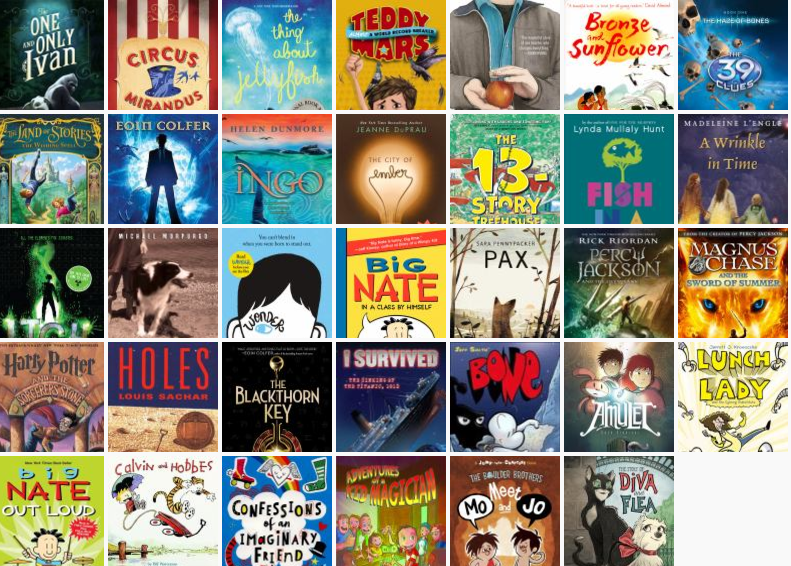
  3. The following set shows the power of carefully selected books for national or regional book awards. In this instance the “Red Dot Book Awards” run by the ISLN. Of the selection for 2016/7: Secrets of Singapore; Confessions of an Imaginary Friend; The Thing about Jelly Fish; Blackthorn Key; Bronze and Sunflower; and Circus Mirandus; made the lists. Once again, these are books that students probably wouldn’t naturally gravitate towards, but which have received a lot of publicity in the school, we have at least 6 copies of each which means they’re more widely available and read and talked about.
  4. The power of author visits. During the past year we’ve had the authors of these titles, and it’s shown clearly in their popularity: Sherlock Sam, Secrets of Singapore / Danger Dan.
  5. The rest. What is so interesting about the list is that 21 boys selected 36 different titles in their top 3 lists and a further 10 titles in their “ones that got away”. I really like that. It shows an increasing maturity in reading and a diversity in taste and choice.

The complete list can be found here:

BWB favourites


BWB where are we at?

After a flurry of research and completing my final paper for my M. Ed, one may think that it’s all over with the inquiry into reluctant readers, boys reading etc. etc.  But it’s not. Far from it in fact. I’ve been a little distracted with the library renovation, a series of unfortunate events with library assistants having close encounters with pregnancy and injuries leading to somewhat more of a day to day burden on my shoulders etc. etc (it’s called “life” I keep reminding myself). But anyway, we carry on unabated with our BWB club (Blokes with Books) and you can come and hear me at the AFCC if you’d like to find out more!

Tim, the teacher leading the club and I had some conversations at the end of last year about how we needed to take things up a notch and really go deeper into the whole reading thing. The question of course is how do you make sure it’s still fun, that they still are committed, while deepening and expanding what they’re reading? We’re talking about 11/12 year old boys after all, and while my dry academic papers sound all unemotional and cool the truth is far from it.  We have spats and have to have firm words about “it’s just a game” and “if you don’t quit fighting about the chairs / beanbags / who got the book first, you will have to stop coming for a while” etc. etc.

But something special has been happening in the two weeks since we’ve been back. Sometimes you just get so caught unawares that you’re not recording or documenting and now I feel I need to document it. Last week our counsellor (who’s joined our team) was sharing how he’d seen an interview with Jamie Oliver about the fact that he’d read his first book at age 38. The boys were actually incredulous. And then a couple started spontaneously sharing how before BWB club they’d never finished a book either, or if they did it was just a quick and easy book and how much more they’re reading now and how it takes practice and perseverance. Note – it also takes courage for a boy this age to come out and say these things to his peers.

This week we reflected on Obama’s reading list and how he’d said it helped calm and focus him in times of stress. And again, a couple of boys put their hands up and said how reading helped them calm down, when they were angry or upset.

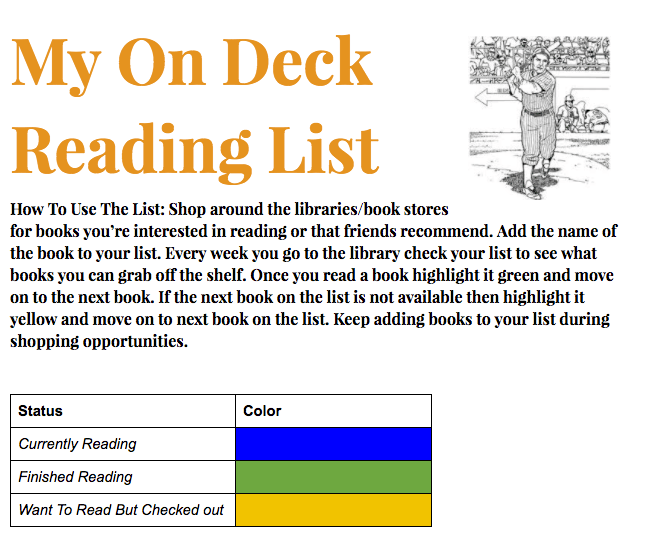
So, whscreen-shot-2017-01-21-at-1-47-36-pmat’s new.  Right now I’m trying to drill into every student at school the necessity of having a “what’s next” list – either a mental list or a  physical list or a pile of books that are the “books in waiting”.  And the great thing about a club like this is that we can try things out on them and see how effective they are.
This week we used Leigh Collazo’s Genre Personality test which you can purchase from TPT (a $5 well spent). My assistants and I spend quite a bit of time this week updating the bookmarks in order to make the book suggestions specific to our library.  The boys did the quiz during the BWB session on Friday and they really enjoyed doing it. It was fun and light-hearted and we kept emphasizing that there was no right or wrong answer and it wasn’t scientific. After they’d tallied up I made a spreadsheet of the topscreen-shot-2017-01-21-at-1-48-01-pm 3 categories of each boy, and as we read out the descriptions there were cries of “yes, that’s exactly how I am” and “I agree” and “yes!”  With their permission we then displayed the results. Most were evenly spread between A, (questioner); B (Escapist) and C (Innovator) with surprisingly few G’s (class clown) which is what I would have expected. Since that took up most of the hour we have with them – we didn’t get around to sharing the bookmarks, and
only introduced the “on deck” spreadsheet to help them keep track of their “what’s next” list – that’s next week’s work.


Reading reluctance – factors

Writing a case study with 3,000 words of which 80% are limited by procedural bits and pieces is proving to be a little frustrating because I am learning SO MUCH.  So I thought I’d share some of it here, because heaven knows it could help someone somewhere somehow.

Remember the whole thing about motivation? That there was extrinsic and intrinsic and the latter was way way better? Turns out there are a lot more bits and pieces to motivation than psych 101 would have you believe. And more importantly there is such interplay between them and external factors and I’d like to add developmental ages and phases as well.


So with reading motivation we have:

  • Extrinsic (rewards, physical, achievement or emotional if you read more)
  • Intrinsic (reading is its own reward – interest, satisfaction etc.)
  • Social (currency gained by knowing stuff, sharing books and reading – turns negative around G5 with peer devaluation)
  • Self-efficacy (belief in ability – changes over time)
  • Work avoidance (starts in G2, avoid reading tasks due to low motivation and/or reading difficulties)

If you want to read just one study on the matter, I’d recommend Lee & Zentall (2015). They summarize most of the knowledge to date, have an excellent bibliography and most importantly add the longitudinal dimension. I really like longitudinal studies, and I know why they’re difficult and costly, but as a parent and an educator, what can be more valuable than recognizing and anticipating bumps along the road for what they are and taking preventative action before a student/child lands in a pot-hole?


I’d like to spend a little more time on self-efficacy. It has to do with self-concept as a reader (Förster & Souvignier, 2014; Proctor, Daley, Louick, Leider, & Gardner, 2014; Smith, Smith, Gilmore, & Jameson, 2012). I find it very interesting that self-efficacy takes a dive around Grade 3. Why? Because that is just the moment when the majority our self-confident readers, having spent 2 or 3 years soaring through the levels of their reading program are suddenly let loose into the big world of both “real chapter books” and needing to access their reading skills in order to “read to learn”. It’s that pivot point. The point at which I tell over anxious parents, “yes, now you can start worrying if the reading is not happening.”


So the question is what should our response be as parents and educators (another good point of the Lee & Zentall article – they add the “so what” bit). Remember the “terrible twos”? Well I think there is nothing more comforting in know that when behavior goes wonky, you have a frame of reference that says “oh, it’s this” accompanied by “I / my child / my student is not alone” and “this is normal” plus, hopefully some strategies in place that can be applied. I’ve just sent my blokes with books a set of positive affirmations that he can use in the Blokes with books club. It was one of a set of resources included in this very handy, practical and readable guide from Ireland (NEPS, 2012).


Then looking at the skill side of things. This is dangerous ground, because if a child is reading below the 30% percentile, (and they’re not 3 or 4 years old – I kid you not – I’ve had pre-kindergarten parents concerned their children are not reading yet – on that topic, please read this article (Suggate, Schaughency, & Reese, 2013)) and they’re over 8 years old, then there may be a problem.


What is the problem – well I’ll say mainly “beware, there be EGOS”. When there is a reading skill issue it is probably as a result of an experiential instructional deficit or a reading related cognitive problem (Scanlon, Gelzheiser, Vellutino, Schatschneider, & Sweeney, 2008). To put it simply, either they haven’t been taught properly at school or the home situation isn’t reinforcing adequately (hear those egos bristling), OR, the child has a reading related cognitive problem (Reading Disability – RD). This can be in decoding (like dyslexia); comprehension or retention and each have a different (here is a lay-person’s article) set of signs and ways of being addressed.


So, what does one do in this case – I like the NEPS article because they call for short, one-on-one or one-on-few and limited interventions of around 12 weeks. Obviously one can start with trying to overcome any instructional deficit, and if that fails, to move onto educational testing and specific RD related interventions. Once again there be Egos in the way – and if it helps at all, I can say “been there, done that, got the tears to prove it”. It’s hard to acknowledge that your child is anything than perfect, or at a pinch that they’re “normally” imperfect. But denial leads to more harm that good, and particularly because early intervention is so much more effective. Embedded in this article on dyslexia (Korbey, 2015) is an awesome scientific journal article (free to read! Yay) on RD, by Norton and Wolf that is very dense and brain spinning, but very good (Norton & Wolf, 2012). Personally I found the discussion on colour naming to be very interesting – talk about an early warning sign that we noticed but didn’t know was important.


I’m going to stop at this point – happy reading in the mean time. As always, interested in your thoughts and comments.

References:

Förster, N., & Souvignier, E. (2014). Learning progress assessment and goal setting: Effects on reading achievement, reading motivation and reading self-concept. Learning and Instruction, 32, 91–100. http://doi.org/10.1016/j.learninstruc.2014.02.002

Korbey, H. (2015, October 1). Understanding dyslexia and the reading brain in kids [Web Log]. Retrieved 11 September 2016, from https://ww2.kqed.org/mindshift/2015/10/01/understanding-dyslexia-and-the-reading-brain-in-kids/

Lee, J., & Zentall, S. S. (2015). Reading motivation and later reading achievement for students with reading disabilities and comparison groups (ADHD and typical): A 3-year longitudinal study. Contemporary Educational Psychology. http://doi.org/10.1016/j.cedpsych.2015.11.001

NEPS. (2012). Effective interventions for struggling readers. National Educational Psychological Service. Retrieved from http://www.education.ie/en/Education-Staff/Information/NEPS-Literacy-Resource/neps_literacy_good_practice_guide.pdf

Norton, E. S., & Wolf, M. (2012). Rapid automatized naming (RAN) and reading fluency: Implications for understanding and treatment of reading disabilities. Annual Review of Psychology, 63(1), 427–452. http://doi.org/10.1146/annurev-psych-120710-100431

Proctor, C. P., Daley, S., Louick, R., Leider, C. M., & Gardner, G. L. (2014). How motivation and engagement predict reading comprehension among native English-speaking and English-learning middle school students with disabilities in a remedial reading curriculum. Learning and Individual Differences, 36, 76–83. http://doi.org/10.1016/j.lindif.2014.10.014

Scanlon, D. M., Gelzheiser, L. M., Vellutino, F. R., Schatschneider, C., & Sweeney, J. M. (2008). Reducing the incidence of early reading difficulties: Professional Development for classroom teachers versus direct interventions for children. Learning and Individual Differences, 18(3), 346–359. http://doi.org/10.1016/j.lindif.2008.05.002

Smith, J. K., Smith, L. F., Gilmore, A., & Jameson, M. (2012). Students’ self-perception of reading ability, enjoyment of reading and reading achievement. Learning and Individual Differences, 22(2), 202–206. http://doi.org/10.1016/j.lindif.2011.04.010

Suggate, S. P., Schaughency, E. A., & Reese, E. (2013). Children learning to read later catch up to children reading earlier. Early Childhood Research Quarterly, 28(1), 33–48. http://doi.org/10.1016/j.ecresq.2012.04.004