Last Sunday afternoon I went to Ikea to have a look at the flow of people, and also to observe the design elements of a very successful store concept. In the end I didn’t use my observations for the official blog post, but rather it inspired me to think about my library space as “solution spaces” which I blogged about here.
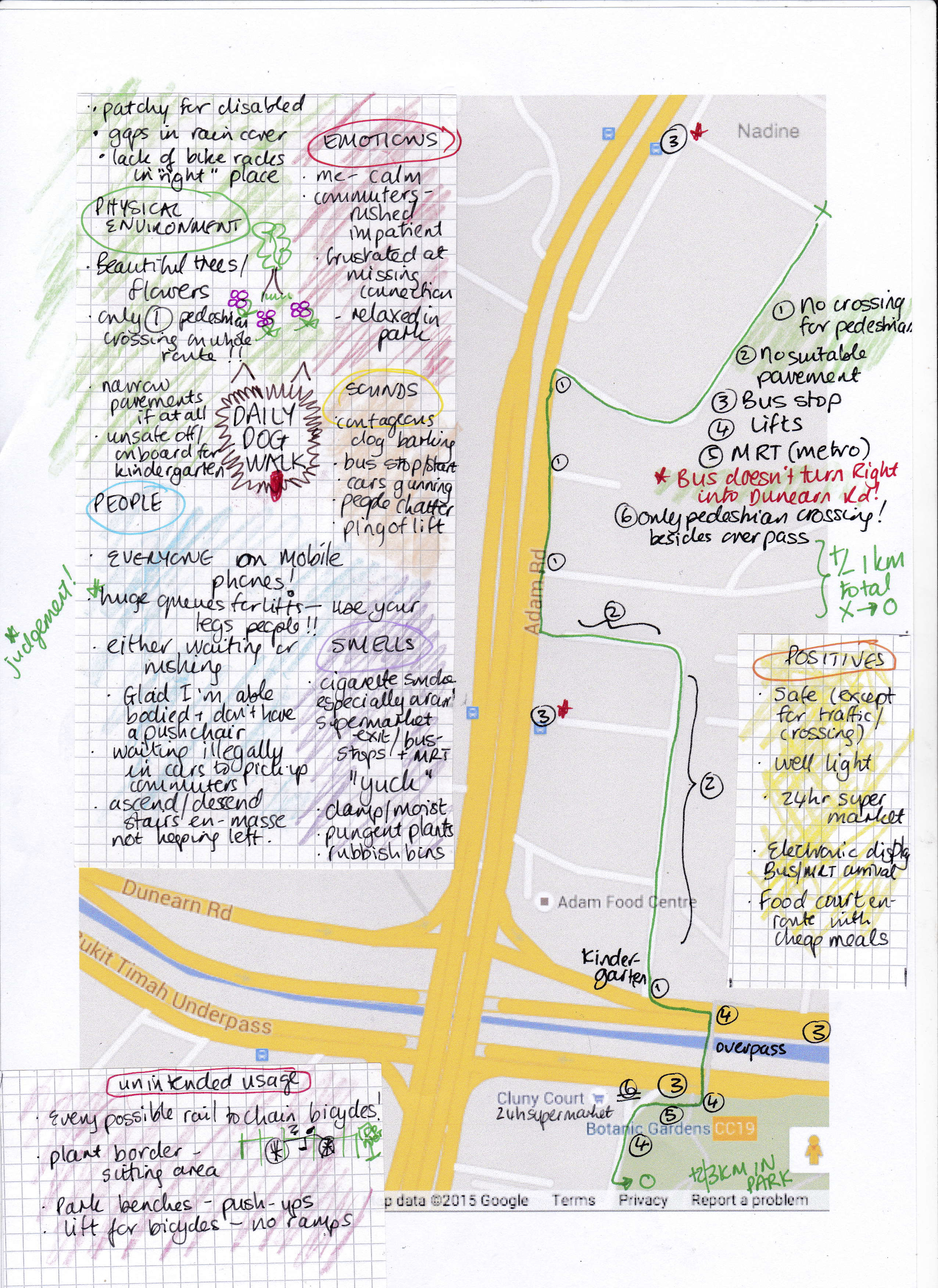
I undertook a dog walk observation exercise where I considered the first stage of the Luma Taxonomy of Innovation – looking (Luma Institute, 2014). My route from home to the Botanic Gardens is roughly 1km and it takes me past a fairly busy transport hub of bus stops and a MRT (mass rail transport) station. Other touch points are a busy food court (Adam Food Centre), a Kindergarten, a church, and a shopping centre with a 24-hour supermarket. As an able-bodied person I employed the technique of “user journey” and “adopting personas” (McNabola et al., 2013) in order to better understand the landscape. It is a route I also sometimes cycle with my children in order to reach the sports fields near the Botanic Gardens, so I considered that experience.
Dogwalk route & observations
McNabola et al (2013) suggest that in mapping a system one considers the “touch points” between users and “the system”. The touch points I identified included:
Changing transport modes (e.g. bus to walking, walking to crossing a road, walking to bus, walking to MRT, public transport to private car, cycling to public transport, public transport or walking to taxi)
Changing intention (transportation to destination – e.g. driving to kindergarten and taking child in; driving to shopping centre and shopping; walking / taking transportation to Botanic Gardens and walking in garden)
Changing persona (able bodied; cyclist; disabled; with stroller; with dog; with young children)
Changing context (raining; peak hour; during the day)
Design techniques – user journey &personas
As can be seen above (full size photos available here), different contexts, personas changes in mode and intentions can come into conflict with each other, or result in unmet or poorly met needs. The Singapore Government is aware of this and has created an “Active Mobility Advisory Panel”.



 Informative Flights - Musings of a Teacher Librarian