Can we be smarter with communicating benefits of reading?

During the vacation I’ve been catching up with some podcasts, including listening to a few new ones that were recommended to me by friends. While there are some great educational podcasts out there, sometimes while one is looking outside of the field that you are struck by things that are relevant.

So it was with this podcast from “You are not so Smart” based on research on how to deal with climate deniers with Per Espen Stocknes.

Because sometimes (most the time) when looking at reluctant readers I’m pretty sure I’m missing the boat on how to communicate effectively and meaningfully with them. Like the time I asked a group why they thought I kept trying to get them to read more and they basically said “because it’s your job Ms!”

So the thing is, there are 5 different ways that you can mess up your communication, which result in the “backfire effect” whereby people negate your message and turn all defensive on you. So you’d be better off saying nothing, than saying something that gets folks’ psychological back’s up.  While the talk related this to climate change I’ll re-interpret them along the lines of getting kids and their families (and even gasp, teachers) to read more, read together, read-aloud.

  • Doom and Gloom
  • Distance
  • Dissonance
  • Denial
  • iDentity

In the doom and gloom scenario you’re telling kids that if they don’t read they’re going to fail, drop out, go to prison, not get a good job, not get into college etc. if they don’t read. Psychologically this leads to a guilt and fear mind frame in the audience, increased passivity and avoidance. When what we really want is for parents and students to jump into action with a plan of daily reading! Another problem with those messages – it’s all too abstract and too distant. It’s the issue that that the problematic future is well, in the future, and right now they’d rather be playing an online game, or kicking a soccer ball. The locus of control is also presumed to be outside their scope of influence, there is reduced urgency and personal agency leading to a feeling of helplessness.

Cognitive dissonance is a very tricky thing when dealing with parents. Every parent, no matter what they may be struggling with privately or publicly with their children have to be believed to be doing the best they can with the knowledge and tools at their disposal. Ditto teachers (I include teachers as there are many teachers who do not read, and do not find reading pleasurable, and struggle with “walking the talk”). When people tell you that you should be reading to your child or reading more, or reading differently that kind of flies in the face of your image of yourself as a good and successful parent and person. And so what one often hears is “I/my husband / his grandpa/ never was much of a reader, and they turned out OK”  or even “we have plenty of books at home” or “he/she borrows books every week“. All of which may be perfectly true, even if those books may never be opened and read … and it’s the “right” answer to shut up a concerned teacher / librarian.

Denial is another mechanism frequently employed – one comes out with some latest research or study that reading is the answer to life, the universe and everything, and all sorts of things get thrown back at you – like “I read that if you read online it’s not effective” or “all they want to read is graphic novels” or some kind of moral licensing – “but he/she is very involved with the school play / the band / Kumon worksheets and doesn’t have the time for reading” and “he/she is doing just fine in class” or even worse “but X is struggling much more“.

The final point has to do with identity.  Everyone, from young students up need to protect their self-esteem and keep their identity intact. For some of my students it’s very important to be cool. And being cool doesn’t involve struggling or appearing to struggle at anything. For many families caught up in the fairyland of expatriate existence, a veneer of “everything is fine” is also very important. Problems with reading – fluency, comprehension, language, and admitting to those problems does not gel with that identity.  At this point a lot of blame gets thrown around. The teacher who didn’t teach properly. The librarian who put them off borrowing after they lost a book. The teacher who won’t let them borrow batman books or insists on “just right” books.  It’s a tough one and part of what we attempted to do with “Blokes with Books” is to make reading cool and social.

Right, so what to do about this.  There were 5 solutions offered by Stocknes and I’ll relate these to what I’m trying to do, and plan to do in the new school year.

  • Social
  • Signals
  • Simple
  • Supportive
  • Storytelling

Keeping things social is something I absolutely subscribe to. As I’ve said so often before, contrary to belief, reading is not a solitary activity. It is social. The kind of things that my students enjoy are book clubs, sitting and reading the same book at the same time and turning the pages at the same time. Reading in a group of three of four and raucously pointing at things and exclaiming.

Feedback and signals need to be those that people can relate to and are relevant.The antidote to distant gloom and doom is making things near and personal, since good behaviour can be contagious – particularly if it’s acknowledged and there is some positive comparison going on. Now this works brilliantly with electricity consumption in the examples given, but I’m a little wary of competitive reading. Cue in all the research done by Krashen et.al and the dangers of extrinsic versus intrinsic rewards and the virtues of free voluntary reading. I’d be the last to deny that (some) kids appear to be motivated by reading points, scores, levels etc. But I’m still not prepared to make that the focus of my efforts. I’ve been thinking long and hard about what kind of comparisons are relevant and meaningful.  One that I’ve used on my students has been to work out the median number of books students in their class and grade read each month and ask them to compare themselves.  The best thing we’ve done for our reluctant (male) readers has been the “blokes with books” club, which has helped both with identity and social belonging.

Schools and homes are incredibly busy environments. It’s imperative to keep things simple and easy, with low barriers.  Some things I’ve already put in place, like allowing students to borrow books on four occasions daily (before and after school at recess and at lunch) on any day of the week, in addition to their normal weekly library lesson with their class. There kind of are limits on the number of books they can borrow based on their age, but they all know that’s negotiable. Likewise parents can now join and supposedly borrow three books at a time, but we have some parents who borrow more and one who gets around 10-20 every Friday, as she’s a working parent and doesn’t get to the library every day. I don’t mind, as long as they keep returning.  Classroom libraries are also a great way of ensuring books are in the hands of students.  That still needs more work.  All our classes have class-libraries, but they’re not functioning optimally. This is a loaded area. The library is “my” domain (but not really) and the class “theirs”, so I can implement best practice with abandon in the former and have to tread carefully in the latter.  What would I like to see / do differently?  More movement more regularly in the class libraries – now books are checked out for the year. Self-checkout / check-in in the classrooms – my fault in prior years and I really need to get that going this year. More weeding of old, tattered and yucky books – it’s starting to happen.  Nicer display – need to think about that as it’s definitely crossing the line. Maybe a workshop on class libraries?

Providing a supportive framework – takes time. Time for you to get to know the students, the teachers the parents. Sticking to the message of the importance of reading without the judgement. Being there and listening when one of the parts of the reading ecosystem need to unburden or get a book list or suggestions without jumping to conclusions or formulaic solutions. I’m incredibly fortunate to have a supportive administration and principal and (so far) an adequate budget, and library assistants who are buying into creating an environment conducive to encouraging reading.

Finally incorporating the storytelling format in communication. Stories need to be personal and individual and incorporate an element of dream actualisation.  I’ve been doing a bit of this around the PYP and Singapore environment (most recently at the AFCC), the stories of the gains my formerly reluctant readers have made compared to their peers really is motivating.  Success stories are wonderful.  But struggle stories are also relevant, and the fact that I have a reluctant reader at home keeps things real and personal. I have no pedestal to preach from as I’ve been exposed to every excuse, every battle, and tried every possible solution myself and I’m still only partially successful in my efforts.

As the new school year starts I hope all your reading dreams for your students come true!

Reading reluctance – factors

Writing a case study with 3,000 words of which 80% are limited by procedural bits and pieces is proving to be a little frustrating because I am learning SO MUCH.  So I thought I’d share some of it here, because heaven knows it could help someone somewhere somehow.

Remember the whole thing about motivation? That there was extrinsic and intrinsic and the latter was way way better? Turns out there are a lot more bits and pieces to motivation than psych 101 would have you believe. And more importantly there is such interplay between them and external factors and I’d like to add developmental ages and phases as well.


So with reading motivation we have:

  • Extrinsic (rewards, physical, achievement or emotional if you read more)
  • Intrinsic (reading is its own reward – interest, satisfaction etc.)
  • Social (currency gained by knowing stuff, sharing books and reading – turns negative around G5 with peer devaluation)
  • Self-efficacy (belief in ability – changes over time)
  • Work avoidance (starts in G2, avoid reading tasks due to low motivation and/or reading difficulties)

If you want to read just one study on the matter, I’d recommend Lee & Zentall (2015). They summarize most of the knowledge to date, have an excellent bibliography and most importantly add the longitudinal dimension. I really like longitudinal studies, and I know why they’re difficult and costly, but as a parent and an educator, what can be more valuable than recognizing and anticipating bumps along the road for what they are and taking preventative action before a student/child lands in a pot-hole?


I’d like to spend a little more time on self-efficacy. It has to do with self-concept as a reader (Förster & Souvignier, 2014; Proctor, Daley, Louick, Leider, & Gardner, 2014; Smith, Smith, Gilmore, & Jameson, 2012). I find it very interesting that self-efficacy takes a dive around Grade 3. Why? Because that is just the moment when the majority our self-confident readers, having spent 2 or 3 years soaring through the levels of their reading program are suddenly let loose into the big world of both “real chapter books” and needing to access their reading skills in order to “read to learn”. It’s that pivot point. The point at which I tell over anxious parents, “yes, now you can start worrying if the reading is not happening.”


So the question is what should our response be as parents and educators (another good point of the Lee & Zentall article – they add the “so what” bit). Remember the “terrible twos”? Well I think there is nothing more comforting in know that when behavior goes wonky, you have a frame of reference that says “oh, it’s this” accompanied by “I / my child / my student is not alone” and “this is normal” plus, hopefully some strategies in place that can be applied. I’ve just sent my blokes with books a set of positive affirmations that he can use in the Blokes with books club. It was one of a set of resources included in this very handy, practical and readable guide from Ireland (NEPS, 2012).


Then looking at the skill side of things. This is dangerous ground, because if a child is reading below the 30% percentile, (and they’re not 3 or 4 years old – I kid you not – I’ve had pre-kindergarten parents concerned their children are not reading yet – on that topic, please read this article (Suggate, Schaughency, & Reese, 2013)) and they’re over 8 years old, then there may be a problem.


What is the problem – well I’ll say mainly “beware, there be EGOS”. When there is a reading skill issue it is probably as a result of an experiential instructional deficit or a reading related cognitive problem (Scanlon, Gelzheiser, Vellutino, Schatschneider, & Sweeney, 2008). To put it simply, either they haven’t been taught properly at school or the home situation isn’t reinforcing adequately (hear those egos bristling), OR, the child has a reading related cognitive problem (Reading Disability – RD). This can be in decoding (like dyslexia); comprehension or retention and each have a different (here is a lay-person’s article) set of signs and ways of being addressed.


So, what does one do in this case – I like the NEPS article because they call for short, one-on-one or one-on-few and limited interventions of around 12 weeks. Obviously one can start with trying to overcome any instructional deficit, and if that fails, to move onto educational testing and specific RD related interventions. Once again there be Egos in the way – and if it helps at all, I can say “been there, done that, got the tears to prove it”. It’s hard to acknowledge that your child is anything than perfect, or at a pinch that they’re “normally” imperfect. But denial leads to more harm that good, and particularly because early intervention is so much more effective. Embedded in this article on dyslexia (Korbey, 2015) is an awesome scientific journal article (free to read! Yay) on RD, by Norton and Wolf that is very dense and brain spinning, but very good (Norton & Wolf, 2012). Personally I found the discussion on colour naming to be very interesting – talk about an early warning sign that we noticed but didn’t know was important.


I’m going to stop at this point – happy reading in the mean time. As always, interested in your thoughts and comments.

References:

Förster, N., & Souvignier, E. (2014). Learning progress assessment and goal setting: Effects on reading achievement, reading motivation and reading self-concept. Learning and Instruction, 32, 91–100. http://doi.org/10.1016/j.learninstruc.2014.02.002

Korbey, H. (2015, October 1). Understanding dyslexia and the reading brain in kids [Web Log]. Retrieved 11 September 2016, from https://ww2.kqed.org/mindshift/2015/10/01/understanding-dyslexia-and-the-reading-brain-in-kids/

Lee, J., & Zentall, S. S. (2015). Reading motivation and later reading achievement for students with reading disabilities and comparison groups (ADHD and typical): A 3-year longitudinal study. Contemporary Educational Psychology. http://doi.org/10.1016/j.cedpsych.2015.11.001

NEPS. (2012). Effective interventions for struggling readers. National Educational Psychological Service. Retrieved from http://www.education.ie/en/Education-Staff/Information/NEPS-Literacy-Resource/neps_literacy_good_practice_guide.pdf

Norton, E. S., & Wolf, M. (2012). Rapid automatized naming (RAN) and reading fluency: Implications for understanding and treatment of reading disabilities. Annual Review of Psychology, 63(1), 427–452. http://doi.org/10.1146/annurev-psych-120710-100431

Proctor, C. P., Daley, S., Louick, R., Leider, C. M., & Gardner, G. L. (2014). How motivation and engagement predict reading comprehension among native English-speaking and English-learning middle school students with disabilities in a remedial reading curriculum. Learning and Individual Differences, 36, 76–83. http://doi.org/10.1016/j.lindif.2014.10.014

Scanlon, D. M., Gelzheiser, L. M., Vellutino, F. R., Schatschneider, C., & Sweeney, J. M. (2008). Reducing the incidence of early reading difficulties: Professional Development for classroom teachers versus direct interventions for children. Learning and Individual Differences, 18(3), 346–359. http://doi.org/10.1016/j.lindif.2008.05.002

Smith, J. K., Smith, L. F., Gilmore, A., & Jameson, M. (2012). Students’ self-perception of reading ability, enjoyment of reading and reading achievement. Learning and Individual Differences, 22(2), 202–206. http://doi.org/10.1016/j.lindif.2011.04.010

Suggate, S. P., Schaughency, E. A., & Reese, E. (2013). Children learning to read later catch up to children reading earlier. Early Childhood Research Quarterly, 28(1), 33–48. http://doi.org/10.1016/j.ecresq.2012.04.004

Mother Tongue – How to assess your likelihood of success

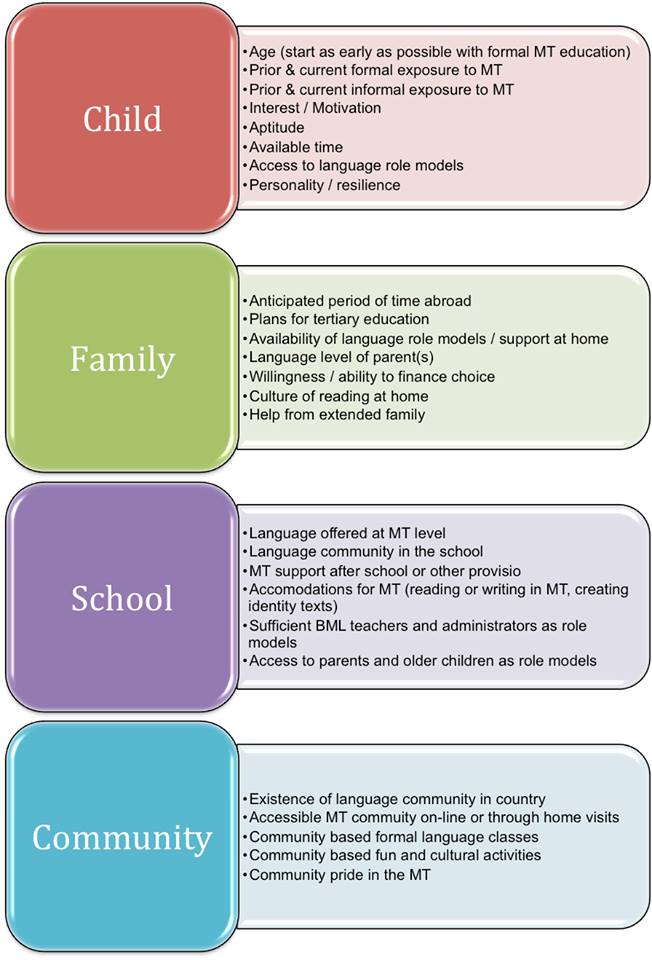
One of the things I did as part of my research was to summarise the factors that contributed to a family being able to teach and maintain their mother tongue in their children while living / being educated in an English dominant environment.

First I present the table of factors, and then I present myself filling in this table as an exercise in my own home.

Analysis: The theories of MT acquisition and maintenance versus the reality of our situation

Theory
Reality – Chinese
Reality – Dutch
Child
Age (start as early as possible with formal MT education)
Both started Chinese immersion in Grade 1 (age 6)
Son started formal Dutch in Grade 5 (age 10)
Prior & current formal exposure to MT
1 hour per day class in International School
None
Prior & current informal exposure to MT
Not much – Hong Kong is Cantonese not Mandarin speaking. Daughter did learn characters through observation on the street.
Dutch spoken at home, exposure through paternal grandparents, aunts, uncles and cousins.
Interest / Motivation
Daughter – High;
Son – Low
Daughter not particularly interested, speaks on holiday and to family
Son – High
Aptitude
Daughter – excellent memory which is necessary for amount of memorization necessary
Son – difficulties with working memory due to ADHD doesn’t rely on memory for learning
Son – very good ear and pronunciation, has taken well to spelling and grammar as it’s taught in a formal structured way (unlike English)
Available time
In HK had ample time (27/28 hours a week in class plus a lot of homework)
Daughter: in SG 5x 40 minutes a week class time, 90 minutes a week tutoring, 100 minutes a week required homework plus whatever time she has for self-motivated study and reading
5 x 40 minutes a week class time (1x of which is self-study)
1 x 120 minutes after school tutoring.
Homework around 60 minutes
Daily reading expected 15-20 minutes (doesn’t always happen)
Access to language role models
Limited to school and tutor and one family friend who we see irregularly
Parents speak Dutch at home to each other, Father speaks Dutch to him, Mother speaks English unless in Dutch context
Personality / resilience
Very determined, sees events as challenges rather than setbacks, competitive, responds well to reward systems, perfectionist, introverted and shy
Very sociable, extroverted, not scared of making mistakes. Quite emotional, inclined to give up when things get difficult, or need help to keep going
Family
Anticipated period of time abroad
Indefinite
Indefinite
Plans for tertiary education
Undecided, probably English medium
Considering studying film or photography in Netherlands (early thoughts)
Availability of language role models / support at home
Mother studied Chinese but level is not sufficient to support high level language and literacy needs practically, only in abstract
Both Mother and father speak Dutch in the home
Language level of parent(s)
Mother – Low level
Father – none
Mother – Fluent speaking reading, listening, written poor
Father – Fluent speaking, reading, listening, writing
Willingness / ability to finance choice
Yes
Yes
Culture of reading at home
Yes – but needs prompting and encouragement as slow difficult process and access to the right leveled material is difficult.
Yes – when father is home do co-reading as well
Help from extended family
None, only moral support
Yes – regular phone calls / FaceTime, visits during vacation and go to school with cousins for a few days
School
Language offered at MT level
Yes in theory.  However in practice the amount of time and level is not adequate, plus not enough leveled reading resources and mentoring
None in curriculum until G9. In G7 & G8 offered after school.  His Dutch classes are an exception and privately arranged and funded
Language community in the school
Yes, however she is not particularly a part of it.
Yes
MT support after school or other proviso
Yes, 90 minutes private tutoring after school, school provides walk in clinics 2x a week
Only from G7, however he’s not at the level required yet
Accommodations for MT (reading or writing in MT, creating identity texts)
Yes, in school (since middle school only) and tutor supplements
Yes, but still limited due to level
Sufficient BML teachers and administrators as role models
Administration & non-language teachers traditionally English / mono-lingual with some exceptions. This is changing a bit.
Access to parents and older children as role models
In principal – but need to tap into this more. No formal structures.
Yes, cultural events organized by Dutch Teacher.
Community
Existence of language community in country
Yes, large Chinese speaking population, however local families are not part of school
Yes, Dutch club and fair sized community with events
Accessible MT community on-line or through home visits
Possibly – not investigated yet
Yes
Community based formal language classes
Many tutoring schools that cater to the Chinese curriculum of local schools
Yes
Community based fun and cultural activities
Not as many as in Hong Kong
Yes through Dutch club and school
Community pride in the MT
Many classmates in MT group are not very motivated to learn Chinese, within SG community Mandarin is the formal standard Chinese while most families speak a dialect at home
Generally yes, however many Dutch people speak English well and will switch in mixed groups