Meting out diversity

The whole diversity thing bothers me. Has for some time. We seem to love the optics of diversity, but not so much the reality.  And so we mete out our diversity in acceptable chunks at acceptable moments. And in doing so we can fool ourselves – most of the time. We also mete out our encounters with diversity such that they don’t necessarily have to touch us in ways that are meaningful. We thereby send clear messages to all our students, diverse and – well what is the word not for diverse – dominant? Oh, begin to define dominant in an international school and don’t bother looking at the nationalities of the students, or pictures of them. You

meteprobably need only to look at a handful of people. Those in leadership. And chances are they’ll all be white male of a certain age, background and education, with a judicious sprinkling of women.


Before anyone gets excited about that, think about the following reported encounter by prospective parents in an ethnically mixed marriage. The primary school I’m at is wonderfully diverse in the composition of the teacher body. On entering a classroom with a caucasian teacher, one of the parents exclaimed “at last, a proper English teacher” (for the record, she wasn’t English, but obviously appearance counts). When at the Neev festival in Bangalore, I remarked to my friend how gorgeous and natural she looked in her salwar kameez and asked her why I hadn’t seen her wearing one at school in Singapore while working for a big name, self-proclaimed “diverse” school. She looked at me aghast and said there was no way it would have been possible outside of the UN celebrations and that all staff was expected to dress professionally and adopt the school values and world view irrespective of their personal beliefs or experience. Now this is a school that prides itself on the fact that they have a uniform but don’t police the interpretation of its manifestation. Where I attended a lecture today, and saw every possible variation in student “teen dress expression” but not so in the teaching body.

DiversityInChildrensBooks2015_f

So we get to the mundane part of throwing some books in the library that reflect the culture, language and backgrounds of our students. Can we even do that without breaking through the cultural myopia? I still have to keep thinking back to this experience when I realised that truly we are up against so much, and putting books in the library is a bandaid on the wound of an amputee. If we struggle even conceptually with putting textbooks from different countries whose educational philosophy we “disagree” with (how dare we?), what happens with literature, that is so much more subversive?


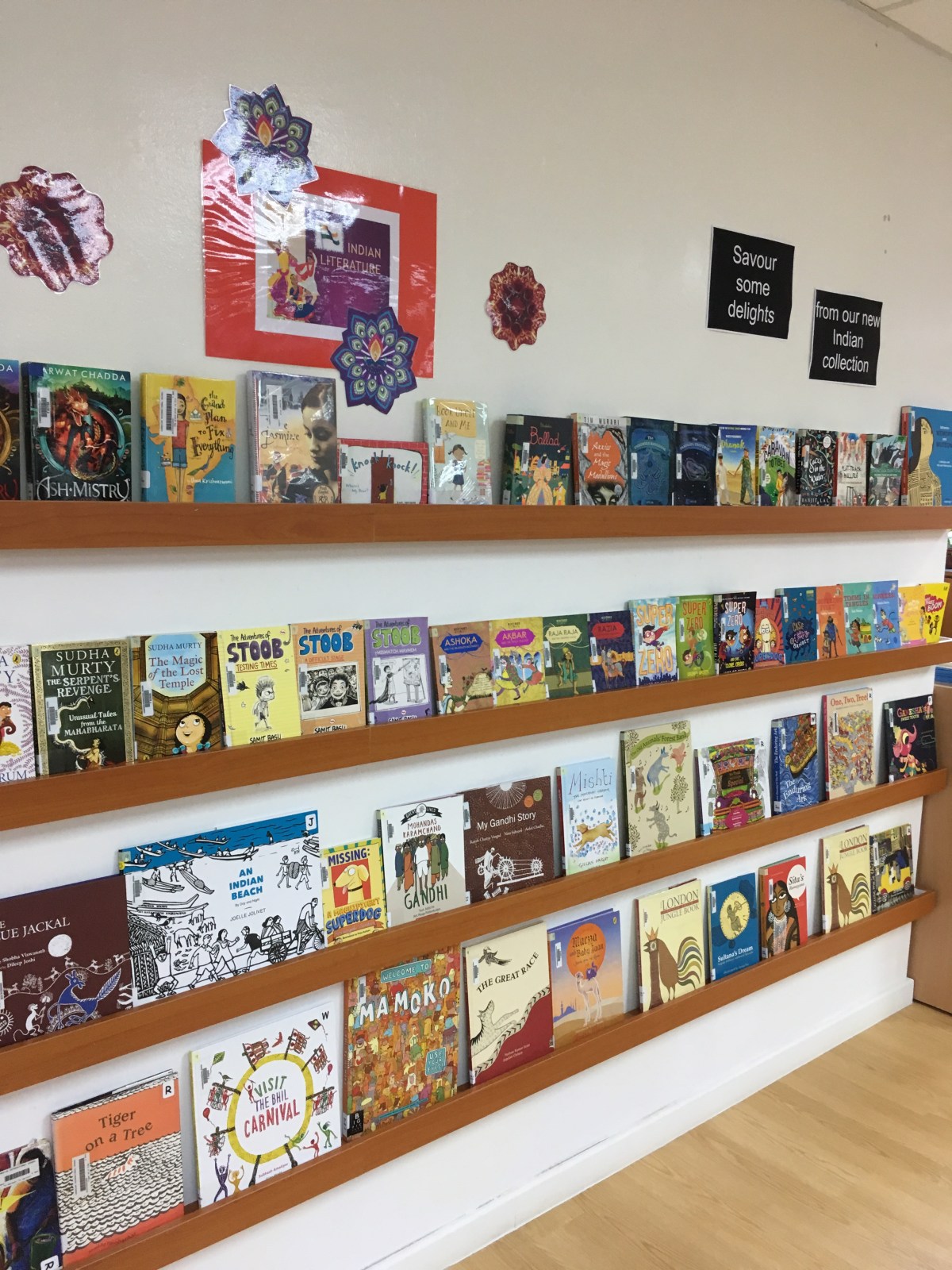
I recently purchased around 100 books written and/or illustrated by Indian authors. It was hard work “selling them” to my students. Even the Indian students. Especially the Indian students. I used the above infographic to explain to students how skewed their world view is.  And the worst of it all, is this in itself is a North American view. Let’s not even talk about the fact that most of the 73.3% white characters and 12.5% animal, truck etc. characters are male. By the end of the week, after discussions about being open-minded and balanced and being a risk-taker, most of my books were borrowed.

A few of my students exclaimed they “loved” one or another of the authors. Some parents expressed surprise that I had so many books, and amazement that I’d used my 30kg luggage allowance to lug back books. Now Indian books are possibly one of the lowest barrier “diverse” books an international school could add to their collection. Quite simply because English is a common language. No translation is required. There is a thriving publishing industry. A huge diaspora. Many schools have 25-30% of their student body from the Indian subcontinent. And yet, until a month ago I probably had fewer than 10 “Indian” books in my collection. Most of them picture books from Tara Books.  Little to nothing in Junior fiction and a few Ash Mistry books in fiction. And now? I have the books. Students have borrowed them once. Will they go back into the shelves along with the Diwali books only to make a reappearance next year this time when it’s acceptable to celebrate and embrace Indian culture?

Any literature on language and culture will quickly point to dominant / aspirational and socio-economic preferred language and culture. As a South African who spent most of her life mired in shame, unable and unwilling to admit to my heritage, I truly “get” the ambivalence (while remaining astounded by continued British bluster – particularly here in Asia).

And that is the problem with every article ever written about diversity. We lament the absence of the optic. We gloss over some of the “hardware” issues (authors, illustrators, translators), we may even get to structural problems (publishing houses, editors, market sizes). But we neglect to think about how the structure of our education and schools will support those tender shoots, will allow our communities to claim not just their heritage, but current philosophies. We close down libraries, we limit budgets, we operate in echo chambers, we fail to make library education affordable and accessible to local staff. We concentrate our online efforts to gadgets and gizmos instead of access, community and understanding.

What do I do in our library / school?

Of course the five f’s: food, fashion, famous people, festivals, and flags. Mea culpa here. I have books about (just about) every nation in our school, and scramble each year to make sure there’s at least one book by the time Uniting Nations comes around.

I buy all the books suitable for my elementary school from the USBBY list – cognisant of the fact that it is the US – i.e. pre-digested for USA sensibilities.

I follow blogs of avid supporters of diverse literature such as Dr. Myra Bacsal’s “Gathering Books” and Rachel Hildebrandt ‘s Global Literature in Libraries (seriously, I’m one of only 200 odd people following this AWESOME Blog??  – they also have a facebook page btw if that’s more your thing).  Who give exposure to people like Avery Fischer Udagawa with her new list for 2017 of 100 more works translated for kids, following Marcia Lynx Qualey’s 2016 100 Great Translated Children’s Books from Around the World.

Following what’s being published via the Bologna book fair. Reading reports such as those created by Wischenbart.

And then I devote part of my budget to buy the books, and make sure they’re slotted into resource lists for our units of inquiry, and read them aloud, and “sell” them to teachers and my PYP coordinators.

Put out google alerts for diverse books, join FB groups of librarians around the world. Ask, ask, ask, in the community, parents, librarians, teachers, students.

Write about it. Write about it again, and again.

What more can we do?

Hard stuff. Advocacy. Fostering a sense of national / cultural pride in all our students – not just those from the dominant / desirable communities. Conversations with teachers and administrators. Looking at what our students are writing about – who are the characters in their writing? Ignoring the deluge of books from BANA countries. Being tireless. Fighting even with institutions doing brilliant work like “Global Readaloud” about the choice of their books that are NOT global. Even when all of this is very very tiring and makes you seem like a harpy.
Rambling thought organisation

I need to write an interpretive discussion paper. I’m trying to organise my thoughts. My first and foremost thought is that writing this paper is in direct contravention to the topic of the paper, which is “Digital scholarship in education, in the context of interdisciplinary knowledge and research” – because my digital scholarship is leading me down all sorts of other avenues and thoughts which definitely do NOT fit into the marking rubric. I’m also immensely frustrated at being a distance learner and not knowing who in the zoo to discuss these thoughts with. I’m tired of rehashing the articles that all say the same thing about the evolution from web 1.0 to 2.0 to 3.0 and the fact that we all can be producers and not just consumers, open access (OA), MOOCs, twitter, blogs blah blah.

Transformative?

What are my thoughts right now – on the exact topic?  In the first place that digital has not been transformative enough to scholarship.  Yes in theory, no in fact. The digital spaces I see in education have been highjacked not by scholars but by self-promoting practitioners of the twitterati. There is a lot of anecdotal rather than research based evidence. And they’re echo-chambers of white middle-class educators, often male. I need to expand my networks, and I’ve been making a concerted effort to follow people who are publishing real peer-reviewed research – some of which are on social media and some of which aren’t.  Some who tweet about their research, most who don’t. Or just refer to conferences they’re talking at or have talked at, or their followers enticingly frustratingly refer to such presentations. The thing is that for all this to be transformative it also needs to be heretical. And heretics are not welcome in institutions. Because they threaten the control and status quo of institutions, and by definition are persona-non-grata and there are pathways of recognition (leading to tenure at which point hopefully you’d be entrenched enough to say what the damn you please but by then you’d probably be entrenched enough to buy into the status quo and have a stake in maintaining it). Yes they are clever. Who runs the MOOCs? Who feeds them, who controls them, finances them and their content? – the institutions.  And the money. Yes, always follow the money. All those wonderful digital tools. Those databases, those journals, encyclopedias.  My gold standard for testing anything a salesman throws at me as a school librarian is looking up “socialism” and “communism” in their search engines. Try it. Just try it.

What is education for?  I’ll buy the ‘transformative’ bit on the micro individual well-heeled personal level, – but take it local or regional or national and you have the ‘productive literate citizen’ emerging. What do we want from the 21st Century learner? Link looks great doesn’t it.  Global citizens and all those skills (not content or facts), and then you click on “pricing” and you can clone plans. I repeat. You can pay to clone plans.  You can pay someone else to do your thinking and planning for you can you can teach to that plan and create clones of every other global child whose school or teacher can afford this.  It’s so slick it’s so nicely designed, it’s so intuitive and easy.

Confrontational and Challenging

Easy. Am I a puritan that I think things have to be a struggle and difficult? Not really, I like Vygotsky and the ideal of proximal development.  I don’t like when kids are proximally developed to be led by the nose or to follow the breadcrumbs to the cottage in the woods made of candy only to find out that they’ll be trapped by the witch of educational debt in a cage that is not of their making.  No, I think that education does not really have so much to be difficult as in inaccessible and alienating, but I think it needs to be difficult in that it should be confrontational and challenging.  And education dominated by packaging – of textbooks, of websites, of learning platforms, of learning plans – created by big corporations and big non-profits cannot be confrontational. It can only be nationalistic or capitalistic or serve the needs of the society in which it finds itself. Or the version of what that society thinks its needs are.  Good productive (national) citizens. Because often being a global citizen is at odds with being a national citizen. Because then you might just want to open the borders and let the refugees in.  You may not vote for the hawks. You’d want to leak confidential documents, hack into university databases, give maternity & paternity leave, free education, a minimum wage, universal health coverage AND WHO WOULD PAY FOR ALL THAT? Huh?

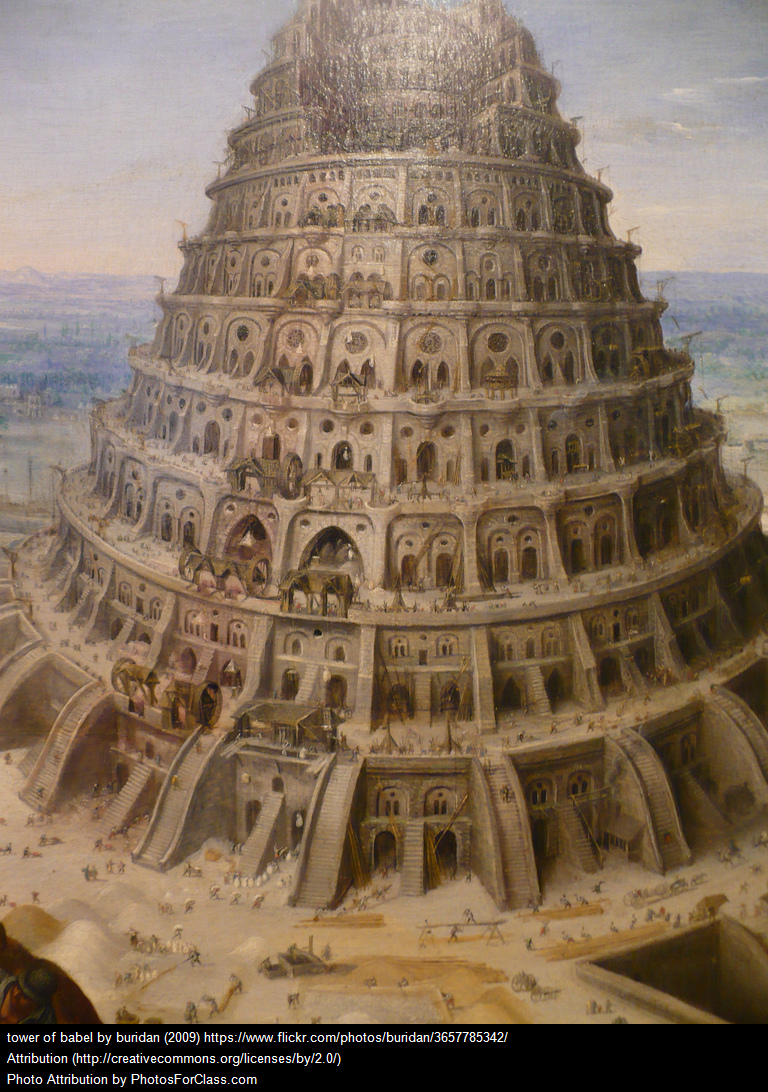
Tower of Babel
Tower of Babel

So the digital. The open borders, the open access. The flat earth. Where a researcher / research at the other end of the world is at the touch of a button or a click of a mouse. As long as you both have the internet. And speak each other’s language (or preferably that current god of all language, English), as long as that research is in a bundle paid for by your institution. As long as you’re part of an institution, because paying $39.95 per article for research that may or may not be relevant, may or may not be any good is no joke for the casual dilettante. And when you leave formal education, when you graduate and lose access to all that body of formal knowledge, lose your writing on fora and institutional blogs, when the gates to the ivory towers slam shut? Are you no longer a scholar? Are you an ex-scholar? A practitioner? I think about this a lot as I reach the end of this degree.

Language and culture

Coming back to the whole language thing.  According to Ren and Montgomery (2015) from 1996 to 2012 – 2,680,395 scholarly articles were published internationally by Chinese authors, 35% of which have never been cited, and the average citation per publication is 6.17 versus 20.45 for an American author. 95% of its most important research “are now published by foreign commercial publisher and locked behind pay-walls” (p. 397).  Most scholars do not have the English proficiency, there are not enough translators and therefore the research remains trapped in Chinese repository systems.  The article is a fascinating glimpse into the profundity of linguistic barriers, cultural and ideological differences in writing, research and performance metrics that are seldom if ever mentioned in the jubilant digital scholarship literature.

Interdisciplinary

As a fairly recent migrant from the world of commerce and industry to the world of education, one of the other articles I read was cause for inner ironical chuckling. Interdisciplinary. What does that mean? That you stay in your academic ivory tower but build bridges to other towers in the same academic village, or even across the pond to another tower where there are English speakers? And you interact only with the grubby world of business when they sell you OLP (online learning platforms) and data analytic systems and student interfaces and lesson plans and databases. But do you consider that you may be able to learn from that world? Even within business schools, the frenetic search for pertinent case studies is to inform and guide practise by current or potential business people.  And so I turn to Siemens and Burr (2013) – who I must say I have a huge amount for respect for, because they are talking, reading about and DOING  research in international research teams. They are grappling with linguistic and cultural barriers. And I read their article and the whole time I’m thinking – you’ve got to be kidding me. Yes, you’re probably breaking new ground in your context, but global companies have been doing this for decades. For eons. Your average wet-nosed graduate in a developing country working for a multi-national could have told you of all these challenges AND how they’re resolved in commerce and industry. I have to wonder, when a paper cites Hofstede – 1980 * if they’ve read and understood it’s context (Shell oil company), why they don’t think – heck – those multinational companies must know a thing or two about this – let’s go and ask them how to resolve this rather than us having to reinvent the wheel. Just pop over to your local business school or track down a travelling salesman with a passport to find out more.

I realise I’ve nearly written 1,500 words right now, and I don’t even begin to cover all the ground that I’d want to cover but can’t. I’ll just end by referring back to Gee and Hayes (2011). The first six chapters are a great read to understand the context of current education, language and literacy as part of a continuum of education across the ages – and they can express this background so much better than my amateur fumblings.  And after giving a context what is the future?  It would have to be in machine translation. In non-affiliation to a single academic organisation or nation. The return of the professional amateur, of “royal societies” that are not royal or national.  Different pathways of legitimisation and accreditation. More cooperation and collaboration but also more confrontation. Assignments that are conceptually bound but content liberated.  Radically open access to both published and rejected research, with commentary as to the rejection – a bit of meta-cognition anyone? Access to assignments with grading. Plagiarism is only an option in a closed rigid system with unimaginative content related assignments.  And those do nothing to further scholarship, digital or otherwise.

(And apologies to all those authors and researchers who are not cited but who are informing my thinking, but were not read in the last few days).

References:

Gee, J. P., & Hayes, E. (2011). Language and learning in the digital age (1st ed). New York, NY: Routledge.
Ren, X., & Montgomery, L. (2015). Open access and soft power: Chinese voices in international scholarship. Media, Culture & Society, 37(3), 394–408. http://doi.org/10.1177/0163443714567019
Siemens, L., & Burr, E. (2013). A trip around the world: Accommodating geographical, linguistic and cultural diversity in academic research teams. Literary and Linguistic Computing, 28(2), 331–343. http://doi.org/10.1093/llc/fqs018
————————

(* As a side note, Hofstede was taught to me as an expat 101 in the early 1990’s before my husband and I left on our first international assignment in Brazil. There is an updated version of his book – co-written by his son and Michael Minkov. Should be read by every ‘global’ educator and student interested in global collaboration and cooperation :

Hofstede, G. H., Hofstede, G. J., & Minkov, M. (2010). Cultures and organizations: software of the mind: intercultural cooperation and its importance for survival (3rd ed). New York: McGraw-Hill.)