It’s not (just) the book

This is a post I’ve been meaning to write for a while. A long while. I’m a member of quite a few librarian and school librarian groups and invariably, at least once a month, a question will pop up asking for a “killer” book. Either one that is perfect for reluctant readers, or one that will entice students to read, or the perfect book for boys, for grade 2, 3, 6, middle grade. There is an assumption out there that there’s a quick fix. That one book that will transform lives, transform non-readers to readers. It’s that one dose of the right drug that will make of our students little reading addicts. Firmly entrenched in the Judaeo-Christian culture of the “road to Damascus”. There is a similar culture amongst dieters and sports people. The one tablet, the one food, the one diet, the one coach.

The truth I’m afraid is more nuanced. Yes there are books that capture and imagination and hearts and minds. Just as the “Kid magician” captured that of my BWB (Blokes with Books) last year. But I think once the flame is kindled with a book, the fire needs to be continually fed in order to keep burning.

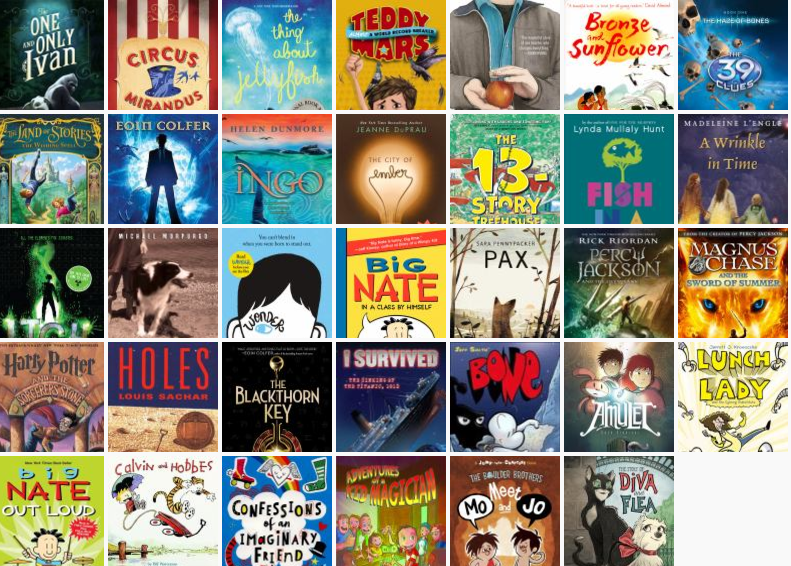
Since I’m giving a session at the AFCC I was asked to provide a book list so that the books could be available after the session for parents and students to purchase. So on Friday I asked my blokes to write down the top 3 books that they’ve read in the last few months. When they’d done that some grumbled that 3 wasn’t enough, so I let them also add “the ones that got away”.  I’ve just gotten around to analysing the list. Now a list is a list prima facie, unless you have a very good feel for what is going on in the school and the environment it would be very easy to misinterpret this list and think that there was something special about the books.  Yes, each of the books selected by the 21 boys have merit, but there is more.

  1. The top books are books with “cult status“.  I deliberately said they couldn’t choose “Wimpy kid” because it’s already at the top of my “top 10 fiction” lists each month. It’s also the book that everyone always mentions as a panacea to reluctant readers. We know that, let’s move on. So in our top books we find the series of “Storey Treehouse” (Andy Griffiths and Terry Denton). Then comes Harry Potter (JK Rowling) – who is still making his mark, followed by Amulet (Kazu Kibuishi) and Conspiracy 365 (Gabrielle Lord).
  2. The next set of books are very special. Mainly because I KNOW they were teacher read-alouds to various classes. This I think is very important. Yes they are great books, I know because I recommended them to the various teachers. But they aren’t always the easiest books to read independently. These include Because of Mr. Terupt, Pax, Wonder and City of Ember. I cannot over emphasize the importance of teachers reading books aloud to their classes. Particularly “first in the series” books.
  3. The following set shows the power of carefully selected books for national or regional book awards. In this instance the “Red Dot Book Awards” run by the ISLN. Of the selection for 2016/7: Secrets of Singapore; Confessions of an Imaginary Friend; The Thing about Jelly Fish; Blackthorn Key; Bronze and Sunflower; and Circus Mirandus; made the lists. Once again, these are books that students probably wouldn’t naturally gravitate towards, but which have received a lot of publicity in the school, we have at least 6 copies of each which means they’re more widely available and read and talked about.
  4. The power of author visits. During the past year we’ve had the authors of these titles, and it’s shown clearly in their popularity: Sherlock Sam, Secrets of Singapore / Danger Dan.
  5. The rest. What is so interesting about the list is that 21 boys selected 36 different titles in their top 3 lists and a further 10 titles in their “ones that got away”. I really like that. It shows an increasing maturity in reading and a diversity in taste and choice.

The complete list can be found here:
BWB favourites


BWB where are we at?

After a flurry of research and completing my final paper for my M. Ed, one may think that it’s all over with the inquiry into reluctant readers, boys reading etc. etc.  But it’s not. Far from it in fact. I’ve been a little distracted with the library renovation, a series of unfortunate events with library assistants having close encounters with pregnancy and injuries leading to somewhat more of a day to day burden on my shoulders etc. etc (it’s called “life” I keep reminding myself). But anyway, we carry on unabated with our BWB club (Blokes with Books) and you can come and hear me at the AFCC if you’d like to find out more!

Tim, the teacher leading the club and I had some conversations at the end of last year about how we needed to take things up a notch and really go deeper into the whole reading thing. The question of course is how do you make sure it’s still fun, that they still are committed, while deepening and expanding what they’re reading? We’re talking about 11/12 year old boys after all, and while my dry academic papers sound all unemotional and cool the truth is far from it.  We have spats and have to have firm words about “it’s just a game” and “if you don’t quit fighting about the chairs / beanbags / who got the book first, you will have to stop coming for a while” etc. etc.

But something special has been happening in the two weeks since we’ve been back. Sometimes you just get so caught unawares that you’re not recording or documenting and now I feel I need to document it. Last week our counsellor (who’s joined our team) was sharing how he’d seen an interview with Jamie Oliver about the fact that he’d read his first book at age 38. The boys were actually incredulous. And then a couple started spontaneously sharing how before BWB club they’d never finished a book either, or if they did it was just a quick and easy book and how much more they’re reading now and how it takes practice and perseverance. Note – it also takes courage for a boy this age to come out and say these things to his peers.

This week we reflected on Obama’s reading list and how he’d said it helped calm and focus him in times of stress. And again, a couple of boys put their hands up and said how reading helped them calm down, when they were angry or upset.

So, whscreen-shot-2017-01-21-at-1-47-36-pmat’s new.  Right now I’m trying to drill into every student at school the necessity of having a “what’s next” list – either a mental list or a  physical list or a pile of books that are the “books in waiting”.  And the great thing about a club like this is that we can try things out on them and see how effective they are.

This week we used Leigh Collazo’s Genre Personality test which you can purchase from TPT (a $5 well spent). My assistants and I spend quite a bit of time this week updating the bookmarks in order to make the book suggestions specific to our library.  The boys did the quiz during the BWB session on Friday and they really enjoyed doing it. It was fun and light-hearted and we kept emphasizing that there was no right or wrong answer and it wasn’t scientific. After they’d tallied up I made a spreadsheet of the topscreen-shot-2017-01-21-at-1-48-01-pm 3 categories of each boy, and as we read out the descriptions there were cries of “yes, that’s exactly how I am” and “I agree” and “yes!”  With their permission we then displayed the results. Most were evenly spread between A, (questioner); B (Escapist) and C (Innovator) with surprisingly few G’s (class clown) which is what I would have expected. Since that took up most of the hour we have with them – we didn’t get around to sharing the bookmarks, and
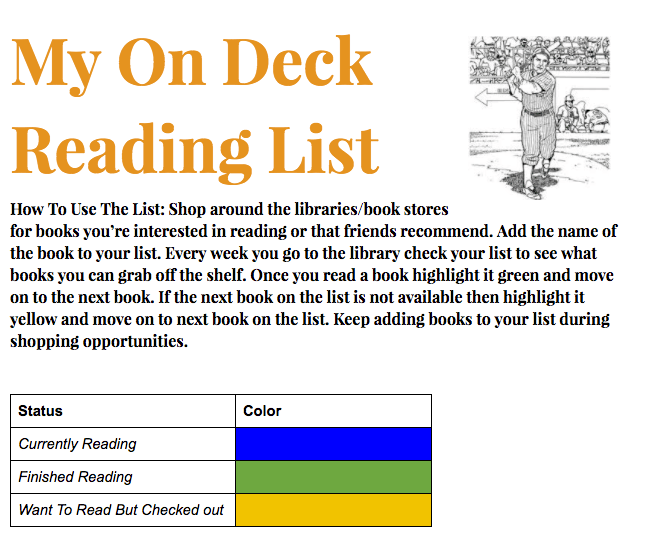
only introduced the “on deck” spreadsheet to help them keep track of their “what’s next” list – that’s next week’s work.


Graphical lies and semi truths

I’ve been geeking out a little with some data in the last 24 hours, looking at the circulation stats of my blokes for the last 2 years plus the last month.  Glancing through the table leads to the conclusion that they are in fact borrowing more books – I know that doesn’t necessarily lead to more reading, but I also know that just having books around is a good thing.  One of the issues is that inherent in international schools is the fact that students come and go. Most of our students have been here for the last 2 years, and a few entered mid-way – so I averaged the monthly book borrowing by assuming 8 months of school (yup, we’re off for 16 weeks of the year), and then apportioned appropriately. (Note 2016/7 data needs to be updated at end of September to give the full 1.5 months).bar

But no-one likes looking at a table of data, so how to get this into a graph?  Now even a 3rd grader would (hopefully) be able to tell you that discrete data = bar chart.  So that leads to this:

That kind of shows you the picture – that the green bars are generally the highest (although maybe I need to invert the colours).

Now, let me show you another picture. This time I am quite incorrectly showing you a line graph.  Why is it wrong – well because a line graph is to show the relationship between two sets of values, with one set being dependent on another. Well, as each point is a different child’s reading,  and one child’s data has nothing to do with another child’s data, so obviously a line graph is nonsense. Except for the fact that it much more clearly shows that students have increased their borrowing since they’ve joined BWB. Quite wrong, but more graphically. I’ve been even linemore deceptive by ordering the data by number of books by date (mainly because the first 6 boys were not at the school in 2014/5 and the next 3 not last year so it made things look more confusing if I didn’t order it.

The next graph is even more pretty but it’s wrong wrong wrong and very deceptive – because I used a “stacked line” it’s no longer showing the boys who they read less than the previous year (s) as I’m adding up their reading over time.

No wonder they say “lie, damned lies and statistic” – maybe they need to add “graphs” to that one.

stacked-lineMore problems with this type of data – it tells you about the quantity, but nothing about the quality of what’s being borrowed. If I drill into various circulation histories I see a lot of “churn” of graphic novels. I’m assuming the lads who’ve read 15 or 20 books in the past month are reading nearly one book a day. That’s assuming they’re reading them. In fact one of the boys who seems to be borrowing and reading less is the boy who is tackling much more sophisticated literature and longer books.

Which shows just how individualised one’s approach needs to be to students, and data, and even goals and aims.  I like to think I’m employing a “bait and switch” tactic in the long term – I wonder if that can be quantified? Thinking aloud – if my books were lexiled and I could for each child see a lexile trail that gets stronger over time … unfortunately wishful thinking at this point as our books aren’t lexiled. I’m wondering if any longitudinal research has been done in this respect? I was watching a demo of Scholastic’s Literacy Pro yesterday and maybe that’s influencing my thinking. Because once you’re in that kind of program the program in itself corrupts the data by only feeding the student books in their lexile range, so you have animals in captivity rather than in the wild, if you see what I mean.

Now to see what the reading data tells me, and to see if there is any way to tie it all together in a pretty picture.  I need a spare mathematician to guide me through this – first year university stats is just not going to cut it I fear!