Writing a case study with 3,000 words of which 80% are limited by procedural bits and pieces is proving to be a little frustrating because I am learning SO MUCH. So I thought I’d share some of it here, because heaven knows it could help someone somewhere somehow.
Remember the whole thing about motivation? That there was extrinsic and intrinsic and the latter was way way better? Turns out there are a lot more bits and pieces to motivation than psych 101 would have you believe. And more importantly there is such interplay between them and external factors and I’d like to add developmental ages and phases as well.
So with reading motivation we have:
- Extrinsic (rewards, physical, achievement or emotional if you read more)
- Intrinsic (reading is its own reward – interest, satisfaction etc.)
- Social (currency gained by knowing stuff, sharing books and reading – turns negative around G5 with peer devaluation)
- Self-efficacy (belief in ability – changes over time)
- Work avoidance (starts in G2, avoid reading tasks due to low motivation and/or reading difficulties)
If you want to read just one study on the matter, I’d recommend Lee & Zentall (2015). They summarize most of the knowledge to date, have an excellent bibliography and most importantly add the longitudinal dimension. I really like longitudinal studies, and I know why they’re difficult and costly, but as a parent and an educator, what can be more valuable than recognizing and anticipating bumps along the road for what they are and taking preventative action before a student/child lands in a pot-hole?
I’d like to spend a little more time on self-efficacy. It has to do with self-concept as a reader (Förster & Souvignier, 2014; Proctor, Daley, Louick, Leider, & Gardner, 2014; Smith, Smith, Gilmore, & Jameson, 2012). I find it very interesting that self-efficacy takes a dive around Grade 3. Why? Because that is just the moment when the majority our self-confident readers, having spent 2 or 3 years soaring through the levels of their reading program are suddenly let loose into the big world of both “real chapter books” and needing to access their reading skills in order to “read to learn”. It’s that pivot point. The point at which I tell over anxious parents, “yes, now you can start worrying if the reading is not happening.”
So the question is what should our response be as parents and educators (another good point of the Lee & Zentall article – they add the “so what” bit). Remember the “terrible twos”? Well I think there is nothing more comforting in know that when behavior goes wonky, you have a frame of reference that says “oh, it’s this” accompanied by “I / my child / my student is not alone” and “this is normal” plus, hopefully some strategies in place that can be applied. I’ve just sent my blokes with books a set of positive affirmations that he can use in the Blokes with books club. It was one of a set of resources included in this very handy, practical and readable guide from Ireland (NEPS, 2012).
Then looking at the skill side of things. This is dangerous ground, because if a child is reading below the 30% percentile, (and they’re not 3 or 4 years old – I kid you not – I’ve had pre-kindergarten parents concerned their children are not reading yet – on that topic, please read this article (Suggate, Schaughency, & Reese, 2013)) and they’re over 8 years old, then there may be a problem.
What is the problem – well I’ll say mainly “beware, there be EGOS”. When there is a reading skill issue it is probably as a result of an experiential instructional deficit or a reading related cognitive problem (Scanlon, Gelzheiser, Vellutino, Schatschneider, & Sweeney, 2008). To put it simply, either they haven’t been taught properly at school or the home situation isn’t reinforcing adequately (hear those egos bristling), OR, the child has a reading related cognitive problem (Reading Disability – RD). This can be in decoding (like dyslexia); comprehension or retention and each have a different (here is a lay-person’s article) set of signs and ways of being addressed.
So, what does one do in this case – I like the NEPS article because they call for short, one-on-one or one-on-few and limited interventions of around 12 weeks. Obviously one can start with trying to overcome any instructional deficit, and if that fails, to move onto educational testing and specific RD related interventions. Once again there be Egos in the way – and if it helps at all, I can say “been there, done that, got the tears to prove it”. It’s hard to acknowledge that your child is anything than perfect, or at a pinch that they’re “normally” imperfect. But denial leads to more harm that good, and particularly because early intervention is so much more effective. Embedded in this article on dyslexia (Korbey, 2015) is an awesome scientific journal article (free to read! Yay) on RD, by Norton and Wolf that is very dense and brain spinning, but very good (Norton & Wolf, 2012). Personally I found the discussion on colour naming to be very interesting – talk about an early warning sign that we noticed but didn’t know was important.
I’m going to stop at this point – happy reading in the mean time. As always, interested in your thoughts and comments.
References:
Förster, N., & Souvignier, E. (2014). Learning progress assessment and goal setting: Effects on reading achievement, reading motivation and reading self-concept. Learning and Instruction, 32, 91–100. http://doi.org/10.1016/j.learninstruc.2014.02.002
Korbey, H. (2015, October 1). Understanding dyslexia and the reading brain in kids [Web Log]. Retrieved 11 September 2016, from https://ww2.kqed.org/mindshift/2015/10/01/understanding-dyslexia-and-the-reading-brain-in-kids/
Lee, J., & Zentall, S. S. (2015). Reading motivation and later reading achievement for students with reading disabilities and comparison groups (ADHD and typical): A 3-year longitudinal study. Contemporary Educational Psychology. http://doi.org/10.1016/j.cedpsych.2015.11.001
NEPS. (2012). Effective interventions for struggling readers. National Educational Psychological Service. Retrieved from http://www.education.ie/en/Education-Staff/Information/NEPS-Literacy-Resource/neps_literacy_good_practice_guide.pdf
Norton, E. S., & Wolf, M. (2012). Rapid automatized naming (RAN) and reading fluency: Implications for understanding and treatment of reading disabilities. Annual Review of Psychology, 63(1), 427–452. http://doi.org/10.1146/annurev-psych-120710-100431
Proctor, C. P., Daley, S., Louick, R., Leider, C. M., & Gardner, G. L. (2014). How motivation and engagement predict reading comprehension among native English-speaking and English-learning middle school students with disabilities in a remedial reading curriculum. Learning and Individual Differences, 36, 76–83. http://doi.org/10.1016/j.lindif.2014.10.014
Scanlon, D. M., Gelzheiser, L. M., Vellutino, F. R., Schatschneider, C., & Sweeney, J. M. (2008). Reducing the incidence of early reading difficulties: Professional Development for classroom teachers versus direct interventions for children. Learning and Individual Differences, 18(3), 346–359. http://doi.org/10.1016/j.lindif.2008.05.002
Smith, J. K., Smith, L. F., Gilmore, A., & Jameson, M. (2012). Students’ self-perception of reading ability, enjoyment of reading and reading achievement. Learning and Individual Differences, 22(2), 202–206. http://doi.org/10.1016/j.lindif.2011.04.010
Suggate, S. P., Schaughency, E. A., & Reese, E. (2013). Children learning to read later catch up to children reading earlier. Early Childhood Research Quarterly, 28(1), 33–48. http://doi.org/10.1016/j.ecresq.2012.04.004
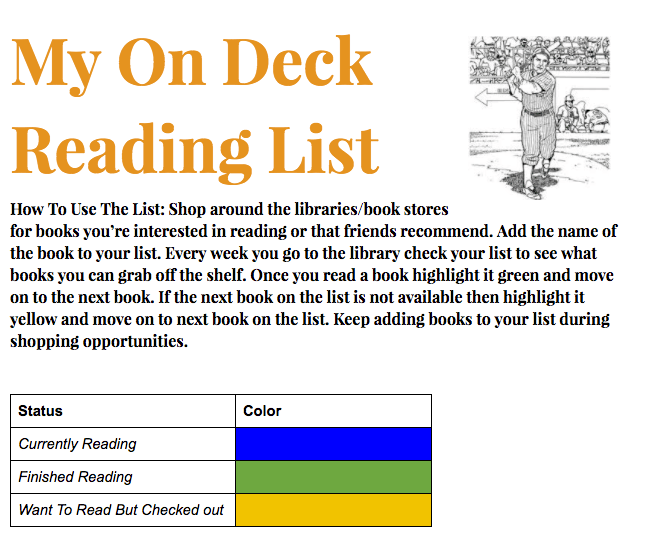
 at’s new. Right now I’m trying to drill into every student at school the necessity of having a “what’s next” list – either a mental list or a physical list or a pile of books that are the “books in waiting”. And the great thing about a club like this is that we can try things out on them and see how effective they are.
 3 categories of each boy, and as we read out the descriptions there were cries of “yes, that’s exactly how I am” and “I agree” and “yes!” With their permission we then displayed the results. Most were evenly spread between A, (questioner); B (Escapist) and C (Innovator) with surprisingly few G’s (class clown) which is what I would have expected. Since that took up most of the hour we have with them – we didn’t get around to sharing the bookmarks, and
 Informative Flights - Musings of a Teacher Librarian