I undertook a dog walk observation exercise where I considered the first stage of the Luma Taxonomy of Innovation – looking (Luma Institute, 2014). My route from home to the Botanic Gardens is roughly 1km and it takes me past a fairly busy transport hub of bus stops and a MRT (mass rail transport) station. Other touch points are a busy food court (Adam Food Centre), a Kindergarten, a church, and a shopping centre with a 24-hour supermarket. As an able-bodied person I employed the technique of “user journey” and “adopting personas” (McNabola et al., 2013) in order to better understand the landscape. It is a route I also sometimes cycle with my children in order to reach the sports fields near the Botanic Gardens, so I considered that experience.
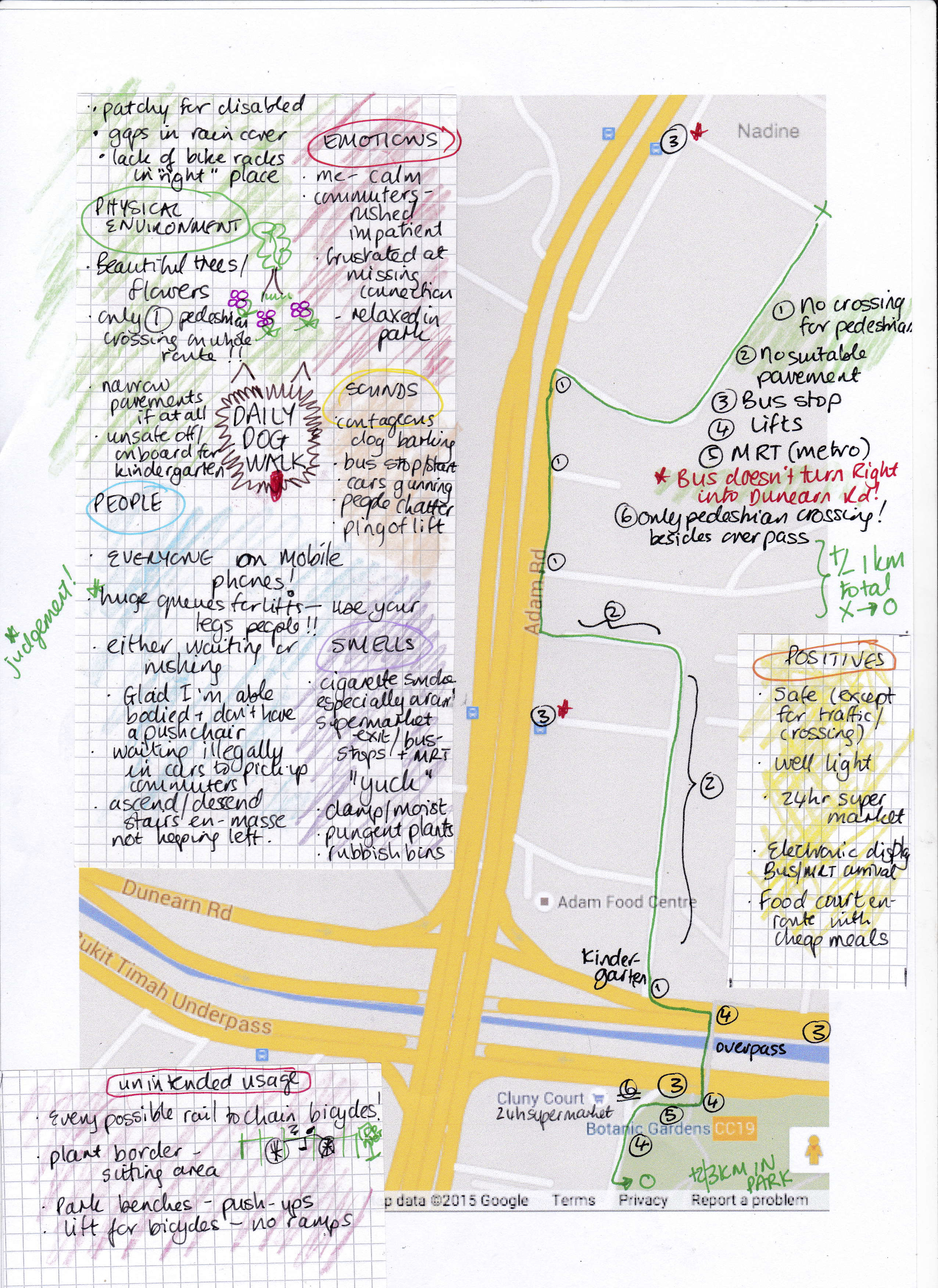
McNabola et al (2013) suggest that in mapping a system one considers the “touch points” between users and “the system”. The touch points I identified included:
- Changing transport modes (e.g. bus to walking, walking to crossing a road, walking to bus, walking to MRT, public transport to private car, cycling to public transport, public transport or walking to taxi)
- Changing intention (transportation to destination – e.g. driving to kindergarten and taking child in; driving to shopping centre and shopping; walking / taking transportation to Botanic Gardens and walking in garden)
- Changing persona (able bodied; cyclist; disabled; with stroller; with dog; with young children)
- Changing context (raining; peak hour; during the day)

As can be seen above (full size photos available here), different contexts, personas changes in mode and intentions can come into conflict with each other, or result in unmet or poorly met needs. The Singapore Government is aware of this and has created an “Active Mobility Advisory Panel”.

References:
Fai, L. K. (2015, July 30). LTA panel to pave the way for safer footpaths, cycling paths – Channel NewsAsia [Newspaper]. Retrieved August 7, 2015, from http://www.channelnewsasia.com/news/singapore/lta-panel-to-pave-the-way/2017806.html
Luma Institute. (2014). A Taxonomy of Innovation. Harvard Business Review, (January – February). Retrieved from https://hbr.org/2014/01/a-taxonomy-of-innovation/ar/1
McNabola, A., Moseley, J., Reed, B., Bisgaard, T., Jossiasen, A. D., Melander, C., … Schultz, O. (2013). Design for public good | Design Council (p. 100). London, UK: Design Council. Retrieved from http://www.designcouncil.org.uk/resources/report/design-public-good

 Informative Flights - Musings of a Teacher Librarian
Nadine it seems to me that in the outdoors where there is open parklands and gardens these nice looking spaces that have a fresh air are invaded by people using mobile phones and it seems to be an unnatural addition to the natural environment. I found this too in my observations. Interesting how as humans technology has moved into this space. Tim Brown suggests that design is human centred and it starts with what we might need or want. Do we want technology to be part of this space or is it unavoidable given our lifestyles?
LikeLike
The quality of your diagram is really lovely, I got a real sense of the diversity of experience that is your walk. I am personally enjoying the shift in perception that this task forced on me. I was reflecting on the very human elements that you identified in the process of communicating your space. It’s interesting that the SIngapore government has introduced an “Active Mobility Advisory Panel”, as it’s clear from your user journey and personas, the problems the space encounters is reflected through the need to consider all human users of the space, not just those who are able bodied as you pointed out. I found the process of persona very empowering, “During a conceptual design process, experienced designers do not just synthesize solutions that satisfy given requirements, they also invent design issues or requirements that capture important aspects of a given problem that assist in solving the problem at hand (Liu, 1996).”It’s kind of ironic that despite my inexperience with design I felt in completing this task, solutions were arising already. Given the succinct nature of your touch points for redesign I felt you responded to the needs of the space really well.
LikeLike